

ASTM C1618M-19
(Test Method)Standard Test Method for Concrete Sanitary Sewer Pipe by Negative (Vacuum) Air Pressure (Metric)
General Information
- Abstract
SIGNIFICANCE AND USE
5.1 This is a quality test control performed at the manufacturing plant to establish that the finished, shippable pipe meets the leakage limits stated in the specifications.
SCOPE
1.1 This test method covers procedures for testing of precast concrete pipe sections, prior to delivery, where maximum field leakage rates are specified.
1.2 Tests described in this standard are intended to be used at the point of manufacture of the concrete pipe and are not intended for testing installed pipe (for field tests see Practices C969 and C1214). The user of this specification is advised that individual or multiple pipe sections may be tested for the purpose of testing the pipe barrel and additionally the joints in straight alignment when multiple pipe sections are tested.
1.3 Test times are based on leakage rates and therefore are proportional only to the pipe diameter and are constant for any length of test pipe or pipeline.
1.4 Test times tabulated and the rate of air loss in this standard are based on successful testing of installed pipelines. However, since air and water have different physical properties, retests of some pipelines not meeting field air tests have been successful when tested with water. The leakage rates of 0.0017 CFM/ft2 and 0.0003 CFM/ft2, were determined empirically as the maximums for pipe to meet the 50 and 200 gal/(in. of internal diameter) (mile of sewer) (24h) test rates, respectively
1.5 The values stated in SI units are to be regarded as standard. No other units of measurement are included in this standard.
Note 1: The availability of this test procedure for concrete pipe varies from location to location. Check with local supplier(s) for availability and recommendations.
1.6 This standard does not purport to address all of the safety concerns, if any, associated with its use. It is the responsibility of the user of this standard to establish appropriate safety, health, and environmental practices and determine the applicability of regulatory limitations prior to use. See Section 6 for specific safety precautions.
1.7 This international standard was developed in accordance with internationally recognized principles on standardization established in the Decision on Principles for the Development of International Standards, Guides and Recommendations issued by the World Trade Organization Technical Barriers to Trade (TBT) Committee.
- Status
- Published
- Publication Date
- 31-Dec-2018
- Technical Committee
- C13 - Concrete Pipe
- Drafting Committee
- C13.09 - Methods of Test
Buy Documents
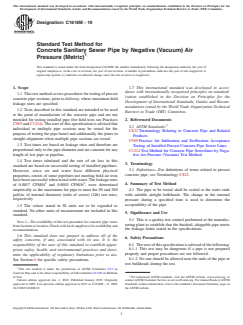
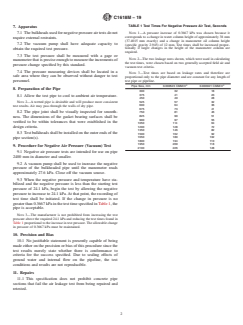


ASTM C1618M-19 - Standard Test Method for Concrete Sanitary Sewer Pipe by Negative (Vacuum) Air Pressure (Metric)
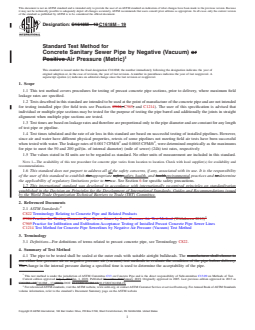
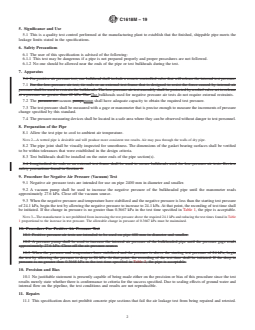


REDLINE ASTM C1618M-19 - Standard Test Method for Concrete Sanitary Sewer Pipe by Negative (Vacuum) Air Pressure (Metric)
Overview
ASTM C1618M-19: Standard Test Method for Concrete Sanitary Sewer Pipe by Negative (Vacuum) Air Pressure (Metric) defines procedures for testing precast concrete sanitary sewer pipe sections using negative (vacuum) or positive air pressure methods. The standard, developed by ASTM, aims to ensure manufactured concrete pipes meet specified leakage limits and conform to quality control requirements before delivery and installation. This test method is relevant for manufacturers, quality control laboratories, and project engineers involved in sewer infrastructure projects where pipe integrity and watertightness are critical.
Keywords: ASTM C1618M-19, vacuum air pressure, concrete sanitary sewer pipe, leakage test, quality control, precast pipe, manufacturing standards
Key Topics
- Purpose: The test verifies that finished, shippable concrete sanitary sewer pipes meet pre-determined leakage limits at the manufacturing plant.
- Test Scope:
- Applies to precast concrete pipe sections before delivery, where maximum field leakage rates are specified.
- Not intended for in-field tests of installed pipes - for field testing refer to ASTM Practices C969 and C1214.
- Test Methods:
- Both negative (vacuum) and positive air pressure tests are described.
- Procedures involve sealing pipe ends, applying air pressure or vacuum, and measuring pressure change over a specified time.
- The manufacturer may test individual or multiple pipe sections, evaluating both the barrel and joints (in straight alignment when testing multiple sections).
- Leakage Criteria:
- Test times are based strictly on pipe diameter (not length), with tabulated reference leak rates.
- Leakage rates were empirically determined and correspond to accepted field test criteria.
- Units: All measurements and test criteria use SI (metric) units.
- Safety Considerations:
- The standard highlights potential dangers during testing, requiring rigorous safety, health, and environmental practices.
- Specific precautions include ensuring no personnel are near pipe ends or test bulkheads during testing.
Applications
Organizations use ASTM C1618M-19 to:
- Validate Product Quality: Ensures concrete sanitary sewer pipes are watertight, durable, and suitable for sewer applications before shipment.
- Quality Assurance in Manufacturing: Establishes performance benchmarks at the point of manufacture, helping to minimize the risk of leaks or failures in service.
- Project Specification Compliance: Contractors and engineers reference this standard in construction specifications to guarantee delivered pipes match project design and regulatory requirements.
- Leakage Rate Assessment: Provides a consistent, industry-accepted method to assess and control leakage in precast concrete pipes, supporting regulatory and infrastructure performance objectives.
- Pipe Repair and Retesting: Outlines that any pipes failing the initial air leakage test may be repaired and retested, allowing for quality improvement in production.
Related Standards
- ASTM C822: Terminology Relating to Concrete Pipe and Related Products
- ASTM C924: Practice for Testing Concrete Pipe Sewer Lines by Low-Pressure Air Test Method (withdrawn)
- ASTM C969: Practice for Infiltration and Exfiltration Acceptance Testing of Installed Precast Concrete Pipe Sewer Lines
- ASTM C1214: Test Method for Concrete Pipe Sewerlines by Negative Air Pressure (Vacuum) Test Method
ASTM C1618M-19 plays a vital role in maintaining the quality and reliability of sanitary sewer systems by providing a standardized approach to leakage testing for precast concrete pipes at the manufacturing stage. Adherence to this and related ASTM standards helps manufacturers, engineers, and project owners ensure long-term performance and regulatory compliance for essential sewer infrastructure.
Relations
- Effective Date
- 01-Jan-2019
- Effective Date
- 01-Jan-2019
- Effective Date
- 01-Jan-2018
- Effective Date
- 15-Apr-2017
- Effective Date
- 01-Jul-2013
- Effective Date
- 01-Feb-2013
- Effective Date
- 01-Nov-2011
- Effective Date
- 01-Dec-2010
- Effective Date
- 01-Jun-2009
- Effective Date
- 01-Jun-2009
- Effective Date
- 01-Nov-2008
- Effective Date
- 02-Jul-2008
- Effective Date
- 15-Feb-2006
- Effective Date
- 01-Oct-2005
- Effective Date
- 15-May-2005
Buy Documents
ASTM C1618M-19 - Standard Test Method for Concrete Sanitary Sewer Pipe by Negative (Vacuum) Air Pressure (Metric)
REDLINE ASTM C1618M-19 - Standard Test Method for Concrete Sanitary Sewer Pipe by Negative (Vacuum) Air Pressure (Metric)
Get Certified
Connect with accredited certification bodies for this standard

Zavod za gradbeništvo Slovenije (ZAG) - Inšpekcija
ZAG inspection body for construction products, structures, and materials.
Sponsored listings
Frequently Asked Questions
ASTM C1618M-19 is a standard published by ASTM International. Its full title is "Standard Test Method for Concrete Sanitary Sewer Pipe by Negative (Vacuum) Air Pressure (Metric)". This standard covers: SIGNIFICANCE AND USE 5.1 This is a quality test control performed at the manufacturing plant to establish that the finished, shippable pipe meets the leakage limits stated in the specifications. SCOPE 1.1 This test method covers procedures for testing of precast concrete pipe sections, prior to delivery, where maximum field leakage rates are specified. 1.2 Tests described in this standard are intended to be used at the point of manufacture of the concrete pipe and are not intended for testing installed pipe (for field tests see Practices C969 and C1214). The user of this specification is advised that individual or multiple pipe sections may be tested for the purpose of testing the pipe barrel and additionally the joints in straight alignment when multiple pipe sections are tested. 1.3 Test times are based on leakage rates and therefore are proportional only to the pipe diameter and are constant for any length of test pipe or pipeline. 1.4 Test times tabulated and the rate of air loss in this standard are based on successful testing of installed pipelines. However, since air and water have different physical properties, retests of some pipelines not meeting field air tests have been successful when tested with water. The leakage rates of 0.0017 CFM/ft2 and 0.0003 CFM/ft2, were determined empirically as the maximums for pipe to meet the 50 and 200 gal/(in. of internal diameter) (mile of sewer) (24h) test rates, respectively 1.5 The values stated in SI units are to be regarded as standard. No other units of measurement are included in this standard. Note 1: The availability of this test procedure for concrete pipe varies from location to location. Check with local supplier(s) for availability and recommendations. 1.6 This standard does not purport to address all of the safety concerns, if any, associated with its use. It is the responsibility of the user of this standard to establish appropriate safety, health, and environmental practices and determine the applicability of regulatory limitations prior to use. See Section 6 for specific safety precautions. 1.7 This international standard was developed in accordance with internationally recognized principles on standardization established in the Decision on Principles for the Development of International Standards, Guides and Recommendations issued by the World Trade Organization Technical Barriers to Trade (TBT) Committee.
SIGNIFICANCE AND USE 5.1 This is a quality test control performed at the manufacturing plant to establish that the finished, shippable pipe meets the leakage limits stated in the specifications. SCOPE 1.1 This test method covers procedures for testing of precast concrete pipe sections, prior to delivery, where maximum field leakage rates are specified. 1.2 Tests described in this standard are intended to be used at the point of manufacture of the concrete pipe and are not intended for testing installed pipe (for field tests see Practices C969 and C1214). The user of this specification is advised that individual or multiple pipe sections may be tested for the purpose of testing the pipe barrel and additionally the joints in straight alignment when multiple pipe sections are tested. 1.3 Test times are based on leakage rates and therefore are proportional only to the pipe diameter and are constant for any length of test pipe or pipeline. 1.4 Test times tabulated and the rate of air loss in this standard are based on successful testing of installed pipelines. However, since air and water have different physical properties, retests of some pipelines not meeting field air tests have been successful when tested with water. The leakage rates of 0.0017 CFM/ft2 and 0.0003 CFM/ft2, were determined empirically as the maximums for pipe to meet the 50 and 200 gal/(in. of internal diameter) (mile of sewer) (24h) test rates, respectively 1.5 The values stated in SI units are to be regarded as standard. No other units of measurement are included in this standard. Note 1: The availability of this test procedure for concrete pipe varies from location to location. Check with local supplier(s) for availability and recommendations. 1.6 This standard does not purport to address all of the safety concerns, if any, associated with its use. It is the responsibility of the user of this standard to establish appropriate safety, health, and environmental practices and determine the applicability of regulatory limitations prior to use. See Section 6 for specific safety precautions. 1.7 This international standard was developed in accordance with internationally recognized principles on standardization established in the Decision on Principles for the Development of International Standards, Guides and Recommendations issued by the World Trade Organization Technical Barriers to Trade (TBT) Committee.
ASTM C1618M-19 is classified under the following ICS (International Classification for Standards) categories: 93.030 - External sewage systems. The ICS classification helps identify the subject area and facilitates finding related standards.
ASTM C1618M-19 has the following relationships with other standards: It is inter standard links to ASTM C1618M-13, ASTM C1214-19, ASTM C822-18, ASTM C969-17, ASTM C1214-13, ASTM C822-13, ASTM C822-11, ASTM C822-10, ASTM C969-02(2009), ASTM C1214-02(2009), ASTM C822-08b, ASTM C822-08a, ASTM C822-06, ASTM C822-05b, ASTM C822-05a. Understanding these relationships helps ensure you are using the most current and applicable version of the standard.
ASTM C1618M-19 is available in PDF format for immediate download after purchase. The document can be added to your cart and obtained through the secure checkout process. Digital delivery ensures instant access to the complete standard document.
Standards Content (Sample)
This international standard was developed in accordance with internationally recognized principles on standardization established in the Decision on Principles for the
Development of International Standards, Guides and Recommendations issued by the World Trade Organization Technical Barriers to Trade (TBT) Committee.
Designation: C1618M − 19
Standard Test Method for
Concrete Sanitary Sewer Pipe by Negative (Vacuum) Air
Pressure (Metric)
This standard is issued under the fixed designation C1618M; the number immediately following the designation indicates the year of
original adoption or, in the case of revision, the year of last revision. A number in parentheses indicates the year of last reapproval. A
superscript epsilon (´) indicates an editorial change since the last revision or reapproval.
1. Scope 1.7 This international standard was developed in accor-
dance with internationally recognized principles on standard-
1.1 Thistestmethodcoversproceduresfortestingofprecast
ization established in the Decision on Principles for the
concrete pipe sections, prior to delivery, where maximum field
Development of International Standards, Guides and Recom-
leakage rates are specified.
mendations issued by the World Trade Organization Technical
1.2 Tests described in this standard are intended to be used
Barriers to Trade (TBT) Committee.
at the point of manufacture of the concrete pipe and are not
intended for testing installed pipe (for field tests see Practices
2. Referenced Documents
C969 and C1214). The user of this specification is advised that
2.1 ASTM Standards:
individual or multiple pipe sections may be tested for the
C822 Terminology Relating to Concrete Pipe and Related
purpose of testing the pipe barrel and additionally the joints in
Products
straight alignment when multiple pipe sections are tested.
C969 Practice for Infiltration and Exfiltration Acceptance
1.3 Test times are based on leakage rates and therefore are
Testing of Installed Precast Concrete Pipe Sewer Lines
proportional only to the pipe diameter and are constant for any
C1214 Test Method for Concrete Pipe Sewerlines by Nega-
length of test pipe or pipeline.
tive Air Pressure (Vacuum) Test Method
1.4 Test times tabulated and the rate of air loss in this
3. Terminology
standard are based on successful testing of installed pipelines.
3.1 Definitions—For definitions of terms related to precast
However, since air and water have different physical
concrete pipe, see Terminology C822.
properties, retests of some pipelines not meeting field air tests
have been successful when tested with water.The leakage rates
2 2
4. Summary of Test Method
of 0.0017 CFM/ft and 0.0003 CFM/ft , were determined
empirically as the maximums for pipe to meet the 50 and 200
4.1 The pipe to be tested shall be sealed at the outer ends
gal/(in. of internal diameter) (mile of sewer) (24h) test rates,
with suitable airtight bulkheads. The change in the internal
respectively
pressure during a specified time is used to determine the
acceptability of the pipe.
1.5 The values stated in SI units are to be regarded as
standard. No other units of measurement are included in this
5. Significance and Use
standard.
5.1 This is a quality test control performed at the manufac-
NOTE 1—The availability of this test procedure for concrete pipe varies
turing plant to establish that the finished, shippable pipe meets
from location to location. Check with local supplier(s) for availability and
the leakage limits stated in the specifications.
recommendations.
1.6 This standard does not purport to address all of the
6. Safety Precautions
safety concerns, if any, associated with its use. It is the
6.1 Theuserofthisspecificationisadvisedofthefollowing:
responsibility of the user of this standard to establish appro-
6.1.1 This test may be dangerous if a pipe is not prepared
priate safety, health, and environmental practices and deter-
properly and proper procedures are not followed.
mine the applicability of regulatory limitations prior to use.
6.1.2 No one should be allowed near the ends of the pipe or
See Section 6 for specific safety precautions.
test bulkheads during the test.
This test method is under the jurisdiction of ASTM Committee C13 on
Concrete Pipe and is the direct responsibility of Subcommittee C13.09 on Methods
of Test. For referenced ASTM standards, visit the ASTM website, www.astm.org, or
Current edition approved Jan. 1, 2019. Published January 2019. Originally contact ASTM Customer Service at service@astm.org. For Annual Book of ASTM
approved in 2005. Last previous edition approved in 2013 as C1618M – 13. DOI: Standards volume information, refer to the standard’s Document Summary page on
10.1520/C1618M-19. the ASTM website
Copyright © ASTM International, 100 Barr Harbor Drive, PO Box C700, West Conshohocken, PA 19428-2959. United States
C1618M − 19
TABLE 1 Test Times For Negative Pressure Air Test, Se
...
This document is not an ASTM standard and is intended only to provide the user of an ASTM standard an indication of what changes have been made to the previous version. Because
it may not be technically possible to adequately depict all changes accurately, ASTM recommends that users consult prior editions as appropriate. In all cases only the current version
of the standard as published by ASTM is to be considered the official document.
Designation: C1618M − 13 C1618M − 19
Standard Test Method for
Concrete Sanitary Sewer Pipe by Negative (Vacuum) or
Positive Air Pressure (Metric)
This standard is issued under the fixed designation C1618M; the number immediately following the designation indicates the year of
original adoption or, in the case of revision, the year of last revision. A number in parentheses indicates the year of last reapproval. A
superscript epsilon (´) indicates an editorial change since the last revision or reapproval.
1. Scope
1.1 This test method covers procedures for testing of precast concrete pipe sections, prior to delivery, where maximum field
leakage rates are specified.
1.2 Tests described in this standard are intended to be used at the point of manufacture of the concrete pipe and are not intended
for testing installed pipe (for field tests see Practices C924, C969, and C1214). The user of this specification is advised that
individual or multiple pipe sections may be tested for the purpose of testing the pipe barrel and additionally the joints in straight
alignment when multiple pipe sections are tested.
1.3 Test times are based on leakage rates and therefore are proportional only to the pipe diameter and are constant for any length
of test pipe or pipeline.
1.4 Test times tabulated and the rate of air loss in this standard are based on successful testing of installed pipelines. However,
since air and water have different physical properties, retests of some pipelines not meeting field air tests have been successful
2 2
when tested with water. The leakage rates of 0.0017 CFM/ft and 0.0003 CFM/ft , were determined empirically as the maximums
for pipe to meet the 50 and 200 gal/(in. of internal diameter) (mile of sewer) (24h) test rates, respectively
1.5 The values stated in SI units are to be regarded as standard. No other units of measurement are included in this standard.
NOTE 1—The availability of this test procedure for concrete pipe varies from location to location. Check with local supplier(s) for availability and
recommendations.
1.6 This standard does not purport to address all of the safety concerns, if any, associated with its use. It is the responsibility
of the user of this standard to establish the appropriate safety safety, health, and healthenvironmental practices and to determine
the applicability of regulatory limitations prior to its use. See Section 6 for specific safety precautions.
1.7 This international standard was developed in accordance with internationally recognized principles on standardization
established in the Decision on Principles for the Development of International Standards, Guides and Recommendations issued
by the World Trade Organization Technical Barriers to Trade (TBT) Committee.
2. Referenced Documents
2.1 ASTM Standards:
C822 Terminology Relating to Concrete Pipe and Related Products
C924 Practice for Testing Concrete Pipe Sewer Lines by Low-Pressure Air Test Method (Withdrawn 2013)
C969 Practice for Infiltration and Exfiltration Acceptance Testing of Installed Precast Concrete Pipe Sewer Lines
C1214 Test Method for Concrete Pipe Sewerlines by Negative Air Pressure (Vacuum) Test Method
3. Terminology
3.1 Definitions—For definitions of terms related to precast concrete pipe, see Terminology C822.
4. Summary of Test Method
4.1 The pipe to be tested shall be sealed at the outer ends with suitable airtight bulkheads. The manufacturer shall choose to
use either low-pressure air or negative pressure air (vacuum) test methods to evaluate the condition of the pipe before delivery.
The change in the internal pressure during a specified time is used to determine the acceptability of the pipe.
This test method is under the jurisdiction of ASTM Committee C13 on Concrete Pipe and is the direct responsibility of Subcommittee C13.09 on Methods of Test.
Current edition approved July 1, 2013Jan. 1, 2019. Published December 2013January 2019. Originally approved in 2005. Last previous edition approved in 2013 as
C1618M – 05C1618M – 13.(2013). DOI: 10.1520/C1618M-13.10.1520/C1618M-19.
For referenced ASTM standards, visit the ASTM website, www.astm.org, or contact ASTM Customer Service at service@astm.org. For Annual Book of ASTM Standards
volume information, refer to the standard’s Document Summary page on the ASTM website
Copyright © ASTM International, 100 Barr Harbor Drive, PO Box C700, West Conshohocken, PA 19428-2959. United States
C1618M − 19
5. Significance and Use
5.1 This is a quality test control performed at the manufacturing plant to establish that the finished, shippable pipe meets the
leakage limits stated in the specifications.
6. Safety Precautions
6.1 The user of this specification is advised of the following:
6.1.1 This test may be dangerous if a pipe is not prepared properly and proper procedures are not followed.
6.1.2 No one should be allowed near the ends of the pipe or test bulkheads during the test.
7. Apparatus
7.1 For positive air pressure test, one bulkhead shall include a remote controlled valve that will release the internal test pressure.
7.1 For the low-pressure air test, tie rods or an external test frame that is designed to resist the force caused by internal air
pressure shall be used to restrain the bulkheads. The low-pressure air test assembly shall be protected by a relief valve set to release
at a pressure no greater than 42 kPa. The The bulkheads used for negative pressure air tests do not require external restraints.
7.2 The pressure or vacuum pumpspump shall have adequate capacity to obtain the required test pressure.
7.3 The test pressure shall be measured with a gage or manometer that is precise enough to measure the increments of pressure
change specified by this standard.
7.4 The pressure measuring devices shall be located in a safe area where they can be observed without danger to test person
...