

ASTM F2277-17a
(Test Method)Standard Test Methods for Evaluating Design and Performance Characteristics of Selectorized Strength Equipment
General Information
- Abstract
SIGNIFICANCE AND USE
4.1 The purpose of these test methods is to provide valid and repeatable test methods for the evaluation of selectorized strength equipment assembled and maintained according to the manufacturer’s specifications. Use of these test methods in conjunction with Specification F2216 is intended to maximize the reliability of selectorized strength equipment design and reduce the risk of serious injury resulting from design deficiencies.
SCOPE
1.1 These test methods specify procedures and apparatus used for testing and evaluating selectorized strength equipment for compliance to Specification F2216. Both design and operational parameters will be evaluated. Where possible and applicable, accepted test methods from other recognized bodies will be used and referenced.
1.2 Requirements—Selectorized strength equipment is to be tested in accordance with these test methods or Test Methods F2571 for all of the following parameters:
1.2.1 Stability,
1.2.2 Edge and corner sharpness,
1.2.3 Tube ends,
1.2.4 Weight stack travel,
1.2.5 Weight stack selector pin retention,
1.2.6 Function of adjustments and locking mechanisms,
1.2.7 Handgrip design and retention,
1.2.8 Assist mechanisms,
1.2.9 Foot supports,
1.2.10 Rope and belt systems:
1.2.10.1 Static load,
1.2.10.2 End fitting design,
1.2.11 Chain drive design,
1.2.12 Pulley design:
1.2.12.1 Rope pulley design,
1.2.12.2 Belt pulley design,
1.2.13 Entrapment zones,
1.2.14 Pull in points,
1.2.15 Weight stack enclosure design,
1.2.16 Loading and deflection:
1.2.16.1 Intrinsic loading and associated deflection,
1.2.16.2 Extrinsic loading and associated deflection,
1.2.16.3 Endurance loading,
1.2.17 Documentation and warnings verification, and
1.2.18 Additional universal design and construction requirements.
1.3 This test method2 contains additional requirements to address the accessibility of the equipment for persons with disabilities.
1.4 The values stated in SI units are to be regarded as the standard. The values in parenthesis are for information only.
1.5 This standard does not purport to address all of the safety concerns, if any, associated with its use. It is the responsibility of the user of this standard to establish appropriate safety, health, and environmental practices and determine the applicability of regulatory limitations prior to use.
1.6 This international standard was developed in accordance with internationally recognized principles on standardization established in the Decision on Principles for the Development of International Standards, Guides and Recommendations issued by the World Trade Organization Technical Barriers to Trade (TBT) Committee.
- Status
- Published
- Publication Date
- 30-Nov-2017
- Technical Committee
- F08 - Sports Equipment, Playing Surfaces, and Facilities
- Drafting Committee
- F08.30 - Fitness Products
Buy Documents
ASTM F2277-17a - Standard Test Methods for Evaluating Design and Performance Characteristics of Selectorized Strength Equipment
REDLINE ASTM F2277-17a - Standard Test Methods for Evaluating Design and Performance Characteristics of Selectorized Strength Equipment
Overview
ASTM F2277-17a is an internationally recognized standard developed by ASTM International for the evaluation of selectorized strength equipment. These test methods are designed to ensure that selectorized strength machines, commonly found in fitness centers and rehabilitation settings, are assembled and maintained according to manufacturers' specifications and meet essential design and performance characteristics. The main objective of ASTM F2277-17a is to maximize the reliability of equipment designs, improve operational safety, and minimize injury risks by providing clear, repeatable methods for equipment testing.
Key Topics
ASTM F2277-17a details comprehensive procedures for testing multiple aspects of selectorized strength equipment, covering both design and operational parameters. The key topics evaluated include:
- Stability - Ensures that equipment remains stationary and secure during use, even under loaded conditions.
- Sharpness and Edge Safety - Evaluates edges, corners, and tube ends for potential injury risks.
- Weight Stack Operation - Tests smooth travel of the weight stack, proper selector pin retention, and enclosure design.
- Adjustment and Lock Mechanisms - Assesses the ease and safety of seat, handle, and position adjustments.
- Handgrip and Foot Support Design - Verifies the integrity, design, and retention of grips and supports.
- Rope, Belt, and Chain System Safety - Includes static load and end fitting evaluations to prevent failure during operation.
- Pulley Design - Checks pulley dimensions and enclosure integrity to prevent accidental disengagement.
- Entrapment and Pull-In Testing - Ensures gaps do not present finger or body entrapment hazards.
- Loading and Deflection - Assesses machine response to intrinsic, extrinsic, and endurance loads during use.
- Documentation and Warnings - Confirms labels and instructions provide adequate safety information as per related standards.
- Universal Accessibility - Contains additional requirements ensuring accessibility for users with disabilities, referencing inclusive design practices.
Applications
ASTM F2277-17a is intended for use wherever selectorized strength equipment is designed, manufactured, installed, or maintained, including:
- Fitness Centers & Commercial Gyms: Routine evaluation of gym equipment to ensure safety, stability, and regulatory compliance.
- Rehabilitation Facilities: Testing of therapeutic strength machines to address the needs of users with varying abilities, ensuring both safety and accessibility.
- Equipment Manufacturers: Integrating these test methods during product development and quality assurance to meet market and legal requirements.
- Quality Auditors & Inspectors: Verifying product conformity before equipment enters the market or during regular facility inspections.
- Facility Managers: Maintaining ongoing safety and operational integrity by incorporating periodic compliance checks using these methods.
Applying ASTM F2277-17a reduces risks associated with design deficiencies, enhances user safety, and supports the development of durable, accessible fitness equipment aligned with international best practices.
Related Standards
Compliance with ASTM F2277-17a often involves reference to several related ASTM standards, ensuring a holistic approach to fitness equipment safety:
- ASTM F2216: Specification for Selectorized Strength Equipment - outlines the primary requirements for these machines.
- ASTM F1749: Specification for Fitness Equipment and Fitness Facility Safety Signage and Labels - sets guidelines for proper documentation and safety signage.
- ASTM F2276: Specification for Fitness Equipment - provides overarching requirements for all fitness machines.
- ASTM F2571: Test Methods for Evaluating Design and Performance Characteristics of Fitness Equipment - offers supplementary test methods.
- ASTM F3022: Test Method for Evaluating Universal Design of Fitness Equipment for Inclusive Use - focuses on accessibility and inclusive usability.
By referencing ASTM F2277-17a, organizations demonstrate a commitment to high safety standards in strength equipment design, installation, and maintenance, supporting both user confidence and operational excellence.
Relations
- Effective Date
- 01-Dec-2017
- Effective Date
- 01-May-2020
- Effective Date
- 01-Dec-2017
- Effective Date
- 01-Apr-2017
- Effective Date
- 01-Oct-2016
- Effective Date
- 01-Oct-2016
- Effective Date
- 01-Apr-2015
- Effective Date
- 01-Apr-2015
- Effective Date
- 01-Sep-2014
- Effective Date
- 01-Jun-2013
- Effective Date
- 01-Mar-2012
- Effective Date
- 01-Feb-2010
- Effective Date
- 15-Nov-2009
- Effective Date
- 01-Jun-2009
- Effective Date
- 01-Jun-2009
Buy Documents
ASTM F2277-17a - Standard Test Methods for Evaluating Design and Performance Characteristics of Selectorized Strength Equipment
REDLINE ASTM F2277-17a - Standard Test Methods for Evaluating Design and Performance Characteristics of Selectorized Strength Equipment
Get Certified
Connect with accredited certification bodies for this standard

BSMI (Bureau of Standards, Metrology and Inspection)
Taiwan's standards and inspection authority.
Sponsored listings
Frequently Asked Questions
ASTM F2277-17a is a standard published by ASTM International. Its full title is "Standard Test Methods for Evaluating Design and Performance Characteristics of Selectorized Strength Equipment". This standard covers: SIGNIFICANCE AND USE 4.1 The purpose of these test methods is to provide valid and repeatable test methods for the evaluation of selectorized strength equipment assembled and maintained according to the manufacturer’s specifications. Use of these test methods in conjunction with Specification F2216 is intended to maximize the reliability of selectorized strength equipment design and reduce the risk of serious injury resulting from design deficiencies. SCOPE 1.1 These test methods specify procedures and apparatus used for testing and evaluating selectorized strength equipment for compliance to Specification F2216. Both design and operational parameters will be evaluated. Where possible and applicable, accepted test methods from other recognized bodies will be used and referenced. 1.2 Requirements—Selectorized strength equipment is to be tested in accordance with these test methods or Test Methods F2571 for all of the following parameters: 1.2.1 Stability, 1.2.2 Edge and corner sharpness, 1.2.3 Tube ends, 1.2.4 Weight stack travel, 1.2.5 Weight stack selector pin retention, 1.2.6 Function of adjustments and locking mechanisms, 1.2.7 Handgrip design and retention, 1.2.8 Assist mechanisms, 1.2.9 Foot supports, 1.2.10 Rope and belt systems: 1.2.10.1 Static load, 1.2.10.2 End fitting design, 1.2.11 Chain drive design, 1.2.12 Pulley design: 1.2.12.1 Rope pulley design, 1.2.12.2 Belt pulley design, 1.2.13 Entrapment zones, 1.2.14 Pull in points, 1.2.15 Weight stack enclosure design, 1.2.16 Loading and deflection: 1.2.16.1 Intrinsic loading and associated deflection, 1.2.16.2 Extrinsic loading and associated deflection, 1.2.16.3 Endurance loading, 1.2.17 Documentation and warnings verification, and 1.2.18 Additional universal design and construction requirements. 1.3 This test method2 contains additional requirements to address the accessibility of the equipment for persons with disabilities. 1.4 The values stated in SI units are to be regarded as the standard. The values in parenthesis are for information only. 1.5 This standard does not purport to address all of the safety concerns, if any, associated with its use. It is the responsibility of the user of this standard to establish appropriate safety, health, and environmental practices and determine the applicability of regulatory limitations prior to use. 1.6 This international standard was developed in accordance with internationally recognized principles on standardization established in the Decision on Principles for the Development of International Standards, Guides and Recommendations issued by the World Trade Organization Technical Barriers to Trade (TBT) Committee.
SIGNIFICANCE AND USE 4.1 The purpose of these test methods is to provide valid and repeatable test methods for the evaluation of selectorized strength equipment assembled and maintained according to the manufacturer’s specifications. Use of these test methods in conjunction with Specification F2216 is intended to maximize the reliability of selectorized strength equipment design and reduce the risk of serious injury resulting from design deficiencies. SCOPE 1.1 These test methods specify procedures and apparatus used for testing and evaluating selectorized strength equipment for compliance to Specification F2216. Both design and operational parameters will be evaluated. Where possible and applicable, accepted test methods from other recognized bodies will be used and referenced. 1.2 Requirements—Selectorized strength equipment is to be tested in accordance with these test methods or Test Methods F2571 for all of the following parameters: 1.2.1 Stability, 1.2.2 Edge and corner sharpness, 1.2.3 Tube ends, 1.2.4 Weight stack travel, 1.2.5 Weight stack selector pin retention, 1.2.6 Function of adjustments and locking mechanisms, 1.2.7 Handgrip design and retention, 1.2.8 Assist mechanisms, 1.2.9 Foot supports, 1.2.10 Rope and belt systems: 1.2.10.1 Static load, 1.2.10.2 End fitting design, 1.2.11 Chain drive design, 1.2.12 Pulley design: 1.2.12.1 Rope pulley design, 1.2.12.2 Belt pulley design, 1.2.13 Entrapment zones, 1.2.14 Pull in points, 1.2.15 Weight stack enclosure design, 1.2.16 Loading and deflection: 1.2.16.1 Intrinsic loading and associated deflection, 1.2.16.2 Extrinsic loading and associated deflection, 1.2.16.3 Endurance loading, 1.2.17 Documentation and warnings verification, and 1.2.18 Additional universal design and construction requirements. 1.3 This test method2 contains additional requirements to address the accessibility of the equipment for persons with disabilities. 1.4 The values stated in SI units are to be regarded as the standard. The values in parenthesis are for information only. 1.5 This standard does not purport to address all of the safety concerns, if any, associated with its use. It is the responsibility of the user of this standard to establish appropriate safety, health, and environmental practices and determine the applicability of regulatory limitations prior to use. 1.6 This international standard was developed in accordance with internationally recognized principles on standardization established in the Decision on Principles for the Development of International Standards, Guides and Recommendations issued by the World Trade Organization Technical Barriers to Trade (TBT) Committee.
ASTM F2277-17a is classified under the following ICS (International Classification for Standards) categories: 17.020 - Metrology and measurement in general. The ICS classification helps identify the subject area and facilitates finding related standards.
ASTM F2277-17a has the following relationships with other standards: It is inter standard links to ASTM F2277-17, ASTM F1749-15(2020), ASTM F2216-17a, ASTM F2216-17, ASTM F3022-16, ASTM F3022-16e1, ASTM F1749-15, ASTM F3022-15, ASTM F3022-14, ASTM F3022-13, ASTM F2216-12, ASTM F2276-10, ASTM F2571-09, ASTM F1749-09, ASTM F2276-09. Understanding these relationships helps ensure you are using the most current and applicable version of the standard.
ASTM F2277-17a is available in PDF format for immediate download after purchase. The document can be added to your cart and obtained through the secure checkout process. Digital delivery ensures instant access to the complete standard document.
Standards Content (Sample)
This international standard was developed in accordance with internationally recognized principles on standardization established in the Decision on Principles for the
Development of International Standards, Guides and Recommendations issued by the World Trade Organization Technical Barriers to Trade (TBT) Committee.
Designation: F2277 − 17a An American National Standard
Standard Test Methods for
Evaluating Design and Performance Characteristics of
Selectorized Strength Equipment
This standard is issued under the fixed designation F2277; the number immediately following the designation indicates the year of
original adoption or, in the case of revision, the year of last revision. A number in parentheses indicates the year of last reapproval. A
superscript epsilon (´) indicates an editorial change since the last revision or reapproval.
INTRODUCTION
The goal of these test methods is to provide reliable and repeatable methods for the evaluation of
selectorized strength equipment. Users of these machines must recognize, however, that conformance
to a standard will not necessarily prevent injuries. Certain physical conditions or limitations may
preclude some persons from using this equipment as intended by the manufacturer, and using this
equipment may increase the risk of injury.
1. Scope 1.2.15 Weight stack enclosure design,
1.2.16 Loading and deflection:
1.1 These test methods specify procedures and apparatus
1.2.16.1 Intrinsic loading and associated deflection,
used for testing and evaluating selectorized strength equipment
1.2.16.2 Extrinsic loading and associated deflection,
for compliance to Specification F2216. Both design and
1.2.16.3 Endurance loading,
operational parameters will be evaluated. Where possible and
1.2.17 Documentation and warnings verification, and
applicable,acceptedtestmethodsfromotherrecognizedbodies
1.2.18 Additionaluniversaldesignandconstructionrequire-
will be used and referenced.
ments.
1.2 Requirements—Selectorized strength equipment is to be
1.3 This test method contains additional requirements to
tested in accordance with these test methods or Test Methods
address the accessibility of the equipment for persons with
F2571 for all of the following parameters:
disabilities.
1.2.1 Stability,
1.2.2 Edge and corner sharpness, 1.4 The values stated in SI units are to be regarded as the
1.2.3 Tube ends, standard. The values in parenthesis are for information only.
1.2.4 Weight stack travel,
1.5 This standard does not purport to address all of the
1.2.5 Weight stack selector pin retention,
safety concerns, if any, associated with its use. It is the
1.2.6 Function of adjustments and locking mechanisms,
responsibility of the user of this standard to establish appro-
1.2.7 Handgrip design and retention,
priate safety, health, and environmental practices and deter-
1.2.8 Assist mechanisms,
mine the applicability of regulatory limitations prior to use.
1.2.9 Foot supports,
1.6 This international standard was developed in accor-
1.2.10 Rope and belt systems:
dance with internationally recognized principles on standard-
1.2.10.1 Static load,
ization established in the Decision on Principles for the
1.2.10.2 End fitting design,
Development of International Standards, Guides and Recom-
1.2.11 Chain drive design,
mendations issued by the World Trade Organization Technical
1.2.12 Pulley design:
Barriers to Trade (TBT) Committee.
1.2.12.1 Rope pulley design,
1.2.12.2 Belt pulley design, 2. Referenced Documents
1.2.13 Entrapment zones, 3
2.1 ASTM Standards:
1.2.14 Pull in points,
This work was funded, in part, by the Rehabilitation Engineering Research
These test methods are under the jurisdiction of ASTM Committee F08 on CenteronRecTechthroughtheNationalInstituteonDisability,Independent Living,
Sports Equipment, Playing Surfaces, and Facilities and are the direct responsibility and Rehabilitation Research grant #90RE5009-01-00.
of Subcommittee F08.30 on Fitness Products. For referenced ASTM standards, visit the ASTM website, www.astm.org, or
Current edition approved Dec. 1, 2017. Published January 2018. Originally contact ASTM Customer Service at service@astm.org. For Annual Book of ASTM
approved in 2003. Last previous edition approved in 2017 as F2277 – 17. DOI: Standards volume information, refer to the standard’s Document Summary page on
10.1520/F2277-17A. the ASTM website.
Copyright © ASTM International, 100 Barr Harbor Drive, PO Box C700, West Conshohocken, PA 19428-2959. United States
F2277 − 17a
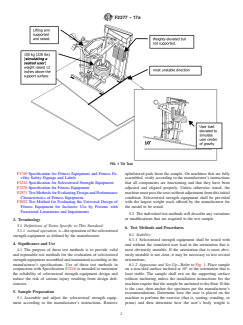
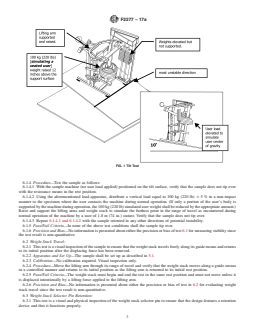
FIG. 1 Tilt Test
F1749 Specification for Fitness Equipment and Fitness Fa- upholstered pads from the sample. On machines that are fully
cility Safety Signage and Labels assembled, verify according to the manufacturer’s instructions
F2216 Specification for Selectorized Strength Equipment that all components are functioning and that they have been
F2276 Specification for Fitness Equipment adjusted and aligned properly. Unless otherwise stated, the
F2571 TestMethodsforEvaluatingDesignandPerformance machinemustpassthetestswithoutadjustmentfromthisinitial
Characteristics of Fitness Equipment condition. Selectorized strength equipment shall be provided
F3022 Test Method for Evaluating the Universal Design of with the largest weight stack offered by the manufacturer for
Fitness Equipment for Inclusive Use by Persons with the model to be tested.
Functional Limitations and Impairments
5.2 The individual test methods will describe any variations
or modifications that are required to the test sample.
3. Terminology
3.1 Definitions of Terms Specific to This Standard:
6. Test Methods and Procedures
3.1.1 normal operation, n—the operation of the selectorized
6.1 Stability:
strength equipment as defined by the manufacturer.
6.1.1 Selectorized strength equipment shall be tested with
4. Significance and Use
and without the simulated user load in the orientation that is
most obviously unstable. If the orientation that is most obvi-
4.1 The purpose of these test methods is to provide valid
ously unstable is not clear, it may be necessary to test several
and repeatable test methods for the evaluation of selectorized
orientations.
strength equipment assembled and maintained according to the
manufacturer’s specifications. Use of these test methods in 6.1.2 Apparatus and Set-Up—Refer to Fig. 1. Place sample
conjunction with Specification F2216 is intended to maximize on a non-skid surface inclined at 10° in the orientation that is
the reliability of selectorized strength equipment design and least stable. The sample shall rest on the supporting surface
reduce the risk of serious injury resulting from design defi- without anchoring unless the installation instructions for the
ciencies. machinerequirethatthesamplebeanchoredtothefloor.Ifthis
is the case, then anchor the specimen per the manufacturer’s
5. Sample Preparation
recommendations. Determine how the user is placed on the
5.1 Assemble and adjust the selectorized strength equip- machine to perform the exercise (that is, seating, standing, or
ment according to the manufacturer’s instructions. Remove prone) and then determine how the user’s body weight is
F2277 − 17a
distributed onto the user support surfaces. For the simulated 6.3.1 This test is a visual and physical inspection of the
use test, a method of applying a steady state load equal to 100 weight stack selector pin to ensure that the design features a
kg (220 lb) simulating the user’s weight and its distribution in retention device and that it functions properly.
the vertical direction at the point(s) of user contact must be 6.3.2 Apparatus and Set Up—The sample shall be set up as
provided. As an example, for a seated user, the user support
described in 5.1. Obtain instructions or a descriptive explana-
surface shall be adjusted to the uppermost position (if adjust- tion of the function of the weight stack selector pin from the
able) and the center of gravity of the 100 kg (220 lb) load shall
manufacturer.
be positioned approximately 300 mm (12 in.) above the user
6.3.3 Calibration—No calibration required. Visual and
support surface. Possible methods of providing this load
function inspection only.
include, but are not limited to, pneumatic cylinder(s) or dead
6.3.4 Procedure—Inspect the weight stack selector pin and
weights.
ensure that it features a retention device that will not allow the
6.1.3 Calibration—Using an angle measuring instrument
pin to be removed from the weight stack unless it is intention-
accurate to within 0.1°, verify the non-skid surface is 10 6
ally removed. Examples of retention devices include, but are
0.5°. Calibrate the load measurement apparatus to confirm
not limited to, spring activated detent balls or a physical
accuracy to within 620 N (4.5 lb) over entire 981 N (220 lb)
deformation of the pin and comparable retention zone on the
range.
weight plate. The operation of the retention system shall be
6.1.4 Procedure—Test the sample as follows:
self-evident. Insert the weight stack selector pin into a weight
6.1.4.1 With the sample machine (no user load applied)
on the weight stack and verify that the retention mechanism
positionedonthetiltsurface,verifythatthesampledoesnottip
functions properly.
over with the resistance means in the rest position.
6.3.5 Pass/Fail Criteria—Weight stack selector pins that do
6.1.4.2 Using the aforementioned load apparatus, distribute
not have a retention means shall fail this test. Retention
a vertical load equal to 100 kg (220 lb) 6 5 % in a non-impact
mechanisms that do not function according to the instructions
manner to the specimen where the user contacts the machine
provided by the manufacturer shall fail this test.
during normal operation. (If only a portion of the user’s body
6.3.6 Precision and Bias—No information is presented
is supported by the machine during operation, the 100 kg (220
about either the precision or bias of test in 6.3 for evaluating
lb) simulated user weight shall be reduced by the appropriate
weight stack selector pin design and function since the test
amount.)Raiseandsupporttheliftingarmsandweightstackto
result is non-quantitative.
simulate the furthest point in the range of travel as encountered
6.4 Entrance/Exit from Machine:
during normal operation of the machine by a user of 1.8 m (74
6.4.1 This test is a visual and physical inspection of the
in.) stature. Verify that the sample does not tip over.
machine to determine whether or not an assist means is
6.1.4.3 Repeat 6.1.4.1 and 6.1.4.2 with the sample oriented
required and then ensure that the design functions properly.
in any other directions of potential instability.
6.4.2 Apparatus and Set Up—The sample shall be set up as
6.1.5 Pass/Fail Criteria—In none of the above test condi-
described in 5.1. Reinstall the upholstered pads for this test.
tions shall the sample tip over.
Obtain instructions or a descriptive explanation of the function
6.1.6 Precision and Bias—No information is presented
of the assist mechanism(s) used on the sample from the
about either the precision or bias of test 6.1 for measuring
manufacturer.
stability since the test result is non-quantitative.
6.4.3 Calibration—No calibration required. Visual and
6.2 Weight Stack Travel:
function inspection only.
6.2.1 This test is a visual inspection of the sample to ensure
6.4.4 Procedure—Adjust the machine for the evaluator’s
that the weight stack travels freely along its guide means and
size according to the manufacturer’s instructions. The evalua-
returns to its initial position after the displacing force has been
tor shall enter the machine and attempt to get into the exercise
removed.
start position as described in the operation instructions pro-
6.2.2 Apparatus and Set Up—The sample shall be set up as
vided by the manufacturer. The evaluator shall be able to get
described in 5.1.
into and back out of the starting position with relative ease. If
6.2.3 Calibration—No calibration required. Visual inspec-
the lifting or user means cannot be reached by the evaluator or
tion only.
if the evaluator cannot get into the starting position easily, then
6.2.4 Procedure—Move the lifting arm through its range of
further adjustment of the machine may be required. If this is
travel and verify that the weight stack moves along a guide
notthecase(themachineisproperlyadjustedpertheoperation
means in a controlled manner and returns to its initial position
instructions for the given body size of the evaluator), then an
as the lifting arm is returned to its initial rest position.
assist means that moves the lifting or user means into the
6.2.5 Pass/Fail Criteria—The weight stack must begin and
direction of lifting stroke must be provided.
end the test in the same rest position and must not move unless
6.4.4.1 If an assist means is provided, then operate the
it is displaced intentionally by a lifting force applied to the
mechanism and ensure that it performs as described in the
lifting arm.
operation instructions. Upon actuation of the assist means, the
6.2.6 Precision and Bias—No information is presented
lifting or user means shall move into the direction of machine
about either the precision or bias of test in 6.2 for evaluating
motion allowing the user to get into the loaded exercise start
weight stack travel since the test result is non-quantitative.
position. Upon completion of the exercise and return of the
6.3 Weight Stack Selector Pin Retention: lifting or user means to the rest position, actuation of the assist
F2277 − 17a
means shall stop the lifting or user means prior to reaching the
unloaded rest position, thereby allowing the user to exit from
the loaded use position.
6.4.5 Pass/Fail Criteria—Machines that do not allow the
user to enter or exit the machine easily shall fail the test.Assist
mechanisms that do not function according to the instructions
providedbythemanufacturershallfailtest.Assistmechanisms
that do not stop the lifting or user means far enough into the
lifting stroke to allow the user to control and/or stop the final
return travel of the lifting or user means shall fail the test.
6.4.6 Precision and Bias—No information is presented
about either the precision or bias of test in 6.4 for evaluating
assist mechanism design and function since the test result is
non-quantitative.
6.5 Belt or Rope System Design and Load Testing:
6.5.1 This test is a visual, physical, and functional inspec-
tion of the cables, belts, or ropes and their end fittings and
attachmentmeansusedonthesampletoroutetheloadfromthe
resistance means to the user means to ensure that the design
functionsasintendedandmeetstheparametersofSpecification
F2216.
6.5.2 Apparatus and Set Up—The sample shall be set up as
described in 5.1. Obtain instructions or a descriptive explana-
tion of the function of the specimen from the manufacturer.
Three cable, belt, or rope specimens measuring 150 mm (5.9
in.) replicating the system installed on sample including their
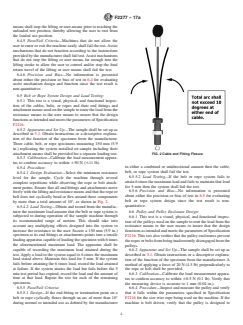
attachment means shall be provided for a separate loading test. FIG. 2 Cable and Fitting Flexure
6.5.3 Calibration—Calibrate the load measurement appara-
tus to confirm accuracy to within 650N(611 lb).
in either a combined or unidirectional amount then the cable,
6.5.4 Procedure:
belt, or rope system shall fail the test.
6.5.4.1 Design Evaluation—Select the minimum resistance
6.5.5.2 Load Testing—If the belt or rope system fails to
level for the sample. Cycle the machine through several
attain 6 times the maximum load and fails to maintain that load
complete repetitions while observing the rope or belt attach-
for 5 min then the system shall fail the test.
ment points. Ensure that all end fittings and attachments move
6.5.6 Precision and Bias—No information is presented
freely with the lifting and resistance means and that the rope or
about either the precision or bias of test in 6.5 for evaluating
belt does not cyclically bend or flex around these components
belt or rope system design since the test result is non-
by more than a total amount of 10°, as shown in Fig. 2.
quantitative.
6.5.4.2 Load Testing—Obtain and record from the manufac-
turer the maximum load amount that the belt or rope system is
6.6 Pulley and Pulley Enclosure Design:
subjected to during operation of the sample machine through
6.6.1 This test is a visual, physical, and functional inspec-
its recommended range of motion. This should take into
tion of the pulleys used on the sample to rout the load from the
account any multiplying effects designed into the system to
resistance means to the user means to insure that the design
increase the resistance to the user. Secure a 150 mm (5.9 in.)
functionsasintendedandmeetstheparametersofSpecification
specimen at its end fittings or attachments points into a tensile
F2216.This test also verifies that the pulley enclosures prevent
loadingapparatuscapableofloadingthespecimenwith6times
theropesorbeltsfrombeinginadvertentlydisengagedfromthe
the aforementioned maximum load. The apparatus shall be
pulleys.
capable of recording the maximum load attained during the
6.6.2 Apparatus and Set Up—The sample shall be set up as
test.Apply a load to the system equal to 6 times the maximum
described in 5.1. Obtain instructions or a descriptive explana-
load stated above. Maintain this load for 5 min. If the system
tion of the function of the specimen from the manufacturer. A
fails before attaining the 6 times load, record the load attained
method of applying a force of 20 N (4.5 lb) perpendicularly to
at failure. If the system attains the load but fails before the 5
the rope or belt shall be provided.
min test period has expired, record the load and the amount of
6.6.3 Calibration—Calibrate the load measurement appara-
time at that load. Repeat the test for each of the remaining
tus to confirm accuracy to within 60.5 N (0.1 lb). Verify that
specimens.
the measuring device is accurate to 1 mm (0.04 in.).
6.5.5 Pass/Fail Criteria:
6.6.4 Procedure—Inspect and measure the pulley and verify
6.5.5.1 Design—If the end fitting or termination point on a that it falls within the parameters specified in Specification
belt or rope cyclically flexes through an arc of more than 10° F2216 for the size wire rope being used on the machine. If the
during normal or intended use as defined by the manufacturer machine is belt driven, verify that the pulley is designed to
F2277 − 17a
6.7.5 Procedure—Refer to Specification F2216 while con-
ducting this test. The evaluator shall place himself/herself on
the sample in the operational position and determine and note
regionsofthesamplethataretobeevaluated.Areasofconcern
that are 1800 mm (71 in.) or more above the floor are exempt
from this requirement and do not need to be examined further.
Areas that are blocked by the user of the equipment throughout
FIG. 3 Probe Specifications
the range of motion are also exempt from further examination.
The evaluator shall pay attention to areas outside their field of
view and areas outside their reach as discussed in Specification
F2216. The evaluator shall determine, for the area of concern,
prevent disengagement. Appropriate means would include
the portion of the body most likely to be injured and then use
convex or concave profile or retainment edges on each side of
the appropriate probe. Insert the probe perpendicular to this
the pulley.
area and cycle the machine through one stroke with the
6.6.4.1 Examine the enclosures for the pulleys. Grasp the
minimum resistance selected to verify probe entrapment.
rope or belt as it exits/enters the enclosure and apply a pulling
Repeat with the full amount of resistance for the area of
force of 20 N (4.5 lb) 90° to the direction of travel. The cable
concern. Pay close attention to the deflection of the machine
or belt shall not come off of the pulley. Repeat this process at
and its components as this deflection may create new areas of
other pulley locations on the machine.
concern. If the probe becomes entrapped, apply a pulling force
6.6.4.2 Select the full resistance level of the sample and
to remove the probe. Record the force required to remove the
move the lifting means through one or more cycles at a slow
probe.
and controlled rate of motion. The pulleys shall rotate as the
6.7.6 Pass/Fail Criteria—The probe shall not become en-
lifting means is cycled.
trapped in any mechanical hazard. Entrapment is defined to
6.6.5 Pass/Fail Criteria—Pulleys with dimensions falling
have occurred if the force to pull out the probe is greater than
outside of those specified in Specification F2216 shall fail test.
4.4 N (1 lb).
Belt pulleys failing to feature a retention design shall fail the
6.7.7 Precision and Bias—No information is presented
test. Enclosures that allow for disengagement of the cable or
about either the precision or bias of test in 6.7 for evaluating
belt shall fail the test. Pulleys that do not rotate under full
entrapment points outside of the field of view of the user since
loading shall fail this test.
the test result is non-quantitative.
6.6.6 Precision and Bias—No information is presented
6.8 Pull-In Point Testing:
about either the precision or bias of test in 6.6 for evaluating
6.8.1 This test is to evaluate the risk of injury to the user or
pulley and pulley enclosure design and function since the test
to a third party due to inadvertent contact between either
result is non-quantitative.
rotating and fixed components of the sample or between the
6.7 Entrapment Testing:
belts/ropes/chains of the sample and their respective cams,
6.7.1 This test is to evaluate the risk of injury to the user or
pulleys, or sprockets. The results of this test determine the
to a third party due to inadvertent contact with a moving
adequacy of spacing between components or the adequacy of
mechanical part and a fixed component of the machine. The
the guarding of those components, or both. Methodology
results of this test determine the adequacy of spacing between
entailsinsertionofasizedprobeintothepullinareasdiscussed
components. Methodology entails insertion of a sized probe
in Specification F2216. It has been assumed that contact in
into the entrapment areas discussed in Specification F2216.It
these areas is inadvertent and therefore the test will be
has been assumed that contact in these areas is inadvertent and
perpendicular and through the area in question and not articu-
therefore the test will be perpendicular and through the area in
lated into all possible areas around the potential hazard.
question and not articulated into all possible areas around the
6.8.2 Apparatus and Set Up—The sample shall be set up as
potential hazard.
described in 5.1 with the upholstered pads reinstalled.This test
6.7.2 Apparatus and Set Up—The sample shall be set up as
requires a probe as specified in Fig. 3. This test also requires a
described in 5.1 with the upholstered pads reinstalled.This test
sized probe of 25 mm (0.98 in.). Verify that all guards are
requires a probe as specified in Fig. 3.
properly positioned and secured. An apparatus capable of
6.7.3 This test also requires sized probes of 9.5 mm (0.38
measuring 4.4 N (1 lb) of pulling force shall be provided.
in.) and 25 mm (0.98 in.) for areas most susceptible to finger
Pressure measuring film capable of measuring 90 N/cm (131
injury and 60 mm (2.36 in.) for all other areas. Verify that all
psi) shall be provided.
guards are properly positioned and secured. An apparatus
6.8.3 Calibration—Calibrate the load measurement appara-
capable of measuring 4.4 N (1 lb) of pulling force shall be
tus to confirm accuracy to within 60.5 N (0.1 lb). Verify that
provided.
6.7.4 Calibration—Calibrate the load measurement appara-
tus to confirm accuracy to within 60.5 N (0.1 lb). Verify that
The sole source of supply of the film (Fuji Prescale Film—single sheet type for
high pressure) known to the committee at this time is Fuji Photo Film Co. Ltd,
the probe conforms to the dimensions shown in Fig. 3. Verify
Tokyo, Japan or their distributors. If you are aware of alternative suppliers, please
that the 9.5 mm (0.37 in.) sized probe is no less than the stated
provide this information toASTM International Headquarters. Your comments will
size and that the other sized probes are no greater than their
receive careful consideration at a meeting of the responsible technical committee,
stated sizes. which you may attend.
F2277 − 17a
the probe conforms to the dimensions shown in Fig. 3. Verify enclosure beyond the furthest range of travel of the weight
that the 9.5 mm (0.37 in.) sized probe is no less than the stated stackforauserof1.8m(74in.)stature.Withtheweightsinthe
size and that the other sized probes are no greater than their rest position, measure and record the spacing between the
stated sizes. weights and the enclosure.
6.8.4 Procedure—The evaluator shall place himself/herself 6.9.5 Pass/Fail Criteria—Spacing for insertion of the
on the sample in the operational position and determine and
weightselectionpinthatexceeds75mm(2.95in.)shallfailthe
note regions of the sample that are to be evaluated. Specifica- test. Enclosures that do not extend 60 mm (2.36 in.) past the
tion F2216 must be referred to in order to determine which furthest range of travel of the weight stack fail the test.
areas shall be evaluated. Areas of concern that are 1800 mm Enclosuresthatarebetween9.5mm(0.37in.)and25mm(0.98
(71 in.) or more above the floor are exempt from this in.) from the edges of the weights shall fail the test.
requirement and do not need to be examined further.Areas that
6.9.6 Precision and Bias—No information is presented
are blocked by the user of the equipment throughout the range
about either the precision or bias of test in 6.9 for evaluating
of motion are also exempt from further examination. The
weight stack enclosure design since the test result is non-
evaluator shall pay attention to areas outside their field of view
quantitative.
and areas outside their reach as discussed in Specification
6.10 Load Testing:
F2216.Theevaluatorshallinserttheprobeperpendiculartothe
6.10.1 Endurance Cycle Testing—This test is a visual and
area in question, parallel to the axis of rotation or plane of
physical inspection of the specimen to ensure that it shall
motion and cycle the machine through one stroke with the full
withstand endurance cycles set forth in Specification F2216
amount of resistance for the specimen selected. If the probe
without failure.
becomes entrapped during either the outward or return stroke,
6.10.1.1 Apparatus and Set Up—The sample shall be set up
apply a pulling force to remove the probe. Record the force
as described in 5.1 with the maximum resistance available for
requiredtoremovetheprobe.Forareasrequiringmorethan4.4
theproduct.Itisacceptable,forthistest,toanchorthemachine
N(1lb)ofremovalforceapplythepressuremeasuringfilmper
to the floor to prevent “walking.” Note and record whether the
the manufacturer’s instructions and cycle the machine again
specimen is intended for consumer or institutional use. Obtain
with the full resistance selected. Record the pressure reading
instruction or a descriptive explanation of the function of the
obtained from the film.
sample machine from the manufacturer. A nonimpact method
6.8.5 Pass/Fail Criteria—The probe shall not become en-
of cycling the machine through at least 80 % of its normal
trapped in any mechanical hazard. Pull-in is defined to have
range of motion, as defined by the manufacturer, shall be
occurred if the force to pull out the probe is greater than 4.4 N
provided.Amethod of recording the number of cycles shall be
(1 lb). Pull in areas in rope and belt driven machines where the
provided.Amethodofloadingthemachinewithextrinsicloads
pressure recorded on the pressure measuring film is 90 N/cm
experienced during the cycling of the machine shall be
(131 psi) or less shall be exempt from guarding requirements.
provided.
6.8.6 Precision and Bias—No information is presented
6.10.1.2 Calibration—Verify the accuracy of the cycle
about either the precision or bias of test in 6.8 for evaluating
counting device to 61 cycle.
pull in points since the test results are non-quantitative.
6.10.1.3 Procedure—Determine from the manufacturer’s
6.9 Weight Stack Enclosure Design:
specifications the maximum range of travel for the machine.
6.9.1 This test is a visual and physical test to evaluate the
Construct and attach to the user means of the machine an
design of the weight stack enclosure provided with the sample.
apparatus capable of moving the user means through 80 % of
Methodologyentailsthevisualexaminationoftheweightstack
this range while loaded with the maximum resistance of the
enclosure relative to the user’s placement on the machine and
machine. The testing apparatus shall move the user means in
the insertion of a sized probe into the areas between the
the same manner that the user does. For example, if the user
weights and the enclosure.
contacts the user means in two locations then the testing
6.9.2 Apparatus and Set Up—The sample shall be set up as
apparatus must do so as well. If during the course of operation
described in 5.1 with the upholstered pads reinstalled. The
the machine receives loading from the user via the user means
sample shall have the weight stack enclosure installed per the
then this shall be considered and figured into the design of the
manufacturer’s instructions. This test requires sized probes of
testing apparatus. If the user’s body weight is a factor in the
9.5 mm (0.37 in.), 25 mm (0.98 in.), and 60 mm (2.36 in.).
loading of the machine during cyclic operation then 135 kg
6.9.3 Calibration—Verify that the 9.5 mm (0.37 in.) sized (300lb),simulatingauser,shallbeattachedtotheusersupport
probe is no less than the stated size and that the other sized
surface at the point of user contact.
probes are no greater than their stated sizes.
(1) The design of the testing apparatus will be unique and
6.9.4 Procedure—The evaluator shall place himself/herself different for each product tested. Careful consideration shall be
on the sample in the operational position and determine and given by the testing facility as to how the test apparatus is
note where the weight stack is relative to their field of vision constructed and they shall communicate with the manufacturer
while using the machine. Referring to Specification F2216, the prior to commencing the test to verify that the apparatus
evaluator shall determine the amount of guarding required functions in a manner similar to how a user would actually use
around the weight stack. Measure and record the spacing and interface with the machine.
provided between the enclosure halves for insertion of the (2) Verify that the counter cycles for each repetition of the
weight selection pin. Measure and record the extension of the machine. Verify that after each repetition the load at the user
F2277 − 17a
means returns to zero prior to the execution of the next 7.1.1.3 Procedure—Inspect all setup positions to ensure that
repetition. This may be done with a load cell or simple visual the sample is adjustable. Document how many adjustments
examination of the system. If the test apparatus is to run there are within each adjustment mechanism, that is, for seats,
unattended then it shall be outfitted with a means of stopping back supports, legs, handles, etc. Verify that either setup of all
if failure occurs on the sample. Begin the test. Periodically adjustments can be done prior to mounting equipment or that
make and record observations during the test. the equipment is self-adjusting across a range of multiple body
(3) If the specimen has multiple stations then replace the sizes and shapes once in the exercise position.
shared components, as specified in Specification F2216, and
7.1.1.4 Pass/Fail Criteria—Access and setup shall conform
repeat the
...
This document is not an ASTM standard and is intended only to provide the user of an ASTM standard an indication of what changes have been made to the previous version. Because
it may not be technically possible to adequately depict all changes accurately, ASTM recommends that users consult prior editions as appropriate. In all cases only the current version
of the standard as published by ASTM is to be considered the official document.
Designation: F2277 − 17 F2277 − 17a An American National Standard
Standard Test Methods for
Evaluating Design and Performance Characteristics of
Selectorized Strength Equipment
This standard is issued under the fixed designation F2277; the number immediately following the designation indicates the year of
original adoption or, in the case of revision, the year of last revision. A number in parentheses indicates the year of last reapproval. A
superscript epsilon (´) indicates an editorial change since the last revision or reapproval.
INTRODUCTION
The goal of these test methods is to provide reliable and repeatable methods for the evaluation of
selectorized strength equipment. Users of these machines must recognize, however, that conformance
to a standard will not necessarily prevent injuries. Certain physical conditions or limitations may
preclude some persons from using this equipment as intended by the manufacturer, and using this
equipment may increase the risk of injury.
1. Scope
1.1 These test methods specify procedures and apparatus used for testing and evaluating selectorized strength equipment for
compliance to Specification F2216. Both design and operational parameters will be evaluated. Where possible and applicable,
accepted test methods from other recognized bodies will be used and referenced.
1.2 Requirements—Selectorized strength equipment is to be tested in accordance with these test methods or Test Methods F2571
for all of the following parameters:
1.2.1 Stability,
1.2.2 Edge and corner sharpness,
1.2.3 Tube ends,
1.2.4 Weight stack travel,
1.2.5 Weight stack selector pin retention,
1.2.6 Function of adjustments and locking mechanisms,
1.2.7 Handgrip design and retention,
1.2.8 Assist mechanisms,
1.2.9 Foot supports,
1.2.10 Rope and belt systems:
1.2.10.1 Static load,
1.2.10.2 End fitting design,
1.2.11 Chain drive design,
1.2.12 Pulley design:
1.2.12.1 Rope pulley design,
1.2.12.2 Belt pulley design,
1.2.13 Entrapment zones,
1.2.14 Pull in points,
1.2.15 Weight stack enclosure design,
1.2.16 Loading and deflection:
1.2.16.1 Intrinsic loading and associated deflection,
1.2.16.2 Extrinsic loading and associated deflection,
1.2.16.3 Endurance loading,
1.2.17 Documentation and warnings verification, and
These test methods are under the jurisdiction of ASTM Committee F08 on Sports Equipment, Playing Surfaces, and Facilities and are the direct responsibility of
Subcommittee F08.30 on Fitness Products.
Current edition approved May 15, 2017Dec. 1, 2017. Published August 2017January 2018. Originally approved in 2003. Last previous edition approved in 20122017 as
F2277 – 12.F2277 – 17. DOI: 10.1520/F2277-17.10.1520/F2277-17A.
Copyright © ASTM International, 100 Barr Harbor Drive, PO Box C700, West Conshohocken, PA 19428-2959. United States
F2277 − 17a
1.2.18 Additional universal design and construction requirements.
1.3 This test method contains additional requirements to address the accessibility of the equipment for persons with disabilities.
1.4 The values stated in SI units are to be regarded as the standard. The values in parenthesis are for information only.
1.5 This standard does not purport to address all of the safety concerns, if any, associated with its use. It is the responsibility
of the user of this standard to establish appropriate safety safety, health, and healthenvironmental practices and determine the
applicability of regulatory limitations prior to use.
1.6 This international standard was developed in accordance with internationally recognized principles on standardization
established in the Decision on Principles for the Development of International Standards, Guides and Recommendations issued
by the World Trade Organization Technical Barriers to Trade (TBT) Committee.
2. Referenced Documents
2.1 ASTM Standards:
F1749 Specification for Fitness Equipment and Fitness Facility Safety Signage and Labels
F2216 Specification for Selectorized Strength Equipment
F2276 Specification for Fitness Equipment
F2571 Test Methods for Evaluating Design and Performance Characteristics of Fitness Equipment
F3022 Test Method for Evaluating the Universal Design of Fitness Equipment for Inclusive Use by Persons with Functional
Limitations and Impairments
3. Terminology
3.1 Definitions of Terms Specific to This Standard:
3.1.1 normal operation, n—the operation of the selectorized strength equipment as defined by the manufacturer.
4. Significance and Use
4.1 The purpose of these test methods is to provide valid and repeatable test methods for the evaluation of selectorized strength
equipment assembled and maintained according to the manufacturer’s specifications. Use of these test methods in conjunction with
Specification F2216 is intended to maximize the reliability of selectorized strength equipment design and reduce the risk of serious
injury resulting from design deficiencies.
5. Sample Preparation
5.1 Assemble and adjust the selectorized strength equipment according to the manufacturer’s instructions. Remove upholstered
pads from the sample. On machines that are fully assembled, verify according to the manufacturer’s instructions that all
components are functioning and that they have been adjusted and aligned properly. Unless otherwise stated, the machine must pass
the tests without adjustment from this initial condition. Selectorized strength equipment shall be provided with the largest weight
stack offered by the manufacturer for the model to be tested.
5.2 The individual test methods will describe any variations or modifications that are required to the test sample.
6. Test Methods and Procedures
6.1 Stability:
6.1.1 Selectorized strength equipment shall be tested with and without the simulated user load in the orientation that is most
obviously unstable. If the orientation that is most obviously unstable is not clear, it may be necessary to test several orientations.
6.1.2 Apparatus and Set-Up—Refer to Fig. 1. Place sample on a non-skid surface inclined at 10° in the orientation that is least
stable. The sample shall rest on the supporting surface without anchoring unless the installation instructions for the machine require
that the sample be anchored to the floor. If this is the case, then anchor the specimen per the manufacturer’s recommendations.
Determine how the user is placed on the machine to perform the exercise (that is, seating, standing, or prone) and then determine
how the user’s body weight is distributed onto the user support surfaces. For the simulated use test, a method of applying a steady
state load equal to 100 kg (220 lb) simulating the user’s weight and its distribution in the vertical direction at the point(s) of user
contact must be provided. As an example, for a seated user, the user support surface shall be adjusted to the uppermost position
(if adjustable) and the center of gravity of the 100 kg (220 lb) load shall be positioned approximately 300 mm (12 in.) above the
user support surface. Possible methods of providing this load include, but are not limited to, pneumatic cylinder(s) or dead weights.
6.1.3 Calibration—Using an angle measuring instrument accurate to within 0.1°, verify the non-skid surface is 10 6 0.5°.
Calibrate the load measurement apparatus to confirm accuracy to within 620 N (4.5 lb) over entire 981 N (220 lb) range.
This work was funded, in part, by the Rehabilitation Engineering Research Center on RecTech through the National Institute on Disability, Independent Living, and
Rehabilitation Research grant #90RE5009-01-00.
For referenced ASTM standards, visit the ASTM website, www.astm.org, or contact ASTM Customer Service at service@astm.org. For Annual Book of ASTM Standards
volume information, refer to the standard’s Document Summary page on the ASTM website.
F2277 − 17a
FIG. 1 Tilt Test
6.1.4 Procedure—Test the sample as follows:
6.1.4.1 With the sample machine (no user load applied) positioned on the tilt surface, verify that the sample does not tip over
with the resistance means in the rest position.
6.1.4.2 Using the aforementioned load apparatus, distribute a vertical load equal to 100 kg (220 lb) 6 5 % in a non-impact
manner to the specimen where the user contacts the machine during normal operation. (If only a portion of the user’s body is
supported by the machine during operation, the 100 kg (220 lb) simulated user weight shall be reduced by the appropriate amount.)
Raise and support the lifting arms and weight stack to simulate the furthest point in the range of travel as encountered during
normal operation of the machine by a user of 1.8 m (74 in.) stature. Verify that the sample does not tip over.
6.1.4.3 Repeat 6.1.4.1 and 6.1.4.2 with the sample oriented in any other directions of potential instability.
6.1.5 Pass/Fail Criteria—In none of the above test conditions shall the sample tip over.
6.1.6 Precision and Bias—No information is presented about either the precision or bias of test 6.1 for measuring stability since
the test result is non-quantitative.
6.2 Weight Stack Travel:
6.2.1 This test is a visual inspection of the sample to ensure that the weight stack travels freely along its guide means and returns
to its initial position after the displacing force has been removed.
6.2.2 Apparatus and Set Up—The sample shall be set up as described in 5.1.
6.2.3 Calibration—No calibration required. Visual inspection only.
6.2.4 Procedure—Move the lifting arm through its range of travel and verify that the weight stack moves along a guide means
in a controlled manner and returns to its initial position as the lifting arm is returned to its initial rest position.
6.2.5 Pass/Fail Criteria—The weight stack must begin and end the test in the same rest position and must not move unless it
is displaced intentionally by a lifting force applied to the lifting arm.
6.2.6 Precision and Bias—No information is presented about either the precision or bias of test in 6.2 for evaluating weight
stack travel since the test result is non-quantitative.
6.3 Weight Stack Selector Pin Retention:
6.3.1 This test is a visual and physical inspection of the weight stack selector pin to ensure that the design features a retention
device and that it functions properly.
F2277 − 17a
6.3.2 Apparatus and Set Up—The sample shall be set up as described in 5.1. Obtain instructions or a descriptive explanation
of the function of the weight stack selector pin from the manufacturer.
6.3.3 Calibration—No calibration required. Visual and function inspection only.
6.3.4 Procedure—Inspect the weight stack selector pin and ensure that it features a retention device that will not allow the pin
to be removed from the weight stack unless it is intentionally removed. Examples of retention devices include, but are not limited
to, spring activated detent balls or a physical deformation of the pin and comparable retention zone on the weight plate. The
operation of the retention system shall be self-evident. Insert the weight stack selector pin into a weight on the weight stack and
verify that the retention mechanism functions properly.
6.3.5 Pass/Fail Criteria—Weight stack selector pins that do not have a retention means shall fail this test. Retention mechanisms
that do not function according to the instructions provided by the manufacturer shall fail this test.
6.3.6 Precision and Bias—No information is presented about either the precision or bias of test in 6.3 for evaluating weight
stack selector pin design and function since the test result is non-quantitative.
6.4 Entrance/Exit from Machine:
6.4.1 This test is a visual and physical inspection of the machine to determine whether or not an assist means is required and
then ensure that the design functions properly.
6.4.2 Apparatus and Set Up—The sample shall be set up as described in 5.1. Reinstall the upholstered pads for this test. Obtain
instructions or a descriptive explanation of the function of the assist mechanism(s) used on the sample from the manufacturer.
6.4.3 Calibration—No calibration required. Visual and function inspection only.
6.4.4 Procedure—Adjust the machine for the evaluator’s size according to the manufacturer’s instructions. The evaluator shall
enter the machine and attempt to get into the exercise start position as described in the operation instructions provided by the
manufacturer. The evaluator shall be able to get into and back out of the starting position with relative ease. If the lifting or user
means cannot be reached by the evaluator or if the evaluator cannot get into the starting position easily, then further adjustment
of the machine may be required. If this is not the case (the machine is properly adjusted per the operation instructions for the given
body size of the evaluator), then an assist means that moves the lifting or user means into the direction of lifting stroke must be
provided.
6.4.4.1 If an assist means is provided, then operate the mechanism and ensure that it performs as described in the operation
instructions. Upon actuation of the assist means, the lifting or user means shall move into the direction of machine motion allowing
the user to get into the loaded exercise start position. Upon completion of the exercise and return of the lifting or user means to
the rest position, actuation of the assist means shall stop the lifting or user means prior to reaching the unloaded rest position,
thereby allowing the user to exit from the loaded use position.
6.4.5 Pass/Fail Criteria—Machines that do not allow the user to enter or exit the machine easily shall fail the test. Assist
mechanisms that do not function according to the instructions provided by the manufacturer shall fail test. Assist mechanisms that
do not stop the lifting or user means far enough into the lifting stroke to allow the user to control and/or stop the final return travel
of the lifting or user means shall fail the test.
6.4.6 Precision and Bias—No information is presented about either the precision or bias of test in 6.4 for evaluating assist
mechanism design and function since the test result is non-quantitative.
6.5 Belt or Rope System Design and Load Testing:
6.5.1 This test is a visual, physical, and functional inspection of the cables, belts, or ropes and their end fittings and attachment
means used on the sample to route the load from the resistance means to the user means to ensure that the design functions as
intended and meets the parameters of Specification F2216.
6.5.2 Apparatus and Set Up—The sample shall be set up as described in 5.1. Obtain instructions or a descriptive explanation
of the function of the specimen from the manufacturer. Three cable, belt, or rope specimens measuring 150 mm (5.9 in.) replicating
the system installed on sample including their attachment means shall be provided for a separate loading test.
6.5.3 Calibration—Calibrate the load measurement apparatus to confirm accuracy to within 650 N (611 lb).
6.5.4 Procedure:
6.5.4.1 Design Evaluation—Select the minimum resistance level for the sample. Cycle the machine through several complete
repetitions while observing the rope or belt attachment points. Ensure that all end fittings and attachments move freely with the
lifting and resistance means and that the rope or belt does not cyclically bend or flex around these components by more than a total
amount of 10°, as shown in Fig. 2.
6.5.4.2 Load Testing—Obtain and record from the manufacturer the maximum load amount that the belt or rope system is
subjected to during operation of the sample machine through its recommended range of motion. This should take into account any
multiplying effects designed into the system to increase the resistance to the user. Secure a 150 mm (5.9 in.) specimen at its end
fittings or attachments points into a tensile loading apparatus capable of loading the specimen with 6 times the aforementioned
maximum load. The apparatus shall be capable of recording the maximum load attained during the test. Apply a load to the system
equal to 6 times the maximum load stated above. Maintain this load for 5 min. If the system fails before attaining the 6 times load,
record the load attained at failure. If the system attains the load but fails before the 5 min test period has expired, record the load
and the amount of time at that load. Repeat the test for each of the remaining specimens.
6.5.5 Pass/Fail Criteria:
F2277 − 17a
FIG. 2 Cable and Fitting Flexure
6.5.5.1 Design—If the end fitting or termination point on a belt or rope cyclically flexes through an arc of more than 10° during
normal or intended use as defined by the manufacturer in either a combined or unidirectional amount then the cable, belt, or rope
system shall fail the test.
6.5.5.2 Load Testing—If the belt or rope system fails to attain 6 times the maximum load and fails to maintain that load for 5
min then the system shall fail the test.
6.5.6 Precision and Bias—No information is presented about either the precision or bias of test in 6.5 for evaluating belt or rope
system design since the test result is non-quantitative.
6.6 Pulley and Pulley Enclosure Design:
6.6.1 This test is a visual, physical, and functional inspection of the pulleys used on the sample to rout the load from the
resistance means to the user means to insure that the design functions as intended and meets the parameters of Specification F2216.
This test also verifies that the pulley enclosures prevent the ropes or belts from being inadvertently disengaged from the pulleys.
6.6.2 Apparatus and Set Up—The sample shall be set up as described in 5.1. Obtain instructions or a descriptive explanation
of the function of the specimen from the manufacturer. A method of applying a force of 20 N (4.5 lb) perpendicularly to the rope
or belt shall be provided.
6.6.3 Calibration—Calibrate the load measurement apparatus to confirm accuracy to within 60.5 N (0.1 lb). Verify that the
measuring device is accurate to 1 mm (0.04 in.).
6.6.4 Procedure—Inspect and measure the pulley and verify that it falls within the parameters specified in Specification F2216
for the size wire rope being used on the machine. If the machine is belt driven, verify that the pulley is designed to prevent
disengagement. Appropriate means would include convex or concave profile or retainment edges on each side of the pulley.
6.6.4.1 Examine the enclosures for the pulleys. Grasp the rope or belt as it exits/enters the enclosure and apply a pulling force
of 20 N (4.5 lb) 90° to the direction of travel. The cable or belt shall not come off of the pulley. Repeat this process at other pulley
locations on the machine.
6.6.4.2 Select the full resistance level of the sample and move the lifting means through one or more cycles at a slow and
controlled rate of motion. The pulleys shall rotate as the lifting means is cycled.
6.6.5 Pass/Fail Criteria—Pulleys with dimensions falling outside of those specified in Specification F2216 shall fail test. Belt
pulleys failing to feature a retention design shall fail the test. Enclosures that allow for disengagement of the cable or belt shall
fail the test. Pulleys that do not rotate under full loading shall fail this test.
6.6.6 Precision and Bias—No information is presented about either the precision or bias of test in 6.6 for evaluating pulley and
pulley enclosure design and function since the test result is non-quantitative.
F2277 − 17a
FIG. 3 Probe Specifications
6.7 Entrapment Testing:
6.7.1 This test is to evaluate the risk of injury to the user or to a third party due to inadvertent contact with a moving mechanical
part and a fixed component of the machine. The results of this test determine the adequacy of spacing between components.
Methodology entails insertion of a sized probe into the entrapment areas discussed in Specification F2216. It has been assumed
that contact in these areas is inadvertent and therefore the test will be perpendicular and through the area in question and not
articulated into all possible areas around the potential hazard.
6.7.2 Apparatus and Set Up—The sample shall be set up as described in 5.1 with the upholstered pads reinstalled. This test
requires a probe as specified in Fig. 3.
6.7.3 This test also requires sized probes of 9.5 mm (0.38 in.) and 25 mm (0.98 in.) for areas most susceptible to finger injury
and 60 mm (2.36 in.) for all other areas. Verify that all guards are properly positioned and secured. An apparatus capable of
measuring 4.4 N (1 lb) of pulling force shall be provided.
6.7.4 Calibration—Calibrate the load measurement apparatus to confirm accuracy to within 60.5 N (0.1 lb). Verify that the
probe conforms to the dimensions shown in Fig. 3. Verify that the 9.5 mm (0.37 in.) sized probe is no less than the stated size and
that the other sized probes are no greater than their stated sizes.
6.7.5 Procedure—Refer to Specification F2216 while conducting this test. The evaluator shall place himself/herself on the
sample in the operational position and determine and note regions of the sample that are to be evaluated. Areas of concern that
are 1800 mm (71 in.) or more above the floor are exempt from this requirement and do not need to be examined further. Areas
that are blocked by the user of the equipment throughout the range of motion are also exempt from further examination. The
evaluator shall pay attention to areas outside their field of view and areas outside their reach as discussed in Specification F2216.
The evaluator shall determine, for the area of concern, the portion of the body most likely to be injured and then use the appropriate
probe. Insert the probe perpendicular to this area and cycle the machine through one stroke with the minimum resistance selected
to verify probe entrapment. Repeat with the full amount of resistance for the area of concern. Pay close attention to the deflection
of the machine and its components as this deflection may create new areas of concern. If the probe becomes entrapped, apply a
pulling force to remove the probe. Record the force required to remove the probe.
6.7.6 Pass/Fail Criteria—The probe shall not become entrapped in any mechanical hazard. Entrapment is defined to have
occurred if the force to pull out the probe is greater than 4.4 N (1 lb).
6.7.7 Precision and Bias—No information is presented about either the precision or bias of test in 6.7 for evaluating entrapment
points outside of the field of view of the user since the test result is non-quantitative.
6.8 Pull-In Point Testing:
6.8.1 This test is to evaluate the risk of injury to the user or to a third party due to inadvertent contact between either rotating
and fixed components of the sample or between the belts/ropes/chains of the sample and their respective cams, pulleys, or
sprockets. The results of this test determine the adequacy of spacing between components or the adequacy of the guarding of those
components, or both. Methodology entails insertion of a sized probe into the pull in areas discussed in Specification F2216. It has
been assumed that contact in these areas is inadvertent and therefore the test will be perpendicular and through the area in question
and not articulated into all possible areas around the potential hazard.
6.8.2 Apparatus and Set Up—The sample shall be set up as described in 5.1 with the upholstered pads reinstalled. This test
requires a probe as specified in Fig. 3. This test also requires a sized probe of 25 mm (0.98 in.). Verify that all guards are properly
positioned and secured. An apparatus capable of measuring 4.4 N (1 lb) of pulling force shall be provided. Pressure measuring film
2 4
capable of measuring 90 N/cm (131 psi) shall be provided.
6.8.3 Calibration—Calibrate the load measurement apparatus to confirm accuracy to within 60.5 N (0.1 lb). Verify that the
probe conforms to the dimensions shown in Fig. 3. Verify that the 9.5 mm (0.37 in.) sized probe is no less than the stated size and
that the other sized probes are no greater than their stated sizes.
6.8.4 Procedure—The evaluator shall place himself/herself on the sample in the operational position and determine and note
regions of the sample that are to be evaluated. Specification F2216 must be referred to in order to determine which areas shall be
evaluated. Areas of concern that are 1800 mm (71 in.) or more above the floor are exempt from this requirement and do not need
to be examined further. Areas that are blocked by the user of the equipment through out throughout the range of motion are also
The sole source of supply of the film (Fuji Prescale Film—single sheet type for high pressure) known to the committee at this time is Fuji Photo Film Co. Ltd, Tokyo,
Japan or their distributors. If you are aware of alternative suppliers, please provide this information to ASTM International Headquarters. Your comments will receive careful
consideration at a meeting of the responsible technical committee, which you may attend.
F2277 − 17a
exempt from further examination. The evaluator shall pay attention to areas outside their field of view and areas outside their reach
as discussed in Specification F2216. The evaluator shall insert the probe perpendicular to the area in question, parallel to the axis
of rotation or plane of motion and cycle the machine through one stroke with the full amount of resistance for the specimen
selected. If the probe becomes entrapped during either the outward or return stroke, apply a pulling force to remove the probe.
Record the force required to remove the probe. For areas requiring more than 4.4 N (1 lb) of removal force apply the pressure
measuring film per the manufacturer’s instructions and cycle the machine again with the full resistance selected. Record the
pressure reading obtained from the film.
6.8.5 Pass/Fail Criteria—The probe shall not become entrapped in any mechanical hazard. Pull-in is defined to have occurred
if the force to pull out the probe is greater than 4.4 N (1 lb). Pull in areas in rope and belt driven machines where the pressure
recorded on the pressure measuring film is 90 N/cm (131 psi) or less shall be exempt from guarding requirements.
6.8.6 Precision and Bias—No information is presented about either the precision or bias of test in 6.8 for evaluating pull in
points since the test results are non-quantitative.
6.9 Weight Stack Enclosure Design:
6.9.1 This test is a visual and physical test to evaluate the design of the weight stack enclosure provided with the sample.
Methodology entails the visual examination of the weight stack enclosure relative to the user’s placement on the machine and the
insertion of a sized probe into the areas between the weights and the enclosure.
6.9.2 Apparatus and Set Up—The sample shall be set up as described in 5.1 with the upholstered pads reinstalled. The sample
shall have the weight stack enclosure installed per the manufacturer’s instructions. This test requires sized probes of 9.5 mm (0.37
in.), 25 mm (0.98 in.), and 60 mm (2.36 in.).
6.9.3 Calibration—Verify that the 9.5 mm (0.37 in.) sized probe is no less than the stated size and that the other sized probes
are no greater than their stated sizes.
6.9.4 Procedure—The evaluator shall place himself/herself on the sample in the operational position and determine and note
where the weight stack is relative to their field of vision while using the machine. Referring to Specification F2216, the evaluator
shall determine the amount of guarding required around the weight stack. Measure and record the spacing provided between the
enclosure halves for insertion of the weight selection pin. Measure and record the extension of the enclosure beyond the furthest
range of travel of the weight stack for a user of 1.8 m (74 in.) stature. With the weights in the rest position, measure and record
the spacing between the weights and the enclosure.
6.9.5 Pass/Fail Criteria—Spacing for insertion of the weight selection pin that exceeds 75 mm (2.95 in.) shall fail the test.
Enclosures that do not extend 60 mm (2.36 in.) past the furthest range of travel of the weight stack fail the test. Enclosures that
are between 9.5 mm (0.37 in.) and 25 mm (0.98 in.) from the edges of the weights shall fail the test.
6.9.6 Precision and Bias—No information is presented about either the precision or bias of test in 6.9 for evaluating weight
stack enclosure design since the test result is non-quantitative.
6.10 Load Testing:
6.10.1 Endurance Cycle Testing—This test is a visual and physical inspection of the specimen to ensure that it shall withstand
endurance cycles set forth in Specification F2216 without failure.
6.10.1.1 Apparatus and Set Up—The sample shall be set up as described in 5.1 with the maximum resistance available for the
product. It is acceptable, for this test, to anchor the machine to the floor to prevent “walking.” Note and record whether the
specimen is intended for consumer or institutional use. Obtain instruction or a descriptive explanation of the function of the sample
machine from the manufacturer. A nonimpact method of cycling the machine through at least 80 % of its normal range of motion,
as defined by the manufacturer, shall be provided. A method of recording the number of cycles shall be provided. A method of
loading the machine with extrinsic loads experienced during the cycling of the machine shall be provided.
6.10.1.2 Calibration—Verify the accuracy of the cycle counting device to 61 cycle.
6.10.1.3 Procedure—Determine from the manufacturer’s specifications the maximum range of travel for the machine. Construct
and attach to the user means of the machine an apparatus capable of moving the user means through 80 % of this range while
loaded with the maximum resistance of the machine. The testing apparatus shall move the user means in the same manner that the
user does. For example, if the user contacts the user means in two locations then the testing apparatus must do so as well. If during
the course of operation the machine receives loading from the user via the user means then this shall be considered and figured
into the design of the testing apparatus. If the user’s body weight is a factor in the loading of the machine during cyclic operation
then 135 kg (300 lb), simulating a user, shall be attached to the user support surface at the point of user contact.
(1) The design of the testing apparatus will be unique and different for each product tested. Careful consideration shall be given
by the testing facility as to how the test apparatus is constructed and they shall communicate with the manufacturer prior to
commencing the test to verify that the apparatus functions in a manner similar to how a user would actually use and interface with
the machine.
(2) Verify that the counter cycles for each repetition of the machine. Verify that after each repetition the load at the user means
returns to zero prior to the execution of the next repetition. This may be done with a load cell or simple visual examination of the
system. If the test apparatus is to run unattended then it shall be outfitted with a means of stopping if failure occurs on the sample.
Begin the test. Periodically make and record observations during the test.
F2277 − 17a
(3) If the specimen has multiple stations then replace the shared components, as specified in Specification F2216, and repeat
the test on the remaining stations.
(4) Upon completion of the cycles specified in Specification F2216 reinstall the upholstered pads and use the machine
according to the instructions provided by the manufacturer.
6.10.1.4 Pass/Fail Criteria—Machines or components that fail to attain the minimum number of cycles specified in
Specification F2216 shall fail the test. Mac
...