


ASTM D5872-95(2000)
(Guide)Standard Guide for Use of Casing Advancement Drilling Methods for Geoenvironmental Exploration and Installation of Subsurface Water-Quality Monitoring Devices
Standard Guide for Use of Casing Advancement Drilling Methods for Geoenvironmental Exploration and Installation of Subsurface Water-Quality Monitoring Devices
SCOPE
1.1 This guide covers how casing-advancement drilling and sampling procedures may be used for geoenvironmental exploration and installation of subsurface water-quality monitoring devices.
1.2 Different methods exist to advance casing for geoenvironmental exploration. Selection of a particular method should be made on the basis of geologic conditions at the site. This guide does not include procedures for wireline rotary casing advancer systems which are addressed in Guide D5786.
1.3 The values stated in inch-pound or SI units are to be regarded separately as the standard. The values given in parentheses are for information only.
1.4 Casing-advancement drilling methods for geoenvironmental exploration and monitoring-device installations will often involve safety planning, administration and documentation. This guide does not purport to specifically address exploration and site safety.
1.5 This standard does not purport to address all of the safety concerns, if any, associated with its use. It is the responsibility of the user of this standard to establish appropriate safety and health practices and determine the applicability of regulatory limitations prior to use.
1.6 This guide offers an organized collection of information or a series of options and does not recommend a specific course of action. This document cannot replace education or experience and should be used in conjunction with professional judgment. Not all aspects of this guide may be applicable in all circumstances. This ASTM standard is not intended to represent or replace the standard of care by which the adequacy of a given professional service must be judged, nor should this document be applied without consideration of a project's many unique aspects. The word "Standard" in the title of this document means only that the document has been approved through the ASTM consensus process.
General Information
Relations

Standards Content (Sample)
NOTICE: This standard has either been superseded and replaced by a new version or withdrawn.
Contact ASTM International (www.astm.org) for the latest information
Designation:D5872–95 (Reapproved 2000)
Standard Guide for
Use of Casing Advancement Drilling Methods for
Geoenvironmental Exploration and Installation of
Subsurface Water-Quality Monitoring Devices
This standard is issued under the fixed designation D 5872; the number immediately following the designation indicates the year of
original adoption or, in the case of revision, the year of last revision. A number in parentheses indicates the year of last reapproval. A
superscript epsilon (e) indicates an editorial change since the last revision or reapproval.
1. Scope 2. Referenced Documents
1.1 This guide covers how casing-advancement drilling and 2.1 ASTM Standards:
sampling procedures may be used for geoenvironmental explo- D 653 Terminology Relating to Soil, Rock, and Contained
ration and installation of subsurface water-quality monitoring Fluids
devices. D 1452 Practice for Soil Investigation and Sampling by
1.2 Different methods exist to advance casing for geoenvi- Auger Borings
ronmental exploration. Selection of a particular method should D 1586 Test Method for Penetration Test and Split-Barrel
be made on the basis of geologic conditions at the site. This Sampling of Soils
guide does not include procedures for wireline rotary casing D 1587 Practice for Thin-Walled Tube Geotechnical Sam-
advancer systems which are addressed in Guide D 5786. pling of Soils
1.3 The values stated in inch-pound or SI units are to be D 2113 Practice for Diamond Core Drilling for Site Inves-
regarded separately as the standard. The values given in tigation
parentheses are for information only. D 2487 Classification of Soils for Engineering Purposes
1.4 Casing-advancement drilling methods for geoenviron- (Unified Soil Classification System)
mental exploration and monitoring-device installations will D 2488 Practice for Description and Identification of Soils
often involve safety planning, administration and documenta- (Visual-Manual Procedure)
tion. This guide does not purport to specifically address D 3550 Practice for Ring-Lined Barrel Sampling of Soils
exploration and site safety. D 4220 Practice for Preserving and Transporting Soil
1.5 This standard does not purport to address all of the Samples
safety concerns, if any, associated with its use. It is the D 4428/D4428M Test Methods for Crosshole Seismic Test-
responsibility of the user of this standard to establish appro- ing
priate safety and health practices and determine the applica- D 4700 Guide for Soil Sampling from the Vadose Zone
bility of regulatory limitations prior to use. D 4750 Test Method for Determining Subsurface Liquid
1.6 This guide offers an organized collection of information Levels in a Borehole or Monitoring Well (Observation
or a series of options and does not recommend a specific Well)
course of action. This document cannot replace education or D 5079 Practices for Preserving and Transporting of Rock
experience and should be used in conjunction with professional Core Samples
judgment. Not all aspects of this guide may be applicable in all D 5088 Practice for Decontamination of Field Equipment
circumstances. This ASTM standard is not intended to repre- Used at Non-Radioactive Waste Sites
sent or replace the standard of care by which the adequacy of D 5092 Practice for Design and Installation of Ground
a given professional service must be judged, nor should this Water Monitoring Wells in Aquifers
document be applied without consideration of a project’s many D 5254 Practice for Minimum Set of Data Elements to
unique aspects. The word “Standard” in the title of this Identify a Ground-Water Site
document means only that the document has been approved D 5299 Guide for Decommissioning of Ground Water
through the ASTM consensus process. Wells, Vadose Zone Monitoring Devices, Boreholes, and
Other Devices for Environmental Activities
D 5408 Guide for the Set of Data Elements to Describe a
This guide is under thejurisdictionofASTMCommitteeD18onSoilandRock Ground-Water Site; in manuscript: Part 1—Additional
and is the direct responsibility of Subcommittee D18.21 on Ground Water and
Vadose Zone Investigations.
Current edition approved Dec. 10, 1995. Published February 1996. Annual Book of ASTM Standards, Vol 04.08.
Copyright © ASTM International, 100 Barr Harbor Drive, PO Box C700, West Conshohocken, PA 19428-2959, United States.
D5872–95 (2000)
Identification Descriptors 3.2.5 coeffıcient of uniformity— C (D), the ratio D /D ,
u 60 10
D 5409 Guide for the Set of Data Elements to Describe a where D is the particle diameter corresponding to 60 % finer
Ground-Water Site; in manuscript: Part 2—Physical De-
on the cumulative particle-size distribution curve, and D is
scriptors the particle diameter corresponding to 10 % finer on the
D 5410 Guide for the Set of Data Elements to Describe a
cumulative particle-size distribution curve.
Ground-WaterSite;inmanuscript:Part3—UsageDescrip-
3.2.6 drawworks—a power-driven winch, or several
tors
winches, usually equipped with a clutch and brake system(s)
D 5434 Guide for Field Logging of Subsurface Explora-
for hoisting or lowering a drilling string.
tions of Soil and Rock
3.2.7 drill hole—a cylindrical hole advanced into the sub-
D 5474 Guide for Selection of Data Elements for Ground-
surface by mechanical means. Also known as a borehole or
Water Investigations
boring.
D 5521 Guide Development of Ground Water Monitoring
3.2.8 drill string—the complete rotary drilling assembly
Wells in Granular Aquifers
under rotation including bit, sampler/core barrel, drill rods and
D 5730 Guide for Site Characterization for Environmental
connector assemblies (subs). The total length of this assembly
Purposes with Emphasis on Soil, Rock, the Vadose Zone
is used to determine drilling depth by referencing the position
and Ground Water
of the top of the string to a datum near the ground surface.
D 5781 Guide for the Use of Dual-Wall Reverse-
Circulation Drilling for Geoenvironmental Exploration 3.2.9 filter pack—also known as a gravel pack or primary
and the Installation of Subsurface Water-Quality Monitor- filter pack in the practice of monitoring-well installations. The
ing Devices gravel pack is usually granular material, having selected
D 5782 Guide for the Use of Direct Air-Rotary Drilling for grain-size characteristics, that is placed between a monitoring
Geoenvironmental Exploration and the Installation of
device and the borehole wall. The basic purpose of the filter
Subsurface Water-Quality Monitoring Devices pack or gravel envelope is to act as: a non-clogging filter when
D 5783 Guide for the Use of Direct-Rotary Drilling with
the aquifer is not suited to natural development or, act as a
Water-BasedDrillingFluidGeoenvironmentalExploration
formation stabilizer when the aquifer is suitable for natural
and the Installation of Subsurface Water-Quality Monitor-
development.
ing Devices
3.2.9.1 Discussion—Under most circumstances a clean,
D 5784 Guide for the Use of Hollow-Stem Augers for
quartz sand or gravel should be used. In some cases a
Geoenvironmental Exploration and the Installation of
pre-packed screen may be used.
Subsurface Water-Quality Monitoring Devices
3.2.10 hoisting line—or drilling line, is wire rope used on
D 5876 Guide for the Use of Direct Rotary Wireline Casing
the drawworks to hoist and lower the drill string.
Advancement Drilling Methods for Geoenvironmental
3.2.11 in-situ testing devices—sensors or probes, used for
Exploration and the Installation of Subsurface Water-
obtaining mechanical- or chemical-test data, that are typically
Quality Monitoring Devices
pushed, rotated or driven below the bottom of a borehole
3. Terminology following completion of an increment of drilling. However,
some in-situ testing devices (such as electronic pressure
3.1 Terminology used within this guide is in accordance
transducers, gas-lift samplers, tensiometers, and so forth) may
with Terminology D 653 with the addition of the following:
require lowering and setting of the device(s) in pre-existing
3.2 Definitions of Terms Specific to This Standard:
boreholes by means of a suspension line or a string of lowering
3.2.1 bentonite—the common name for drilling fluid addi-
rods or pipes. Centralizers may be required to correctly
tives and well-construction products consisting mostly of
position the device(s) in the borehole.
naturally occurring montmorillonite. Some bentonite products
have chemical additives that may affect water-quality analyses.
3.2.12 mast—or derrick, on a drilling rig is used for
3.2.2 bentonite granules and chips—irregularly-shaped par-
supporting the crown block, top drive, pulldown chains,
ticles of bentonite (free from additives) that have been dried
hoisting lines, etc. It must be constructed to safely carry the
and separated into a specific size range.
expected loads encountered in drilling and completion of wells
3.2.3 bentonite pellets—roughly spherical- or disc-shaped
of the diameter and depth for which the rig manufacturer
units of compressed bentonite powder (some pellet manufac-
specifies the equipment.
turers coat the bentonite with chemicals that may affect the
3.2.12.1 Discussion—To allow for contingencies, it is rec-
water-quality analysis).
ommendedthattheratedcapacityofthemastshouldbeatleast
3.2.4 cleanout depth—thedepthtowhichtheendofthedrill
twice the anticipated weight load or normal pulling load.
string (bit or core barrel cutting end) has reached after an
3.2.13 piezometer—an instrument placed below ground sur-
interval of cutting. The cleanout depth (or drilled depth as it is
face to measure hydraulic head at a point.
referred to after cleaning out of any sloughed material in the
3.2.14 subsurface water-quality monitoring device—an
bottom of the borehole) is usually recorded to the nearest 0.1 ft
instrument placed below ground surface to obtain a sample for
(0.03 m).
analyses of the chemical, biological, or radiological character-
istics of subsurface pore water or to make in-situ measure-
Annual Book of ASTM Standards, Vol 04.09. ments.
D5872–95 (2000)
4. Significance and Use tions include: direct air rotary in combination with a drill-
through casing driver, and conventional rotary bits or down-
4.1 Casing advancement may be used in support of geoen-
the-holehammerdrillwithorwithoutunderreamingcapability.
vironmental exploration and for installation of subsurface
Each of these methods requires a specific type of drill rig and
water-quality monitoring devices in both unconsolidated and
tools.
consolidated materials. Casing-advancement systems and pro-
cedures used for geoenvironmental exploration and instrumen-
NOTE 2—In NorthAmerica, the sizes of casings bits, drill rods and core
tation installations consist of direct air-rotary drilling utilizing
barrels are standardized by American Petroleum Institute (API) and the
Diamond Core Drill Manufacturers Association (DCDMA). Refer to the
conventional rotary bits or a down-the-hole hammer drill with
DCDMA Technical Manual and to published materials of API for
underreaming capability, in combination with a drill-through
available sizes and capacities of drilling tools equipment.
casing driver.
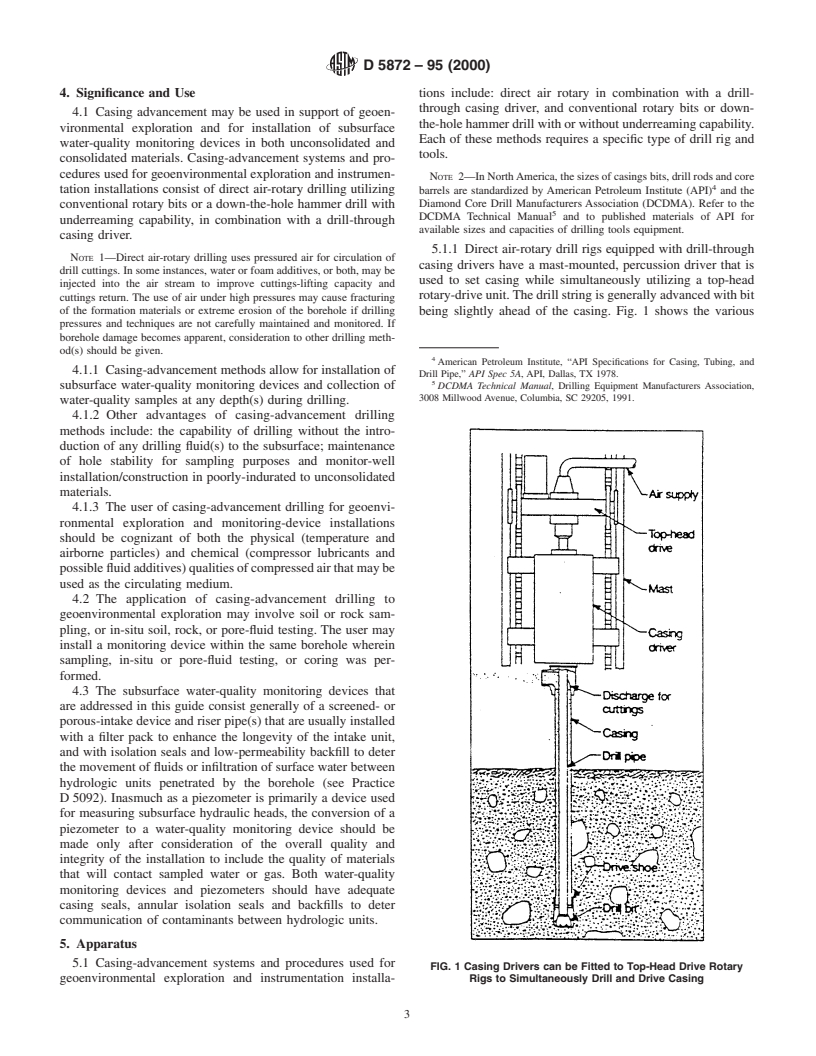
5.1.1 Direct air-rotary drill rigs equipped with drill-through
NOTE 1—Direct air-rotary drilling uses pressured air for circulation of
casing drivers have a mast-mounted, percussion driver that is
drill cuttings. In some instances, water or foam additives, or both, may be
used to set casing while simultaneously utilizing a top-head
injected into the air stream to improve cuttings-lifting capacity and
rotary-driveunit.Thedrillstringisgenerallyadvancedwithbit
cuttings return. The use of air under high pressures may cause fracturing
of the formation materials or extreme erosion of the borehole if drilling being slightly ahead of the casing. Fig. 1 shows the various
pressures and techniques are not carefully maintained and monitored. If
borehole damage becomes apparent, consideration to other drilling meth-
od(s) should be given.
American Petroleum Institute, “API Specifications for Casing, Tubing, and
4.1.1 Casing-advancement methods allow for installation of
Drill Pipe,” API Spec 5A, API, Dallas, TX 1978.
subsurface water-quality monitoring devices and collection of DCDMA Technical Manual, Drilling Equipment Manufacturers Association,
3008 Millwood Avenue, Columbia, SC 29205, 1991.
water-quality samples at any depth(s) during drilling.
4.1.2 Other advantages of casing-advancement drilling
methods include: the capability of drilling without the intro-
duction of any drilling fluid(s) to the subsurface; maintenance
of hole stability for sampling purposes and monitor-well
installation/construction in poorly-indurated to unconsolidated
materials.
4.1.3 The user of casing-advancement drilling for geoenvi-
ronmental exploration and monitoring-device installations
should be cognizant of both the physical (temperature and
airborne particles) and chemical (compressor lubricants and
possiblefluidadditives)qualitiesofcompressedairthatmaybe
used as the circulating medium.
4.2 The application of casing-advancement drilling to
geoenvironmental exploration may involve soil or rock sam-
pling, or in-situ soil, rock, or pore-fluid testing. The user may
install a monitoring device within the same borehole wherein
sampling, in-situ or pore-fluid testing, or coring was per-
formed.
4.3 The subsurface water-quality monitoring devices that
are addressed in this guide consist generally of a screened- or
porous-intake device and riser pipe(s) that are usually installed
with a filter pack to enhance the longevity of the intake unit,
and with isolation seals and low-permeability backfill to deter
the movement of fluids or infiltration of surface water between
hydrologic units penetrated by the borehole (see Practice
D 5092). Inasmuch as a piezometer is primarily a device used
for measuring subsurface hydraulic heads, the conversion of a
piezometer to a water-quality monitoring device should be
made only after consideration of the overall quality and
integrity of the installation to include the quality of materials
that will contact sampled water or gas. Both water-quality
monitoring devices and piezometers should have adequate
casing seals, annular isolation seals and backfills to deter
communication of contaminants between hydrologic units.
5. Apparatus
5.1 Casing-advancement systems and procedures used for
FIG. 1 Casing Drivers can be Fitted to Top-Head Drive Rotary
geoenvironmental exploration and instrumentation installa- Rigs to Simultaneously Drill and Drive Casing
D5872–95 (2000)
components of the drill-thr
...
Questions, Comments and Discussion
Ask us and Technical Secretary will try to provide an answer. You can facilitate discussion about the standard in here.