

ASTM D8069-17a
(Test Method)Standard Test Method for Determining Flexural Modulus of Full Section Pultruded Fiber Reinforced Polymer (FRP) Composite Members with Doubly Symmetric Cross Sections under Bending
General Information
- Abstract
SIGNIFICANCE AND USE
5.1 Determination of flexural modulus by this test method is especially useful for quality control and specification purposes.
5.2 Experimental values for flexural modulus will vary with specimen depth, span length, loading rate, ambient test temperature, and other atmospheric conditions.
5.3 Before proceeding with this test method, reference should be made to the specification of the material being tested, including constituent materials of the specimen. Any test specimen preparation, environmental or loading conditioning, dimensions, or testing parameters covered in the material specification, or both, shall take precedence over those mentioned in this test method. If there are no material specifications, then these default conditions apply. Table 1 in Classification D4000 lists the ASTM materials standards that currently exist.
SCOPE
1.1 This test method covers the determination of Flexural Modulus of pultruded open and closed fiber reinforced polymer (FRP) composites of doubly symmetrical cross sections (sections having geometric symmetry about both the major and minor axes) about their geometric centroid subjected to flexure and shear. This test method utilizes a three-point loading system applied to a simply supported beam.
1.2 The values stated in SI units are to be regarded as the standard. The values provided in parentheses are for information only.
1.3 This standard does not purport to address all of the safety concerns, if any, associated with its use. It is the responsibility of the user of this standard to establish appropriate safety, health, and environmental practices and determine the applicability of regulatory limitations prior to use.
Note 1: The is no known ISO equivalent to this standard.
1.4 This international standard was developed in accordance with internationally recognized principles on standardization established in the Decision on Principles for the Development of International Standards, Guides and Recommendations issued by the World Trade Organization Technical Barriers to Trade (TBT) Committee.
- Status
- Published
- Publication Date
- 30-Nov-2017
- Technical Committee
- D20 - Plastics
- Drafting Committee
- D20.18 - Reinforced Thermosetting Plastics
Buy Documents
ASTM D8069-17a - Standard Test Method for Determining Flexural Modulus of Full Section Pultruded Fiber Reinforced Polymer (FRP) Composite Members with Doubly Symmetric Cross Sections under Bending
REDLINE ASTM D8069-17a - Standard Test Method for Determining Flexural Modulus of Full Section Pultruded Fiber Reinforced Polymer (FRP) Composite Members with Doubly Symmetric Cross Sections under Bending
Overview
ASTM D8069-17a is a standardized test method developed by ASTM International for determining the flexural modulus of full section pultruded fiber reinforced polymer (FRP) composite members with doubly symmetric cross-sections under bending. This test is essential for characterizing the stiffness of composite structural members by measuring how they deform under load, providing critical data for use in quality control, material specification, and compliance in structural applications.
The standard outlines a three-point bending test on simply supported beams, using specific specimen preparation, loading protocols, and measurement procedures to ensure reproducibility and reliability. The emphasis is on materials with symmetrical geometry, both about their major and minor axes, commonly encountered in civil engineering and infrastructure applications.
Key Topics
- Pultruded FRP Composites: Focus on both open and closed sections produced by pultrusion, a manufacturing technique offering consistent profile shapes and properties.
- Doubly Symmetric Cross Sections: Required for reliable modulus measurement, ensuring the section is geometrically uniform about its centroid.
- Flexural Modulus Determination: Establishes how much a FRP section resists bending, which is vital for predictive structural modeling.
- Testing Parameters: Span-to-depth ratios, specimen size, loading rate, and environmental conditions all affect results and are detailed within the method.
- Quality Control: The test supports factory quality assurance and compliance with specified mechanical property requirements.
- Apparent Modulus: For tests outside the prescribed span-to-depth range (20 ≤ L/h ≤ 32), the result is reported as "apparent flexural modulus."
- Repeatability and Reproducibility: Method includes protocols for validating test results and addresses sample and equipment calibration.
Applications
This standard is widely utilized in:
- Civil Engineering Structures: Ensures that bridges, walkways, and support beams using FRP composites meet necessary stiffness criteria for safety and performance.
- Material Specification and Product Certification: Enables manufacturers and specifiers to confirm that pultruded FRP products meet industry and customer-defined flexural modulus requirements.
- Research and Development: Serves as a benchmark procedure for the optimization and comparison of advanced composite materials.
- Quality Assurance Programs: Supports regular production checks and certification, providing reliable mechanical property data for compliance and continuous improvement programs.
- Infrastructure Rehabilitation: Applies to the validation of retrofit FRP components used in the strengthening and maintenance of existing structures.
Related Standards
ASTM D8069-17a is closely associated with other ASTM and international standards in the fields of plastics, composites, and structural testing:
- ASTM D790 – Test Methods for Flexural Properties of Unreinforced and Reinforced Plastics and Electrical Insulating Materials
- ASTM D4000 – Classification System for Specifying Plastic Materials
- ASTM D3878 – Terminology for Composite Materials
- ASTM E4 – Practices for Force Verification of Testing Machines
- ASTM E177 – Practice for Use of the Terms Precision and Bias in ASTM Test Methods
- ASTM E6 – Terminology Relating to Methods of Mechanical Testing
Note: There is currently no ISO equivalent to ASTM D8069-17a.
Practical Value
Adopting ASTM D8069-17a ensures consistent, reliable flexural modulus data for pultruded FRP composites, facilitating:
- Accurate structural design and analysis
- Enhanced product reliability
- Clear communication between manufacturers, specifiers, and users
- Regulatory and contractual compliance for public and private infrastructure projects
By providing a rigorous, standardized method, ASTM D8069-17a supports the growing use of fiber reinforced polymer composites in diverse structural applications where stiffness and durability are critical.
Relations
- Effective Date
- 01-Dec-2017
- Effective Date
- 01-Feb-2024
- Effective Date
- 01-Nov-2023
- Effective Date
- 01-Sep-2023
- Effective Date
- 01-Feb-2020
- Effective Date
- 01-Jan-2020
- Effective Date
- 15-Oct-2019
- Effective Date
- 01-Aug-2019
- Effective Date
- 15-Apr-2019
- Effective Date
- 15-Apr-2019
- Effective Date
- 01-Feb-2019
- Effective Date
- 01-Dec-2018
- Effective Date
- 01-Nov-2018
- Effective Date
- 01-Jun-2018
- Effective Date
- 01-Apr-2018
Buy Documents
ASTM D8069-17a - Standard Test Method for Determining Flexural Modulus of Full Section Pultruded Fiber Reinforced Polymer (FRP) Composite Members with Doubly Symmetric Cross Sections under Bending
REDLINE ASTM D8069-17a - Standard Test Method for Determining Flexural Modulus of Full Section Pultruded Fiber Reinforced Polymer (FRP) Composite Members with Doubly Symmetric Cross Sections under Bending
Get Certified
Connect with accredited certification bodies for this standard

DIN CERTCO
DIN Group product certification.

Smithers Quality Assessments
US management systems and product certification.
Sponsored listings
Frequently Asked Questions
ASTM D8069-17a is a standard published by ASTM International. Its full title is "Standard Test Method for Determining Flexural Modulus of Full Section Pultruded Fiber Reinforced Polymer (FRP) Composite Members with Doubly Symmetric Cross Sections under Bending". This standard covers: SIGNIFICANCE AND USE 5.1 Determination of flexural modulus by this test method is especially useful for quality control and specification purposes. 5.2 Experimental values for flexural modulus will vary with specimen depth, span length, loading rate, ambient test temperature, and other atmospheric conditions. 5.3 Before proceeding with this test method, reference should be made to the specification of the material being tested, including constituent materials of the specimen. Any test specimen preparation, environmental or loading conditioning, dimensions, or testing parameters covered in the material specification, or both, shall take precedence over those mentioned in this test method. If there are no material specifications, then these default conditions apply. Table 1 in Classification D4000 lists the ASTM materials standards that currently exist. SCOPE 1.1 This test method covers the determination of Flexural Modulus of pultruded open and closed fiber reinforced polymer (FRP) composites of doubly symmetrical cross sections (sections having geometric symmetry about both the major and minor axes) about their geometric centroid subjected to flexure and shear. This test method utilizes a three-point loading system applied to a simply supported beam. 1.2 The values stated in SI units are to be regarded as the standard. The values provided in parentheses are for information only. 1.3 This standard does not purport to address all of the safety concerns, if any, associated with its use. It is the responsibility of the user of this standard to establish appropriate safety, health, and environmental practices and determine the applicability of regulatory limitations prior to use. Note 1: The is no known ISO equivalent to this standard. 1.4 This international standard was developed in accordance with internationally recognized principles on standardization established in the Decision on Principles for the Development of International Standards, Guides and Recommendations issued by the World Trade Organization Technical Barriers to Trade (TBT) Committee.
SIGNIFICANCE AND USE 5.1 Determination of flexural modulus by this test method is especially useful for quality control and specification purposes. 5.2 Experimental values for flexural modulus will vary with specimen depth, span length, loading rate, ambient test temperature, and other atmospheric conditions. 5.3 Before proceeding with this test method, reference should be made to the specification of the material being tested, including constituent materials of the specimen. Any test specimen preparation, environmental or loading conditioning, dimensions, or testing parameters covered in the material specification, or both, shall take precedence over those mentioned in this test method. If there are no material specifications, then these default conditions apply. Table 1 in Classification D4000 lists the ASTM materials standards that currently exist. SCOPE 1.1 This test method covers the determination of Flexural Modulus of pultruded open and closed fiber reinforced polymer (FRP) composites of doubly symmetrical cross sections (sections having geometric symmetry about both the major and minor axes) about their geometric centroid subjected to flexure and shear. This test method utilizes a three-point loading system applied to a simply supported beam. 1.2 The values stated in SI units are to be regarded as the standard. The values provided in parentheses are for information only. 1.3 This standard does not purport to address all of the safety concerns, if any, associated with its use. It is the responsibility of the user of this standard to establish appropriate safety, health, and environmental practices and determine the applicability of regulatory limitations prior to use. Note 1: The is no known ISO equivalent to this standard. 1.4 This international standard was developed in accordance with internationally recognized principles on standardization established in the Decision on Principles for the Development of International Standards, Guides and Recommendations issued by the World Trade Organization Technical Barriers to Trade (TBT) Committee.
ASTM D8069-17a is classified under the following ICS (International Classification for Standards) categories: 83.120 - Reinforced plastics. The ICS classification helps identify the subject area and facilitates finding related standards.
ASTM D8069-17a has the following relationships with other standards: It is inter standard links to ASTM D8069-17, ASTM D883-24, ASTM D883-23, ASTM D4762-23, ASTM E2309/E2309M-20, ASTM D883-20, ASTM D3878-19a, ASTM D883-19c, ASTM D883-19a, ASTM D3878-19, ASTM D883-19, ASTM D883-18a, ASTM D883-18, ASTM D4762-18, ASTM D3878-18. Understanding these relationships helps ensure you are using the most current and applicable version of the standard.
ASTM D8069-17a is available in PDF format for immediate download after purchase. The document can be added to your cart and obtained through the secure checkout process. Digital delivery ensures instant access to the complete standard document.
Standards Content (Sample)
This international standard was developed in accordance with internationally recognized principles on standardization established in the Decision on Principles for the
Development of International Standards, Guides and Recommendations issued by the World Trade Organization Technical Barriers to Trade (TBT) Committee.
Designation: D8069 − 17a
Standard Test Method for
Determining Flexural Modulus of Full Section Pultruded
Fiber Reinforced Polymer (FRP) Composite Members with
Doubly Symmetric Cross Sections under Bending
This standard is issued under the fixed designation D8069; the number immediately following the designation indicates the year of
original adoption or, in the case of revision, the year of last revision.Anumber in parentheses indicates the year of last reapproval.A
superscript epsilon (´) indicates an editorial change since the last revision or reapproval.
1. Scope* D3878Terminology for Composite Materials
D4000Classification System for Specifying Plastic Materi-
1.1 This test method covers the determination of Flexural
als
Modulusofpultrudedopenandclosedfiberreinforcedpolymer
D4762Guide for Testing Polymer Matrix Composite Mate-
(FRP) composites of doubly symmetrical cross sections (sec-
rials
tions having geometric symmetry about both the major and
E4Practices for Force Verification of Testing Machines
minoraxes)abouttheirgeometriccentroidsubjectedtoflexure
E6Terminology Relating to Methods of MechanicalTesting
and shear. This test method utilizes a three-point loading
E177Practice for Use of the Terms Precision and Bias in
system applied to a simply supported beam.
ASTM Test Methods
1.2 The values stated in SI units are to be regarded as the
E691Practice for Conducting an Interlaboratory Study to
standard. The values provided in parentheses are for informa-
Determine the Precision of a Test Method
tion only.
E1309 Guide for Identification of Fiber-Reinforced
1.3 This standard does not purport to address all of the
Polymer-MatrixCompositeMaterialsinDatabases(With-
safety concerns, if any, associated with its use. It is the drawn 2015)
responsibility of the user of this standard to establish appro-
E1434Guide for Recording Mechanical Test Data of Fiber-
priate safety, health, and environmental practices and deter- ReinforcedCompositeMaterialsinDatabases(Withdrawn
mine the applicability of regulatory limitations prior to use.
2015)
E2309/E2309MPractices for Verification of Displacement
NOTE 1—The is no known ISO equivalent to this standard.
Measuring Systems and Devices Used in MaterialTesting
1.4 This international standard was developed in accor-
Machines
dance with internationally recognized principles on standard-
ization established in the Decision on Principles for the
3. Terminology
Development of International Standards, Guides and Recom-
3.1 Definitions—Terminology D3878 defines terms relating
mendations issued by the World Trade Organization Technical
to high-modulus fibers and their composites. Terminology
Barriers to Trade (TBT) Committee.
D883definestermsrelatingtoplastics.TerminologyE6defines
terms relating to mechanical testing. In the event of a conflict
2. Referenced Documents
between terms, Terminology D3878 shall have precedence
2.1 ASTM Standards:
over the other terminologies.
D883Terminology Relating to Plastics
3.2 Definitionsofvariablesusedincalculationsasshownin
D790Test Methods for Flexural Properties of Unreinforced
Section 11 and 12 are as follows:
and Reinforced Plastics and Electrical Insulating Materi-
P > 20% of estimated ultimate load, N (lbf)
als
20%
4 4
I = moment of inertia about the neutral axis, mm (in. )
L = test span length, mm (in.)
h = total height of test specimen, mm (in.)
ThistestmethodisunderthejurisdictionofASTMCommitteeD20onPlastics
P > 5% of estimated ultimate load, N (lbf)
5%
and is the direct responsibility of Subcommittee D20.18 on Reinforced Thermoset-
P = load value used to calculate E, N (lbf)
ting Plastics.
δ = deflection value used to calculate E, mm (in.)
Current edition approved Dec. 1, 2017. Published January 2018. Originally
δ > deflection at 20% of estimated ultimate load, mm (in.)
20%
approved in 2017. Last previous edition approved in 2017 as D8069–17. DOI:
δ > deflection at 5% of estimated ultimate load, mm (in.)
5%
10.1520/D8069-17A.
For referenced ASTM standards, visit the ASTM website, www.astm.org, or
contact ASTM Customer Service at service@astm.org. For Annual Book of ASTM
Standards volume information, refer to the standard’s Document Summary page on The last approved version of this historical standard is referenced on
the ASTM website. www.astm.org.
*A Summary of Changes section appears at the end of this standard
Copyright © ASTM International, 100 Barr Harbor Drive, PO Box C700, West Conshohocken, PA 19428-2959. United States
D8069 − 17a
6. Apparatus
E = Flexural modulus, MPa (psi)
6.1 Testing Machine—A properly installed and operated
4. Summary of Test Method
hydraulic or mechanical load actuator, ideally one which can
4.1 The full-scale specimen rests on two rounded solid
be operated at constant rates of load or deflection, is used in
metal cylindrical supports or pivoted end supports and is
combination with a properly calibrated load cell. Error in the
loadedbymeansofaloadingramlocatedmidwaybetweenthe
loadmeasuringsystemshallnotexceed 61%ofthemaximum
supports, as shown in Fig. 1. The beam span-to-depth ratio
load expected to be measured. The test setup shall also be
(L/h) should be within the range of 20 ≤ L/h ≤ 32 to determine
equipped with deflection measuring devices. The stiffness of
the flexural modulus.
the testing apparatus shall be such that the total elastic
deformation of the load frame does not exceed 1% of the total
4.2 The maximum load placed on the specimen shall be
deflection of the test specimen during testing, or appropriate
approximately equal to 20 percent of the estimated ultimate
correctionsshallbemade.Theaccuracyofthetestingmachine
load determined in accordance with 11.10.
shall be calibrated and verified in accordance with Practices
4.3 Load and deflection are recorded at mid-span during all
E4.
stages of the test procedure as outlined in Section 11.
6.2 Reaction Supports and Loading Nose—Thebeamspeci-
4.4 If a span specified by the user, in the contract for a
men shall be placed over two rounded metal cylindrical
particular application, is under the span-to-depth ratio of 20
supports or over pivoted bearing surfaces which can accom-
(L/h < 20) or over 32 (L/h > 32), the flexural modulus shall be
modate free rotation at the ends of the beam specimen. If the
reported as apparent flexural modulus.
metal cylindrical supports or pivoted bearing surfaces cause
anylocalcrushingtothetestspecimenunderloading,thebeam
5. Significance and Use
specimenshallbesupportedbymetalbearingplatestoprevent
5.1 Determinationofflexuralmodulusbythistestmethodis
damage to the beam at the point of contact between the beam
especiallyusefulforqualitycontrolandspecificationpurposes.
specimenandreactionsupport.Theplatesshallbeofsufficient
length, thickness, and width to provide a firm bearing surface
5.2 Experimentalvaluesforflexuralmoduluswillvarywith
specimen depth, span length, loading rate, ambient test and ensure a uniform bearing stress across the flange width of
the beam specimen. The bearing plates shall be supported by
temperature, and other atmospheric conditions.
devices that provide unrestricted longitudinal deformation and
5.3 Before proceeding with this test method, reference
rotation of the beam specimen at the reactions due to loading.
shouldbemadetothespecificationofthematerialbeingtested,
including constituent materials of the specimen. Any test 6.3 Loading Nose—The transverse loading at the center of
specimen preparation, environmental or loading conditioning, the test specimen span shall be applied through a metal block
dimensions, or testing parameters covered in the material with4in.width(alongthelengthofthebeamspecimen)by ⁄2
specification, or both, shall take precedence over those men- in. thick, with rounded edges or with a radius of curvature
tioned in this test method. If there are no material approximately equal to two times the beam specimen depth,
specifications, then these default conditions apply. Table 1 in extending across the entire specimen flange width. If the user
Classification D4000 lists the ASTM materials standards that chooses to test the specimen by placing an elastomeric pad in
currently exist. betweenthemetalblockandthetopflangesurfaceofthebeam
FIG. 1 Test Fixture and Setup
D8069 − 17a
specimen to avoid any local crushing of the sample, a ⁄2 in. and the test specimens may be tested at normal room tempera-
thick Shore A durometer hardness 40 to 60 shall be used and ture (20-25°C or 68-77°F).
thedeflectionshallbemeasuredatthebottomflangesurfaceof
10.2 If no explicit conditioning process is performed the
the test specimen using a dial gauge or LVDT.
specimen conditioning process shall be reported as “uncondi-
6.4 Measuring Devices for Sectional Dimensions—Allmea- tioned.”
suring devices used to measure cross-sectional dimensions
11. Test Setup and Procedure
shallbeaccuratetowithin 60.0254mm(60.001in.).Devices
used to measure span length shall be accurate to within 6
11.1 If needed, condition test specimens as required. Store
1.5875 mm (6 ⁄16 in.).
the test specimens in the conditioned environment until test
time if the test environment is different than the conditioning
6.5 Deflection Measuring Device—A properly calibrated
environment.
device to measure the deflection of the beam at mid-span shall
be used. The device shall record the deflection during the test
11.2 Before testing, measure and record the cross-sectional
for certain magnitude of applied load (in accordance with
shape and dimensions as necessary. Record the dimensions to
11.10). In the absence of an automated system, a properly
three significant figures.
calibrated deflection dial gauge may be used with at least one
11.3 Measure and record the length of the support and
reading for every five seconds throughout the duration of the
loading spans.
test. The deflection dial gauge shall be accurate to 60.0254
11.4 Rate of Testing—Set the loading nose displacement to
mm (60.001 in).
be continuous and at a rate as calculated by Eq 1:
7. Sampling and Test Specimens
R 5 Z 3 L ⁄ 6 3 h (1)
~ ! ~ !
7.1 Sampling—Test at least five specimens per test condi-
where:
tion unless valid results within 1% can be gained through the
use of at least three specimens, as in the case of a designed R = loading nose displacement rate, mm/min (in./min),
Z = rate of straining of the outer fiber, mm/mm/min (in./in./
experiment.
min), which shall be rangning from 0.001 to 0.0008,
7.2 Specimens—The test beam specimens shall be molded
L = test span length, mm (in.), and
shapes manufactured using a pultrusion process. Specimens
h = depth of test specimen, mm (in.).
shall be full-scale samples, tested at the desired span length.
11.5 The actual loading nose displacement rate range shall
The span-to-depth ratio of specimens shall never be less than
be within 610% of that calculated by Eq 1.
20 or greater than 32 unless the sample needs to be tested in
accordance with 13.4 for apparent modulus. Sufficient over-
11.6 Fixture Installation—Arrange the loading fixture for a
hang(alengthof5%-10%ofthetestspan)shallbeprovided
three-point bend test, and place specimen in the testing
overeachendsupporttopreventsamplefromslippingfromthe
apparatus accordingly.
supports.
11.7 Specimen Insertion and Alignment—Place the speci-
7.3 Specimen Preparation—Take precautions when cutting
menintothetestfixture.Alignthefixtureandspecimensothat
beam specimens to the desired span length to avoid notches,
the longitudinal axis of the specimen is perpendicular (within
rough or uneven surfaces, or delaminations due to inappropri-
1°)tothelongitudinalaxisoftheloadingnose,andtheloading
ate test specimen preparation methods. The use of diamond
nose is parallel (within 1°) to the plane of the top face of the
coated machining tools are recommended in the preparation of
specimen.
test specimens.
11.8 Loading—Applyforceatthemid-spanofthespecimen
7.4 Labeling—Labelthetestspecimens(date,batchnumber,
forthree-pointbending(Section6)attheratecalculatedin11.4
line number) so that they will be distinct from each other and
while recording data. Even though continuous recording is
traceablebacktothespecimenoforiginofmanufacturing,and
recommended, discrete recording of load-displacement data
will neither influence the test nor be affected by it.
shall be permitted.
8. Hazards
NOTE 2—Discrete recording may result in slightly lower bending
modulus.Whenusinganydeflectionmeasuringdevice,otherthanonethat
8.1 Precautions shall be taken to prevent the sample from
continuously records deflection vs. force (stress vs. strain) for modulus
kicking out of place under inc
...
This document is not an ASTM standard and is intended only to provide the user of an ASTM standard an indication of what changes have been made to the previous version. Because
it may not be technically possible to adequately depict all changes accurately, ASTM recommends that users consult prior editions as appropriate. In all cases only the current version
of the standard as published by ASTM is to be considered the official document.
Designation: D8069 − 17 D8069 − 17a
Standard Test Method for
Determining Flexural Modulus of Full Section Pultruded
Fiber Reinforced Polymer (FRP) Composite Members with
Doubly Symmetric Cross Sections under Bending
This standard is issued under the fixed designation D8069; the number immediately following the designation indicates the year of
original adoption or, in the case of revision, the year of last revision. A number in parentheses indicates the year of last reapproval. A
superscript epsilon (´) indicates an editorial change since the last revision or reapproval.
1. Scope Scope*
1.1 This test method covers the determination of Flexural Modulus of pultruded open and closed fiber reinforced polymer (FRP)
composites of doubly symmetrical cross sections about (sections having geometric symmetry about both the major and minor axes)
about their geometric centroid subjected to flexure and shear. This test method utilizes a three-point loading system applied to a
simply supported beam.
1.2 The values stated in SI units are to be regarded as the standard. The values provided in parentheses are for information only.
1.3 This standard does not purport to address all of the safety concerns, if any, associated with its use. It is the responsibility
of the user of this standard to establish appropriate safety safety, health, and healthenvironmental practices and determine the
applicability of regulatory limitations prior to use.
NOTE 1—The is no known ISO equivalent to this standard.
1.4 This international standard was developed in accordance with internationally recognized principles on standardization
established in the Decision on Principles for the Development of International Standards, Guides and Recommendations issued
by the World Trade Organization Technical Barriers to Trade (TBT) Committee.
2. Referenced Documents
2.1 ASTM Standards:
D883 Terminology Relating to Plastics
D790 Test Methods for Flexural Properties of Unreinforced and Reinforced Plastics and Electrical Insulating Materials
D3878 Terminology for Composite Materials
D4000 Classification System for Specifying Plastic Materials
D4762 Guide for Testing Polymer Matrix Composite Materials
D7290 Practice for Evaluating Material Property Characteristic Values for Polymeric Composites for Civil Engineering
Structural Applications
E4 Practices for Force Verification of Testing Machines
E6 Terminology Relating to Methods of Mechanical Testing
E177 Practice for Use of the Terms Precision and Bias in ASTM Test Methods
E691 Practice for Conducting an Interlaboratory Study to Determine the Precision of a Test Method
E1309 Guide for Identification of Fiber-Reinforced Polymer-Matrix Composite Materials in Databases (Withdrawn 2015)
E1434 Guide for Recording Mechanical Test Data of Fiber-Reinforced Composite Materials in Databases (Withdrawn 2015)
E2309/E2309M Practices for Verification of Displacement Measuring Systems and Devices Used in Material Testing Machines
3. Terminology
3.1 Definitions—Terminology D3878 defines terms relating to high-modulus fibers and their composites. Terminology D883
defines terms relating to plastics. Terminology E6 defines terms relating to mechanical testing. In the event of a conflict between
terms, Terminology D3878 shall have precedence over the other terminologies.
This test method is under the jurisdiction of ASTM Committee D20 on Plastics and is the direct responsibility of Subcommittee D20.18 on Reinforced Thermosetting
Plastics.
Current edition approved Jan. 1, 2017Dec. 1, 2017. Published January 2017January 2018. Originally approved in 2017. Last previous edition approved in 2017 as
D8069–17. DOI: 10.1520/D8069-17.10.1520/D8069-17A.
For referenced ASTM standards, visit the ASTM website, www.astm.org, or contact ASTM Customer Service at service@astm.org. For Annual Book of ASTM Standards
volume information, refer to the standard’s Document Summary page on the ASTM website.
The last approved version of this historical standard is referenced on www.astm.org.
*A Summary of Changes section appears at the end of this standard
Copyright © ASTM International, 100 Barr Harbor Drive, PO Box C700, West Conshohocken, PA 19428-2959. United States
D8069 − 17a
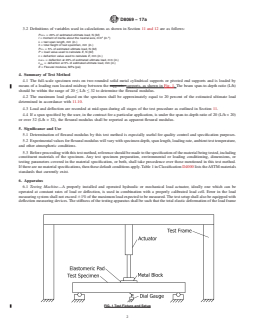
3.2 Definitions of variables used in calculations as shown in Section 11 and 12 are as follows:
P > 20% of estimated ultimate load, N (lbf)
20%
4 4
I = moment of inertia about the neutral axis, mm (in. )
L = test span length, mm (in.)
h = total height of test specimen, mm (in.)
P > 5% of estimated ultimate load, N (lbf)
5%
P = load value used to calculate E, N (lbf)
δ = deflection value used to calculate E, mm (in.)
δ > deflection at 20% of estimated ultimate load, mm (in.)
20%
δ > deflection at 5% of estimated ultimate load, mm (in.)
5%
E = Flexural modulus, MPa (psi)
4. Summary of Test Method
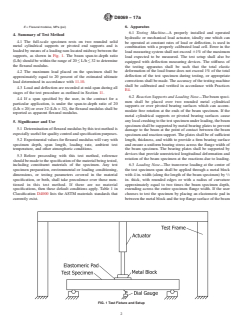
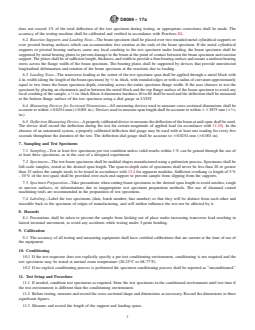
4.1 The full-scale specimen rests on two rounded solid metal cylindrical supports or pivoted end supports and is loaded by
means of a loading ram located midway between the supports. supports, as shown in Fig. 1. The beam span-to-depth ratio (L/h)
should be within the range of 20 ≤ L/h ≤ 32 to determine the flexural modulus.
4.2 The maximum load placed on the specimen shall be approximately equal to 20 percent of the estimated ultimate load
determined in accordance with 11.10.
4.3 Load and deflection are recorded at mid-span during all stages of the test procedure as outlined in Section 11.
4.4 If a span specified by the user, in the contract for a particular application, is under the span-to-depth ratio of 20 (L/h < 20)
or over 32 (L/h > 32), the flexural modulus shall be reported as apparent flexural modulus.
5. Significance and Use
5.1 Determination of flexural modulus by this test method is especially useful for quality control and specification purposes.
5.2 Experimental values for flexural modulus will vary with specimen depth, span length, loading rate, ambient test temperature,
and other atmospheric conditions.
5.3 Before proceeding with this test method, reference should be made to the specification of the material being tested, including
constituent materials of the specimen. Any test specimen preparation, environmental or loading conditioning, dimensions, or
testing parameters covered in the material specification, or both, shall take precedence over those mentioned in this test method.
If there are no material specifications, then these default conditions apply. Table 1 in Classification D4000 lists the ASTM materials
standards that currently exist.
6. Apparatus
6.1 Testing Machine—A properly installed and operated hydraulic or mechanical load actuator, ideally one which can be
operated at constant rates of load or deflection, is used in combination with a properly calibrated load cell. Error in the load
measuring system shall not exceed 61% of the maximum load expected to be measured. The test setup shall also be equipped with
deflection measuring devices. The stiffness of the testing apparatus shall be such that the total elastic deformation of the load frame
FIG. 1 Test Fixture and Setup
D8069 − 17a
does not exceed 1% of the total deflection of the test specimen during testing, or appropriate corrections shall be made. The
accuracy of the testing machine shall be calibrated and verified in accordance with Practices E4.
6.2 Reaction Supports and Loading Nose—The beam specimen shall be placed over two rounded metal cylindrical supports or
over pivoted bearing surfaces which can accommodate free rotation at the ends of the beam specimen. If the metal cylindrical
supports or pivoted bearing surfaces cause any local crushing to the test specimen under loading, the beam specimen shall be
supported by metal bearing plates to prevent damage to the beam at the point of contact between the beam specimen and reaction
support. The plates shall be of sufficient length, thickness, and width to provide a firm bearing surface and ensure a uniform bearing
stress across the flange width of the beam specimen. The bearing plates shall be supported by devices that provide unrestricted
longitudinal deformation and rotation of the beam specimen at the reactions due to loading.
6.3 Loading Nose—The transverse loading at the center of the test specimen span shall be applied through a metal block with
4 in. width (along the length of the beam specimen) by ⁄2 in. thick, with rounded edges or with a radius of curvature approximately
equal to two times the beam specimen depth, extending across the entire specimen flange width. If the user chooses to test the
specimen by placing an elastomeric pad in between the metal block and the top flange surface of the beam specimen to avoid any
local crushing of the sample, a ⁄2 in. thick Shore A durometer hardness 40 to 60 shall be used and the deflection shall be measured
at the bottom flange surface of the test specimen using a dial gauge or LVDT.
6.4 Measuring Devices for Sectional Dimensions—All measuring devices used to measure cross-sectional dimensions shall be
accurate to within 60.0254 mm (60.001 in.). Devices used to measure span length shall be accurate to within 6 1.5875 mm (6 ⁄16
in.).
6.5 Deflection Measuring Device—A properly calibrated device to measure the deflection of the beam at mid-span shall be used.
The device shall record the deflection during the test for certain magnitude of applied load (in accordance with 11.10). In the
absence of an automated system, a properly calibrated deflection dial gauge may be used with at least one reading for every five
seconds throughout the duration of the test. The deflection dial gauge shall be accurate to 60.0254 mm (60.001 in).
7. Sampling and Test Specimens
7.1 Sampling—Test at least five specimens per test condition unless valid results within 1 % can be gained through the use of
at least three specimens, as in the case of a designed experiment.
7.2 Specimens—The test beam specimens shall be molded shapes manufactured using a pultrusion process. Specimens shall be
full-scale samples, tested at the desired span length. The span-to-depth ratio of specimens shall never be less than 20 or greater
than 32 unless the sample needs to be tested in accordance with 13.4 for apparent modulus. Sufficient overhang (a length of 5 %
- 10 % of the test span) shall be provided over each end support to prevent sample from slipping from the supports.
7.3 Specimen Preparation—Take precautions when cutting beam specimens to the desired span length to avoid notches, rough
or uneven surfaces, or delaminations due to inappropriate test specimen preparation methods. The use of diamond coated
machining tools are recommended in the preparation of test specimens.
7.4 Labeling—Label the test specimens (date, batch number, line number) so that they will be distinct from each other and
traceable back to the specimen of origin of manufacturing, and will neither influence the test nor be affected by it.
8. Hazards
8.1 Precautions shall be taken to prevent the sample from kicking out of place under increasing transverse load resulting in
lateral torsional movement, to avoid any accidents while testing under 3-point bending.
9. Calibration
9.1 The accuracy of all testing and measuring equipment shall have certified calibrations that are current at the time of use of
the equipment.
10. Conditioning
10.1 If the test requestor does not explicitly specify a pre-test conditioning environment, conditioning is not required and the
test specimens may be tested at normal room temperature (20-25°C or 68-77°F).
10.2 If no explicit conditioning process is performed the specimen conditioning process shall be reported as “unconditioned.”
11. Test Setup and Procedure
11.1 If needed, condition test specimens as required. Store the test specimens in the conditioned environment until test time if
the test environment is different than the conditioning environment.
11.2 Before testing, measure and record the cross-sectional shape and dimensions as necessary. Record the dimensions to three
significant figures.
11.3 Measure and record the length of the support and loading spans.
D8069 − 17a
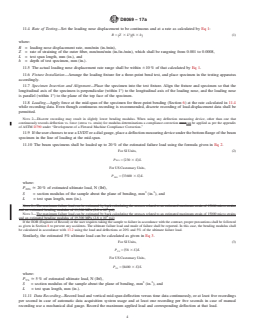
11.4 Rate of Testing—Set the loading nose displacement to be continuous and at a rate as calculated by Eq 1:
R 5 ~Z 3 L !⁄~6 3 h! (1)
where:
R = loading nose displacement rate, mm/min (in./min),
Z = rate of straining of the outer fiber, mm/mm/min (in./in./min), which shall be rangning from 0.001 to 0.0008,
L = test span length, mm (in.), and
h = depth of test specimen, mm (in.).
11.5 The actual loading nose displacement rate range shall be within 610 % of that calculated by Eq 1.
11.6 Fixture Installation—Arrange the loading fixture for a three-point bend test, and place specimen in the testing apparatus
accordingly.
11.7 Specimen Insertion and Alignment—Place the specimen into the test fixture. Align the fixture and specimen so that the
longitudinal axis of the specimen is perpendicular (within 1°) to the longitudinal axis of the loading nose, and the loading nose
is para
...