

ASTM D8019-23
(Test Method)Standard Test Methods for Determining the Full Section Flexural Modulus and Bending Strength of Fiber Reinforced Polymer Crossarms Assembled with Center Mount Brackets
General Information
- Abstract
SIGNIFICANCE AND USE
5.1 Determination of the flexural modulus, beam bending strength and full assembly strength, by this test method is especially useful for product validation, design and specification purposes.
5.2 Calculated values for flexural modulus, bending strength and full assembly strength will vary with specimen depth, span length, hole configurations, loading rate, and ambient test temperature. A minimum span to depth ratio of 16:1 is required for establishing the flexural modulus, wherein shear deformation effects are neglected.
5.3 Validity—Stress at failure, σ, is only valid for crossarm failures due to local compression buckling. Other controlling modes of failure will dictate the ultimate phase loading capacities. For example, in-plane shear, fastener pin bearing, position hardware, center mount failures and fastener pull out will dictate the failure mode and the crossarm capacity.
SCOPE
1.1 These test methods cover the determination of the flexural modulus and bending strength of both the tangent and deadend Fiber Reinforced Polymer (FRP) composite crossarms loaded perpendicular to the plane of minor and major axes. One method covers testing of assembled tangent crossarms including the tangent bracket and relative hardware. The other method covers testing of assembled deadend crossarms with a deadend bracket and relative phase loading hardware. The failure modes and associated stresses can be used for predicting the phase load capacities of pultruded crossarms specific to certain conductor loading scenarios exerted by conductors.
1.2 The test data described in this standard can be used for predicting the vertical and horizontal component loads of deadend and tangent arms. Both deadend and tangent crossarms shall be tested in the two configurations described in Figures 1 and 2, respectively. This will permit the manufacturers to publish both vertical and horizontal design capacities for deadend crossarm configurations so that two way bending stresses, caused by catenary effects, can be considered when developing the capacity of the deadend crossarms by utility design engineers and manufacturers.
1.3 The values stated in either SI units or inch-pound units are to be regarded separately as standard. The values stated in each system may not be exact equivalents; therefore, each system shall be used independently of the other. Combining values from the two systems may result in nonconformance with the standard.
1.4 This standard will not address all factors that affect the phase loading capacity.
1.5 This standard does not address the use of core materials that are added to increase the structural capacity of the crossarms. Contribution of core materials shall not be considered within the calculations provided in this standard. Use of core material properties in design computations to identify improvement in design strengths of crossarms is the sole responsibility of the designee in-charge of the project.
1.6 Torsional effects occurring during standard in service usage are not considered within this standard.
1.7 This standard does not purport to address all of the safety concerns, if any, associated with its use. It is the responsibility of the user of this standard to establish appropriate safety, health, and environmental practices and determine the applicability of regulatory limitations prior to use.
Note 1: There is no known ISO equivalent to this standard.
1.8 This international standard was developed in accordance with internationally recognized principles on standardization established in the Decision on Principles for the Development of International Standards, Guides and Recommendations issued by the World Trade Organization Technical Barriers to Trade (TBT) Committee.
- Status
- Published
- Publication Date
- 31-Oct-2023
- Technical Committee
- D20 - Plastics
- Drafting Committee
- D20.18 - Reinforced Thermosetting Plastics
Buy Documents
ASTM D8019-23 - Standard Test Methods for Determining the Full Section Flexural Modulus and Bending Strength of Fiber Reinforced Polymer Crossarms Assembled with Center Mount Brackets
REDLINE ASTM D8019-23 - Standard Test Methods for Determining the Full Section Flexural Modulus and Bending Strength of Fiber Reinforced Polymer Crossarms Assembled with Center Mount Brackets
Overview
ASTM D8019-23 defines standardized test methods for determining the full section flexural modulus and bending strength of fiber reinforced polymer (FRP) crossarms assembled with center mount brackets. These test methods are critical for assessing the mechanical performance and structural integrity of both tangent and deadend pultruded FRP composite crossarms used in utility and power distribution applications. The procedures outlined allow manufacturers, engineers, and specifiers to validate products, optimize designs, and ensure consistent, reliable performance under typical service conditions.
Key Topics
- Flexural Modulus Measurement: The standard details methods to evaluate the flexural modulus of FRP crossarms, reflecting the material’s stiffness and ability to resist bending under load.
- Bending Strength Determination: It specifies procedures to determine the maximum load the crossarm can handle before failure when subjected to bending forces, vital for safe structural design.
- Tangent and Deadend Crossarm Testing: The test methods cover both types of crossarms, assembled with hardware and brackets as per manufacturer specifications, simulating real-world installations.
- Failure Modes Assessment: The guidance allows for identification and analysis of different failure modes such as local compression buckling, in-plane shear, fastener pin bearing, position hardware failures, and fastener pull out.
- Test Configuration: Tests must be performed with a minimum span to depth ratio to ensure accurate modulus measurement, disregarding shear deformation effects.
- Comprehensive Reporting: Requirements include documenting geometry, span length, conditioning, loading rate, and all test results for traceability and quality assurance.
Applications
- Product Validation and Quality Assurance: Utility pole and power distribution crossarm manufacturers use these test methods to validate product performance before market release or field installation.
- Design Optimization: Engineers leverage test data to ensure crossarm designs meet specified vertical and horizontal load requirements in various installation scenarios, including those subject to two-way bending stresses.
- Specification and Certification: Test results support compliance with utility and industry specifications, providing documented evidence of mechanical properties such as flexural modulus and bending strength.
- Failure Analysis and Safety: Assessment of modes and loads at failure enables safer designs by anticipating potential mechanical weaknesses under operational loads.
- Published Design Capacities: Enables publication of both vertical and horizontal load capacities for different crossarm designs, assisting utility engineers in system planning and asset management.
Related Standards
- ASTM D883 - Terminology Relating to Plastics
- ASTM E4 - Practices for Force Calibration and Verification of Testing Machines
- ASTM E177 - Practice for Use of the Terms Precision and Bias in ASTM Test Methods
- ASTM E456 - Terminology Relating to Quality and Statistics
- ASTM E691 - Practice for Conducting an Interlaboratory Study to Determine Precision of a Test Method
- ASTM D4968 - Practice for Annual Review of Test Methods and Specifications for Plastics
- ASTM E2935 - Practice for Evaluating Equivalence of Two Testing Processes
Note: There is currently no ISO equivalent to ASTM D8019-23 for testing the flexural modulus and bending strength of FRP crossarms assembled with center mount brackets.
By following ASTM D8019-23, stakeholders in the electric utility and composite structures industry can ensure the reliability, safety, and performance of fiber reinforced polymer crossarms, supporting long-term infrastructure integrity and compliance with industry best practices.
Keywords: ASTM D8019-23, fiber reinforced polymer crossarms, flexural modulus, bending strength, power distribution, pultruded composites, utility pole crossarms, structural testing, standard test methods.
Relations
- Effective Date
- 01-Nov-2023
- Effective Date
- 01-Feb-2024
- Effective Date
- 01-Nov-2023
- Effective Date
- 01-Apr-2022
- Effective Date
- 01-Apr-2022
- Effective Date
- 01-Nov-2023
Buy Documents
ASTM D8019-23 - Standard Test Methods for Determining the Full Section Flexural Modulus and Bending Strength of Fiber Reinforced Polymer Crossarms Assembled with Center Mount Brackets
REDLINE ASTM D8019-23 - Standard Test Methods for Determining the Full Section Flexural Modulus and Bending Strength of Fiber Reinforced Polymer Crossarms Assembled with Center Mount Brackets
Get Certified
Connect with accredited certification bodies for this standard

DIN CERTCO
DIN Group product certification.

Smithers Quality Assessments
US management systems and product certification.
Sponsored listings
Frequently Asked Questions
ASTM D8019-23 is a standard published by ASTM International. Its full title is "Standard Test Methods for Determining the Full Section Flexural Modulus and Bending Strength of Fiber Reinforced Polymer Crossarms Assembled with Center Mount Brackets". This standard covers: SIGNIFICANCE AND USE 5.1 Determination of the flexural modulus, beam bending strength and full assembly strength, by this test method is especially useful for product validation, design and specification purposes. 5.2 Calculated values for flexural modulus, bending strength and full assembly strength will vary with specimen depth, span length, hole configurations, loading rate, and ambient test temperature. A minimum span to depth ratio of 16:1 is required for establishing the flexural modulus, wherein shear deformation effects are neglected. 5.3 Validity—Stress at failure, σ, is only valid for crossarm failures due to local compression buckling. Other controlling modes of failure will dictate the ultimate phase loading capacities. For example, in-plane shear, fastener pin bearing, position hardware, center mount failures and fastener pull out will dictate the failure mode and the crossarm capacity. SCOPE 1.1 These test methods cover the determination of the flexural modulus and bending strength of both the tangent and deadend Fiber Reinforced Polymer (FRP) composite crossarms loaded perpendicular to the plane of minor and major axes. One method covers testing of assembled tangent crossarms including the tangent bracket and relative hardware. The other method covers testing of assembled deadend crossarms with a deadend bracket and relative phase loading hardware. The failure modes and associated stresses can be used for predicting the phase load capacities of pultruded crossarms specific to certain conductor loading scenarios exerted by conductors. 1.2 The test data described in this standard can be used for predicting the vertical and horizontal component loads of deadend and tangent arms. Both deadend and tangent crossarms shall be tested in the two configurations described in Figures 1 and 2, respectively. This will permit the manufacturers to publish both vertical and horizontal design capacities for deadend crossarm configurations so that two way bending stresses, caused by catenary effects, can be considered when developing the capacity of the deadend crossarms by utility design engineers and manufacturers. 1.3 The values stated in either SI units or inch-pound units are to be regarded separately as standard. The values stated in each system may not be exact equivalents; therefore, each system shall be used independently of the other. Combining values from the two systems may result in nonconformance with the standard. 1.4 This standard will not address all factors that affect the phase loading capacity. 1.5 This standard does not address the use of core materials that are added to increase the structural capacity of the crossarms. Contribution of core materials shall not be considered within the calculations provided in this standard. Use of core material properties in design computations to identify improvement in design strengths of crossarms is the sole responsibility of the designee in-charge of the project. 1.6 Torsional effects occurring during standard in service usage are not considered within this standard. 1.7 This standard does not purport to address all of the safety concerns, if any, associated with its use. It is the responsibility of the user of this standard to establish appropriate safety, health, and environmental practices and determine the applicability of regulatory limitations prior to use. Note 1: There is no known ISO equivalent to this standard. 1.8 This international standard was developed in accordance with internationally recognized principles on standardization established in the Decision on Principles for the Development of International Standards, Guides and Recommendations issued by the World Trade Organization Technical Barriers to Trade (TBT) Committee.
SIGNIFICANCE AND USE 5.1 Determination of the flexural modulus, beam bending strength and full assembly strength, by this test method is especially useful for product validation, design and specification purposes. 5.2 Calculated values for flexural modulus, bending strength and full assembly strength will vary with specimen depth, span length, hole configurations, loading rate, and ambient test temperature. A minimum span to depth ratio of 16:1 is required for establishing the flexural modulus, wherein shear deformation effects are neglected. 5.3 Validity—Stress at failure, σ, is only valid for crossarm failures due to local compression buckling. Other controlling modes of failure will dictate the ultimate phase loading capacities. For example, in-plane shear, fastener pin bearing, position hardware, center mount failures and fastener pull out will dictate the failure mode and the crossarm capacity. SCOPE 1.1 These test methods cover the determination of the flexural modulus and bending strength of both the tangent and deadend Fiber Reinforced Polymer (FRP) composite crossarms loaded perpendicular to the plane of minor and major axes. One method covers testing of assembled tangent crossarms including the tangent bracket and relative hardware. The other method covers testing of assembled deadend crossarms with a deadend bracket and relative phase loading hardware. The failure modes and associated stresses can be used for predicting the phase load capacities of pultruded crossarms specific to certain conductor loading scenarios exerted by conductors. 1.2 The test data described in this standard can be used for predicting the vertical and horizontal component loads of deadend and tangent arms. Both deadend and tangent crossarms shall be tested in the two configurations described in Figures 1 and 2, respectively. This will permit the manufacturers to publish both vertical and horizontal design capacities for deadend crossarm configurations so that two way bending stresses, caused by catenary effects, can be considered when developing the capacity of the deadend crossarms by utility design engineers and manufacturers. 1.3 The values stated in either SI units or inch-pound units are to be regarded separately as standard. The values stated in each system may not be exact equivalents; therefore, each system shall be used independently of the other. Combining values from the two systems may result in nonconformance with the standard. 1.4 This standard will not address all factors that affect the phase loading capacity. 1.5 This standard does not address the use of core materials that are added to increase the structural capacity of the crossarms. Contribution of core materials shall not be considered within the calculations provided in this standard. Use of core material properties in design computations to identify improvement in design strengths of crossarms is the sole responsibility of the designee in-charge of the project. 1.6 Torsional effects occurring during standard in service usage are not considered within this standard. 1.7 This standard does not purport to address all of the safety concerns, if any, associated with its use. It is the responsibility of the user of this standard to establish appropriate safety, health, and environmental practices and determine the applicability of regulatory limitations prior to use. Note 1: There is no known ISO equivalent to this standard. 1.8 This international standard was developed in accordance with internationally recognized principles on standardization established in the Decision on Principles for the Development of International Standards, Guides and Recommendations issued by the World Trade Organization Technical Barriers to Trade (TBT) Committee.
ASTM D8019-23 is classified under the following ICS (International Classification for Standards) categories: 83.120 - Reinforced plastics. The ICS classification helps identify the subject area and facilitates finding related standards.
ASTM D8019-23 has the following relationships with other standards: It is inter standard links to ASTM D8019-15, ASTM D883-24, ASTM D883-23, ASTM E456-13a(2022)e1, ASTM E456-13a(2022), ASTM D7745-19. Understanding these relationships helps ensure you are using the most current and applicable version of the standard.
ASTM D8019-23 is available in PDF format for immediate download after purchase. The document can be added to your cart and obtained through the secure checkout process. Digital delivery ensures instant access to the complete standard document.
Standards Content (Sample)
This international standard was developed in accordance with internationally recognized principles on standardization established in the Decision on Principles for the
Development of International Standards, Guides and Recommendations issued by the World Trade Organization Technical Barriers to Trade (TBT) Committee.
Designation: D8019 − 23
Standard Test Methods for
Determining the Full Section Flexural Modulus and Bending
Strength of Fiber Reinforced Polymer Crossarms
Assembled with Center Mount Brackets
This standard is issued under the fixed designation D8019; the number immediately following the designation indicates the year of
original adoption or, in the case of revision, the year of last revision. A number in parentheses indicates the year of last reapproval. A
superscript epsilon (´) indicates an editorial change since the last revision or reapproval.
1. Scope* ered within the calculations provided in this standard. Use of
core material properties in design computations to identify
1.1 These test methods cover the determination of the
improvement in design strengths of crossarms is the sole
flexural modulus and bending strength of both the tangent and
responsibility of the designee in-charge of the project.
deadend Fiber Reinforced Polymer (FRP) composite crossarms
loaded perpendicular to the plane of minor and major axes.
1.6 Torsional effects occurring during standard in service
One method covers testing of assembled tangent crossarms
usage are not considered within this standard.
including the tangent bracket and relative hardware. The other
1.7 This standard does not purport to address all of the
method covers testing of assembled deadend crossarms with a
safety concerns, if any, associated with its use. It is the
deadend bracket and relative phase loading hardware. The
responsibility of the user of this standard to establish appro-
failure modes and associated stresses can be used for predicting
priate safety, health, and environmental practices and deter-
the phase load capacities of pultruded crossarms specific to
mine the applicability of regulatory limitations prior to use.
certain conductor loading scenarios exerted by conductors.
1.2 The test data described in this standard can be used for NOTE 1—There is no known ISO equivalent to this standard.
predicting the vertical and horizontal component loads of
1.8 This international standard was developed in accor-
deadend and tangent arms. Both deadend and tangent cros-
dance with internationally recognized principles on standard-
sarms shall be tested in the two configurations described in
ization established in the Decision on Principles for the
Figures 1 and 2, respectively. This will permit the manufactur-
Development of International Standards, Guides and Recom-
ers to publish both vertical and horizontal design capacities for
mendations issued by the World Trade Organization Technical
deadend crossarm configurations so that two way bending
Barriers to Trade (TBT) Committee.
stresses, caused by catenary effects, can be considered when
developing the capacity of the deadend crossarms by utility
2. Referenced Documents
design engineers and manufacturers.
2.1 ASTM Standards:
1.3 The values stated in either SI units or inch-pound units
D883 Terminology Relating to Plastics
are to be regarded separately as standard. The values stated in
D4968 Practice for Annual Review of Test Methods and
each system may not be exact equivalents; therefore, each
Specifications for Plastics
system shall be used independently of the other. Combining
E4 Practices for Force Calibration and Verification of Test-
values from the two systems may result in nonconformance
ing Machines
with the standard.
E177 Practice for Use of the Terms Precision and Bias in
1.4 This standard will not address all factors that affect the
ASTM Test Methods
phase loading capacity.
E456 Terminology Relating to Quality and Statistics
1.5 This standard does not address the use of core materials
E691 Practice for Conducting an Interlaboratory Study to
that are added to increase the structural capacity of the Determine the Precision of a Test Method
crossarms. Contribution of core materials shall not be consid-
E2935 Practice for Evaluating Equivalence of Two Testing
Processes
This test method is under the jurisdiction of ASTM Committee D20 on Plastics
and is the direct responsibility of Subcommittee D20.18 on Reinforced Thermoset-
ting Plastics. For referenced ASTM standards, visit the ASTM website, www.astm.org, or
Current edition approved Nov. 1, 2023. Published November 2023. Originally contact ASTM Customer Service at service@astm.org. For Annual Book of ASTM
approved in 2015. Last previous edition approved in 2015 as D8019 – 15. DOI: Standards volume information, refer to the standard’s Document Summary page on
10.1520/D8019-23. the ASTM website.
*A Summary of Changes section appears at the end of this standard
Copyright © ASTM International, 100 Barr Harbor Drive, PO Box C700, West Conshohocken, PA 19428-2959. United States
D8019 − 23
3. Terminology loading into the bracket and arm mimicking the tangent
connection to a wood, fiberglass, steel or concrete pole.
3.1 Terms used in this standard are defined in accordance
4.2.4 A load is induced into the crossarm assembly such that
with Terminology D883, unless otherwise specified. For terms
the bracket and phase hardware is loaded until failure.
relating to precision and bias and associated issues, the terms
4.2.5 Load and deflection data are to be recorded at set
used in this standard are defined in accordance with Terminol-
intervals or continuously until failure occurs.
ogy E456.
3.2 Definitions of variables used in the calculations as
5. Significance and Use
shown in Section 11 are as follows:
5.1 Determination of the flexural modulus, beam bending
strength and full assembly strength, by this test method is
a = distance from phase hardware to the center mount
especially useful for product validation, design and specifica-
bolt through the crossarm, in. (m),
2 2
tion purposes.
A = area of the webs in shear in. [m ],
w
E = flexural modulus, psi (Pa),
5.2 Calculated values for flexural modulus, bending
I = moment of inertia about the neutral axis of the
strength and full assembly strength will vary with specimen
4 4
crossarm, in. [m ],
depth, span length, hole configurations, loading rate, and
L = support span, in. [m],
ambient test temperature. A minimum span to depth ratio of
M = moment at failure, lbf-in [N•m],
16:1 is required for establishing the flexural modulus, wherein
P = ultimate or failure load acting through a single center
shear deformation effects are neglected.
mount bolt, lbf [N],
5.3 Validity—Stress at failure, σ, is only valid for crossarm
S = section modulus about the neutral axis of the
x
3 3
crossarm, in. [m ], failures due to local compression buckling. Other controlling
V = in-plane shear force, lbf [N], modes of failure will dictate the ultimate phase loading
σ = bending stress at failure, psi [Pa],
capacities. For example, in-plane shear, fastener pin bearing,
δ = deflection relative to the applied load, in. [m],
position hardware, center mount failures and fastener pull out
τ = maximum transverse shear stress, psi [Pa],
max
will dictate the failure mode and the crossarm capacity.
3 3
Q = static moment of area in. [m ],
t = thickness of region or regions under consideration in.
6. Apparatus
[m].
6.1 Testing Machine—A properly installed and operated
4. Summary of Test Methods Including Deadend and load actuator, ideally one which can be operated at constant
Tangent Crossarm Configurations with Commercial rates of load or deflection, used in combination with a properly
Hardware Attached calibrated load cell. Error in the load measuring system shall
not exceed 61 % of the maximum load expected to be
4.1 Deadend Crossarms:
measured. The test setup shall also be equipped with deflection
4.1.1 The assembled deadend crossarm, including two
measuring devices. The stiffness of the testing apparatus shall
phase single sided position hardware and a center mount
be such that the total elastic deformation of the load frame does
bracket fabricated to the specifications as detailed by the
not exceed 1 % of the total deflection of the test specimen
manufacturer, is positioned in a bend apparatus and loaded
during testing, or appropriate corrections shall be made. The
until failure occurs.
accuracy of the testing machine shall be calibrated and verified
4.1.2 A center mount bracket or a fabricated test bracket,
in accordance with Practices E4.
matching the bolt size and dimensional specifications of the
manufacturer’s commercial bracket, is attached to the arm as 6.2 Loading Noses and Supports—The crossarms shall be
detailed by the manufacturer. either loaded through the center mount, or through the phase
hardware. The test fixture shall allow for various lengths of
4.1.3 The bracket is to be loaded or constrained, depending
on the load apparatus, such that no eccentric loading occurs. crossarms to be evaluated. The crossarm length range shall be
dictated by typical industry requirements. Spreader bars used
4.1.4 Load is induced into the crossarm assembly until a
structural failure of the hardware or crossarm occurs. throughout the testing shall be doubly symmetric steel sections.
4.1.5 Load and deflection data are to be recorded at set The spreader bar shall be oriented to induce bending about the
intervals or continuously until failure occurs. major axis. Additionally, the spreader bar shall be designed to
allow for in-plane movement parallel to its minor axis.
4.2 Tangent Crossarms:
4.2.1 The assembled tangent crossarm, including a center 6.3 Deadend Crossarm Loaded Through the Center Mount:
mount tangent bracket fabricated to the specifications as 6.3.1 2-Conductor Locations—When loading through the
detailed by the manufacturer, is positioned in a bend apparatus center mount, the manufacturer’s deadend crossarm shall be
and loaded until failure occurs. assembled with a production center mount bracket or fabri-
4.2.2 A tangent bracket, matching the specifications of the cated replica. Load shall be applied through the back of the
manufacturer’s commercial bracket, is attached to the arm as center mount bracket. The deadend crossarm shall be fully
detailed by the manufacturer, and schematically shown in Figs. fabricated, representing the finished product, with the phase
3 and 4. position deadend hardware attached. The crossarm test fixture
4.2.3 The bracket is to be loaded or constrained, depending supports shall connect directly to the phase position hardware.
on the load apparatus, such that the load produces eccentric Load is applied through the center mount bracket, into the arm
D8019 − 23
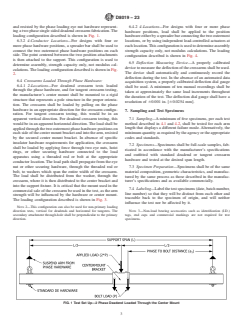
and resisted by the phase loading eye nut hardware represent- 6.4.2 4-Locations—For designs with four or more phase
ing a two phase single sided deadend crossarm fabrication. The hardware positions, load shall be applied to the position
loading configuration described is shown in Fig. 1.
hardware either by a spreader bar connecting the two outermost
6.3.2 4-Conductor Locations—For designs with four or locations, or by using independent load-controlled actuators at
more phase hardware positions, a spreader bar shall be used to
each location. This configuration is used to determine assembly
connect the two outermost phase hardware positions on each
strength capacity only, not modulus calculations. The loading
side. The point centered between the two position attachments
configuration described is shown in Fig. 4.
is then attached to the support. This configuration is used to
6.5 Deflection Measuring Device—A properly calibrated
determine assembly, strength capacity only, not modulus cal-
device to measure the deflection of the crossarms shall be used.
culations. The loading configuration described is shown in Fig.
The device shall automatically and continuously record the
2.
deflection during the test. In the absence of an automated data
6.4 Crossarms Loaded Through Phase Hardware:
acquisition system, a properly calibrated deflection dial gauge
6.4.1 2-Locations—For deadend crossarm tests loaded
shall be used. A minimum of ten manual recordings shall be
through the phase hardware, and for tangent crossarm testing,
taken at approximately the same load increments throughout
the manufacturer’s center mount shall be mounted to a rigid
the duration of the test. The deflection dial gauge shall have a
structure that represents a pole structure in the proper orienta-
resolution of 60.001 in. [60.0254 mm].
tion. The crossarm shall be loaded by pulling on the phase
hardware in an appropriate direction for the crossarm configu-
7. Sampling and Test Specimens
ration. For tangent crossarm testing, this would be in an
apparent vertical direction. For deadend crossarm testing, this 7.1 Sampling—A minimum of five specimens, per each test
method described in 4.1 and 4.2, shall be tested for each arm
would be in an apparent horizontal direction. The load shall be
applied through the two outermost phase hardware positions on length that displays a different failure mode. Alternatively, the
minimum quantity as required by the agency or the appropriate
each side of the center mount bracket and into the arm, resisted
by the secured center mount bracket. In absence of specific codes and standards.
insulator hardware requirements for application, the crossarm
7.2 Specimens—Specimens shall be full-scale samples, fab-
shall be loaded by applying force through two eye nuts, hoist
ricated in accordance with the manufacturer’s specifications
rings, or other securing hardware connected to the load
and outfitted with standard deadend or tangent crossarm
apparatus using a threaded rod or bolt at the appropriate
hardware and tested at the desired span length.
conductor location. The load path shall propagate from the eye
nut or other securing hardware, through the threaded rod or
7.3 Specimen Preparation—Specimens shall be of the same
bolt, to washers which span the entire width of the crossarm. material composition, geometric characteristics, and manufac-
The load shall be distributed from the washer, through the
tured by the same process as those described in the manufac-
crossarm, where it is then distributed to the center bracket and turer’s specifications and as available commercially.
into the support fixture. It is criti
...
This document is not an ASTM standard and is intended only to provide the user of an ASTM standard an indication of what changes have been made to the previous version. Because
it may not be technically possible to adequately depict all changes accurately, ASTM recommends that users consult prior editions as appropriate. In all cases only the current version
of the standard as published by ASTM is to be considered the official document.
Designation: D8019 − 15 D8019 − 23
Standard Test Methods for
Determining the Full Section Flexural Modulus and Bending
Strength of Fiber Reinforced Polymer Crossarms
Assembled with Center Mount Brackets
This standard is issued under the fixed designation D8019; the number immediately following the designation indicates the year of
original adoption or, in the case of revision, the year of last revision. A number in parentheses indicates the year of last reapproval. A
superscript epsilon (´) indicates an editorial change since the last revision or reapproval.
1. Scope Scope*
1.1 These test methods cover the determination of the flexural modulus and bending strength of both the tangent and deadend arms
bent about their Fiber Reinforced Polymer (FRP) composite crossarms loaded perpendicular to the plane of minor and major axes.
One method covers testing of assembled tangent crossarms including the tangent bracket and relative hardware. The other method
covers testing of assembled deadend crossarms with a deadend bracket and relative phase loading hardware. The failure modes
and associated stresses can be used for predicting the phase load capacities of pultruded crossarms specific to certain conductor
loading scenarios.scenarios exerted by conductors.
1.2 The test methodsdata described in this standard can be used for predicting the vertical and horizontal component loads of
deadend and tangent arms. Both deadend and tangent crossarms shall be tested in the two configurations described in Figures 1
and 2. 2, respectively. This will permit the manufacturesmanufacturers to publish both vertical and horizontal design capacities for
deadend crossarm configurations so that two way bending stresses, caused by catenary effects, can be considered when developing
the capacity of the deadend crossarms by utility design engineers and manufacturers.
1.3 The values stated in either SI units or inch-pound units are to be regarded separately as standard. The values stated in each
system may not be exact equivalents; therefore, each system shall be used independently of the other. Combining values from the
two systems may result in nonconformance with the standard.
1.4 This standard will not address all factors that affect the phase loading capacity.
1.5 This standard does not address the use of core materials that are added to increase the structural capacity of the crossarms.
Core material Contribution of core materials shall not be considered inwithin the calculations provided in this standard. Use of core
material properties in design computations to identify improvement in design strengths of crossarms is the sole responsibility of
the designee in-charge of the project.
1.6 Torsional effects occurring during standard in service usage are not considered within this standard.
1.7 This standard does not purport to address all of the safety concerns, if any, associated with its use. It is the responsibility
of the user of this standard to establish appropriate safety and healthsafety, health, and environmental practices and determine
the applicability of regulatory limitations prior to use.
This test method is under the jurisdiction of ASTM Committee D20 on Plastics and is the direct responsibility of Subcommittee D20.18 on Reinforced Thermosetting
Plastics.
Current edition approved Dec. 1, 2015Nov. 1, 2023. Published January 2016November 2023. Originally approved in 2015. Last previous edition approved in 2015 as
D8019 – 15. DOI: 10.1520/D8019-15.10.1520/D8019-23.
*A Summary of Changes section appears at the end of this standard
Copyright © ASTM International, 100 Barr Harbor Drive, PO Box C700, West Conshohocken, PA 19428-2959. United States
D8019 − 23
NOTE 1—There is no known ISO equivalent to this standard.
1.8 This international standard was developed in accordance with internationally recognized principles on standardization
established in the Decision on Principles for the Development of International Standards, Guides and Recommendations issued
by the World Trade Organization Technical Barriers to Trade (TBT) Committee.
2. Referenced Documents
2.1 ASTM Standards:
D883 Terminology Relating to Plastics
D4968 Practice for Annual Review of Test Methods and Specifications for Plastics
E4 Practices for Force Calibration and Verification of Testing Machines
E177 Practice for Use of the Terms Precision and Bias in ASTM Test Methods
E456 Terminology Relating to Quality and Statistics
E691 Practice for Conducting an Interlaboratory Study to Determine the Precision of a Test Method
E2935 Practice for Evaluating Equivalence of Two Testing Processes
3. Terminology
3.1 Terms used in this standard are defined in accordance with Terminology D883, unless otherwise specified. For terms relating
to precision and bias and associated issues, the terms used in this standard are defined in accordance with Terminology E456.
3.2 Definitions of variables used in the calculations as shown in Section 11 are as follows:
a = distance from phase hardware to the center mount bolt through the crossarm, in. (m),
2 2
A = area of the webs in shear in. [m ],
w
E = flexural modulus, psi (Pa),
4 4
I = moment of inertia about the neutral axis of the crossarm, in. [m ],
L = support span, in. [m],
M = moment at failure, lbf-in [N•m],
P = ultimate or failure load acting through a single center mount bolt, lbf [N],
3 3
S = section modulus about the neutral axis of the crossarm, in. [m ],
x
V = in-plane shear force, lbf [N],
σ = bending stress at failure, psi [Pa],
δ = deflection relative to the applied load, in. [m],
τ = maximum transverse shear stress, psi [Pa],
max
3 3
Q = static moment of area in. [m ],
t = thickness of region or regions under consideration in. [m].
4. Summary of Test Methods Including Deadend and Tangent Crossarm Configurations with Commercial Hardware
Attached
4.1 Deadend Crossarms:
4.1.1 The assembled deadend crossarm, including two phase single sided position hardware and a center mount bracket fabricated
to the specifications as detailed by the manufacturer, is positioned in a three point bend apparatus and loaded until failure occurs.
4.1.2 A center mount bracket or a fabricated test bracket, matching the bolt size and dimensional specifications of the
manufacturersmanufacturer’s commercial bracket, is attached to the arm as detailed by the manufacturer.
4.1.3 A three point bend load is then induced into the cross arm assembly until a structural failure of the hardware or crossarm
occurs.
4.1.3 The bracket is to be loaded or constrained, depending on the load apparatus, such that no eccentric loading occurs.
For referenced ASTM standards, visit the ASTM website, www.astm.org, or contact ASTM Customer Service at service@astm.org. For Annual Book of ASTM Standards
volume information, refer to the standard’s Document Summary page on the ASTM website.
D8019 − 23
4.1.4 Load is induced into the crossarm assembly until a structural failure of the hardware or crossarm occurs.
4.1.5 Load and deflection data are to be recorded at set intervals or continuously until failure occurs.
4.2 Tangent Crossarms:
4.2.1 The assembled tangent crossarm, including two phase single sided deadend position hardware and a center mount tangent
bracket fabricated to the specifications as detailed by the manufacturer, is positioned in a three point bend apparatus and loaded
until failure occurs.
4.2.2 A tangent bracket, matching the specifications,specifications of the manufacturersmanufacturer’s commercial bracket, is
attached to the arm as detailed by the manufacturer.manufacturer, and schematically shown in Figs. 3 and 4.
4.2.3 A three point bend load is then induced into the crossarm assembly such that the bracket and phase hardware is loaded until
failure.
4.2.3 The bracket is to be loaded or constrained, depending on the load apparatus, such that the load produces eccentric loading
into the bracket and arm mimicking the tangent connection to a wood, fiberglass, steel or concrete pole.
4.2.4 A load is induced into the crossarm assembly such that the bracket and phase hardware is loaded until failure.
4.2.5 Load and deflection data are to be recorded at set intervals or continuously until failure occurs.
5. Significance and Use
5.1 Determination of the flexural modulus, beam bending strength and full assembly strength, by this test method is especially
useful for product validation, design and specification purposes.
5.2 Calculated values for flexural modulus, bending strength and full assembly strength will vary with specimen depth, span
length, hole configurations, loading rate, and ambient test temperature. A minimum span to depth ratio of 16:1 is required for
establishing the flexural modulus. modulus, wherein shear deformation effects are neglected.
5.3 Validity—Stress at failure, σ, is only valid for crossarm failures due to local compression buckling. Other controlling modes
of failure will dictate the ultimate phase loading capacities. For example, in-plane shear, fastener pin bearing, position hardware,
center mount failures and fastener pull out will dictate the failure mode and ultimately the crossarm capacity.
6. Apparatus
6.1 Testing Machine—A properly installed and operated load actuator, ideally one which can be operated at constant rates of load
or deflection, used in combination with a properly calibrated load cell. Error in the load measuring system shall not exceed 61 %
of the maximum load expected to be measured. The test setup shall also be equipped with deflection measuring devices. The
stiffness of the testing apparatus shall be such that the total elastic deformation of the load frame does not exceed 1 % of the total
deflection of the test specimen during testing, or appropriate corrections shall be made. The accuracy of the testing machine shall
be calibrated and verified in accordance with Practices E4.
6.2 Loading Noses and Supports—The crossarms shall be either loaded through the center mount, or through the phase hardware.
The test fixture shall allow for various lengths of crossarms to be evaluated. The crossarm length range shall be dictated by typical
industry requirements. Spreader bars used throughout the testing shall be doubly symmetric steel sections. The spreader bar shall
be oriented to induce bending about the major axis. Additionally, the spreader bar shall be designed to allow for in-plane movement
parallel to its minor axis.
6.3 Loading Noses and Supports: Deadend Crossarm Loaded Through the Center Mount:
6.3.1 2-Conductor Locations—The manufacturer’s deadend crossarm shall be either loaded through the center mount, or through
the phase hardware. In the event of When loading through the center mount, the manufacturer’s deadend crossarm shall be
assembled with a production center mount bracket or fabricated replica. Load shall be applied through the back of the center mount
D8019 − 23
bracket. The deadend crossarm shall be fully fabricated, representing the finished product, with the phase position deadend
hardware attached. The crossarm test fixture supports shall connect directly to the phase position hardware. Load is applied through
the center mount bracket, into the arm and resisted by the phase loading eye nut hardware representing a two phase single sided
deadend crossarm fabrication. The loading configuration described is shown in Fig. 1.
6.3.2 4-Conductor Locations—For deadend crossarm testing loaded through the phase hardware, and for tangent crossarm testing,
the manufacturer’s center mount shall be mounted to a rigid structure that represents a pole structure in the proper orientation. The
crossarm shall be loaded by pulling on the phase hardware in an appropriate direction for the test method. For tangent crossarm
testing, this would be in an apparent vertical direction. For deadend crossarm testing, this would be in an apparent horizontal
direction. designs with four or more phase hardware positions, a spreader bar shall be used to connect the two outermost phase
hardware positions on each side. The point centered between the two position attachments is then attached to the support. This
configuration is used to determine assembly, strength capacity only, not modulus calculations. The loading configuration described
is shown in Fig. 2.
6.3 Deadend Crossarm Test Set Up—The test fixture shall allow for various lengths of crossarms to be tested. The crossarm length
range shall be dictated by typical industry offerings. The fixture shall permit the loading of the arm in one of two ways: such that
the load is applied through the center mount bracket, into the arm and resisted by the phase loading eyenut hardware representing
a two phase single sided deadend crossarm fabrication, or such that the load is applied through the phase loading eye nut hardware
representing two phase single sided deadend crossarm fabrication, into the arm, and resisted by the secured center mount bracket.
The loading configuration described is shown in Fig. 1.
6.4 Tangent Crossarm Test Set Up—The test fixture shall allow for various lengths of tangent crossarms to be tested. The crossarm
length range shall be dictated by typical industry requirements. The fixture shall permit the tangent bracket to be solidly mounted
to a structural member that represents a pole.
6.4 In absence of specific insulator hardware requirements for application, the tangent crossarm shall be loaded by applying an
apparent vertical force through two eyenuts, hoist rings, or other securing hardware connected to the load apparatus using a
threaded rod or bolt at the appropriate conductor location, in a configuration which represents typical tangent arm usage. The load
path shall propagate from the eyenut or other securing hardware, through the threaded rod or bolt, to washers which span the entire
width of the crossarm. The load shall then be distributed from the washer, through the crossarm, where it is then distributed to the
tangent bracket and into the mount. It is critical that the mount used in the commercial sale of the tangent arm be used in the test,
as the arm strength will be influenced by the hardware or center mount. The loading configuration described is shown in Fig.
2.Crossarms Loaded Through Phase Hardware:
6.4.1 2-Locations—For deadend crossarm tests loaded through the phase hardware, and for tangent crossarm testing, the
manufacturer’s center mount shall be mounted to a rigid structure that represents a pole structure in the proper orientation. The
crossarm shall be loaded by pulling on the phase hardware in an appropriate direction for the crossarm configuration. For tangent
crossarm testing, this would be in an apparent vertical direction. For deadend crossarm testing, this would be in an apparent
horizontal direction. The load shall be applied through the two outermost phase hardware positions on each side of the center
mount bracket and into the arm, resisted by the secured center mount bracket. In absence of specific insulator hardware
requirements for application, the crossarm shall be loaded by applying force through two eye nuts, hoist rings, or other securing
hardware connected to the load apparatus using a threaded rod or bolt at the appropriate conductor location. The load path shall
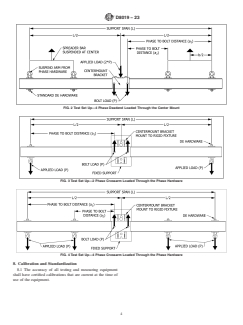
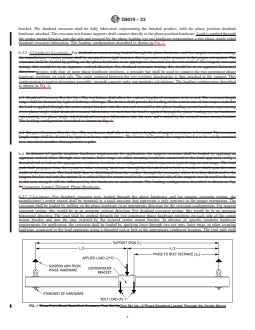
FIG. 1 Three-Point Bend Dead End Crossarm Test Set UpTest Set Up—2 Phase Deadend Loaded Through the Center Mount
D8019 − 23
FIG. 2 Three-Point Bend Tangent Crossarm TestTest Set Up—4 Phase Deadend Loaded Through the Center Mount
propagate from the eye nut or other securing hardware, through the threaded rod or bolt, to washers which span the entire width
of the crossarm. The load shall be distributed from the washer, through the crossarm, where it is then distributed to the center
bracket and into the support fixture. It is critical that the mount used in the commercial sale of the crossarm be used in the test,
as the arm strength will be influenced by the hardware or center mount. The loading configuration described is shown in Fig. 3.
NOTE 2—This configuration can also be used for non-primary loading direction tests, vertical for deadends and horizontal for tangents. The secondary
attachment through-hole shall be perpendicular to the primary direction.
6.4.2 4-
...