

ASTM C1913-21
(Practice)Standard Practice for Sampling Gaseous Uranium Hexafluoride Using Zeolite in Single-Use Destructive Assay Sampler
General Information
- Abstract
SIGNIFICANCE AND USE
5.1 Facility operators and safeguards inspectors routinely collect UF6 samples from processing lines, isotopic enrichment cascades or storage cylinders to determine uranium isotopic composition. The isotope ratio n(235U)/n(238U) is particularly important since it is used to calculate the amount of fissile 235U in the sample.
5.2 Conventional sampling practices (such as Practices C1052 and C1703) collect samples of UF6, usually in quantities greater than one gram. Due to the chemical hazards of UF6 (and in some cases the high collection mass), an increasing number of air transport operators are unwilling to transport such samples. In contrast, SUDA samples are expected to be transported as excepted quantities (for example, under UN 2910 (3)), as the conversion to a less hazardous, more stable chemical species avoids the chemical hazards of UF6 similar to Practice C1880. Additionally, the decreased shipping requirement and small collection mass of SUDA samplers (less than Practice C1880) allow for multiple SUDA samples to be transported in the same shipment.
5.3 For safeguards applications, isotopic measurements that fall within the 2010 International Target Value (ITV) ranges (5) have been demonstrated (1).
5.4 This practice provides the following qualities:
5.4.1 Fitness for purpose in verifying nuclear material declarations.
5.4.2 A safe, simple and fast procedure for the sample collector that minimizes sample handling and potential for cross-contamination.
5.4.3 Flexibility for use in a wide variety of facilities.
5.4.4 Robustness to adapt to minor changes in facility operating parameters.
5.4.5 Confidentiality for the operating facility from which the sample is collected.
5.4.6 Safety in sample handling and transport since the sample is a less hazardous, more stable form (specifically, UO2F2 is more stable and less volatile than UF6 gas).
5.4.7 Ease of sample preparation in the laboratory with reduced processing hazards during recove...
SCOPE
1.1 This practice is applicable to sampling gaseous uranium hexafluoride (UF6) from processing facilities, isotope enrichment cascades or storage cylinders, using the sorbent properties of zeolite in a single-use destructive assay (SUDA) sampler.
1.2 This practice is based on the SUDA method developed at Pacific Northwest National Laboratory (1)2 for collection of samples of UF6 for determination of uranium isotopic content for nuclear material safeguards and other applications.
1.3 The UF6 collected is converted to uranyl fluoride (UO2F2), allowing samples to be handled and categorized for transport under less stringent conditions than are required for UF6.
1.4 This practice can be used to collect samples for safeguards measurements. Safeguards samples collected with this practice have been shown to provide suitable isotopic measurements (1).
1.5 This practice has not been demonstrated for suitability for compliance with Specifications C787 and C996. Practices C1052 or C1703 can be used to collect samples for compliance with these specifications.
1.6 The scope of this practice does not include provisions for preventing criticality.
1.7 Units—The values stated in SI units are to be regarded as standard. The values given in parentheses after SI units are provided for information only and are not considered standard.
1.8 This standard does not purport to address all of the safety concerns, if any, associated with its use. It is the responsibility of the user of this standard to establish appropriate safety, health, and environmental practices and determine the applicability of regulatory limitations prior to use.
1.9 This international standard was developed in accordance with internationally recognized principles on standardization established in the Decision on Principles for the Development of International Standards, Guides and Recommendations issued by the World Trade Organization Technical Bar...
- Status
- Published
- Publication Date
- 31-May-2021
- Technical Committee
- C26 - Nuclear Fuel Cycle
- Drafting Committee
- C26.02 - Fuel and Fertile Material Specifications
Overview
ASTM C1913-21 is the international standard practice for sampling gaseous uranium hexafluoride (UF6) using zeolite in a single-use destructive assay (SUDA) sampler. Developed by ASTM International, this standard helps address safety, transport, and analytical needs when collecting UF6 samples from nuclear processing facilities, isotope enrichment cascades, or storage cylinders. The method converts the hazardous UF6 gas into a more stable and less volatile compound, uranyl fluoride (UO2F2), facilitating safer handling and efficient transport.
By using engineered zeolite sorbent thin films, the SUDA sampler allows for precise collection of small UF6 sample quantities. This approach supports the verification of uranium isotopic composition, a key measurement in nuclear material safeguards and control.
Key Topics
Safe Sampling of UF6 Gas
The SUDA method minimizes chemical hazards by converting UF6 to a chemically stable form for analysis and transportation.Nuclear Safeguards and Material Control
Accurate isotopic ratio measurements, crucial for determining the fissile 235U content, support compliance with international safeguards requirements.Transport Advantages
Compared to conventional UF6 sampling, SUDA samples qualify as “excepted quantities” (e.g., under UN 2910), reducing regulatory barriers and allowing for multiple samples in one shipment.Operational Flexibility
The standard supports sampling in a variety of facility types and adapts to minor process changes, enhancing utility and robustness.Sample Confidentiality and Handling
The procedure is simple, reduces sample handling steps, minimizes cross-contamination risks, and promotes operational confidentiality.Laboratory Preparation
Samples are easy to prepare for analysis in the laboratory, decreasing hazards during uranium recovery and measurement steps.
Applications
ASTM C1913-21 is tailored to several important applications within the nuclear fuel cycle:
Facility Compliance and Safeguards
Used by facility operators and safeguards inspectors, this standard enables the collection of reliable UF6 samples for verifying material declarations and conducting nonproliferation inspections.Isotopic Analysis
Samples prepared by this method are suitable for high-precision isotopic composition measurements using mass spectrometry techniques, supporting both routine monitoring and quality control.Transport of Radioactive Materials
By converting UF6 gas into the more stable UO2F2, SUDA samples are classified under less stringent shipping regulations, facilitating international and air transport.Adaptable Implementation
The standard’s flexible methodology allows its use across different types of facilities and sampling points, such as main processing lines, enrichment cascades, and storage cylinders.
Related Standards
ASTM C1913-21 is part of a suite of standards developed for nuclear materials sampling and analysis. It references and relates to several other ASTM and ISO standards, including:
- ASTM C1052 - Practice for Bulk Sampling of Liquid Uranium Hexafluoride
- ASTM C1703 - Practice for Sampling of Gaseous Uranium Hexafluoride for Enrichment
- ASTM C1880 - Practice for Sampling Gaseous Uranium Hexafluoride Using Alumina Pellets
- ASTM C1474, C1477, C1672, C1832, C1871 - Test methods for uranium isotopic analysis
- ASTM C787 and C996 - Specifications for uranium hexafluoride (SUDA is not validated for these, but C1052 or C1703 may be used)
- ISO 2861:2020 - Vacuum technology-Dimensions of clamped-type quick-release couplings
Practical Value
Utilizing ASTM C1913-21 ensures that UF6 sampling in nuclear facilities is conducted safely, efficiently, and in compliance with modern transport and regulatory requirements. The standard supports international nuclear material safeguards by enabling accurate, robust, and practical sampling procedures, ultimately facilitating trusted analysis and global nuclear security.
Keywords: uranium hexafluoride sampling, SUDA sampler, zeolite, uranyl fluoride, nuclear safeguards, isotopic analysis, ASTM C1913-21, UF6 sampling standard, radioactive material transport, uranium isotope ratios.
Relations
- Effective Date
- 01-Jan-2024
- Effective Date
- 01-Dec-2023
- Effective Date
- 01-Jul-2020
- Effective Date
- 01-Mar-2020
- Effective Date
- 01-Mar-2020
- Effective Date
- 01-Nov-2019
- Refers
ASTM C1880-19 - Standard Practice for Sampling Gaseous Uranium Hexafluoride using Alumina Pellets - Effective Date
- 01-Jun-2019
- Effective Date
- 01-Feb-2019
- Effective Date
- 01-Feb-2018
- Effective Date
- 01-Jan-2017
- Effective Date
- 01-Jul-2015
- Effective Date
- 01-Jul-2015
- Effective Date
- 15-Jun-2014
- Effective Date
- 15-Jan-2014
- Effective Date
- 01-Jan-2014
Get Certified
Connect with accredited certification bodies for this standard

DNV
DNV is an independent assurance and risk management provider.

Lloyd's Register
Lloyd's Register is a global professional services organisation specialising in engineering and technology.
DNV Energy Systems
Energy and renewable energy certification.
Sponsored listings
Frequently Asked Questions
ASTM C1913-21 is a standard published by ASTM International. Its full title is "Standard Practice for Sampling Gaseous Uranium Hexafluoride Using Zeolite in Single-Use Destructive Assay Sampler". This standard covers: SIGNIFICANCE AND USE 5.1 Facility operators and safeguards inspectors routinely collect UF6 samples from processing lines, isotopic enrichment cascades or storage cylinders to determine uranium isotopic composition. The isotope ratio n(235U)/n(238U) is particularly important since it is used to calculate the amount of fissile 235U in the sample. 5.2 Conventional sampling practices (such as Practices C1052 and C1703) collect samples of UF6, usually in quantities greater than one gram. Due to the chemical hazards of UF6 (and in some cases the high collection mass), an increasing number of air transport operators are unwilling to transport such samples. In contrast, SUDA samples are expected to be transported as excepted quantities (for example, under UN 2910 (3)), as the conversion to a less hazardous, more stable chemical species avoids the chemical hazards of UF6 similar to Practice C1880. Additionally, the decreased shipping requirement and small collection mass of SUDA samplers (less than Practice C1880) allow for multiple SUDA samples to be transported in the same shipment. 5.3 For safeguards applications, isotopic measurements that fall within the 2010 International Target Value (ITV) ranges (5) have been demonstrated (1). 5.4 This practice provides the following qualities: 5.4.1 Fitness for purpose in verifying nuclear material declarations. 5.4.2 A safe, simple and fast procedure for the sample collector that minimizes sample handling and potential for cross-contamination. 5.4.3 Flexibility for use in a wide variety of facilities. 5.4.4 Robustness to adapt to minor changes in facility operating parameters. 5.4.5 Confidentiality for the operating facility from which the sample is collected. 5.4.6 Safety in sample handling and transport since the sample is a less hazardous, more stable form (specifically, UO2F2 is more stable and less volatile than UF6 gas). 5.4.7 Ease of sample preparation in the laboratory with reduced processing hazards during recove... SCOPE 1.1 This practice is applicable to sampling gaseous uranium hexafluoride (UF6) from processing facilities, isotope enrichment cascades or storage cylinders, using the sorbent properties of zeolite in a single-use destructive assay (SUDA) sampler. 1.2 This practice is based on the SUDA method developed at Pacific Northwest National Laboratory (1)2 for collection of samples of UF6 for determination of uranium isotopic content for nuclear material safeguards and other applications. 1.3 The UF6 collected is converted to uranyl fluoride (UO2F2), allowing samples to be handled and categorized for transport under less stringent conditions than are required for UF6. 1.4 This practice can be used to collect samples for safeguards measurements. Safeguards samples collected with this practice have been shown to provide suitable isotopic measurements (1). 1.5 This practice has not been demonstrated for suitability for compliance with Specifications C787 and C996. Practices C1052 or C1703 can be used to collect samples for compliance with these specifications. 1.6 The scope of this practice does not include provisions for preventing criticality. 1.7 Units—The values stated in SI units are to be regarded as standard. The values given in parentheses after SI units are provided for information only and are not considered standard. 1.8 This standard does not purport to address all of the safety concerns, if any, associated with its use. It is the responsibility of the user of this standard to establish appropriate safety, health, and environmental practices and determine the applicability of regulatory limitations prior to use. 1.9 This international standard was developed in accordance with internationally recognized principles on standardization established in the Decision on Principles for the Development of International Standards, Guides and Recommendations issued by the World Trade Organization Technical Bar...
SIGNIFICANCE AND USE 5.1 Facility operators and safeguards inspectors routinely collect UF6 samples from processing lines, isotopic enrichment cascades or storage cylinders to determine uranium isotopic composition. The isotope ratio n(235U)/n(238U) is particularly important since it is used to calculate the amount of fissile 235U in the sample. 5.2 Conventional sampling practices (such as Practices C1052 and C1703) collect samples of UF6, usually in quantities greater than one gram. Due to the chemical hazards of UF6 (and in some cases the high collection mass), an increasing number of air transport operators are unwilling to transport such samples. In contrast, SUDA samples are expected to be transported as excepted quantities (for example, under UN 2910 (3)), as the conversion to a less hazardous, more stable chemical species avoids the chemical hazards of UF6 similar to Practice C1880. Additionally, the decreased shipping requirement and small collection mass of SUDA samplers (less than Practice C1880) allow for multiple SUDA samples to be transported in the same shipment. 5.3 For safeguards applications, isotopic measurements that fall within the 2010 International Target Value (ITV) ranges (5) have been demonstrated (1). 5.4 This practice provides the following qualities: 5.4.1 Fitness for purpose in verifying nuclear material declarations. 5.4.2 A safe, simple and fast procedure for the sample collector that minimizes sample handling and potential for cross-contamination. 5.4.3 Flexibility for use in a wide variety of facilities. 5.4.4 Robustness to adapt to minor changes in facility operating parameters. 5.4.5 Confidentiality for the operating facility from which the sample is collected. 5.4.6 Safety in sample handling and transport since the sample is a less hazardous, more stable form (specifically, UO2F2 is more stable and less volatile than UF6 gas). 5.4.7 Ease of sample preparation in the laboratory with reduced processing hazards during recove... SCOPE 1.1 This practice is applicable to sampling gaseous uranium hexafluoride (UF6) from processing facilities, isotope enrichment cascades or storage cylinders, using the sorbent properties of zeolite in a single-use destructive assay (SUDA) sampler. 1.2 This practice is based on the SUDA method developed at Pacific Northwest National Laboratory (1)2 for collection of samples of UF6 for determination of uranium isotopic content for nuclear material safeguards and other applications. 1.3 The UF6 collected is converted to uranyl fluoride (UO2F2), allowing samples to be handled and categorized for transport under less stringent conditions than are required for UF6. 1.4 This practice can be used to collect samples for safeguards measurements. Safeguards samples collected with this practice have been shown to provide suitable isotopic measurements (1). 1.5 This practice has not been demonstrated for suitability for compliance with Specifications C787 and C996. Practices C1052 or C1703 can be used to collect samples for compliance with these specifications. 1.6 The scope of this practice does not include provisions for preventing criticality. 1.7 Units—The values stated in SI units are to be regarded as standard. The values given in parentheses after SI units are provided for information only and are not considered standard. 1.8 This standard does not purport to address all of the safety concerns, if any, associated with its use. It is the responsibility of the user of this standard to establish appropriate safety, health, and environmental practices and determine the applicability of regulatory limitations prior to use. 1.9 This international standard was developed in accordance with internationally recognized principles on standardization established in the Decision on Principles for the Development of International Standards, Guides and Recommendations issued by the World Trade Organization Technical Bar...
ASTM C1913-21 is classified under the following ICS (International Classification for Standards) categories: 27.120.30 - Fissile materials and nuclear fuel technology. The ICS classification helps identify the subject area and facilitates finding related standards.
ASTM C1913-21 has the following relationships with other standards: It is inter standard links to ASTM C859-24, ASTM C1672-23, ASTM C1052-20, ASTM C996-20, ASTM C787-20, ASTM C1477-19, ASTM C1880-19, ASTM C1474-19, ASTM C1871-18, ASTM C1672-17, ASTM C787-15, ASTM C996-15, ASTM C859-14a, ASTM C859-14, ASTM C1477-08(2014). Understanding these relationships helps ensure you are using the most current and applicable version of the standard.
ASTM C1913-21 is available in PDF format for immediate download after purchase. The document can be added to your cart and obtained through the secure checkout process. Digital delivery ensures instant access to the complete standard document.
Standards Content (Sample)
This international standard was developed in accordance with internationally recognized principles on standardization established in the Decision on Principles for the
Development of International Standards, Guides and Recommendations issued by the World Trade Organization Technical Barriers to Trade (TBT) Committee.
Designation:C1913 −21
Standard Practice for
Sampling Gaseous Uranium Hexafluoride Using Zeolite in
Single-Use Destructive Assay Sampler
This standard is issued under the fixed designation C1913; the number immediately following the designation indicates the year of
original adoption or, in the case of revision, the year of last revision. A number in parentheses indicates the year of last reapproval. A
superscript epsilon (´) indicates an editorial change since the last revision or reapproval.
1. Scope 1.9 This international standard was developed in accor-
dance with internationally recognized principles on standard-
1.1 This practice is applicable to sampling gaseous uranium
ization established in the Decision on Principles for the
hexafluoride (UF ) from processing facilities, isotope enrich-
Development of International Standards, Guides and Recom-
ment cascades or storage cylinders, using the sorbent proper-
mendations issued by the World Trade Organization Technical
ties of zeolite in a single-use destructive assay (SUDA)
Barriers to Trade (TBT) Committee.
sampler.
1.2 This practice is based on the SUDA method developed 2. Referenced Documents
at Pacific Northwest National Laboratory (1) for collection of 3
2.1 ASTM Standards:
samples of UF for determination of uranium isotopic content
C787 Specification for Uranium Hexafluoride for Enrich-
for nuclear material safeguards and other applications.
ment
1.3 The UF collected is converted to uranyl fluoride C859 Terminology Relating to Nuclear Materials
(UO F ), allowing samples to be handled and categorized for C996 Specification for Uranium Hexafluoride Enriched to
2 2
transport under less stringent conditions than are required for Less Than 5 % U
UF . C1052 Practice for Bulk Sampling of Liquid Uranium
Hexafluoride
1.4 This practice can be used to collect samples for safe-
C1474 Test Method forAnalysis of Isotopic Composition of
guards measurements. Safeguards samples collected with this
Uranium in Nuclear-Grade Fuel Material by Quadrupole
practicehavebeenshowntoprovidesuitableisotopicmeasure-
Inductively Coupled Plasma-Mass Spectrometry
ments (1).
C1477 Test Method for Isotopic Abundance Analysis of
1.5 This practice has not been demonstrated for suitability
Uranium Hexafluoride and Uranyl Nitrate Solutions by
for compliance with Specifications C787 and C996. Practices
Multi-Collector, Inductively Coupled Plasma-Mass Spec-
C1052 or C1703 can be used to collect samples for compliance
trometry
with these specifications.
C1672 Test Method for Determination of Uranium or Pluto-
nium Isotopic Composition or Concentration by the Total
1.6 The scope of this practice does not include provisions
Evaporation Method Using a Thermal Ionization Mass
for preventing criticality.
Spectrometer
1.7 Units—The values stated in SI units are to be regarded
C1703 Practice for Sampling of Gaseous Uranium
as standard. The values given in parentheses after SI units are
Hexafluoride for Enrichment
provided for information only and are not considered standard.
C1832 Test Method for Determination of Uranium Isotopic
1.8 This standard does not purport to address all of the
Composition by Modified Total Evaporation (MTE)
safety concerns, if any, associated with its use. It is the
Method Using Thermal Ionization Mass Spectrometer
responsibility of the user of this standard to establish appro-
C1871 Test Method for Determination of Uranium Isotopic
priate safety, health, and environmental practices and deter-
Composition by the Double Spike Method Using a Ther-
mine the applicability of regulatory limitations prior to use.
mal Ionization Mass Spectrometer
C1880 Practice for Sampling Gaseous Uranium Hexafluo-
ride using Alumina Pellets
D1193 Specification for Reagent Water
This practice is under the jurisdiction of ASTM Committee C26 on Nuclear
Fuel Cycle and is the direct responsibility of Subcommittee C26.02 on Fuel and
Fertile Material Specifications.
Current edition approved June 1, 2021. Published July 2021. DOI: 10.1520/ For referenced ASTM standards, visit the ASTM website, www.astm.org, or
C1913-21. contact ASTM Customer Service at service@astm.org. For Annual Book of ASTM
The boldface numbers in parentheses refer to the list of references at the end of Standards volume information, refer to the standard’s Document Summary page on
this standard. the ASTM website.
Copyright © ASTM International, 100 Barr Harbor Drive, PO Box C700, West Conshohocken, PA 19428-2959. United States
C1913−21
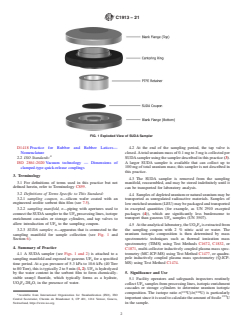
FIG. 1Exploded View of SUDA Sampler
D1418 Practice for Rubber and Rubber Latices— 4.2 At the end of the sampling period, the tap valve is
Nomenclature closed.Atotal uranium mass of 0.1 mg to 3 mg is collected per
SUDAsampler using the sampler described in this practice (3).
2.2 ISO Standards:
A larger SUDA sampler is available that can collect up to
ISO 2861:2020 Vacuum technology — Dimensions of
100 mg of total uranium mass; this sampler is not described in
clamped-type quick-release couplings
this practice.
3. Terminology
4.3 The SUDA sampler is removed from the sampling
3.1 For definitions of terms used in this practice but not
manifold, reassembled, and may be stored indefinitely until it
defined herein, refer to Terminology C859.
can be transported for laboratory analysis.
3.2 Definitions of Terms Specific to This Standard:
4.4 Samples of depleted uranium or natural uranium may be
3.2.1 sampling coupon, n—silicon wafer coated with an
transported as unregulated radioactive materials. Samples of
engineered zeolite sorbent thin film (see 7.5).
low enriched uranium (LEU) may be packaged and transported
in excepted quantities (for example, as UN 2910 excepted
3.2.2 sampling manifold, n—piping with apertures used to
packages (4)), which are significantly less burdensome to
connecttheSUDAsamplertotheUF processinglines,isotope
transport than gaseous UF samples (UN 3507).
enrichment cascades or storage cylinders, and tap valves to
allow introduction of UF to the sampling coupon.
4.5 Attheanalyticallaboratory,theUO F isextractedfrom
2 2
the sampling coupon with 2 % nitric acid or water. The
3.2.3 SUDA sampler, n—apparatus that is connected to the
sampling manifold for sample collection (see Fig. 1 and uranium isotopic composition is then determined by mass
spectrometric techniques such as thermal ionization mass
Section 6).
spectrometry (TIMS) using Test Methods C1672, C1832,or
4. Summary of Practice
C1871, multi-collector inductively coupled plasma mass spec-
trometry (MC-ICP-MS) using Test Method C1477, or quadru-
4.1 A SUDA sampler (see Figs. 1 and 2) is attached to a
pole inductively coupled plasma mass spectrometry (Q-ICP-
sampling manifold and exposed to gaseous UF for a specified
MS) using Test Method C1474.
time period. At a gas pressure of 5.3 kPa to 10.6 kPa (40 Torr
to80 Torr),thisistypically2to5min (1, 2).UF ishydrolyzed
5. Significance and Use
by the water content in the sorbent film to form chemically-
stable uranyl fluoride, which typically forms as a hydrate,
5.1 Facility operators and safeguards inspectors routinely
UO F ·2H O, in the presence of water.
2 2 2 collectUF samplesfromprocessinglines,isotopicenrichment
cascades or storage cylinders to determine uranium isotopic
235 238
composition. The isotope ratio n( U)/n( U) is particularly
Available from International Organization for Standardization (ISO), ISO
importantsinceitisusedtocalculatetheamountoffissile U
Central Secretariat, Chemin de Blandonnet 8, CP 401, 1214 Vernier, Geneva,
Switzerland, https://www.iso.org. in the sample.
C1913−21
5.5 Samples collected using this practice are suitable for
determinationofuraniumisotopiccomposition,asdescribedin
4.5, for safeguards applications. Care must be taken to ensure
cleanliness of the sampling tap to be used for SUDA samples,
as any UF holdup in the sampling tap from previous sample
collection could affect sample collection and isotopic measure-
ments (see Section 9 for further details regarding this issue).
Other applications of this practice are possible but require
validation prior to use.
6. Apparatus
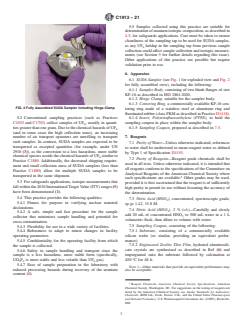
6.1 SUDA Sampler (see Fig. 1 for exploded view and Fig. 2
for fully assembled view), including the following:
6.1.1 Sampler Body, consisting of two blank flanges of size
KF-16 as described in ISO 2861:2020.
6.1.2 Hinge Clamp, suitable for the sampler body.
6.1.3 Centering Ring, a commercially available KF-16 cen-
FIG. 2Fully Assembled SUDA Sampler Including Hinge Clamp
tering ring made of a stainless steel or aluminum ring and
fluorinatedrubber(classFKMasdescribedinPracticeD1418).
5.2 Conventional sampling practices (such as Practices 6.1.4 Insert, Polytetrafluoroethylene (PTFE), to hold the
C1052 and C1703) collect samples of UF , usually in quanti- sampling coupon in place within the sampler body.
ties greater than one gram. Due to the chemical hazards of UF
6.1.5 Sampling Coupon, prepared as described in 7.5.
(and in some cases the high collection mass), an increasing
7. Reagents
number of air transport operators are unwilling to transport
such samples. In contrast, SUDA samples are expected to be
7.1 Purity of Water—Unless otherwise indicated, references
transported as excepted quantities (for example, under UN
to water shall be understood to mean reagent water as defined
2910 (3)), as the conversion to a less hazardous, more stable
by Type 1 of Specification D1193.
chemicalspeciesavoidsthechemicalhazardsofUF similarto
7.2 Purity of Reagents—Reagent grade chemicals shall be
Practice C1880. Additionally, the decreased shipping require-
used in all tests. Unless otherwise indicated, it is intended that
ment and small collection mass of SUDA samplers (less than
all reagents conform to the specifications of the Committee on
Practice C1880) allow for multiple SUDA samples to be
Analytical Reagents of the American Chemical Society where
transported in the same shipment.
such specifications are available. Other grades may be used,
5.3 For safeguards applications, isotopic measurements that
provided it is first ascertained that the reagent is of sufficiently
fallwithinthe2010InternationalTargetValue(ITV)ranges (5)
high purity to permit its use without lessening the accuracy of
have been demonstrated (1).
the determination.
5.4 This practice provides the following qualities:
7.3 Nitric Acid (HNO ), concentrated, spectroscopic grade,
5.4.1 Fitness for purpose in verifying nuclear material
sp gr 1.42, 15.8 M.
declarations.
7.4 Nitric Acid (HNO ), 2 % (v/v)—Carefully and slowly
5.4.2 A safe, simple and fast procedure for the sample
add 20 mL of concentrated HNO to 500 mL water ina1L
collector that minimizes sample handling and potential for
volumetric flask, then dilute to volume with water.
cross-contamination.
7.5 Sampling Coupon, consisting of the following:
5.4.3 Flexibility for use in a wide variety of facilities.
5.4.4 Robustness to adapt to minor changes in facility 7.5.1 Substrate, consisting of a commercially available
silicon wafer (or similar, providing an equivalent perfor-
operating parameters.
mance).
5.4.5 Confidentiality for the operating facility from which
7.5.2 Engineered Zeolite Thin Film, hydrated aluminosili-
the sample is collected.
cate crystals are synthesized as described in Ref (6) and
5.4.6 Safety in sample handling and transport since the
impregnated onto the substrate followed by calcination at
sample is a less hazardous, more stable form (specifically,
450 °C for 48 h.
UO F is more stable and less volatile than UF gas).
2 2 6
5.4.7 Ease of sample preparation in the laboratory with
NOTE 1—Other materials that provide an equivalent performance may
reduced processing hazards during recovery of the uranium
also be acceptable.
content (1).
Reagent Chemicals, American Chemical Society Specifications, American
Chemical Society, Washington, DC. For suggestions on the testing of reagents not
listed by the American Chemical Society, see Analar Standards for Laboratory
Chemicals, BDH Ltd., Poole, Dorset, U.K., and the United States Pharmacopeia
and National Formulary, U.S. Pharmacopeial Convention, Inc. (USPC), Rockville,
MD.
C1913−21
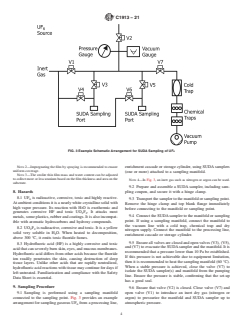
FIG. 3Example Schematic Arrangement for SUDA Sampling of UF
NOTE 2—Impregnating the film by spraying is recommended to ensure
enrichment cascade or storage cylinder, using SUDAsamplers
uniform coverage.
(o
...