

ASTM E1021-15(2019)
(Test Method)Standard Test Method for Spectral Responsivity Measurements of Photovoltaic Devices
General Information
- Abstract
SIGNIFICANCE AND USE
5.1 The spectral responsivity of a photovoltaic device is necessary for computing spectral mismatch parameter (see Test Method E973). Spectral mismatch is used in Test Method E948 to measure the performance of photovoltaic cells in simulated sunlight, in Test Methods E1036 to measure the performance of photovoltaic modules and arrays, in Test Method E1125 to calibrate photovoltaic primary reference cells using a tabular spectrum, and in Test Method E1362 to calibrate photovoltaic secondary reference cells. The spectral mismatch parameter can be computed using absolute or relative spectral responsivity data.
5.2 This test method measures the differential spectral responsivity of a photovoltaic device. The procedure requires the use of white-light bias to enable the user to evaluate the dependence of the differential spectral responsivity on the intensity of light reaching the device. When such dependence exists, the overall spectral responsivity should be equivalent to the differential spectral responsivity at a light bias level somewhere between zero and the intended operating conditions of the device. Depending on the linearity response of the DUT over the intensity range up to the intended operating conditions, it may not be necessary to set up a very high light bias level.
5.3 The spectral responsivity of a photovoltaic device is useful for understanding device performance and material characteristics.
5.4 The procedure described herein is appropriate for use in either research and development applications or in product quality control by manufacturers.
5.5 The reference photodetector’s calibration must be traceable to SI units through a National Institute of Standards and Technology (NIST) spectral responsivity scale or other relevant radiometric scale.3 ,4 The calibration mode of the photodetector (irradiance or power) will affect the procedures used and the kinds of measurements that can be performed.
5.6 This test method does not address issues...
SCOPE
1.1 This test method is to be used to determine either the absolute or relative spectral responsivity response of a single-junction photovoltaic device.
1.2 Because quantum efficiency is directly related to spectral responsivity, this test method may be used to determine the quantum efficiency of a single-junction photovoltaic device (see 10.10).
1.3 This test method requires the use of a bias light.
1.4 The values stated in SI units are to be regarded as standard. No other units of measurement are included in this standard.
1.5 This standard does not purport to address all of the safety concerns, if any, associated with its use. It is the responsibility of the user of this standard to establish appropriate safety, health, and environmental practices and determine the applicability of regulatory limitations prior to use.
1.6 This international standard was developed in accordance with internationally recognized principles on standardization established in the Decision on Principles for the Development of International Standards, Guides and Recommendations issued by the World Trade Organization Technical Barriers to Trade (TBT) Committee.
- Status
- Published
- Publication Date
- 31-Mar-2019
- Technical Committee
- E44 - Solar, Geothermal and Other Alternative Energy Sources
- Drafting Committee
- E44.09 - Photovoltaic Electric Power Conversion
Overview
ASTM E1021-15(2019): Standard Test Method for Spectral Responsivity Measurements of Photovoltaic Devices establishes a reliable procedure for determining the absolute or relative spectral responsivity of single-junction photovoltaic (PV) devices. Spectral responsivity, defined as the output current per incident radiant power or irradiance at a specific wavelength, is a critical parameter influencing the accurate evaluation, calibration, and performance assessment of PV cells, modules, and arrays. This ASTM standard supports both research and development efforts as well as quality control in manufacturing environments, and ensures calibration traceability to SI units through recognized reference scales.
Key Topics
Spectral Responsivity Measurement: The central focus is on procedures for measuring how a single-junction PV device responds to different wavelengths of light. Both absolute and relative measurements are described, depending on application requirements and available calibration devices.
White-Light Bias Use: The method requires a white-light bias during testing, allowing assessment of the device's responsivity under operating conditions similar to actual use, and evaluating linearity over varying light intensities.
Critical Role in Performance Evaluation: Accurate spectral responsivity information is essential for calculating the spectral mismatch parameter (referenced in ASTM E973), which enables comparison of PV device performance under different spectral conditions.
Calibration Traceability: The reference photodetector used in these measurements must have calibration that is traceable to SI units, typically verified through the National Institute of Standards and Technology (NIST) or equivalent organizations worldwide.
Adaptability: The test method is suitable for absolute or relative measurements, and can accommodate varying apparatus configurations, such as the size of the monochromatic beam and the photodetector.
Quantum Efficiency Determination: Because spectral responsivity is directly related to quantum efficiency, the standard also enables determination of quantum efficiency for PV devices.
Applications
Research and Development: The method supports detailed analysis of PV device and material properties, essential for photovoltaic innovation and optimization in labs and pilot lines.
Quality Control: Manufacturers use this standard to ensure consistent product performance. Spectral responsivity data aid in the calibration of reference cells as well as routine module testing.
Device Calibration: It is referenced in other ASTM standards for calibrating both primary and secondary photovoltaic reference cells, providing foundational traceability for PV measurement systems.
Spectral Mismatch Correction: Used to calculate correction factors when comparing device performance under different spectral conditions, critical for accurate simulation and testing, especially when transitioning between simulated and natural sunlight.
Standardized Testing: Provides a harmonized methodology, facilitating interlaboratory agreements and international trade by meeting recognized WTO principles for standardization.
Related Standards
- ASTM E973: Method for determining the spectral mismatch parameter, essential for comparing device responses under different spectra.
- ASTM E948: Test method for performance of photovoltaic cells under simulated sunlight using reference cells.
- ASTM E1036: Procedures for electrical performance measurement of PV modules and arrays using reference cells.
- ASTM E1125 & ASTM E1362: Cover calibration of primary and secondary terrestrial photovoltaic reference cells.
- ASTM E2236: Procedures for spectral response of multi-junction PV cells and modules.
- ASTM G173: Reference solar spectral irradiance tables, widely used in PV calibration and testing.
Practical Value
ASTM E1021-15(2019) is a cornerstone in the field of photovoltaic testing, providing a standardized approach to measure and understand PV device spectral responsivity. The standard enables accurate calibration, product benchmarking, and supports consistent quality assurance across the solar industry. Spectral responsivity data derived from this method are key in correcting for spectral mismatch, ensuring reliable PV device performance data, and fostering confidence in solar energy systems worldwide. With calibration traceable to SI units, it underpins metrological rigor necessary for global PV commerce and research.
Relations
- Replaces
ASTM E1021-15 - Standard Test Method for Spectral Responsivity Measurements of Photovoltaic Devices - Effective Date
- 01-Apr-2019
- Effective Date
- 01-Jun-2020
- Effective Date
- 01-Apr-2019
- Effective Date
- 01-Feb-2019
- Effective Date
- 01-Nov-2016
- Effective Date
- 01-Jul-2016
- Effective Date
- 01-Jul-2016
- Effective Date
- 01-Dec-2015
- Effective Date
- 01-Dec-2015
- Effective Date
- 01-Nov-2015
- Effective Date
- 01-Mar-2015
- Effective Date
- 01-Mar-2015
- Effective Date
- 01-Mar-2015
- Effective Date
- 01-Feb-2015
- Effective Date
- 01-Feb-2015
Get Certified
Connect with accredited certification bodies for this standard

DNV
DNV is an independent assurance and risk management provider.

Lloyd's Register
Lloyd's Register is a global professional services organisation specialising in engineering and technology.
DNV Energy Systems
Energy and renewable energy certification.
Sponsored listings
Frequently Asked Questions
ASTM E1021-15(2019) is a standard published by ASTM International. Its full title is "Standard Test Method for Spectral Responsivity Measurements of Photovoltaic Devices". This standard covers: SIGNIFICANCE AND USE 5.1 The spectral responsivity of a photovoltaic device is necessary for computing spectral mismatch parameter (see Test Method E973). Spectral mismatch is used in Test Method E948 to measure the performance of photovoltaic cells in simulated sunlight, in Test Methods E1036 to measure the performance of photovoltaic modules and arrays, in Test Method E1125 to calibrate photovoltaic primary reference cells using a tabular spectrum, and in Test Method E1362 to calibrate photovoltaic secondary reference cells. The spectral mismatch parameter can be computed using absolute or relative spectral responsivity data. 5.2 This test method measures the differential spectral responsivity of a photovoltaic device. The procedure requires the use of white-light bias to enable the user to evaluate the dependence of the differential spectral responsivity on the intensity of light reaching the device. When such dependence exists, the overall spectral responsivity should be equivalent to the differential spectral responsivity at a light bias level somewhere between zero and the intended operating conditions of the device. Depending on the linearity response of the DUT over the intensity range up to the intended operating conditions, it may not be necessary to set up a very high light bias level. 5.3 The spectral responsivity of a photovoltaic device is useful for understanding device performance and material characteristics. 5.4 The procedure described herein is appropriate for use in either research and development applications or in product quality control by manufacturers. 5.5 The reference photodetector’s calibration must be traceable to SI units through a National Institute of Standards and Technology (NIST) spectral responsivity scale or other relevant radiometric scale.3 ,4 The calibration mode of the photodetector (irradiance or power) will affect the procedures used and the kinds of measurements that can be performed. 5.6 This test method does not address issues... SCOPE 1.1 This test method is to be used to determine either the absolute or relative spectral responsivity response of a single-junction photovoltaic device. 1.2 Because quantum efficiency is directly related to spectral responsivity, this test method may be used to determine the quantum efficiency of a single-junction photovoltaic device (see 10.10). 1.3 This test method requires the use of a bias light. 1.4 The values stated in SI units are to be regarded as standard. No other units of measurement are included in this standard. 1.5 This standard does not purport to address all of the safety concerns, if any, associated with its use. It is the responsibility of the user of this standard to establish appropriate safety, health, and environmental practices and determine the applicability of regulatory limitations prior to use. 1.6 This international standard was developed in accordance with internationally recognized principles on standardization established in the Decision on Principles for the Development of International Standards, Guides and Recommendations issued by the World Trade Organization Technical Barriers to Trade (TBT) Committee.
SIGNIFICANCE AND USE 5.1 The spectral responsivity of a photovoltaic device is necessary for computing spectral mismatch parameter (see Test Method E973). Spectral mismatch is used in Test Method E948 to measure the performance of photovoltaic cells in simulated sunlight, in Test Methods E1036 to measure the performance of photovoltaic modules and arrays, in Test Method E1125 to calibrate photovoltaic primary reference cells using a tabular spectrum, and in Test Method E1362 to calibrate photovoltaic secondary reference cells. The spectral mismatch parameter can be computed using absolute or relative spectral responsivity data. 5.2 This test method measures the differential spectral responsivity of a photovoltaic device. The procedure requires the use of white-light bias to enable the user to evaluate the dependence of the differential spectral responsivity on the intensity of light reaching the device. When such dependence exists, the overall spectral responsivity should be equivalent to the differential spectral responsivity at a light bias level somewhere between zero and the intended operating conditions of the device. Depending on the linearity response of the DUT over the intensity range up to the intended operating conditions, it may not be necessary to set up a very high light bias level. 5.3 The spectral responsivity of a photovoltaic device is useful for understanding device performance and material characteristics. 5.4 The procedure described herein is appropriate for use in either research and development applications or in product quality control by manufacturers. 5.5 The reference photodetector’s calibration must be traceable to SI units through a National Institute of Standards and Technology (NIST) spectral responsivity scale or other relevant radiometric scale.3 ,4 The calibration mode of the photodetector (irradiance or power) will affect the procedures used and the kinds of measurements that can be performed. 5.6 This test method does not address issues... SCOPE 1.1 This test method is to be used to determine either the absolute or relative spectral responsivity response of a single-junction photovoltaic device. 1.2 Because quantum efficiency is directly related to spectral responsivity, this test method may be used to determine the quantum efficiency of a single-junction photovoltaic device (see 10.10). 1.3 This test method requires the use of a bias light. 1.4 The values stated in SI units are to be regarded as standard. No other units of measurement are included in this standard. 1.5 This standard does not purport to address all of the safety concerns, if any, associated with its use. It is the responsibility of the user of this standard to establish appropriate safety, health, and environmental practices and determine the applicability of regulatory limitations prior to use. 1.6 This international standard was developed in accordance with internationally recognized principles on standardization established in the Decision on Principles for the Development of International Standards, Guides and Recommendations issued by the World Trade Organization Technical Barriers to Trade (TBT) Committee.
ASTM E1021-15(2019) is classified under the following ICS (International Classification for Standards) categories: 27.160 - Solar energy engineering. The ICS classification helps identify the subject area and facilitates finding related standards.
ASTM E1021-15(2019) has the following relationships with other standards: It is inter standard links to ASTM E1021-15, ASTM E948-16(2020), ASTM E1036-15(2019), ASTM E927-19, ASTM E948-16, ASTM E1125-16, ASTM E973-16, ASTM E973-15, ASTM E1362-15, ASTM E927-10(2015), ASTM E1125-10(2015), ASTM E2236-10(2015), ASTM E973-10(2015), ASTM E1036-15, ASTM E948-15. Understanding these relationships helps ensure you are using the most current and applicable version of the standard.
ASTM E1021-15(2019) is available in PDF format for immediate download after purchase. The document can be added to your cart and obtained through the secure checkout process. Digital delivery ensures instant access to the complete standard document.
Standards Content (Sample)
This international standard was developed in accordance with internationally recognized principles on standardization established in the Decision on Principles for the
Development of International Standards, Guides and Recommendations issued by the World Trade Organization Technical Barriers to Trade (TBT) Committee.
Designation: E1021 − 15 (Reapproved 2019) An American National Standard
Standard Test Method for
Spectral Responsivity Measurements of Photovoltaic
Devices
This standard is issued under the fixed designation E1021; the number immediately following the designation indicates the year of
original adoption or, in the case of revision, the year of last revision.Anumber in parentheses indicates the year of last reapproval.A
superscript epsilon (´) indicates an editorial change since the last revision or reapproval.
1. Scope E948Test Method for Electrical Performance of Photovol-
taic Cells Using Reference Cells Under Simulated Sun-
1.1 This test method is to be used to determine either the
light
absolute or relative spectral responsivity response of a single-
E973Test Method for Determination of the Spectral Mis-
junction photovoltaic device.
match Parameter Between a Photovoltaic Device and a
1.2 Because quantum efficiency is directly related to spec-
Photovoltaic Reference Cell
tralresponsivity,thistestmethodmaybeusedtodeterminethe
E1036Test Methods for Electrical Performance of Noncon-
quantum efficiency of a single-junction photovoltaic device
centrator Terrestrial Photovoltaic Modules and Arrays
(see 10.10).
Using Reference Cells
E1125 Test Method for Calibration of Primary Non-
1.3 This test method requires the use of a bias light.
ConcentratorTerrestrial Photovoltaic Reference Cells Us-
1.4 The values stated in SI units are to be regarded as
ing a Tabular Spectrum
standard. No other units of measurement are included in this
E1362Test Methods for Calibration of Non-Concentrator
standard.
Photovoltaic Non-Primary Reference Cells
1.5 This standard does not purport to address all of the
E2236Test Methods for Measurement of Electrical Perfor-
safety concerns, if any, associated with its use. It is the
mance and Spectral Response of Nonconcentrator Multi-
responsibility of the user of this standard to establish appro-
junction Photovoltaic Cells and Modules
priate safety, health, and environmental practices and deter-
G173TablesforReferenceSolarSpectralIrradiances:Direct
mine the applicability of regulatory limitations prior to use.
Normal and Hemispherical on 37° Tilted Surface
1.6 This international standard was developed in accor-
dance with internationally recognized principles on standard-
3. Terminology
ization established in the Decision on Principles for the
3.1 Definitions—Definitions of terms used in this test
Development of International Standards, Guides and Recom-
method may be found in Terminology E772.
mendations issued by the World Trade Organization Technical
3.2 Definitions of Terms Specific to This Standard:
Barriers to Trade (TBT) Committee.
3.2.1 chopper, n—a rotating blade or other device used to
modulate a light source.
2. Referenced Documents
3.2.2 device under test (DUT), n—aphotovoltaicdevicethat
2.1 ASTM Standards:
is subjected to a spectral responsivity measurement.
E691Practice for Conducting an Interlaboratory Study to
Determine the Precision of a Test Method
3.2.3 irradiance mode calibration, n—a calibration method
E772Terminology of Solar Energy Conversion
in which the reference photodetector measures the irradiance
E927Classification for Solar Simulators for Electrical Per-
produced by the monochromatic beam.
formance Testing of Photovoltaic Devices
3.2.4 monitor photodetector, n—a photodetector incorpo-
rated into the optical system to monitor the amount of light
reaching the device under test, enabling adjustments to be
This test method is under the jurisdiction of ASTM Committee E44 on Solar,
made to accommodate varying light intensity.
GeothermalandOtherAlternativeEnergySourcesandisthedirectresponsibilityof
Subcommittee E44.09 on Photovoltaic Electric Power Conversion.
3.2.5 monochromatic beam, n—choppedlightfromamono-
Current edition approved April 1, 2019. Published April 2019. Originally
chromatic source reaching the reference photodetector or
approved in 1993. Last previous edition approved in 2015 as E1021–15. DOI:
device under test.
10.1520/E1021-15R19.
For referenced ASTM standards, visit the ASTM website, www.astm.org, or
3.2.6 monochromator, n—an optical device that allows a
contact ASTM Customer Service at service@astm.org. For Annual Book of ASTM
selected wavelength of light to pass while blocking other
Standardsvolume information, refer to the standard’s Document Summary page on
the ASTM website. wavelengths.
Copyright © ASTM International, 100 Barr Harbor Drive, PO Box C700, West Conshohocken, PA 19428-2959. United States
E1021 − 15 (2019)
3.2.7 power mode calibration, n—a calibration method in φ—power of the monochromatic beam or irradiance of the
–2
which the reference photodetector measures the power in the monochromatic beam, W or W·m ,
–19
monochromatic beam. q—elementary charge, 1.602176565×10 C,
Q—external quantum efficiency dimensionless or percent,
3.2.8 reference photodetector, n—a calibrated photodetector
R —absolute spectral responsivity for irradiance mode,
ia
with a known spectral responsivity over a wavelength range
2 –1
A·m ·W ,
and used to quantify the amount of light in a monochromatic
–1
R —absolutespectralresponsivityforpowermode,A·W ,
pa
beam.
R —relative spectral responsivity for irradiance mode,
ir
3.2.9 spectral bandwidth, n—the range of wavelengths in a
dimensionless,
monochromatic light source, determined as the difference
R —relative spectral responsivity for power mode,
pr
between its half-maximum-intensity wavelengths.
dimensionless,
–1 2 –1
3.3 Symbols:
SR—spectral responsivity, A·W or A·m ·W .
3.3.1 The following symbols and units are used in this test
3.3.2 Symbolic quantities that are functions of wavelength
method:
appear as X(λ).
A—illuminated device area, m ,
−1
4. Summary of Test Method
c—speed of light in vacuum, 299792458 m·s ,
CV —monitor photodetector calibration value for irradi-
Mi
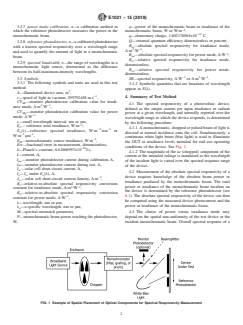
4.1 The spectral responsivity of a photovoltaic device,
2 −1
ance mode, A·m ·W ,
defined as the output current per input irradiance or radiant
CV —monitor photodetector calibration value for power
Mp
power at a given wavelength, and normally reported over the
−1
mode, A·W
wavelength range to which the device responds, is determined
ε—small wavelength interval, nm or µm,
by the following procedure:
−2
E — reference total irradiance, W·m ,
o
4.1.1 Amonochromatic, chopped or pulsed beam of light is
–2 –1
E (λ)—reference spectral irradiance, W·m ·nm or
o
directed at normal incidence onto the cell. Simultaneously, a
–2 –1
W·m ·µm ,
continuous white light beam (bias light) is used to illuminate
–2
E —monochromatic source irradiance, W·m ,
M
the DUT at irradiance levels intended for end use operating
Err—fractional error in measurement, dimensionless,
conditions of the device. See Fig. 1.
–34
h—Planck’s constant, 6.62606957×10 J·s,
4.1.2 The magnitude of the ac (chopped) component of the
I—current, A,
current at the intended voltage is monitored as the wavelength
I —monitor photodetector current during calibration, A,
mc
of the incident light is varied over the spectral response range
l —monitor photodetector current during test, A,
mt
of the device.
I —solar cell short-circuit current, A,
sc
4.2 Measurement of the absolute spectral responsivity of a
I —I under E (λ), A,
o sc o
–2 device requires knowledge of the absolute beam power or
J —solar cell short-circuit current density, A·m ,
sc
irradiance produced by the monochromatic beam. The total
K—relative-to-absolute spectral responsivity conversion
i
2 –1 power or irradiance of the monochromatic beam incident on
constant for irradiance mode, A·m ·W ,
the device is determined by the reference photodetector (see
K —relative-to-absolute spectral responsivity conversion
p
–1 6.1). The absolute spectral responsivity of the device can then
constant for power mode, A·W ,
be computed using the measured device photocurrent and the
λ—wavelength, nm or µm,
power or irradiance of the monochromatic beam.
λ —a specific wavelength, nm or µm,
o
M—spectral mismatch parameter, 4.3 The choice of power versus irradiance mode may
P—monochromatic beam power reaching the photodetector, depend on the spatial non-uniformity of the test device or the
W, incident monochromatic beam. Overall spectral response of a
FIG. 1 Example of Spatial Placement of Optical Components for Spectral Responsivity Measurement
E1021 − 15 (2019)
test device with substantial spatial non-uniformity of response 5.8 This test method is intended for use with a single-
shouldbeperformedinirradiancemodewithamonochromatic junction photovoltaic cell. It can also be used to measure the
beam of high spatial uniformity. spectral responsivity of a single junction within a series-
connected, multiple-junction photovoltaic device if electrical
4.4 Thetestprocedurecanbeadaptedtoprovideabsoluteor
contact can be made to the individual junction(s) of interest.
relative spectral responsivity measurements, depending on the
calibration device used, its calibration mode and the relative 5.9 With additional procedures (see Test Methods E2236),
sizes of the calibration device, the monochromatic beam size, one can determine the spectral responsivity of individual
and the device being measured. junctionswithinseries-connected,multiple-junction,photovol-
taic devices when electrical contact can only be made to the
5. Significance and Use
entire device’s two terminals.
5.1 The spectral responsivity of a photovoltaic device is 5
5.10 Using forward biasing techniques , it is possible to
necessaryforcomputingspectralmismatchparameter(seeTest
extendtheprocedureinthistestmethodtomeasurethespectral
MethodE973).SpectralmismatchisusedinTestMethodE948
responsivity of individual series-connected cells within photo-
to measure the performance of photovoltaic cells in simulated
voltaicmodules.Thesetechniquesarebeyondthescopeofthis
sunlight,inTestMethodsE1036tomeasuretheperformanceof
test method.
photovoltaic modules and arrays, in Test Method E1125 to
calibrate photovoltaic primary reference cells using a tabular
6. Apparatus
spectrum, and in Test Method E1362 to calibrate photovoltaic
6.1 Reference Photodetector:
secondary reference cells. The spectral mismatch parameter
6.1.1 The following detectors are acceptable for use in the
can be computed using absolute or relative spectral responsiv-
calibration of the monochromatic light source:
ity data.
6.1.1.1 Pyroelectric radiometer, and
5.2 This test method measures the differential spectral
6.1.1.2 Cryogenic radiometer, and
responsivity of a photovoltaic device. The procedure requires
6.1.1.3 Spectrally calibrated photodiode, photodiode irradi-
the use of white-light bias to enable the user to evaluate the
ance detector, or solar cell, calibrated in power or irradiance
dependence of the differential spectral responsivity on the
mode.
intensity of light reaching the device. When such dependence
NOTE 1—A spectrally calibrated photodiode should have calibration
exists, the overall spectral responsivity should be equivalent to
data that includes the entire spectral response range of the device to be
the differential spectral responsivity at a light bias level
tested. If a part of the range is omitted, it will limit the spectral range of
somewherebetweenzeroandtheintendedoperatingconditions theresultsofthistest,causinganerrorincomputingthespectralmismatch
parameter.
of the device. Depending on the linearity response of the DUT
NOTE2—Aphotodetectorcalibratedinpowermodemusthavespatially
over the intensity range up to the intended operating
uniform spectral responsivity over its photosensitive region. A photode-
conditions, it may not be necessary to set up a very high light
tector calibrated in irradiance mode may have spatially non-uniform
bias level.
spectralresponsivitycharacteristics,andmustonlybeusedwithauniform
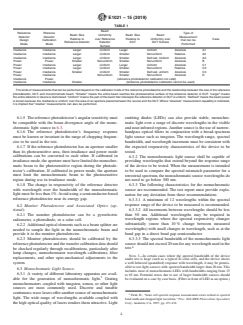
monochromatic beam larger than its surface area. See also Table 1.
5.3 The spectral responsivity of a photovoltaic device is
6.1.2 Thereferencephotodetectormusthaveaknownlinear
useful for understanding device performance and material
current versus incident light intensity ratio over the range of
characteristics.
intensitiesandwavelengthsofthemonochromaticlightsource.
5.4 The procedure described herein is appropriate for use in
6.1.3 The reference photodetector’s calibration must be
either research and development applications or in product
traceable to SI units through a National Institute of Standards
quality control by manufacturers.
and Technology (NIST) spectral responsivity scale or other
3,4
5.5 The reference photodetector’s calibration must be trace-
relevant radiometric scale.
able to SI units through a National Institute of Standards and
6.1.4 The uniformity of responsivity over the surface of the
Technology (NIST) spectral responsivity scale or other rel-
reference photodetector must be characterized if it will not be
3,4
evant radiometric scale. The calibration mode of the photo-
entirely illuminated (overfill illumination) by the monochro-
detector (irradiance or power) will affect the procedures used
matic light beam. A photodetector with spatially uniform
and the kinds of measurements that can be performed.
sensitivity is suitable for use in both power mode and irradi-
ance mode measurements. Non-uniform detectors are suitable
5.6 This test method does not address issues of sample
for use in irradiance mode with uniform light beams only. The
stability.
non-uniformity of the incident radiation should be ideally
5.7 Usingresultsobtainedbythistestmethodandadditional
betterthan 62%.Forbestresults,useaphotodetectorwiththe
measurements including reflectance versus wavelength, one
best spatial response uniformity available. The spatial unifor-
cancomputetheinternalquantumefficiencyofadevice.These
mity map of the reference detector are typically provided as
measurements are beyond the scope of this test method.
part of the calibration documents for one or two wavelengths.
Larason, T. C., Bruce, S. S., and Parr,A. C., NIST Special Publication 250-41
Spectroradiometric Detector Measurements, Washington, DC, U.S. Government Emery, K. A., “Measurement and Characterization of Solar Cells and
Printing Office, 1998. Also available at http://ois.nist.gov/sdm/ Modules,” Handbook of Photovoltaic Science and Engineering, Chapter 16, pp.
Eppeldauer, G., Racz, M., and Larason, T., “Optical characterization of 701-747, Luque, A., and Hegedus, S., Eds., John Wiley & Sons, W. Sussex, U.K.,
diffuser-input standard irradiance meters,” SPIE Vol 3573, 1998, pp. 220-224. ISBN0-471-49196-9.
E1021 − 15 (2019)
TABLE 1
Beam
Reference Rference Type of
Beam Size Uniformity Beam Size Beam
Detector Detector Measurement
Relative to over Reference Relative to Uniformity over Case
Design Calibration that can be
Reference Detector Detector DUT DUT Surface
Mode Mode Performed
Surface
Irradiance Irradiance Larger Uniform Larger Uniform Absolute A1
Irradiance Irradiance Larger Uniform Smaller Nonuniform Relative A2
Irradiance Irradiance Larger Uniform Smaller Defined, Uniform Absolute A3
Power Power Smaller Nonuniform Smaller Nonuniform Absolute B
Power Irradiance Larger Uniform Larger Uniform Absolute C1
Power Irradiance Larger Uniform Smaller Nonuniform Relative C2
Power Irradiance Smaller Uniform Smaller Defined, uniform Absolute C3
Power Irradiance Nonunifrom Smaller Nonuniform Absolute D
Irradiance Power (reference photodetector calibration not valid)
Irradiance Irradiance Smaller (reference photodetector calibration cannot be used)
The kinds of measurements that can be performed depend on the calibration mode of the reference photodetector and the relationship between the size ofthe reference
photodetector, DUT, and monochromatic beam. “Smaller” means the entire beam reaches the photosensitive surface of the reference detector or DUT. “Larger” means
theentiredetectorordeviceisilluminated.“Uniform”meansthepartofthebeamthatinterceptsthereferencedetectororDUTisuniform.“Defined”meansthebeampower
is known because the irradiance is uniform over the area of an aperture placed between the source and the DUT. Where “absolute” measurement capability is indicated,
it is implied that “relative” measurements can also be performed.
6.1.5 Thereferencephotodetector’sangularsensitivitymust emitting diodes (LEDs) can also provide stable, monochro-
be compatible with the beam divergence angle of the mono- matic light over a range of discrete wavelengths in the visible
chromatic light source in 6.3. andnear-infraredregions.Anothersourceistheuseofnarrow-
6.1.6 The reference photodetector’s frequency response bandpass optical filters in conjunction with a broad-spectrum
must be known or invariant in the range of chopping frequen- light source such as tungsten. The wavelength range, spectral
cies to be used in the test. bandwidth, and wavelength increment must be consistent with
6.1.7 If the reference photodetector has an aperture smaller the expected responsivity characteristics of the device to be
than its photosensitive area, then irradiance and power mode tested.
calibrations can be converted to each other. If calibrated in 6.3.2 The monochromatic light source shall be capable of
irradiancemode,theaperturemusthavelimitedthemonochro-
providing wavelengths that extend beyond the response range
matic beam to the photosensitive region during the photode- of the device to be tested. When the measurement is intended
tector’s calibration. If calibrated in power mode, the aperture
to be used to compute the spectral mismatch parameter for a
must limit the monochromatic beam to the photosensitive terrestrialspectrum,themonochromaticsourcewavelengthsdo
region during use in irradiance mode.
not need to go below 300 nm.
6.1.8 The change in responsivity of the reference detector
6.3.3 The following characteristics for the monochromatic
with wavelength over the bandwidth of the monochromatic
source are recommended. The test report must provide expla-
lightmustbelessthan1%.Avoidusingasemiconductor-based
nation for any deviation from these recommendations.
reference photodetector near its energy gap.
6.3.3.1 A minimum of 12 wavelengths within the spectral
response range of the device to be measured is recommended.
6.2 Monitor Photodetector and Associated Optics (op-
6.3.3.2 All increments between wavelengths should be less
tional):
than 50 nm. Additional wavelengths may be required in
6.2.1 The monitor photodetector can be a pyroelectric
wavelength regions where the spectral responsivity changes
radiometer, a photodiode, or a solar cell.
substantially (more than 10% change between measured
6.2.2 Additionalopticalelementssuchasabeamsplitterare
wavelengths) with small changes in wavelength, such as at the
needed to sample the light in the monochromatic beam and
band gap in a direct band gap semiconductor.
provide it to the monitor photodetector.
6.3.3.3 The spectral bandwidth of the monochromatic light
6.2.3 Monitor photodetectors should be calibrated by the
referencephotodetectorandthetransfercalibrationdatashould sourceshouldnotexceed20nmforanywavelengthusedinthe
test.
be checked regularly through recalibrations, particularly after
lamp changes, monochromator wavelength calibrations, filter
NOTE 3—In certain cases where the spectral bandwidth of the device
replacements, and other opto-mechanical adjustments to the
under test is large (such as a typical Si solar cell), and the device shows
system.
a well-behaved (quantified) response with wavelength, it may be permis-
sible to use light sources with spectral bandwidth larger than 20 nm. This
6.3 Monochromatic Light Source:
includes most of monochromatic LEDs with bandwidths ranging from 15
6.3.1 A variety of different laboratory apparatus are avail-
to 65 nm. Potential errors due to use of larger bandwidth sources should
able for the generation of monochromatic light. Grating beevaluatedonacasebycasebasis.(FilterinfrontofLEDasanoption.)
monochromators coupled with tungsten, xenon, or other light
sources are most commonly used. Discrete and tunable
continuous-wavelasersofferanothersourceofmonochromatic
Field, H., “Solar cell spectral response measurement errors related to spectral
light. The wide range of wavelengths available coupled with
bandwidthandchoppedlightwaveform,” Proc. 26th IEEE Photovoltaic Specialists
the high optical quality of lasers renders them attractive. Light Conf., Anaheim, CA, 1997, pp. 471-474.
E1021 − 15 (2019)
6.3.4 The presence of small amounts of light in the mono- 6.3.10 An optical shutter may be used to interrupt the
chromatic beam at wavelengths other than the intended wave- monochromatic beam to reduce delays involved with source
and supply warm-up times during the test procedure (see 9.1.2
length can cause substantial errors in the measurement. The
magnitude of expected error can be determined from the and 9.1.4). Such a shutter should be installed between the
chopper and the test fixture to prevent chopped bias light from
following equation:
being interpreted as true signal.
λo2ε `
Err·SR ·Ø ·2ε. SR λ ·Ø λ ·dλ1 SR λ ·Ø λ ·dλ (1)
* ~ ! ~ ! * ~ ! ~ !
λo λo
6.3.11 The center wavelength of a bandpass filter should be
0 λ
o1ε
where ε is 1.5 times the spectral bandwidth in 6.3.3.3, λ is the measured preferably with a spectroradiometer in the test plane
o
wavelength of concern, SR is the spectral response of the test as opposed to measuring the filter transmittance. If a mono-
device, and φ is the power or irradiance of the monochromatic chromator is used, its wavelength calibration should be peri-
odically checked.
beam.Theapparatusmustbedesignedandtestedtoensurethat
this requirement is met for a particular error level (0.005 is
6.4 Monochromatic Light Modulation—A rotating blade or
recommended).Ifahighererrorlevelisusedinthetest,itmust
otherdeviceusedtomodulatethemonochromaticlightsource.
be noted in the test report. The error can be estimated by
6.4.1 The chopper blades should be designed to minimize
measuring a test device known to respond at a wavelength of
modulated stray light.
concern with a filter that blocks that wavelength in front of the
6.4.2 To minimize the modulation of room light or bias
test device. In a grating monochromator system, this may
light, the chopper should be configured to be close to the
require the use of order-sorting filters or a prism monochro-
monochromatic light source, or integrated within the mono-
mator to attenuate stray light and higher-order wavelengths of
chromatic light source. If the chopper and filters are mounted
the diffracted light. Stray light is a particular problem when
at the exit of the monochromator, the filters should be between
making measurements in the ultraviolet region using tungsten
the chopper and the test device.
sources or using a pyroelectric reference detector with band-
6.4.3 The radiant output of other monochromatic light
pass filters.
sources such as LEDs can be electronically modulated by use
of pulse-triggered current drivers.
6.3.5 Care must be taken to minimize scattered chopped
6.5 Bias Light Source—A stable, dc light source used to
light reaching the DUT. A non-reflective cavity enclosing the
illuminate the device during the measurement.
monochromatic light chopper (see 6.4), and the adjacent
6.5.1 The bias light should emit radiation at wavelengths
entrance or exit optics of the monochromatic light source can
throughout the responsivity range of the device under test. A
help minimize the modulation of stray light by the chopper.
good choice is a tungsten lamp with a stable dc power supply
Monochromator entrance and exit slits should be non-
to minimize temporal instability.
reflective. Materials that appear black to the eye may actually
6.5.2 Thelightshouldbeofsufficientintensitytoensurethe
reflect substantial amounts of infrared light. To evaluate the
DUT is operating in its linear response region. If the DUT is
presence of stray light due to bias light modulated by the
not linear, the bias light source should provide bias light over
chopper, one can measure the signal produced by a DUT with
the intensity range of interest.
bias light present but the lamp in the monochromatic source
6.5.3 Thebiassourceshouldcontainnosignificantharmon-
turned off (not shuttered).
ics of the chopper frequency used with the monochromatic
6.3.6 The monochromatic light source shall be capable of
source. This can be achieved by using a well regulated, dc
providing a temporal stability of 61 % during the calibration
power supply for the bias light. Mechanical vibrations, either
and measurement period unless a monitor photodetector is
from the chopper or other sources, shall not be allowed to
used, in which case 610 % is acceptable. The temporal
modulate the bias light.
stability need only be maintained during the time needed for a
6.5.4 Some bias sources can introduce a significant amount
complete cycle of measuring the signal from the DUT and
of noise in the measurement over a range of frequencies,
measuring the signal from the reference photodetector and
creating instability in the data collection by the modulated
exchanging the positions of these two units (if applicable).
current measurement instrument (see 6.6). If possible, the
6.3.7 If the monochromatic beam spatial uniformity devi-
monochromatic light’s chopping frequency should be shifted
ates more than 62 % over the part of the beam intercepted by
away from such unwanted sources of noise.
the device being tested, then the source is considered
6.6 Modulated Current Measurement Instruments—A sys-
“nonuniform,” and the kinds of tests that can be performed are
tem to quantify the alternating current produced by the DUT,
limited, according to Table 1.
the monitor photodetector (if used) and (if appropriate) the
6.3.8 It is recommended that the monochromatic light
reference photodetector.
source be able to illuminate the entire area of the device to be
6.6.1 A current-to-voltage converter, followed by a lock-in
tested. If it is not, at least two measurements of the spectral
amplifier or true-root-mean-square (RMS) voltmeter can be
responsivity in different regions of the device are required (see
used to detect the low-level, modulated current from the
9.1.13 and 9.1.13.1).
6.3.9 The monochromatic source must illuminate the entire
reference photodetector and be uniform over the detector’s
Hamadani, B. H., Roller,
...