

ASTM C368-88(2020)
(Test Method)Standard Test Method for Impact Resistance of Ceramic Tableware
General Information
- Abstract
SIGNIFICANCE AND USE
3.1 The purpose of this test method is to predict product resistance to impact breakage in service.
SCOPE
1.1 This test method covers the following tests:
1.1.1 Impact tests at the center of both flatware and hollow ware and at the rim of hollow ware, and
1.1.2 Chipping tests at the rim of flatware. Specimens may be either glazed or unglazed.
Note 1: The impact test at the center of the specimen is used to determine: (1) the magnitude of a blow that will produce initial fracture, and (2) the amount of energy necessary to produce complete failure. In the first case, the initial fracture shows on the side of the piece opposite from that being struck and appears to be a function of the square of the thickness and of the inherent brittleness of the body or body-glaze combination; it is relatively independent of the size or design of the specimen. The second factor is more dependent upon design and often is subject to wide variation within a given group of pieces.
Note 2: The impact test at the rim of hollow ware is similar to a chipping test, and the type of failure that is obtained is useful in evaluating the effect of the shape of the object.
Note 3: In addition to the inherent strength of the body, chipping test results are greatly affected by contour of rim and to a lesser extent by thickness of rim, inclination of leaf, and fit of glaze.
1.2 The values stated in inch-pound units are to be regarded as standard. The values given in parentheses are mathematical conversions to SI units that are provided for information only and are not considered standard.
1.3 This standard does not purport to address all of the safety concerns, if any, associated with its use. It is the responsibility of the user of this standard to establish appropriate safety, health, and environmental practices and determine the applicability of regulatory limitations prior to use.
1.4 This international standard was developed in accordance with internationally recognized principles on standardization established in the Decision on Principles for the Development of International Standards, Guides and Recommendations issued by the World Trade Organization Technical Barriers to Trade (TBT) Committee.
- Status
- Published
- Publication Date
- 31-Oct-2020
- Technical Committee
- C21 - Ceramic Whitewares and Related Products
- Drafting Committee
- C21.03 - Methods for Whitewares and Environmental Concerns

Overview
ASTM C368-88(2020) - Standard Test Method for Impact Resistance of Ceramic Tableware provides a standardized methodology for evaluating the ability of ceramic tableware products-such as plates, cups, and bowls-to resist impact breakage and chipping during regular use. Developed by ASTM International, this standard enables manufacturers, quality assurance teams, and regulatory bodies to assess product performance and predict durability under real-world service conditions. It covers test procedures for both glazed and unglazed ceramic ware.
Key Topics
Purpose and Significance
- Predicts how ceramic tableware will perform under impact stresses encountered in everyday settings.
- Aims to support product design improvement and quality control through standardized assessment.
Test Coverage
- Impact Tests: Performed at the center of both flatware (such as plates) and hollow ware (such as cups), as well as at the rim of hollow ware, to determine the energy required for initial fracture and complete failure.
- Chipping Tests: Conducted at the rim of flatware to measure resistance to chipping-a key indicator of product longevity and safety.
Variables Assessed
- Thickness and material brittleness significantly affect impact resistance at the center of ceramic pieces.
- Rim contour, rim thickness, glaze fit, and object shape influence chipping performance, especially along the edges.
Standardized Units
- Uses inch-pound units as the standard measurement, with SI conversions provided for reference.
Applications
The ASTM C368-88(2020) standard is widely implemented by:
- Manufacturers: For product development, batch quality control, and in-house comparative testing to ensure compliance and optimize design for resilience.
- Third-Party Testing Laboratories: To certify products for distribution, especially in markets where durability and consumer safety are critical.
- Retailers and Regulatory Agencies: For validating claims related to impact and break resistance, and ensuring tableware products meet industry safety standards.
- Product Designers and Engineers: Who require empirical data on the effects of geometry, thickness, and glazing on product robustness.
Typical products tested using this standard include restaurant ware, household dinnerware, hotel and catering tableware, and specialty ceramics where breakage resistance is essential. The method enables users to evaluate new formulations or design modifications efficiently.
Related Standards
For a comprehensive approach to ceramic tableware testing and product certification, the following standards are relevant:
- ASTM C554 - Standard Terminology Relating to Ceramic Whitewares and Related Products
- ASTM C738 - Standard Test Method for Lead and Cadmium Extracted from Glazed Ceramic Surfaces
- ISO 6486 - Ceramic ware, glass-ceramic ware and glass dinnerware in contact with food - Release of lead and cadmium
- ASTM C242 - Standard Terminology of Glass and Glass Products
ASTM C368-88(2020) supports global trade and consumer confidence by establishing reliable, reproducible methods for assessing ceramic tableware impact resistance in alignment with World Trade Organization technical barrier principles. By adopting this standard, stakeholders can enhance product quality, address consumer safety requirements, and improve satisfaction in both domestic and international markets.
Frequently Asked Questions
ASTM C368-88(2020) is a standard published by ASTM International. Its full title is "Standard Test Method for Impact Resistance of Ceramic Tableware". This standard covers: SIGNIFICANCE AND USE 3.1 The purpose of this test method is to predict product resistance to impact breakage in service. SCOPE 1.1 This test method covers the following tests: 1.1.1 Impact tests at the center of both flatware and hollow ware and at the rim of hollow ware, and 1.1.2 Chipping tests at the rim of flatware. Specimens may be either glazed or unglazed. Note 1: The impact test at the center of the specimen is used to determine: (1) the magnitude of a blow that will produce initial fracture, and (2) the amount of energy necessary to produce complete failure. In the first case, the initial fracture shows on the side of the piece opposite from that being struck and appears to be a function of the square of the thickness and of the inherent brittleness of the body or body-glaze combination; it is relatively independent of the size or design of the specimen. The second factor is more dependent upon design and often is subject to wide variation within a given group of pieces. Note 2: The impact test at the rim of hollow ware is similar to a chipping test, and the type of failure that is obtained is useful in evaluating the effect of the shape of the object. Note 3: In addition to the inherent strength of the body, chipping test results are greatly affected by contour of rim and to a lesser extent by thickness of rim, inclination of leaf, and fit of glaze. 1.2 The values stated in inch-pound units are to be regarded as standard. The values given in parentheses are mathematical conversions to SI units that are provided for information only and are not considered standard. 1.3 This standard does not purport to address all of the safety concerns, if any, associated with its use. It is the responsibility of the user of this standard to establish appropriate safety, health, and environmental practices and determine the applicability of regulatory limitations prior to use. 1.4 This international standard was developed in accordance with internationally recognized principles on standardization established in the Decision on Principles for the Development of International Standards, Guides and Recommendations issued by the World Trade Organization Technical Barriers to Trade (TBT) Committee.
SIGNIFICANCE AND USE 3.1 The purpose of this test method is to predict product resistance to impact breakage in service. SCOPE 1.1 This test method covers the following tests: 1.1.1 Impact tests at the center of both flatware and hollow ware and at the rim of hollow ware, and 1.1.2 Chipping tests at the rim of flatware. Specimens may be either glazed or unglazed. Note 1: The impact test at the center of the specimen is used to determine: (1) the magnitude of a blow that will produce initial fracture, and (2) the amount of energy necessary to produce complete failure. In the first case, the initial fracture shows on the side of the piece opposite from that being struck and appears to be a function of the square of the thickness and of the inherent brittleness of the body or body-glaze combination; it is relatively independent of the size or design of the specimen. The second factor is more dependent upon design and often is subject to wide variation within a given group of pieces. Note 2: The impact test at the rim of hollow ware is similar to a chipping test, and the type of failure that is obtained is useful in evaluating the effect of the shape of the object. Note 3: In addition to the inherent strength of the body, chipping test results are greatly affected by contour of rim and to a lesser extent by thickness of rim, inclination of leaf, and fit of glaze. 1.2 The values stated in inch-pound units are to be regarded as standard. The values given in parentheses are mathematical conversions to SI units that are provided for information only and are not considered standard. 1.3 This standard does not purport to address all of the safety concerns, if any, associated with its use. It is the responsibility of the user of this standard to establish appropriate safety, health, and environmental practices and determine the applicability of regulatory limitations prior to use. 1.4 This international standard was developed in accordance with internationally recognized principles on standardization established in the Decision on Principles for the Development of International Standards, Guides and Recommendations issued by the World Trade Organization Technical Barriers to Trade (TBT) Committee.
ASTM C368-88(2020) is classified under the following ICS (International Classification for Standards) categories: 97.040.60 - Cookware, cutlery and flatware. The ICS classification helps identify the subject area and facilitates finding related standards.
ASTM C368-88(2020) is available in PDF format for immediate download after purchase. The document can be added to your cart and obtained through the secure checkout process. Digital delivery ensures instant access to the complete standard document.
Standards Content (Sample)
This international standard was developed in accordance with internationally recognized principles on standardization established in the Decision on Principles for the
Development of International Standards, Guides and Recommendations issued by the World Trade Organization Technical Barriers to Trade (TBT) Committee.
Designation: C368 − 88 (Reapproved 2020)
Standard Test Method for
Impact Resistance of Ceramic Tableware
This standard is issued under the fixed designation C368; the number immediately following the designation indicates the year of
original adoption or, in the case of revision, the year of last revision. A number in parentheses indicates the year of last reapproval. A
superscript epsilon (´) indicates an editorial change since the last revision or reapproval.
1. Scope 2. Referenced Documents
2.1 ASTM Adjuncts:
1.1 This test method covers the following tests:
ADJC0368 Machine for Testing Chinaware
1.1.1 Impact tests at the center of both flatware and hollow
ware and at the rim of hollow ware, and
3. Significance and Use
1.1.2 Chipping tests at the rim of flatware. Specimens may
3.1 The purpose of this test method is to predict product
be either glazed or unglazed.
resistance to impact breakage in service.
NOTE 1—The impact test at the center of the specimen is used to
4. Apparatus
determine: (1) the magnitude of a blow that will produce initial fracture,
and (2) the amount of energy necessary to produce complete failure. In the
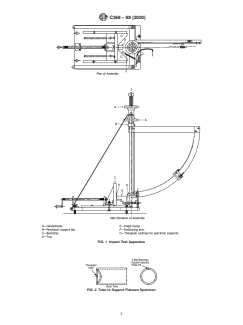
4.1 Impact Tester, Pendulum Type—The impact test appara-
first case, the initial fracture shows on the side of the piece opposite from
tus (Figs. 1 and 2) shall consist of a device having the
that being struck and appears to be a function of the square of the
following essential features:
thickness and of the inherent brittleness of the body or body-glaze
4.1.1 Asteel tup of specified size and of hardness Rockwell
combination; it is relatively independent of the size or design of the
specimen. The second factor is more dependent upon design and often is C55,
subject to wide variation within a given group of pieces.
4.1.2 Support of a tup by a V-suspension,
NOTE 2—The impact test at the rim of hollow ware is similar to a
4.1.3 Provision for a means of release from fixed heights so
chipping test, and the type of failure that is obtained is useful in evaluating
astogivereproducibleresults,independentoftheoperator,and
the effect of the shape of the object.
4.1.4 Provision for holding the test specimen in place by
NOTE 3—In addition to the inherent strength of the body, chipping test
spring clamps against rigid metal supports.
results are greatly affected by contour of rim and to a lesser extent by
thickness of rim, inclination of leaf, and fit of glaze.
4.2 Micrometer—For measuring thickness of test
specimens, a micrometer caliper that can be read to 0.001 in.
1.2 The values stated in inch-pound units are to be regarded
(0.03 mm) shall be used.
as standard. The values given in parentheses are mathematical
conversions to SI units that are provided for information only
5. Test Specimens
and are not considered standard.
5.1 Specimens shall be selected so as to be representative of
1.3 This standard does not purport to address all of the
thelotbeingsampled.Ingeneral,impacttestsshallbebasedon
safety concerns, if any, associated with its use. It is the
a minimum of ten specimens and chipping tests on at least five
responsibility of the user of this standard to establish appro-
specimens. Specimens shall be inspected for soundness and
priate safety, health, and environmental practices and deter-
obvious physical defects before testing.
mine the applicability of regulatory limitations prior to use.
6. Procedure for Impact Testing of Flatware
1.4 This international standard was developed in accor-
dance with internationally recognized principles on standard-
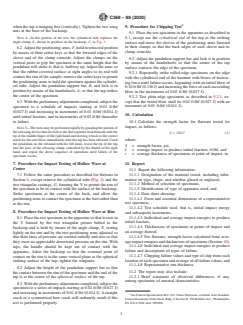
6.1 Mount the cylindrical tube shown in Fig. 2 (Note 4)on
ization established in the Decision on Principles for the
the backstop, C, Fig. 1, and set at a height such that the three
Development of International Standards, Guides and Recom-
ball bearings mounted in the end of the cylindrical tube are in
mendations issued by the World Trade Organization Technical contact and symmetrical with the central portion of the
Barriers to Trade (TBT) Committee.
specimen, which shall be stood on edge on the base plate. The
specimen may be tested with either the face or the back toward
the hammer; in general, a lower failure value is obtained when
the face is struck. Adjust the backstop so that the spherical
This test method is under the jurisdiction ofASTM Committee C21 on Ceramic
surface of the tup, D, just touches the surface of the specimen
Whitewares and Related Products and is the direct responsibility of Subcommittee
C21.03 on Methods for Whitewares and Environmental Concerns.
Current edition approved Nov. 1, 2020. Published December 2020. Originally
approved in 1955. Last previous edition approved in 2016 as C368 – 88 (2016). Detailed working drawings of the apparatus are available from ASTM
DOI: 10.1520/C0368-88R206. International Headquarters. Order Adjunct No. ADJC0368.
Copyright © ASTM International, 100 Barr Harbor Drive, PO Box C700, West Conshohocken, PA 19428-2959. United States
C368 − 88 (2020)
FIG. 1 Impact Test Apparatus
FIG. 2 Tube to Support Flatware Specimen
C368 − 88 (2020)
when the tup is hanging free (vertically). Tighten the two wing 9. Procedure for Chipping Test
nuts at the base of the backstop.
9.1 Place the test specimen in the apparatus as described in
8.1, except use the cylindrical end of the tup as the striking
NOTE 4—In this portion of the test, the cylindrical tube replaces the
angle clamp, E, shown in position on the backstop, C,in Fig. 1.
surface and move the sleeves of the positioning arms forward
in their clamps so that the back edges of each sleeve and its
6.2 Adjust the positioning arms,F, held in retracted position
clamp coincide.
by means of their cotter keys so that the forward edges of the
sleeve and of the clamp coincide. Adjust the clamps on the
9.2 Adjust the pendulum support bar and lock it in position
vertical posts to grip the specimen at the same height that the
by means of the handwheels so that the center of the tup
pendulum will strike it; that is, halfway up.Adjust the arms so
surface contacts the edge of the specimen.
that the rubber-covered surface at right angles to its rod will
9.2.1 Repeatedly strike rolled-edge specimens on the edge
contact
...