

ASTM D5472/D5472M-20
(Practice)Standard Practice for Determining Specific Capacity and Estimating Transmissivity at the Control Well
General Information
- Abstract
SIGNIFICANCE AND USE
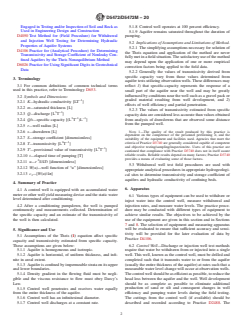
5.1 Assumptions of the Theis (1) equation affect specific capacity and transmissivity estimated from specific capacity. These assumptions are given below:
5.1.1 Aquifer is homogeneous and isotropic.
5.1.2 Aquifer is horizontal, of uniform thickness, and infinite in areal extent.
5.1.3 Aquifer is confined by impermeable strata on its upper and lower boundaries.
5.1.4 Density gradient in the flowing fluid must be negligible and the viscous resistance to flow must obey Darcy's Law.
5.1.5 Control well penetrates and receives water equally from the entire thickness of the aquifer.
5.1.6 Control well has an infinitesimal diameter.
5.1.7 Control well discharges at a constant rate.
5.1.8 Control well operates at 100 percent efficiency.
5.1.9 Aquifer remains saturated throughout the duration of pumping.
5.2 Implications of Assumptions and Limitations of Method.
5.2.1 The simplifying assumptions necessary for solution of the Theis equation and application of the method are never fully met in a field situation. The satisfactory use of the method may depend upon the application of one or more empirical correction factors being applied to the field data.
5.2.2 Generally the values of transmissivity derived from specific capacity vary from those values determined from aquifer tests utilizing observation wells. These differences may reflect 1) that specific-capacity represents the response of a small part of the aquifer near the well and may be greatly influenced by conditions near the well such as a gravel pack or graded material resulting from well development, and 2) effects of well efficiency and partial penetration.
5.2.3 The values of transmissivity estimated from specific capacity data are considered less accurate than values obtained from analysis of drawdowns that are observed some distance from the pumped well.
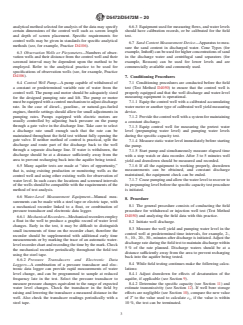
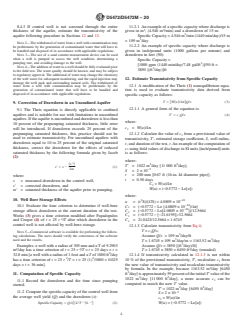
Note 1: The quality of the result produced by this practice is dependent on the competence of the personnel performing it...
SCOPE
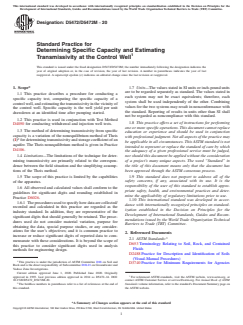
1.1 This practice describes a procedure for conducting a specific capacity test, computing the specific capacity of a control well, and estimating the transmissivity in the vicinity of the control well. Specific capacity is the well yield per unit drawdown at an identified time after pumping started.
1.2 This practice is used in conjunction with Test Method D4050 for conducting withdrawal and injection well tests.
1.3 The method of determining transmissivity from specific capacity is a variation of the nonequilibrium method of Theis (1)2 for determining transmissivity and storage coefficient of an aquifer. The Theis nonequilibrium method is given in Practice D4106.
1.4 Limitations—The limitations of the technique for determining transmissivity are primarily related to the correspondence between the field situation and the simplifying assumptions of the Theis method.
1.5 The scope of this practice is limited by the capabilities of the apparatus.
1.6 All observed and calculated values shall conform to the guidelines for significant digits and rounding established in Practice D6026.
1.6.1 The procedures used to specify how data are collected/recorded and calculated in this practice are regarded as the industry standard. In addition, they are representative of the significant digits that should generally be retained. The procedures used do not consider material variation, purpose for obtaining the data, special purpose studies, or any considerations for the user’s objectives; and it is common practice to increase or reduce significant digits of reported data to commensurate with these considerations. It is beyond the scope of this practice to consider significant digits used in analysis methods for engineering design.
1.7 Units—The values stated in SI units or inch-pound units are to be regarded separately as standard. The values stated in each system may not be exact equivalents; therefore, each system...
- Status
- Published
- Publication Date
- 31-May-2020
- Technical Committee
- D18 - Soil and Rock
- Drafting Committee
- D18.21 - Groundwater and Vadose Zone Investigations
Buy Documents
ASTM D5472/D5472M-20 - Standard Practice for Determining Specific Capacity and Estimating Transmissivity at the Control Well
REDLINE ASTM D5472/D5472M-20 - Standard Practice for Determining Specific Capacity and Estimating Transmissivity at the Control Well
Overview
ASTM D5472/D5472M-20 is the Standard Practice for Determining Specific Capacity and Estimating Transmissivity at the Control Well, developed by ASTM International. This practice defines procedures for conducting specific capacity tests in wells, calculating the specific capacity of a control well, and estimating aquifer transmissivity near the control well. Specific capacity, commonly used in groundwater hydrology, is the well yield per unit drawdown after a specified time of pumping, which helps in evaluating well performance and aquifer properties.
This standard is vital for groundwater professionals seeking reliable methods to assess aquifer characteristics, design well testing programs, and inform groundwater resource management decisions.
Key Topics
- Specific Capacity: This is defined as the ratio of well yield to drawdown, determined at a specified time after pumping begins.
- Transmissivity Estimation: The practice provides a method to estimate transmissivity-how much water can be transmitted horizontally through a unit width of aquifer-based on specific capacity data.
- Theis Nonequilibrium Method: The estimation process uses a variation of the Theis method, which relies on certain simplifying assumptions about aquifer conditions.
- Assumptions and Limitations:
- The aquifer is homogeneous, isotropic, horizontal, of uniform thickness, and of infinite areal extent.
- It is confined by impermeable layers above and below and remains saturated during the test.
- The control well is fully penetrating, operates at full efficiency, and maintains a constant discharge rate.
- In reality, these assumptions may not hold strictly in the field, so empirical correction factors may be needed for accuracy.
- Data Quality: The reliability of results depends on operator competence, equipment calibration, and adherence to industry standards for data collection and reporting.
Applications
This standard supports a range of groundwater resource and engineering applications, including:
- Aquifer Characterization: Determining specific capacity and transmissivity is essential for understanding groundwater availability and flow characteristics.
- Well Design and Performance Evaluation: Specific capacity tests inform decisions on well construction, development, and rehabilitation.
- Groundwater Management: Accurate estimates of transmissivity help manage pumping rates, protect against over-extraction, and design sustainable water supply systems.
- Site Assessment: Used in environmental and geotechnical investigations to assess suitability for water supply or contamination remediation.
- Hydraulic Property Determination: Supports calculation of hydraulic conductivity and storage coefficients when integrated with other standards (such as ASTM D4050 and D4106).
Practitioners using ASTM D5472/D5472M-20 can enhance groundwater studies, efficiently analyze field data, and comply with recognized best practices for hydrogeological testing.
Related Standards
To ensure robust testing programs and data interoperability, ASTM D5472/D5472M-20 is used in conjunction with related ASTM standards:
- ASTM D4050: Field procedures for withdrawal and injection well testing for determining hydraulic properties of aquifer systems.
- ASTM D4106: Analytical procedures for determining transmissivity and storage coefficient of nonleaky confined aquifers using the Theis nonequilibrium method.
- ASTM D653: Terminology relating to soil, rock, and contained fluids.
- ASTM D2488: Guidelines for soil description and identification using visual-manual procedures.
- ASTM D3740: Requirements for agencies involved in testing or inspection of soil and rock.
- ASTM D6026: Standard practice for using significant digits in geotechnical data, ensuring consistency and precision in data handling and reporting.
By following ASTM D5472/D5472M-20 and associated standards, groundwater professionals can perform standardized well testing, obtain dependable aquifer property measurements, and support informed water resource decisions. This enhances the accuracy, efficiency, and credibility of aquifer evaluations and hydrological studies.
Relations
- Effective Date
- 01-Nov-2023
- Effective Date
- 01-Jan-2020
- Effective Date
- 01-Oct-2019
- Effective Date
- 15-Jul-2017
- Effective Date
- 15-Apr-2015
- Effective Date
- 01-Aug-2014
- Effective Date
- 01-Jun-2014
- Effective Date
- 01-May-2012
- Effective Date
- 01-Mar-2012
- Effective Date
- 01-Sep-2011
- Effective Date
- 01-Sep-2011
- Effective Date
- 01-Mar-2010
- Effective Date
- 15-Jun-2009
- Effective Date
- 15-May-2009
- Effective Date
- 01-Jan-2009
Buy Documents
ASTM D5472/D5472M-20 - Standard Practice for Determining Specific Capacity and Estimating Transmissivity at the Control Well
REDLINE ASTM D5472/D5472M-20 - Standard Practice for Determining Specific Capacity and Estimating Transmissivity at the Control Well
Get Certified
Connect with accredited certification bodies for this standard

CIS Institut d.o.o.
Personal Protective Equipment (PPE) certification body. Notified Body NB-2890 for EU Regulation 2016/425 PPE.

Kiwa BDA Testing
Building and construction product certification.
Kmetijski inštitut Slovenije
Agricultural Institute of Slovenia. Soil testing, plant health, agricultural product analysis.
Sponsored listings
Frequently Asked Questions
ASTM D5472/D5472M-20 is a standard published by ASTM International. Its full title is "Standard Practice for Determining Specific Capacity and Estimating Transmissivity at the Control Well". This standard covers: SIGNIFICANCE AND USE 5.1 Assumptions of the Theis (1) equation affect specific capacity and transmissivity estimated from specific capacity. These assumptions are given below: 5.1.1 Aquifer is homogeneous and isotropic. 5.1.2 Aquifer is horizontal, of uniform thickness, and infinite in areal extent. 5.1.3 Aquifer is confined by impermeable strata on its upper and lower boundaries. 5.1.4 Density gradient in the flowing fluid must be negligible and the viscous resistance to flow must obey Darcy's Law. 5.1.5 Control well penetrates and receives water equally from the entire thickness of the aquifer. 5.1.6 Control well has an infinitesimal diameter. 5.1.7 Control well discharges at a constant rate. 5.1.8 Control well operates at 100 percent efficiency. 5.1.9 Aquifer remains saturated throughout the duration of pumping. 5.2 Implications of Assumptions and Limitations of Method. 5.2.1 The simplifying assumptions necessary for solution of the Theis equation and application of the method are never fully met in a field situation. The satisfactory use of the method may depend upon the application of one or more empirical correction factors being applied to the field data. 5.2.2 Generally the values of transmissivity derived from specific capacity vary from those values determined from aquifer tests utilizing observation wells. These differences may reflect 1) that specific-capacity represents the response of a small part of the aquifer near the well and may be greatly influenced by conditions near the well such as a gravel pack or graded material resulting from well development, and 2) effects of well efficiency and partial penetration. 5.2.3 The values of transmissivity estimated from specific capacity data are considered less accurate than values obtained from analysis of drawdowns that are observed some distance from the pumped well. Note 1: The quality of the result produced by this practice is dependent on the competence of the personnel performing it... SCOPE 1.1 This practice describes a procedure for conducting a specific capacity test, computing the specific capacity of a control well, and estimating the transmissivity in the vicinity of the control well. Specific capacity is the well yield per unit drawdown at an identified time after pumping started. 1.2 This practice is used in conjunction with Test Method D4050 for conducting withdrawal and injection well tests. 1.3 The method of determining transmissivity from specific capacity is a variation of the nonequilibrium method of Theis (1)2 for determining transmissivity and storage coefficient of an aquifer. The Theis nonequilibrium method is given in Practice D4106. 1.4 Limitations—The limitations of the technique for determining transmissivity are primarily related to the correspondence between the field situation and the simplifying assumptions of the Theis method. 1.5 The scope of this practice is limited by the capabilities of the apparatus. 1.6 All observed and calculated values shall conform to the guidelines for significant digits and rounding established in Practice D6026. 1.6.1 The procedures used to specify how data are collected/recorded and calculated in this practice are regarded as the industry standard. In addition, they are representative of the significant digits that should generally be retained. The procedures used do not consider material variation, purpose for obtaining the data, special purpose studies, or any considerations for the user’s objectives; and it is common practice to increase or reduce significant digits of reported data to commensurate with these considerations. It is beyond the scope of this practice to consider significant digits used in analysis methods for engineering design. 1.7 Units—The values stated in SI units or inch-pound units are to be regarded separately as standard. The values stated in each system may not be exact equivalents; therefore, each system...
SIGNIFICANCE AND USE 5.1 Assumptions of the Theis (1) equation affect specific capacity and transmissivity estimated from specific capacity. These assumptions are given below: 5.1.1 Aquifer is homogeneous and isotropic. 5.1.2 Aquifer is horizontal, of uniform thickness, and infinite in areal extent. 5.1.3 Aquifer is confined by impermeable strata on its upper and lower boundaries. 5.1.4 Density gradient in the flowing fluid must be negligible and the viscous resistance to flow must obey Darcy's Law. 5.1.5 Control well penetrates and receives water equally from the entire thickness of the aquifer. 5.1.6 Control well has an infinitesimal diameter. 5.1.7 Control well discharges at a constant rate. 5.1.8 Control well operates at 100 percent efficiency. 5.1.9 Aquifer remains saturated throughout the duration of pumping. 5.2 Implications of Assumptions and Limitations of Method. 5.2.1 The simplifying assumptions necessary for solution of the Theis equation and application of the method are never fully met in a field situation. The satisfactory use of the method may depend upon the application of one or more empirical correction factors being applied to the field data. 5.2.2 Generally the values of transmissivity derived from specific capacity vary from those values determined from aquifer tests utilizing observation wells. These differences may reflect 1) that specific-capacity represents the response of a small part of the aquifer near the well and may be greatly influenced by conditions near the well such as a gravel pack or graded material resulting from well development, and 2) effects of well efficiency and partial penetration. 5.2.3 The values of transmissivity estimated from specific capacity data are considered less accurate than values obtained from analysis of drawdowns that are observed some distance from the pumped well. Note 1: The quality of the result produced by this practice is dependent on the competence of the personnel performing it... SCOPE 1.1 This practice describes a procedure for conducting a specific capacity test, computing the specific capacity of a control well, and estimating the transmissivity in the vicinity of the control well. Specific capacity is the well yield per unit drawdown at an identified time after pumping started. 1.2 This practice is used in conjunction with Test Method D4050 for conducting withdrawal and injection well tests. 1.3 The method of determining transmissivity from specific capacity is a variation of the nonequilibrium method of Theis (1)2 for determining transmissivity and storage coefficient of an aquifer. The Theis nonequilibrium method is given in Practice D4106. 1.4 Limitations—The limitations of the technique for determining transmissivity are primarily related to the correspondence between the field situation and the simplifying assumptions of the Theis method. 1.5 The scope of this practice is limited by the capabilities of the apparatus. 1.6 All observed and calculated values shall conform to the guidelines for significant digits and rounding established in Practice D6026. 1.6.1 The procedures used to specify how data are collected/recorded and calculated in this practice are regarded as the industry standard. In addition, they are representative of the significant digits that should generally be retained. The procedures used do not consider material variation, purpose for obtaining the data, special purpose studies, or any considerations for the user’s objectives; and it is common practice to increase or reduce significant digits of reported data to commensurate with these considerations. It is beyond the scope of this practice to consider significant digits used in analysis methods for engineering design. 1.7 Units—The values stated in SI units or inch-pound units are to be regarded separately as standard. The values stated in each system may not be exact equivalents; therefore, each system...
ASTM D5472/D5472M-20 is classified under the following ICS (International Classification for Standards) categories: 13.060.10 - Water of natural resources. The ICS classification helps identify the subject area and facilitates finding related standards.
ASTM D5472/D5472M-20 has the following relationships with other standards: It is inter standard links to ASTM D3740-23, ASTM D4050-20, ASTM D3740-19, ASTM D2488-17, ASTM D4106-15, ASTM D653-14, ASTM D4050-14, ASTM D3740-12a, ASTM D3740-12, ASTM D653-11, ASTM D3740-11, ASTM D3740-10, ASTM D2488-09a, ASTM D2488-09, ASTM D653-09. Understanding these relationships helps ensure you are using the most current and applicable version of the standard.
ASTM D5472/D5472M-20 is available in PDF format for immediate download after purchase. The document can be added to your cart and obtained through the secure checkout process. Digital delivery ensures instant access to the complete standard document.
Standards Content (Sample)
This international standard was developed in accordance with internationally recognized principles on standardization established in the Decision on Principles for the
Development of International Standards, Guides and Recommendations issued by the World Trade Organization Technical Barriers to Trade (TBT) Committee.
Designation:D5472/D5472M −20
Standard Practice for
Determining Specific Capacity and Estimating
Transmissivity at the Control Well
This standard is issued under the fixed designation D5472/D5472M; the number immediately following the designation indicates the
year of original adoption or, in the case of revision, the year of last revision. A number in parentheses indicates the year of last
reapproval. A superscript epsilon (´) indicates an editorial change since the last revision or reapproval.
1. Scope* 1.7 Units—The values stated in SI units or inch-pound units
are to be regarded separately as standard. The values stated in
1.1 This practice describes a procedure for conducting a
each system may not be exact equivalents; therefore, each
specific capacity test, computing the specific capacity of a
system shall be used independently of the other. Combining
controlwell,andestimatingthetransmissivityinthevicinityof
values for the two systems may result in nonconformance with
the control well. Specific capacity is the well yield per unit
the standard. Reporting of results in units other than SI shall
drawdown at an identified time after pumping started.
not be regarded as noncompliance with this standard.
1.2 This practice is used in conjunction with Test Method
1.8 This practice offers a set of instructions for performing
D4050 for conducting withdrawal and injection well tests.
one or more specific operations. This document cannot replace
1.3 The method of determining transmissivity from specific
education or experience and should be used in conjunction
capacity is a variation of the nonequilibrium method of Theis
with professional judgment. Not all aspects of the practice may
(1) fordeterminingtransmissivityandstoragecoefficientofan
be applicable in all circumstances. This ASTM standard is not
aquifer. The Theis nonequilibrium method is given in Practice
intended to represent or replace the standard of care by which
D4106.
the adequacy of a given professional service must be judged,
1.4 Limitations—The limitations of the technique for deter- nor should this document be applied without the consideration
of a project’s many unique aspects. The word “Standard” in
mining transmissivity are primarily related to the correspon-
dence between the field situation and the simplifying assump- the title of this document means only that the document has
been approved through the ASTM consensus process.
tions of the Theis method.
1.9 This standard does not purport to address all of the
1.5 The scope of this practice is limited by the capabilities
safety concerns, if any, associated with its use. It is the
of the apparatus.
responsibility of the user of this standard to establish appro-
1.6 All observed and calculated values shall conform to the
priate safety, health, and environmental practices and deter-
guidelines for significant digits and rounding established in
mine the applicability of regulatory limitations prior to use.
Practice D6026.
1.10 This international standard was developed in accor-
1.6.1 Theproceduresusedtospecifyhowdataarecollected/
dance with internationally recognized principles on standard-
recorded and calculated in this practice are regarded as the
ization established in the Decision on Principles for the
industry standard. In addition, they are representative of the
Development of International Standards, Guides and Recom-
significant digits that should generally be retained. The proce-
mendations issued by the World Trade Organization Technical
dures used do not consider material variation, purpose for
Barriers to Trade (TBT) Committee.
obtaining the data, special purpose studies, or any consider-
ations for the user’s objectives; and it is common practice to
2. Referenced Documents
increase or reduce significant digits of reported data to com-
2.1 ASTM Standards:
mensurate with these considerations. It is beyond the scope of
D653Terminology Relating to Soil, Rock, and Contained
this practice to consider significant digits used in analysis
Fluids
methods for engineering design.
D2488Practice for Description and Identification of Soils
(Visual-Manual Procedures)
This practice is under the jurisdiction of ASTM Committee D18 on Soil and
D3740Practice for Minimum Requirements for Agencies
Rock and is the direct responsibility of Subcommittee D18.21 on Groundwater and
Vadose Zone Investigations.
Current edition approved June 1, 2020. Published June 2020. Originally
approved in 1993. Last previous edition approved in 2014 as D5472–14. DOI: For referenced ASTM standards, visit the ASTM website, www.astm.org, or
10.1520/D5472_D5472M-20. contact ASTM Customer Service at service@astm.org. For Annual Book of ASTM
The boldface numbers in parentheses refer to a list of references at the end of Standards volume information, refer to the standard’s Document Summary page on
this standard. the ASTM website.
*A Summary of Changes section appears at the end of this standard
Copyright © ASTM International, 100 Barr Harbor Drive, PO Box C700, West Conshohocken, PA 19428-2959. United States
D5472/D5472M−20
Engaged in Testing and/or Inspection of Soil and Rock as 5.1.8 Control well operates at 100 percent efficiency.
Used in Engineering Design and Construction 5.1.9 Aquifer remains saturated throughout the duration of
D4050Test Method for (Field Procedure) for Withdrawal
pumping.
and Injection Well Testing for Determining Hydraulic
5.2 Implications of Assumptions and Limitations of Method.
Properties of Aquifer Systems
5.2.1 Thesimplifyingassumptionsnecessaryforsolutionof
D4106Practice for (Analytical Procedure) for Determining
the Theis equation and application of the method are never
Transmissivity and Storage Coefficient of Nonleaky Con-
fullymetinafieldsituation.Thesatisfactoryuseofthemethod
fined Aquifers by the Theis Nonequilibrium Method
may depend upon the application of one or more empirical
D6026Practice for Using Significant Digits in Geotechnical
correction factors being applied to the field data.
Data
5.2.2 Generally the values of transmissivity derived from
specific capacity vary from those values determined from
3. Terminology
aquifertestsutilizingobservationwells.Thesedifferencesmay
3.1 For common definitions of common technical terms
reflect 1) that specific-capacity represents the response of a
used in this practice, refer to Terminology D653.
small part of the aquifer near the well and may be greatly
influenced by conditions near the well such as a gravel pack or
3.2 Symbols and Dimensions:
−1
graded material resulting from well development, and 2)
3.2.1 K—hydraulic conductivity [LT ]
effects of well efficiency and partial penetration.
3.2.2 m—saturated thickness [L]
5.2.3 The values of transmissivity estimated from specific
3 −1
3.2.3 Q—discharge [L T ]
capacity data are considered less accurate than values obtained
3 −1 −1
3.2.4 Q/s—specific capacity [(L T )L ] from analysis of drawdowns that are observed some distance
from the pumped well.
3.2.5 r—well radius [L]
NOTE 1—The quality of the result produced by this practice is
3.2.6 s—drawdown [L]
dependent on the competence of the personnel performing it, and the
3.2.7 S—storage coefficient [dimensionless]
suitability of the equipment and facilities used. Agencies that meet the
2 −1
criteria of Practice D3740 are generally considered capable of competent
3.2.8 T—transmissivity [L T ]
and objective testing/sampling/inspection/etc. Users of this practice are
2 −1
3.2.9 T'—provisional value of transmissivity [L T ]
cautioned that compliance with Practice D3740 does not in itself assure
reliable results. Reliable results depend on many factors; Practice D3740
3.2.10 t—elapsed time of pumping [T]
provides a means of evaluating some of those factors.
3.2.11 u—r S/4Tt [dimensionless]
5.3 Withdrawal well test field procedures are used with
3.2.12 W(u)—well function of “u” [dimensionless]
appropriate analytical procedures in appropriate hydrogeologi-
3.2.13 c —[W(u)/4π]
1 cal sites to determine transmissivity and storage coefficient of
aquifers and hydraulic conductivity of confining beds.
4. Summary of Practice
6. Apparatus
4.1 A control well is equipped with an accumulated water
meterorotherwellyieldmeasuringdeviceandthestaticwater
6.1 Various types of equipment can be used to withdraw or
level determined after conditioning.
inject water into the control well, measure withdrawal and
injection rates, and measure water levels. The practice proce-
4.2 After a conditioning pumpdown, the well is pumped
continuously and measurements collected. Determination of dure may be conducted with different types of equipment to
achieve similar results. The objectives to be achieved by the
the specific capacity and an estimate of the transmissivity of
the well is then calculated. use of the equipment are given in this section and in Sections
7 and 8. The selection of equipment and measuring apparatus
5. Significance and Use will be evaluated to ensure that sufficient accuracy and sensi-
tivity will be provided for the later evaluation of data by
5.1 Assumptions of the Theis (1) equation affect specific
Practice D4106.
capacity and transmissivity estimated from specific capacity.
These assumptions are given below: 6.2 Control Well—Discharge or injection well test methods
5.1.1 Aquifer is homogeneous and isotropic. require that water be withdrawn from or injected into a single
5.1.2 Aquifer is horizontal, of uniform thickness, and infi- well.This well, known as the control well, must be drilled and
nite in areal extent. completed such that it transmits water to or from the aquifer
5.1.3 Aquiferisconfinedbyimpermeablestrataonitsupper (usually the entire thickness of the aquifer) at rates such that a
and lower boundaries. measurable water level change will occur at observation wells.
5.1.4 Density gradient in the flowing fluid must be negli- Thecontrolwellshouldbeasefficientaspossible,toreducethe
gible and the viscous resistance to flow must obey Darcy’s head loss between the aquifer and the well. Well development
Law. should be as complete as possible to eliminate additional
5.1.5 Control well penetrates and receives water equally production of sand or silt and consequent changes in well
from the entire thickness of the aquifer. efficiency and pumping water levels during the field testing.
5.1.6 Control well has an infinitesimal diameter. The cuttings from the control well (if available) should be
5.1.7 Control well discharges at a constant rate. described and recorded according to Practice D2488. The
D5472/D5472M−20
analytical method selected for analysis of the data may specify 6.6.3 Equipmentusedformeasuringflows,andwaterlevels
certain dimensions of the control well such as screen length should have calibration records, or be calibrated for the field
and depth of screen placement. Specific requirements for test.
control wells may be given in standards for specific analytical
6.7 Sand Content Measurement Device—Apparatus to mea-
methods (see, for example, Practice D4106).
sure the sand content in discharged water. Cone Types (for
6.3 Observation Wells or Piezometers—Numbers of obser- example,Imhoff)canbeusedforhigherconcentrationsofsand
vation wells and their distance from the control well and their in the discharge water and centrifugal sand separators (for
screened interval may be dependent upon the method to be example, Rossum) can be used for lower levels and are
employed. Refer to the analytical practice to be used for commercially available and commonly used.
specifications of observation wells (see, for example, Practice
D4106). 7. Conditioning Procedures
6.4 Control Well Pump—A pump capable of withdrawal of 7.1 Conditioning procedures are conducted before the field
test (Test Method D4050) to ensure that the control well is
a constant or predetermined variable rate of water from the
control well. The pump and motor should be adequately sized properly equipped and that the well discharge and water-level
measuring equipment is operational.
for the designed pumping rate and lift. The pump or motor
mustbeequippedwithacontrolmechanismtoadjustdischarge 7.1.1 Equip the control well with a calibrated accumulating
rate. In the case of diesel-, gasoline-, or natural-gas-fueled water meter or another type of calibrated well yield measuring
engines, throttle settings should allow for small adjustments in device.
pumping rates. Pumps equipped with electric motors are
7.1.2 Providethecontrolwellwithasystemformaintaining
usually controlled by adjusting back pressure on the pump
a constant discharge.
through a gate valve in the discharge line. Take care to select
7.1.3 Equip control well for measuring the pretest water
a discharge rate small enough such that the rate can be
level (prepumping water level) and pumping water levels
maintained throughout the field test without fully opening the
during the specific capacity test.
gate valve. If neither method of control is practical, split the
7.1.4 Measurestaticwaterlevelimmediatelybeforestarting
discharge and route part of the discharge back to the well
the pump.
through a separate discharge line. If water is withdrawn, the
7.1.5 Start pump and simultaneously measure elapsed time
discharge should be at a distance sufficiently away from the
with a stop watch or data recorder. After 3 to 5 minutes well
area to prevent recharging bac
...
This document is not an ASTM standard and is intended only to provide the user of an ASTM standard an indication of what changes have been made to the previous version. Because
it may not be technically possible to adequately depict all changes accurately, ASTM recommends that users consult prior editions as appropriate. In all cases only the current version
of the standard as published by ASTM is to be considered the official document.
Designation: D5472/D5472M − 14 D5472/D5472M − 20
Standard Test Method Practice for
Determining Specific Capacity and Estimating
Transmissivity at the Control Well
This standard is issued under the fixed designation D5472/D5472M; the number immediately following the designation indicates the
year of original adoption or, in the case of revision, the year of last revision. A number in parentheses indicates the year of last
reapproval. A superscript epsilon (´) indicates an editorial change since the last revision or reapproval.
1. Scope*
1.1 This test describes a procedure for conducting a specific capacity test, computing the specific capacity of a control well, and
estimating the transmissivity in the vicinity of the control well. Specific capacity is the well yield per unit drawdown at an identified
time after pumping started.
1.2 This test method is used in conjunction with Test Method D4050 for conducting withdrawal and injection well tests.
1.3 The method of determining transmissivity from specific capacity is a variation of the nonequilibrium method of Theis (1)
for determining transmissivity and storage coefficient of an aquifer. The Theis nonequilibrium method is given in Test Method
D4106.
1.4 Limitations—The limitations of the technique for determining transmissivity are primarily related to the correspondence
between the field situation and the simplifying assumptions of the Theis method.
1.5 The scope of this test method is limited by the capabilities of the apparatus.
1.6 All observed and calculated values shall conform to the guidelines for significant digits and rounding established in Practice
D6026.
1.6.1 The procedures used to specify how data are collected/recorded and calculated in this standard are regarded as the industry
standard. In addition, they are representative of the significant digits that should generally be retained. The procedures used do not
consider material variation, purpose for obtaining the data, special purpose studies, or any considerations for the user’s objectives;
and it is common practice to increase or reduce significant digits of reported data to commensurate with these considerations. It
is beyond the scope of this standard to consider significant digits used in analysis methods for engineering design.
1.7 The values stated in SI units are to be regarded as standard. Rationalized inch-pound units also are used in this standard.
Each system of units is to be regarded separately as standard.
1.8 This standard may involve hazardous materials, operations, and equipment. This standard does not address safety problems
associated with its use. It is the responsibility of the user of this standard to establish appropriate safety and health practices and
determine the applicability of regulatory limitations prior to use.
2. Referenced Documents
2.1 ASTM Standards:
D653 Terminology Relating to Soil, Rock, and Contained Fluids
D2488 Practice for Description and Identification of Soils (Visual-Manual Procedures)
D3740 Practice for Minimum Requirements for Agencies Engaged in Testing and/or Inspection of Soil and Rock as Used in
Engineering Design and Construction
D4050 Test Method for (Field Procedure) for Withdrawal and Injection Well Testing for Determining Hydraulic Properties of
Aquifer Systems
This test method practice is under the jurisdiction of ASTM Committee D18 on Soil and Rock and is the direct responsibility of Subcommittee D18.21 on Groundwater
and Vadose Zone Investigations.
Current edition approved June 15, 2014June 1, 2020. Published August 2014June 2020. Originally approved in 1993. Last previous edition approved in 2005 as
D5472–93(2005), which was withdrawn February 2014 and reinstated in June 2014. DOI: 10.1520/D5472_D5472M-14.2014 as D5472–14. DOI: 10.1520/D5472_D5472M-
20.
The boldface numbers in parentheses refer to a list of references at the end of this standard.
For referenced ASTM standards, visit the ASTM website, www.astm.org, or contact ASTM Customer Service at service@astm.org. For Annual Book of ASTM Standards
volume information, refer to the standard’s Document Summary page on the ASTM website.
*A Summary of Changes section appears at the end of this standard
Copyright © ASTM International, 100 Barr Harbor Drive, PO Box C700, West Conshohocken, PA 19428-2959. United States
D5472/D5472M − 20
D4106 Practice for (Analytical Procedure) for Determining Transmissivity and Storage Coefficient of Nonleaky Confined
Aquifers by the Theis Nonequilibrium Method
D6026 Practice for Using Significant Digits in Geotechnical Data
3. Terminology
3.1 For common definitions of terms in this standard, refer to Terminology D653.
3.2 Symbols and Dimensions:
−1
3.2.1 K—hydraulic conductivity [LT ]
3.2.2 m—saturated thickness [L]
3 −1
3.2.3 Q—discharge [L T ]
3 −1 −1
3.2.4 Q/s—specific capacity [(L T )L ]
3.2.5 r—well radius [L]
3.2.6 s—drawdown [L]
3.2.7 S—storage coefficient [dimensionless]
2 −1
3.2.8 T—transmissivity [L T ]
2 −1
3.2.9 T'—provisional value of transmissivity [L T ]
3.2.10 t—elapsed time of pumping [T]
3.2.11 u—r S/4Tt [dimensionless]
3.2.12 W(u)—well function of “u” [dimensionless]
3.2.13 c —[W(u)/4π]
4. Summary of Test Method
4.1 A control well is equipped with an accumulated water meter or other well yield measuring device and the static water level
determined after conditioning.
4.2 After a conditioning pumpdown, the well is pumped continuously and measurements collected. Determination of the
specific capacity and an estimate of the transmissivity of the well is then calculated.
5. Significance and Use
5.1 Assumptions of the Theis (1) equation affect specific capacity and transmissivity estimated from specific capacity. These
assumptions are given below:
5.1.1 Aquifer is homogeneous and isotropic.
5.1.2 Aquifer is horizontal, of uniform thickness, and infinite in areal extent.
5.1.3 Aquifer is confined by impermeable strata on its upper and lower boundaries.
5.1.4 Density gradient in the flowing fluid must be negligible and the viscous resistance to flow must obey Darcy’s Law.
5.1.5 Control well penetrates and receives water equally from the entire thickness of the aquifer.
5.1.6 Control well has an infinitesimal diameter.
5.1.7 Control well discharges at a constant rate.
5.1.8 Control well operates at 100 percent efficiency.
5.1.9 Aquifer remains saturated throughout the duration of pumping.
5.2 Implications of Assumptions and Limitations of Method.
5.2.1 The simplifying assumptions necessary for solution of the Theis equation and application of the method are never fully
met in a field test situation. The satisfactory use of the method may depend upon the application of one or more empirical
correction factors being applied to the field data.
5.2.2 Generally the values of transmissivity derived from specific capacity vary from those values determined from aquifer tests
utilizing observation wells. These differences may reflect 1) that specific-capacity represents the response of a small part of the
aquifer near the well and may be greatly influenced by conditions near the well such as a gravel pack or graded material resulting
from well development, and 2) effects of well efficiency and partial penetration.
5.2.3 The values of transmissivity estimated from specific capacity data are considered less accurate than values obtained from
analysis of drawdowns that are observed some distance from the pumped well.
NOTE 1—The quality of the result produced by this standard is dependent on the competence of the personnel performing it, and the suitability of the
equipment and facilities used. Agencies that meet the criteria of Practice D3740 are generally considered capable of competent and objective
testing/sampling/inspection/etc. Users of this standard are cautioned that compliance with Practice D3740 does not in itself assure reliable results. Reliable
results depend on many factors; Practice D3740 provides a means of evaluating some of those factors.
D5472/D5472M − 20
5.3 Withdrawal well test field procedures are used with appropriate analytical procedures in appropriate hydrogeological sites
to determine transmissivity and storage coefficient of aquifers and hydraulic conductivity of confining beds.
6. Apparatus
6.1 Various types of equipment can be used to withdraw or inject water into the control well, measure withdrawal and injection
rates, and measure water levels. The test procedure may be conducted with different types of equipment to achieve similar results.
The objectives to be achieved by the use of the equipment are given in this section and in Sections 7 and 8. The selection of
equipment and measuring apparatus will be evaluated to ensure that sufficient accuracy and sensitivity will be provided for the later
evaluation of data by Test Method D4106.
6.2 Control Well—Discharge or injection well test methods require that water be withdrawn from or injected into a single well.
This well, known as the control well, must be drilled and completed such that it transmits water to or from the aquifer (usually
the entire thickness of the aquifer) at rates such that a measurable water level change will occur at observation wells. The control
well should be as efficient as possible, to reduce the head loss between the aquifer and the well. Well development should be as
complete as possible to eliminate additional production of sand or silt and consequent changes in well efficiency and pumping
water levels during the test. The cuttings from the control well should be described and recorded according to Practice D2488. The
analytical method selected for analysis of the data may specify certain dimensions of the control well such as screen length and
depth of screen placement. Specific requirements for control wells may be given in standards for specific analytical methods (see,
for example, Test Method D4106).
6.3 Observation Wells or Piezometers—Numbers of observation wells and their distance from the control well and their
screened interval may be dependent upon the test method to be employed. Refer to the analytical test method to be used for
specifications of observation wells (see, for example, Test Method D4106).
6.4 Control Well Pump—A pump capable of withdrawal of a constant or predetermined variable rate of water from the control
well. The pump and motor should be adequately sized for the designed pumping rate and lift. The pump or motor must be equipped
with a control mechanism to adjust discharge rate. In the case of diesel-, gasoline-, or natural-gas-fueled engines, throttle settings
should allow for small adjustments in pumping rates. Pumps equipped with electric motors are usually controlled by adjusting back
pressure on the pump through a gate valve in the discharge line. Take care to select a discharge rate small enough such that the
rate can be maintained throughout the test without fully opening the gate valve. If neither method of control is practical, split the
discharge and route part of the discharge back to the well through a separate discharge line. If water is withdrawn, the discharge
should be at a distance sufficiently away from the area to prevent recharging back into the aquifer being tested.
6.5 Many aquifer tests are made at “sites of opportunity,” that is, using existing production wells as the control well and using
other existing wells for observation of water level. In such cases the locations and screened intervals of the wells should be
compatible with the requirements of the method of test analysis.
6.6 Water-Level Measurement Equipment—Manual measurements can be made with a steel tape or electric tape, with a
mechanical recorder linked to a float, or combination of pressure transducer and electronic data logger.
6.6.1 Mechanical Recorders—Mechanical recorders employ a float in the well to produce a graphic record of water level
changes. Early in the test, it may be difficult to distinguish small increments of time on the recorder chart, therefore the recorder
should be supplemented with additional early time measurements or by marking the trace of an automatic waterlevel recorder chart
and recording the time by the mark. Check the mechanical recorder periodically throughout the test using the steel tape.
6.6.2 Pressure Transducers and Electronic Data Loggers—A combination of a pressure transducer and electronic data logger
can provide rapid measurements of water level change, and can be programmed to sample at reduced frequency late in the test.
Select the pressure transducer to measure pressure changes equivalent to the range of expected water level changes. Check the
transducer in the field by raising and lowering the transducer a measured distance in the well. Also check the transducer readings
periodically with a steel tape.
6.6.3 Equipment used for measuring flows, and water levels should have calibration records, or be calibrated for the test.
6.7 Sand Content Measurement Device—Apparatus to measure the sand content in discharged water. Cone Types (for example,
Imhoff) can be used for higher concentrations of sand in the discharge water and centrifugal sand separators (for example, Rossum)
can be used for lower levels and are commercially available and commonly used.
7. Conditioning Procedures
7.1 Conditioning procedures are conducted before the test to ensure that the control well is properly equipped and that the well
discharge and water-level measuring equipment is operational.
7.1.1 Equip the control well with a calibrated accumulating water meter or another type of calibrated well yield measuring
device.
7.1.2 Provide the control well with a system for maintaining a constant discharge.
7.1.3 Equip control well for measuring the pretest water level (prepumping water level) and pumping water levels during the
specific capacity test.
D5472/D5472M − 20
7.1.4 Measure static water level immediately before starting the pump.
7.1.5 Start pump and simultaneously measure elapsed time with a stop watch or data recorder. After 3 to 5 minutes well yield
and drawdown should be measured and recorded.
7.1.6 If all the equipment is working properly, drawdown measurements can be obtained, and constant discharge maintained,
the equipment check can be ended.
7.1.7 Cease pumping and allow the water level to recover to its prepumping level before the specific capacity test procedure
is initiated.
8. Test Procedure
8.1 Initiate well discharge.
8.2 Measure the well yield and pumping water level in the control well at predetermined time intervals, for example, 2-, 5-, 10-,
20-, 30-, minutes after discharge is initiated. Adjust the discharge rate during the test to maintain discharge within 5 % of the rate
planned. Discharge waters should be at a distance sufficiently away from the area to prevent recharging back into the aquifer being
tested.
8.3 While test continues make the following calculations:
8.3.1 Adjust drawdown for effects of desaturation of the aquifer, if applicable (see Section 9).
8.3.2 Determine the specific capacity (see Section 11) and estimate transmissivity (see Section 12). If well bore storage effects
are negligible (see Section 10), compare the new value of T' to the value used to calculate c , if the value is within 10 %, the test
can be terminated.
8.3.3 If control well is not screened through the entire thickness of the aquifer, estimate the transmissivity of the aquifer
following procedure in Sections 12 and 13.
NOTE 2—The withdrawal of water from a well with contamination may be problematic by the generation of contaminated water that will have to be
handled and disposed of in accordance with applicable regulations.
NOTE 3—The use of a sand content measurement device can be used when a well is pumped to assess the well condition, determining a pumping rate,
and avoiding damage to the well.
9. Correction of Drawdown in an Unconfined Aquifer
9.1 The Theis equation is directly applicable to confined aquifers and is suitable for use with limitations in unconfined aquifers.
If the aquifer is unconfined and drawdown is less than 10 percent of the prepumping saturated thickness, little error will be
introduced. If drawdown exceeds 25 percent of the prepumping saturated thickness, this test should not be used to estimate
transmissivity. For unconfined aquifers with drawdown equal to 10 to 25 percent of the original saturated thickness, correct the
drawdown for the effects of reduced saturated thickness by the following formula given by Jacob (2):
~s !
s'5 s 2 (1)
2m
where:
s = measured drawdown in the control well,
s' = corrected drawdown, and
m' = saturated thickness of the aquifer prior to pumping.
10. Well Bore Storage Effects
10.1 Evaluate the time criterion to determine if well-bore storage affects drawdown at the current duration of the test. Weeks
(3) gives a time criterion modified after Papadopulos and Cooper (4) of t > 25 r /T after which drawdown in the control well is
not affected by well-bore storage.
2 2
Examples: a well with a radius of 305 mm and a T of 9.2903 m /day has a time criterion of t > 25 r /T = t > 25 days = t > 32.8
2 2 2
min [a well with a radius of 1 foot and a T of 1000 ft /day has a time criterion of t > 25 r /T = t > 25 (1) /1000 = 0.025 days = t
> 36 min].
11. Computation of Specific Capacity
11.1 Record the drawdown and the time since pumping started.
11.2 Compute the specific capacity of the control well from the average well yield (Q) and the drawdown (s):
3 21 21
Specific Capacity 5 Q/s@~L T !L # (2)
3 3
11.2.1 An example of a specific capacity where discharge is given in m , (4.546 m /min) and a drawdown of 15 m:
3 3
Specific Capacity = 4.546 m /min (1440 min/day)/15 m = 109 m /day
11.2.2 An example of specific capacity where discharge is given in inch/pound units (1000 gallons per minute) and drawdown
in feet (50):
D5472/D5472M − 20
Specific Capacity =
[1000 gpm (1440 min/day/7.48 gal/ft )]/50 ft =
3850 [(ft /day)]ft
12. Estimate Transmissivity from Specific Capacity
12.1 A modification of the Theis (1) nonequilibrium equation is used to evaluate transmissivity data derived from specific
capacity as follows:
T 5 @W~u!/4π#Q/s (3)
12.1.1 A general form of the equation is:
T'5 c Q/s (4)
where:
c = W(u)/4π.
12.1.2 Calculate the value of c from a provisional value of transmissivity, T', estimated storage coefficient, S, well radius, r,
and duration of the test, t. An example of the computation of c using field values of discharge in SI units [inch/pound] units is
as follows:
where:
2 2
T' = 1022 m /day [11 000 ft /day],
−5
S = 2 × 10
r = 200 mm [0.67 ft (16-in. Id diameter pipe)],
t = 0.50 days
C = W(u)/4π
W(u) = (−0.5772 − Ln[u])
where:
2 −10
u = (r S)/(4Tt) = 4.0809 × 10
−10
C = (−0.5772 − Ln [4.0809 × 10 )/4π]
−10
C = (−0.5772 − Ln[4.0809 × 10 ])/12.5664
C = (−0.5772 − [−21.6195]) ⁄12.5664
C = 21.0423/12.5664 = 1.6745
12.1.3 Calculate transmissivity from Eq 4;
T = c Q/s,
Assume Q/s = 109 m /day/ft
3 3
T = 1.6745 × 10⁹ m /day/m = 1163.52 m /day
Assume Q/s = 3850 [(ft /day)/ft]
T = 1.6745 × 3850 = 6450 ft /day (rounded)
12.1.4 If transmissivity calculated in 12.1.3 is not within 10 % of the provisional transmissivity, T', recalculate c from the new
3 2
value of transmissivity and recalculate transmissivity by formula. In the example, because 1163.52 m /day [6450 ft /day] is
2 2
approximately 59 percent of the initial T' value of the 1022 m /day [11 000 ft /day], a more accurate c can be computed to match
the new T' value.
2 2
T' = 1022 m /day [6450 ft /day]
−5
S = 2 × 10
c = W(u)/4π
W(u) = (−0.5772 − Ln[u])
where:
2 −6 −10
u = (r S)/(4Tt) = 8.9780 × 10 = 6.9597 × 10
−10
C = (−0.5772 − Ln 6.9597 × 10 )/4π
−10
C = (−0.5772 − Ln 6.9597 × 10 )/12.5664
C = (−0.5772 − (−21.0857) ⁄12.5664
C = 20.5085/12.5664 = 1.6320
thus:
T' = C (Q/s) =
2 2
1.6320 × 10²² m /day = 1667 m /day
[1.6320 × 3850 = 6300 ft /day (rounded)]
The new value of transmissivity is within 10 % of the value used to compute transmissivity.
NOTE 4—The initial estimates of transmissivity can be based on values of transmissivity and storage of the aquifer determined at other locations or
D5472/D5472M − 20
from a general knowledge of the aquifer properties. The transmissivity could be estimated from driller’s logs using methods described by Gutentag and
−6
others (5). The storage coefficient can be estimated for unconfined aquifer as 0.2 and for confined aquifers as b × 10 , where b is the thickness of the
aquifer in metres [feet]. In areas where aquifer properties are not known and drillers log data are lacking, the following values, modified from Harlan,
Kolm, and Gutentag (6) can be used as initial estimates of c :
Confined aquifers 1.6
Unconfined aquifers 0.8
13. Correction of Transmissivity for Partially Penetrating Well
13.1 If the full aquifer thickness is not screened, the value of T' represents the transmissivity of the screened section of the
aquifer. To estimate the transmissivity of the full thickness of the aquifer, divide estimated transmissivity by the length of the
screened interval to compute the hydraulic conductivity (K). After computing (K) the hydraulic conductivity value is multiplied
by the entire thickness of the saturated thickness (m) of the aquifer to compute an estimate of transmissivity as: T = Km .
14. Report: Test Data Sheets/Forms
14.1 Prepare a report containing all data, including a description of the field site, well construction, names of personnel
involved, plots of pumping water level and well discharge with time.
14.2 Present analysis of data, using iteration techniques for c, when results differ from initial input values of T and S.
14.3 Compare estimated test conditions with the test method assumptions listed in 5.1.
14.4 Calibration records for flowmeters, water level devices and systems.
14.5 Sand content in discharge water (if used) data.
15. Precision and Bias
15.1 Precision—Test data on precision is not presented due to the nature of this test method. It is either not feasible or too costly
at this time to have ten or more agencies participate in an in situ testing program at a given site.
15.1.1 The subcommittee (insert number) is seeking any data from the users of this test method that might be used to make a
limited statement on precision.
15.2 Bias—There is no accepted reference value for this test method, therefore bias cannot be determined.
16. Keywords
16.1 aquifers; aquifer tests; control wells; hydraulic conductivity; observation wells; specific capacity; storage coefficient;
transmissivity; unconfined aquifers
REFERENCES
(1) Theis, C. V., 1935, The Relation Between the Lowering of Duration of Discharge of a Well Using Ground-Water Storage: American Geophysical
Union Transactions, v. 16. pt. 2, p. 519–524.
(2) Jacob, C. E., “Determining the Permeability of Water-Table Aquifers,” in Bentall, Ray, Compiler, “Methods of Determining Permeability,
Transmissibility, and Drawdown,” U.S. Geological Survey Water-Supply Paper 1536-I, 1963, pp. 245–271.
(3) Weeks, E. P., 1978, Aquifer Tests—the State of the Art in Hydrology: in Proceedings Invitational Well-Testing Symposium, October 19–21, 1977,
Lawrence Berkeley Laboratory, University of California, LBL-7027, UC-66, TID 4500-R66, p. 14–26.
(4) Papadopulos, I. S., and Cooper, H. H., Jr., 1967, Drawdown in a Well of Large Diameter: Water Resources Research, v. 3, no. 1, p. 241–244.
(5) Gutentag, E. D., Heimes, F. J., Krothe, N. C., Luckey, R. R., and Weeks, J. B., 1984, Geohydrology of the High Plains Aquifer in parts of Colorado,
Kansas, Nebraska, New Mexico, Oklahoma, South Dakota, Texas, and Wyoming: U.S. Geological Survey Professional Paper 1400-B, 63 p.
(6) Harlan, R. L., Kolm, K. E., and Gutentag, E. D., 1989, Water-Well Design and Construction: Elsevier, Amsterdam, 205, p.
D5472/D5472M − 20
SUMMARY OF CHANGES
In accordance with Committee D18 policy, this section identifies the location of changes to this standard since
the last edition (1993 (Reapproved 2005)) that may impact the use of this standard.
(1) Revised section 1.3 to make Standard a combined SI/Inch Pound standard. Revised examples and dimensions throughout to
reflect a combined SI/inchpound system.
(2) Revised title of Section 13.
(3) Updated Precision and Bias Statement
(4) Updated Terminology introduction and removed terminology already existing in D653.
(5) Added information and notes for the use of D3740 and D6026.
(6) Added Summary of Test Method, new Section 4, and renumbered existing sections
(7) Imported the description of equipment used from D4050 to make standard stand alone.
(8) Added notes and renumbered existing notes.
ASTM International takes no position respecting the validity of any patent rights asserted in connection with any item mentioned
in this standard. Users of this standard are expressly advised that determination of the validity of any such patent rights, and the risk
of infringement of such rights, are entirely their own responsibility.
This standard is subject to revision at any time by the responsible technical committee and must be reviewed every five years and
if not revised, either reapproved or withdrawn. Your comments are invited either for revision of this standard or for additional standards
and should be addressed to ASTM International Headquarters. Your comments will receive careful consideration at a meeting of the
responsible technical committee, which you may attend. If you feel that your comments have not received a fair hearing you should
make your views known to the ASTM Committee on Standards, at the address shown below.
This standard is copyrighted by ASTM International, 100 Barr Harbor Drive, PO Box C700, West Conshohocken, PA 19428-2959,
United States. Individual reprints (single or multiple copies) of this standard may be obtained by contacting ASTM at the above
address or at 610-832-9585 (phone), 610-832-9555 (fax), or serv
...