

ASTM D7027-20
(Test Method)Standard Test Method for Evaluation of Scratch Resistance of Polymeric Coatings and Plastics Using an Instrumented Scratch Machine
General Information
- Abstract
SIGNIFICANCE AND USE
5.1 Scratch tests are performed on specimens:
(1) to evaluate the scratch resistance of a particular material,
(2) to rank the relative scratch resistance of different materials, or
(3) to determine the scratch coefficient of friction of materials.
5.2 Since polymers exhibit mechanical properties that are strongly dependent on temperature, the test standard prescribed herein is designed to yield reproducible results when users perform tests under the similar testing environment and on specimens of the same material and surface texture that are subjected to the same conditioning procedures.
5.3 Certain polymers are self-healing (recoverable) when subjected to scratches and other physical deformations because of their viscoelastic and relaxation properties. It is important to note the difference between the instantaneous (if readily measurable) and residual scratch damage and compare results appropriately to ensure reproducibility. It is recommended that 24 hours be allowed for viscoelastic recovery when considering residual scratch depth.
5.4 “Whitening” of the scratched surface is a key damage mechanism that has prompted much concern in automotive and other applications where surface aesthetics is important. This type of damage is undesirable because it is evident to the human eye. The critical normal load at which this phenomenon appears serves as a benchmark in ranking material performance, especially from an aesthetic point of view.
SCOPE
1.1 This test method describes a laboratory procedure using an instrumented scratch machine to produce and quantify surface damage under controlled conditions. This test method is able to characterize the scratch resistance of polymers by measuring many significant material parameters. The scratch-inducing and data acquisition process is automated to avoid user-influenced effects that may affect the results.
1.2 The values stated in SI units are to be regarded as standard. The values in parentheses are for information only.
1.3 This standard does not purport to address all of the safety concerns, if any, associated with its use. It is the responsibility of the user of this standard to establish appropriate safety, health, and environmental practices and determine the applicability of regulatory limitations prior to use.
Note 1: This standard is equivalent to ISO 19252.
1.4 This international standard was developed in accordance with internationally recognized principles on standardization established in the Decision on Principles for the Development of International Standards, Guides and Recommendations issued by the World Trade Organization Technical Barriers to Trade (TBT) Committee.
- Status
- Published
- Publication Date
- 31-Aug-2020
- Technical Committee
- D20 - Plastics
- Drafting Committee
- D20.10 - Mechanical Properties
Buy Documents
ASTM D7027-20 - Standard Test Method for Evaluation of Scratch Resistance of Polymeric Coatings and Plastics Using an Instrumented Scratch Machine
REDLINE ASTM D7027-20 - Standard Test Method for Evaluation of Scratch Resistance of Polymeric Coatings and Plastics Using an Instrumented Scratch Machine
Overview
ASTM D7027-20, titled "Standard Test Method for Evaluation of Scratch Resistance of Polymeric Coatings and Plastics Using an Instrumented Scratch Machine", establishes a laboratory procedure to assess and quantify surface damage from scratching on polymer-based materials. Utilizing an instrumented scratch machine, this standard ensures objective, repeatable measurements of scratch resistance, critical normal load, and scratch coefficient of friction. The method supports product development and quality control in industries where the surface aesthetics and durability of polymers are crucial, such as automotive, electronics, and consumer goods sectors.
Key Topics
Scratch Resistance Evaluation: The standard describes procedures to evaluate a material’s resistance to surface scratches, focusing on both instant and residual damage.
Critical Normal Load: Determines the load at which a material exhibits unacceptable surface damage-commonly whitening or visible deformation-serving as a benchmark for comparing material performance.
Scratch Coefficient of Friction: Measures the resistance encountered by a stylus tip moving across the material, distinguishing between static and kinetic friction components.
Automated, Reproducible Testing: The process utilizes automated equipment, minimizing operator influence and ensuring consistent, reliable results.
Polymers’ Temperature Sensitivity: The standard prescribes control of environmental variables and specimen conditioning, underscoring reproducibility when testing polymers with temperature-dependent properties.
Visual and Instrumented Analysis: Emphasizes both visual inspection and instrument-based evaluation (e.g., profilometers, microscopes, or scanners) for quantifying scratch damage characteristics-width, depth, and degree of whitening.
Applications
ASTM D7027-20 provides practical methodologies for:
Material Selection and Product Development:
- Automotive manufacturers use this test to ensure interior and exterior plastics resist unsightly scratches and whitening, maintaining product appearance.
- Electronics producers apply the method to test plastic enclosures and screens for daily wear resistance.
Comparative Material Ranking:
- Enables engineers to compare various polymers and coatings under identical conditions, supporting data-based decisions in polymer selection.
- Facilitates benchmarking versus industry standards or competitive products.
Quality Control and Consistency:
- Allows manufacturers to monitor batch-to-batch consistency in scratch resistance.
- Supports documentation required by clients who demand compliance to international polymer scratch resistance standards.
Research and Failure Analysis:
- Academic and industrial research teams utilize the standard to understand failure modes such as micro-cracking or whitening.
- Useful in identifying “self-healing” behavior in polymers by comparing instantaneous and residual scratch damage.
Related Standards
To ensure comprehensive scratch resistance evaluation and alignment with global practices, ASTM D7027-20 references or is related to:
- ISO 19252: International equivalent focused on instrumented scratch testing of plastics.
- ASTM D618: Practice for conditioning plastics prior to testing.
- ASTM D638: Test method for tensile properties of plastics.
- ASTM D883: Terminology relating to plastics.
- ASTM D1894: Test method for static and kinetic coefficients of friction of plastic film and sheeting.
- ASTM G171: Test method for scratch hardness using a diamond stylus.
- ASTM E177 & E456: Guidance on test method precision, bias, and terminology.
By following ASTM D7027-20, laboratories and manufacturers worldwide can achieve credible, standardized scratch resistance data for polymeric materials, aiding material qualification, product development, and quality assurance. This standard is essential for any organization looking to enhance the surface durability of plastics and polymeric coatings across diverse industries.
Relations
- Effective Date
- 01-Feb-2024
- Effective Date
- 01-Feb-2024
- Effective Date
- 01-Jan-2024
- Effective Date
- 01-Nov-2023
- Effective Date
- 01-Nov-2023
- Effective Date
- 01-Apr-2022
- Effective Date
- 01-Jan-2020
- Effective Date
- 01-Aug-2019
- Effective Date
- 15-Apr-2019
- Effective Date
- 01-Feb-2019
- Effective Date
- 01-Dec-2018
- Effective Date
- 01-Nov-2018
- Refers
ASTM G171-03(2017) - Standard Test Method for Scratch Hardness of Materials Using a Diamond Stylus - Effective Date
- 01-Nov-2017
- Effective Date
- 01-Oct-2017
- Effective Date
- 01-Oct-2017
Buy Documents
ASTM D7027-20 - Standard Test Method for Evaluation of Scratch Resistance of Polymeric Coatings and Plastics Using an Instrumented Scratch Machine
REDLINE ASTM D7027-20 - Standard Test Method for Evaluation of Scratch Resistance of Polymeric Coatings and Plastics Using an Instrumented Scratch Machine
Get Certified
Connect with accredited certification bodies for this standard

DVS-ZERT GmbH
German welding certification society.
CARES (UK Certification Authority for Reinforcing Steels)
UK certification for reinforcing steels and construction.
EWF/IIW (European/International Welding Federation)
International welding personnel certification.
Sponsored listings
Frequently Asked Questions
ASTM D7027-20 is a standard published by ASTM International. Its full title is "Standard Test Method for Evaluation of Scratch Resistance of Polymeric Coatings and Plastics Using an Instrumented Scratch Machine". This standard covers: SIGNIFICANCE AND USE 5.1 Scratch tests are performed on specimens: (1) to evaluate the scratch resistance of a particular material, (2) to rank the relative scratch resistance of different materials, or (3) to determine the scratch coefficient of friction of materials. 5.2 Since polymers exhibit mechanical properties that are strongly dependent on temperature, the test standard prescribed herein is designed to yield reproducible results when users perform tests under the similar testing environment and on specimens of the same material and surface texture that are subjected to the same conditioning procedures. 5.3 Certain polymers are self-healing (recoverable) when subjected to scratches and other physical deformations because of their viscoelastic and relaxation properties. It is important to note the difference between the instantaneous (if readily measurable) and residual scratch damage and compare results appropriately to ensure reproducibility. It is recommended that 24 hours be allowed for viscoelastic recovery when considering residual scratch depth. 5.4 “Whitening” of the scratched surface is a key damage mechanism that has prompted much concern in automotive and other applications where surface aesthetics is important. This type of damage is undesirable because it is evident to the human eye. The critical normal load at which this phenomenon appears serves as a benchmark in ranking material performance, especially from an aesthetic point of view. SCOPE 1.1 This test method describes a laboratory procedure using an instrumented scratch machine to produce and quantify surface damage under controlled conditions. This test method is able to characterize the scratch resistance of polymers by measuring many significant material parameters. The scratch-inducing and data acquisition process is automated to avoid user-influenced effects that may affect the results. 1.2 The values stated in SI units are to be regarded as standard. The values in parentheses are for information only. 1.3 This standard does not purport to address all of the safety concerns, if any, associated with its use. It is the responsibility of the user of this standard to establish appropriate safety, health, and environmental practices and determine the applicability of regulatory limitations prior to use. Note 1: This standard is equivalent to ISO 19252. 1.4 This international standard was developed in accordance with internationally recognized principles on standardization established in the Decision on Principles for the Development of International Standards, Guides and Recommendations issued by the World Trade Organization Technical Barriers to Trade (TBT) Committee.
SIGNIFICANCE AND USE 5.1 Scratch tests are performed on specimens: (1) to evaluate the scratch resistance of a particular material, (2) to rank the relative scratch resistance of different materials, or (3) to determine the scratch coefficient of friction of materials. 5.2 Since polymers exhibit mechanical properties that are strongly dependent on temperature, the test standard prescribed herein is designed to yield reproducible results when users perform tests under the similar testing environment and on specimens of the same material and surface texture that are subjected to the same conditioning procedures. 5.3 Certain polymers are self-healing (recoverable) when subjected to scratches and other physical deformations because of their viscoelastic and relaxation properties. It is important to note the difference between the instantaneous (if readily measurable) and residual scratch damage and compare results appropriately to ensure reproducibility. It is recommended that 24 hours be allowed for viscoelastic recovery when considering residual scratch depth. 5.4 “Whitening” of the scratched surface is a key damage mechanism that has prompted much concern in automotive and other applications where surface aesthetics is important. This type of damage is undesirable because it is evident to the human eye. The critical normal load at which this phenomenon appears serves as a benchmark in ranking material performance, especially from an aesthetic point of view. SCOPE 1.1 This test method describes a laboratory procedure using an instrumented scratch machine to produce and quantify surface damage under controlled conditions. This test method is able to characterize the scratch resistance of polymers by measuring many significant material parameters. The scratch-inducing and data acquisition process is automated to avoid user-influenced effects that may affect the results. 1.2 The values stated in SI units are to be regarded as standard. The values in parentheses are for information only. 1.3 This standard does not purport to address all of the safety concerns, if any, associated with its use. It is the responsibility of the user of this standard to establish appropriate safety, health, and environmental practices and determine the applicability of regulatory limitations prior to use. Note 1: This standard is equivalent to ISO 19252. 1.4 This international standard was developed in accordance with internationally recognized principles on standardization established in the Decision on Principles for the Development of International Standards, Guides and Recommendations issued by the World Trade Organization Technical Barriers to Trade (TBT) Committee.
ASTM D7027-20 is classified under the following ICS (International Classification for Standards) categories: 25.220.60 - Organic coatings. The ICS classification helps identify the subject area and facilitates finding related standards.
ASTM D7027-20 has the following relationships with other standards: It is inter standard links to ASTM D883-24, ASTM A276/A276M-24a, ASTM A276/A276M-24, ASTM G99-23, ASTM D883-23, ASTM E456-13a(2022)e1, ASTM D883-20, ASTM D883-19c, ASTM D883-19a, ASTM D883-19, ASTM D883-18a, ASTM D883-18, ASTM G171-03(2017), ASTM E456-13A(2017)e3, ASTM E456-13A(2017)e1. Understanding these relationships helps ensure you are using the most current and applicable version of the standard.
ASTM D7027-20 is available in PDF format for immediate download after purchase. The document can be added to your cart and obtained through the secure checkout process. Digital delivery ensures instant access to the complete standard document.
Standards Content (Sample)
This international standard was developed in accordance with internationally recognized principles on standardization established in the Decision on Principles for the
Development of International Standards, Guides and Recommendations issued by the World Trade Organization Technical Barriers to Trade (TBT) Committee.
Designation: D7027 − 20
Standard Test Method for
Evaluation of Scratch Resistance of Polymeric Coatings and
Plastics Using an Instrumented Scratch Machine
This standard is issued under the fixed designation D7027; the number immediately following the designation indicates the year of
original adoption or, in the case of revision, the year of last revision.Anumber in parentheses indicates the year of last reapproval.A
superscript epsilon (´) indicates an editorial change since the last revision or reapproval.
1. Scope* E177Practice for Use of the Terms Precision and Bias in
ASTM Test Methods
1.1 This test method describes a laboratory procedure using
E456Terminology Relating to Quality and Statistics
an instrumented scratch machine to produce and quantify
G99Test Method for Wear Testing with a Pin-on-Disk
surface damage under controlled conditions. This test method
Apparatus
is able to characterize the scratch resistance of polymers by
G171Test Method for Scratch Hardness of Materials Using
measuring many significant material parameters. The scratch-
a Diamond Stylus
inducing and data acquisition process is automated to avoid
user-influenced effects that may affect the results.
3. Terminology
1.2 The values stated in SI units are to be regarded as
3.1 Terms used in this standard are defined in accordance
standard. The values in parentheses are for information only.
with Terminology D883, unless otherwise specified. For terms
1.3 This standard does not purport to address all of the
relating to precision and bias and associated issues, the terms
safety concerns, if any, associated with its use. It is the
used in this standard are defined in accordance with Terminol-
responsibility of the user of this standard to establish appro-
ogy E456.
priate safety, health, and environmental practices and deter-
3.2 Definitions:
mine the applicability of regulatory limitations prior to use.
3.2.1 ASV Software, n—Automatic Scratch Visualization,a
NOTE 1—This standard is equivalent to ISO 19252.
computer program which automates the identification of the
1.4 This international standard was developed in accor-
point of failure in a rising load scratch tests using contrast as
dance with internationally recognized principles on standard-
the failure criteria.
ization established in the Decision on Principles for the
3.2.1.1 Discussion—TheASVsoftwaredeterminesfailureif
Development of International Standards, Guides and Recom-
acontinuouschangeincontrastbetweenthescratchgrooveand
mendations issued by the World Trade Organization Technical
theundamagedmaterialsurfacereaches+3%,-3%,or 63%.
Barriers to Trade (TBT) Committee.
The continuity criterion is defined as a region of length equal
to 2 diameters of the scratch stylus with 90 % or more of the
2. Referenced Documents
region exceeding the contrast criterion. The lowest load point
2.1 ASTM Standards:
on the scratch from which there is a continuous contrasting
A276/A276MSpecification for Stainless Steel Bars and
regionisconsideredthepointoffailure.Thisprogramisuseful
Shapes
for visual analysis of the test and may be used for other
D618Practice for Conditioning Plastics for Testing
applications,suchaspass-failcriterionforscratchvisibility.An
D638Test Method for Tensile Properties of Plastics
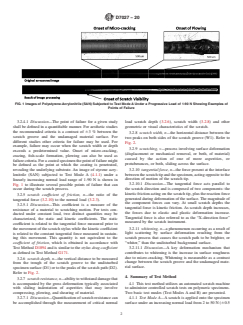
example of the application of ASV is shown in Fig. 1.
D883Terminology Relating to Plastics
3.2.2 critical normal load, n—the normal load at which
D1894Test Method for Static and Kinetic Coefficients of
failure(see3.2.4)ofthematerialwithinthescratchgroovefirst
Friction of Plastic Film and Sheeting
occurs.
3.2.3 normal load, n—a load applied onto the scratch stylus
thatisimposedinaverticallydownwarddirection,perpendicu-
ThistestmethodisunderthejurisdictionofASTMCommitteeD20onPlastics
and is the direct responsibility of Subcommittee D20.10 on Mechanical Properties.
lar to the surface of the specimen.
Current edition approved Sept. 1, 2020. Published October 2020. Originally
3.2.3.1 Discussion—The normal load is also referred to as
approved in 2005. Last previous edition approved in 2013 as D7027–13. DOI:
the “Z-direction load.”
10.1520/D7027-20.
For referenced ASTM standards, visit the ASTM website, www.astm.org, or
3.2.4 point of failure, n—the point along a rising-load
contact ASTM Customer Service at service@astm.org. For Annual Book of ASTM
scratch path at which the damage to the surface is first
Standards volume information, refer to the standard’s Document Summary page on
the ASTM website. considered to be unacceptable.
*A Summary of Changes section appears at the end of this standard
Copyright © ASTM International, 100 Barr Harbor Drive, PO Box C700, West Conshohocken, PA 19428-2959. United States
D7027 − 20
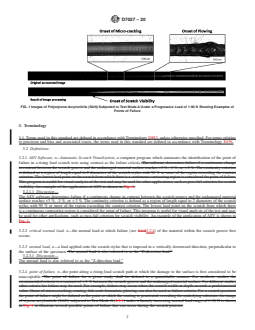
FIG. 1 Images of Polystyrene-Acrylonitrile (SAN) Subjected to Test Mode A Under a Progressive Load of 1-90 N Showing Examples of
Points of Failure
3.2.4.1 Discussion—The point of failure for a given study load scratch depth (3.2.6), scratch width (3.2.8) and other
shall be defined in a quantifiable manner. For aesthetic studies geometric or visual characteristics of the scratch.
the recommended criteria is a contrast of 63 % between the
3.2.8 scratch width, n—the horizontal distance between the
scratch groove and the undamaged material surface. For
two peaks on both sides of the scratch groove (W1). Refer to
different studies other criteria for failure may be used. For
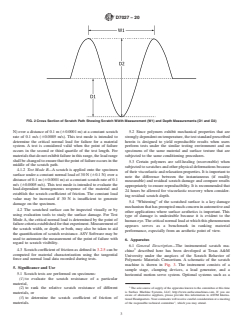
Fig. 2.
example, failure may occur when the scratch width or depth
3.2.9 scratching, v—process involving surface deformation
exceeds a predetermined value. Onset of micro-cracking,
(displacement or mechanical removal, or both, of material)
crazing, fish-scale formation, plowing can also be used as
caused by the action of one of more asperities, or
failurecriteria.Foracoatedspecimenthepointoffailuremight
protuberances, or both, sliding across the surface.
be defined as the point at which the coating is penetrated,
3.2.10 tangential force, n—the force present at the interface
revealing the underlying substrate. An image of styrene acry-
betweenthescratchtipandthespecimen,actingoppositetothe
lonitrile (SAN) subjected to Test Mode A (4.1.1) under a
direction of motion of the scratch tip.
linearly increasing normal load range of 1-90 N is shown in
3.2.10.1 Discussion—The tangential force acts parallel to
Fig. 1 to illustrate several possible points of failure that can
occur during the scratch process. the scratch direction and is composed of two components: the
kineticfrictionactingonthescratchtip,plusthereactionforce
3.2.5 scratch coeffıcient of friction, n—the ratio of the
generatedduringdeformationofthesurface.Themagnitudeof
tangential force (3.2.10) to the normal load (3.2.3).
the component forces can vary. At small scratch depths the
3.2.5.1 Discussion—This coefficient is a measure of the
tangential force is kinetic friction. As scratch depth increases,
resistance of a material to scratching motion. For tests con-
the forces due to elastic and plastic deformation increase.
ducted under constant load, two distinct quantities may be
Tangential force is also referred to as the “X-direction force”
characterized, the static and kinetic coefficients. The static
measured by the scratch instrument.
coefficient is related to the tangential force measured prior to
themovementofthescratchstyluswhilethekineticcoefficient 3.2.11 whitening, n—a phenomenon occurring as a result of
is related to the constant tangential force measured in sustain- light scattering by surface deformation resulting from the
ing this movement. This quantity is not equivalent to the scratch process that causes the scratch path to be brighter, or
coeffıcient of friction, which is obtained in accordance with “whiter,” than the undisturbed background surface.
TestMethodD1894andissimilartothe stylus drag coeffıcient 3.2.11.1 Discussion—A key deformation mechanism that
as defined in Test Method G171.
contributes to whitening is the increase in surface roughness
due to micro-cracking. Whitening is measurable as a contrast
3.2.6 scratch depth, n—the vertical distance to be measured
change between the scratch groove and the undamaged mate-
from the trough of the scratch groove to the undisturbed
rial surface.
specimensurface(D1)ortothepeaksofthescratchpath(D2).
Refer to Fig. 2.
4. Summary of Test Method
3.2.7 scratchresistance,n—abilitytowithstanddamagethat
is accompanied by the gross deformation typically associated 4.1 This test method utilizes an automated scratch machine
to administer controlled scratch tests on polymeric specimens.
with sliding indentation of asperities that may involve
compressing, plowing, and shearing of material. Two basic test modes (Test Modes A and B) are presented.
3.2.7.1 Discussion—Quantificationofscratchresistancecan 4.1.1 Test Mode A—Ascratch is applied onto the specimen
be accomplished through the measurement of critical normal surface under an increasing normal load from 2 to 50 N (60.5
D7027 − 20
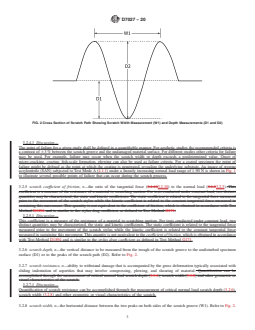
FIG. 2 Cross Section of Scratch Path Showing Scratch Width Measurement (W1) and Depth Measurements (D1 and D2)
5.2 Since polymers exhibit mechanical properties that are
N) over a distance of 0.1 m (60.0001 m) at a constant scratch
rate of 0.1 m/s (60.0005 m/s). This test mode is intended to stronglydependentontemperature,theteststandardprescribed
determine the critical normal load for failure for a material herein is designed to yield reproducible results when users
system. A test is considered valid when the point of failure perform tests under the similar testing environment and on
occurs in the second or third quartile of the test length. For specimens of the same material and surface texture that are
materialsthatdonotexhibitfailureinthisrange,theloadrange subjected to the same conditioning procedures.
shallbechangedtoensurethatthepointoffailureoccursinthe
5.3 Certain polymers are self-healing (recoverable) when
middle of the scratch path.
subjectedtoscratchesandotherphysicaldeformationsbecause
4.1.2 Test Mode B—Ascratch is applied onto the specimen
oftheirviscoelasticandrelaxationproperties.Itisimportantto
surface under a constant normal load of 30 N (60.1 N) over a
note the difference between the instantaneous (if readily
distanceof0.1m(60.0001m)ataconstantscratchrateof0.1
measurable) and residual scratch damage and compare results
m/s (60.0005 m/s). This test mode is intended to evaluate the
appropriately to ensure reproducibility. It is recommended that
load-dependant homogeneous response of the material and
24 hours be allowed for viscoelastic recovery when consider-
establish the scratch coefficient of friction. The constant load
ing residual scratch depth.
value may be increased if 30 N is insufficient to generate
5.4 “Whitening” of the scratched surface is a key damage
damage on the specimen.
mechanismthathaspromptedmuchconcerninautomotiveand
4.2 The scratched surface can be inspected visually or by
other applications where surface aesthetics is important. This
using evaluation tools to study the surface damage. For Test
type of damage is undesirable because it is evident to the
ModeA, the critical normal load is determined by the point of
humaneye.Thecriticalnormalloadatwhichthisphenomenon
failurecriteriaestablishedforthatexperiment.Measurementof
appears serves as a benchmark in ranking material
the scratch width, or depth, or both, may also be taken to aid
performance, especially from an aesthetic point of view.
the quantification of scratch resistance.ASV Software may be
used to automate the measurement of the point of failure with
6. Apparatus
regard to scratch visibility.
6.1 General Description—The instrumented scratch ma-
4.3 Scratch coefficient of friction as defined in 3.2.5 can be
chine described here has been developed at Texas A&M
computed for material characterization using the tangential
University under the auspices of the Scratch Behavior of
force and normal load data recorded during tests.
Polymeric Materials Consortium. A schematic of the scratch
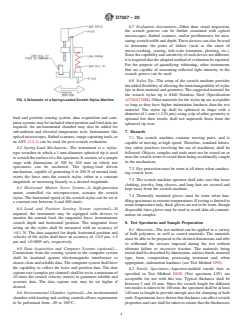
machine is shown in Fig. 3. The instrument consists of a
5. Significance and Use
sample stage, clamping devices, a load generator, and a
5.1 Scratch tests are performed on specimens:
horizontal motion servo system. Optional systems such as a
(1)to evaluate the scratch resistance of a particular
material,
Thesolesourceofsupplyoftheapparatusknowntothecommitteeatthistime
(2)to rank the relative scratch resistance of different
is Surface Machine Systems, LLC, http://www.surfacemachines.com. If you are
materials, or
aware of alternative suppliers, please provide this information to ASTM Interna-
(3)to determine the scratch coefficient of friction of
tional Headquarters.Your comments will receive careful consideration at a meeting
materials. of the responsible technical committee , which you may attend.
D7027 − 20
6.7 Evaluation Instruments—Other than visual inspection,
the scratch grooves can be further examined with optical
microscopes, flatbed scanners, and/or profilometers for mea-
suringscratchwidthanddepth.Thesedevicescanalsobeused
to determine the point of failure (such as the onset of
micro-cracking, crazing, fish-scale formation, plowing, etc.).
Sincethecapabilityandsensitivityofeachdevicearedifferent,
itisrequiredthattheadoptedmethodofevaluationbereported.
For the purpose of quantifying whitening, other instruments
that are capable of measuring reflected light intensity in the
scratch groove can be used.
6.8 Stylus Tip—The setup of the scratch machine provides
theaddedflexibilityofallowingtheinterchangeabilityofstylus
tips in their material and geometry.The suggested material for
the scratch stylus tip is #440 Stainless Steel (Specification
A276/A276M).Othermaterialsforthestylustipareacceptable
FIG. 3 Schematic of a Spring-Loaded Scratch Stylus Machine
so long as they have higher indentation hardness than the test
material. The stylus tip shall be spherical in shape with a
diameterof1mm(62.54µm);usingatipofothergeometryis
load and position sensing system, data acquisition and com-
optional but their results shall not supersede those from the
putersystemsmaybeincludedwhenpositionandloaddataare
spherical tip tests.
required. An environmental chamber may also be added for
7. Hazards
sub-ambient and elevated temperature tests. Instruments like
opticalmicroscopes,flatbedscanners,imagecapturingtools,or
7.1 The scratch machine contains moving parts, and is
an ASV (3.2.1) can be used for post-scratch evaluation.
capable of moving at high speed. Therefore, standard labora-
6.2 Spring-Load Mechanism—The instrument is a stylus- tory safety practices involving the use of machinery shall be
followed. Objects, samples and tools must not be stored on or
type scratcher in which a 1-mm-diameter spherical tip is used
toscratchthesurfaceofaflatspecimen.Itconsistsofasample near the scratch tester to avoid them being accidentally caught
in the mechanism.
stage with dimensions of 305 by 610 mm on which test
specimens can be anchored. The spring-load driven
7.2 Eye protection must be worn at all times when conduct-
mechanism, capable of generating 0 to 200 N of normal load,
ing scratch tests.
exerts the force onto the scratch stylus, either at a constant
7.3 The scratch machine operator shall take care that loose
magnitude or increasing linearly to a desired magnitude.
clothing, jewelry, long sleeves, and long hair are secured and
6.3 Horizontal Motion Servo System—A high-precision
kept away from the scratch machine.
motor, controlled via microprocessor, actuates the scratch
7.4 Thermally insulated gloves must be worn when han-
stylus. The horizontal speed of the scratch stylus can be set at
dlingspecimensatextremetemperatures.Iftestingislimitedto
a constant rate between 0 and 400 mm/s.
roomtemperatureonly,thickglovesarenottobeworn,though
6.4 Load and Position Sensing System (optional)—If
disposablelatexglovesmaybeusedtoavoidskin-oilcontami-
required, the instrument may be equipped with devices to
nation on samples.
monitor the normal load, the tangential force, instantaneous
scratch depth and horizontal position. The tangential force 8. Test Specimens and Sample Preparation
acting on the stylus shall be measured with an accuracy of
8.1 Materials—The test method can be applied to a variety
60.1 N. The data acquired for depth, horizontal position and
of bulk polymers, as well as coated materials. The materials
velocity of the stylus shall have an accuracy of 60.5 µm, 65
mustbeabletobepreparedtothedesireddimensionsandable
µm and 60.0005 m/s, respectively.
to withstand the stresses imposed during the test without
6.5 Data Acquisition and Computer Systems (optional)— ultimate failure or excessive fracture. The materials being
Connections from the
...
This document is not an ASTM standard and is intended only to provide the user of an ASTM standard an indication of what changes have been made to the previous version. Because
it may not be technically possible to adequately depict all changes accurately, ASTM recommends that users consult prior editions as appropriate. In all cases only the current version
of the standard as published by ASTM is to be considered the official document.
Designation: D7027 − 13 D7027 − 20
Standard Test Method for
Evaluation of Scratch Resistance of Polymeric Coatings and
Plastics Using an Instrumented Scratch Machine
This standard is issued under the fixed designation D7027; the number immediately following the designation indicates the year of
original adoption or, in the case of revision, the year of last revision. A number in parentheses indicates the year of last reapproval. A
superscript epsilon (´) indicates an editorial change since the last revision or reapproval.
1. Scope Scope*
1.1 This test method describes a laboratory procedure using an instrumented scratch machine to produce and quantify surface
damage under controlled conditions. This test method is able to characterize the scratch resistance of polymers by measuring many
significant material parameters. The scratch-inducing and data acquisition process is automated to avoid user-influenced effects that
may affect the results.
1.2 The values stated in SI units are to be regarded as standard. The values in parentheses are for information only.
1.3 This standard does not purport to address all of the safety concerns, if any, associated with its use. It is the responsibility
of the user of this standard to establish appropriate safety safety, health, and healthenvironmental practices and determine the
applicability of regulatory limitations prior to use.
NOTE 1—This standard is equivalent to ISO 19252.
1.4 This international standard was developed in accordance with internationally recognized principles on standardization
established in the Decision on Principles for the Development of International Standards, Guides and Recommendations issued
by the World Trade Organization Technical Barriers to Trade (TBT) Committee.
2. Referenced Documents
2.1 ASTM Standards:
A276/A276M Specification for Stainless Steel Bars and Shapes
D618 Practice for Conditioning Plastics for Testing
D638 Test Method for Tensile Properties of Plastics
D883 Terminology Relating to Plastics
D1894 Test Method for Static and Kinetic Coefficients of Friction of Plastic Film and Sheeting
E177 Practice for Use of the Terms Precision and Bias in ASTM Test Methods
E456 Terminology Relating to Quality and Statistics
G99 Test Method for Wear Testing with a Pin-on-Disk Apparatus
G171 Test Method for Scratch Hardness of Materials Using a Diamond Stylus
This test method is under the jurisdiction of ASTM Committee D20 on Plastics and is the direct responsibility of Subcommittee D20.10 on Mechanical Properties.
Current edition approved Oct. 15, 2013Sept. 1, 2020. Published October 2013October 2020. Originally approved in 2005. Last previous edition approved in 20052013
ε1
as D7027–05–13. . DOI: 10.1520/D7027-13.10.1520/D7027-20.
For referenced ASTM standards, visit the ASTM website, www.astm.org, or contact ASTM Customer Service at service@astm.org. For Annual Book of ASTM Standards
volume information, refer to the standard’s Document Summary page on the ASTM website.
*A Summary of Changes section appears at the end of this standard
Copyright © ASTM International, 100 Barr Harbor Drive, PO Box C700, West Conshohocken, PA 19428-2959. United States
D7027 − 20
FIG. 1 Images of Polystyrene-Acrylonitrile (SAN) Subjected to Test Mode A Under a Progressive Load of 1-90 N Showing Examples of
Points of Failure
3. Terminology
3.1 Terms used in this standard are defined in accordance with Terminology D883, unless otherwise specified. For terms relating
to precision and bias and associated issues, the terms used in this standard are defined in accordance with Terminology E456.
3.2 Definitions:
3.2.1 ASV Software, n—Automatic Scratch Visualization, a computer program which automates the identification of the point of
failure in a rising load scratch tests using contrast as the failure criteria. The software determines failure if a continuous change
in contrast between the scratch groove and the undamaged material surface reaches +3 %, -3 %, or 63 %. The continuity criterion
is defined as a region of length equal to 2 diameters of the scratch stylus with 90 % or more of the region exceeding the contrast
criterion. The lowest load point on the scratch from which there is a continuous contrasting region is considered the point of failure.
This program is useful for visual analysis of the test and may be used for other applications, such as pass-fail criterion for scratch
visibility. An example of the application of ASV is shown in Fig. 1.
3.2.1.1 Discussion—
The ASV software determines failure if a continuous change in contrast between the scratch groove and the undamaged material
surface reaches +3 %, -3 %, or 63 %. The continuity criterion is defined as a region of length equal to 2 diameters of the scratch
stylus with 90 % or more of the region exceeding the contrast criterion. The lowest load point on the scratch from which there
is a continuous contrasting region is considered the point of failure. This program is useful for visual analysis of the test and may
be used for other applications, such as pass-fail criterion for scratch visibility. An example of the application of ASV is shown in
Fig. 1.
3.2.2 critical normal load, n—the normal load at which failure (see 3.1.43.2.4) of the material within the scratch groove first
occurs.
3.2.3 normal load, n—a load applied onto the scratch stylus that is imposed in a vertically downward direction, perpendicular to
the surface of the specimen. The normal load is also referred to as the “Z-direction load.”
3.2.3.1 Discussion—
The normal load is also referred to as the “Z-direction load.”
3.2.4 point of failure, n—the point along a rising-load scratch path at which the damage to the surface is first considered to be
unacceptable. The point of failure for a given study shall be defined in a quantifiable manner. For aesthetic studies the
recommended criteria is a contrast of 63 % between the scratch groove and the undamaged material surface. For different studies
other criteria for failure may be used. For example, failure may occur when the scratch width or depth exceeds a predetermined
value. Onset of micro-cracking, crazing, fish-scale formation, plowing can also be used as failure criteria. For a coated specimen
the point of failure might be defined as the point at which the coating is penetrated, revealing the underlying substrate. An image
of styrene acrylonitrile (SAN) subjected to Test Mode A (4.1.1) under a linearly increasing normal load range of 1-90 N is shown
in Fig. 1 to illustrate several possible points of failure that can occur during the scratch process.
D7027 − 20
FIG. 2 Cross Section of Scratch Path Showing Scratch Width Measurement (W1) and Depth Measurements (D1 and D2)
3.2.4.1 Discussion—
The point of failure for a given study shall be defined in a quantifiable manner. For aesthetic studies the recommended criteria is
a contrast of 63 % between the scratch groove and the undamaged material surface. For different studies other criteria for failure
may be used. For example, failure may occur when the scratch width or depth exceeds a predetermined value. Onset of
micro-cracking, crazing, fish-scale formation, plowing can also be used as failure criteria. For a coated specimen the point of
failure might be defined as the point at which the coating is penetrated, revealing the underlying substrate. An image of styrene
acrylonitrile (SAN) subjected to Test Mode A (4.1.1) under a linearly increasing normal load range of 1-90 N is shown in Fig. 1
to illustrate several possible points of failure that can occur during the scratch process.
3.2.5 scratch coeffıcient of friction, n—the ratio of the tangential force (3.1.103.2.10) to the normal load (3.1.33.2.3). This
coefficient is a measure of the resistance of a material to scratching motion. For tests conducted under constant load, two distinct
quantities may be characterized, the static and kinetic coefficients. The static coefficient is related to the tangential force measured
prior to the movement of the scratch stylus while the kinetic coefficient is related to the constant tangential force measured in
sustaining this movement. This quantity is not equivalent to the coefficient of friction, which is obtained in accordance with Test
Method D1894 and is similar to the stylus drag coefficient as defined in Test Method G171.
3.2.5.1 Discussion—
This coefficient is a measure of the resistance of a material to scratching motion. For tests conducted under constant load, two
distinct quantities may be characterized, the static and kinetic coefficients. The static coefficient is related to the tangential force
measured prior to the movement of the scratch stylus while the kinetic coefficient is related to the constant tangential force
measured in sustaining this movement. This quantity is not equivalent to the coeffıcient of friction, which is obtained in accordance
with Test Method D1894 and is similar to the stylus drag coeffıcient as defined in Test Method G171.
3.2.6 scratch depth, n—the vertical distance to be measured from the trough of the scratch groove to the undisturbed specimen
surface (D1) or to the peaks of the scratch path (D2). Refer to Fig. 2.
3.2.7 scratch resistance, n—ability to withstand damage that is accompanied by the gross deformation typically associated with
sliding indentation of asperities that may involve compressing, plowing, and shearing of material. Quantification can be
accomplished through the measurement of critical normal load scratch depth (3.1.6), scratch width (3.1.8) and other geometric or
visual characteristics of the scratch.
3.2.7.1 Discussion—
Quantification of scratch resistance can be accomplished through the measurement of critical normal load scratch depth (3.2.6),
scratch width (3.2.8) and other geometric or visual characteristics of the scratch.
3.2.8 scratch width, n—the horizontal distance between the two peaks on both sides of the scratch groove (W1). Refer to Fig. 2.
D7027 − 20
3.2.9 scratching, v—process involving surface deformation (displacement or mechanical removal, or both, of material) caused by
the action of one of more asperities, or protuberances, or both, sliding across the surface.
3.2.10 tangential force, n—the force present at the interface between the scratch tip and the specimen, acting opposite to the
direction of motion of the scratch tip. The tangential force acts parallel to the scratch direction and is composed of two components:
the kinetic friction acting on the scratch tip, plus the reaction force generated during deformation of the surface. The magnitude
of the component forces can vary. At small scratch depths the tangential force is kinetic friction. As scratch depth increases, the
forces due to elastic and plastic deformation increase. Tangential force is also referred to as the “X-direction force” measured by
the scratch instrument.
3.2.10.1 Discussion—
The tangential force acts parallel to the scratch direction and is composed of two components: the kinetic friction acting on the
scratch tip, plus the reaction force generated during deformation of the surface. The magnitude of the component forces can vary.
At small scratch depths the tangential force is kinetic friction. As scratch depth increases, the forces due to elastic and plastic
deformation increase. Tangential force is also referred to as the “X-direction force” measured by the scratch instrument.
3.2.11 whitening, n—a phenomenon occurring as a result of light scattering by surface deformation resulting from the scratch
process that causes the scratch path to be brighter, or “whiter,” than the undisturbed background surface. Key deformation
mechanisms include increase in surface roughness due to micro-cracking. Whitening is measurable as a contrast change between
the scratch groove and the undamaged material surface.
3.2.11.1 Discussion—
A key deformation mechanism that contributes to whitening is the increase in surface roughness due to micro-cracking. Whitening
is measurable as a contrast change between the scratch groove and the undamaged material surface.
4. Summary of Test Method
4.1 This test method utilizes an automated scratch machine to administer controlled scratch tests on polymeric specimens. Two
basic test modes (Test Modes A and B) are presented.
4.1.1 Test Mode A—A scratch is applied onto the specimen surface under an increasing normal load from 2 to 50 N (60.5 N) over
a distance of 0.1 m (60.0001 m) at a constant scratch rate of 0.1 m/s (60.0005 m/s). This test mode is intended to determine the
critical normal load for failure for a material system. The A test is considered valid when the point of failure should occur occurs
in the second or third quartile of the test length. For materials that do not exhibit failure in this range, the load range mayshall be
changed to ensure that the point of failure occurs in the middle of the scratch path.
4.1.2 Test Mode B—A scratch is applied onto the specimen surface under a constant normal load of 30 N (60.1 N) over a distance
of 0.1 m (60.0001 m) at a constant scratch rate of 0.1 m/s (60.0005 m/s). This test mode is intended to evaluate the
load-dependant homogeneous response of the material and establish the scratch coefficient of friction. The constant load value may
be increased if 30 N is insufficient to generate damage on the specimen.
4.2 The scratched surface can be inspected visually or by using evaluation tools to study the surface damage. For Test Mode A,
the critical normal load is determined by the point of failure criteria established for that experiment. Measurement of the scratch
width, or depth, or both, may also be taken to aid the quantification of scratch resistance. ASV Software may be used to automate
the measurement of the point of failure with regard to scratch visibility.
4.3 Scratch coefficient of friction as defined in 3.1.53.2.5 can be computed for material characterization using the tangential force
and normal load data recorded during tests.
5. Significance and Use
5.1 Scratch tests are performed on specimens:
(1) to evaluate the scratch resistance of a particular material,
(2) to rank the relative scratch resistance of different materials, or
(3) to determine the scratch coefficient of friction of materials.
5.2 Since polymers exhibit mechanical properties that are strongly dependent on temperature, the test standard prescribed herein
D7027 − 20
FIG. 3 Schematic of a Spring-Loaded Scratch Stylus Machine
is designed to yield reproducible results when users perform tests under the similar testing environment and on specimens of the
same material and surface texture that are subjected to the same conditioning procedures.
5.3 Certain polymers are self-healing (recoverable) when subjected to scratches and other physical deformations because of their
viscoelastic and relaxation properties. It is important to note the difference between the instantaneous (if readily measurable) and
residual scratch damage and compare results appropriately to ensure reproducibility. It is recommended that 24 hours be allowed
for viscoelastic recovery when considering residual scratch depth.
5.4 “Whitening” of the scratched surface is a key damage mechanism that has prompted much concern in automotive and other
applications where surface aesthetics is important. This type of damage is undesirable because it is evident to the human eye. The
critical normal load at which this phenomenon appears serves as a benchmark in ranking material performance, especially from
an aesthetic point of view.
6. Apparatus
6.1 General Description—The instrumented scratch machine described here has been developed at Texas A&M University under
the auspices of the Scratch Behavior of Polymeric Materials Consortium. A schematic of the scratch machine is shown in Fig. 3.
The instrument consists of a sample stage, clamping devices, a load generator, and a horizontal motion servo system. Optional
systems such as a load and position sensing system, data acquisition and computer systems may be included when position and
load data are required. An environmental chamber may also be added for sub-ambient and elevated temperature tests. Instruments
like optical microscopes, flatbed scanners, image capturing tools, or an ASV (3.1.13.2.1) can be used for post-scratch evaluation.
6.2 Spring-Load Mechanism—The instrument is a stylus-type scratcher in which a 1-mm-diameter spherical tip is used to scratch
the surface of a flat specimen. It consists of a sample stage with dimensions of 305 by 610 mm on which test specimens can be
anchored. The spring-load driven mechanism, capable of generating 0 to 200 N of normal load, exerts the force onto the scratch
stylus, either at a constant magnitude or increasing linearly to a desired magnitude.
6.3 Horizontal Motion Servo System—A high-precision motor, controlled via microprocessor, actuates the scratch stylus. The
horizontal speed of the scratch stylus can be set at a constant rate between 0 and 400 mm/s.
6.4 Load and Position Sensing System (optional)—If required, the instrument may be equipped with devices to monitor the normal
load, the tangential force, instantaneous scratch depth and horizontal position. The tangential force acting on the stylus shall be
measured with an accuracy of 60.1 N. The data acquired for depth, horizontal position and velocity of the stylus shall have an
accuracy of 60.5 μm, 65 μm and 60.0005 m/s, respectively.
The sole source of supply of the apparatus known to the committee at this time is Surface Machine Systems, LLC, http://www.surfacemachines.com. If you are aware
of alternative suppliers, please provide this information to ASTM International Headquarters. Your comments will receive careful consideration at a meeting of the responsible
technical committee , which you may attend.
D7027 − 20
6.5 Data Acquisition and Computer Systems (optional)—Connections from the sensing system to the computer system shall be
insulated against electromagnetic interference to ensure clean and reliable data. The computer system shall have the capability to
collect the force and position data. The data capture rate (samples per channel) shall be set to a minimum of 10 times the scratch
velocity (mm/s) to guarantee reliable and accurate data. The data capture rate may be set higher if desired.
6.6 Environmental Chamber (optional)—An environmental chamber with heating and cooling controls allows experiments to be
performed from –50 to 100°C.
6.7 Evaluation Instruments—Other than visual inspection, the scratch grooves can be further examined with optical microscopes,
flatbed scanners, and/or profilometers for measuring scratch width and depth. These devices can also be used to determine the point
of failure (such as the onset of micro-cracking, crazing, fish-scale formation, plowing, etc.). Since the capability and sensitivity
of each device are different, it is required that the adopted method of evaluation be reported. For the purpose of quantifying
whitening, other instruments that are capable of measuring reflected light intensity in the scratch groove can be used.
6.8 Stylus Tip—The setup of the scratch machine provides the added flexibility of allowing the interchangeability of stylus tips
in their material and geometry. The suggested material for the scratch stylus tip is #440 Stainless Steel. Steel (Specification
A276/A276M). Other materials for the stylus tip are acceptable so long as they have higher indentation hardness than the test
material. The stylus tip shall be spherical in shape with a diameter of 1 mm (62.54 μm); using a tip of other geometry is optional
but their results shall not supersede those from the spherical tip tests.
7. Hazards
7.1 The scratch machine contains moving parts, and is capable of moving at high speed. Therefore, standard laboratory safety
practices involving the use of machinery shouldshall be followed. Objects, samples and tools must not be stored on or near the
scratch tester to avoid them being accidentally caught in the mechanism.
7.2 Eye protection must be worn at all times when conducting scratch tests.
7.3 The scratch machine operator shall take care that loose clothing, jewelry, long sleeves, and long hair are secured and kept away
from the scratch machine.
7.4 Thermally insulated gloves must be worn when handling specimens at extreme temperatures. If testing is limited to room
temperature only, thick gloves are not to be worn, though disposable latex gloves may be used to
...