


ASTM F1168-88(1994)
(Guide)Guide for Use in the Establishment of Thermal Processes for Foods Packaged in Flexible Containers (Withdrawn 2000)
Guide for Use in the Establishment of Thermal Processes for Foods Packaged in Flexible Containers (Withdrawn 2000)
SCOPE
1.1 This guide contains guidelines and recommended procedures for use in the establishment of thermal processes necessary to produce commercially sterile foods packaged in hermetically sealed flexible containers. It applies to foods packaged in flexible containers that are sterilized by the application of heat from fluid heating media, particularly steam, air, water, their combinations, and their mixtures.
1.2 Specifically, this guide describes procedures for determining environmental conditions in the retort during thermal processing of foods in flexible containers and for determining heating and cooling characteristics of such products during processing. Procedures are described by which these data are used in the determination or evaluation, or both, of safe thermal processes for food packaged in flexible containers.
1.3 Limitations- This guide does not cover the theoretical and practical considerations that justify thermal processing as a means of rendering a packaged food product commercially sterile, nor does this guide describe methods by which thermal processes are verified or confirmed by biological methods, such as by inoculated pack and count reduction techniques.
1.4 This standard does not purport to address all of the safety problems, if any, associated with its use. It is the responsibility of the user of this standard to establish appropriate safety and health practices and determine the applicability of regulatory limitations prior to use.
1.5 The sections in this guide appear in the following sequence: Section Scope 1 Terminology 2 Summary of Guide 3 Significance and Use 4 Procedures: Temperature Measurement 5 Evaluation of Retort Performance 6 Process Time Determination by Heat Penetration 7 Tests Process Verification 8 Records of Temperature Distribution and Heat Pene- 9 tration Studies Retort Equipment Requirements X1 References
General Information
Standards Content (Sample)
NOTICE: This standard has either been superseded and replaced by a new version or
withdrawn. Contact ASTM International (www.astm.org) for the latest information.
Designation: F 1168 – 88 (Reapproved 1994)
AMERICAN SOCIETY FOR TESTING AND MATERIALS
100 Barr Harbor Dr., West Conshohocken, PA 19428
Reprinted from the Annual Book of ASTM Standards. Copyright ASTM
Standard Guide for
Use in the Establishment of Thermal Processes for Foods
Packaged in Flexible Containers
This standard is issued under the fixed designation F 1168; the number immediately following the designation indicates the year of
original adoption or, in the case of revision, the year of last revision. A number in parentheses indicates the year of last reapproval. A
superscript epsilon (e) indicates an editorial change since the last revision or reapproval.
1. Scope 2. Terminology
1.1 This guide contains guidelines and recommended pro- 2.1 Definitions of Terms Specific to This Standard:
cedures for use in the establishment of thermal processes
2.1.1 ballast container—a filled and sealed flexible retort-
necessary to produce commercially sterile foods packaged in able container enclosing a fixed volume of nonbiological
hermetically sealed flexible containers. It applies to foods
material that is approximately equal to a food-filled container
packaged in flexible containers that are sterilized by the of the same size and shape in terms of the rate and extent to
application of heat from fluid heating media, particularly
which it will absorb thermal energy by convection and con-
steam, air, water, their combinations, and their mixtures. duction.
1.2 Specifically, this guide describes procedures for deter-
2.1.2 come-up time—time required following the introduc-
mining environmental conditions in the retort during thermal
tion of heating media into the retort to raise the temperature at
processing of foods in flexible containers and for determining
the reference thermometer location in the retort to the process
heating and cooling characteristics of such products during
temperature.
processing. Procedures are described by which these data are
2.1.3 cook time—time span during which the retort is
used in the determination or evaluation, or both, of safe thermal
maintained at or above the specified processing temperature
processes for food packaged in flexible containers.
(that is, time span between end of come-up and beginning of
1.3 Limitations—This guide does not cover the theoretical
cooling, sometimes referred to as the operator’s process time).
and practical considerations that justify thermal processing as
2.1.4 cooling time—time required following the introduc-
a means of rendering a packaged food product commercially
tion of cooling water into the retort to lower the product
sterile, nor does this guide describe methods by which thermal
internal temperature to a specified value (commonly 40 to
processes are verified or confirmed by biological methods,
45°C).
such as by inoculated pack and count reduction techniques.
2.1.5 critical factors—physical and chemical factors that
1.4 This standard does not purport to address all of the
influence the thermal response of a product to thermal process-
safety concerns, if any, associated with its use. It is the
ing or the inhibition or inactivation of microorganisms, or
responsibility of the user of this standard to establish appro-
combination thereof, of public health significance, and which
priate safety and health practices and determine the applica-
pertain to the flexible container, the enclosed substances
bility of regulatory limitations prior to use.
(including gases), the retort, and environmental conditions
1.5 The sections in this guide appear in the following
within and around the container from the time of product filling
sequence:
to the end of thermal processing.
Section
2.1.6 operator’s process time—time between the end of
Scope 1
come-up and steam off.
Terminology 2
2.1.7 temperature stability—the degree to which tempera-
Summary of Guide 3
Significance and Use 4
ture remains constant at a particular location.
Procedures:
2.1.8 temperature uniformity—the degree to which tem-
Temperature Measurement 5
Evaluation of Retort Performance 6 peratures are equal throughout a particular volume.
Process Time Determination by Heat Penetration Tests 7
2.2 Symbols:
Process Verification 8
2.2.1 F —the F value for a hypothetical product that
M o
Records of Temperature Distribution and Heat Pene- 9
tration Studies uniformly exhibits temperatures that are synchronously iden-
Retort Equipment Requirements X1
tical to that of the internal retort environment at the designated
References
retort location during the designated process cycle, and under
the designated process conditions.
2.2.2 F —the equivalent time in minutes at 121.1°C for
o
This guide is under the jurisdiction of ASTM Committee F-2 on Flexible
product at the slowest heating point within the container under
Barrier Materials and is the direct responsibility of Subcommittee F02.30 on Test
the designated process conditions to achieve the same level of
Methods.
Current edition approved Aug. 26, 1988. Published October 1988. destruction of bacterial spores or vegetative cells of a particular
F 1168
organism and z value as by the existence of that reference foods and having access to all necessary facilities for making
temperature at that point for that time (centerpoint lethality). thermal process determinations.
2.2.3 F —the equivalent time in minutes at 121.1°C for all
s
PROCEDURES
points within the container under the designated process
conditions to achieve the same level of destruction of bacterial
5. Temperature Measurement
spores or vegetative cells of a particular organism and z value
5.1 Introduction:
as by the existence of that temperature for that time (integrated
5.1.1 Temperature measurement within the flexible con-
lethality).
tainer can be made difficult by its thin profile and flexibility,
2.2.4 z—number of Celsius degrees required for the thermal
and from the potential for irregularity of its thickness. The
destruction to traverse one log cycle.
shorter process times that can be expected for products
3. Summary of Guide
packaged in thin profile containers (thickness # width) de-
mand a high accuracy and precision of the temperature
3.1 A food product is prepared and sealed within a flexible
measuring system, since product internal temperatures change
container. Information pertaining to its formulation and condi-
quickly, and because data must be acquired at a rapid rate.
tions prior to thermal processing treatment is recorded. The
5.1.2 Factors that can produce errors or may affect tempera-
packaged product is subjected to a program of temperature,
ture measurements are:
pressure, and other relevant conditions within a retort, com-
5.1.2.1 The interaction of heat transfer media with tempera-
prising a come-up phase, a cook phase, and a cooling phase.
ture sensing devices,
Temperature measurements of the food product at its slowest
5.1.2.2 Heat conduction along a temperature sensor or its
heating location are made, along with measurements describ-
support device,
ing processing conditions, at regular time intervals. These data
5.1.2.3 Sudden or rapid changes in temperature or pressure
are used to obtain heating and cooling rates for the specific
conditions, or both, and
product-retort system, and are used in determining the process-
5.1.2.4 Stray voltages that exist between the contents of the
ing time necessary to achieve the specified lethality (for
container and its environment.
example, F ) for the product.
o
5.1.3 The acquisition of accurate time-temperature data
3.2 The procedures involve the following aspects:
describing the heating and cooling temperatures attained in the
3.2.1 Selection, assembly, and testing of the temperature
measurement system, retort, as well as the stability and uniformity of temperature
conditions in the product zone of the retort is essential for a
3.2.2 Evaluation and testing of the retort system,
3.2.3 Measurement of (1) heating and cooling medium meaningful process validation. Measurements of the tempera-
ture of the heating media are subject to many of the same
temperatures during processing, and (2) the stability and
precautions that apply to product temperature measurements,
distribution of these temperatures in the retort during each
and these may be further affected by container racking arrange-
phase of processing,
ments and specific factors related to the retort design.
3.2.4 Identification of data requirements and measurement
5.2 Thermometry Systems:
and reporting of critical factors,
5.2.1 Thermocouples:
3.2.5 Selection of the number of containers to be tested, the
5.2.1.1 Thermocouples are used extensively for heat pen-
number of replicate tests, and the simulation conditions,
etration studies and retort temperature distribution tests be-
3.2.6 Fitting and placement of the temperature sensing
cause they are simply constructed, rugged, and inexpensive.
element in the product,
However, care must be exercised when using thermocouples to
3.2.7 Process lethality and process time determinations,
ensure that measurements result strictly from the temperature
3.2.8 Verification of the process, and
of the thermocouple junction and not from stray electrical
3.2.9 Reporting of results and scheduled process.
currents, poorly constructed circuitry, or poorly designed or
4. Significance and Use
constructed instrumentation. Copper-constantan (Type T) ther-
4.1 Food products processed in flexible containers carry mocouple wire insulated with TFE-fluorocarbon is recom-
with them the same hazard potential as any other thermally mended for use in the temperature range of interest in thermal
processed food product packaged in a hermetically sealed processing. This wire has the advantage of being resistant to
container and subjected to a thermal sterilization process. heat and corrosion in moist environments. It is recommended
Stringent process development and control procedures must be that stranded thermocouple lead wire which is 22 gage or larger
employed and maintained to avoid a significant risk to human be used to minimize cold working effects. The effects of shunt
health from resulting products. The use of this guide in leakage between two lead wires or connections is minimized
developing these procedures should help to ensure that foods by using a larger wire size.
packaged in flexible retort containers will be commercially 5.2.1.2 Conditions inside the retort or inside the filled
sterile. container necessitate special requirements and precautions in
4.2 The intention of this guide is to provide standardized, the use of thermocouples. The following are considered to be
reproducible, and reliable procedures leading to the establish- particularly important:
ment of safe thermal processes for foods in flexible containers. (a) Keep connections for thermocouple lead wires to a
Application of this guide should not be made except by minimum, using plug and jack connectors designed for this
specialists competent in the commercial thermal processing of purpose. Ideally, thermocouple connections should not be
F 1168
made inside the retort vessel, and a continuous lead of thermocouple wire or sheath than through the food product,
thermocouple wire from the measuring junction to the outside and may lead to large temperature measurement errors. An
of the retort should be employed. Clean connections scrupu-
insertion depth of at least ten times the probe diameter is
lously before each use to ensure intimate electrical contact.
required. Probe-induced errors in temperature measurement are
Exposed (for example, soldered) connections inside the retort
discussed by Kemper and Harper (2).
should be hermetically and electrically insulated using a high
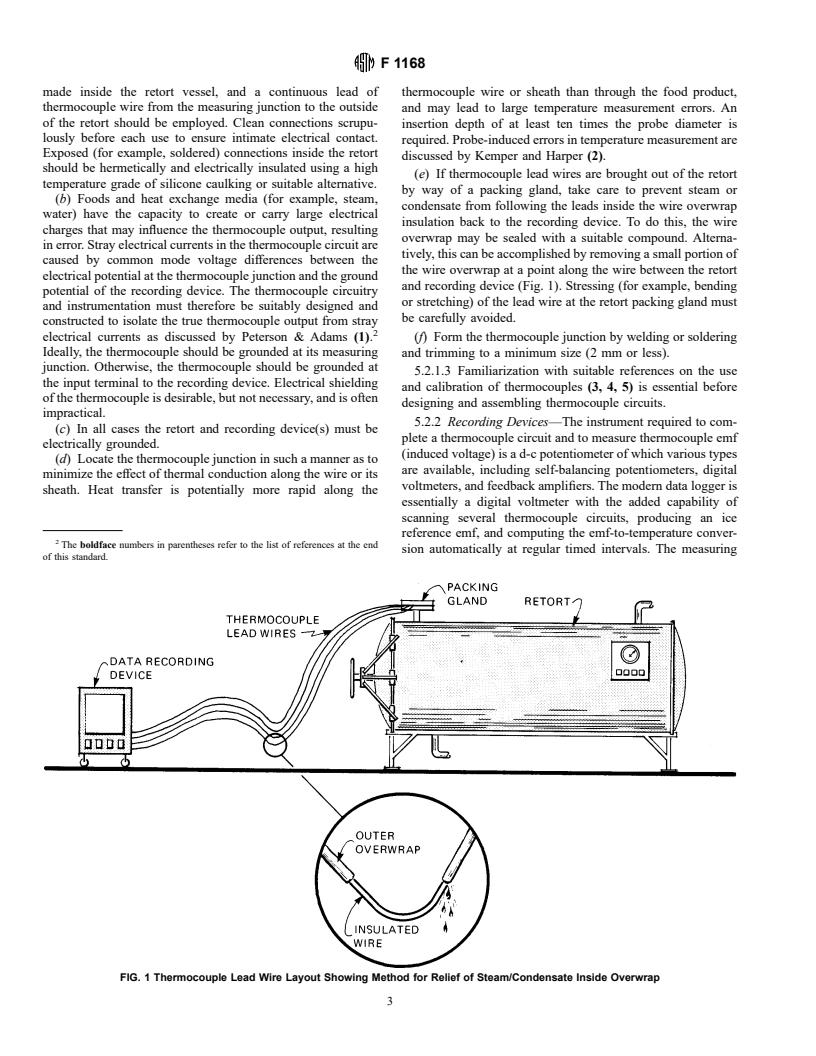
(e) If thermocouple lead wires are brought out of the retort
temperature grade of silicone caulking or suitable alternative.
by way of a packing gland, take care to prevent steam or
(b) Foods and heat exchange media (for example, steam,
condensate from following the leads inside the wire overwrap
water) have the capacity to create or carry large electrical
insulation back to the recording device. To do this, the wire
charges that may influence the thermocouple output, resulting
overwrap may be sealed with a suitable compound. Alterna-
in error. Stray electrical currents in the thermocouple circuit are
tively, this can be accomplished by removing a small portion of
caused by common mode voltage differences between the
the wire overwrap at a point along the wire between the retort
electrical potential at the thermocouple junction and the ground
and recording device (Fig. 1). Stressing (for example, bending
potential of the recording device. The thermocouple circuitry
or stretching) of the lead wire at the retort packing gland must
and instrumentation must therefore be suitably designed and
be carefully avoided.
constructed to isolate the true thermocouple output from stray
electrical currents as discussed by Peterson & Adams (1). (f) Form the thermocouple junction by welding or soldering
Ideally, the thermocouple should be grounded at its measuring and trimming to a minimum size (2 mm or less).
junction. Otherwise, the thermocouple should be grounded at
5.2.1.3 Familiarization with suitable references on the use
the input terminal to the recording device. Electrical shielding
and calibration of thermocouples (3, 4, 5) is essential before
of the thermocouple is desirable, but not necessary, and is often
designing and assembling thermocouple circuits.
impractical.
5.2.2 Recording Devices—The instrument required to com-
(c) In all cases the retort and recording device(s) must be
plete a thermocouple circuit and to measure thermocouple emf
electrically grounded.
(induced voltage) is a d-c potentiometer of which various types
(d) Locate the thermocouple junction in such a manner as to
are available, including self-balancing potentiometers, digital
minimize the effect of thermal conduction along the wire or its
voltmeters, and feedback amplifiers. The modern data logger is
sheath. Heat transfer is potentially more rapid along the
essentially a digital voltmeter with the added capability of
scanning several thermocouple circuits, producing an ice
reference emf, and computing the emf-to-temperature conver-
The boldface numbers in parentheses refer to the list of references at the end
sion automatically at regular timed intervals. The measuring
of this standard.
FIG. 1 Thermocouple Lead Wire Layout Showing Method for Relief of Steam/Condensate Inside Overwrap
F 1168
and recording device should be designed to operate satisfacto- or both, in the heating medium in which they are to be used.
rily in a common mode voltage difference of at least
...
Questions, Comments and Discussion
Ask us and Technical Secretary will try to provide an answer. You can facilitate discussion about the standard in here.