

ASTM C1506-17
(Test Method)Standard Test Method for Water Retention of Hydraulic Cement-Based Mortars and Plasters
General Information
- Abstract
SIGNIFICANCE AND USE
4.1 This test method provides a means for determining the ability of mortars and plasters to retain water under suction. Test results may be used to determine compliance with specifications.
4.2 The results obtained using this test method can be used to compare the relative ability of mortars and plasters to retain water under suction.
4.3 The results obtained using this test method for masonry mortars do not necessarily indicate the degree of water retention when used with masonry units, since the amount of water absorbed by the unit depends on the rate of absorption of the masonry unit.
4.4 The results obtained using this test method for plasters (stucco) do not necessarily indicate the degree of water retention when the plaster is applied as a second coat on the surface of a previously applied plaster base coat, since the amount of water absorbed from the second coat of plaster depends on the rate of absorption of the base coat. This is also true when a plaster is applied as a coating on masonry units.
SCOPE
1.1 This test method provides for the determination of water retention of hydraulic cement-based mortars and plasters.
1.2 The values stated in SI units are to be regarded as standard. No other units of measurement are included in this standard. When this test method refers to combined-unit standards, the selection of the measurement systems is at the user’s discretion.
1.3 This standard does not purport to address all of the safety concerns, if any, associated with its use. It is the responsibility of the user of this standard to establish appropriate safety, health and environmental practices and determine the applicability of regulatory limitations prior to use. (Warning—Fresh hydraulic cementitious mixtures are caustic and may cause chemical burns to skin and tissue upon prolonged exposure.)2
1.4 This international standard was developed in accordance with internationally recognized principles on standardization established in the Decision on Principles for the Development of International Standards, Guides and Recommendations issued by the World Trade Organization Technical Barriers to Trade (TBT) Committee.
- Status
- Published
- Publication Date
- 31-Jul-2017
- Technical Committee
- C01 - Cement
- Drafting Committee
- C01.22 - Workability
Buy Documents
ASTM C1506-17 - Standard Test Method for Water Retention of Hydraulic Cement-Based Mortars and Plasters
REDLINE ASTM C1506-17 - Standard Test Method for Water Retention of Hydraulic Cement-Based Mortars and Plasters
Overview
ASTM C1506-17 is the Standard Test Method for Water Retention of Hydraulic Cement-Based Mortars and Plasters, developed by ASTM International. This standard provides an established procedure to determine the water retention capacity of mortars and plasters formulated with hydraulic cement. Water retention is a critical property that influences workability, adhesion, and performance in construction materials. By assessing how well mortars and plasters resist water loss under suction, this test method guides manufacturers, contractors, and laboratories in meeting material specifications and ensuring optimum product quality.
Key Topics
- Purpose: ASTM C1506-17 outlines a process to evaluate the ability of hydraulic cement-based mortars and plasters to retain water when subjected to vacuum suction.
- Test Procedure: The standard describes measuring the flow of the material before and after controlled suction is applied, with results expressed as a percentage.
- Significance: Water retention influences the ease of application, setting characteristics, and final performance of mortars and plasters.
- Limitations: Results may not directly correspond to water retention behavior in actual masonry or multi-coat plaster systems, as absorption characteristics of substrates (e.g., masonry units or base coats) can alter outcomes.
- Units: Only SI units are considered standard in this method.
- Safety Considerations: Users must observe appropriate safety, health, and environmental practices, as fresh hydraulic cement-based materials are caustic and can cause chemical burns.
Applications
ASTM C1506-17 is applied throughout the construction and building materials industry for:
- Quality Control: Manufacturers utilize this test to verify that mortars and plasters meet water retention specifications before sale or use.
- Comparative Analysis: Laboratories compare the water retention abilities of different formulations, optimizing mixes for distinct applications or climatic conditions.
- Material Specification Compliance: The method helps ensure products conform to architectural or engineering requirements, reducing on-site issues such as premature setting or inadequate adhesion.
- Research & Development: Product developers assess the influence of additives or alternative binders on water retention, supporting innovation in sustainable building materials.
- Field Troubleshooting: When adhesion or application issues arise, this test provides a quantifiable measure for diagnosing material performance.
- Global Construction Standards: As an internationally recognized method, ASTM C1506-17 supports harmonization of construction product standards, facilitating trade and ensuring consistent quality worldwide.
Related Standards
Several ASTM standards complement or are referenced by ASTM C1506-17, enhancing the consistency and reliability of testing:
- ASTM C109/C109M - Test Method for Compressive Strength of Hydraulic Cement Mortars
- ASTM C185 - Test Method for Air Content of Hydraulic Cement Mortar
- ASTM C230/C230M - Specification for Flow Table for Use in Tests of Hydraulic Cement
- ASTM C305 - Practice for Mechanical Mixing of Hydraulic Cement Pastes and Mortars of Plastic Consistency
- ASTM C511 - Specification for Mixing Rooms, Moist Cabinets, Moist Rooms, and Water Storage Tanks Used in Testing
- ASTM C1437 - Test Method for Flow of Hydraulic Cement Mortar
- ASTM E832 - Specification for Laboratory Filter Papers
By adhering to ASTM C1506-17 and its referenced documents, professionals in the construction industry ensure accurate assessment of mortar and plaster water retention, contributing to durable, high-quality building projects and compliance with international standards.
Relations
- Effective Date
- 01-Aug-2017
- Effective Date
- 01-Feb-2024
- Effective Date
- 01-Jan-2024
- Effective Date
- 15-Dec-2023
- Effective Date
- 15-Jul-2020
- Effective Date
- 01-Apr-2020
- Effective Date
- 01-Dec-2019
- Effective Date
- 01-Jul-2019
- Effective Date
- 01-Jul-2015
- Refers
ASTM C230/C230M-14 - Standard Specification for Flow Table for Use in Tests of Hydraulic Cement - Effective Date
- 01-Oct-2014
- Effective Date
- 01-Dec-2013
- Effective Date
- 01-Jul-2013
- Effective Date
- 15-Jun-2013
- Refers
ASTM C230/C230M-13 - Standard Specification for Flow Table for Use in Tests of Hydraulic Cement - Effective Date
- 01-Jun-2013
- Effective Date
- 01-Jun-2013
Buy Documents
ASTM C1506-17 - Standard Test Method for Water Retention of Hydraulic Cement-Based Mortars and Plasters
REDLINE ASTM C1506-17 - Standard Test Method for Water Retention of Hydraulic Cement-Based Mortars and Plasters
Get Certified
Connect with accredited certification bodies for this standard

DIBt (Deutsches Institut für Bautechnik)
German Institute for Building Technology.
DIN CERTCO
DIN Group product certification.

Aboma Certification B.V.
Specialized in construction, metal, and transport sectors.
Sponsored listings
Frequently Asked Questions
ASTM C1506-17 is a standard published by ASTM International. Its full title is "Standard Test Method for Water Retention of Hydraulic Cement-Based Mortars and Plasters". This standard covers: SIGNIFICANCE AND USE 4.1 This test method provides a means for determining the ability of mortars and plasters to retain water under suction. Test results may be used to determine compliance with specifications. 4.2 The results obtained using this test method can be used to compare the relative ability of mortars and plasters to retain water under suction. 4.3 The results obtained using this test method for masonry mortars do not necessarily indicate the degree of water retention when used with masonry units, since the amount of water absorbed by the unit depends on the rate of absorption of the masonry unit. 4.4 The results obtained using this test method for plasters (stucco) do not necessarily indicate the degree of water retention when the plaster is applied as a second coat on the surface of a previously applied plaster base coat, since the amount of water absorbed from the second coat of plaster depends on the rate of absorption of the base coat. This is also true when a plaster is applied as a coating on masonry units. SCOPE 1.1 This test method provides for the determination of water retention of hydraulic cement-based mortars and plasters. 1.2 The values stated in SI units are to be regarded as standard. No other units of measurement are included in this standard. When this test method refers to combined-unit standards, the selection of the measurement systems is at the user’s discretion. 1.3 This standard does not purport to address all of the safety concerns, if any, associated with its use. It is the responsibility of the user of this standard to establish appropriate safety, health and environmental practices and determine the applicability of regulatory limitations prior to use. (Warning—Fresh hydraulic cementitious mixtures are caustic and may cause chemical burns to skin and tissue upon prolonged exposure.)2 1.4 This international standard was developed in accordance with internationally recognized principles on standardization established in the Decision on Principles for the Development of International Standards, Guides and Recommendations issued by the World Trade Organization Technical Barriers to Trade (TBT) Committee.
SIGNIFICANCE AND USE 4.1 This test method provides a means for determining the ability of mortars and plasters to retain water under suction. Test results may be used to determine compliance with specifications. 4.2 The results obtained using this test method can be used to compare the relative ability of mortars and plasters to retain water under suction. 4.3 The results obtained using this test method for masonry mortars do not necessarily indicate the degree of water retention when used with masonry units, since the amount of water absorbed by the unit depends on the rate of absorption of the masonry unit. 4.4 The results obtained using this test method for plasters (stucco) do not necessarily indicate the degree of water retention when the plaster is applied as a second coat on the surface of a previously applied plaster base coat, since the amount of water absorbed from the second coat of plaster depends on the rate of absorption of the base coat. This is also true when a plaster is applied as a coating on masonry units. SCOPE 1.1 This test method provides for the determination of water retention of hydraulic cement-based mortars and plasters. 1.2 The values stated in SI units are to be regarded as standard. No other units of measurement are included in this standard. When this test method refers to combined-unit standards, the selection of the measurement systems is at the user’s discretion. 1.3 This standard does not purport to address all of the safety concerns, if any, associated with its use. It is the responsibility of the user of this standard to establish appropriate safety, health and environmental practices and determine the applicability of regulatory limitations prior to use. (Warning—Fresh hydraulic cementitious mixtures are caustic and may cause chemical burns to skin and tissue upon prolonged exposure.)2 1.4 This international standard was developed in accordance with internationally recognized principles on standardization established in the Decision on Principles for the Development of International Standards, Guides and Recommendations issued by the World Trade Organization Technical Barriers to Trade (TBT) Committee.
ASTM C1506-17 is classified under the following ICS (International Classification for Standards) categories: 91.100.10 - Cement. Gypsum. Lime. Mortar. The ICS classification helps identify the subject area and facilitates finding related standards.
ASTM C1506-17 has the following relationships with other standards: It is inter standard links to ASTM C1506-16b, ASTM C670-24a, ASTM C670-24, ASTM C109/C109M-23, ASTM C305-20, ASTM C185-20, ASTM C185-19, ASTM E832-81(2019), ASTM C185-15, ASTM C230/C230M-14, ASTM C511-13, ASTM C670-13, ASTM C1437-13, ASTM C230/C230M-13, ASTM C305-13. Understanding these relationships helps ensure you are using the most current and applicable version of the standard.
ASTM C1506-17 is available in PDF format for immediate download after purchase. The document can be added to your cart and obtained through the secure checkout process. Digital delivery ensures instant access to the complete standard document.
Standards Content (Sample)
This international standard was developed in accordance with internationally recognized principles on standardization established in the Decision on Principles for the
Development of International Standards, Guides and Recommendations issued by the World Trade Organization Technical Barriers to Trade (TBT) Committee.
Designation: C1506 − 17
Standard Test Method for
Water Retention of Hydraulic Cement-Based Mortars and
Plasters
This standard is issued under the fixed designation C1506; the number immediately following the designation indicates the year of
original adoption or, in the case of revision, the year of last revision. A number in parentheses indicates the year of last reapproval. A
superscript epsilon (´) indicates an editorial change since the last revision or reapproval.
1. Scope* of Hydraulic Cement
C305 Practice for Mechanical Mixing of Hydraulic Cement
1.1 This test method provides for the determination of water
Pastes and Mortars of Plastic Consistency
retention of hydraulic cement-based mortars and plasters.
C511 Specification for Mixing Rooms, Moist Cabinets,
1.2 The values stated in SI units are to be regarded as
Moist Rooms, and Water Storage Tanks Used in the
standard. No other units of measurement are included in this
Testing of Hydraulic Cements and Concretes
standard. When this test method refers to combined-unit
C670 Practice for Preparing Precision and Bias Statements
standards, the selection of the measurement systems is at the
for Test Methods for Construction Materials
user’s discretion.
C1437 Test Method for Flow of Hydraulic Cement Mortar
1.3 This standard does not purport to address all of the E832 Specification for Laboratory Filter Papers
safety concerns, if any, associated with its use. It is the
3. Summary of Test Method
responsibility of the user of this standard to establish appro-
3.1 After initial mixing is complete, the flow of the mortar
priate safety, health and environmental practices and deter-
or plaster is determined.The mortar or plaster is then subjected
mine the applicability of regulatory limitations prior to use.
to a controlled vacuum suction for 60 s, after which the flow is
(Warning—Fresh hydraulic cementitious mixtures are caustic
again determined. The water retention is the final flow divided
and may cause chemical burns to skin and tissue upon
by the initial flow expressed as a percentage.
prolonged exposure.)
1.4 This international standard was developed in accor-
4. Significance and Use
dance with internationally recognized principles on standard-
4.1 This test method provides a means for determining the
ization established in the Decision on Principles for the
ability of mortars and plasters to retain water under suction.
Development of International Standards, Guides and Recom-
Test results may be used to determine compliance with
mendations issued by the World Trade Organization Technical
specifications.
Barriers to Trade (TBT) Committee.
4.2 The results obtained using this test method can be used
2. Referenced Documents
to compare the relative ability of mortars and plasters to retain
water under suction.
2.1 ASTM Standards:
C109/C109M Test Method for Compressive Strength of
4.3 The results obtained using this test method for masonry
Hydraulic Cement Mortars (Using 2-in. or [50-mm] Cube
mortars do not necessarily indicate the degree of water
Specimens)
retention when used with masonry units, since the amount of
C185 Test Method for Air Content of Hydraulic Cement
water absorbed by the unit depends on the rate of absorption of
Mortar
the masonry unit.
C230/C230M Specification for Flow Table for Use in Tests
4.4 The results obtained using this test method for plasters
(stucco) do not necessarily indicate the degree of water
retention when the plaster is applied as a second coat on the
This test method is under the jurisdiction ofASTM Committee C01 on Cement
surface of a previously applied plaster base coat, since the
and is the direct responsibility of Subcommittee C01.22 on Workability.
Current edition approved Aug. 1, 2017. Published February 2018. Originally
amount of water absorbed from the second coat of plaster
approved in 2001. Last previous edition approved in 2016 as C1506 – 16b. DOI:
depends on the rate of absorption of the base coat. This is also
10.1520/C1506-17.
true when a plaster is applied as a coating on masonry units.
Section on Safety, Manual of Cement Testing, Annual Book of ASTM
Standards, Vol 04.01.
5. Apparatus
For referenced ASTM standards, visit the ASTM website, www.astm.org, or
contact ASTM Customer Service at service@astm.org. For Annual Book of ASTM
5.1 Tamper, conforming to Test Method C109/C109M.
Standards volume information, refer to the standard’s Document Summary page on
the ASTM website. 5.2 Straightedge, conforming to Test Method C185.
*A Summary of Changes section appears at the end of this standard
Copyright © ASTM International, 100 Barr Harbor Drive, PO Box C700, West Conshohocken, PA 19428-2959. United States
C1506 − 17
5.3 Flow Table, conforming to Specification C230/C230M. 7. Materials
7.1 Thecompositionofthemortarorplastertobetestedfor
5.4 Mixing Apparatus, conforming to the requirements pre-
water retention shall be that described in the specification of
scribed in Practice C305.
the material being considered, or that desired.
5.5 Filter Paper—The filter paper shall be medium
retentive,correspondingtoType1,ClassB,inaccordancewith
8. Mixing of Mortar and Plaster
Specification E832. It shall be 150 mm in diameter.
8.1 The mortar or plaster to be tested for water retention
shall be mixed as specified in the section on Procedure for
5.6 Filtration Assembly, an apparatus essentially as shown
in Fig. 1 shall be used. This apparatus consists of a perforated Mixing Mortars of Practice C305, or as described in the
specification for the material being considered.
dish resting on a funnel, which is connected by a three-way
stopcock to a vacuum flask, to which a controlled vacuum is
9. Procedure
applied. The perforated dish shall be made of metal not
attacked by masonry mortar or plaster (Note 1).The metal base 9.1 Preparation of Apparatus—Seat the perforated dish on
of the dish shall have a thickness of 2.0 6 0.3 mm and shall the greased gasket or greased rim of the funnel. Place a wetted
conform to the requirements given in Fig. 1.The stopcock bore filter paper in the bottom of the dish. Turn the stopcock to
shall have a 4.0 6 0.5-mm diameter, and the connecting glass apply the vacuum to the funnel and check the apparatus for
tubing shall have a minimum inside diameter of 4 mm. The leaks. Adjust the vacuum to 7.0 6 0.4 kPa (Note 2). Turn the
length of the tubing projecting into the 1-L flask from the stopcock to shut off the vacuum from the funnel. Do not
stopcock shall extend at least 25 mm below the center line of remove the dish from the funnel until instructed to do so in 9.5.
the vacuum connection. The contact surfaces of the funnel and
9.2 Determination of Flow—Determine the flow in accor-
perforated dish shall be plane and may need to be lapped to
dance with Test Method C1437.
ensure intimate contact. An airtight seal shall be maintained
9.3 Preparation of Mortar or Plaster Bed—Immediately
between the funnel and the dish during the test. This shall be
after making the flow test, return the mortar or plaster on the
accomplished by either of the following procedures. (1)A
flow table to the mixing bowl and remix the entire batch for
synthetic (grease-resistant) rubber gasket permanently sealed
15 s at medium speed. Immediately after remixing, fill the
to the top of the funnel using petrolatum or light grease to
perforated dish with the material to slightly above the rim.
provide a seal between the gasket and dish. (2)Apetroleum or
Tamp 15 times with the tamper. Apply
...
This document is not an ASTM standard and is intended only to provide the user of an ASTM standard an indication of what changes have been made to the previous version. Because
it may not be technically possible to adequately depict all changes accurately, ASTM recommends that users consult prior editions as appropriate. In all cases only the current version
of the standard as published by ASTM is to be considered the official document.
Designation: C1506 − 16b C1506 − 17
Standard Test Method for
Water Retention of Hydraulic Cement-Based Mortars and
Plasters
This standard is issued under the fixed designation C1506; the number immediately following the designation indicates the year of
original adoption or, in the case of revision, the year of last revision. A number in parentheses indicates the year of last reapproval. A
superscript epsilon (´) indicates an editorial change since the last revision or reapproval.
1. Scope*
1.1 This test method provides for the determination of water retention of hydraulic cement-based mortars and plasters.
1.2 The values stated in SI units are to be regarded as standard. No other units of measurement are included in this standard.
When this test method refers to combined-unit standards, the selection of the measurement systems is at the user’s discretion.
1.3 This standard does not purport to address all of the safety concerns, if any, associated with its use. It is the responsibility
of the user of this standard to establish appropriate safety safety, health and healthenvironmental practices and determine the
applicability of regulatory limitations prior to use. (Warning—Fresh hydraulic cementitious mixtures are caustic and may cause
chemical burns to skin and tissue upon prolonged exposure.)
1.4 This international standard was developed in accordance with internationally recognized principles on standardization
established in the Decision on Principles for the Development of International Standards, Guides and Recommendations issued
by the World Trade Organization Technical Barriers to Trade (TBT) Committee.
2. Referenced Documents
2.1 ASTM Standards:
C109/C109M Test Method for Compressive Strength of Hydraulic Cement Mortars (Using 2-in. or [50-mm] Cube Specimens)
C185 Test Method for Air Content of Hydraulic Cement Mortar
C230/C230M Specification for Flow Table for Use in Tests of Hydraulic Cement
C305 Practice for Mechanical Mixing of Hydraulic Cement Pastes and Mortars of Plastic Consistency
C511 Specification for Mixing Rooms, Moist Cabinets, Moist Rooms, and Water Storage Tanks Used in the Testing of Hydraulic
Cements and Concretes
C670 Practice for Preparing Precision and Bias Statements for Test Methods for Construction Materials
C1437 Test Method for Flow of Hydraulic Cement Mortar
E832 Specification for Laboratory Filter Papers
3. Summary of Test Method
3.1 After initial mixing is complete, the flow of the mortar or plaster is determined. The mortar or plaster is then subjected to
a controlled vacuum suction for 60 s, after which the flow is again determined. The water retention is the final flow divided by
the initial flow expressed as a percentage.
4. Significance and Use
4.1 This test method provides a means for determining the ability of mortars and plasters to retain water under suction. Test
results may be used to determine compliance with specifications.
4.2 The results obtained using this test method can be used to compare the relative ability of mortars and plasters to retain water
under suction.
This test method is under the jurisdiction of ASTM Committee C01 on Cement and is the direct responsibility of Subcommittee C01.22 on Workability.
Current edition approved Dec. 1, 2016Aug. 1, 2017. Published December 2016February 2018. Originally approved in 2001. Last previous edition approved in 2016 as
C1506 – 16a.C1506 – 16b. DOI: 10.1520/C1506-16B.10.1520/C1506-17.
Section on Safety, Manual of Cement Testing, Annual Book of ASTM Standards, Vol 04.01.
For referenced ASTM standards, visit the ASTM website, www.astm.org, or contact ASTM Customer Service at service@astm.org. For Annual Book of ASTM Standards
volume information, refer to the standard’s Document Summary page on the ASTM website.
*A Summary of Changes section appears at the end of this standard
Copyright © ASTM International, 100 Barr Harbor Drive, PO Box C700, West Conshohocken, PA 19428-2959. United States
C1506 − 17
4.3 The results obtained using this test method for masonry mortars do not necessarily indicate the degree of water retention
when used with masonry units, since the amount of water absorbed by the unit depends on the rate of absorption of the masonry
unit.
4.4 The results obtained using this test method for plasters (stucco) do not necessarily indicate the degree of water retention
when the plaster is applied as a second coat on the surface of a previously applied plaster base coat, since the amount of water
absorbed from the second coat of plaster depends on the rate of absorption of the base coat. This is also true when a plaster is
applied as a coating on masonry units.
5. Apparatus
5.1 Tamper, conforming to Test Method C109/C109M.
5.2 Straightedge, conforming to Test Method C185.
5.3 Flow Table, conforming to Specification C230/C230M.
5.4 Mixing Apparatus, conforming to the requirements prescribed in Practice C305.
5.5 Filter Paper—The filter paper shall be medium retentive, corresponding to Type 1, Class B, in accordance with Specification
E832. It shall be 150 mm in diameter.
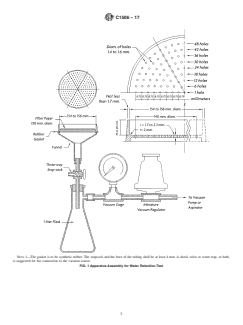
5.6 Filtration Assembly, an apparatus essentially as shown in Fig. 1 shall be used. This apparatus consists of a perforated dish
resting on a funnel, which is connected by a three-way stopcock to a vacuum flask, to which a controlled vacuum is applied. The
perforated dish shall be made of metal not attacked by masonry mortar or plaster (Note 1). The metal base of the dish shall have
a thickness of 2.0 6 0.3 mm and shall conform to the requirements given in Fig. 1. The stopcock bore shall have a 4.0 6 0.5-mm
diameter, and the connecting glass tubing shall have a minimum inside diameter of 4 mm. The length of the tubing projecting into
the 1-L flask from the stopcock shall extend at least 25 mm below the center line of the vacuum connection. The contact surfaces
of the funnel and perforated dish shall be plane and may need to be lapped to ensure intimate contact. An airtight seal shall be
maintained between the funnel and the dish during the test. This shall be accomplished by either of the following procedures. (1)
A synthetic (grease-resistant) rubber gasket may be permanently sealed to the top of the funnel using petrolatum or light grease
to ensureprovide a seal between the gasket and dish. (2) The top of the funnel may be lightly coated with petroleum or light grease
to ensureA petroleum or light grease coating on the top of the funnel to provide a seal between the funnel and dish. Care shall be
taken Take care to ensure that none of the holes in the perforated dish become clogged. Hardened, smooth, not rapid The filter paper
shall be used. It shall be 150 mm in diameter and be placed placed into the dish so as to completely cover the perforations in the
dish.
NOTE 1—Stainless steel, brass, and bronze are suitable metals for this purpose.
5.7 Controlled Vacuum Source:
5.7.1 A vacuum gagegauge capable of reading at least 9-kPa pressure in 0.1-kPa increments (Note 2 and Note 3), connected
to a miniature vacuum regulator having a maximum 55-kPa capacity, which is then connected to a vacuum pump or water aspirator
as shown in Fig. 1. Connection is made between the vacuum flask and the vacuum gage.gauge.
NOTE 2—Vacuum values are all given as pressure relative to atmospheric pressure.
NOTE 3—GagesGauges reading pressure in other units are acceptable as long as their capacity and scale increments comply with the levels specified
here. (For example, a vacuum gagegauge with a minimum capacity of 70 mm of Hg in 1-mm increments is acceptable. To convert mm of Hg to kPa,
multiply by 0.1333. Thus the 7.0-kPa starting pressure is equivalent to 53-mm Hg.)
5.8 Water-re
...