

ASTM F712-06(2018)
(Specification)Standard Test Methods and Specifications for Electrically Insulating Plastic Guard Equipment for Protection of Workers
General Information
- Abstract
SIGNIFICANCE AND USE
4.1 All three tests may be used for product design qualification.
4.2 This specification covers the minimum electrical, chemical, and physical properties designated by the manufacturer and the detailed procedures by which such properties are to be determined. The purchaser has the option to perform or have performed any of these tests and may reject equipment that fails to meet the standard criteria. Claims concerning failure to meet the specification are subject to verification by the manufacturer.
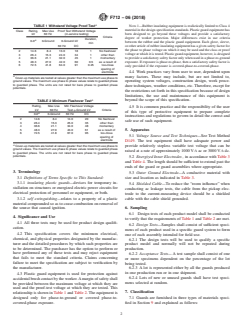
4.3 Plastic guard equipment is used for protection against accidental brush contact by the worker. A margin of safety shall be provided between the maximum voltage at which they are used and the proof-test voltage at which they are tested. This relationship is shown in Table 1 and Table 2. The equipment is designed only for phase-to-ground or covered phase-to-covered-phase exposure.
Note 1: Rubber insulating equipment is realistically limited to Class 4 material in the design specification standards. Plastic guard equipment has been designed to go beyond these voltages and provide a satisfactory degree of worker protection. Major differences exist in use criteria between the rubber and the plastic guard equipment. Each glove, sleeve, or other article of rubber insulating equipment has a given safety factor for the phase to phase voltage on which it may be used and the class or proof voltage at which it is tested. Plastic guard equipment, however, is designed to provide a satisfactory safety factor only when used in a phase-to-ground exposure. If exposure is phase-to-phase, then a satisfactory safety factor is only provided if the exposure is covered-phase-to-covered-phase.
4.4 Work practices vary from user to user, dependent upon many factors. These may include, but are not limited to, operating system voltages, construction design, work procedure techniques, weather conditions, etc. Therefore, except for the restrictions set forth in this specification becaus...
SCOPE
1.1 These test methods cover three electrical tests on plastic guards and assembled guard systems. They are:
1.1.1 Method A—Withstand voltage proof test,
1.1.2 Method B—Flashover voltage, and
1.1.3 Method C—Leakage current.
1.1.4 This specification covers plastic guard equipment and guard systems used by workers for temporary insulation on electric power circuits.
1.1.5 Plastic guard equipment covered by this specification is rated for momentary, or brush contact only. Maximum-use voltages are covered in Table 1 and Table 2. (A) Cover-up materials are tested at values greater than the maximum use phase to ground values. The maximum use phase to phase values relate to guarded phase to guarded phase. The units are not rated for bare phase to guarded phase potentials. (A) Cover-up materials are tested at values greater than the maximum use phase to ground values. The maximum use phase to phase values relate to guarded phase to guarded phase. The units are not rated for bare phase to guarded phase potentials.
1.2 These test methods cover, but are not limited to, the following typical guards:
1.2.1 Conductor Guards and Connecting Covers as follows:
1.2.1.1 Line guards,
1.2.1.2 Line guard connectors,
1.2.1.3 Insulator covers,
1.2.1.4 Dead-end covers,
1.2.1.5 Bus guards, and
1.2.1.6 Bus “T” guards.
1.2.2 Structure and Apparatus Covers as follows:
1.2.2.1 Pole guards,
1.2.2.2 Ridge pin covers,
1.2.2.3 Switch blade covers,
1.2.2.4 Arm guards,
1.2.2.5 Cutout covers,
1.2.2.6 Structural barriers, and
1.2.2.7 Cross arm guard.
1.3 It is common practice for the user of this equipment to prepare instructions for the correct use and maintenance.
1.4 The use and maintenance of this equipment is beyond the scope of these test methods.
1.5 This standard does not purport to address all of the safety concerns, if any, associated with its use. It is the responsibility of the user o...
- Status
- Published
- Publication Date
- 14-Apr-2018
- Technical Committee
- F18 - Electrical Protective Equipment for Workers
- Drafting Committee
- F18.25 - Insulating Cover-Up Equipment
Overview
ASTM F712-06(2018) specifies the standard test methods and requirements for electrically insulating plastic guard equipment intended to protect workers from electrical hazards during work on or around energized power circuits. This standard covers both the test procedures and the key physical, chemical, and electrical properties needed for such plastic guards to be considered safe and effective for use as temporary insulation. Developed by ASTM International, this standard is widely used by manufacturers, utilities, and safety professionals to ensure compliance with safety regulations and to minimize the risk of accidental contact with live electrical conductors.
Key Topics
Test Methods: Includes three major test procedures to assess electrical safety:
- Withstand Voltage Proof Test: Confirms the guard’s ability to insulate at specified proof voltages.
- Flashover Voltage Test: Establishes the voltage at which electrical breakdown occurs across the guard.
- Leakage Current Test: Measures the electrical current that leaks through the material under voltage stress.
Product Classes and Types:
- Guards are classified into five voltage classes and furnished in three material types:
- Type I: Cold-weather-resistant plastic
- Type II: Self-extinguishing plastic
- Type III: Self-extinguishing and cold-weather-resistant plastic
- Guards are classified into five voltage classes and furnished in three material types:
Physical and Chemical Properties:
- Specifies requirements for impact strength, dielectric strength, water absorption, and flame retardancy to ensure durable, safe equipment.
Equipment Types:
- Covers a range of guards and covers, including line and bus guards, insulator covers, pole guards, arm guards, structural barriers, and more.
Safety Margin:
- Ensures a safety factor between the use voltage and the tested proof voltage, guarding against accidental contact.
Inspection, Marking, and Quality Assurance:
- Procedures for inspection, rejection, certification, and marking to verify compliance and traceability.
Applications
Plastic guard equipment standardized by ASTM F712-06(2018) plays a critical role in the following applications:
- Electric Utility Maintenance: Protects linemen and maintenance personnel from accidental brush contact with energized components during repairs and upgrades on power lines, substations, and transformers.
- Construction: Used when working near existing energized lines during installation or maintenance of new structures.
- Industrial Plants: Provides temporary insulation in settings with exposed electrical systems to ensure worker safety during service interruptions or upgrades.
- Compliance and Procurement: Enables safety managers and purchasing agents to specify and accept only products that meet internationally recognized protective equipment standards.
By adhering to this standard, organizations help meet occupational safety requirements, reduce the risk of electrical accidents, and ensure workers are protected by rigorously tested guard systems.
Related Standards
To ensure comprehensive electrical safety and performance of protective equipment, ASTM F712-06(2018) references several important supporting standards:
- ASTM D149: Dielectric breakdown voltage and dielectric strength of solid insulating materials.
- ASTM D256: Determining impact resistance (Izod) of plastics.
- ASTM D570: Water absorption of plastics.
- IEEE 978: Guide for in-service maintenance and electrical testing of live-line tools.
- ANSI C39.5: Safety requirements for electrical/electronic measuring and controlling instrumentation.
- UL 94: Flammability testing of plastic materials.
Keywords: electrical protective equipment, plastic guard equipment, ASTM F712, insulating guard, worker protection, dielectric strength, electrical safety, utility safety, insulating materials.
Relations
- Effective Date
- 15-Apr-2018
- Effective Date
- 01-Jan-2020
- Effective Date
- 01-Dec-2006
- Effective Date
- 01-Dec-2006
- Refers
ASTM D256-06 - Standard Test Methods for Determining the Izod Pendulum Impact Resistance of Plastics - Effective Date
- 15-Mar-2006
- Effective Date
- 01-Nov-2005
- Effective Date
- 01-Nov-2005
- Refers
ASTM D256-05 - Standard Test Methods for Determining the Izod Pendulum Impact Resistance of Plastics - Effective Date
- 01-Jan-2005
- Refers
ASTM D256-04 - Standard Test Methods for Determining the Izod Pendulum Impact Resistance of Plastics - Effective Date
- 01-May-2004
- Effective Date
- 01-Mar-2004
- Refers
ASTM D256-03 - Standard Test Methods for Determining the Izod Pendulum Impact Resistance of Plastics - Effective Date
- 01-Dec-2003
- Effective Date
- 10-Aug-2002
- Refers
ASTM D256-02 - Standard Test Methods for Determining the Izod Pendulum Impact Resistance of Plastics - Effective Date
- 10-Aug-2002
- Effective Date
- 10-Nov-2000
- Effective Date
- 10-Jul-1998
Get Certified
Connect with accredited certification bodies for this standard

CIS Institut d.o.o.
Personal Protective Equipment (PPE) certification body. Notified Body NB-2890 for EU Regulation 2016/425 PPE.

Kiwa BDA Testing
Building and construction product certification.
Kmetijski inštitut Slovenije
Agricultural Institute of Slovenia. Soil testing, plant health, agricultural product analysis.
Sponsored listings
Frequently Asked Questions
ASTM F712-06(2018) is a technical specification published by ASTM International. Its full title is "Standard Test Methods and Specifications for Electrically Insulating Plastic Guard Equipment for Protection of Workers". This standard covers: SIGNIFICANCE AND USE 4.1 All three tests may be used for product design qualification. 4.2 This specification covers the minimum electrical, chemical, and physical properties designated by the manufacturer and the detailed procedures by which such properties are to be determined. The purchaser has the option to perform or have performed any of these tests and may reject equipment that fails to meet the standard criteria. Claims concerning failure to meet the specification are subject to verification by the manufacturer. 4.3 Plastic guard equipment is used for protection against accidental brush contact by the worker. A margin of safety shall be provided between the maximum voltage at which they are used and the proof-test voltage at which they are tested. This relationship is shown in Table 1 and Table 2. The equipment is designed only for phase-to-ground or covered phase-to-covered-phase exposure. Note 1: Rubber insulating equipment is realistically limited to Class 4 material in the design specification standards. Plastic guard equipment has been designed to go beyond these voltages and provide a satisfactory degree of worker protection. Major differences exist in use criteria between the rubber and the plastic guard equipment. Each glove, sleeve, or other article of rubber insulating equipment has a given safety factor for the phase to phase voltage on which it may be used and the class or proof voltage at which it is tested. Plastic guard equipment, however, is designed to provide a satisfactory safety factor only when used in a phase-to-ground exposure. If exposure is phase-to-phase, then a satisfactory safety factor is only provided if the exposure is covered-phase-to-covered-phase. 4.4 Work practices vary from user to user, dependent upon many factors. These may include, but are not limited to, operating system voltages, construction design, work procedure techniques, weather conditions, etc. Therefore, except for the restrictions set forth in this specification becaus... SCOPE 1.1 These test methods cover three electrical tests on plastic guards and assembled guard systems. They are: 1.1.1 Method A—Withstand voltage proof test, 1.1.2 Method B—Flashover voltage, and 1.1.3 Method C—Leakage current. 1.1.4 This specification covers plastic guard equipment and guard systems used by workers for temporary insulation on electric power circuits. 1.1.5 Plastic guard equipment covered by this specification is rated for momentary, or brush contact only. Maximum-use voltages are covered in Table 1 and Table 2. (A) Cover-up materials are tested at values greater than the maximum use phase to ground values. The maximum use phase to phase values relate to guarded phase to guarded phase. The units are not rated for bare phase to guarded phase potentials. (A) Cover-up materials are tested at values greater than the maximum use phase to ground values. The maximum use phase to phase values relate to guarded phase to guarded phase. The units are not rated for bare phase to guarded phase potentials. 1.2 These test methods cover, but are not limited to, the following typical guards: 1.2.1 Conductor Guards and Connecting Covers as follows: 1.2.1.1 Line guards, 1.2.1.2 Line guard connectors, 1.2.1.3 Insulator covers, 1.2.1.4 Dead-end covers, 1.2.1.5 Bus guards, and 1.2.1.6 Bus “T” guards. 1.2.2 Structure and Apparatus Covers as follows: 1.2.2.1 Pole guards, 1.2.2.2 Ridge pin covers, 1.2.2.3 Switch blade covers, 1.2.2.4 Arm guards, 1.2.2.5 Cutout covers, 1.2.2.6 Structural barriers, and 1.2.2.7 Cross arm guard. 1.3 It is common practice for the user of this equipment to prepare instructions for the correct use and maintenance. 1.4 The use and maintenance of this equipment is beyond the scope of these test methods. 1.5 This standard does not purport to address all of the safety concerns, if any, associated with its use. It is the responsibility of the user o...
SIGNIFICANCE AND USE 4.1 All three tests may be used for product design qualification. 4.2 This specification covers the minimum electrical, chemical, and physical properties designated by the manufacturer and the detailed procedures by which such properties are to be determined. The purchaser has the option to perform or have performed any of these tests and may reject equipment that fails to meet the standard criteria. Claims concerning failure to meet the specification are subject to verification by the manufacturer. 4.3 Plastic guard equipment is used for protection against accidental brush contact by the worker. A margin of safety shall be provided between the maximum voltage at which they are used and the proof-test voltage at which they are tested. This relationship is shown in Table 1 and Table 2. The equipment is designed only for phase-to-ground or covered phase-to-covered-phase exposure. Note 1: Rubber insulating equipment is realistically limited to Class 4 material in the design specification standards. Plastic guard equipment has been designed to go beyond these voltages and provide a satisfactory degree of worker protection. Major differences exist in use criteria between the rubber and the plastic guard equipment. Each glove, sleeve, or other article of rubber insulating equipment has a given safety factor for the phase to phase voltage on which it may be used and the class or proof voltage at which it is tested. Plastic guard equipment, however, is designed to provide a satisfactory safety factor only when used in a phase-to-ground exposure. If exposure is phase-to-phase, then a satisfactory safety factor is only provided if the exposure is covered-phase-to-covered-phase. 4.4 Work practices vary from user to user, dependent upon many factors. These may include, but are not limited to, operating system voltages, construction design, work procedure techniques, weather conditions, etc. Therefore, except for the restrictions set forth in this specification becaus... SCOPE 1.1 These test methods cover three electrical tests on plastic guards and assembled guard systems. They are: 1.1.1 Method A—Withstand voltage proof test, 1.1.2 Method B—Flashover voltage, and 1.1.3 Method C—Leakage current. 1.1.4 This specification covers plastic guard equipment and guard systems used by workers for temporary insulation on electric power circuits. 1.1.5 Plastic guard equipment covered by this specification is rated for momentary, or brush contact only. Maximum-use voltages are covered in Table 1 and Table 2. (A) Cover-up materials are tested at values greater than the maximum use phase to ground values. The maximum use phase to phase values relate to guarded phase to guarded phase. The units are not rated for bare phase to guarded phase potentials. (A) Cover-up materials are tested at values greater than the maximum use phase to ground values. The maximum use phase to phase values relate to guarded phase to guarded phase. The units are not rated for bare phase to guarded phase potentials. 1.2 These test methods cover, but are not limited to, the following typical guards: 1.2.1 Conductor Guards and Connecting Covers as follows: 1.2.1.1 Line guards, 1.2.1.2 Line guard connectors, 1.2.1.3 Insulator covers, 1.2.1.4 Dead-end covers, 1.2.1.5 Bus guards, and 1.2.1.6 Bus “T” guards. 1.2.2 Structure and Apparatus Covers as follows: 1.2.2.1 Pole guards, 1.2.2.2 Ridge pin covers, 1.2.2.3 Switch blade covers, 1.2.2.4 Arm guards, 1.2.2.5 Cutout covers, 1.2.2.6 Structural barriers, and 1.2.2.7 Cross arm guard. 1.3 It is common practice for the user of this equipment to prepare instructions for the correct use and maintenance. 1.4 The use and maintenance of this equipment is beyond the scope of these test methods. 1.5 This standard does not purport to address all of the safety concerns, if any, associated with its use. It is the responsibility of the user o...
ASTM F712-06(2018) is classified under the following ICS (International Classification for Standards) categories: 13.260 - Protection against electric shock. Live working. The ICS classification helps identify the subject area and facilitates finding related standards.
ASTM F712-06(2018) has the following relationships with other standards: It is inter standard links to ASTM F712-06(2011), ASTM D149-20, ASTM D256-06a, ASTM D256-06ae1, ASTM D256-06, ASTM D570-98(2005), ASTM D256-05a, ASTM D256-05, ASTM D256-04, ASTM D149-97a(2004), ASTM D256-03, ASTM D256-02e1, ASTM D256-02, ASTM D256-00e1, ASTM D570-98. Understanding these relationships helps ensure you are using the most current and applicable version of the standard.
ASTM F712-06(2018) is available in PDF format for immediate download after purchase. The document can be added to your cart and obtained through the secure checkout process. Digital delivery ensures instant access to the complete standard document.
Standards Content (Sample)
This international standard was developed in accordance with internationally recognized principles on standardization established in the Decision on Principles for the
Development of International Standards, Guides and Recommendations issued by the World Trade Organization Technical Barriers to Trade (TBT) Committee.
Designation:F712 −06 (Reapproved 2018)
Standard Test Methods and Specifications for
Electrically Insulating Plastic Guard Equipment for
Protection of Workers
ThisstandardisissuedunderthefixeddesignationF712;thenumberimmediatelyfollowingthedesignationindicatestheyearoforiginal
adoptionor,inthecaseofrevision,theyearoflastrevision.Anumberinparenthesesindicatestheyearoflastreapproval.Asuperscript
epsilon (´) indicates an editorial change since the last revision or reapproval.
1. Scope responsibility of the user of this standard to establish appro-
priate safety, health, and environmental practices and deter-
1.1 Thesetestmethodscoverthreeelectricaltestsonplastic
mine the applicability of regulatory limitations prior to use.
guards and assembled guard systems. They are:
1.6 The values stated in inch-pound units are to be regarded
1.1.1 Method A—Withstand voltage proof test,
as standard. The values given in parentheses are mathematical
1.1.2 Method B—Flashover voltage, and
conversions to SI units that are provided for information only
1.1.3 Method C—Leakage current.
and are not considered standard.
1.1.4 This specification covers plastic guard equipment and
1.7 This international standard was developed in accor-
guard systems used by workers for temporary insulation on
dance with internationally recognized principles on standard-
electric power circuits.
ization established in the Decision on Principles for the
1.1.5 Plastic guard equipment covered by this specification
Development of International Standards, Guides and Recom-
is rated for momentary, or brush contact only. Maximum-use
mendations issued by the World Trade Organization Technical
voltages are covered in Table 1 and Table 2.
Barriers to Trade (TBT) Committee.
1.2 These test methods cover, but are not limited to, the
following typical guards:
2. Referenced Documents
1.2.1 Conductor Guards and Connecting Covers as follows:
2.1 ASTM Standards:
1.2.1.1 Line guards,
D149Test Method for Dielectric Breakdown Voltage and
1.2.1.2 Line guard connectors,
DielectricStrengthofSolidElectricalInsulatingMaterials
1.2.1.3 Insulator covers,
at Commercial Power Frequencies
1.2.1.4 Dead-end covers,
D256Test Methods for Determining the Izod Pendulum
1.2.1.5 Bus guards, and
1.2.1.6 Bus “T” guards. Impact Resistance of Plastics
D570Test Method for Water Absorption of Plastics
1.2.2 Structure and Apparatus Covers as follows:
1.2.2.1 Pole guards,
2.2 IEEE Standard:
1.2.2.2 Ridge pin covers,
IEEE 978Guide for In-Service Maintenance and Electrical
1.2.2.3 Switch blade covers,
Testing for Live-Line Tools
1.2.2.4 Arm guards,
2.3 ANSI Standard:
1.2.2.5 Cutout covers,
C39.5Safety Requirements for Electrical and Electronic
1.2.2.6 Structural barriers, and
Measuring and Controlling Instrumentation
1.2.2.7 Cross arm guard.
2.4 UL Standard:
1.3 It is common practice for the user of this equipment to
94Tests for Flammability of Plastic Materials for Parts in
prepare instructions for the correct use and maintenance.
Devices and Appliances
1.4 The use and maintenance of this equipment is beyond
the scope of these test methods.
1.5 This standard does not purport to address all of the 2
For referenced ASTM standards, visit the ASTM website, www.astm.org, or
safety concerns, if any, associated with its use. It is the contact ASTM Customer Service at service@astm.org. For Annual Book of ASTM
Standards volume information, refer to the standard’s Document Summary page on
the ASTM website.
1 3
These test methods are under the jurisdiction of ASTM Committee F18 on Available from Institute of Electrical and Electronics Engineers, Inc. (IEEE),
Electrical Protective Equipment for Workers and are the direct responsibility of 445 Hoes Ln., P.O. Box 1331, Piscataway, NJ 08854-1331, http://www.ieee.org.
Subcommittee F18.25 on Insulating Cover-Up Equipment. Available fromAmerican National Standards Institute (ANSI), 25 W. 43rd St.,
Current edition approved April 15, 2018. Published April 2018. Originally 4th Floor, New York, NY 10036, http://www.ansi.org.
approved in 1981. Last previous edition approved in 2011 as F712–06 (2011). Available from Underwriters Laboratories (UL), 333 Pfingsten Rd.,
DOI: 10.1520/F0712-06R18. Northbrook, IL 60062-2096, http://www.ul.com.
Copyright © ASTM International, 100 Barr Harbor Drive, PO Box C700, West Conshohocken, PA 19428-2959. United States
F712−06 (2018)
A
TABLE 1 Withstand Voltage Proof Test NOTE1—RubberinsulatingequipmentisrealisticallylimitedtoClass4
materialinthedesignspecificationstandards.Plasticguardequipmenthas
Class Rating, Max Use Proof Test Withstand Voltage
been designed to go beyond these voltages and provide a satisfactory
kV 60 Hz (in-service testing)
Criteria
degree of worker protection. Major differences exist in use criteria
Duration,
A
0-0 0-Ground 0-Ground kV
between the rubber and the plastic guard equipment. Each glove, sleeve,
min
60 Hz DC orotherarticleofrubberinsulatingequipmenthasagivensafetyfactorfor
the phase to phase voltage on which it may be used and the class or proof
2 14.6 8.4 13.0 18 1 No flashover
voltageatwhichitistested.Plasticguardequipment,however,isdesigned
other than
3 26.4 15.3 24.0 34 1
toprovideasatisfactorysafetyfactoronlywhenusedinaphase-to-ground
4 36.6 21.1 32.0 45 1 momentary
as a result of
5 48.3 27.0 42.0 60 0.5 exposure.Ifexposureisphase-to-phase,thenasatisfactorysafetyfactoris
6 72.5 41.8 64.0 91 0.25 too-close
only provided if the exposure is covered-phase-to-covered-phase.
spacing of
4.4 Work practices vary from user to user, dependent upon
electrode
A many factors. These may include, but are not limited to,
Cover-upmaterialsaretestedatvaluesgreaterthanthemaximumusephaseto
groundvalues.Themaximumusephasetophasevaluesrelatetoguardedphase
operating system voltages, construction design, work proce-
to guarded phase. The units are not rated for bare phase to guarded phase
dure techniques, weather conditions, etc. Therefore, except for
potentials.
the restrictions set forth in this specification because of design
limitations, the use and maintenance of this equipment is
A
beyond the scope of this specification.
TABLE 2 Minimum Flashover Test
Rating, Max Use Min Flashover Voltage
4.5 It is common practice and the responsibility of the user
kV 60 Hz Test φ-Ground kV
Criteria
of this type of protective equipment to prepare complete
A
0-0 0-Ground 60 Hz DC
instructions and regulations to govern in detail the correct and
2 14.6 8.4 14.0 20 No flashover
safe use of such equipment.
3 26.4 15.3 25.0 35 other than
4 36.6 21.1 34.0 48 momentary
5 48.3 27.0 43.0 61 as a result of
5. Apparatus
6 72.5 41.8 67.0 95 too-close
5.1 Voltage Source and Test Techniques—See Test Method
spacing of
electrode
D149. The test equipment shall have adequate power and
A
Cover-upmaterialsaretestedatvaluesgreaterthanthemaximumusephaseto
provide relatively stepless variable test voltage that can be
groundvalues.Themaximumusephasetophasevaluesrelatetoguardedphase
raised at a rate of approximately 1000V⁄s ac or 3000V⁄s dc.
to guarded phase. The units are not rated for bare phase to guarded phase
potentials.
5.2 Energized Inner Electrodes ,inaccordancewithTable3
and Table 4. The length should be sufficient to extend past the
ends of the guard or guard assemblies where appropriate.
3. Terminology
5.3 Outer Ground Electrode—A conductive material with
size and location as indicated in Table 3.
3.1 Definitions of Terms Specific to This Standard:
3.1.1 insulating plastic guards—devices for temporary in-
5.4 Shielded Cable—To reduce the “room influence” when
stallation on structures or energized electric power circuits for
conducting ac leakage tests, the cable from the pickup elec-
electrical protection of personnel or equipment, or both.
trode to the current-measuring device should be a shielded
3.1.2 self extinguishing—relates to a property of a plastic cable with the cable shield grounded.
materialcompoundedsoastoceasecombustiononremovalof
6. Sampling
the source that caused ignition.
6.1 Design tests of each product model shall be conducted
4. Significance and Use
to verify that the requirements of Table 1 and Table 2 are met.
4.1 All three tests may be used for product design qualifi-
6.2 Design Tests—Samples shall consist of sufficient speci-
cation.
mens of each product used in a specific guard system to form
4.2 This specification covers the minimum electrical,
one of each assembly intended for field use.
chemical, and physical properties designated by the manufac-
6.2.1 The design tests will be used to qualify a specific
turer and the detailed procedures by which such properties are
product model and normally will not be repeated during
to be determined. The purchaser has the option to perform or
production.
have performed any of these tests and may reject equipment
6.2.2 Acceptance Tests— A test sample shall consist of one
that fails to meet the standard criteria. Claims concerning
or more specimens dependent on the percentage of the lot
failure to meet the specification are subject to verification by
being tested.
the manufacturer.
6.2.3 A lot is represented either by all the guards produced
in one production run or in one shipment.
4.3 Plastic guard equipment is used for protection against
6.2.4 Lots of new or unused guards shall have test speci-
accidentalbrushcontactbytheworker.Amarginofsafetyshall
mens selected at random.
be provided between the maximum voltage at which they are
used and the proof-test voltage at which they are tested. This
7. Classification
relationship is shown in Table 1 and Table 2.The equipment is
designed only for phase-to-ground or covered phase-to- 7.1 Guards are furnished in three types of materials speci-
covered-phase exposure. fied in Section 9 and explained as follows:
F712−06 (2018)
TABLE 3 Typical Electrodes for Testing Plastic Guard Equipment
A
Outer Ground Electrode
A
Type of Guards Energized Inner Electrode for All Tests
Proof Test Flashover and Leakage Tests
B
Line guards and line guard Round metal tube or bar. Complete electode shall be 4 by 6-in. flexible conductive pad
connectors spaced back from openings placed alternately on all exterior
Insulator covers and deadened Maximum conductor, hardware and insulator assembly for through which the energized surfaces and across conductor
C
covers which rated or similar mock-up including mandrel of electrode protrudes during the opening of guard and assembled
D
conductive material approximate. test only as necessary to avoid guard system joints spaced back
E C
Pole guards, ridge pin and Round metal tube, fabricated mandrel flashover. Therefore, the entire from openings through which the
D
switch blade covers or cluster small metal tubes. area of each cover shall be tested energized electrode protrudes
as nearly as practical. during the test only as necessary
D
Arm guards Round or rectangular metal tube or fabricated mandrel. to avoid flashover at outer ends.
C
Cutout covers Largest cutout with bare leads covered with equal rated
C
line hose. Or similar mock-up including mandrel of
D
conductive material.
Structural barrier Rectangular metal sheets approximately 3 mm (0.06 in.)
thick, having smoothly rounded edges and corners,
have been found to be satisfactory for this purpose.
Also satisfactory are wet felt or sponge-top electodes.
A
Moistened electrodes may be secured with rubber straps or blanket pins. Pressure-sensitive tape is helpful in securing dry metal foil electrodes.
B
Suitable materials include: metal foil or screen; tap water-moistened sponge sheeting, or blanket made of wool, or similar material including synthetics.
C
Thin metal sheet or screen wire secured on wood frames make suitable electrodes. Carved synthetic sponge moistened with tap water is suitable for small forms.
D
The dimensions of the mandrel are to approximate the maximum size of equipment to which the guard system is to be applied.
E
Metal canisters made for storing rubber blankets make suitable electrodes for pole guard tests.
TABLE 4 Inner Electrode Sizes
7.3 Guards are made in five classes in accordance with the
Rating—Max Use Inner Electrode Diameter, in. (mm) voltage ratings in Annex A1.
A
Class kV 60 Hz
Min Max
φ −φφ−Gr. 8. Ordering Information
2 14.6 8.4 0.25 (6.4) 0.75 (19.1)
8.1 Orders for guards under this specification shall include
3 26.4 15.3 0.25 (6.4) 0.75 (19.1)
the designation ASTM Specification F712 and should includ
...