

ASTM D4729-19
(Test Method)Standard Test Method for In Situ Stress and Modulus of Deformation Using the Flat Jack Method
General Information
- Abstract
SIGNIFICANCE AND USE
5.1 Flat jack tests are useful to assess rock mass deformability and stresses in the design stages of projects as well as for issues with existing projects; for example, stresses around an underground opening. The in situ stress values can be used as an important parameter for interpretation and validation of test results and analytical models.
5.2 This test method has been successfully used for other applications such as concrete dams and masonry structures. This test method is similar to the techniques and equipment used in C1196 and C1197. However, this standard is written more for rock and where irregular surfaces may be involved and both in situ stress and deformability are obtained in one test.
Note 1: Notwithstanding the statements on precision and bias contained in this test method; the precision of this test method is dependent on the competence of the personnel performing it, and the suitability of the equipment and facilities used. Agencies that meet the criteria of Practice D3740 are generally considered capable of competent and objective testing. Users of this test method are cautioned that compliance with Practice D3740 does not in itself assure reliable testing. Reliable testing depends on many factors; Practice D3740 provides a means of evaluating some of those factors.
SCOPE
1.1 The flat jack test measures the natural or altered in situ stress at a rock surface either for a surface outcrop or an underground excavation surface. The modulus of deformation and the long-term deformational properties (creep) may also be evaluated for the applied stress range, however long-term creep is not covered by this method.
1.2 This method covers square flat jacks that are placed in a rock slot and if required encapsulated in the slot.
1.3 Deformation readings are taken at the surface, but this standard does not exclude deformation readings being taken below the surface, such as using a flat jack which is set up to obtain displacement data internally.
1.4 All observed and calculated values shall conform to the guidelines for significant digits and rounding established in Practice D6026.
1.4.1 The procedures used to specify how data are collected/recorded or calculated in this standard are regarded as the industry standard. In addition, they are representative of the significant digits that generally should be retained. The procedures used do not consider material variation, purpose for obtaining the data, special purpose studies, or any considerations for the user’s objectives; and it is common practice to increase or reduce significant digits of reported data to be commensurate with these considerations. It is beyond the scope of this standard to consider significant digits used in analysis methods for engineering design.
1.5 Limitation—The flat jack test measures the average stress normal to the surface of the test chamber, underground excavation, or outcrop. In situ stress levels must be determined by theoretical interpretations of these data.
1.6 Assumptions and Factors Influencing the Data:
1.6.1 The stress relief is assumed to be an elastic, reversible process. In nonhomogeneous or highly fractured materials, this may not be completely true.
1.6.2 The equations assume that the rock mass is isotropic and homogeneous. Anisotropic effects may be estimated by testing in different orientations.
1.6.3 The flat jack is assumed to be 100 % efficient. The design and size requirements of 7.1 were determined to satisfy this requirement to within a few percent.
1.6.4 The jack is assumed to be aligned with the principal stresses on the surface being measured. Shear stresses are not canceled by jack pressure. Orientating the tests in three directions in each plane tested prevents the misalignment from being excessive for at least one of the tests.
1.7 Units—The values stated in inch-pound units are to be regarded as standard. The values given in parentheses ar...
- Status
- Published
- Publication Date
- 31-May-2019
- Technical Committee
- D18 - Soil and Rock
- Drafting Committee
- D18.12 - Rock Mechanics
Overview
ASTM D4729-19 is a standardized test method established by ASTM International for determining in situ stress and modulus of deformation in rock masses through the use of the flat jack method. This procedure is widely utilized in geotechnical engineering to assess the stability and deformation characteristics of rock surrounding excavations, surface outcrops, or existing underground openings. The results are vital for the design and validation of analytical and structural models used in a variety of engineering projects, including tunnels, foundations, concrete dams, and masonry structures.
Key Topics
- Purpose: The flat jack test quantifies natural or modified in situ stresses and the modulus of deformation at rock surfaces, providing essential data for design, validation, and troubleshooting in civil and geotechnical engineering.
- Test Method: The flat jack is installed in a slot cut into the rock. Stress relief is achieved by cutting the slot, and deformation is measured. The hydraulic flat jack is then pressurized to restore displacement to its pre-slot state, allowing estimation of in situ stress and deformability.
- Surface and Subsurface Measurements: Readings are typically taken at the rock surface, but the method also supports interior displacement data collection in certain configurations.
- Assumptions and Limitations:
- The test assumes elastic, reversible stress relief in mostly homogeneous, isotropic rock.
- Average stress normal to the surface is measured; theoretical interpretation is required for full stress level characterization.
- Variations in material properties, test setup, or environmental conditions, such as temperature or local geological features, can influence accuracy and interpretation.
- The method is not intended for direct assessment of long-term creep.
- Data Quality: The reliability of test results depends significantly on the competence and qualification of personnel and adequacy of equipment, aligning with guidelines outlined in ASTM D3740.
- Reporting: Data should be documented in accordance with significant digit and rounding guidelines to maintain consistency and integrity, per ASTM D6026.
Applications
The ASTM D4729-19 flat jack method plays a critical role in:
- Underground Excavation Design: Provides key parameters for modeling and support design by measuring rock mass stress and deformability close to tunnels or shafts.
- Assessment of Existing Structures: Useful for evaluating stresses and deformation properties in rock supporting existing underground openings or cut slopes to identify potential issues or validate remedial measures.
- Civil Infrastructure: Has been successfully applied to concrete dams and masonry structures, assisting in monitoring load transfer and structural health.
- Construction Quality Control: Supports verification of ground conditions before, during, and after excavation or construction, minimizing risks related to unexpected movements or failures.
Related Standards
To ensure comprehensive and compliant testing, the following ASTM standards are commonly referenced alongside ASTM D4729-19:
- ASTM D3740 - Minimum requirements for agencies involved in testing/inspection of soil and rock
- ASTM D6026 - Practice for using significant digits in geotechnical data
- ASTM C1196 - Test method for in situ compressive stress in masonry using flat jacks
- ASTM C1197 - Test method for in situ measurement of masonry deformability characteristics via flat jack
- ASTM D2113 - Practice for rock core drilling and sampling
- ASTM D653 - Terminology relating to soil, rock, and contained fluids
These related standards help ensure the quality assurance, precision, and correct application of the flat jack method in various engineering settings.
Keywords: ASTM D4729-19, flat jack method, in situ stress, modulus of deformation, rock mass, geotechnical testing, underground excavation, rock mechanics, deformation measurement, engineering standards, pressure testing.
Relations
- Effective Date
- 01-Jun-2019
- Effective Date
- 01-Jan-2024
- Effective Date
- 01-Nov-2023
- Effective Date
- 01-Dec-2019
- Effective Date
- 01-Oct-2019
- Effective Date
- 01-May-2018
- Effective Date
- 15-Jul-2016
- Effective Date
- 01-Jul-2015
- Effective Date
- 01-Aug-2014
- Effective Date
- 01-Jul-2014
- Effective Date
- 01-Jul-2014
- Effective Date
- 01-May-2012
- Effective Date
- 01-Mar-2012
- Effective Date
- 01-Sep-2011
- Effective Date
- 01-Sep-2011
Get Certified
Connect with accredited certification bodies for this standard

Zavod za gradbeništvo Slovenije (ZAG) - Inšpekcija
ZAG inspection body for construction products, structures, and materials.
Sponsored listings
Frequently Asked Questions
ASTM D4729-19 is a standard published by ASTM International. Its full title is "Standard Test Method for In Situ Stress and Modulus of Deformation Using the Flat Jack Method". This standard covers: SIGNIFICANCE AND USE 5.1 Flat jack tests are useful to assess rock mass deformability and stresses in the design stages of projects as well as for issues with existing projects; for example, stresses around an underground opening. The in situ stress values can be used as an important parameter for interpretation and validation of test results and analytical models. 5.2 This test method has been successfully used for other applications such as concrete dams and masonry structures. This test method is similar to the techniques and equipment used in C1196 and C1197. However, this standard is written more for rock and where irregular surfaces may be involved and both in situ stress and deformability are obtained in one test. Note 1: Notwithstanding the statements on precision and bias contained in this test method; the precision of this test method is dependent on the competence of the personnel performing it, and the suitability of the equipment and facilities used. Agencies that meet the criteria of Practice D3740 are generally considered capable of competent and objective testing. Users of this test method are cautioned that compliance with Practice D3740 does not in itself assure reliable testing. Reliable testing depends on many factors; Practice D3740 provides a means of evaluating some of those factors. SCOPE 1.1 The flat jack test measures the natural or altered in situ stress at a rock surface either for a surface outcrop or an underground excavation surface. The modulus of deformation and the long-term deformational properties (creep) may also be evaluated for the applied stress range, however long-term creep is not covered by this method. 1.2 This method covers square flat jacks that are placed in a rock slot and if required encapsulated in the slot. 1.3 Deformation readings are taken at the surface, but this standard does not exclude deformation readings being taken below the surface, such as using a flat jack which is set up to obtain displacement data internally. 1.4 All observed and calculated values shall conform to the guidelines for significant digits and rounding established in Practice D6026. 1.4.1 The procedures used to specify how data are collected/recorded or calculated in this standard are regarded as the industry standard. In addition, they are representative of the significant digits that generally should be retained. The procedures used do not consider material variation, purpose for obtaining the data, special purpose studies, or any considerations for the user’s objectives; and it is common practice to increase or reduce significant digits of reported data to be commensurate with these considerations. It is beyond the scope of this standard to consider significant digits used in analysis methods for engineering design. 1.5 Limitation—The flat jack test measures the average stress normal to the surface of the test chamber, underground excavation, or outcrop. In situ stress levels must be determined by theoretical interpretations of these data. 1.6 Assumptions and Factors Influencing the Data: 1.6.1 The stress relief is assumed to be an elastic, reversible process. In nonhomogeneous or highly fractured materials, this may not be completely true. 1.6.2 The equations assume that the rock mass is isotropic and homogeneous. Anisotropic effects may be estimated by testing in different orientations. 1.6.3 The flat jack is assumed to be 100 % efficient. The design and size requirements of 7.1 were determined to satisfy this requirement to within a few percent. 1.6.4 The jack is assumed to be aligned with the principal stresses on the surface being measured. Shear stresses are not canceled by jack pressure. Orientating the tests in three directions in each plane tested prevents the misalignment from being excessive for at least one of the tests. 1.7 Units—The values stated in inch-pound units are to be regarded as standard. The values given in parentheses ar...
SIGNIFICANCE AND USE 5.1 Flat jack tests are useful to assess rock mass deformability and stresses in the design stages of projects as well as for issues with existing projects; for example, stresses around an underground opening. The in situ stress values can be used as an important parameter for interpretation and validation of test results and analytical models. 5.2 This test method has been successfully used for other applications such as concrete dams and masonry structures. This test method is similar to the techniques and equipment used in C1196 and C1197. However, this standard is written more for rock and where irregular surfaces may be involved and both in situ stress and deformability are obtained in one test. Note 1: Notwithstanding the statements on precision and bias contained in this test method; the precision of this test method is dependent on the competence of the personnel performing it, and the suitability of the equipment and facilities used. Agencies that meet the criteria of Practice D3740 are generally considered capable of competent and objective testing. Users of this test method are cautioned that compliance with Practice D3740 does not in itself assure reliable testing. Reliable testing depends on many factors; Practice D3740 provides a means of evaluating some of those factors. SCOPE 1.1 The flat jack test measures the natural or altered in situ stress at a rock surface either for a surface outcrop or an underground excavation surface. The modulus of deformation and the long-term deformational properties (creep) may also be evaluated for the applied stress range, however long-term creep is not covered by this method. 1.2 This method covers square flat jacks that are placed in a rock slot and if required encapsulated in the slot. 1.3 Deformation readings are taken at the surface, but this standard does not exclude deformation readings being taken below the surface, such as using a flat jack which is set up to obtain displacement data internally. 1.4 All observed and calculated values shall conform to the guidelines for significant digits and rounding established in Practice D6026. 1.4.1 The procedures used to specify how data are collected/recorded or calculated in this standard are regarded as the industry standard. In addition, they are representative of the significant digits that generally should be retained. The procedures used do not consider material variation, purpose for obtaining the data, special purpose studies, or any considerations for the user’s objectives; and it is common practice to increase or reduce significant digits of reported data to be commensurate with these considerations. It is beyond the scope of this standard to consider significant digits used in analysis methods for engineering design. 1.5 Limitation—The flat jack test measures the average stress normal to the surface of the test chamber, underground excavation, or outcrop. In situ stress levels must be determined by theoretical interpretations of these data. 1.6 Assumptions and Factors Influencing the Data: 1.6.1 The stress relief is assumed to be an elastic, reversible process. In nonhomogeneous or highly fractured materials, this may not be completely true. 1.6.2 The equations assume that the rock mass is isotropic and homogeneous. Anisotropic effects may be estimated by testing in different orientations. 1.6.3 The flat jack is assumed to be 100 % efficient. The design and size requirements of 7.1 were determined to satisfy this requirement to within a few percent. 1.6.4 The jack is assumed to be aligned with the principal stresses on the surface being measured. Shear stresses are not canceled by jack pressure. Orientating the tests in three directions in each plane tested prevents the misalignment from being excessive for at least one of the tests. 1.7 Units—The values stated in inch-pound units are to be regarded as standard. The values given in parentheses ar...
ASTM D4729-19 is classified under the following ICS (International Classification for Standards) categories: 93.020 - Earthworks. Excavations. Foundation construction. Underground works. The ICS classification helps identify the subject area and facilitates finding related standards.
ASTM D4729-19 has the following relationships with other standards: It is inter standard links to ASTM D4729-08, ASTM D6027/D6027M-24, ASTM D3740-23, ASTM C476-19, ASTM D3740-19, ASTM C476-18, ASTM C476-16, ASTM D6027/D6027M-15, ASTM D653-14, ASTM C1196-14, ASTM C1197-14, ASTM D3740-12a, ASTM D3740-12, ASTM D653-11, ASTM D3740-11. Understanding these relationships helps ensure you are using the most current and applicable version of the standard.
ASTM D4729-19 is available in PDF format for immediate download after purchase. The document can be added to your cart and obtained through the secure checkout process. Digital delivery ensures instant access to the complete standard document.
Standards Content (Sample)
This international standard was developed in accordance with internationally recognized principles on standardization established in the Decision on Principles for the
Development of International Standards, Guides and Recommendations issued by the World Trade Organization Technical Barriers to Trade (TBT) Committee.
Designation: D4729 − 19
Standard Test Method for
In Situ Stress and Modulus of Deformation Using the Flat
Jack Method
This standard is issued under the fixed designation D4729; the number immediately following the designation indicates the year of
original adoption or, in the case of revision, the year of last revision. A number in parentheses indicates the year of last reapproval. A
superscript epsilon (´) indicates an editorial change since the last revision or reapproval.
1. Scope* 1.6.2 The equations assume that the rock mass is isotropic
and homogeneous. Anisotropic effects may be estimated by
1.1 The flat jack test measures the natural or altered in situ
testing in different orientations.
stress at a rock surface either for a surface outcrop or an
1.6.3 The flat jack is assumed to be 100 % efficient. The
underground excavation surface. The modulus of deformation
design and size requirements of 7.1 were determined to satisfy
andthelong-termdeformationalproperties(creep)mayalsobe
this requirement to within a few percent.
evaluatedfortheappliedstressrange,howeverlong-termcreep
is not covered by this method.
1.6.4 The jack is assumed to be aligned with the principal
stresses on the surface being measured. Shear stresses are not
1.2 This method covers square flat jacks that are placed in a
canceled by jack pressure. Orientating the tests in three
rock slot and if required encapsulated in the slot.
directions in each plane tested prevents the misalignment from
1.3 Deformation readings are taken at the surface, but this
being excessive for at least one of the tests.
standard does not exclude deformation readings being taken
below the surface, such as using a flat jack which is set up to 1.7 Units—The values stated in inch-pound units are to be
obtain displacement data internally. regarded as standard. The values given in parentheses are
mathematical conversions to SI units that are provided for
1.4 All observed and calculated values shall conform to the
information only and are not considered standard. Add if
guidelines for significant digits and rounding established in
appropriate, “Reporting of test results in units other than
Practice D6026.
inch-poundsshallnotberegardedasnonconformancewiththis
1.4.1 Theproceduresusedtospecifyhowdataarecollected/
standard.”
recorded or calculated in this standard are regarded as the
1.7.1 The gravitational system of inch-pound units is used
industry standard. In addition, they are representative of the
significant digits that generally should be retained. The proce- when dealing with inch-pound units. In this system, the pound
dures used do not consider material variation, purpose for (lbf) represents a unit of force (weight), while the unit for mass
obtaining the data, special purpose studies, or any consider- is slugs. The slug unit is not given unless dynamic (F=ma)
ations for the user’s objectives; and it is common practice to
calculations are involved. For standards involving the determi-
increase or reduce significant digits of reported data to be nation of mass or the use of density and unit weight, include
commensuratewiththeseconsiderations.Itisbeyondthescope
the following numbered paragraph.
of this standard to consider significant digits used in analysis
1.7.2 The slug unit of mass is typically not used in com-
methods for engineering design.
mercial practice; that is, density, balances, and so on.
Therefore, the standard unit for mass in this standard is either
1.5 Limitation—The flat jack test measures the average
kilogram (kg) or gram (g) or both. Also, the equivalent
stress normal to the surface of the test chamber, underground
inch-pound unit (slug) is not given/presented in parentheses.
excavation, or outcrop. In situ stress levels must be determined
by theoretical interpretations of these data.
1.7.3 It is common practice in the engineering/construction
profession to concurrently use pounds to represent both a unit
1.6 Assumptions and Factors Influencing the Data:
of mass (lbm) and of force (lbf). This practice implicitly
1.6.1 The stress relief is assumed to be an elastic, reversible
combines two separate systems of units; the absolute and the
process. In nonhomogeneous or highly fractured materials, this
gravitational systems. It is scientifically undesirable to com-
may not be completely true.
bine the use of two separate sets of inch-pound units within a
single standard. As stated, this standard includes the gravita-
ThistestmethodisunderthejurisdictionofASTMCommitteeD18onSoiland
tional system of inch-pound units and does not use/present the
Rock and is the direct responsibility of Subcommittee D18.12 on Rock Mechanics.
slug unit for mass. However, the use of balances or scales
CurrenteditionapprovedJune1,2019.PublishedJuly2019.Originallyapproved
recording pounds of mass (lbm) or recording density in lbm/ft
in 1987. Last previous edition approved in 2008 as D4729 – 08, which was
withdrawn July 2017 and reinstated in June 2019. DOI: 10.1520/D4729-19. shall not be regarded as nonconformance with this standard.
*A Summary of Changes section appears at the end of this standard
Copyright © ASTM International, 100 Barr Harbor Drive, PO Box C700, West Conshohocken, PA 19428-2959. United States
D4729 − 19
1.8 This standard does not purport to address all of the 3.2.3 demountable mechanical (DEMEC) strain gauges,
safety concerns, if any, associated with its use. It is the n—mechanical gauges using ‘contact’ measuring principles to
responsibility of the user of this standard to establish appro- make transfer-length strain measurements.
priate safety, health, and environmental practices and deter-
3.2.4 skin stress, n—the tangential stress at the surface of an
mine the applicability of regulatory limitations prior to use.
opening.
1.9 This international standard was developed in accor-
3.2.5 in situ stress, n—thestressfieldexistinginarockmass
dance with internationally recognized principles on standard-
at the surface or below the surface prior to or after excavation
ization established in the Decision on Principles for the
of an opening.
Development of International Standards, Guides and Recom-
mendations issued by the World Trade Organization Technical 4. Summary of Test Method
Barriers to Trade (TBT) Committee.
4.1 The in situ stress in the rock mass is relieved by cutting
a slot into the rock perpendicular to the surface of the
2. Referenced Documents
underground excavation or rock outcrop using a diamond saw
or overlapping drill holes. The deformation caused by this
2.1 ASTM Standards:
stress relief is measured.
C476 Specification for Grout for Masonry
C1196 Test Method for In Situ Compressive Stress Within
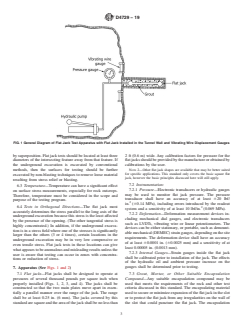
4.2 A hydraulic flat jack (Fig. 1) is placed into the slot and
Solid Unit Masonry Estimated Using Flatjack Measure-
grouted if the slot is too wide or the surface was left uneven
ments
and could puncture the flat jack. The flat jack is then pressur-
C1197 Test Method for In Situ Measurement of Masonry
ized until the above-measured (stress relief) displacement is
Deformability Properties Using the Flatjack Method
canceled or recovered. This reapplied stress is approximately
D653 Terminology Relating to Soil, Rock, and Contained
equal to the stress in the rock mass at the test location in a
Fluids
direction perpendicular to the plane of the jack. The deforma-
D2113 Practice for Rock Core Drilling and Sampling of
tional characteristics of the rock mass are evaluated by
Rock for Site Exploration
incrementally loading or unloading the flat jack and measuring
D3740 Practice for Minimum Requirements for Agencies
the corresponding deformation.
Engaged in Testing and/or Inspection of Soil and Rock as
5. Significance and Use
Used in Engineering Design and Construction
D5720 Practice for Static Calibration of Electronic
5.1 Flat jack tests are useful to assess rock mass deform-
Transducer-Based Pressure Measurement Systems for
ability and stresses in the design stages of projects as well as
Geotechnical Purposes (Withdrawn 2018)
for issues with existing projects; for example, stresses around
D6026 Practice for Using Significant Digits in Geotechnical
an underground opening. The in situ stress values can be used
Data
as an important parameter for interpretation and validation of
D6027/D6027M Practice for Calibrating Linear Displace-
test results and analytical models.
ment Transducers for Geotechnical Purposes
5.2 This test method has been successfully used for other
applications such as concrete dams and masonry structures.
3. Terminology
This test method is similar to the techniques and equipment
used in C1196 and C1197. However, this standard is written
3.1 Definitions:
more for rock and where irregular surfaces may be involved
3.1.1 For definitions of common technical terms in this
and both in situ stress and deformability are obtained in one
standard, refer to Terminology D653.
test.
3.2 Definitions of Terms Specific to This Standard:
NOTE 1—Notwithstanding the statements on precision and bias con-
3.2.1 cancellation pressure, n—the pressure in the flat jack
tained in this test method; the precision of this test method is dependent
onthecompetenceofthepersonnelperformingit,andthesuitabilityofthe
required to return the rock to its initial position before the slot
equipment and facilities used. Agencies that meet the criteria of Practice
was cut.
D3740 are generally considered capable of competent and objective
3.2.2 coeffıcient for test geometry, n—a constant dependent testing. Users of this test method are cautioned that compliance with
Practice D3740 does not in itself assure reliable testing. Reliable testing
upon the point at which pressure is measured, size of the flat
depends on many factors; Practice D3740 provides a means of evaluating
jack, and its relationship with the slot dimension and nearness
some of those factors.
of surface.
6. Interferences
6.1 Local Geologic Features—Local features, particularly
faults, shear zones, and alike, can influence the local stress
For referenced ASTM standards, visit the ASTM website, www.astm.org, or
contact ASTM Customer Service at service@astm.org. For Annual Book of ASTM
field. Large inclusions in the rock can affect both the stress and
Standards volume information, refer to the standard’s Document Summary page on
deformational properties. Test locations should be carefully
the ASTM website.
selected so that the effects of such features are reduced or, if
The last approved version of this historical standard is referenced on
www.astm.org. they are the features of interest, accounted for fully.
Lama, R.D., andVutukuri,V.S., Handbook on Mechanical Properties of Rocks;
6.2 Influence of Excavations—Other excavations intersect-
Testing Techniques and Results, Volume III, Department of Mining Engineering,
Broken Hill Division, Australia, 1978. ing the test site will cause complex stress concentration effects
D4729 − 19
FIG. 1 General Diagram of Flat Jack Test Apparatus with Flat Jack Installed in the Tunnel Wall and Vibrating Wire Displacement Gauges
by superposition. Flat jack tests should be located at least three 2 ft (0.6 m) wide. Any calibration factors for pressure for the
diameters of the intersecting feature away from that feature. If flatjacksshouldbeprovidedbythemanufactureorobtainedby
the underground excavation is excavated by conventional calibrations by the user.
methods, then the surfaces for testing should be further NOTE 2—Other flat jack shapes are available that may be better suited
for specific applications. This standard only covers the basic square flat
excavated by non-blasting techniques to remove loose material
jack, however the basic principles discussed here will still apply.
resulting from stress relief or blasting.
7.2 Instrumentation:
6.3 Temperature—Temperature can have a significant effect
7.2.1 Pressure—Electronic transducers or hydraulic gauges
on surface stress measurements, especially for rock outcrops.
may be used to monitor flat jack pressure. The pressure
Therefore, temperature must be considered in the scope and
transducer shall have an accuracy of at least 620 lbf/
purpose of the testing program.
in. (60.14 MPa), including errors introduced by the readout
6.4 Tests in Orthogonal Directions—The flat jack most
system and a sensitivity of at least 10 lbf/in. (0.069 MPa).
accurately determines the stress parallel to the long axis of the
7.2.2 Deformation—Deformation measurement devices in-
underground excavation because this stress is the least affected
cluding mechanical dial gauges, and electronic transducers
by the presence of the opening. (The other tangential stress is
such as LVDTs, vibrating wire or linear potentiometers. The
highly concentrated.) In addition, if the underground excava-
devices can be either stationary, or portable, such as demount-
tion is in a stress field where one of the stresses is significantly
ablemechanical(DEMEC)straingauges,dependingonthesite
larger than the others (3 or 4 times), certain locations in the
requirements. The deformation device shall have an accuracy
underground excavation may be in very low compressive or
of at least 60.0001 in. (60.0025 mm) and a sensitivity of at
even tensile stress. Flat jack tests in these locations can give
least 0.00005 in. (0.0013 mm).
whatappearstobeanomalousandmisleadingresultsunlessthe
7.2.3 Internal Gauges—Strain gauges inside the flat jack
user is aware that testing can occur in zones with concentra-
shall be calibrated prior to installation of the jack. The effects
tions or reduction of stress.
of the hydraulic oil and ambient pressure increase on the
gauges shall be determined prior to testing.
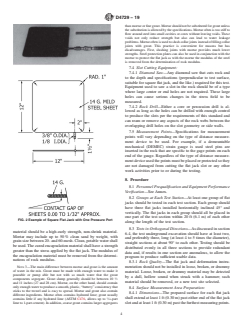
7. Apparatus (See Figs. 1 and 2)
7.1 Flat jacks—Flat jacks shall be designed to operate at 7.3 Grout, Mortar, or Other Suitable Encapsulation
pressures of several thousand pounds per square inch when Compound—Any suitable encapsulation compound may be
properly installed (Figs. 1, 2, 3, and 4). The jacks shall be used that meets the requirements of the rock and other test
constructed so that the two main plates move apart in essen- criteria discussed in this standard. The encapsulating material
tially a parallel manner over the range of the jack. The range used to secure or minimize expansion of the flat jack in the slot
shall be at least 0.25 in. (6 mm). The jacks covered by this or to protect the flat jack from any irregularities on the wall of
standardaresquareandtheareaofthejackshallbenolessthan the slot that could puncture the flat jack. The encapsulation
D4729 − 19
thanmortarorfinegrout.Mortarshouldnotbesubstitutedforgroutunless
the substitution is allowed by the specifications. Mortar often is too stiff to
flow around steel into small cavities or cores without leaving voids.These
voids not only reduce strength but also can lead to water leakage
problems.Mortaroftenisusedtoslushcollarjointsinsteadoffillingcollar
joints with grout. This practice is convenient for masons but has
disadvantages. First, slushing joints with mortar provides much lower
strengths. Steel protection plates can also be used in conjunction with the
mortar to protect the flat jack as with the mortar the modulus of the steel
is removed from the determination of rock modulus.
7.4 Slot Cutting Equipment:
7.4.1 Diamond Saw—Any diamond saw that cuts rock and
to the depth and specifications (perpendicular to test surface,
suitable for square flat jack, and the like.) required for this test.
Equipment used to saw a slot in the rock should be of a type
where large center or end holes are not required. These large
holes can cause serious changes in the stress field to be
measured.
7.4.2 Rock Drill—Either a core or percussion drill is al-
lowed as long as the holes can be drilled with enough control
to produce the slots per the requirements of this standard and
can ream or remove any aspects of the rock webs between the
overlapping drill holes on the slot geometry or side walls.
7.5 Measurement Points—Specifications for measurement
points will vary depending on the type of distance measure-
ment device to be used. For example, if a demountable
mechanical (DEMEC) strain gauge is used steel pins are
inserted in the rock that are specific to the gage points on each
end of the gauge. Regardless of the type of distance measure-
mentdeviceusedthepointsmustbeplacedorprotectedsothey
are not damaged from cutting the flat jack slot or any other
work activities prior to or during the testing.
8. Procedure
8.1 Personnel Prequalification and Equipment Performance
Verification—See Annex.
8.2 Groups at Each Test Station—At least one group of flat
jacks should be tested in each test section. Each group should
have three flat jacks installed horizontally inclined 45° and
vertically. The flat jacks in each group should all be placed in
one part of the test section within 20 ft (6.1 m) of each other
FIG. 2 Example of Square Flat Jack with One Pressure Port
along the length of the test section.
8.3 Tests in Orthogonal Directions—As discussed in section
material should be a high-early strength, non-shrink material.
6.4, the test underground excavation should have at least two,
Mortar may include up to 50 % clean sand by weight, with
and preferably three, long (at least 4 to 5 times the diameter),
grain size between 20- and 60-mesh. Clean, potable water shall
straight sections at about 90° to each other. Testing should be
be used.The cured encapsulation material shall have a strength
distributed evenly in all three sections to provide redundant
greater than the stress applied by the flat jack. The modulus of
data and, if results in one section are anomalous, to allow the
the encapsulation material must be removed from the determi-
program to produce sufficient usable data.
nations of rock modulus.
8.3.1 Rock Quality—The flat jack and deformation instru-
NOTE 3—The main difference between mortar and grout is the amount mentation should not be installed in loose, broken, or drummy
of water in the mix. Grout must be made with enough water to make it
material. Loose, broken, or drummy material may be detected
pourable or pump able but not with so much water that the grout
by a dull, hollow sound when struck with a hammer; such
components segregate. Grout slump generally should be between 10 ⁄2
material should be removed, or a new test site selected.
and 11 inches (27 and 28 cm). Mortar, on the other hand, should contain
onlyenoughwatertoproduceasmooth,plastic,“buttery”consistencythat
8.4 Surface Measurement Area Preparation:
sticks to the trowel and is easy to spread. Mortar and grout also contain
8.4.1 Dimensions—The prepared surface for each flat jack
different ingredients. Mortar often contains hydrated lime; grout usually
shall extend at least 1 ft (0.30 m) past either end of the flat jack
contains little if any hydrated lime (ASTM C476, allows up to ⁄10-part
limeto1-partcement).Inaddition,coarsegroutcontainslargeraggregates slotandatleast1ft(0.30m)pastthefurthestmeasuringpoints.
D4729 − 19
The transducers or flat jack shall be 1 ft (0.30 m) inside the 8.8 Relaxation Measurements—Deformation between all
prepared surface at any point (see Fig. 3). measurement points shall be measured and recorded immedi-
8.4.2 Method—Drilling to a uniform depth may be required ately upon completion of slot cutting and again immediately
to prepare the rock face. Residual rock between the drill holes prior to testing.The number of significant digits to be read will
may be removed by moving the drill bit or special reaming or depend on the stiffness of the rock and the type of readout
flattening bit back and forth until a smooth surface is achieved. being used. The number of significant digits should be such
In softer material, coarse grinding, chipping, or cutting devices that the readout can obtain a reading, differing by at least two
that are not as aggressive may be required or utilized. units, for each increment and decrement. If the rock undergoes
8.4.3 Smoothness—Ideally, the prepared surface should be a strain under constant load over a period of time, several
plane. The difference between the highest and lowest points on intermediate readings shall be taken to evaluate this effect.
the prepared surface shall be not greater than 2 in. (50 mm).
8.9 Flat Jack Installation—Flat jacks shall be centered in
the slot and recessed 3 in. (75 mm) from the face of the
8.5 Transducer a
...