

ASTM F1122-22
(Specification)Standard Specification for Quick Disconnect Couplings (6 in. NPS and Smaller)
General Information
- Abstract
ABSTRACT
This specification covers the manufacturing data required to produce a variety of styles and sizes of quick disconnect couplings up to and including NPS 6 for marine use that ensure interchangeability and safety of operation. Quick disconnect couplings shall consist of the following types: Standard class and Class I. Adapters and couplers are to be produced as castings or forgings. Cam handles may be produced by casting, forging, or sintered metal processes. Maximum allowable working pressure (MAWP) for a Standard Class coupling shall be 25 % of its burst pressure. Maximum allowable working pressure for a Class I coupling shall be 20 % of its burst pressure. The following test shall be performed: pressure tests and production test.
SCOPE
1.1 This specification covers the manufacturing data required to produce a variety of styles and sizes of quick disconnect couplings up to and including NPS 6 for marine use that ensure interchangeability and safety of operation.
1.2 In general, quick disconnect couplings are hose and pipe end fittings that permit quick mechanical attachment by means other than bolted or threaded fittings. The method of attachment is a male coupling half (adapter, tank unit) that fits into a female coupling half (coupler, hose unit) of the same size.
1.2.1 By closing attached cam handles on cam and groove couplings, the coupling halves seal, permitting fluids to be transported under pressure through the quick disconnect coupling.
1.2.2 By aligning the rollers on the hose unit coupler with the notches on the tank unit adapter on the dry disconnect coupling (DDC), push the coupler onto the adapter and rotate past 100°. This will lock the couplings together, create a seal and open the internal valves for full flow with low pressure drop. The dual poppet design shut-off mechanism seals liquids and gases behind the valve, eliminating fugitive emissions and the danger of a spill upon disconnection.
1.3 The values stated in inch-pound units are to be regarded as standard. The values given in parentheses are mathematical conversions to SI units that are provided for information only and are not considered standard.
1.4 The following safety hazards caveat pertains only to the test method described in this specification: This standard does not purport to address all of the safety concerns, if any, associated with its use. It is the responsibility of the user of this standard to establish appropriate safety, health, and environmental practices and determine the applicability of regulatory limitations prior to use.
1.5 This international standard was developed in accordance with internationally recognized principles on standardization established in the Decision on Principles for the Development of International Standards, Guides and Recommendations issued by the World Trade Organization Technical Barriers to Trade (TBT) Committee.
- Status
- Published
- Publication Date
- 31-May-2022
- Technical Committee
- F25 - Ships and Marine Technology
- Drafting Committee
- F25.11 - Machinery and Piping Systems
Buy Documents
ASTM F1122-22 - Standard Specification for Quick Disconnect Couplings (6 in. NPS and Smaller)
REDLINE ASTM F1122-22 - Standard Specification for Quick Disconnect Couplings (6 in. NPS and Smaller)
Overview
ASTM F1122-22 is the internationally recognized standard specification for quick disconnect couplings up to and including 6 inches nominal pipe size (NPS), with a particular focus on marine applications. These quick disconnect couplings are key hose and pipe end fittings that enable fast, secure mechanical attachment without the need for bolted or threaded connections, enhancing both safety and operational efficiency in marine and industrial fluid transfer systems.
The standard provides comprehensive guidance on the manufacturing, testing, and marking of both Standard Class and Class I quick disconnect couplings, ensuring interchangeability and safety across a wide range of sizes and styles. Adapters, couplers, tank units, and hose units are covered, with clear requirements for construction, materials, pressure ratings, and testing methods.
Key Topics
- Scope and Purpose
- Applicable to quick disconnect couplings up to 6 in. NPS for marine use
- Ensures product interoperability, safety, and reliability
- Coupling Types and Designs
- Standard Class (4:1 burst safety factor)
- Class I (5:1 burst safety factor)
- Cam and groove, and dry disconnect coupling (DDC) types
- Materials and Manufacturing
- Pressure-retaining parts from materials listed in the ASME Boiler and Pressure Vessel Code (Section VIII, Div. 1 or ASME B31.1)
- Cam handles produced by casting, forging, or sintered metal, with safety locking features
- Gaskets made of elastomeric materials suitable for the intended fluid
- Performance and Testing
- Maximum allowable working pressures: at least 150 psi for ≤ 4 in., and 75 psi for 5 & 6 in. sizes
- Pressure tests include prototype and production hydrostatic testing to 1.5x MAWP
- Leak testing under pressure and twist
- Requirements for electrical continuity (< 10 Ω)
- Interchangeability and Dimensioning
- Tolerances and dimensions ensure fittings can be replaced or paired across different manufacturers
- Marking requirements for traceability, pressure rating, and material identification
Applications
Quick disconnect couplings compliant with ASTM F1122-22 are widely utilized in:
- Marine and Shipboard Systems
- Fuel transfer, ballast water, bilge and fire-fighting piping systems
- Fluid systems requiring frequent or emergency connection/disconnection
- Industrial Fluid Transfer
- Chemical processing plants and oil & gas installations, particularly where safety and environmental containment are critical
- Loading/unloading operations for hazardous or sensitive fluids, using DDC with fugitive emission control
- Aviation and Ground Fueling
- Facilities conforming to STANAG standards for kerosene and diesel fuel receipt and delivery
By following this standard, manufacturers and operators can minimize system leaks, prevent accidental spillage, and guarantee the safe, reliable interchangeability of connections, even in high-pressure or hazardous environments.
Related Standards
Several additional standards are referenced and often used in conjunction with ASTM F1122-22, including:
- ASME Boiler and Pressure Vessel Code, Sections VIII and IX - For pressure design and welding
- ASME/ANSI B2.1 - Pipe threads (except Dryseal)
- ASME B16.5, B16.24, B16.42 - Flanged fittings and pipe flanges
- MSS-SP-6, MSS-SP-25, MSS-SP-55 - Flange facing, product marking, and casting quality
- ISO 3601, ISO 2230 - O-rings and rubber product storage
- STANAG 3756 - NATO fluid handling equipment
Complying with ASTM F1122-22 ensures compatibility with established international practices for quick disconnect couplings in marine and related industries, supporting safe, efficient, and standardized piping connections.
Buy Documents
ASTM F1122-22 - Standard Specification for Quick Disconnect Couplings (6 in. NPS and Smaller)
REDLINE ASTM F1122-22 - Standard Specification for Quick Disconnect Couplings (6 in. NPS and Smaller)
Get Certified
Connect with accredited certification bodies for this standard

Institut za varilstvo d.o.o. (Welding Institute)
Slovenia's leading welding institute since 1952. ISO 3834, EN 1090, pressure equipment certification, NDT personnel, welder qualification. Only IIW Au
Sponsored listings
Frequently Asked Questions
ASTM F1122-22 is a technical specification published by ASTM International. Its full title is "Standard Specification for Quick Disconnect Couplings (6 in. NPS and Smaller)". This standard covers: ABSTRACT This specification covers the manufacturing data required to produce a variety of styles and sizes of quick disconnect couplings up to and including NPS 6 for marine use that ensure interchangeability and safety of operation. Quick disconnect couplings shall consist of the following types: Standard class and Class I. Adapters and couplers are to be produced as castings or forgings. Cam handles may be produced by casting, forging, or sintered metal processes. Maximum allowable working pressure (MAWP) for a Standard Class coupling shall be 25 % of its burst pressure. Maximum allowable working pressure for a Class I coupling shall be 20 % of its burst pressure. The following test shall be performed: pressure tests and production test. SCOPE 1.1 This specification covers the manufacturing data required to produce a variety of styles and sizes of quick disconnect couplings up to and including NPS 6 for marine use that ensure interchangeability and safety of operation. 1.2 In general, quick disconnect couplings are hose and pipe end fittings that permit quick mechanical attachment by means other than bolted or threaded fittings. The method of attachment is a male coupling half (adapter, tank unit) that fits into a female coupling half (coupler, hose unit) of the same size. 1.2.1 By closing attached cam handles on cam and groove couplings, the coupling halves seal, permitting fluids to be transported under pressure through the quick disconnect coupling. 1.2.2 By aligning the rollers on the hose unit coupler with the notches on the tank unit adapter on the dry disconnect coupling (DDC), push the coupler onto the adapter and rotate past 100°. This will lock the couplings together, create a seal and open the internal valves for full flow with low pressure drop. The dual poppet design shut-off mechanism seals liquids and gases behind the valve, eliminating fugitive emissions and the danger of a spill upon disconnection. 1.3 The values stated in inch-pound units are to be regarded as standard. The values given in parentheses are mathematical conversions to SI units that are provided for information only and are not considered standard. 1.4 The following safety hazards caveat pertains only to the test method described in this specification: This standard does not purport to address all of the safety concerns, if any, associated with its use. It is the responsibility of the user of this standard to establish appropriate safety, health, and environmental practices and determine the applicability of regulatory limitations prior to use. 1.5 This international standard was developed in accordance with internationally recognized principles on standardization established in the Decision on Principles for the Development of International Standards, Guides and Recommendations issued by the World Trade Organization Technical Barriers to Trade (TBT) Committee.
ABSTRACT This specification covers the manufacturing data required to produce a variety of styles and sizes of quick disconnect couplings up to and including NPS 6 for marine use that ensure interchangeability and safety of operation. Quick disconnect couplings shall consist of the following types: Standard class and Class I. Adapters and couplers are to be produced as castings or forgings. Cam handles may be produced by casting, forging, or sintered metal processes. Maximum allowable working pressure (MAWP) for a Standard Class coupling shall be 25 % of its burst pressure. Maximum allowable working pressure for a Class I coupling shall be 20 % of its burst pressure. The following test shall be performed: pressure tests and production test. SCOPE 1.1 This specification covers the manufacturing data required to produce a variety of styles and sizes of quick disconnect couplings up to and including NPS 6 for marine use that ensure interchangeability and safety of operation. 1.2 In general, quick disconnect couplings are hose and pipe end fittings that permit quick mechanical attachment by means other than bolted or threaded fittings. The method of attachment is a male coupling half (adapter, tank unit) that fits into a female coupling half (coupler, hose unit) of the same size. 1.2.1 By closing attached cam handles on cam and groove couplings, the coupling halves seal, permitting fluids to be transported under pressure through the quick disconnect coupling. 1.2.2 By aligning the rollers on the hose unit coupler with the notches on the tank unit adapter on the dry disconnect coupling (DDC), push the coupler onto the adapter and rotate past 100°. This will lock the couplings together, create a seal and open the internal valves for full flow with low pressure drop. The dual poppet design shut-off mechanism seals liquids and gases behind the valve, eliminating fugitive emissions and the danger of a spill upon disconnection. 1.3 The values stated in inch-pound units are to be regarded as standard. The values given in parentheses are mathematical conversions to SI units that are provided for information only and are not considered standard. 1.4 The following safety hazards caveat pertains only to the test method described in this specification: This standard does not purport to address all of the safety concerns, if any, associated with its use. It is the responsibility of the user of this standard to establish appropriate safety, health, and environmental practices and determine the applicability of regulatory limitations prior to use. 1.5 This international standard was developed in accordance with internationally recognized principles on standardization established in the Decision on Principles for the Development of International Standards, Guides and Recommendations issued by the World Trade Organization Technical Barriers to Trade (TBT) Committee.
ASTM F1122-22 is classified under the following ICS (International Classification for Standards) categories: 23.040.60 - Flanges, couplings and joints. The ICS classification helps identify the subject area and facilitates finding related standards.
ASTM F1122-22 is available in PDF format for immediate download after purchase. The document can be added to your cart and obtained through the secure checkout process. Digital delivery ensures instant access to the complete standard document.
Standards Content (Sample)
This international standard was developed in accordance with internationally recognized principles on standardization established in the Decision on Principles for the
Development of International Standards, Guides and Recommendations issued by the World Trade Organization Technical Barriers to Trade (TBT) Committee.
Designation:F1122 −22 An American National Standard
Standard Specification for
Quick Disconnect Couplings (6 in. NPS and Smaller)
This standard is issued under the fixed designation F1122; the number immediately following the designation indicates the year of
original adoption or, in the case of revision, the year of last revision.Anumber in parentheses indicates the year of last reapproval.A
superscript epsilon (´) indicates an editorial change since the last revision or reapproval.
1. Scope Development of International Standards, Guides and Recom-
mendations issued by the World Trade Organization Technical
1.1 This specification covers the manufacturing data re-
Barriers to Trade (TBT) Committee.
quired to produce a variety of styles and sizes of quick
disconnectcouplingsuptoandincludingNPS6formarineuse
2. Referenced Documents
that ensure interchangeability and safety of operation.
2.1 MSS Standards:
1.2 Ingeneral,quickdisconnectcouplingsarehoseandpipe
MSS-SP-6 Standard Finish for Contact Faces of Pipe
end fittings that permit quick mechanical attachment by means
Flanges and Connecting End Flanges of Valves and
other than bolted or threaded fittings. The method of attach-
Fittings
ment is a male coupling half (adapter, tank unit) that fits into a
MSS-SP-25Standard Marking System for Valves, Fittings,
female coupling half (coupler, hose unit) of the same size.
Flanges, and Unions
1.2.1 By closing attached cam handles on cam and groove
MSS-SP-55Quality Standard for Steel Castings for Valves,
couplings, the coupling halves seal, permitting fluids to be
Flanges, and Fittings and Other Piping Components (Vi-
transported under pressure through the quick disconnect cou-
sual Method)
pling.
2.2 ASME Standards:
1.2.2 By aligning the rollers on the hose unit coupler with
the notches on the tank unit adapter on the dry disconnect ASME Boiler and Pressure Vessel CodeSection VIII, Divi-
sion 1
coupling (DDC), push the coupler onto the adapter and rotate
past 100°. This will lock the couplings together, create a seal ASME Boiler and Pressure Vessel CodeSection IX
ASME/ANSI B2.1Pipe Threads (Except Dryseal)
and open the internal valves for full flow with low pressure
drop.The dual poppet design shut-off mechanism seals liquids B16.5Pipe Flanges and Flanged Fittings: NPS 1/2 through
NPS 24 Metric/Inch Standard
and gases behind the valve, eliminating fugitive emissions and
the danger of a spill upon disconnection. B16.24Cast Copper Alloy Pipe Flanges, Flanged Fittings,
and Valves: Classes 150, 300, 600, 900, 1500, and 2500
1.3 The values stated in inch-pound units are to be regarded
B16.42Ductile Iron Pipe Flanges and Flanged Fittings:
as standard. The values given in parentheses are mathematical
Classes 150 and 300
conversions to SI units that are provided for information only
B31.1Power Piping
and are not considered standard.
2.3 Other Standards:
1.4 The following safety hazards caveat pertains only to the
STANAG 3756Facilities and Equipment for Receipt and
test method described in this specification: This standard does
Delivery of Aviation Kerosene and Diesel Fuels
not purport to address all of the safety concerns, if any,
ISO 3601Fluid power systems — O-rings
associated with its use. It is the responsibility of the user of this
ISO 2230Rubber products — Guidelines for storage
standard to establish appropriate safety, health, and environ-
mental practices and determine the applicability of regulatory
3. Terminology
limitations prior to use.
3.1 Definitions of Terms Specific to This Standard:
1.5 This international standard was developed in accor-
dance with internationally recognized principles on standard-
ization established in the Decision on Principles for the
AvailablefromManufacturersStandardizationSocietyoftheValveandFittings
Industry(MSS),127ParkSt.,NE,Vienna,VA22180-4602,http://www.mss-hq.org.
Available from American Society of Mechanical Engineers (ASME), ASME
This specification is under the jurisdiction ofASTM Committee F25 on Ships International Headquarters, Two Park Ave., New York, NY 10016-5990, http://
and Marine Technology and is the direct responsibility of Subcommittee F25.11 on www.asme.org.
Machinery and Piping Systems. Available from SAI Global, 205 West Wacker Dr., Suite 1800, Chicago, IL
Current edition approved June 1, 2022. Published August 2022. Originally 60606, https://infostore.saiglobal.com.
approved in 1987. Last previous edition approved in 2021 as F1122–04 (2021). Available fromAmerican National Standards Institute (ANSI), 25 W. 43rd St.,
DOI: 10.1520/F1122-22. 4th Floor, New York, NY 10036, http://www.ansi.org.
Copyright © ASTM International, 100 Barr Harbor Drive, PO Box C700, West Conshohocken, PA 19428-2959. United States
F1122−22
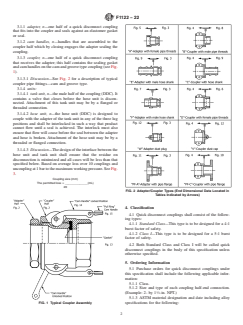
3.1.1 adapter, n—one half of a quick disconnect coupling
that fits into the coupler and seals against an elastomer gasket
or seal.
3.1.2 cam handles, n—handles that are assembled to the
coupler half which by closing engages the adapter sealing the
coupling.
3.1.3 coupler, n—one half of a quick disconnect coupling
that receives the adapter; this half contains the sealing gasket
andcamhandlesonthecamandgroovetypecoupling(seeFig.
1).
3.1.3.1 Discussion—See Fig. 2 for a description of typical
coupler pipe fittings—cam and groove type.
3.1.4 units:
3.1.4.1 tank unit, n—themalehalfofthecoupling(DDC).It
contains a valve that closes before the hose unit is discon-
nected. Attachment of this tank unit may be by a flanged or
threaded connection.
3.1.4.2 hose unit, n—the hose unit (DDC) is designed to
couple with the adapter of the tank unit in any of the three lug
positions and shall be interlocked in such a way that product
cannot flow until a seal is achieved. The interlock must also
ensure that flow will cease before the seal between the adapter
and hose is broken. Attachment of the hose unit may be by a
threaded or flanged connection.
3.1.4.3 Discussion—Thedesignoftheinterfacebetweenthe
hose unit and tank unit shall ensure that the residue on
disconnection is minimized and all cases will be less than that
specified below. Based on average loss over 10 couplings and
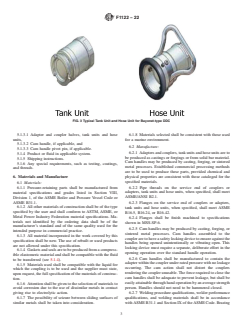
uncouplingat1bartothemaximumworkingpressure.SeeFig.
3.
Coupling size (mm)
The permitted loss = ______________(mL)
FIG. 2 Adapter/Coupler Types (End Dimensional Data Located in
Tables Indicated by Arrows)
4. Classification
4.1 Quick disconnect couplings shall consist of the follow-
ing types:
4.1.1 Standard Class—This type is to be designed for a 4:1
burst factor of safety.
4.1.2 Class I—This type is to be designed for a 5:1 burst
factor of safety.
4.2 Both Standard Class and Class I will be called quick
disconnect couplings in the body of this specification unless
otherwise specified.
5. Ordering Information
5.1 Purchase orders for quick disconnect couplings under
this specification shall include the following applicable infor-
mation:
5.1.1 Class.
5.1.2 Size and type of each coupling half-end connection.
(Example: 2- by 1 ⁄2-in. NPT.)
5.1.3 ASTM material designation and date including alloy
FIG. 1 Typical Coupler Assembly specifications for the following:
F1122−22
FIG. 3Typical Tank Unit and Hose Unit for Bayonet-type DDC
5.1.3.1 Adapter and coupler halves, tank units and hose 6.1.8 Materials selected shall be consistent with those used
units, for a marine environment.
5.1.3.2 Cam handle, if applicable, and
6.2 Manufacture:
5.1.3.3 Cam handle pivot pin, if applicable.
6.2.1 Adaptersandcouplers,tankunitsandhoseunitsareto
5.1.4 Product or fluid in applicable system.
be produced as castings or forgings or from solid bar material.
5.1.5 Shipping instructions.
Cam handles may be produced by casting, forging, or sintered
5.1.6 Any special requirements, such as testing, coatings,
metal processes. Established commercial processing methods
and threads.
are to be used to produce these parts, provided chemical and
6. Materials and Manufacture physical properties are consistent with those cataloged for the
specified materials.
6.1 Materials:
6.2.2 Pipe threads on the service end of couplers or
6.1.1 Pressure-retaining parts shall be manufactured from
adapters, tank units and hose units, when specified, shall meet
material specifications and grades listed in Section VIII,
ASME/ANSI B2.1.
Division 1, of the ASME Boiler and Pressure Vessel Code or
ASME B31.1.
6.2.3 Flanges on the service end of couplers or adapters,
6.1.2 All other materials of construction shall be of the type
tank units and hose units, when specified, shall meet ASME
specified by the user and shall conform to ASTM, ASME, or
B16.5, B16.24, or B16.42.
Metal Power Industry Federation material specifications. Ma-
6.2.4 Flanges shall be finish machined to specifications
terials not identified by the ordering data shall be of the
shown in MSS-SP-6.
manufacturer’s standard and of the same quality used for the
6.2.5 Cam handles may be produced by casting, forging, or
intended purpose in commercial practice.
sintered metal processes. Cam handles assembled to the
6.1.3 All material incorporated in the work covered by this
coupleraretohaveasafetylockingdevicetoensureagainstthe
specification shall be new. The use of rebuilt or used products
handles being opened unintentionally or vibrating open. This
are not allowed under this specification.
locking device must require a separate, deliberate effort in the
6.1.4 Gasketsandsealsaretobeproducedfromacompress-
opening operation over the standard handle operation.
ibleelastomericmaterialandshallbecompatiblewiththefluid
6.2.6 Cam handles shall be manufactured to contain the
to be transferred (see 5.1.4).
adapterwithinthecouplerunderratedpressurewithnoleakage
6.1.5 Materials used shall be compatible with the liquid for
occurring. The cam action shall not distort the couplers
which the coupling is to be used and the supplier must state,
rendering the coupler unusable.The force required to close the
uponrequest,thefullspecificationofthematerialsofconstruc-
cam handles shall be adequate to prevent leakage, but shall be
tion.
easilyattainablethroughhandoperationbyanaveragestrength
6.1.6 Attentionshallbegiventotheselectionofmaterialsto
person. Handles should not need to be hammered closed.
avoid corrosion due to the use of dissimilar metals in contact
giving rise to electrolytic action. 6.2.7 Weldingprocedurequalifications,welderperformance
qualifications, and welding materials shall be in accordance
6.1.7 The possibility of seizure between sliding surfaces of
similar metals shall be taken into consideration. withASMEB31.1andSectionIXoftheASMECode.Brazing
F1122−22
or soldering shall not be used. Where radiography is required MSS-SP-55. Machined surfaces are to be finish machined to a
(see 12.1), all welds shall be butt welds. 125-µin. (3175-µmm) (AA) finish or better with no porosity
showing.
7. Other Requirements
9.1.1 Couplings are to be free of burrs or sharp edges.
7.1 All couplings shall have a maximum allowable working
Machinedsurfacesaretobefreeofnicksorscratchesthatmay
pressureofnotlessthan150psi(1034kPa)upto4in.nominal
affect the sealing capabilities of the couplings.
size. For 5in. and 6in. cam and groove couplings, the MAWP
9.1.2 Surfaces are to be sound with good appearance and
shall not be less than 75 psi (517 kPa).
true pattern. Internal surfaces, if not machined, shall be
smooth, as expected from good quality casting, and free from
7.2 Maximum allowable working pressure (MAWP) for a
any flaw that would render the part unsafe for its intended use.
Standard Class coupling shall be 25% of its burst pressure.
9.2 Cam handles are to be smooth, having no burrs or sharp
7.3 Maximum allowable working pressure for a Class I
edges. Cam closing surface is to be continuous, providing an
coupling shall be 20% of its burst pressure.
increasing axial pull on mating adapter until proper seating
7.4 Burst pressure shall be determined in accordance with
against the gasket occurs.
Section VIII, Division 1, of the ASME Code.
9.3 Defective parts are not to be repaired by welding,
7.5 The electrical resistance across a coupling, measured
brazing, or any other method, to fill porosity or other flaws in
fromthreadtothread(orflange)withthecouplingdry,shallbe
the casting.
less than 10Ω.
9.4 Gasketsaretobeproducedhavingparallelsealingfaces.
7.6 The hydrostatic test pressure for couplings shall be 1.5
Faces are not to contain any imperfections that will allow
times MAWP (see 11.2).
leakage to occur at working pressure.
7.7 The design of DDC couplings should permit coupling
9.5 Seals are to conform to standards appropriate to general
and uncoupling when pressurized to 60 psi (4 bar) without
class and usage of O-rings ISO 3601, ISO 2230 compliant.
excessive spillage or force.
9.6 All the seals and washers shall be compatible with the
7.8 Pressure Drop for DDC—The coupling shall be tested
liquid for which the coupling is to be employed and the
as specified over its full flow range and the pressure drop
supplier must state, upon request, the full specification of the
presented in graphical form.
materials supplied.
7.9 The test fluid may be either water or kerosene. This
should be clearly stated along with the density and viscosity of
10. Number of Tests
the fluid
10.1 A prototype coupling of each size of each particular
7.10 The maximum flowrate shall be calculated to give a
design shall be tested to determine conformance to this
maximum velocity of 17.25 f/s (5.25 m/s) through the mini-
specification.
mum bore of the coupling. Higher flow rates may be achieved
10.2 Each coupling shall be tested as outlined in production
at an increased pressure loss.
testing of 11.2.
7.11 The pressure drop at 17.25 f/s (5.25 m/s) for the
coupling tested with kerosene shall be less than 7.5 psi
11. Test Methods
(0.5bar).
11.1 Prototype testing of each size of each particular design
shall be as follows. Maintain the indicated test pressures for at
8. Dimensions
least 1 min without leakage.
8.1 The dimensions and tolerances required to ensure inter-
11.1.1 Pressure test to twice the MAWP after having been
changeability of adapter and coupler halves (cam and groove
cycled (connected, closed, opened, and disconnected) three
type), of common sizes, shall be as given in Figs. 4-16.
times.
8.2 SizesaslistedinthetablescorrespondtoNPSforpiping
11.1.2 Pressure test at MAWP while applying a moment of
systems.
1000in.-lbs(113N·M)toonecouplinghalfattemptingtotwist
it loose. Reapply MAWP after the moment is removed.
8.3 The dimensions and tolerances required to ensure inter-
changeability of tank units and hose units (DDC type), of
11.2 Production Test—Hydrostatically test each coupling to
common sizes, shall be as given in Fig. 17 and Fig. 18. Only
1.5 times MAWP.
the dimensions of the tank unit face are stated.
11.3 The test apparatus for 11.2 is to be a state-of-the-art
8.3.1 The methods of connecting the tank unit to the tank,
device, designed to apply internal pressure to the coupling
and the hose unit to the hose are not covered by this standard.
halves with gasket or seals in place. Dye can be used in the
8.3.2 The size of the coupling shall be defined by the
fluid to apply the hydrostatic pressure to facilitate observation
nominal bore size of the adapter to the nearest half inch or
of leakage should leakage occur.
metric equivalent of this size.
9. Workmanship, Finish, and Appearance 12. Inspection
9.1 Couplings are to be produced with quality workman- 12.1 Nondestructive examination of welds shall be per-
ship. Casting surface quality is to be in accordance with formed as required by ASME B31.1. Additionally, 100%
F1122−22
NOTE 1—Unidentified tolerances; fractional = 6 ⁄64 (60.4), decimal = +0.000/−0.005 (+0.000/−0.127)
...
This document is not an ASTM standard and is intended only to provide the user of an ASTM standard an indication of what changes have been made to the previous version. Because
it may not be technically possible to adequately depict all changes accurately, ASTM recommends that users consult prior editions as appropriate. In all cases only the current version
of the standard as published by ASTM is to be considered the official document.
Designation: F1122 − 04 (Reapproved 2021) F1122 − 22 An American National Standard
Standard Specification for
Quick Disconnect Couplings (6 in. NPS and Smaller)
This standard is issued under the fixed designation F1122; the number immediately following the designation indicates the year of
original adoption or, in the case of revision, the year of last revision. A number in parentheses indicates the year of last reapproval. A
superscript epsilon (´) indicates an editorial change since the last revision or reapproval.
1. Scope
1.1 This specification covers the manufacturing data required to produce a variety of styles and sizes of quick disconnect couplings
up to and including NPS 6 for marine use that ensure interchangeability and safety of operation.
1.2 In general, quick disconnect couplings are hose and pipe end fittings that permit quick mechanical attachment by means other
than bolted or threaded fittings. The method of attachment is a male coupling half (adapter) (adapter, tank unit) that fits into a
female coupling half (coupler) (coupler, hose unit) of the same size. By closing attached cam handles, the coupling halves seal,
permitting fluids to be transported under pressure through the quick disconnect coupling.
1.2.1 By closing attached cam handles on cam and groove couplings, the coupling halves seal, permitting fluids to be transported
under pressure through the quick disconnect coupling.
1.2.2 By aligning the rollers on the hose unit coupler with the notches on the tank unit adapter on the dry disconnect coupling
(DDC), push the coupler onto the adapter and rotate past 100°. This will lock the couplings together, create a seal and open the
internal valves for full flow with low pressure drop. The dual poppet design shut-off mechanism seals liquids and gases behind
the valve, eliminating fugitive emissions and the danger of a spill upon disconnection.
1.3 The values stated in inch-pound units are to be regarded as standard. The values given in parentheses are mathematical
conversions to SI units that are provided for information only and are not considered standard.
1.4 The following safety hazards caveat pertains only to the test method described in this specification: This standard does not
purport to address all of the safety concerns, if any, associated with its use. It is the responsibility of the user of this standard to
establish appropriate safety, health, and environmental practices and determine the applicability of regulatory limitations prior
to use.
1.5 This international standard was developed in accordance with internationally recognized principles on standardization
established in the Decision on Principles for the Development of International Standards, Guides and Recommendations issued
by the World Trade Organization Technical Barriers to Trade (TBT) Committee.
2. Referenced Documents
2.1 MSS Standards:
MSS-SP-6 Standard Finish for Contact Faces of Pipe Flanges and Connecting End Flanges of Valves and Fittings
MSS-SP-25 Standard Marking System for Valves, Fittings, Flanges, and Unions
MSS-SP-55 Quality Standard for Steel Castings for Valves, Flanges, and Fittings and Other Piping Components (Visual Method)
This specification is under the jurisdiction of ASTM Committee F25 on Ships and Marine Technology and is the direct responsibility of Subcommittee F25.11 on
Machinery and Piping Systems.
Current edition approved June 1, 2021June 1, 2022. Published June 2021August 2022. Originally approved in 1987. Last previous edition approved in 20152021 as
F1122 – 04 (2015).(2021). DOI: 10.1520/F1122-04R21.10.1520/F1122-22.
Available from Manufacturers Standardization Society of the Valve and Fittings Industry (MSS), 127 Park St., NE, Vienna, VA 22180-4602, http://www.mss-hq.org.
Copyright © ASTM International, 100 Barr Harbor Drive, PO Box C700, West Conshohocken, PA 19428-2959. United States
F1122 − 22
2.2 ASME Standards:
ASME Boiler and Pressure Vessel Code Section VIII, Division 1
ASME Boiler and Pressure Vessel Code Section IX
ASME/ANSI B2.1 Pipe Threads (Except Dryseal)
B16.5 Pipe Flanges and Flanged Fittings: NPS 1/2 through NPS 24 Metric/Inch Standard
B16.24 Cast Copper Alloy Pipe Flanges, Flanged Fittings, and Valves: Classes 150, 300, 600, 900, 1500, and 2500
B16.42 Ductile Iron Pipe Flanges and Flanged Fittings: Classes 150 and 300
B31.1 Power Piping
2.3 Other Standards:
STANAG 3756 Facilities and Equipment for Receipt and Delivery of Aviation Kerosene and Diesel Fuels
ISO 3601 Fluid power systems — O-rings
ISO 2230 Rubber products — Guidelines for storage
3. Terminology
3.1 Definitions of Terms Specific to This Standard:
3.1.1 adapter, n—one half of a quick disconnect coupling that fits into the coupler and seals against an elastomer gasket positioned
inside the coupler.or seal.
3.1.2 cam handles, n—handles that are assembled to the coupler half which by closing engages the adapter sealing the coupling.
3.1.3 coupler, n—one half of a quick disconnect coupling that receives the adapter. Thisadapter; this half contains the sealing
gasket and cam handles on the cam and groove type coupling (see Fig. 1).
3.1.3.1 Discussion—
See Fig. 2 for a description of typical coupler pipe fittings. fittings—cam and groove type.
3.1.4 units:
3.1.4.1 tank unit, n—the male half of the coupling (DDC). It contains a valve that closes before the hose unit is disconnected.
Attachment of this tank unit may be by a flanged or threaded connection.
FIG. 1 Typical Coupler Assembly
Available from American Society of Mechanical Engineers (ASME), ASME International Headquarters, Two Park Ave., New York, NY 10016-5990, http://
www.asme.org.
Available from SAI Global, 205 West Wacker Dr., Suite 1800, Chicago, IL 60606, https://infostore.saiglobal.com.
Available from American National Standards Institute (ANSI), 25 W. 43rd St., 4th Floor, New York, NY 10036, http://www.ansi.org.
F1122 − 22
FIG. 2 Adapter/Coupler Types (End Dimensional Data Located in Tables Indicated by Arrows)
3.1.4.2 hose unit, n—the hose unit (DDC) is designed to couple with the adapter of the tank unit in any of the three lug positions
and shall be interlocked in such a way that product cannot flow until a seal is achieved. The interlock must also ensure that flow
will cease before the seal between the adapter and hose is broken. Attachment of the hose unit may be by a threaded or flanged
connection.
3.1.4.3 Discussion—
The design of the interface between the hose unit and tank unit shall ensure that the residue on disconnection is minimized and
all cases will be less than that specified below. Based on average loss over 10 couplings and uncoupling at 1 bar to the maximum
working pressure. See Fig. 3.
Coupling size (mm)
The permitted loss = ______________(mL)
4. Classification
4.1 Quick disconnect couplings shall consist of the following types:
4.1.1 Standard Class—This type is to be designed for a 4:1 burst factor of safety.
4.1.2 Class I—This type is to be designed for a 5:1 burst factor of safety.
F1122 − 22
FIG. 3 Typical Tank Unit and Hose Unit for Bayonet-type DDC
4.2 Both Standard Class and Class I will be called quick disconnect couplings in the body of this specification unless otherwise
specified.
5. Ordering Information
5.1 Purchase orders for quick disconnect couplings under this specification shall include the following applicable information:
5.1.1 Class.
5.1.2 Size and type of each coupling half-end connection. (Example: 2- by 1 ⁄2-in. NPT.)
5.1.3 ASTM material designation and date including alloy specifications for the following:
5.1.3.1 Adapter and coupler halves, tank units and hose units,
5.1.3.2 Cam handle, if applicable, and
5.1.3.3 Cam handle pivot pin.pin, if applicable.
5.1.4 Product or fluid in applicable system.
5.1.5 Shipping instructions.
5.1.6 Any special requirements, such as testing, coatings, and threads.
6. Materials and Manufacture
6.1 Materials:
6.1.1 Pressure-retaining parts shall be manufactured from material specifications and grades listed in Section VIII, Division 1, of
the ASME Boiler and Pressure Vessel Code or ASME B31.1.
6.1.2 All other materials of construction shall be of the type specified by the user and shall conform to ASTM, ASME, or Metal
Power Industry Federation material specifications. Materials not identified by the ordering data shall be of the manufacturer’s
standard and of the same quality used for the intended purpose in commercial practice.
F1122 − 22
6.1.3 All material incorporated in the work covered by this specification shall be new. The use of rebuilt or used products are not
allowed under this specification.
6.1.4 Gaskets and seals are to be produced from a compressible elastomeric material and shall be compatible with the fluid to be
transferred (see 5.1.4).
6.1.5 Materials used shall be compatible with the liquid for which the coupling is to be used and the supplier must state, upon
request, the full specification of the materials of construction.
6.1.6 Attention shall be given to the selection of materials to avoid corrosion due to the use of dissimilar metals in contact giving
rise to electrolytic action.
6.1.7 The possibility of seizure between sliding surfaces of similar metals shall be taken into consideration.
6.1.8 Materials selected shall be consistent with those used for a marine environment.
6.2 Manufacture:
6.2.1 Adapters and couplers couplers, tank units and hose units are to be produced as castings or forgings. forgings or from solid
bar material. Cam handles may be produced by casting, forging, or sintered metal processes. Established commercial processing
methods are to be used to produce these parts, provided chemical and physical properties are consistent with those cataloged for
the specified materials.
6.2.2 Pipe threads on the service end of couplers or adapters, tank units and hose units, when specified, shall meet ASME/ANSI
B2.1.
6.2.3 Flanges on the service end of couplers or adapters, tank units and hose units, when specified, shall meet ASME B16.5,
B16.24, or B16.42.
6.2.4 Flanges shall be finish machined to specifications shown in MSS-SP-6.
6.2.5 Cam handles may be produced by casting, forging, or sintered metal processes. Cam handles assembled to the coupler are
to have a safety locking device to ensure against the handles being opened unintentionally or vibrating open. This locking device
must require a separate, deliberate effort in the opening operation over the standard handle operation.
6.2.6 Cam handles shall be manufactured to contain the adapter within the coupler under rated pressure with no leakage occurring.
The cam action shall not distort the couplers rendering the coupler unusable. The force required to close the cam handles shall be
adequate to prevent leakage, but shall be easily attainable through hand operation by an average strength person. Handles should
not need to be hammered closed.
6.2.7 Welding procedure qualifications, welder performance qualifications, and welding materials shall be in accordance with
ASME B31.1 and Section IX of the ASME Code. Brazing or soldering shall not be used. Where radiography is required (see 12.1),
all welds shall be butt welds.
7. Other Requirements
7.1 All couplings shall have a maximum allowable working pressure of not less than 150 psi (1034 kPa) up to 4 in. nominal size.
For 5 in. and 6 in. cam and groove couplings, the MAWP shall not be less than 75 psi (517 kPa).
7.2 Maximum allowable working pressure (MAWP) for a Standard Class coupling shall be 25 % of its burst pressure.
7.3 Maximum allowable working pressure for a Class I coupling shall be 20 % of its burst pressure.
7.4 Burst pressure shall be determined in accordance with Section VIII, Division 1, of the ASME Code.
F1122 − 22
7.5 The electrical resistance across a coupling, measured from thread to thread (or flange) with the coupling dry, shall be less than
10 Ω.
7.6 The hydrostatic test pressure for couplings shall be 1.5 times MAWP (see 11.2).
7.7 The design of DDC couplings should permit coupling and uncoupling when pressurized to 60 psi (4 bar) without excessive
spillage or force.
7.8 Pressure Drop for DDC—The coupling shall be tested as specified over its full flow range and the pressure drop presented in
graphical form.
7.9 The test fluid may be either water or kerosene. This should be clearly stated along with the density and viscosity of the fluid
7.10 The maximum flowrate shall be calculated to give a maximum velocity of 17.25 f/s (5.25 m/s) through the minimum bore
of the coupling. Higher flow rates may be achieved at an increased pressure loss.
7.11 The pressure drop at 17.25 f/s (5.25 m/s) for the coupling tested with kerosene shall be less than 7.5 psi (0.5 bar).
8. Dimensions
8.1 The dimensions and tolerances required to ensure interchangeability of adapter and coupler halves, halves (cam and groove
type), of common sizes, shall be as given in Figs. 3-4-1516.
8.2 Sizes as listed in the tables correspond to NPS for piping systems.
8.3 The dimensions and tolerances required to ensure interchangeability of tank units and hose units (DDC type), of common
sizes, shall be as given in Fig. 17 and Fig. 18. Only the dimensions of the tank unit face are stated.
8.3.1 The methods of connecting the tank unit to the tank, and the hose unit to the hose are not covered by this standard.
8.3.2 The size of the coupling shall be defined by the nominal bore size of the adapter to the nearest half inch or metric equivalent
of this size.
9. Workmanship, Finish, and Appearance
9.1 Couplings are to be produced with quality workmanship. Casting surface quality is to be in accordance with MSS-SP-55.
Machined surfaces are to be finish machined to a 125-μin. (3175-μmm) (AA) finish or better with no porosity showing.
9.1.1 Couplings are to be free of burrs or sharp edges. Machined surfaces are to be free of nicks or scratches that may affect the
sealing capabilities of the couplings.
9.1.2 Surfaces are to be sound with good appearance and true pattern. Internal surfaces, if not machined, shall be smooth, as
expected from good quality casting, and free from any flaw that would render the part unsafe for its intended use.
9.2 Cam handles are to be smooth, having no burrs or sharp edges. Cam closing surface is to be continuous, providing an
increasing axial pull on mating adapter until proper seating against the gasket occurs.
9.3 Defective parts are not to be repaired by welding, brazing, or any other method, to fill porosity or other flaws in the casting.
9.4 Gaskets are to be produced having parallel sealing faces. Faces are not to contain any imperfections that will allow leakage
to occur at working pressure.
9.5 Seals are to conform to standards appropriate to general class and usage of O-rings ISO 3601, ISO 2230 compliant.
F1122 − 22
NOTE 1—Unidentified tolerances; fractional = 6 ⁄64 (60.4), decimal = +0.000/−0.005 (+0.000/−0.127), angular = 62° (60.035 rad)
Dimensions, in. (mm)
Size
A B C D E F G H J
7 27 1 3
1.264 1.035 1 ⁄32 ⁄32 0.471 1 0.378 ⁄16 ⁄32
⁄2 (32.1) (26.3) (31) (21) (12) (25.4) (9.6) (1.6) (2.4)
7 31 1 3
1.264 1.035 1 ⁄32 ⁄32 0.471 1 0.378 ⁄16 ⁄32
⁄4 (32.1) (26.3) (31) (24.6) (12) (25.4) (9.6) (1.6) (2.4)
3 3 5 3 3
1.446 1.144 1 ⁄8 1 ⁄32 0.565 1 ⁄16 0.378 ⁄32 ⁄32
1 (36.7) (29) (34.9) (27.8) (14.3) (33.3) (9.6) (2.4) (2.4)
23 1 9 1 1
1.792 1.388 1 ⁄32 1 ⁄4 0.690 1 ⁄16 0.441 ⁄8 ⁄8
1 ⁄4 (45.5) (35.2) (43.6) (31.7) (17.5) (39.7) (11.2) (3) (3)
1 9 5 1 1
2.105 1.690 2 ⁄32 1 ⁄16 0.690 1 ⁄8 0.441 ⁄8 ⁄8
1 ⁄2 (53.4) (42.9) (51.6) (39.7) (17.5) (41.3) (11.2) (3) (3)
13 15 7 1 1
2.484 2.065 2 ⁄32 1 ⁄16 0.848 1 ⁄8 0.441 ⁄8 ⁄8
2 (63.1) (52.4) (61.1) (49.2) (21.5) (47.6) (11.2) (3) (3)
7 7 15 1 5
2.985 2.545 2 ⁄8 2 ⁄16 0.848 1 ⁄16 0.441 ⁄8 ⁄32
2 ⁄2 (75.8) (64.6) (73) (61.9) (21.5) (49.2) (11.2) (3) (4)
1 3 1 5
3.604 3.202 3 ⁄2 3 ⁄32 0.895 2 0.503 ⁄8 ⁄32
3 (91.5) (81.3) (88.9) (78.6) (22.7) (50.8) (12.8) (3) (4)
19 1 1 1 7
4.708 4.307 4 ⁄32 4 ⁄8 0.895 2 ⁄16 0.503
...