

ASTM D3824-20
(Test Method)Standard Test Methods for Continuous Measurement of Oxides of Nitrogen in the Ambient or Workplace Atmosphere by Chemiluminescence
General Information
- Abstract
SIGNIFICANCE AND USE
5.1 Most oxides of nitrogen are formed during high-temperature combustion. The U.S. Environmental Protection Agency (EPA) has set primary and secondary air quality standards for NO2 that are designed to protect the public health and the public welfare (40 CFR, Part 50).
5.2 Oxides of nitrogen are generated by many industrial processes that can result in employee exposures. These are regulated by the Occupational Safety and Health Administration (OSHA), which has promulgated exposure limits for the industrial working environment (29 CFR, Part 1910).
5.3 These test methods have been found to be satisfactory for measuring oxides of nitrogen in ambient and workplace atmospheres over the ranges shown in 1.1.
SCOPE
1.1 These test methods cover procedures for the continuous determination of total nitrogen dioxide (NO2) and nitric oxide (NO) as NOx, or nitric oxide (NO) alone or nitrogen dioxide (NO2) alone, in the ranges shown in the following table:
Approximate Range of Concentration
(25°C and 101.3 kPa (1 atm))
Gas
Ambient Atmosphere
Workplace Atmosphere
μg/m3 (ppm)
mg/m3 (ppm)
NO
10 to 600 (0.01 to 0.5)
0.6 to 30 (0.5 to 25)
(NO + NO2) = NOx
20 to 1000 (0.01 to 0.05)
1 to 50 (0.5 to 25)
NO2
20 to 1000 (0.01 to 0.5)
1 to 50 (0.5 to 25)
1.2 The test methods are based on the chemiluminescent reaction between nitric oxide and ozone.
1.3 The values stated in SI units are to be regarded as standard. The values given in parentheses after SI units are provided for information only and are not considered standard.
1.4 This standard does not purport to address all of the safety concerns, if any, associated with its use. It is the responsibility of the user of this standard to establish appropriate safety, health, and environmental practices and determine the applicability of regulatory limitations prior to use. For specific precautionary statements, see Section 9.
1.5 This international standard was developed in accordance with internationally recognized principles on standardization established in the Decision on Principles for the Development of International Standards, Guides and Recommendations issued by the World Trade Organization Technical Barriers to Trade (TBT) Committee.
- Status
- Published
- Publication Date
- 30-Nov-2020
- Technical Committee
- D22 - Air Quality
- Drafting Committee
- D22.03 - Ambient Atmospheres and Source Emissions
Buy Documents
ASTM D3824-20 - Standard Test Methods for Continuous Measurement of Oxides of Nitrogen in the Ambient or Workplace Atmosphere by Chemiluminescence
REDLINE ASTM D3824-20 - Standard Test Methods for Continuous Measurement of Oxides of Nitrogen in the Ambient or Workplace Atmosphere by Chemiluminescence
Overview
ASTM D3824-20: Standard Test Methods for Continuous Measurement of Oxides of Nitrogen in the Ambient or Workplace Atmosphere by Chemiluminescence establishes procedures for monitoring nitrogen oxides (NO, NO₂, and NOₓ) using continuous chemiluminescence methods. These test methods are widely used in air quality management, environmental compliance, and occupational health to accurately detect and quantify nitrogen oxide levels in ambient and industrial workplace environments. The standard supports regulatory compliance with U.S. EPA and OSHA air quality requirements, as well as workplace exposure limits.
Key Topics
- Chemiluminescence Detection: The methods described are based on the chemiluminescent reaction between nitric oxide (NO) and ozone (O₃). The resulting light emission, measured by a photomultiplier tube, is directly proportional to the NO concentration.
- Measurement Range: Procedures are provided for measuring:
- Nitric oxide (NO) alone
- Nitrogen dioxide (NO₂) alone
- Total oxides of nitrogen (NOₓ = NO + NO₂)
- Ranges covered include 10 to 600 μg/m³ for NO and 20 to 1000 μg/m³ for NO₂ or NOₓ in ambient atmospheres.
- Precision and Accuracy: The method offers high precision and low detection limits, ensuring reliable results for both environmental and workplace air quality assessments.
- Calibration and Quality Control: Regular calibration using standard reference materials and frequent checks for zero and span ensure continued accuracy. Calibration methods include gas-phase titration and the use of permeation devices.
- Minimizing Interferences: The technique demonstrates minimal interferences from common atmospheric gases, employing optical filters and design considerations to avoid false readings.
Applications
- Environmental Monitoring: This standard is essential for agencies and organizations tasked with measuring ambient air quality, supporting compliance with EPA's National Ambient Air Quality Standards (NAAQS) for NO₂.
- Industrial Hygiene: The methods enable facilities to assess and control employee exposure to nitrogen oxides, as regulated by OSHA, promoting safer workplace environments.
- Continuous Emissions Monitoring: The procedures are suitable for integration into continuous emission monitoring systems (CEMS) at combustion sources such as power plants, manufacturing sites, and refineries.
- Regulatory Compliance: Adoption of ASTM D3824-20 allows organizations to meet requirements specified in 40 CFR Part 50 (EPA) and 29 CFR Part 1910 (OSHA) for air pollution monitoring and workplace safety.
- Research Applications: The standard provides a reliable foundation for academic and industrial research into atmospheric chemistry, combustion processes, and pollution control technologies.
Related Standards
- ASTM D1356: Terminology relating to sampling and analysis of atmospheres.
- ASTM D1357: Practice for planning the sampling of the ambient atmosphere.
- ASTM D1914: Practice for conversion units and factors relating to sampling and analysis of atmospheres.
- ASTM D3249: Practice for general ambient air analyzer procedures.
- ASTM D3609: Calibration techniques using permeation tubes.
- ASTM D3631: Test methods for measuring surface atmospheric pressure.
- EPA 40 CFR Parts 50 and 53: Clean Air Act reference methods for measuring ambient NO₂.
- OSHA 29 CFR Part 1910: Workplace exposure limits for nitrogen oxides.
Keywords: ASTM D3824-20, nitrogen oxides monitoring, chemiluminescence, ambient air quality, workplace atmosphere, NOₓ detection, NO₂ measurement, EPA standards, OSHA compliance, continuous emissions monitoring, air sampling, environmental standards.
Relations
- Effective Date
- 01-Sep-2023
- Effective Date
- 01-Sep-2020
- Effective Date
- 15-Mar-2020
- Effective Date
- 01-Oct-2019
- Effective Date
- 01-Aug-2019
- Effective Date
- 01-Mar-2017
- Effective Date
- 15-Oct-2015
- Effective Date
- 01-Jul-2015
- Effective Date
- 01-Apr-2015
- Effective Date
- 01-Dec-2014
- Effective Date
- 01-May-2014
- Effective Date
- 15-Jan-2014
- Effective Date
- 01-Oct-2011
- Effective Date
- 01-Oct-2011
- Effective Date
- 01-Oct-2011
Buy Documents
ASTM D3824-20 - Standard Test Methods for Continuous Measurement of Oxides of Nitrogen in the Ambient or Workplace Atmosphere by Chemiluminescence
REDLINE ASTM D3824-20 - Standard Test Methods for Continuous Measurement of Oxides of Nitrogen in the Ambient or Workplace Atmosphere by Chemiluminescence
Get Certified
Connect with accredited certification bodies for this standard

CIS Institut d.o.o.
Personal Protective Equipment (PPE) certification body. Notified Body NB-2890 for EU Regulation 2016/425 PPE.

Kiwa BDA Testing
Building and construction product certification.
Kmetijski inštitut Slovenije
Agricultural Institute of Slovenia. Soil testing, plant health, agricultural product analysis.
Sponsored listings
Frequently Asked Questions
ASTM D3824-20 is a standard published by ASTM International. Its full title is "Standard Test Methods for Continuous Measurement of Oxides of Nitrogen in the Ambient or Workplace Atmosphere by Chemiluminescence". This standard covers: SIGNIFICANCE AND USE 5.1 Most oxides of nitrogen are formed during high-temperature combustion. The U.S. Environmental Protection Agency (EPA) has set primary and secondary air quality standards for NO2 that are designed to protect the public health and the public welfare (40 CFR, Part 50). 5.2 Oxides of nitrogen are generated by many industrial processes that can result in employee exposures. These are regulated by the Occupational Safety and Health Administration (OSHA), which has promulgated exposure limits for the industrial working environment (29 CFR, Part 1910). 5.3 These test methods have been found to be satisfactory for measuring oxides of nitrogen in ambient and workplace atmospheres over the ranges shown in 1.1. SCOPE 1.1 These test methods cover procedures for the continuous determination of total nitrogen dioxide (NO2) and nitric oxide (NO) as NOx, or nitric oxide (NO) alone or nitrogen dioxide (NO2) alone, in the ranges shown in the following table: Approximate Range of Concentration (25°C and 101.3 kPa (1 atm)) Gas Ambient Atmosphere Workplace Atmosphere μg/m3 (ppm) mg/m3 (ppm) NO 10 to 600 (0.01 to 0.5) 0.6 to 30 (0.5 to 25) (NO + NO2) = NOx 20 to 1000 (0.01 to 0.05) 1 to 50 (0.5 to 25) NO2 20 to 1000 (0.01 to 0.5) 1 to 50 (0.5 to 25) 1.2 The test methods are based on the chemiluminescent reaction between nitric oxide and ozone. 1.3 The values stated in SI units are to be regarded as standard. The values given in parentheses after SI units are provided for information only and are not considered standard. 1.4 This standard does not purport to address all of the safety concerns, if any, associated with its use. It is the responsibility of the user of this standard to establish appropriate safety, health, and environmental practices and determine the applicability of regulatory limitations prior to use. For specific precautionary statements, see Section 9. 1.5 This international standard was developed in accordance with internationally recognized principles on standardization established in the Decision on Principles for the Development of International Standards, Guides and Recommendations issued by the World Trade Organization Technical Barriers to Trade (TBT) Committee.
SIGNIFICANCE AND USE 5.1 Most oxides of nitrogen are formed during high-temperature combustion. The U.S. Environmental Protection Agency (EPA) has set primary and secondary air quality standards for NO2 that are designed to protect the public health and the public welfare (40 CFR, Part 50). 5.2 Oxides of nitrogen are generated by many industrial processes that can result in employee exposures. These are regulated by the Occupational Safety and Health Administration (OSHA), which has promulgated exposure limits for the industrial working environment (29 CFR, Part 1910). 5.3 These test methods have been found to be satisfactory for measuring oxides of nitrogen in ambient and workplace atmospheres over the ranges shown in 1.1. SCOPE 1.1 These test methods cover procedures for the continuous determination of total nitrogen dioxide (NO2) and nitric oxide (NO) as NOx, or nitric oxide (NO) alone or nitrogen dioxide (NO2) alone, in the ranges shown in the following table: Approximate Range of Concentration (25°C and 101.3 kPa (1 atm)) Gas Ambient Atmosphere Workplace Atmosphere μg/m3 (ppm) mg/m3 (ppm) NO 10 to 600 (0.01 to 0.5) 0.6 to 30 (0.5 to 25) (NO + NO2) = NOx 20 to 1000 (0.01 to 0.05) 1 to 50 (0.5 to 25) NO2 20 to 1000 (0.01 to 0.5) 1 to 50 (0.5 to 25) 1.2 The test methods are based on the chemiluminescent reaction between nitric oxide and ozone. 1.3 The values stated in SI units are to be regarded as standard. The values given in parentheses after SI units are provided for information only and are not considered standard. 1.4 This standard does not purport to address all of the safety concerns, if any, associated with its use. It is the responsibility of the user of this standard to establish appropriate safety, health, and environmental practices and determine the applicability of regulatory limitations prior to use. For specific precautionary statements, see Section 9. 1.5 This international standard was developed in accordance with internationally recognized principles on standardization established in the Decision on Principles for the Development of International Standards, Guides and Recommendations issued by the World Trade Organization Technical Barriers to Trade (TBT) Committee.
ASTM D3824-20 is classified under the following ICS (International Classification for Standards) categories: 13.040.30 - Workplace atmospheres. The ICS classification helps identify the subject area and facilitates finding related standards.
ASTM D3824-20 has the following relationships with other standards: It is inter standard links to ASTM D3195/D3195M-10(2023), ASTM D1356-20a, ASTM D1356-20, ASTM D3249-95(2019), ASTM D1357-95(2019), ASTM D3631-99(2017), ASTM D1356-15a, ASTM D1356-15, ASTM D3195/D3195M-10(2015), ASTM D1356-14b, ASTM D1356-14a, ASTM D1356-14, ASTM D3631-99(2011), ASTM D3249-95(2011), ASTM D1357-95(2011). Understanding these relationships helps ensure you are using the most current and applicable version of the standard.
ASTM D3824-20 is available in PDF format for immediate download after purchase. The document can be added to your cart and obtained through the secure checkout process. Digital delivery ensures instant access to the complete standard document.
Standards Content (Sample)
This international standard was developed in accordance with internationally recognized principles on standardization established in the Decision on Principles for the
Development of International Standards, Guides and Recommendations issued by the World Trade Organization Technical Barriers to Trade (TBT) Committee.
Designation: D3824 − 20
Standard Test Methods for
Continuous Measurement of Oxides of Nitrogen in the
Ambient or Workplace Atmosphere by Chemiluminescence
This standard is issued under the fixed designation D3824; the number immediately following the designation indicates the year of
original adoption or, in the case of revision, the year of last revision.Anumber in parentheses indicates the year of last reapproval.A
superscript epsilon (´) indicates an editorial change since the last revision or reapproval.
1. Scope D1356Terminology Relating to Sampling and Analysis of
Atmospheres
1.1 These test methods cover procedures for the continuous
D1357Practice for Planning the Sampling of the Ambient
determination of total nitrogen dioxide (NO ) and nitric oxide
Atmosphere
(NO) as NO , or nitric oxide (NO) alone or nitrogen dioxide
x
D1914PracticeforConversionUnitsandFactorsRelatingto
(NO ) alone, in the ranges shown in the following table:
Sampling and Analysis of Atmospheres
Approximate Range of Concentration
D3195/D3195MPractice for Rotameter Calibration
(25°C and 101.3 kPa (1 atm))
D3249Practice for General Ambient Air Analyzer Proce-
Gas Ambient Atmosphere Workplace Atmosphere
dures
3 3
µg/m (ppm) mg/m (ppm)
D3609Practice for Calibration Techniques Using Perme-
NO 10 to 600 (0.01 to 0.5) 0.6 to 30 (0.5 to 25) ation Tubes
(NO+NO )=NO 20 to 1000 (0.01 to 0.05) 1 to 50 (0.5 to 25)
2 x
D3631Test Methods for Measuring Surface Atmospheric
NO 20 to 1000 (0.01 to 0.5) 1 to 50 (0.5 to 25)
Pressure
1.2 The test methods are based on the chemiluminescent
2.2 Other Documents:
reaction between nitric oxide and ozone.
29 CFRPart 1910, Occupational Safety and Health Stan-
1.3 The values stated in SI units are to be regarded as
dards
standard. The values given in parentheses after SI units are
40 CFRParts 50 and 53, Environmental Protection Agency
provided for information only and are not considered standard.
Regulations on Ambient Air Monitoring Reference and
Equivalent Methods
1.4 This standard does not purport to address all of the
safety concerns, if any, associated with its use. It is the
3. Terminology
responsibility of the user of this standard to establish appro-
priate safety, health, and environmental practices and deter-
3.1 Definitions:
mine the applicability of regulatory limitations prior to use. 3.1.1 Four definitions of terms used in these test methods,
For specific precautionary statements, see Section 9.
refer to Terminology D1356 and Practice D3249.
1.5 This international standard was developed in accor-
4. Summary of Test Methods
dance with internationally recognized principles on standard-
ization established in the Decision on Principles for the
4.1 The principle of the methodology is based upon the
Development of International Standards, Guides and Recom-
chemiluminescence,ortheemissionoflight,resultingfromthe
mendations issued by the World Trade Organization Technical
homogeneousgasphasereactionofnitricoxideandozone (1).
Barriers to Trade (TBT) Committee.
The equation is as follows:
NO1O 5 NO *1O (1)
2. Referenced Documents 3 2 2
2.1 ASTM Standards:
NO * 5 NO 1hv
2 2
In the presence of excess ozone, the intensity of the light
These test methods are under the jurisdiction ofASTM Committee D22 on Air
emission is directly proportional to the nitric oxide concentra-
Quality and are the direct responsibility of Subcommittee D22.03 on Ambient
tion.
Atmospheres and Source Emissions.
Current edition approved Dec. 1, 2020. Published January 2021. Originally
approved in 1979. Last previous edition approved in 2012 as D3824–12. DOI:
10.1520/D3824-20. Available from U.S. Government Printing Office, Superintendent of
For referenced ASTM standards, visit the ASTM website, www.astm.org, or Documents, 732 N. Capitol St., NW, Washington, DC 20401-0001, http://
contact ASTM Customer Service at service@astm.org. For Annual Book of ASTM www.access.gpo.gov.
Standards volume information, refer to the standard’s Document Summary page on The boldface numbers in parentheses refer to a list of references at the end of
the ASTM website. this standard.
Copyright © ASTM International, 100 Barr Harbor Drive, PO Box C700, West Conshohocken, PA 19428-2959. United States
D3824 − 20
4.2 To measure nitric oxide concentrations, the gas sample 6.2 The chemiluminescent detection of NO with O is
being analyzed is blended with ozone in a flow reactor. The subject to positive interference from olefins (for example
resulting light emissions are monitored by a photomultiplier 2-butene)andorganicsulfurcompounds(forexamplemethane
tube. thiol) (2, 3).
6.2.1 Negative interference approaching 10% may occur at
4.3 Tomeasuretotaloxidesofnitrogen(NO =NO+NO ),
x 2
high humidities for instruments that have been calibrated with
the gas sample is diverted through a NO to NO converter
dry span gas (4).
before being admitted to the flow reactor.
6.3 When the instrument is operated in the NO or NO
2 x
4.4 To measure nitrogen dioxide (NO ), the gas sample is
modes, any nitrogen compound decomposing to NO in the
intermittently diverted through the converter, and the NO
converter or yielding products capable of generating atomic
signal subtracted from the NO signal. Some instruments
x
hydrogen or chlorine in the ozonator will produce a positive
utilize a dual stream principle with two reaction chambers.
interference (2, 5, 6).
6.3.1 Reported interferences are presented in Annex A8.
5. Significance and Use
Note that some organic sulfur species will positively interfere
5.1 Most oxides of nitrogen are formed during high-
in the NO mode, and negatively in the NO mode.
temperature combustion. The U.S. Environmental Protection
Agency (EPA) has set primary and secondary air quality
7. Apparatus
standardsforNO thataredesignedtoprotectthepublichealth
7.1 Commercially available analyzers of oxides of nitrogen
and the public welfare (40 CFR, Part 50).
shall be installed on location and their acceptable performance
5.2 Oxides of nitrogen are generated by many industrial
demonstrated by the manufacturer. Minimum performance
processes that can result in employee exposures. These are
specificationsareshowninAnnexA1.Themanufacturersshall
regulated by the Occupational Safety and Health Administra-
verify that the instrument meets the specifications as deter-
tion (OSHA), which has promulgated exposure limits for the
mined by the test methods in 40 CFR, Part 53 or applicable
industrial working environment (29 CFR, Part 1910).
regional or international regulations.
5.3 These test methods have been found to be satisfactory
7.2 A simplified schematic of the analyzer used in the
for measuring oxides of nitrogen in ambient and workplace
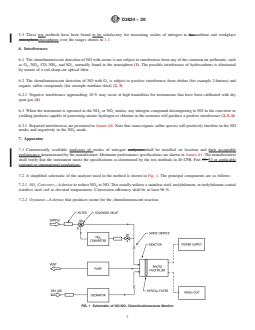
method is shown in Fig. 1. The principal components are as
atmospheres over the ranges shown in 1.1.
follows:
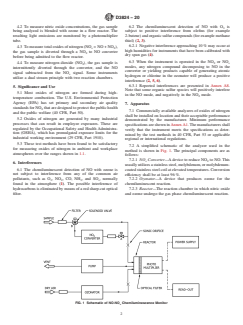
7.2.1 NO Converter—Adevice to reduce NO to NO. This
x 2
6. Interferences
usuallyutilizesastainlesssteel,molybdenum,ormolybdenum-
6.1 The chemiluminescent detection of NO with ozone is coated stainless steel coil at elevated temperatures. Conversion
not subject to interference from any of the common air efficiency shall be at least 96%.
pollutants, such as O,NO , CO, NH , and SO , normally 7.2.2 Ozonator—A device that produces ozone for the
3 2 3 x
found in the atmosphere (1). The possible interference of chemiluminescent reaction.
hydrocarbons is eliminated by means of a red sharp-cut optical 7.2.3 Reactor—The reaction chamber in which nitric oxide
filter. and ozone undergo the gas phase chemiluminescent reaction.
FIG. 1 Schematic of NO-NO Chemiluminescence Monitor
x
D3824 − 20
7.2.4 Photomultiplier—Adevice used in conjunction with a titrator shall be made with glass and TFE-fluorocarbon.
red sharp-cut optical filter (600 nm) (1) for measuring the light
NOTE 2—Recent advances in technology have produced systems that
output of the reaction between nitric oxide and ozone.
have only one reaction chamber and no mixing chamber, or dilute high
(Warning—The photomultiplier tube may become perma-
NO concentration to a lower value prior to mixing with O in the reaction
nently damaged if it is exposed to ambient light while the high
chamber.
voltage is on.)
7.4.2 Air Flowmeters, capable of measuring air flows be-
7.2.5 Pump—Adevice to provide a flow of gas (sample and
tween 0 to 10 L/min with an accuracy of 62%.
ozone) through the reaction chamber and to set the reactor
7.4.3 Nitric Oxide Flowmeters, capable of measuring nitric
operating pressure for a given flow rate.
oxide flow between 0 to 100 mL/min with an accuracy of 62
7.2.6 Pressure Regulator for Standard NO Cylinder—A
%.
two-stageregulatortofittheNOcylinder,havinginternalparts
ofstainlesssteelwithatetrafluoroethylene(TFE)-fluorocarbon 7.4.4 Soap Bubble Flowmeter, for calibrating the NO flow-
or polychlorotrifluorethylene seat and a delivery pressure of
meter with an accuracy of 62%.
200 kPa (30 psi). It shall contain a purge port or purge
7.4.5 Ozone Generator, consisting of a quartz tube fixed
assembly to flush the regulator and delivery systems after
adjacent to a low-pressure mercury vapor lamp capable of
connecting the regulators to the NO cylinder, but before the
emitting ultraviolet light of 185 nm. Alternatively, an ozone
cylinder valve is opened.
generation using an UV lamp, electrode, or corona discharge
7.3 Zero and Span Calibrator, containing an NO perme- module can be used. The concentration of ozone is controlled
ation device (see Practice D3609), a means of controlling the by adjusting the generator as specified by the manufacturer.
temperature of the permeation device to 60.1°C, flow
7.4.6 Reaction Chamber—Aborosilicate glass bulb (a Kjel-
controllers,flowmeters,andanairpump.Itshallincludemeans
dahl bulb is satisfactory) (see Annex A2 for choosing size).
of continually flushing the permeation device with pure nitro-
7.4.7 Mixing Chamber—Similar 7.4.6; a borosilicate glass
gen gas that has been passed through a drying tube containing
bulb (a Kjeldahl bulb is satisfactory) (see Annex A2 for
a mixture of molecular sieve and indicating calcium sulfate.
choosing size).
NOTE 1—In some applications, permeation device accuracy may be too
7.5 Air Purifier,topurifyambientairforuseinthezeroand
lowforspancalibrationsmeetingdataqualityobjectivesbutthesedevices
span calibrator and in the gas phase titration apparatus. It
can still be used to check responses or track drift in these cases. As an
alternative, compressed NO gas standards certified to 61 % analytic
consists of an indicating silica gel trap to remove moisture, an
uncertainty can be used instead of permeate.
ozonegeneratortoconvertnitricoxidetonitrogendioxide,and
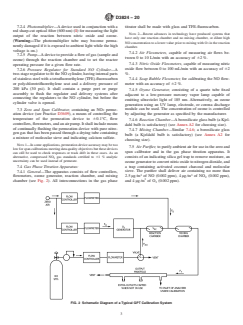
7.4 Gas Phase Titration Apparatus: a trap containing activated coconut charcoal and molecular
sieve. The purifier shall deliver air containing no more than
7.4.1 General—The apparatus consists of flow controllers,
3 3
flowmeters, ozone generator, reaction chamber, and mixing 2.5µg⁄m of NO (0.002ppm), 4µg⁄m of NO (0.002ppm),
and 4µg⁄m of O (0.002ppm).
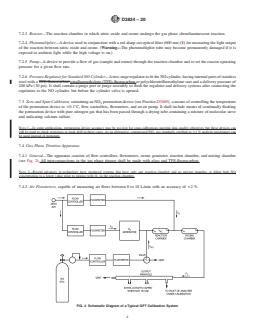
chamber (see Fig. 2). All interconnections in the gas phase
FIG. 2 Schematic Diagram of a Typical GPT Calibration System
D3824 − 20
7.6 Temperature Sensor to Measure Ambient Temperature— 9.5 The NO and NO SRMs are not indefinitely stable with
Temperature measuring devices such as RTDs (resistance time; the stated concentration will change. They shall not be
temperature devices), thermistors, and organic liquid-in-glass usedforalongerperiodoftimethanthatrecommendedintheir
thermometersmeetingtherequirementsofspecificapplications certificate.
may be used.
10. Sampling
7.7 Barograph or Barometer, capable of measuring atmo-
spheric pressure to 60.5 kPa (see Test Methods D3631).
10.1 General—For planning sampling programs, refer to
Practices D1357 and D3249.
7.8 Ozone Analyzer, chemiluminescent or ultraviolet, meet-
ing the requirements of 40 CFR, Part 50. 10.2 When sampling the outside ambient atmosphere from
an enclosure with an ambient monitor, utilize a TFE-
7.9 Recorders, strip chart recorders (three) or electronic/
fluorocarbonorborosilicateprobeorsamplingline.Extendthe
computer-based data recording for use during calibration.
probeatleast1m(3ft)fromthebuildingandprotectitagainst
the entry of precipitation. Utilize a TFE-fluorocarbon in-line
8. Reagents and Materials
filter of 0.5-mm pore size to remove particulates from the air
8.1 Primary Standard (either 8.1.1 or 8.1.2 is satisfactory):
stream. Heat the portion of the probe inside the building above
8.1.1 Nitric Oxide Standard Cylinder, traceable to National
the highest ambient outdoor temperature encountered at the
Institute of Standards and Technology (NIST) Reference Ma-
sampling location to prevent condensation.
terial SRM-1683 cylinder containing 60mg⁄m (50ppm) of
NO in N , or SRM-1684a cylinder containing 120mg⁄m
2 11. Calibration and Standardization
(100ppm) of NO in N .
11.1 Analyzer:
8.1.2 Nitrogen Dioxide Standard Permeation Device, trace-
11.1.1 For calibration procedures, refer to Annex A2 and
able to NIST Reference Material SRM-1629.
Annex A3.
8.2 Nitric Oxide Working Cylinder, containing from 60 to
11.1.2 Frequency of Calibration—Perform a complete cali-
120 mg/m (50 to 100 ppm) NO in oxygen-free nitrogen and
bration at least once a month.
less than 2 mg/m (1 ppm) of NO .
11.2 Flowmeters:
8.3 Nitrogen Dioxide Permeation Device, for use in zero
11.2.1 Calibrate the flowmeters of the zero and span cali-
and span calibration.
brator and the gas phase titration apparatus in accordance with
Practice D3195/D3195M.
8.4 Nitrogen, ultra high purity nitrogen, oxygen-free, con-
3 3
11.2.2 Calibrate any flow orifice with a flowmeter that has
taining less than 10µg⁄m of NO or 20µg⁄m of NO
been calibrated in accordance with Practice D3195/D3195M.
(0.01ppm).
11.2.3 Perform the calibrations in 11.2.1 when the flowme-
8.5 Molecular Sieve, type 4E, 3.36 to 1.41 mm (6 to 14
ters are received, when they are cleaned, and when they show
mesh).
signs of erratic behavior.
8.6 Calcium Sulfate, indicating.
11.2.4 Perform the calibration in 11.2.2 when the analyzers
are received and when the orifices are cleaned or replaced.
8.7 Activated Coconut Charcoal, 3.36 to 1.41 mm (6 to 14
mesh).
11.3 Zero and Span Calibrator:
11.3.1 Calibrate the zero and span calibrator in accordance
8.8 Silica Gel, indicating, 3.36 to 1.41 mm (6 to 14 mesh).
with Annex A4.
NOTE 3—Mesh sizes are not SI standard but are included to facilitate
11.3.2 Perform the calibration when the nitrogen dioxide
use of this standard in regions where material sizes are sold using this
permeation device is received and at least every month
non-SI units of measure.
thereafter.
9. Precautions
11.4 Certification of NO Cylinder—Procedures for certify-
ing NO working cylinder against a primary standard traceable
9.1 The handling and storage of compressed gas cylinders
to standard reference material. (See Annex A7.)
and the installation and use of the analyzer shall follow
Practice D3249. Cylinders shall not be exposed to direct
12. Procedure
sunlight.
12.1 After proper calibration has been established, activate
9.2 The exhaust from the analyzer may contain high con-
the analyzer system to sample the atmosphere to be tested.
centrations of ozone if the internal scrubber of the analyzer
fails or becomes exhausted. For this reason, vent the exhaust
12.2 Taketherecorderelectronicdevice,orcomputeroutput
from the vicinity of the analyzer and work area. and determine the concentration of NO, NO,orNO directly
x 2
fromthecalibrationcurvesindesiredunitsofpartspermillion.
9.3 Vent excess gases from calibrations outside the work
area and downwind of the sample probe. 12.3 Check the NO converter efficiency at least every
month in accordance with Annex A5.
9.4 Purge the NO cylinder regulators with nitrogen using
the purge port or assembly before opening the NO cylinder 12.4 Perform a zero and span check daily in accordance
valve. with Annex A6.
D3824 − 20
12.5 Check the flow rates of all gases in the calibrator daily 14. Precision and Bias
with the flowmeters and adjust if necessary.
14.1 Precision (7):
14.1.1 Thewithin-laboratoryrelativestandarddeviationhas
12.6 Check the indicating drying tubes weekly and replace
been found to be 6% of the NO concentration over the range
whenthecolorindicatesthat75%ofthecapacityofthedrying
75 to 300 µg NO /m (0.04 to 0.16 ppm), based on 1-h
material has been reached.
averages (7).
12.7 Replace all nonindicating drying tubes at least every
14.1.2 The between-laboratories relative standard deviation
three months.
hasbeenfoundtobeapproximately14%overthesamerange,
based on 1-h averages (7).
12.8 Replace the aerosol filter in the sampling line at least
NOTE 4—The stated precision data are for NO modes. There are no
weekly.
precision data available for NO or NO modes.
x
14.2 Bias—The bias is determined by the summation of
13. Calculations
errors that occur during instrument calibration and data collec-
13.1 The signal output of the analyzer is frequently dis-
tion. The principal uncertainties are introduced during the
played on a computer screen or potentiometric recorder and is calibration procedure and are primarily determined by the
recorded in an electronic data file. accuracy and calibration of the flowmeters used and the
accuracy of the certification of the NIST traceable reference
3 3
13.2 To convert ppm to µg/m or mg/m , refer to Practice
cylinder or permeation tube.
D1914.
15. Keywords
15.1 ambientatmospheres;analysis;chemiluminescencere-
action; nitric oxide; nitrogen dioxide; oxides of nitrogen;
sampling; workplace atmospheres
ANNEXES
(Mandatory Information)
A1. MINIMUM PERFORMANCE SPECIFICATIONS FOR AMBIENT AND WORKPLACE ATMOSPHERES
Ambient Workplace
(see for example 40 CFR, (see for example 29 CFR,
Specification Part 50) Part 1910)
Range, ppm 50 to 0.5 0 to 25
Noise, ppm 0.005 0.25
Lower detection limit, ppm 0.01 0.5
Zero drift, 12 and 24 h, ppm ±0.02 ±1.0
Span drift, 24 h, %:
20 % of upper range limit ±20 ±10
80 % of upper range limit ±5 ±2.5
Lag time, min 0.5 0.5
Rise time, min 1.0 1.0
Fall time, min 1.0 1.0
Precision, ppm:
20 % of upper range limit 0.02 1.0
80 % of upper range limit 0.03 1.5
D3824 − 20
A2. METHOD OF CALIBRATION OF AMBIENT NO, NO , AND NO ANALYZERS BY GAS-PHASE TITRATION (8)
2 x
A2.1 Principle and Applicability P 5 @NO# 3t $ 2.75ppm 2 min (A2.1)
~ !
R R
RC
A2.1.1 The following is a gas-phase technique for the
where:
dynamic calibration of ambient air monitors for nitric oxide
[NO] =
RC
F
NO
(NO), nitrogen dioxide (NO ), and total oxides of nitrogen
@NO# (A2.2)
S D
STD
F 1F
(NO ) analyzers. The technique is based upon application of O NO
x
therapidhomogeneousgas-phasereactionbetweenNOandO
t =
R
V
to produce a stoichiometric quantity of NO (9). The quanti-
RC
,2min (A2.3)
tativenatureofthereactionisusedinamannersuchthat,once F 1F
O ND
theconcentrationofreactedNOisknown,theconcentrationof
P = dynamic parameter specification, ppm·min,
NO isdetermined.TheNOandNO channelsoftheNO/NO / R
2 x x
[NO] = NO concentration in reaction chamber, ppm,
RC
NO analyzer are first calibrated by flow dilution of a standard
t = resident time of reactant gases in reaction
R
NO cylinder. Ozone is then added to excess NO in a dynamic
chamber, min,
calibration system, and the NO channel is used to measure
[NO] = concentration of the undiluted working NO
STD
changes in NO concentration. Upon the addition of O , the
standard, ppm,
decrease in NO concentration observed on the calibrated NO
V = volume of reaction chamber, mL,
RC
analyzer is equivalent to the concentration of NO produced.
F = air flow through O generator, mL/min,
O 3
The amount of NO generated is varied by changing the
F = NO flow, mL/min,
NO
concentration of O added.
F = F + F + F =total flow at manifold, mL/
T O NO D
min, and
A2.2 Total Air Flow Requirements
F = diluent air flow, mL/min.
D
A2.2.1 Determine the minimum total flow required at the
A2.3.2 Application of Dynamic Parameter Specification:
sample manifold. This flow rate is controlled by the number
A2.3.2.1 General—A wide range of combinations of reac-
and sample flow rate demand of the individual analyzers to be
tant NO concentrations and residence times is possible, giving
connected to the manifold at the same time. Allow at least 10
the analyst broad latitude in designing a GPT calibration
to 50% flow in excess of the required total flow.
system to meet individual requirements. For rapid calibration,
A2.2.2 The operational characteristics of the ozone source
it is suggested that the residence time be restricted to times
limit the maximum flow of the calibration system. To deter-
shorter than 2 min. Use the dynamic parameter specification to
mine this flow, adjust the ozone source to near maximum
set up a GPT dynamic calibration system as follows:
irradiation, then measure the O produced at different levels of
A2.3.2.2 Select the total flow, F , for the calibration system
T
airflowthroughthegenerator,forexample,1to10L/min,with
as measured at the sampling manifold. The recommended
the ozone monitor. A plot of the O concentration versus the
range for F is 1000 to 10000 mL/min. For a particular
T
reciprocal air flow should be linear. The air flow that gives the
system, the minimum value for F is determined from the
T
desired maximum O concentration, as determined by the
sample flow requirements of the analyzer(s) under calibration
maximum concentration of NO needed for calibration, repre-
withprovisionmadeforasuitableexcessflow.(Anexcessflow
sentsthemaximumtotalflowforacalibrationsystemusingthe
ofatleast10to50%issuggested.)Themaximumvaluefor F
T
generator.Lowerairflowscanbeusedtogeneratetherequired
is determined by the operation characteristics of the particular
O concentrations by reducing the level of irradiation of the
ozone source. Considering the restraints on F , the analyst
T
ultraviolet lamp. If the air flow characteristics of the ozone
should select a suitable value for F .
T
generator do not meet the minimum total flow requirements of
A2.3.2.3 Select a suitable volume, V , for the reaction
RC
the analyzer under calibration, then either the generator must
chamber.This volume will be fixed (and can be estimated) if a
be replaced or the number of analyzers to be calibrated
commercial calibration system is used. The recommended
simultaneously must be reduced.
range for V is 100 to 500 mL.
RC
A2.3 Dynamic Parameter Specification
A2.3.2.4 Select a working NO standard cylinder to be used
for GPTthat has a nominal concentration in the range of about
A2.3.1 The key to a quantitative reaction between NO and
50to100ppmNO.Theexactcylinderconcentration,[NO] ,
O in gas phase titration is providing a reaction chamber of STD
is determined by referencing the cylinder against primary
sufficient volume to allow the reactants to remain in proximity
standard traceable to a standard reference material (see Annex
for a minimum time such that the reaction goes to completion
A7).
(less than 1% residual O ). This will occur if the following
criterion is met:The product of the concentration of NO in the A2.3.2.5 Once F , V , and [NO] are determined, cal-
T RC STD
reaction chamber, [NO] , in ppm, times the residence time of culate the flow of NO, F , required to generate an NO
...
This document is not an ASTM standard and is intended only to provide the user of an ASTM standard an indication of what changes have been made to the previous version. Because
it may not be technically possible to adequately depict all changes accurately, ASTM recommends that users consult prior editions as appropriate. In all cases only the current version
of the standard as published by ASTM is to be considered the official document.
Designation: D3824 − 12 D3824 − 20
Standard Test Methods for
Continuous Measurement of Oxides of Nitrogen in the
Ambient or Workplace Atmosphere by the
Chemiluminescent MethodChemiluminescence
This standard is issued under the fixed designation D3824; the number immediately following the designation indicates the year of
original adoption or, in the case of revision, the year of last revision. A number in parentheses indicates the year of last reapproval. A
superscript epsilon (´) indicates an editorial change since the last revision or reapproval.
1. Scope
1.1 These test methods cover procedures for the continuous determination of total nitrogen dioxide (NO ) and nitric oxide (NO)
as NO , or nitric oxide (NO) alone or nitrogen dioxide (NO ) alone, in the ranges shown in the following table:
x 2
These test methods cover procedures for the continuous determination of total nitrogen dioxide (NO ) and nitric oxide (NO) as
NO , or nitric oxide (NO) alone or nitrogen dioxide (NO ) alone, in the ranges shown in the following table:
x 2
Approximate Range of Concentration
(25°C and 101.3 kPa (1 atm))
Gas Ambient Atmosphere Workplace Atmosphere
3 3
μg/m (ppm) (Note 1) mg/m (ppm) (Note 1)
3 3
μg/m (ppm) mg/m (ppm)
NO 10 to 600 (0.01 to 0.5) 0.6 to 30 (0.5 to 25)
(NO + NO ) = NO 20 to 1000 (0.01 to 0.05) 1 to 50 (0.5 to 25)
2 x
NO 20 to 1000 (0.01 to 0.5) 1 to 50 (0.5 to 25)
NOTE 1—Approximate range: 25°C and 101.3 kPa (1 atm).
1.2 The test methods are based on the chemiluminescent reaction between nitric oxide and ozone.
1.3 The values stated in SI units are to be regarded as standard. No other units of measurement are included in this The values
given in parentheses after SI units are provided for information only and are not considered standard.
1.4 This standard does not purport to address all of the safety concerns, if any, associated with its use. It is the responsibility
of the user of this standard to establish appropriate safety safety, health, and healthenvironmental practices and determine the
applicability of regulatory limitations prior to use. For specific precautionary statements, see Section 9.
1.5 This international standard was developed in accordance with internationally recognized principles on standardization
established in the Decision on Principles for the Development of International Standards, Guides and Recommendations issued
by the World Trade Organization Technical Barriers to Trade (TBT) Committee.
These test methods are under the jurisdiction of ASTM Committee D22 on Air Quality and are the direct responsibility of Subcommittee D22.03 on Ambient Atmospheres
and Source Emissions.
Current edition approved April 1, 2012Dec. 1, 2020. Published May 2012January 2021. Originally approved in 1979. Last previous edition approved in 20052012 as
D3824 – 95 (2005).D3824 – 12. DOI: 10.1520/D3824-12.10.1520/D3824-20.
Copyright © ASTM International, 100 Barr Harbor Drive, PO Box C700, West Conshohocken, PA 19428-2959. United States
D3824 − 20
2. Referenced Documents
2.1 ASTM Standards:
D1356 Terminology Relating to Sampling and Analysis of Atmospheres
D1357 Practice for Planning the Sampling of the Ambient Atmosphere
D1914 Practice for Conversion Units and Factors Relating to Sampling and Analysis of Atmospheres
D3195D3195/D3195M Practice for Rotameter Calibration
D3249 Practice for General Ambient Air Analyzer Procedures
D3609 Practice for Calibration Techniques Using Permeation Tubes
D3631 Test Methods for Measuring Surface Atmospheric Pressure
2.2 Other Documents:
29 CFR CFR, Part 1910, Occupational Safety and Health Standards
40 CFR CFR, Parts 50 and 53, Environmental Protection Agency Regulations on Ambient Air Monitoring Reference and
Equivalent Methods
3. Terminology
3.1 Definitions:
3.1.1 Four definitions of terms used in these test methods, refer to Terminology D1356 and Practice D3249.
4. Summary of Test MethodMethods
4.1 The principle of the methodology is based upon the chemiluminescence, or the emission of light, resulting from the
homogeneous gas phase reaction of nitric oxide and ozone (1). The equation is as follows:
NO1O 5 NO *1O (1)
3 2 2
NO *5 NO 1hv
2 2
NO1O 5 NO *1O (1)
3 2 2
NO *5 NO 1hv
2 2
In the presence of excess ozone, the intensity of the light emission is directly proportional to the nitric oxide concentration.
4.2 To measure nitric oxide concentrations, the gas sample being analyzed is blended with ozone in a flow reactor. The resulting
light emissions are monitored by a photomultiplier tube.
4.3 To measure total oxides of nitrogen (NO = NO + NO ), the gas sample is diverted through a NO to NO converter before
x 2 2
being admitted to the flow reactor.
4.4 To measure nitrogen dioxide (NO ), the gas sample is intermittently diverted through the converter, and the NO signal
subtracted from the NO signal. Some instruments utilize a dual stream principle with two reaction chambers.
x
5. Significance and Use
5.1 Most oxides of nitrogen are formed during high-temperature combustion. The U.S. Environmental Protection Agency (EPA)
has set primary and secondary air quality standards for NO that are designed to protect the public health and the public welfare
(40 CFR, Part 50).
5.2 Oxides of nitrogen are generated by many industrial processes that can result in employee exposures. These are regulated by
the Occupational Safety and Health Administration (OSHA)(OSHA), which has promulgated exposure limits for the industrial
working environment (29 CFR, Part 1910).
For referenced ASTM standards, visit the ASTM website, www.astm.org, or contact ASTM Customer Service at service@astm.org. For Annual Book of ASTM Standards
volume information, refer to the standard’sstandard’s Document Summary page on the ASTM website.
Available from U.S. Government Printing Office, Superintendent of Documents, U.S. Printing Office, 732 N. Capitol St., NW, Washington, DC 20402.20401-0001,
http://www.access.gpo.gov.
The boldface numbers in parentheses refer to thea list of references at the end of these test methods.this standard.
D3824 − 20
5.3 These test methods have been found to be satisfactory for measuring oxides of nitrogen in the ambient and workplace
atmosphereatmospheres over the ranges shown in 1.1.
6. Interferences
6.1 The chemiluminescent detection of NO with ozone is not subject to interference from any of the common air pollutants, such
as O , NO , CO, NH , and SO , normally found in the atmosphere (1). The possible interference of hydrocarbons is eliminated
3 2 3 x
by means of a red sharp-cut optical filter.
6.2 The chemiluminescent detection of NO with O is subject to positive interference from olefins (for example 2-butene) and
organic sulfur compounds (for example methane thiol) (2, 3).
6.2.1 Negative interference approaching 10 % may occur at high humidities for instruments that have been calibrated with dry
span gas (4).
6.3 When the instrument is operated in the NO or NO modes, any nitrogen compound decomposing to NO in the converter or
2 x
yielding products capable of generating atomic hydrogen or chlorine in the ozonator will produce a positive interference (2, 5, 6).
6.3.1 Reported interferences are presented in Annex A8. Note that some organic sulfur species will positively interfere in the NO
mode, and negatively in the NO mode.
7. Apparatus
7.1 Commercially available analyzers of oxides of nitrogen analyzers shall be installed on location and their acceptable
performance demonstrated by the manufacturer. Minimum performance specifications are shown in Annex A1. The manufacturers
shall verify that the instrument meets the specifications as determined by the test methods in 40 CFR, Part 53. 53 or applicable
regional or international regulations.
7.2 A simplified schematic of the analyzer used in the method is shown in Fig. 1. The principal components are as follows:
7.2.1 NO Converter—A device to reduce NO to NO. This usually utilizes a stainless steel, molybdenum, or molybdenum-coated
x 2
stainless steel coil at elevated temperatures. Conversion efficiency shall be at least 96 %.
7.2.2 Ozonator—A device that produces ozone for the chemiluminescent reaction.
FIG. 1 Schematic of NO-NO Chemiluminescence Monitor
x
D3824 − 20
7.2.3 Reactor—The reaction chamber in which nitric oxide and ozone undergo the gas phase chemiluminescent reaction.
7.2.4 Photomultiplier—A device used in conjunction with a red sharp-cut optical filter (600 nm) (1) for measuring the light output
of the reaction between nitric oxide and ozone. (Warning—The photomultiplier tube may become permanently damaged if it is
exposed to ambient light while the high voltage is on.)
7.2.5 Pump—A device to provide a flow of gas (sample and ozone) through the reaction chamber and to set the reactor operating
pressure for a given flow rate.
7.2.6 Pressure Regulator for Standard NO Cylinder—A two-stage regulator to fit the NO cylinder, having internal parts of stainless
steel with a TFE-fluorocarbon tetrafluoroethylene (TFE)-fluorocarbon or polychlorotrifluorethylene seat and a delivery pressure of
200 kPa (30 psi). It shall contain a purge port or purge assembly to flush the regulator and delivery systems after connecting the
regulators to the NO cylinder, but before the cylinder valve is opened.
7.3 Zero and Span Calibrator, containing an NO permeation device (see Practice D3609), a means of controlling the temperature
of the permeation device to 60.1°C, flow controllers, flowmeters, and an air pump. It shall include means of continually flushing
the permeation device with pure nitrogen gas that has been passed through a drying tube containing a mixture of molecular sieve
and indicating calcium sulfate.
NOTE 1—In some applications, permeation device accuracy may be too low for span calibrations meeting data quality objectives but these devices can
still be used to check responses or track drift in these cases. As an alternative, compressed NO gas standards certified to 61 % analytic uncertainty can
be used instead of permeate.
7.4 Gas Phase Titration Apparatus:
7.4.1 General—The apparatus consists of flow controllers, flowmeters, ozone generator, reaction chamber, and mixing chamber
(see Fig. 2). All interconnections in the gas phase titrator shall be made with glass and TFE-fluorocarbon.
NOTE 2—Recent advances in technology have produced systems that have only one reaction chamber and no mixing chamber, or dilute high NO
concentration to a lower value prior to mixing with O in the reaction chamber.
7.4.2 Air Flowmeters, capable of measuring air flows between 0 to 10 L/min with an accuracy of 62 %.
FIG. 2 Schematic Diagram of a Typical GPT Calibration System
D3824 − 20
7.4.3 Nitric Oxide Flowmeters, capable of measuring nitric oxide flow between 0 to 100 mL/min.mL/min with an accuracy of 62
%.
7.4.4 Soap Bubble Flowmeter, for calibrating the NO flowmeter with an accuracy of 62 %.
7.4.5 Ozone Generator, consisting of a quartz tube fixed adjacent to a low-pressure mercury vapor lamp capable of emitting
ultraviolet light of 185 nm. Alternatively, an ozone generation using an UV lamp, electrode, or corona discharge module can be
used. The concentration of ozone is controlled by adjusting the generator as specified by the manufacturer.
7.4.6 Reaction Chamber—A borosilicate glass bulb (a Kjeldahl bulb is satisfactory) (see Annex A2 for choosing size).
7.4.7 Mixing Chamber—AllSimilar 7.4.6interconnections in the gas phase titrator shall be made with glass and; a borosilicate
glass bulb (a Kjeldahl bulb is satisfactory) (see Annex A2 TFE-fluorocarbon.for choosing size).
7.5 Air Purifier, to purify ambient air for use in the zero and span calibrator and in the gas phase titration apparatus. It consists
of an indicating silica gel trap to remove moisture, an ozone generator to convert nitric oxide to nitrogen dioxide, and a trap
containing activated coconut charcoal and molecular sieve. The purifier shall deliver air containing no more than 2.5
3 3 3
2.5 μg μg/m⁄m of NO (0.002 ppm), (0.002 ppm), 4 μg 4 μg/m⁄m of NO (0.002 ppm), (0.002 ppm), and 4 4 μg μg/m⁄m of O
2 3
(0.002 ppm).(0.002 ppm).
7.6 Temperature Sensor to Measure Ambient Temperature—Temperature measuring devices such as RTDs (Resistance Tempera-
ture Devices), thermistors(resistance temperature devices), thermistors, and organic liquid-in-glass thermometers meeting the
requirements of specific applications may be used.
7.7 Barograph or Barometer, capable of measuring atmospheric pressure to 60.5 kPa (see Test Methods D3631).
7.8 Ozone Analyzer, chemiluminescent or ultraviolet, meeting the requirements of 40 CFR, Part 50.
7.9 Strip Chart Recorders, three, strip chart recorders (three) or electronic/computer-based data recording for use during
calibration.
8. Reagents and Materials
8.1 Primary Standard (either 8.1.1 or 8.1.2 is satisfactory):
8.1.1 Nitric Oxide Standard Cylinder, traceable to National Institute of Standards and Technology (NIST) Reference Material
SRM-1683 cylinder containing 60 60 mg mg/m⁄m (50 ppm) (50 ppm) of NO in N , or SRM-1684a cylinder containing 120
120 mg mg/m⁄m (100 ppm) (100 ppm) of NO in N .
8.1.2 Nitrogen Dioxide Standard Permeation Device, traceable to NIST Reference Material SRM-1629.
8.2 Nitric Oxide Working Cylinder, containing from 60 to 120 mg/m (50 to 100 ppm) NO in oxygen-free nitrogen and less than
2 mg/m (1 ppm) of NO .
8.3 Nitrogen Dioxide Permeation Device, for use in zero and span calibration.
3 3
8.4 Nitrogen, zero ultra high purity nitrogen, oxygen-free, containing less than 10 10 μg μg/m⁄m of NO or 20 20 μg μg/m⁄m of
NO (0.01 ppm).(0.01 ppm).
8.5 Molecular Sieve, type 4E, 6 to 14 mesh.3.36 to 1.41 mm (6 to 14 mesh).
8.6 Calcium Sulfate, indicating.
8.7 Activated Coconut Charcoal, 6 to 14 mesh.3.36 to 1.41 mm (6 to 14 mesh).
D3824 − 20
8.8 Silica Gel, indicating, 6 to 14 mesh.3.36 to 1.41 mm (6 to 14 mesh).
NOTE 3—Mesh sizes are not SI standard but are included to facilitate use of this standard in regions where material sizes are sold using this non-SI units
of measure.
9. Precautions
9.1 The handling and storage of compressed gas cylinders and the installation and use of the analyzer shall follow Practice D3249.
Cylinders shall not be exposed to direct sunlight.
9.2 The exhaust from the analyzer may contain high concentrations of ozone if the internal scrubber of the analyzer fails or
becomes exhausted. For this reason, vent the exhaust from the vicinity of the analyzer and work area.
9.3 Vent excess gases from calibrations outside the work area and downwind of the sample probe.
9.4 Purge the NO cylinder regulators with nitrogen using the purge port or assembly before opening the NO cylinder valve.
9.5 The NO and NO SRMs are not indefinitely stable with time; the stated concentration will change. They shall not be used for
a longer period of time than that recommended in their certificate.
10. Sampling
10.1 General—For planning sampling programs, refer to Practices D1357 and D3249.
10.2 When sampling the outside ambient atmosphere from an enclosure with an ambient monitor, utilize a TFE-fluorocarbon or
borosilicate probe or sampling line. Extend the probe at least 1 m [3 ft](3 ft) from the building and protect it against the entry of
precipitation. Utilize a TFE-fluorocarbon in-line filter of 0.5-mm pore size to remove particulates from the air stream. Heat the
portion of the probe inside the building above the highest ambient outdoor temperature encountered at the sampling location to
prevent condensation.
11. Calibration and Standardization
11.1 Analyzer:
11.1.1 For calibration procedures, refer to Annex A2 and Annex A3.
11.1.2 Frequency of Calibration—Perform a complete calibration at least once a month.
11.2 Flowmeters:
11.2.1 Calibrate the flowmeters of the zero and span calibrator and the gas phase titration apparatus in accordance with Practice
D3195D3195/D3195M.
11.2.2 Calibrate any flow orifice with a flowmeter that has been calibrated in accordance with Practice D3195D3195/D3195M.
11.2.3 Perform the calibrations in 11.2.1 when the flowmeters are received, when they are cleaned, and when they show signs of
erratic behavior.
11.2.4 Perform the calibration in 11.2.2 when the analyzers are received and when the orifices are cleaned or replaced.
11.3 Zero and Span Calibrator:
11.3.1 Calibrate the zero and span calibrator in accordance with Annex A4.
11.3.2 Perform the calibration when the nitrogen dioxide permeation device is received and at least every month thereafter.
D3824 − 20
11.4 Certification of NO Cylinder—Procedures for certifying NO working cylinder against an NIST traceable NO cylinder or
NIST traceable NOa primary standard traceable to standard reference material. (See permeation device are given in Annex A7.)
12. Procedure
12.1 After proper calibration has been established, allowactivate the analyzer system to sample the atmosphere to be tested.
12.2 Take the recorder electronic device, or computer output and determine the concentration of NO, NO , or NO directly from
x 2
the calibration curves in desired units of parts per million.
12.3 Check the NO converter efficiency at least every month in accordance with Annex A5.
12.4 Perform a zero and span check daily in accordance with Annex A6.
12.5 Check the flow rates of all gases in the calibrator daily with the flowmeters and adjust if necessary.
12.6 Check the indicating drying tubes weekly and replace when the color indicates that 75 % of the capacity of the drying
material has been reached.
12.7 Replace all nonindicating drying tubes at least every three months.
12.8 Replace the aerosol filter in the sampling line at least weekly.
12.9 Check the paper and ink supply in the recorder daily.
13. Calculations
13.1 The signal output of the analyzer is generallyfrequently displayed on a computer screen or potentiometric recorder and is read
directly in parts per million.recorded in an electronic data file.
3 3
13.2 To convert ppm to μg/m or mg/m , refer to Practice D1914.
D3824 − 20
14. Precision and Bias
14.1 Precision (7):
14.1.1 The within-laboratory relative standard deviation has been found to be 6 % of the NO concentration over the range 75 to
300 μg NO /m (0.04 to 0.16 ppm), based on 1-h averages (7).
14.1.2 The between-laboratories relative standard deviation has been found to be approximately 14 % over the same range, based
on 1-h averages (7).
NOTE 4—The stated precision data are for NO modes. There are no precision data available for NO or NO modes.
2 x
14.2 Bias—The bias is determined by the summation of errors that occur during instrument calibration and data collection. The
principal uncertainties are introduced during the calibration procedure and are primarily determined by the accuracy and calibration
of the flowmeters used and the accuracy of the certification of the NIST traceable reference cylinder or permeation tube.
15. Keywords
15.1 ambient atmospheres; analysis; chemiluminescence reaction; nitric oxide; nitrogen dioxide; oxides of nitrogen; sampling;
workplace atmospheres
ANNEXES
(Mandatory Information)
A1. MINIMUM PERFORMANCE SPECIFICATIONSPECIFICATIONS FOR AMBIENT AND WORKPLACE ATMOSPHERES
Ambient
(See 40 CFR Workplace
Specification Part 50)
Ambient Workplace
(see for example 40 CFR, (see for example 29 CFR,
Specification Part 50) Part 1910)
Range, ppm 50 to 0.5 0 to 25
Noise, ppm 0.005 0.25
Lower detection limit, ppm 0.01 0.5
Zero drift, 12 and 24 h, ppm ±0.02 ± 1.0
Zero drift, 12 and 24 h, ppm ±0.02 ±1.0
Span drift, 24 h,%:
Span drift, 24 h, %:
20 % of upper range limit ± 20 ± 10
20 % of upper range limit ±20 ±10
80 % of upper range limit ± 5 ± 2.5
80 % of upper range limit ±5 ±2.5
Lag time, min 0.5 0.5
Rise time, min 1.0 1.0
Fall time, min 1.0 1.0
Precision, ppm:
20 % of upper range limit 0.02 1.0
20 % of upper range limit 0.02 1.0
80 % of upper range limit 0.03 1.5
80 % of upper range limit 0.03 1.5
D3824 − 20
A2. METHOD OF CALIBRATION OF AMBIENT NO, NO , AND NO ANALYZERS BY GAS-PHASE TITRATION (8)
2 x
A2.1 Principle and Applicability
A2.1.1 The following is a gas-phase technique for the dynamic calibration of ambient air monitors for nitric oxide (NO), nitrogen
dioxide (NO ), and total oxides of nitrogen (NO ) analyzers. The technique is based upon application of the rapid homogeneous
2 x
gas-phase reaction between NO and O to produce a stoichiometric quantity of NO (9). The quantitative nature of the reaction
3 2
is used in a manner such that, once the concentration of reacted NO is known, the concentration of NO is determined. The NO
and NO channels of the NO/NO /NO analyzer are first calibrated by flow dilution of a standard NO cylinder. Ozone is then added
x x 2
to excess NO in a dynamic calibration system, and the NO channel is used to measure changes in NO concentration. Upon the
addition of O , the decrease in NO concentration observed on the calibrated NO analyzer is equivalent to the concentration of NO
3 2
produced. The amount of NO generated is varied by changing the concentration of O added.
2 3
A2.2 Total Air Flow Requirements
A2.2.1 Determine the minimum total flow required at the sample manifold. This flow rate is controlled by the number and sample
flow rate demand of the individual analyzers to be connected to the manifold at the same time. Allow at least 10 to 50 % flow in
excess of the required total flow.
A2.2.2 The operational characteristics of the ozone source limit the maximum flow of the calibration system. To determine this
flow, adjust the ozone source to near maximum irradiation, then measure the O produced at different levels of air flow through
the generator, for example, 1 to 10 L/min, with the ozone monitor. A plot of the O concentration versus the reciprocal air flow
should be linear. The air flow that gives the desired maximum O concentration, as determined by the maximum concentration of
NO needed for calibration, represents the maximum total flow for a calibration system using the generator. Lower air flows can
be used to generate the required O concentrations by reducing the level of irradiation of the ultraviolet lamp. If the air flow
characteristics of the ozone generator do not meet the minimum total flow requirements of the analyzer under calibration, then
either the generator must be replaced or the number of analyzers to be calibrated simultaneously must be reduced.
A2.3 Dynamic Parameter Specification
A2.3.1 The key to a quantitative reaction between NO and O in gas phase titration is providing a reaction chamber of sufficient
volume to allow the reactants to remain in proximity for a minimum time such that the reaction goes to completion (less than 1 %
residual O ). This will occur if the following criterion is met: The product of the concentration of NO in the reaction chamber,
[NO] , in ppm, times the residence time of the reactants in the chamber, t , in minutes, must be at least 2.75 ppm-minutes or
RC R
greater. This product is called the dynamic parameter specification, P . Expressed algebraically, the specified condition isis:
R
P 5 NO 3t $ 2.75 ppm 2 min (A2.1)
@ # ~ !
R R
RC
P 5 @NO# 3t $ ~2.75 ppm 2 min! (A2.1)
R R
RC
where:
[NO] =
RC
F
NO
NO (A2.2)
@ # S D
STD
F 1F
O NO
D3824 − 20
t =
R
V
RC
,2min (A2.3)
F 1F
O ND
P = dynamic parameter specification, ppm·min,
R
[NO] = NO concentration in reaction chamber, ppm,
RC
t = resident time of reactant gases in reaction chamber, min,
R
[NO] = concentration of the undiluted working NO standard, ppm,
STD
V = volume of reaction chamber, mL,
RC
F = air flow through O generator, mL/min,
O 3
F = NO flow, mL/min,
NO
F = F + F + F = total flow at manifold, mL/min, and
T O NO D
F = diluent air flow, mL/min.
D
D3824 − 20
A2.3.2 Application of Dynamic Parameter Specification:
A2.3.2.1 General—A wide range of combinations of reactant NO concentrations and residence times is possible, giving the analyst
broad latitude in designing a GPT calibration system to meet individual requirements. For rapid calibration, it is suggested that the
residence time be restricted to times shorter than 2 min. Use the dynamic parameter specification to set up a GPT dynamic
calibration system as follows:
A2.3.2.2 Select the total flow, F , for the calibration system as measured at the sampling manifold. The recommended range for
T
F is 1000 to 10 000 mL/min. For a particular system, the minimum value for F is determined from the sample flow requirements
T T
of the analyzer(s) under calibration with provision made for a suitable excess flow. (An excess flow of at least 10 to 50 % is
suggested.) The maximum value for F is determined by the operation characteristics of the particular ozone source. Considering
T
the restraints on F , the analyst should select a suitable value for F .
T T
A2.3.2.3 Select a suitable volume, V , for the reaction chamber. This volume will be fixed (and can be estimated) if a commercial
RC
calibration system is used. The recommended range for V is 100 to 500 mL.
RC
A2.3.2.4 Select a working NO standard cylinder to be used for GPT that has a nominal concentration in the range of about 50 to
100 ppm NO. The exact cylinder concentration, [NO] , is determined by referencing the cylinder against an NIST traceable NO
STD
or NOprimary standard traceable to a standard reference material (see Annex A7).
A2.3.2.5 Once F , V , and [NO] are determined, calculate the flow of NO, F , required to generate an NO concentration
T RC STD NO
at the manifold, [NO] , of 90 % of the upper range limit (URL) of the NO channel. For example, i
...