

ASTM D4962-18
(Practice)Standard Practice for NaI(Tl) Gamma-Ray Spectrometry of Water
General Information
- Abstract
SIGNIFICANCE AND USE
5.1 Gamma-ray spectrometry is used to identify radionuclides and to make quantitative measurements. Use of a computer and a library of standard spectra will be required for quantitative analysis of complex mixtures of nuclides.
5.2 Variation of the physical geometry of the sample and its relationship with the detector will produce both qualitative and quantitative variations in the gamma-ray spectrum. To adequately account for these geometry effects, calibrations are designed to duplicate all conditions including source-to-detector distance, sample shape and size, and sample matrix encountered when samples are measured. This means that a complete set of library standards may be required for each geometry and sample to detector distance combination that will be used.
5.3 Since some spectrometry systems are calibrated at many discrete distances from the detector, a wide range of activity levels can be measured on the same detector. For high-level samples, extremely low efficiency geometries may be used. Quantitative measurements can be made accurately and precisely when high activity level samples are placed at distances of 1 m or more from the detector.
5.4 Electronic problems, such as erroneous deadtime correction, loss of resolution, and random summing, may be avoided by keeping the gross count rate below 2000 counts per second and also keeping the deadtime of the analyzer below 5 %. Total counting time is governed by the activity of the sample, the detector source distance, and the acceptable Poisson counting uncertainty.
SCOPE
1.1 This practice covers the measurement of radionuclides in water by means of gamma-ray spectrometry. It is applicable to nuclides emitting gamma-rays with energies greater than 50 keV. For typical counting systems and sample types, activity levels of about 40 Bq (1080 pCi) are easily measured and sensitivities of about 0.4 Bq (11 pCi) are found for many nuclides (1-10).2 Count rates in excess of 2000 counts per second should be avoided because of electronic limitations. High count rate samples can be accommodated by dilution or by increasing the sample to detector distance.
1.2 This practice can be used for either quantitative or relative determinations. In tracer work, the results may be expressed by comparison with an initial concentration of a given nuclide which is taken as 100 %. For radioassay, the results may be expressed in terms of known nuclidic standards for the radionuclides known to be present. In addition to the quantitative measurement of gamma-ray activity, gamma-ray spectrometry can be used for the identification of specific gamma-ray emitters in a mixture of radionuclides but that ability is limited when using low energy resolution Na(Tl) detectors as compared to High Purity Germanium (HPGe) detectors. General information on radioactivity and the measurement of radiation has been published (11 and 12). Information on specific application of gamma-ray spectrometry is also available in the literature (13-16).
1.3 The values stated in SI units are to be regarded as standard. The values given in parentheses after SI units are included for information only and are not considered standard.
1.4 This standard does not purport to address all of the safety concerns, if any, associated with its use. It is the responsibility of the user of this standard to establish appropriate safety, health, and environmental practices and determine the applicability of regulatory limitations prior to use.
1.5 This international standard was developed in accordance with internationally recognized principles on standardization established in the Decision on Principles for the Development of International Standards, Guides and Recommendations issued by the World Trade Organization Technical Barriers to Trade (TBT) Committee.
- Status
- Published
- Publication Date
- 30-Sep-2018
- Technical Committee
- D19 - Water
- Drafting Committee
- D19.04 - Methods of Radiochemical Analysis
Overview
ASTM D4962-18: Standard Practice for NaI(Tl) Gamma-Ray Spectrometry of Water provides guidelines for measuring radionuclides in water using thallium-activated sodium iodide [NaI(Tl)] detectors and gamma-ray spectrometry. This standard enables identification and quantification of gamma-ray emitting radionuclides with energies above 50 keV in water samples, supporting both environmental monitoring and compliance activities. The standard is particularly valuable for laboratories, water utilities, and regulatory agencies performing routine or investigative radiochemical analyses.
Key Topics
Gamma-Ray Spectrometry Methodology
Details the use of NaI(Tl) detectors for detecting and measuring radioactive isotopes in water samples, with emphasis on appropriate calibration, spectral analysis, and quantitative results.Sample Geometry and Calibration
Recognizes the effects of the physical relationship between sample and detector on measurement accuracy. Comprehensive calibration is necessary to account for different sample sizes, shapes, and source-to-detector distances.Detection Limits and Sensitivity
Typical detection sensitivity allows measurement of activity levels around 40 Bq, with some nuclides detected at or below 0.4 Bq, providing robust capability for low-level environmental radiochemistry.Quantitative and Qualitative Analysis
Supports both precise quantification of specific radionuclide concentrations and identification of radionuclide species in simple or complex mixtures using spectrum analysis and reference libraries.Instrument Setup and Quality Control
Covers best practices for equipment setup, including energy calibration, efficiency calibration, and periodic quality assurance checks to ensure consistent detector performance.Data Handling and Uncertainty
Encourages regular assessment of background and counting uncertainties, and outlines approaches to minimize electronic interferences and statistical errors during analysis.
Applications
Environmental Monitoring
Used by regulatory laboratories and water authorities to monitor radioactive contaminants in drinking water, groundwaters, and surface waters, thereby ensuring compliance with health and environmental standards.Radioassay and Tracer Studies
Employed in tracer experiments or recovery studies to assess radiochemical yields or to track radionuclide migration in various water matrices.Nuclear and Industrial Facility Compliance
Essential for periodic checks of liquid effluents and workplace water supplies at nuclear power plants, research reactors, and radiochemical laboratories.Emergency Response and Remediation
Supports rapid quantification and identification of radionuclide contamination in water following accidental releases or environmental incidents.Research and Reference Analysis
Provides a reproducible framework for analytical method development and inter-laboratory studies involving gamma-ray spectrometry of water.
Related Standards
- ASTM D1129 - Terminology Relating to Water
- ASTM D3648 - Practices for the Measurement of Radioactivity
- ASTM D7902 - Terminology for Radiochemical Analyses
- ASTM E181 - Test Methods for Detector Calibration and Analysis of Radionuclides
Practical Value
Adopting ASTM D4962-18 ensures standardized, accurate, and reliable measurement of radionuclide activity in water using NaI(Tl) gamma-ray spectrometry. It enhances confidence in regulatory compliance data, supports public health efforts, and provides guidance for troubleshooting and quality control. The standard is a vital tool for laboratories seeking efficient, validated protocols for gamma-ray detection in aqueous samples.
Keywords: gamma-ray spectrometry, NaI(Tl) detector, water radionuclide measurement, gamma pulse height analysis, environmental radioactivity, ASTM D4962-18
Relations
- Effective Date
- 01-Oct-2018
- Effective Date
- 01-May-2020
- Effective Date
- 01-May-2020
- Effective Date
- 01-Feb-2018
- Effective Date
- 01-Feb-2016
- Effective Date
- 15-Jan-2014
- Effective Date
- 15-Jan-2014
- Effective Date
- 01-Jan-2011
- Effective Date
- 01-Mar-2010
- Effective Date
- 01-Jan-2010
- Effective Date
- 01-Sep-2006
- Effective Date
- 01-Sep-2006
- Effective Date
- 15-Feb-2006
- Effective Date
- 01-Jul-2004
- Effective Date
- 01-Mar-2004
Get Certified
Connect with accredited certification bodies for this standard

CIS Institut d.o.o.
Personal Protective Equipment (PPE) certification body. Notified Body NB-2890 for EU Regulation 2016/425 PPE.

Kiwa BDA Testing
Building and construction product certification.
Kmetijski inštitut Slovenije
Agricultural Institute of Slovenia. Soil testing, plant health, agricultural product analysis.
Sponsored listings
Frequently Asked Questions
ASTM D4962-18 is a standard published by ASTM International. Its full title is "Standard Practice for NaI(Tl) Gamma-Ray Spectrometry of Water". This standard covers: SIGNIFICANCE AND USE 5.1 Gamma-ray spectrometry is used to identify radionuclides and to make quantitative measurements. Use of a computer and a library of standard spectra will be required for quantitative analysis of complex mixtures of nuclides. 5.2 Variation of the physical geometry of the sample and its relationship with the detector will produce both qualitative and quantitative variations in the gamma-ray spectrum. To adequately account for these geometry effects, calibrations are designed to duplicate all conditions including source-to-detector distance, sample shape and size, and sample matrix encountered when samples are measured. This means that a complete set of library standards may be required for each geometry and sample to detector distance combination that will be used. 5.3 Since some spectrometry systems are calibrated at many discrete distances from the detector, a wide range of activity levels can be measured on the same detector. For high-level samples, extremely low efficiency geometries may be used. Quantitative measurements can be made accurately and precisely when high activity level samples are placed at distances of 1 m or more from the detector. 5.4 Electronic problems, such as erroneous deadtime correction, loss of resolution, and random summing, may be avoided by keeping the gross count rate below 2000 counts per second and also keeping the deadtime of the analyzer below 5 %. Total counting time is governed by the activity of the sample, the detector source distance, and the acceptable Poisson counting uncertainty. SCOPE 1.1 This practice covers the measurement of radionuclides in water by means of gamma-ray spectrometry. It is applicable to nuclides emitting gamma-rays with energies greater than 50 keV. For typical counting systems and sample types, activity levels of about 40 Bq (1080 pCi) are easily measured and sensitivities of about 0.4 Bq (11 pCi) are found for many nuclides (1-10).2 Count rates in excess of 2000 counts per second should be avoided because of electronic limitations. High count rate samples can be accommodated by dilution or by increasing the sample to detector distance. 1.2 This practice can be used for either quantitative or relative determinations. In tracer work, the results may be expressed by comparison with an initial concentration of a given nuclide which is taken as 100 %. For radioassay, the results may be expressed in terms of known nuclidic standards for the radionuclides known to be present. In addition to the quantitative measurement of gamma-ray activity, gamma-ray spectrometry can be used for the identification of specific gamma-ray emitters in a mixture of radionuclides but that ability is limited when using low energy resolution Na(Tl) detectors as compared to High Purity Germanium (HPGe) detectors. General information on radioactivity and the measurement of radiation has been published (11 and 12). Information on specific application of gamma-ray spectrometry is also available in the literature (13-16). 1.3 The values stated in SI units are to be regarded as standard. The values given in parentheses after SI units are included for information only and are not considered standard. 1.4 This standard does not purport to address all of the safety concerns, if any, associated with its use. It is the responsibility of the user of this standard to establish appropriate safety, health, and environmental practices and determine the applicability of regulatory limitations prior to use. 1.5 This international standard was developed in accordance with internationally recognized principles on standardization established in the Decision on Principles for the Development of International Standards, Guides and Recommendations issued by the World Trade Organization Technical Barriers to Trade (TBT) Committee.
SIGNIFICANCE AND USE 5.1 Gamma-ray spectrometry is used to identify radionuclides and to make quantitative measurements. Use of a computer and a library of standard spectra will be required for quantitative analysis of complex mixtures of nuclides. 5.2 Variation of the physical geometry of the sample and its relationship with the detector will produce both qualitative and quantitative variations in the gamma-ray spectrum. To adequately account for these geometry effects, calibrations are designed to duplicate all conditions including source-to-detector distance, sample shape and size, and sample matrix encountered when samples are measured. This means that a complete set of library standards may be required for each geometry and sample to detector distance combination that will be used. 5.3 Since some spectrometry systems are calibrated at many discrete distances from the detector, a wide range of activity levels can be measured on the same detector. For high-level samples, extremely low efficiency geometries may be used. Quantitative measurements can be made accurately and precisely when high activity level samples are placed at distances of 1 m or more from the detector. 5.4 Electronic problems, such as erroneous deadtime correction, loss of resolution, and random summing, may be avoided by keeping the gross count rate below 2000 counts per second and also keeping the deadtime of the analyzer below 5 %. Total counting time is governed by the activity of the sample, the detector source distance, and the acceptable Poisson counting uncertainty. SCOPE 1.1 This practice covers the measurement of radionuclides in water by means of gamma-ray spectrometry. It is applicable to nuclides emitting gamma-rays with energies greater than 50 keV. For typical counting systems and sample types, activity levels of about 40 Bq (1080 pCi) are easily measured and sensitivities of about 0.4 Bq (11 pCi) are found for many nuclides (1-10).2 Count rates in excess of 2000 counts per second should be avoided because of electronic limitations. High count rate samples can be accommodated by dilution or by increasing the sample to detector distance. 1.2 This practice can be used for either quantitative or relative determinations. In tracer work, the results may be expressed by comparison with an initial concentration of a given nuclide which is taken as 100 %. For radioassay, the results may be expressed in terms of known nuclidic standards for the radionuclides known to be present. In addition to the quantitative measurement of gamma-ray activity, gamma-ray spectrometry can be used for the identification of specific gamma-ray emitters in a mixture of radionuclides but that ability is limited when using low energy resolution Na(Tl) detectors as compared to High Purity Germanium (HPGe) detectors. General information on radioactivity and the measurement of radiation has been published (11 and 12). Information on specific application of gamma-ray spectrometry is also available in the literature (13-16). 1.3 The values stated in SI units are to be regarded as standard. The values given in parentheses after SI units are included for information only and are not considered standard. 1.4 This standard does not purport to address all of the safety concerns, if any, associated with its use. It is the responsibility of the user of this standard to establish appropriate safety, health, and environmental practices and determine the applicability of regulatory limitations prior to use. 1.5 This international standard was developed in accordance with internationally recognized principles on standardization established in the Decision on Principles for the Development of International Standards, Guides and Recommendations issued by the World Trade Organization Technical Barriers to Trade (TBT) Committee.
ASTM D4962-18 is classified under the following ICS (International Classification for Standards) categories: 13.060.30 - Sewage water. The ICS classification helps identify the subject area and facilitates finding related standards.
ASTM D4962-18 has the following relationships with other standards: It is inter standard links to ASTM D4962-17, ASTM D1129-13(2020)e2, ASTM D7902-20, ASTM D7902-18, ASTM D7902-16, ASTM D7902-14, ASTM D7902-14e1, ASTM D3648-04(2011), ASTM D1129-10, ASTM E181-10, ASTM D1129-06ae1, ASTM D1129-06a, ASTM D1129-06, ASTM D3648-04, ASTM D1129-04. Understanding these relationships helps ensure you are using the most current and applicable version of the standard.
ASTM D4962-18 is available in PDF format for immediate download after purchase. The document can be added to your cart and obtained through the secure checkout process. Digital delivery ensures instant access to the complete standard document.
Standards Content (Sample)
This international standard was developed in accordance with internationally recognized principles on standardization established in the Decision on Principles for the
Development of International Standards, Guides and Recommendations issued by the World Trade Organization Technical Barriers to Trade (TBT) Committee.
Designation: D4962 − 18
Standard Practice for
NaI(Tl) Gamma-Ray Spectrometry of Water
This standard is issued under the fixed designation D4962; the number immediately following the designation indicates the year of
original adoption or, in the case of revision, the year of last revision. A number in parentheses indicates the year of last reapproval. A
superscript epsilon (´) indicates an editorial change since the last revision or reapproval.
1. Scope 1.5 This international standard was developed in accor-
dance with internationally recognized principles on standard-
1.1 This practice covers the measurement of radionuclides
ization established in the Decision on Principles for the
in water by means of gamma-ray spectrometry. It is applicable
Development of International Standards, Guides and Recom-
to nuclides emitting gamma-rays with energies greater than 50
mendations issued by the World Trade Organization Technical
keV. For typical counting systems and sample types, activity
Barriers to Trade (TBT) Committee.
levels of about 40 Bq (1080 pCi) are easily measured and
sensitivities of about 0.4 Bq (11 pCi) are found for many
2. Referenced Documents
nuclides (1-10). Count rates in excess of 2000 counts per
2.1 ASTM Standards:
second should be avoided because of electronic limitations.
D1129 Terminology Relating to Water
High count rate samples can be accommodated by dilution or
D3648 Practices for the Measurement of Radioactivity
by increasing the sample to detector distance.
D7902 Terminology for Radiochemical Analyses
1.2 This practice can be used for either quantitative or
E181 Test Methods for Detector Calibration andAnalysis of
relative determinations. In tracer work, the results may be
Radionuclides
expressed by comparison with an initial concentration of a
3. Terminology
given nuclide which is taken as 100 %. For radioassay, the
results may be expressed in terms of known nuclidic standards
3.1 Definitions:
for the radionuclides known to be present. In addition to the
3.1.1 For definitions of terms used in this standard, refer to
quantitative measurement of gamma-ray activity, gamma-ray
Terminologies D1129 and D7902.
spectrometry can be used for the identification of specific
4. Summary of Practice
gamma-ray emitters in a mixture of radionuclides but that
ability is limited when using low energy resolution Na(Tl)
4.1 Gamma-ray spectra are commonly measured with
detectors as compared to High Purity Germanium (HPGe)
modular equipment consisting of a detector, amplifier, analog-
detectors. General information on radioactivity and the mea-
to-digital converter, multi-channel analyzer device, and a
surement of radiation has been published (11 and 12). Infor-
computer (17 and 18).
mation on specific application of gamma-ray spectrometry is
4.2 Thallium-activated sodium-iodide crystals, NaI(Tl),
also available in the literature (13-16).
which can be operated at ambient temperatures, are often used
1.3 The values stated in SI units are to be regarded as
as gamma-ray detectors in spectrometer systems. However,
standard. The values given in parentheses after SI units are
their energy resolution limits their use to the analysis of single
included for information only and are not considered standard.
nuclides or simple mixtures of a few nuclides. A resolution of
about7 %(45keVfullwidthatonehalfthe Cspeakheight)
1.4 This standard does not purport to address all of the
at 662 keV can be expected for a NaI(Tl) detector in a 76 mm
safety concerns, if any, associated with its use. It is the
by 76 mm-configuration. There are solid scintillators such as
responsibility of the user of this standard to establish appro-
cerium doped LaBr that may provide a performance advan-
priate safety, health, and environmental practices and deter-
tage over NaI(Tl) in terms of energy resolution but whose
mine the applicability of regulatory limitations prior to use.
suitability should be evaluated and documented before being
considered as a substitute for NaI(Tl).
4.3 Interaction of a gamma-ray with the atoms in a NaI(Tl)
This practice is under the jurisdiction ofASTM Committee D19 on Water and
is the direct responsibility of Subcommittee D19.04 on Methods of Radiochemical
detector results in light photons that can be detected by a
Analysis.
Current edition approved Oct. 1, 2018. Published November 2018. Originally
approved in 1989. Last previous edition approved in 2017 as D4962 – 17. DOI: For referenced ASTM standards, visit the ASTM website, www.astm.org, or
10.1520/D4962-18. contact ASTM Customer Service at service@astm.org. For Annual Book of ASTM
The boldface numbers in parentheses refer to the references at the end of this Standards volume information, refer to the standard’s Document Summary page on
practice. the ASTM website.
Copyright © ASTM International, 100 Barr Harbor Drive, PO Box C700, West Conshohocken, PA 19428-2959. United States
D4962 − 18
amplifier of sufficient gain to produce voltage output pulses in
the amplitude range from 0 to 10 V.
4.4 The combination of an analog-to-digital converter and
multichannel pulse-height analyzer is used to determine the
amplitude of each pulse originating in the detector, and
accumulates in a memory the number of pulses in each
amplitude band (or channel) in a given counting time (17 and
18).Fora0to2MeV spectrum two hundred channels may be
adequate but most current systems provide a thousand or more
channels.
4.5 The distribution of the amplitudes (pulse heights) of the
pulse energies, represented by the pulse height, can be sepa-
rated into two principal components. One of these components
has a nearly Gaussian distribution and is the result of total
absorption of the gamma-ray energy in the detector; this peak
is normally referred to as the full-energy peak or photopeak.
The other component is a continuous one, lower in energy than
the photopeak. This continuous curve is referred to as the
Compton continuum and results from interactions wherein the
gamma photons lose only part of their energy to the detector.
4.6 Other peaks components, such as escape peaks, back-
scattered gamma-rays, or X-rays from shields, are often
superimposed on the Compton continuum. These portions of
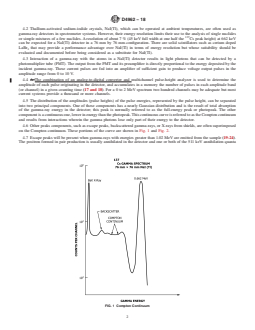
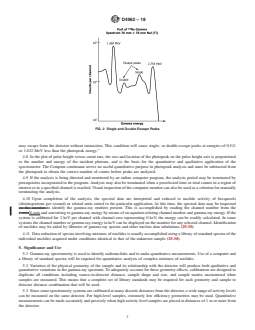
the curve are shown in Fig. 1 and Fig. 2.
4.7 Escape peaks will be present when gamma-rays with
energies greater than 1.02 MeV are emitted from the sample
(19-24). The positron formed in pair production is usually
annihilated in the detector and one or both of the 511 keV
annihilation quanta may escape from the detector without
interaction. This condition will cause single- or double-escape
FIG. 1 Compton Continuum
peaks at energies of 0.511 or 1.022 MeV less than the
photopeak energy.”
4.8 In the plot of pulse height versus count rate, the size and
location of the photopeak on the pulse height axis is propor-
tional to the number and energy of the incident photons, and is
the basis for the quantitative and qualitative application of the
spectrometer. The Compton continuum serves no useful quan-
titative purpose in photopeak analysis and must be subtracted
from the photopeak to obtain the correct number of counts
before peaks are analyzed.
4.9 If the analysis is being directed and monitored by an
online computer program, the analysis period may be termi-
nated by prerequisites incorporated in the program. Analysis
may also be terminated when a preselected time or total counts
in a region of interest or in a specified channel is reached.
Visual inspection of the computer monitor can also be used as
a criterion for manually terminating the analysis.
4.10 Upon completion of the analysis, the spectral data are
interpreted and reduced to nuclide activity of becquerels
(disintegrations per second) or related units suited to the
particular application. At this time, the spectral data may be
inspected to identify the gamma-ray emitters present. This is
FIG. 2 Single and Double Escape Peaks
accomplished by reading the channel number from the X-axis
and converting to gamma-ray energy by means of an equation
photomultiplier tube (PMT). The output from the PMT and its relating channel number and gamma-ray energy. If the system
preamplifier is directly proportional to the energy deposited by is calibrated for 2 keV per channel with channel zero repre-
the incident gamma-ray. These current pulses are fed into an senting 0 keV, the energy can be readily calculated. In some
D4962 − 18
systems the channel number or gamma-ray energy in keV can cause the loss of counts from the other two peaks. Cascade
be displayed on the monitor for any selected channel. Identi- summing may be reduced by increasing the source to detector
fication of nuclides may be aided by libraries of gamma-ray distance.Summingismoresignificantifawell-typedetectoris
spectra and other nuclear data tabulations (25-30). used.
4.11 Data reduction of spectra involving mixtures of nu- 6.3 Random summing occurs in all measurements but is a
clides is usually accomplished using a library of standard function of count rate. The total random summing rate is
spectra of the individual nuclides acquired under conditions proportional to the square of the total number of counts. For
identical to that of the unknown sample (25-30). most systems, random summing losses can be held to less than
1 % by limiting the total counting rate to 2000 counts per
5. Significance and Use
second (see Test Methods E181).
5.1 Gamma-ray spectrometry is used to identify radionu-
6.4 The density of the sample is another factor that can
clides and to make quantitative measurements. Use of a
affect quantitative results. This source of error can be avoided
computer and a library of standard spectra will be required for
by preparing the standards for calibration in matrices of the
quantitative analysis of complex mixtures of nuclides.
same density of the sample under analysis.
5.2 Variation of the physical geometry of the sample and its
7. Apparatus
relationship with the detector will produce both qualitative and
quantitative variations in the gamma-ray spectrum. To ad- 7.1 Gamma Ray Spectrometer, consisting of the following
equately account for these geometry effects, calibrations are components, as shown in Fig. 3. Some currently available
designed to duplicate all conditions including source-to-
commercial systems incorporate the power supply,
detector distance, sample shape and size, and sample matrix preamplifier, amplifier, analog-to-digital converter, and multi-
encountered when samples are measured. This means that a
channel analyzer into a single unit.
complete set of library standards may be required for each 7.1.1 Detector Assembly—Sodium iodide crystal, activated
geometryandsampletodetectordistancecombinationthatwill
with about 0.1 % thallium iodide, cylindrical, with or without
be used. aninnersamplewell,51to102mmindiameter,44to102-mm
high, and hermetically sealed in an opaque container with a
5.3 Sincesomespectrometrysystemsarecalibratedatmany
transparentwindow.Thecrystalshouldcontainlessthan5µg/g
discrete distances from the detector, a wide range of activity
of potassium, and should be free of other radioactive materials.
levels can be measured on the same detector. For high-level
In order to establish freedom from other radioactive materials,
samples, extremely low efficiency geometries may be used.
themanufacturershouldsupplythegamma-rayspectrumofthe
Quantitative measurements can be made accurately and pre-
background of the crystal between 80 and 3000 keV. The
cisely when high activity level samples are placed at distances
of1mor more from the detector.
5.4 Electronic problems, such as erroneous deadtime
correction, loss of resolution, and random summing, may be
avoided by keeping the gross count rate below 2000 counts per
second and also keeping the deadtime of the analyzer below
5 %. Total counting time is governed by the activity of the
sample, the detector source distance, and the acceptable
Poisson counting uncertainty.
6. Interferences
6.1 In complex mixtures of gamma-ray emitters, the degree
of interference of one nuclide in the determination of another
isgovernedbyseveralfactors.Ifthegamma-rayemissionrates
from different radionuclides are similar, interference will occur
when the photopeaks are not completely resolved and overlap.
Amethod of predicting the gamma-ray resolution of a detector
is given in the literature (31). If the nuclides are present in the
mixture in unequal portions radiometrically, and nuclides of
higher gamma-ray energies are predominant, there are serious
interferences with the interpretation of minor, less energetic
gamma-ray photopeaks. The complexity of the analysis
methodisduetotheresolutionoftheseinterferencesand,thus,
one of the main reasons for computerized systems.
6.2 Cascade summing may occur when nuclides that decay
by a gamma-ray cascade are analyzed. Cobalt-60 is an ex-
ample; 1173 and 1333 keV gamma-rays from the same decay
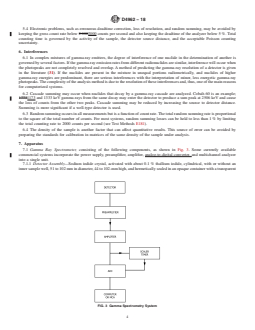
may enter the detector to produce a sum peak at 2506 keV and FIG. 3 Gamma Spectrometry System
D4962 − 18
crystal should be attached and optically coupled to a photo- degrade the higher-energy gamma-rays. Therefore, it is impor-
multiplier or other suitable optical sensor such as an avalanche tant to calibrate the detector with standards of the same
photodiode. A photomultiplier requires a preamplifier or a geometry and density. A beta absorber consisting of about 6
cathode follower compatible with the amplifier. The resolution mm of aluminum, beryllium, or plastic may be used for
(FWHM) of the assembly for the photopeak of Cs should be samples that have a significant beta activity and high beta
less than 9 %. energies.
7.1.2 Shield—The detector assembly shall be surrounded by
an external radiation shield made of dense metal, equivalent to 9. Single or Simple Mixtures of Radionuclides
102 mm of lead in gamma-ray attenuation capability. It is
9.1 Calibration and Standardization:
desirable that the inner walls of the shield be at least 127 mm
9.1.1 Begin operation of the instrumentation and detector
distant from the detector surfaces to reduce backscatter. If the
according to the manufacturer’s instructions. Initial set-up
shield is made of lead or a lead liner, the shield may have a
includesallelectronicadjustmenttoprovideconstantoperating
graded inner liner of, for example, 1.6 mm of cadmium or tin
conditions consistent with the application and life expectancy
lined with 0.4 mm of copper, to attenuate lead X-rays at 88
of the calibrations. Adjust the analog-to-digital converter gain
keV, on the surface near the detector. The shield must have a
and threshold, amplifier gain and zero-level, and detector high
door or port for inserting and removing samples.
voltage, or bias, to yield an optimum energy calibration,
7.1.3 High Voltage Power/Bias Supply—High-voltage
usually 2 keV per channel. Modern commercial equipment is
power supply of range (usually from 500 to 3000 V and up to
capable of linearity to the extent that the energy may be
10 mA) sufficient to operate a NaI(Tl) detector,
interpreted by the operator directly to the nearest 5 keVsimply
photomultiplier, and its preamplifier assembly. The power
by reading the channel number of the highest channel in a
supply shall be regulated to 0.1 % with a ripple of not more
peak. The energy calibration is usually accomplished with
than 0.01 %. Line noise caused by other equipment shall be
radioactive sources covering the entire range of interest. All
removed with radiofrequency filters and additional regulators.
efficiency calibrations and source analyses are performed with
7.1.4 Preamplifier/Amplifier—An amplifier compatible with
the same gain settings and the same high voltage setting.
the preamplifier or emitter follower and with the pulse-height
Obtain efficiency calibrations by placing an appropriate vol-
analyzer.
ume of a radionuclide standard solution traceable to a national
7.1.5 Scalar/Timer—A scalar/timer may be used to monitor
metrology institute such as National Institute of Standards and
the count and regulate the spectral acquisition.
Technology (NIST) containing 100 to 10 000 Bq in a container
7.1.6 ADC/MCA—A multichannel pulse-height analyzer
and placing the container on the detector or in the detector
(MCA) or stand-alone analog-to-digital-converter (ADC) un-
well.
der software control of a separate computer, performs many
9.1.2 Preparation of Apparatus:
functions required for gamma-ray spectrometry. An MCA or
9.1.2.1 Follow the manufacturer’s instructions, limitations,
computer collects the data, provides a visual display, and
and cautions for the set up of and the preliminary testing for all
outputs final results or raw data for later analysis. The four
of the spectrometry equipment to be used in the analysis. This
major components of an MCA are the ADC, the memory, the
equipment could include detectors, power supplies,
control, and the input/output circuitry and devices. The ADC
preamplifiers, amplifiers, multichannel analyzers, and comput-
digitizes the analog pulses from the detector amplifier. These
ers. Some currently available commercial systems incorporate
pulses represent energy. The digital result selects a memory
the power supply, preamplifier, amplifier, and multichannel
location(channelnumber)whichisusedtostorethenumberof
analyzer into a single unit.
events which have occurred with that energy. Simple data
9.1.2.2 Placeanappropriatevolumeofasingleradionuclide
analysis and control of the MCA is accomplished by control-
or mixed radionuclide standard traceable to a national metrol-
lingfactorssuchastheinput/output,channelsummingoverset
ogy institute such as NIST in a sealed container and place the
regions of interest, and system energy calibration.
container at a desirable and reproducible source-to-detector
7.1.7 Data Storage—Becauseoftheuseofmicroprocessors,
distance. The solution above should provide about 100 counts
modern MCAs provide a wide range of input and output (I/O)
per second in the peaks of interest. In all radionuclide
capabilities to an associated computer.
measurements, the volumes, shape, and physical and chemical
characteristics of the samples, and the corresponding standard,
8. Container for Test Specimen
and their containers must be as identical as practicable for the
most accurate results. If precipitates or residues are to be
8.1 Sample mounts and containers must have a convenient
analyzed, then evaporate the standards on the same type of
reproducible geometry. Considerations include commercial
mount as the sample.
availability, ease of use and disposal, and the containment of
9.1.3 Energy Calibration:
radioactivity for protection of the working environment and
9.1.3.1 Multichannel analyzers and NaI(Tl) detectors being
personnel from contamination. The evaporation of liquid
samples to dryness is not necessary and liquid samples up to produced today are capable of producing an almost linear
energy response.
several litres may be used. However, samples that have been
evaporated to dryness for gross beta counting can also be used 9.1.3.2 The energy calibration (channel number of the
for gamma-ray spectrometry. Massive samples may cause multichannel analyzer versus the gamma-ray energy) of the
significant self-absorption of low-energy gamma-rays and detector system is accomplished at a fixed gain using standards
D4962 − 18
containing known radionuclides. The standards should be in portion of the half-life, apply a correction factor for decay
sealed containers and should emit at least four different during the count (25-30).
gamma-ray energies covering the range of interest, usually 50
9.1.4.2 Correcttheradioactivitystandardsourcegamma-ray
keV to 2000 keV in order to test for system linearity. Some emission rate for the decay from the time of standardization to
commercially available nuclides suitable for energy calibration
the time at which the count rate is measured.
are noted in Table 1; others have been listed (17 and 18).
9.1.4.3 Calculate the full-energy peak efficiency using the
Verify the radionuclide purity of the standards periodically to
observed net count rate in the full energy peak and the
ensureagainstaccidentalcontaminationorthepresenceoflong
gamma-ray emission rate of the standard source. The gamma-
lived impurities by compari
...
This document is not an ASTM standard and is intended only to provide the user of an ASTM standard an indication of what changes have been made to the previous version. Because
it may not be technically possible to adequately depict all changes accurately, ASTM recommends that users consult prior editions as appropriate. In all cases only the current version
of the standard as published by ASTM is to be considered the official document.
Designation: D4962 − 17 D4962 − 18
Standard Practice for
NaI(Tl) Gamma-Ray Spectrometry of Water
This standard is issued under the fixed designation D4962; the number immediately following the designation indicates the year of
original adoption or, in the case of revision, the year of last revision. A number in parentheses indicates the year of last reapproval. A
superscript epsilon (´) indicates an editorial change since the last revision or reapproval.
1. Scope
1.1 This practice covers the measurement of radionuclides in water by means of gamma-ray spectrometry. It is applicable to
nuclides emitting gamma-rays with energies greater than 50 keV. For typical counting systems and sample types, activity levels
of about 40 Bq (1080 pCi) are easily measured and sensitivities of about 0.4 Bq (11 pCi) are found for many nuclides (1-10).
Count rates in excess of 2000 counts per second should be avoided because of electronic limitations. High count rate samples can
be accommodated by dilution or by increasing the sample to detector distance.
1.2 This practice can be used for either quantitative or relative determinations. In tracer work, the results may be expressed by
comparison with an initial concentration of a given nuclide which is taken as 100 %. For radioassay, the results may be expressed
in terms of known nuclidic standards for the radionuclides known to be present. In addition to the quantitative measurement of
gamma-ray activity, gamma-ray spectrometry can be used for the identification of specific gamma-ray emitters in a mixture of
radionuclides. radionuclides but that ability is limited when using low energy resolution Na(Tl) detectors as compared to High
Purity Germanium (HPGe) detectors. General information on radioactivity and the measurement of radiation has been published
(11 and 12). Information on specific application of gamma-ray spectrometry is also available in the literature (13-16).
1.3 The values stated in SI units are to be regarded as standard. The values given in parentheses after SI units are included for
information only and are not considered standard.
1.4 This standard does not purport to address all of the safety concerns, if any, associated with its use. It is the responsibility
of the user of this standard to establish appropriate safety, health, and environmental practices and determine the applicability of
regulatory limitations prior to use.
1.5 This international standard was developed in accordance with internationally recognized principles on standardization
established in the Decision on Principles for the Development of International Standards, Guides and Recommendations issued
by the World Trade Organization Technical Barriers to Trade (TBT) Committee.
2. Referenced Documents
2.1 ASTM Standards:
D1129 Terminology Relating to Water
D3648 Practices for the Measurement of Radioactivity
D7902 Terminology for Radiochemical Analyses
E181 Test Methods for Detector Calibration and Analysis of Radionuclides
3. Terminology
3.1 Definitions:
3.1.1 For definitions of terms used in this standard, refer to Terminologies D1129 and D7902.
4. Summary of Practice
4.1 Gamma-ray spectra are commonly measured with modular equipment consisting of a detector, amplifier, analog-to-digital
converter, multi-channel analyzer device, and a computer (17 and 18).
This practice is under the jurisdiction of ASTM Committee D19 on Water and is the direct responsibility of Subcommittee D19.04 on Methods of Radiochemical Analysis.
Current edition approved Nov. 1, 2017Oct. 1, 2018. Published November 2017November 2018. Originally approved in 1989. Last previous edition approved in 20092017
as D4962 – 02 (2009).D4962 – 17. DOI: 10.1520/D4962-17.10.1520/D4962-18.
The boldface numbers in parentheses refer to the references at the end of this practice.
For referenced ASTM standards, visit the ASTM website, www.astm.org, or contact ASTM Customer Service at service@astm.org. For Annual Book of ASTM Standards
volume information, refer to the standard’sstandard’s Document Summary page on the ASTM website.
Copyright © ASTM International, 100 Barr Harbor Drive, PO Box C700, West Conshohocken, PA 19428-2959. United States
D4962 − 18
4.2 Thallium-activated sodium-iodide crystals, NaI(Tl), which can be operated at ambient temperatures, are often used as
gamma-ray detectors in spectrometer systems. However, their energy resolution limits their use to the analysis of single nuclides
or simple mixtures of a few nuclides. A resolution of about 7 % (45 keV full width at one half the Cs peak height) at 662 keV
can be expected for a NaI(Tl) detector in a 76 mm by 76 mm-configuration. There are solid scintillators such as cerium doped
LaBr that may provide a performance advantage over NaI(Tl) in terms of energy resolution but whose suitability should be
evaluated and documented before being considered as a substitute for NaI(Tl).
4.3 Interaction of a gamma-ray with the atoms in a NaI(Tl) detector results in light photons that can be detected by a
photomultiplier tube (PMT). The output from the PMT and its preamplifier is directly proportional to the energy deposited by the
incident gamma-ray. These current pulses are fed into an amplifier of sufficient gain to produce voltage output pulses in the
amplitude range from 0 to 10 V.
4.4 A The combination of an analog-to-digital converter and multichannel pulse-height analyzer is used to determine the
amplitude of each pulse originating in the detector, and accumulates in a memory the number of pulses in each amplitude band
(or channel) in a given counting time (17 and 18). For a 0 to 2 MeV spectrum two hundred channels may be adequate but most
current systems provide a thousand or more channels.
4.5 The distribution of the amplitudes (pulse heights) of the pulse energies, represented by the pulse height, can be separated
into two principal components. One of these components has a nearly Gaussian distribution and is the result of total absorption
of the gamma-ray energy in the detector; this peak is normally referred to as the full-energy peak or photopeak. The other
component is a continuous one, lower in energy than the photopeak. This continuous curve is referred to as the Compton continuum
and results from interactions wherein the gamma photons lose only part of their energy to the detector.
4.6 Other peaks components, such as escape peaks, backscattered gamma-rays, or X-rays from shields, are often superimposed
on the Compton continuum. These portions of the curve are shown in Fig. 1 and Fig. 2.
4.7 Escape peaks will be present when gamma-rays with energies greater than 1.02 MeV are emitted from the sample (19-24).
The positron formed in pair production is usually annihilated in the detector and one or both of the 511 keV annihilation quanta
FIG. 1 Compton Continuum
D4962 − 18
FIG. 2 Single and Double Escape Peaks
may escape from the detector without interaction. This condition will cause single- or double-escape peaks at energies of 0.511
or 1.022 MeV less than the photopeak energy.”
4.8 In the plot of pulse height versus count rate, the size and location of the photopeak on the pulse height axis is proportional
to the number and energy of the incident photons, and is the basis for the quantitative and qualitative application of the
spectrometer. The Compton continuum serves no useful quantitative purpose in photopeak analysis and must be subtracted from
the photopeak to obtain the correct number of counts before peaks are analyzed.
4.9 If the analysis is being directed and monitored by an online computer program, the analysis period may be terminated by
prerequisites incorporated in the program. Analysis may also be terminated when a preselected time or total counts in a region of
interest or in a specified channel is reached. Visual inspection of the computer monitor can also be used as a criterion for manually
terminating the analysis.
4.10 Upon completion of the analysis, the spectral data are interpreted and reduced to nuclide activity of becquerels
(disintegrations per second) or related units suited to the particular application. At this time, the spectral data may be inspected
on the monitor to identify the gamma-ray emitters present. This is accomplished by reading the channel number from the
x-axisX-axis and converting to gamma-ray energy by means of an equation relating channel number and gamma-ray energy. If the
system is calibrated for 2 keV per channel with channel zero representing 0 keV, the energy can be readily calculated. In some
systems the channel number or gamma-ray energy in keV can be displayed on the monitor for any selected channel. Identification
of nuclides may be aided by libraries of gamma-ray spectra and other nuclear data tabulations (25-30).
4.11 Data reduction of spectra involving mixtures of nuclides is usually accomplished using a library of standard spectra of the
individual nuclides acquired under conditions identical to that of the unknown sample (25-30).
5. Significance and Use
5.1 Gamma-ray spectrometry is used to identify radionuclides and to make quantitative measurements. Use of a computer and
a library of standard spectra will be required for quantitative analysis of complex mixtures of nuclides.
5.2 Variation of the physical geometry of the sample and its relationship with the detector will produce both qualitative and
quantitative variations in the gamma-ray spectrum. To adequately account for these geometry effects, calibrations are designed to
duplicate all conditions including source-to-detector distance, sample shape and size, and sample matrix encountered when
samples are measured. This means that a complete set of library standards may be required for each geometry and sample to
detector distance combination that will be used.
5.3 Since some spectrometry systems are calibrated at many discrete distances from the detector, a wide range of activity levels
can be measured on the same detector. For high-level samples, extremely low efficiency geometries may be used. Quantitative
measurements can be made accurately and precisely when high activity level samples are placed at distances of 1 m or more from
the detector.
D4962 − 18
5.4 Electronic problems, such as erroneous deadtime correction, loss of resolution, and random summing, may be avoided by
keeping the gross count rate below 2 0002000 counts per second and also keeping the deadtime of the analyzer below 5 %. Total
counting time is governed by the activity of the sample, the detector source distance, and the acceptable Poisson counting
uncertainty.
6. Interferences
6.1 In complex mixtures of gamma-ray emitters, the degree of interference of one nuclide in the determination of another is
governed by several factors. If the gamma-ray emission rates from different radionuclides are similar, interference will occur when
the photopeaks are not completely resolved and overlap. A method of predicting the gamma-ray resolution of a detector is given
in the literature (31). If the nuclides are present in the mixture in unequal portions radiometrically, and nuclides of higher
gamma-ray energies are predominant, there are serious interferences with the interpretation of minor, less energetic gamma-ray
photopeaks. The complexity of the analysis method is due to the resolution of these interferences and, thus, one of the main reasons
for computerized systems.
6.2 Cascade summing may occur when nuclides that decay by a gamma-ray cascade are analyzed. Cobalt-60 is an example;
17731173 and 1333 keV gamma-rays from the same decay may enter the detector to produce a sum peak at 2506 keV and cause
the loss of counts from the other two peaks. Cascade summing may be reduced by increasing the source to detector distance.
Summing is more significant if a well-type detector is used.
6.3 Random summing occurs in all measurements but is a function of count rate. The total random summing rate is proportional
to the square of the total number of counts. For most systems, random summing losses can be held to less than 1 % by limiting
the total counting rate to 2000 counts per second (see Test Methods E181).
6.4 The density of the sample is another factor that can affect quantitative results. This source of error can be avoided by
preparing the standards for calibration in matrices of the same density of the sample under analysis.
7. Apparatus
7.1 Gamma Ray Spectrometer, consisting of the following components, as shown in Fig. 3. Some currently available
commercial systems incorporate the power supply, preamplifier, amplifier, analog-to-digital converter, and multichannel analyzer
into a single unit.
7.1.1 Detector Assembly—Sodium iodide crystal, activated with about 0.1 % thallium iodide, cylindrical, with or without an
inner sample well, 51 to 102 mm in diameter, 44 to 102-mm high, and hermetically sealed in an opaque container with a transparent
FIG. 3 Gamma Spectrometry System
D4962 − 18
window. The crystal should contain less than 5 μg/g of potassium, and should be free of other radioactive materials. In order to
establish freedom from other radioactive materials, the manufacturer should supply the gamma-ray spectrum of the background
of the crystal between 80 and 3000 keV. The crystal should be attached and optically coupled to a photomultiplier or other suitable
optical sensor such as an avalanche photodiode. A photomultiplier requires a preamplifier or a cathode follower compatible with
the amplifier. The resolution (FWHM) of the assembly for the photopeak of Cs should be less than 9 %.
7.1.2 Shield—The detector assembly shall be surrounded by an external radiation shield made of dense metal, equivalent to 102
mm of lead in gamma-ray attenuation capability. It is desirable that the inner walls of the shield be at least 127 mm distant from
the detector surfaces to reduce backscatter. If the shield is made of lead or a lead liner, the shield may have a graded inner liner
of of, for example, 1.6 mm of cadmium or tin lined with 0.4 mm of copper, to attenuate lead X-rays at 88 keV, on the surface near
the detector. The shield must have a door or port for inserting and removing samples.
7.1.3 High Voltage Power/Bias Supply—High-voltage power supply of range (usually from 500 to 3000 V and up to 10 mA)
sufficient to operate a NaI(Tl) detector, photomultiplier, and its preamplifier assembly. The power supply shall be regulated to
0.1 % with a ripple of not more than 0.01 %. Line noise caused by other equipment shall be removed with radiofrequency filters
and additional regulators.
7.1.4 Preamplifier/Amplifier—An amplifier compatible with the preamplifier or emitter follower and with the pulse-height
analyzer.
7.1.5 Scalar/Timer—A scalar/timer may be used to monitor the count and regulate the spectral acquisition.
7.1.6 ADC/MCA—A multichannel pulse-height analyzer (MCA) or stand-alone analog-to-digital-converter (ADC) under
software control of a separate computer, performs many functions required for gamma-ray spectrometry. An MCA or computer
collects the data, provides a visual display, and outputs final results or raw data for later analysis. The four major components of
an MCA are the ADC, the memory, the control, and the input/output circuitry and devices. The ADC digitizes the analog pulses
from the detector amplifier. These pulses represent energy. The digital result selects a memory location (channel number) which
is used to store the number of events which have occurred with that energy. Simple data analysis and control of the MCA is
accomplished by controlling factors such as the input/output, channel summing over set regions of interest, and system energy
calibration.
7.1.7 Data Storage—Because of the use of microprocessors, modern MCAs provide a wide range of input and output (I/O)
capabilities to an associated computer.
8. Container for Test Specimen
8.1 Sample mounts and containers must have a convenient reproducible geometry. Considerations include commercial
availability, ease of use and disposal, and the containment of radioactivity for protection of the working environment and personnel
from contamination. The evaporation of liquid samples to dryness is not necessary and liquid samples up to several litres may be
used. However, samples that have been evaporated to dryness for gross beta counting can also be used for gamma-ray spectrometry.
Massive samples may cause significant self-absorption of low-energy gamma-rays and degrade the higher-energy gamma-rays.
Therefore, it is important to calibrate the detector with standards of the same geometry and density. A beta absorber consisting of
about 6 mm of aluminum, beryllium, or plastic may be used for samples that have a significant beta activity and high beta energies.
9. Single or Simple Mixtures of Radionuclides
9.1 Calibration and Standardization:
9.1.1 Begin operation of the instrumentation and detector according to the manufacturer’smanufacturer’s instructions. Initial
set-up includes all electronic adjustment to provide constant operating conditions consistent with the application and life
expectancy of the calibrations. Adjust the analog-to-digital converter gain and threshold, amplifier gain and zero-level, and detector
high voltage, or bias, to yield an optimum energy calibration, usually 2 keV per channel. Modern commercial equipment is capable
of linearity to the extent that the energy may be interpreted by the operator directly to the nearest 5 keV simply by reading the
channel number of the highest channel in a peak. The energy calibration is usually accomplished with radioactive sources covering
the entire range of interest. All efficiency calibrations and source analyses are performed with the same gain settings and the same
high voltage setting. Obtain efficiency calibrations by placing an appropriate volume of a radionuclide standard solution traceable
to a national metrology institute such as NISTNational Institute of Standards and Technology (NIST) containing 100 to 10 000 Bq
in a container and placing the container on the detector or in the detector well.
9.1.2 Preparation of Apparatus:
9.1.2.1 Follow the manufacturer’smanufacturer’s instructions, limitations, and cautions for the set up of and the preliminary
testing for all of the spectrometry equipment to be used in the analysis. This equipment could include detectors, power supplies,
preamplifiers, amplifiers, multichannel analyzers, and computers. Some currently available commercial systems incorporate the
power supply, preamplifier, amplifier, and multichannel analyzer into a single unit.
9.1.2.2 Place an appropriate volume of a single radionuclide or mixed radionuclide standard traceable to a national metrology
institute such as NIST in a sealed container and place the container at a desirable and reproducible source-to-detector distance. The
solution above should provide about 100 counts per second in the peaks of interest. In all radionuclide measurements, the volumes,
D4962 − 18
shape, and physical and chemical characteristics of the samples, and the corresponding standard, and their containers must be as
identical as practicable for the most accurate results. If precipitates or residues are to be analyzed, then evaporate the standards
on the same type of mount as the sample.
9.1.3 Energy Calibration:
9.1.3.1 Multichannel analyzers and NaI(Tl) detectors being produced today are capable of producing an almost linear energy
response.
9.1.3.2 The energy calibration (channel number of the multichannel analyzer versus the gamma-ray energy) of the detector
system is accomplished at a fixed gain using standards containing known radionuclides. The standards should be in sealed
containers and should emit at least four different gamma-ray energies covering the range of interest, usually 50 keV to 2000 keV
in order to test for system linearity. Some commercially available nuclides suitable for energy calibration are:are Pb, 46.5noted
241 109 141 51 137 54 22
in Table 1keV;; Am, 59.5 keV; Cd, 88 keV; Ce, 145 keV; Cr, 320 keV, Cs, 662 keV, Mn, 835 keV; Na, 511 and
88 60 226
1275 keV; Y, 898 and 1836 keV; Co, 1173 and 1332 keV; equilibrated Ra, 186, 352, 609, 1120, and 1765 keV; others have
been listed (17 and 18). Verify the radionuclide purity of the standards periodically to ensure against accidental contamination or
the presence of long lived impurities by comparing the observed spectra with the spectra published in the literature (17 and 18).
9.1.3.3 Calibrate the multichannel analyzer to cover the range of interest. If the range is 50 to 2000 keV, adjust the gain of the
system until the Cs photopeak, 662 keV, is about one-third full scale. Leaving the gain constant, locate at least three other
photopeaks of different energies, covering the same range. Calibrate the system based upon the manufacturer’smanufacturer’s
instructions of at least two, and preferably three, photopeaks. A near linear relationship will be observed if the equipment is
operating properly. Samples should not be analyzed if there is a significant non-linear relationship. If the spectrometry system is
computerized, follow the appropriate manufacturer input instructions for the determination of the slope and intercept. During each
day in which the spectrometry system is being used to analyze samples, repeat the above sequence of operations using at least two
different gamma-ray energies. If the slope and intercept are essentially unchanged, the energy calibration data remain valid. If
...