

ASTM D4209-07(2019)
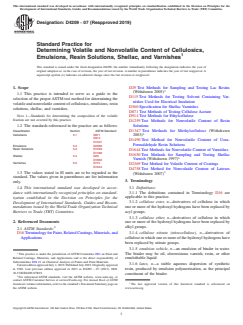
(Practice)Standard Practice for Determining Volatile and Nonvolatile Content of Cellulosics, Emulsions, Resin Solutions, Shellac, and Varnishes
General Information
- Abstract
SIGNIFICANCE AND USE
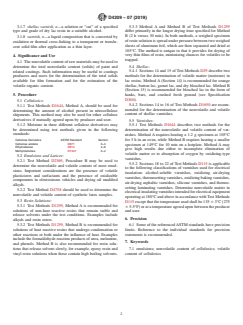
4.1 The nonvolatile content of raw materials may be used to determine the total nonvolatile content (solids) of paint and related coatings. Such information may be useful to coatings producers and users for the determination of the total solids available for film formation and for the estimation of the volatile organic content.
SCOPE
1.1 This practice is intended to serve as a guide to the selection of the proper ASTM test method for determining the volatile and nonvolatile content of cellulosics, emulsions, resin solutions, shellac, and varnishes.
Note 1: Standards for determining the composition of the volatile fraction are not covered by this practice.
1.2 The standards referenced in the practice are as follows:
Classification
Section
ASTM Standard
Cellulosics
5.1
D871
D914
D1347
Emulsions
5.2
D2369
Resin Solutions
5.3
D1259
D1490
Shellac
5.4
D29
D1650
Varnishes
5.5
D115
D1644
1.3 The values stated in SI units are to be regarded as the standard. The values given in parentheses are for information only.
1.4 This international standard was developed in accordance with internationally recognized principles on standardization established in the Decision on Principles for the Development of International Standards, Guides and Recommendations issued by the World Trade Organization Technical Barriers to Trade (TBT) Committee.
- Status
- Published
- Publication Date
- 30-Jun-2019
- Technical Committee
- D01 - Paint and Related Coatings, Materials, and Applications
- Drafting Committee
- D01.21 - Chemical Analysis of Paints and Paint Materials


Overview
ASTM D4209-07(2019) - Standard Practice for Determining Volatile and Nonvolatile Content of Cellulosics, Emulsions, Resin Solutions, Shellac, and Varnishes provides a comprehensive guide for professionals in the coatings and chemical industries. This practice serves as a reference for selecting the appropriate ASTM test methods to determine the volatile and nonvolatile (solids) content in a range of materials commonly used in paints, coatings, and related formulations. Accurate determination of volatile and nonvolatile content is critical for manufacturers, formulators, and users to assess solids available for film formation and estimate volatile organic content, impacting both product performance and regulatory compliance.
Key Topics
Scope: This standard outlines the recommended procedures for selecting ASTM test methods to measure volatile and nonvolatile content in:
- Cellulosic materials
- Emulsions
- Resin solutions
- Shellac
- Varnishes
Significance: The nonvolatile (solids) content indicates the portion of raw materials remaining after volatiles have evaporated, essential for:
- Determining available solids for coating film formation
- Calculating volatile organic content (VOC) for regulatory needs
Reference Methods: ASTM D4209 lists appropriate test methods by material type, enabling accurate and consistent measurement:
- Cellulosics: ASTM D871, D914
- Emulsions: ASTM D2369
- Resin solutions: ASTM D1259, D1490
- Shellac: ASTM D29, D1650
- Varnishes: ASTM D115, D1644
Units: Results must be reported in SI units for standardization, with alternative units provided for reference.
Applications
The guidance in ASTM D4209-07(2019) is widely used across industries such as paints, coatings, adhesives, and chemical manufacturing for:
- Quality Control: Ensuring raw materials and finished products meet required specifications for solids and volatile content.
- Regulatory Compliance: Supporting calculation of VOC content, which is vital for meeting environmental standards and industry regulations.
- Formulation Development: Assisting chemists and formulators in adjusting recipes to achieve desired coating properties, such as film thickness and durability.
- Process Optimization: Facilitating accurate measurement and adjustment of nonvolatile content for consistent manufacturing outcomes.
The standard also addresses selection of the most suitable methods for different material chemistries, whether dealing with alcohol-based solutions, heat-reactive resins, or synthetic emulsions. Clear differentiation ensures that volatile and nonvolatile content is reliably determined, regardless of product type.
Related Standards
ASTM D4209 references a range of specific ASTM standards, each tailored to particular materials:
- ASTM D871: Testing Cellulose Acetate
- ASTM D914: Testing Ethylcellulose
- ASTM D1347: Testing Methylcellulose
- ASTM D2369: Measuring Volatile Content in Coatings (Emulsions)
- ASTM D1259: Nonvolatile Content of Resin Solutions
- ASTM D1490: Urea-Formaldehyde Resin Solutions
- ASTM D29: Sampling and Testing Lac Resins (Shellac)
- ASTM D1650: Sampling and Testing Shellac Varnish
- ASTM D115: Testing Varnishes for Electrical Insulation
- ASTM D1644: Nonvolatile Content of Varnishes
For the most effective use of ASTM D4209, consult the relevant test method for your specific material and application. For broader context on terminology and materials, refer to ASTM D16: Terminology for Paint, Related Coatings, Materials, and Applications.
Employing ASTM D4209-07(2019) ensures precision, reproducibility, and international acceptance in volatile and nonvolatile content determination, helping organizations meet quality, environmental, and performance goals.
Relations
- Effective Date
- 01-Jul-2019
- Effective Date
- 01-Mar-2024
- Effective Date
- 01-Feb-2024
- Effective Date
- 01-Jan-2024
- Effective Date
- 01-Dec-2019
- Effective Date
- 01-Jun-2019
- Effective Date
- 01-Jan-2019
- Effective Date
- 01-Aug-2018
- Effective Date
- 01-Jun-2018
- Effective Date
- 01-Nov-2017
- Effective Date
- 01-Jul-2016
- Effective Date
- 01-Jun-2015
- Effective Date
- 01-Dec-2014
- Effective Date
- 01-Nov-2014
- Effective Date
- 01-May-2013
Frequently Asked Questions
ASTM D4209-07(2019) is a standard published by ASTM International. Its full title is "Standard Practice for Determining Volatile and Nonvolatile Content of Cellulosics, Emulsions, Resin Solutions, Shellac, and Varnishes". This standard covers: SIGNIFICANCE AND USE 4.1 The nonvolatile content of raw materials may be used to determine the total nonvolatile content (solids) of paint and related coatings. Such information may be useful to coatings producers and users for the determination of the total solids available for film formation and for the estimation of the volatile organic content. SCOPE 1.1 This practice is intended to serve as a guide to the selection of the proper ASTM test method for determining the volatile and nonvolatile content of cellulosics, emulsions, resin solutions, shellac, and varnishes. Note 1: Standards for determining the composition of the volatile fraction are not covered by this practice. 1.2 The standards referenced in the practice are as follows: Classification Section ASTM Standard Cellulosics 5.1 D871 D914 D1347 Emulsions 5.2 D2369 Resin Solutions 5.3 D1259 D1490 Shellac 5.4 D29 D1650 Varnishes 5.5 D115 D1644 1.3 The values stated in SI units are to be regarded as the standard. The values given in parentheses are for information only. 1.4 This international standard was developed in accordance with internationally recognized principles on standardization established in the Decision on Principles for the Development of International Standards, Guides and Recommendations issued by the World Trade Organization Technical Barriers to Trade (TBT) Committee.
SIGNIFICANCE AND USE 4.1 The nonvolatile content of raw materials may be used to determine the total nonvolatile content (solids) of paint and related coatings. Such information may be useful to coatings producers and users for the determination of the total solids available for film formation and for the estimation of the volatile organic content. SCOPE 1.1 This practice is intended to serve as a guide to the selection of the proper ASTM test method for determining the volatile and nonvolatile content of cellulosics, emulsions, resin solutions, shellac, and varnishes. Note 1: Standards for determining the composition of the volatile fraction are not covered by this practice. 1.2 The standards referenced in the practice are as follows: Classification Section ASTM Standard Cellulosics 5.1 D871 D914 D1347 Emulsions 5.2 D2369 Resin Solutions 5.3 D1259 D1490 Shellac 5.4 D29 D1650 Varnishes 5.5 D115 D1644 1.3 The values stated in SI units are to be regarded as the standard. The values given in parentheses are for information only. 1.4 This international standard was developed in accordance with internationally recognized principles on standardization established in the Decision on Principles for the Development of International Standards, Guides and Recommendations issued by the World Trade Organization Technical Barriers to Trade (TBT) Committee.
ASTM D4209-07(2019) is classified under the following ICS (International Classification for Standards) categories: 87.060.20 - Binders. The ICS classification helps identify the subject area and facilitates finding related standards.
ASTM D4209-07(2019) has the following relationships with other standards: It is inter standard links to ASTM D4209-07(2013), ASTM D115-17(2024), ASTM D2369-24, ASTM D16-24, ASTM D914-12(2019), ASTM D360-12(2019), ASTM D871-96(2019), ASTM D1490-01(2018), ASTM D1259-06(2018), ASTM D115-17, ASTM D16-16, ASTM D2369-10(2015)e1, ASTM D16-14, ASTM D115-14, ASTM D1490-01(2013). Understanding these relationships helps ensure you are using the most current and applicable version of the standard.
ASTM D4209-07(2019) is available in PDF format for immediate download after purchase. The document can be added to your cart and obtained through the secure checkout process. Digital delivery ensures instant access to the complete standard document.
Standards Content (Sample)
This international standard was developed in accordance with internationally recognized principles on standardization established in the Decision on Principles for the
Development of International Standards, Guides and Recommendations issued by the World Trade Organization Technical Barriers to Trade (TBT) Committee.
Designation: D4209 − 07 (Reapproved 2019)
Standard Practice for
Determining Volatile and Nonvolatile Content of Cellulosics,
Emulsions, Resin Solutions, Shellac, and Varnishes
This standard is issued under the fixed designation D4209; the number immediately following the designation indicates the year of
original adoption or, in the case of revision, the year of last revision. A number in parentheses indicates the year of last reapproval. A
superscript epsilon (´) indicates an editorial change since the last revision or reapproval.
1. Scope D29 Test Methods for Sampling and Testing Lac Resins
(Withdrawn 2005)
1.1 This practice is intended to serve as a guide to the
D115 Test Methods for Testing Solvent Containing Var-
selection of the proper ASTM test method for determining the
nishes Used for Electrical Insulation
volatile and nonvolatile content of cellulosics, emulsions, resin
D360 Specification for Shellac Varnishes
solutions, shellac, and varnishes.
D871 Test Methods of Testing Cellulose Acetate
NOTE 1—Standards for determining the composition of the volatile
D914 Test Methods for Ethylcellulose
fraction are not covered by this practice.
D1259 Test Methods for Nonvolatile Content of Resin
1.2 The standards referenced in the practice are as follows:
Solutions
D1347 Test Methods for Methylcellulose (Withdrawn
Classification Section ASTM Standard
Cellulosics 5.1 D871
2003)
D914
D1490 Test Method for Nonvolatile Content of Urea-
D1347
Formaldehyde Resin Solutions
Emulsions 5.2 D2369
Resin Solutions 5.3 D1259
D1644 Test Methods for Nonvolatile Content of Varnishes
D1490
D1650 Test Methods for Sampling and Testing Shellac
Shellac 5.4 D29
Varnish (Withdrawn 1997)
D1650
Varnishes 5.5 D115
D2369 Test Method for Volatile Content of Coatings
D1644
D4758 Test Method for Nonvolatile Content of Latexes
1.3 The values stated in SI units are to be regarded as the
(Withdrawn 2007)
standard. The values given in parentheses are for information
3. Terminology
only.
3.1 Definitions:
1.4 This international standard was developed in accor-
3.1.1 The definitions contained in Terminology D16 are
dance with internationally recognized principles on standard-
applicable to this practice.
ization established in the Decision on Principles for the
3.1.2 cellulose ester, n—derivatives of cellulose in which
Development of International Standards, Guides and Recom-
one or more of the hydroxyl hydrogens have been replaced by
mendations issued by the World Trade Organization Technical
acyl groups.
Barriers to Trade (TBT) Committee.
3.1.3 cellulose ether, n—derivatives of cellulose in which
2. Referenced Documents
one or more of the hydroxyl hydrogens have been replaced by
alkyl groups.
2.1 ASTM Standards:
D16 TerminologyforPaint,RelatedCoatings,Materials,and 3.1.4 cellulose nitrate (nitrocellulose), n—derivatives of
cellulose in which one or more of the hydroxyl hydrogens have
Applications
been replaced by nitrate groups.
3.1.5 emulsion vehicle, n—an emulsion of binder in water.
The binder may be oil, oleoresinous varnish, resin, or other
This practice is under the jurisdiction of ASTM Committee D01 on Paint and
Related Coatings, Materials, and Applications and is the direct responsibility of
emulsifiable liquid.
Subcommittee D01.21 on Chemical Analysis of Paints and Paint Materials.
3.1.6 latex, n—a stable aqueous dispersion of synthetic
Current edition approved July 1, 2019. Published July 2019. Originally approved
in 1982. Last previous edition approved in 2013 as D4209 – 07 (2013). DOI: resin, produced by emulsion polymerization, as the principal
10.1520/D4209-07R19.
constituent of the binder.
For referenced ASTM standards, visit the ASTM website, www.astm.org, or
contact ASTM Customer Service at service@astm.org. For Annual Book of ASTM
Standards volume information, refer to the standard’s Document Summary page on The last approved version of this historical standard is referenced on
the ASTM website. www.astm.org.
Copyright © ASTM International, 100 Barr Harbor Drive, PO Box C700, West Conshohocken, PA 19428-2959. United States
D4209 − 07 (2019)
3.1.7 shellac varnish, n—a solution or “cut” of a specified 5.3.3 Method A and Method B of Test Methods D1259
type and grade of dry lac resin in a suitable alcohol. differ primarily in the longer drying time specified for Method
B (2 h versus 30 min). In both methods, a weighed specimen
3.1.8 varnish, n—a liquid composition that is converted by
of resin solution is spread under pressure between two weighed
oxidation or thermal cross-linking to a transparent or translu-
sheets of aluminum foil, which are then separated and dried at
cent solid film after application as a thin layer.
105°C. The method is unique in that it provides for drying of
very thin films of resin, minimizing chances for volatiles to be
4. Significance and Use
trapped.
4.1 The nonvolatile content of raw materials may be used to
5.4 Shellac:
det
...