

ASTM D914-12(2019)
(Test Method)Standard Test Methods for Ethylcellulose
General Information
- Abstract
SIGNIFICANCE AND USE
5.1 The results of this test are used for calculating the total solids in the sample and, by common usage, all materials volatile at this test temperature are designated as moisture.
5.2 Moisture analysis (along with sulfated ash) is used to calculate the amount of active polymer in the material and shall be considered when determining the amount of ethylcellulose in various functions.
SCOPE
1.1 These test methods cover the testing of ethylcellulose.
1.2 The test procedures appear in the following order:
Sections
Moisture
4 to 6
Sulfated Ash
7 to 11
Chlorides (as Sodium Chloride)
12 to 16
Ethoxyl Content
20 to 24
Viscosity
25 to 39
1.3 The values stated in SI units are to be regarded as standard. The values given in parentheses are for information only.
1.4 Warning—Mercury has been designated by EPA and many state agencies as a hazardous material that can cause central nervous system, kidney and liver damage. Mercury, or its vapor, may be hazardous to health and corrosive to materials. Caution should be taken when handling mercury and mercury-containing products. See the applicable product Material Safety Data Sheet (MSDS) for details and EPA’s website (http://www.epa.gov/mercury/faq.htm) for additional information. Users should be aware that selling mercury or mercury-containing products, or both, in your state may be prohibited by state law.
1.5 This standard does not purport to address all of the safety concerns, if any, associated with its use. It is the responsibility of the user of this standard to establish appropriate safety, health, and environmental practices and determine the applicability of regulatory limitations prior to use.
1.6 This international standard was developed in accordance with internationally recognized principles on standardization established in the Decision on Principles for the Development of International Standards, Guides and Recommendations issued by the World Trade Organization Technical Barriers to Trade (TBT) Committee.
- Status
- Published
- Publication Date
- 30-Nov-2019
- Technical Committee
- D01 - Paint and Related Coatings, Materials, and Applications
- Drafting Committee
- D01.36 - Cellulose and Cellulose Derivatives
Overview
ASTM D914-12(2019): Standard Test Methods for Ethylcellulose covers widely accepted procedures for testing ethylcellulose, a key cellulose ether used across industries for its film-forming, binding, and thickening properties. This ASTM standard provides standardized methods for determining essential physical and chemical characteristics, including moisture content, sulfated ash, chlorides (as sodium chloride), ethoxyl content, and viscosity of ethylcellulose. Compliance with ASTM D914 enables manufacturers, laboratories, and quality assurance professionals to verify the quality and consistency of ethylcellulose for both regulatory and commercial applications.
Key Topics
- Moisture Content Determination: Measures volatile materials at prescribed temperature, designated as "moisture," which is critical for accurate solids and polymer content calculation.
- Sulfated Ash Content: Assesses inorganic residue after ignition with sulfuric acid. This helps quantify non-polymerizable content affecting clarity and film properties.
- Chlorides (as Sodium Chloride): Evaluates sodium chloride content, which impacts purity, solution performance, and is a key by-product from the manufacturing process.
- Ethoxyl Content: Determines the level of ethoxyl substitution, which significantly influences solubility, rheology, and film-forming properties.
- Viscosity Measurement: Measures the thickening ability of ethylcellulose in specified solvent systems using standardized viscometers, relating to processability and end-use performance.
Applications
The test methods provided in ASTM D914-12(2019) are essential in:
- Quality Control: Ensuring the delivered ethylcellulose meets required specifications for industrial, pharmaceutical, and food uses.
- Product Development: Adjusting formulation parameters such as solubility, viscosity, and film-forming properties by accurately measuring ethoxyl content and viscosity.
- Regulatory Compliance: Supporting documentation required for meeting government or industry standards - particularly for applications where purity and active polymer content are mandated.
- Manufacturing Consistency: Monitoring batch-to-batch variations through standardized moisture, ash, and chloride determination.
- Troubleshooting and Process Optimization: Identifying sources of performance issues in coatings, films, adhesives, and controlled-release systems related to raw material properties.
Related Standards
Professionals working with ethylcellulose often reference related ASTM and international standards, including:
- ASTM D446: Specifications and operating instructions for glass capillary kinematic viscometers.
- ASTM D4794: Test method for determination of ethoxyl or hydroxyethoxyl substitution in cellulose ether products.
- ASTM D362 and D841: Specifications for industrial and nitration grade toluene, highlighting solvent compatibility in test procedures.
- ASTM E2251: Specification for liquid-in-glass thermometers for precision temperature control in testing.
- Good Laboratory Practices (GLP): General standards for chemical testing to ensure safety and environmental compliance, especially when hazardous materials like mercury are involved.
Practical Value
Adhering to ASTM D914-12(2019):
- Enhances reliability and reproducibility across laboratories and supply chains.
- Supports customer confidence with traceable, internationally recognized test results.
- Assists in the selection of appropriate grades of ethylcellulose for demanding applications in paints, coatings, pharmaceuticals, and food products.
- Provides clear, actionable results for making formulation and purchasing decisions based on verified polymer content, purity, and performance attributes.
Using ASTM D914-12(2019) as a benchmark ensures that ethylcellulose materials align with global quality expectations and regulatory requirements, supporting innovation and consistency in end-use applications.
Relations
- Effective Date
- 01-Dec-2019
- Effective Date
- 15-Nov-2019
- Effective Date
- 01-Jul-2017
- Effective Date
- 01-Jun-2017
- Effective Date
- 01-Feb-2013
- Effective Date
- 01-Dec-2012
- Effective Date
- 01-Nov-2012
- Effective Date
- 01-Jul-2011
- Effective Date
- 01-May-2011
- Effective Date
- 01-Nov-2010
- Effective Date
- 01-Jan-2010
- Effective Date
- 01-Feb-2009
- Effective Date
- 01-Jan-2008
- Effective Date
- 01-Nov-2007
- Effective Date
- 01-Jan-2007
Get Certified
Connect with accredited certification bodies for this standard

Control Union Certifications
Global certification for agriculture and sustainability.

Gozdarski inštitut Slovenije
Slovenian Forestry Institute. Forest management certification support, timber testing.
Sponsored listings
Frequently Asked Questions
ASTM D914-12(2019) is a standard published by ASTM International. Its full title is "Standard Test Methods for Ethylcellulose". This standard covers: SIGNIFICANCE AND USE 5.1 The results of this test are used for calculating the total solids in the sample and, by common usage, all materials volatile at this test temperature are designated as moisture. 5.2 Moisture analysis (along with sulfated ash) is used to calculate the amount of active polymer in the material and shall be considered when determining the amount of ethylcellulose in various functions. SCOPE 1.1 These test methods cover the testing of ethylcellulose. 1.2 The test procedures appear in the following order: Sections Moisture 4 to 6 Sulfated Ash 7 to 11 Chlorides (as Sodium Chloride) 12 to 16 Ethoxyl Content 20 to 24 Viscosity 25 to 39 1.3 The values stated in SI units are to be regarded as standard. The values given in parentheses are for information only. 1.4 Warning—Mercury has been designated by EPA and many state agencies as a hazardous material that can cause central nervous system, kidney and liver damage. Mercury, or its vapor, may be hazardous to health and corrosive to materials. Caution should be taken when handling mercury and mercury-containing products. See the applicable product Material Safety Data Sheet (MSDS) for details and EPA’s website (http://www.epa.gov/mercury/faq.htm) for additional information. Users should be aware that selling mercury or mercury-containing products, or both, in your state may be prohibited by state law. 1.5 This standard does not purport to address all of the safety concerns, if any, associated with its use. It is the responsibility of the user of this standard to establish appropriate safety, health, and environmental practices and determine the applicability of regulatory limitations prior to use. 1.6 This international standard was developed in accordance with internationally recognized principles on standardization established in the Decision on Principles for the Development of International Standards, Guides and Recommendations issued by the World Trade Organization Technical Barriers to Trade (TBT) Committee.
SIGNIFICANCE AND USE 5.1 The results of this test are used for calculating the total solids in the sample and, by common usage, all materials volatile at this test temperature are designated as moisture. 5.2 Moisture analysis (along with sulfated ash) is used to calculate the amount of active polymer in the material and shall be considered when determining the amount of ethylcellulose in various functions. SCOPE 1.1 These test methods cover the testing of ethylcellulose. 1.2 The test procedures appear in the following order: Sections Moisture 4 to 6 Sulfated Ash 7 to 11 Chlorides (as Sodium Chloride) 12 to 16 Ethoxyl Content 20 to 24 Viscosity 25 to 39 1.3 The values stated in SI units are to be regarded as standard. The values given in parentheses are for information only. 1.4 Warning—Mercury has been designated by EPA and many state agencies as a hazardous material that can cause central nervous system, kidney and liver damage. Mercury, or its vapor, may be hazardous to health and corrosive to materials. Caution should be taken when handling mercury and mercury-containing products. See the applicable product Material Safety Data Sheet (MSDS) for details and EPA’s website (http://www.epa.gov/mercury/faq.htm) for additional information. Users should be aware that selling mercury or mercury-containing products, or both, in your state may be prohibited by state law. 1.5 This standard does not purport to address all of the safety concerns, if any, associated with its use. It is the responsibility of the user of this standard to establish appropriate safety, health, and environmental practices and determine the applicability of regulatory limitations prior to use. 1.6 This international standard was developed in accordance with internationally recognized principles on standardization established in the Decision on Principles for the Development of International Standards, Guides and Recommendations issued by the World Trade Organization Technical Barriers to Trade (TBT) Committee.
ASTM D914-12(2019) is classified under the following ICS (International Classification for Standards) categories: 85.040 - Pulps. The ICS classification helps identify the subject area and facilitates finding related standards.
ASTM D914-12(2019) has the following relationships with other standards: It is inter standard links to ASTM D914-12, ASTM D841-19, ASTM D841-17a, ASTM D841-17, ASTM D841-13, ASTM D446-12, ASTM D841-12, ASTM D841-11, ASTM E2251-11, ASTM E2251-10, ASTM D841-10, ASTM D4794-94(2009), ASTM D841-02(2008)e1, ASTM E2251-07, ASTM D446-07. Understanding these relationships helps ensure you are using the most current and applicable version of the standard.
ASTM D914-12(2019) is available in PDF format for immediate download after purchase. The document can be added to your cart and obtained through the secure checkout process. Digital delivery ensures instant access to the complete standard document.
Standards Content (Sample)
This international standard was developed in accordance with internationally recognized principles on standardization established in the Decision on Principles for the
Development of International Standards, Guides and Recommendations issued by the World Trade Organization Technical Barriers to Trade (TBT) Committee.
Designation: D914 − 12 (Reapproved 2019)
Standard Test Methods for
Ethylcellulose
This standard is issued under the fixed designation D914; the number immediately following the designation indicates the year of
original adoption or, in the case of revision, the year of last revision. A number in parentheses indicates the year of last reapproval. A
superscript epsilon (´) indicates an editorial change since the last revision or reapproval.
1. Scope 2. Referenced Documents
1.1 These test methods cover the testing of ethylcellulose. 2.1 ASTM Standards:
D362 SpecificationforIndustrialGradeToluene(Withdrawn
1.2 The test procedures appear in the following order:
1989)
Sections
D446 Specifications and Operating Instructions for Glass
Moisture 4 to 6
Capillary Kinematic Viscometers
Sulfated Ash 7 to 11
Chlorides (as Sodium Chloride) 12 to 16
D841 Specification for Nitration Grade Toluene
Ethoxyl Content 20 to 24
D4794 Test Method for Determination of Ethoxyl or Hy-
Viscosity 25 to 39
droxyethoxyl Substitution in Cellulose Ether Products by
1.3 The values stated in SI units are to be regarded as
Gas Chromatography
standard. The values given in parentheses are for information
E2251 Specification for Liquid-in-Glass ASTM Thermom-
only.
eters with Low-Hazard Precision Liquids
1.4 Warning—Mercury has been designated by EPA and
3. Purity of Reagents and Materials
many state agencies as a hazardous material that can cause
central nervous system, kidney and liver damage. Mercury, or 3.1 Reagent grade chemicals shall be used in all tests.
its vapor, may be hazardous to health and corrosive to Unless otherwise indicated, all of the reagents used shall
materials.Cautionshouldbetakenwhenhandlingmercuryand conform to the specifications of the Committee on Analytical
mercury-containing products. See the applicable product Ma- Reagents of the American Chemical Society, where such
terial Safety Data Sheet (MSDS) for details and EPA’s website specifications are available. Where such specifications have
(http://www.epa.gov/mercury/faq.htm) for additional informa- not been established, reagents of the best grade available shall
tion. Users should be aware that selling mercury or mercury- be used. References to water shall be understood to mean
containingproducts,orboth,inyourstatemaybeprohibitedby distilled water.
state law.
MOISTURE
1.5 This standard does not purport to address all of the
safety concerns, if any, associated with its use. It is the 4. Scope
responsibility of the user of this standard to establish appro-
4.1 Thistestmethodcoversthedeterminationofthevolatile
priate safety, health, and environmental practices and deter-
content of ethylcellulose.
mine the applicability of regulatory limitations prior to use.
4.2 This international standard was developed in accor-
1.6 This international standard was developed in accor-
dance with internationally recognized principles on standard-
dance with internationally recognized principles on standard-
ization established in the Decision on Principles for the
ization established in the Decision on Principles for the
Development of International Standards, Guides and Recom-
For referenced ASTM standards, visit the ASTM website, www.astm.org, or
mendations issued by the World Trade Organization Technical
contact ASTM Customer Service at service@astm.org. For Annual Book of ASTM
Barriers to Trade (TBT) Committee.
Standards volume information, refer to the standard’s Document Summary page on
the ASTM website.
The last approved version of this historical standard is referenced on
www.astm.org.
1 4
These test methods are under the jurisdiction of ASTM Committee D01 on ACS Reagent Chemicals, Specifications and Procedures for Reagents and
Paint and Related Coatings, Materials, and Applications and are the direct Standard-Grade Reference Materials, American Chemical Society, Washington,
responsibility of Subcommittee D01.36 on Cellulose and Cellulose Derivatives. DC. For suggestions on the testing of reagents not listed by theAmerican Chemical
Current edition approved Dec. 1, 2019. Published December 2019. Originally Society, see Analar Standards for Laboratory Chemicals, BDH Ltd., Poole, Dorset,
approved in 1947. Last previous edition approved in 2012 as D914 – 12. DOI: U.K., and the United States Pharmacopeia and National Formulary, U.S. Pharma-
10.1520/D0914-12R19. copeial Convention, Inc. (USPC), Rockville, MD.
Copyright © ASTM International, 100 Barr Harbor Drive, PO Box C700, West Conshohocken, PA 19428-2959. United States
D914 − 12 (2019)
Development of International Standards, Guides and Recom- lated applications. Excessive ash may also affect solution
mendations issued by the World Trade Organization Technical clarity and film properties.
Barriers to Trade (TBT) Committee.
12. Apparatus
5. Significance and Use
12.1 Muffle Furnace.
5.1 The results of this test are used for calculating the total
12.2 Crucibles, either porcelain, 30–mLhigh, form cracked,
solids in the sample and, by common usage, all materials
platinum.
volatile at this test temperature are designated as moisture.
5.2 Moisture analysis (along with sulfated ash) is used to
13. Reagent
calculatetheamountofactivepolymerinthematerialandshall
13.1 Sulfuric Acid (sp gr 1.84)—Concentrated sulfuric acid
be considered when determining the amount of ethylcellulose
(H SO ).
2 4
in various functions.
14. Procedure
6. Apparatus
14.1 Ignite a crucible for 10 to 15 min at 800 6 25°C, cool
6.1 Oven, gravity convection, capable of maintaining a
in a desiccator, and weigh to the nearest 0.001 g.
temperature of 105 6 3°C.
14.2 Weigh about5gof sample to the nearest 0.001 g
6.2 Weighing Bottles.
(previously dried for3hat 105°C) into the crucible. Burn off
6.3 Analytical Balance.
the bulk of the carbonaceous material directly over a flame.
After cooling, add 1 mLof H SO in such a way as to moisten
2 4
7. Procedure
the entire ash; then cautiously heat with the burner to dense
7.1 Weigh accurately 2 to5gofthe sample to the nearest
white fumes. Ignite in a muffle furnace at 800 6 25°C until all
0.001 g into a tared dish (fitted with a lid) and dry for2hinan
signs of carbon are gone. Cool in a desiccator and reweigh to
oven at 100 to 105°C. Remove the dish from the oven, cover
the nearest 0.001 g.
with a lid, cool in a desiccator, and weigh.
15. Calculation
8. Calculation
15.1 Calculate the percent ash (as sulfate), C, as follows:
8.1 Calculate the percent moisture, M as follows:
C 5 ~A/B! 3100 (2)
M 5 A/B 3100 (1)
~ !
where:
where:
A = ash, g, and
A = mass loss on heating, g, and
B = sample used, g.
B = sample used, g.
16. Precision and Bias
9. Precision and Bias
16.1 Precision—Statistical analysis of interlaboratory (re-
9.1 Precision—Statistical analysis of intralaboratory (re-
producibility) test results indicates a precision of 610 % at the
peatability) test results indicates a precision of 65 % at the
95 % confidence level.
95 % confidence level.
16.2 Bias—No statement of bias can be made as no suitable
9.2 Bias—No statement of bias can be made as no suitable
reference material is available as a standard.
reference material is available as a standard.
CHLORIDES (as Sodium Chloride)
SULFATED ASH
17. Scope
10. Scope
17.1 This test method covers the determination of the
10.1 This test method covers the determination of the
chloride content of ethylcellulose.
residue on ignition of ethylcellulose after a specimen has been
treated with sulfuric acid.
17.2 This international standard was developed in accor-
dance with internationally recognized principles on standard-
10.2 This international standard was developed in accor-
ization established in the Decision on Principles for the
dance with internationally recognized principles on standard-
Development of International Standards, Guides and Recom-
ization established in the Decision on Principles for the
mendations issued by the World Trade Organization Technical
Development of International Standards, Guides and Recom-
Barriers to Trade (TBT) Committee.
mendations issued by the World Trade Organization Technical
Barriers to Trade (TBT) Committee.
18. Significance and Use
11. Significance and Use
18.1 Sodium chloride is a major by-product of the ethylcel-
11.1 This test method (along with moisture) is used to lulose manufacturing process. This test is a measure of the
calculate the active polymer in the material. It shall be used purity of ethylcellulose. Chlorides may also affect solution
when testing ethylcellulose in United States government regu- properties.
D914 − 12 (2019)
19. Apparatus 20.2 Ethanol-Distilled Water Solvent Mixture (80 + 20)—
Mix 800 g of 2B ethanol with 200 g of water. Add 7.5 g of
19.1 Titration pH Meter.
aerosol OT 100 % surface-active agent per 3000 g of ethanol-
19.2 Mercury-Mercurous Sulfate Reference Electrode—The
water mixture.
electrode uses a potassium sulfate electrolyte to avoid chloride
20.3 Potassium Nitrate (KNO ) Solution (saturated) for salt
contamination from a chloride electrolyte.
bridge (Fig. 1).
19.3 Silver-Silver Chloride Electrode—The electrode is
20.4 Silver Nitrate, Standard Solution (0.02 N)—Dissolve
coated with silver chloride periodically. Prepare the electrode
3.4 g of silver nitrate (AgNO ) in water, dilute to 1 L with
by polishing with fine steel wool, briefly soaking it in 5 %
waterinavolumetricflask,andmix.Weighexactly0.5845gof
potassium cyanide solution, and rinsing it with water. Coat the
dry, primary standard sodium chloride (NaCl), dissolve in 25
electrode with silver chloride by electrodeposition from 0.1 N
mLof water, and dilute to 1 Lwith water in a volumetric flask.
potassiumchloridesolutionusinga3-Vdrycellandaplatinum
Add 10 mL of H SO (1 + 16) to each aliquot before titrating.
2 4
wire electrode. Connect the silver electrode to the positive pole
Titrate aliquots of this solution potentiometrically with the
of the battery and electrolyze for 20 s; then reverse the
AgNO solution. Calculate the normality, N, of the AgNO
connections for 5 s. Repeat these operations twice, and finally, 3 3
solution as follows:
chloridize the silver electrode for 20 s at the positive terminal.
Store the silver electrode in 0.1 N potassium chloride solution.
N 5 A/B 30.01 (3)
~ !
Rinse the electrode with water and wipe it with a soft tissue
where:
before each titration.
A = 0.01 N NaCl solution added, mL, and
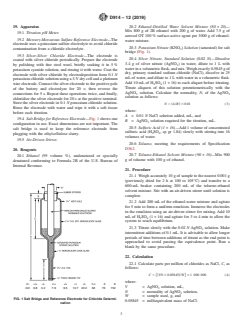
19.4 Salt Bridge for Reference Electrode—Fig. 1 shows one
B = AgNO solution required for the titration, mL.
configuration in use. Exact dimensions are not important. The
20.5 Sulfuric Acid (1 + 16)—Add 1 volume of concentrated
salt bridge is used to keep the reference electrode from
sulfuric acid (H SO , sp gr 1.84) slowly with stirring into 16
plugging with the ethylcellulose slurry. 2 4
volumes of water.
19.5 Air-Driven Stirrer.
20.6 Toluene, meeting the requirements of Specification
D362.
20. Reagents
20.7 Toluene-Ethanol Solvent Mixture (90 + 10)—Mix 900
20.1 Ethanol (95 volume %), undenatured or specially
g of toluene with 100 g of ethanol.
denatured conforming to Formula 2B of the U.S. Bureau of
Internal Revenue.
21. Procedure
21.1 Weigh accurately 10 g of sample to the nearest 0.001 g
(previously dried for2hat100to 105°C) and transfer to a
600-mL beaker containing 200 mL of the toluene-ethanol
solvent mixture. Stir with an air-driven stirrer until solution is
complete.
21.2 Add 200 mL of the ethanol-water mixture and agitate
for 5 min to form a uniform emulsion. Immerse the electrodes
in the emulsion using an air-driven stirrer for mixing. Add 10
mL of H SO (1 + 16) and agitate for 3 to 4 min to allow the
2 4
system to reach equilibrium.
21.3 Titrate slowly with the 0.02 N AgNO solution. Make
intermittent additions of 0.1 mL. It is advisable to allow longer
periods of time between additions of titrant as the end point is
approached to avoid passing the equivalence point. Run a
blank by the same procedure.
22. Calculation
22.1 Calculate parts per million of chlorides as NaCl, C,as
follows:
C 5 VN 30.05845 /W 31 000 000 (4)
@~ ! #
where:
1 1 5 3 1 7 1
in. ⁄32 ⁄8 ⁄16 ⁄8 ⁄2 ⁄8 1 ⁄2 3 6
V = AgNO solution, mL,
mm 0.8 3.2 7.9 9.5 12.7 22.2 38 76 152
N = normality of AgNO solution,
W = sample used, g, and
FIG. 1 Salt Bridge and Reference Electrode for Chloride Determi-
0.05845 = milliequivalent mass of NaCl.
nation
D914 − 12 (2019)
23. Precision and Bias
23.1 Precision—Statistical analysis of interlaboratory (re-
producibility) test results indicates a precision of 65 % at the
95 % confidence level.
23.2 Bias—No statement of bias can be made as no suitable
reference material is available as a standard.
ETHOXYL CONTENT
24. Scope
24.1 This test method covers the determination of the
ethoxyl content of ethylcellulose.
24.2 For an alternative method see Test Method D4794.
24.3 This international standard was developed in accor-
dance with internationally recognized principles on standard-
ization established in the Decision on Principles for the
Development of International Standards, Guides and Recom-
mendations issued by the World Trade Organization Technical
Barriers to Trade (TBT) Committee.
25. Significance and Use
25.1 This test method determines the amount of substituent
groups added to the cellulose backbone. The level can greatly
affect solution properties, rheology, solubility parameters, and
film properties.
26. Apparatus
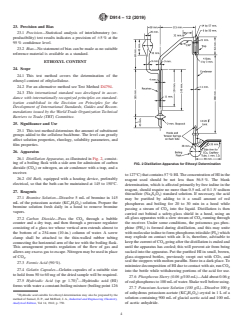
26.1 Distillation Apparatus, as illustrated in Fig. 2, consist-
ing of a boiling flask with a side arm for admission of carbon
FIG. 2 Distillation Apparatus for Ethoxyl Determination
dioxide (CO ) or nitrogen, an air condenser with a trap, and a
receiver.
to127°C)thatcontains57 %HI.TheconcentrationofHIinthe
26.2 Oil Bath, equipped with a heating device, preferably
reagent used should be not less than 56.5 %. The blank
electrical, so that the bath can be maintained at 145 to 150°C.
determination, which is affected primarily by free iodine in the
reagent, should require no more than 0.5 mL of 0.1 N sodium
27. Reagents
thiosulfate (Na S O ) standard solution. If necessary, the acid
2 2 3
27.1 Bromine Solution—Dissolve 5 mL of bromine in 145
may be purified by adding to it a small amount of red
mL of the potassium acetate (KC H O ) solution. Prepare the
2 3 2
phosphorus and boiling for 20 to 30 min in a hood while
bromine solution fresh daily in a hood to remove bromine
passing a stream of CO into the liquid. Distillation is then
vapors.
carried out behind a safety-glass shield in a hood, using an
all-glass apparatus with a slow stream of CO running through
27.2 Carbon Dioxide—Pass the CO through a bubble
the receiver. Under some conditions, the poisonous gas phos-
counter and a dry trap, and then through a pressure regulator
phine (PH ) is formed during distillation, and this may unite
consisting of a glass tee whose vertical arm extends almost to
withmoleculariodinetoformphosphorustriiodide(PI )which
the bottom of a 254-mm (10-in.) column of water. A screw
may explode on contact with air. It is, therefore, advisable to
clamp shall be attached to the thin-walled rubber tubing
keepthecurrentofCO goingafterthedistillationisendedand
connecting the horizontal arm of the tee with the boiling flask.
until the apparatus has cooled; this will prevent air from being
This arrangement permits regulation of the flow of gas and
sucked into the apparatus. Put the purified HI in small, brown,
allowsanyexcessgastoescape.Nitrogenmaybeusedinplace
glass-stoppered bottles, previously swept out with CO , and
of CO .
seal the stoppers with molten paraffin. Store in a dark place.To
27.3 Formic Acid (90 %).
minimize decomposition of HI due to contact with air, run CO
27.4 Gelatin Capsules—Gelatin capsules of a suitable size
into the bottle while withdrawing portions of the acid for use.
to hold from 50 to 60 mg of the dried sample will be required.
27.6 Phosphorus Slurry (0.06 g/100 mL)—Add about 0.06 g
27.5 Hydriodic Acid (sp gr 1.70) —Hydriodic acid (HI)
ofredphosphorusto100mLofwater.Shakewellbeforeusing.
forms with water a constant-boiling mixture (boiling point 126
27.7 Potassium Acetate Solution (100 g/L)—Dissolve 100 g
of anhydrous potassium acetate (KC H O ) crystal in 1 L of a
5 2 3 2
Hydriodic acid suitable for ethoxyl determination may also be prepared by the
solution containing 900 mL of glacial acetic acid and 100 mL
method of Samsel, E. P., and McHard, J.A., Industrial and Engineering Chemistry,
Analytical Edition, Vol 14, 1942, p. 750. of acetic anhydride.
------------
...