

ASTM D1439-22
(Test Method)Standard Test Methods for Sodium Carboxymethylcellulose
General Information
- Abstract
SIGNIFICANCE AND USE
5.1 Moisture analysis (along with purity) is used to calculate the amount of active polymer in the material and must be considered when determining the amount of sodium carboxymethylcellulose to use in various formulations.
SCOPE
1.1 These test methods cover the testing of sodium carboxymethylcellulose.
1.2 The test procedures appear in the following order:
Sections
Moisture
4 – 9
Degree of Etherification:
Test Method A—Acid Wash
10 – 17
Test Method B—Nonaqueous Titration
10, 12, 18 – 23
Viscosity
24 – 29
Purity
30 – 37
Sodium Glycolate
38 – 46
Sodium Chloride
47 – 54
Density
55 – 61
1.3 The values stated in SI units are to be regarded as the standard. The values given in parentheses are for information only.
1.4 This standard does not purport to address all of the safety concerns, if any, associated with its use. It is the responsibility of the user of this standard to establish appropriate safety, health, and environmental practices and determine the applicability of regulatory limitations prior to use. For specific hazard statements, see 15.1 and 20.
1.5 This international standard was developed in accordance with internationally recognized principles on standardization established in the Decision on Principles for the Development of International Standards, Guides and Recommendations issued by the World Trade Organization Technical Barriers to Trade (TBT) Committee.
- Status
- Published
- Publication Date
- 30-Nov-2022
- Technical Committee
- D01 - Paint and Related Coatings, Materials, and Applications
- Drafting Committee
- D01.36 - Cellulose and Cellulose Derivatives
Overview
ASTM D1439-22: Standard Test Methods for Sodium Carboxymethylcellulose is an international standard developed by ASTM International. This document outlines a comprehensive set of analytical procedures for testing sodium carboxymethylcellulose (NaCMC), a widely used water-soluble polymer derived from cellulose. The standard details methods to measure quality characteristics including moisture content, degree of etherification, viscosity, purity, sodium glycolate, sodium chloride content, and density. These properties are critically important for industries that utilize NaCMC in formulations for food, pharmaceuticals, cosmetics, and industrial products.
Key Topics
- Moisture Determination: Essential for quantifying the active polymer in a sample and adjusting NaCMC levels in formulations.
- Degree of Etherification: Includes two test methods (acid wash and nonaqueous titration) to evaluate the number of carboxymethyl groups introduced to cellulose, which affects product performance.
- Viscosity Measurement: Assesses the polymer's thickening ability-a primary function in most NaCMC applications.
- Purity Assessment: Determines the percentage of active ingredient, critical for controlling the quality of both crude and refined grades.
- Sodium Glycolate & Sodium Chloride Content: Measures impurities, especially relevant for food, pharmaceutical, and cosmetic uses where purity is regulated.
- Density Testing: Provides data that can affect processing and packaging requirements.
Applications
ASTM D1439-22 is widely applied in quality control and regulatory compliance for sodium carboxymethylcellulose products. Key applications include:
- Formulation Development: Ensures accurate dosage and performance by providing clear methods for calculating active polymer and moisture levels.
- Regulatory Compliance: Used by manufacturers and auditors in industries like food, cosmetics, and pharmaceuticals to meet government and industry standards for purity and safety.
- Quality Assurance: Facilitates batch-to-batch consistency in properties such as viscosity, purity, and impurity content, which is critical for end-use performance.
- Research and Development: Provides standardized test conditions for comparative studies, innovation, and materials research.
The standard is referenced by both suppliers and buyers to establish material specifications and ensure that sodium carboxymethylcellulose meets required technical criteria.
Related Standards
- ASTM D1347 (Withdrawn): Test methods for methylcellulose, relevant for comparative and legacy testing.
- ASTM E1: Specification for ASTM Liquid-in-Glass Thermometers, referenced for temperature measurement compliance.
- International Principles: Developed under World Trade Organization (WTO) guidelines to support global harmonization and remove technical barriers to trade.
Practical Value
ASTM D1439-22 provides a uniform and reliable basis for evaluating sodium carboxymethylcellulose quality. By adhering to these standardized test methods, manufacturers and users can:
- Minimize product variability
- Ensure compliance with regulatory requirements
- Facilitate product selection and qualification for various industrial sectors
- Satisfy documentation needs for audits and certifications
Adoption of this standard ultimately promotes transparency, efficiency, and product integrity in the global sodium carboxymethylcellulose market, benefiting suppliers, manufacturers, and end users alike. For the most accurate and up-to-date procedures, users should consult the official, current version of the standard published by ASTM International.
Relations
- Effective Date
- 01-May-2013
- Effective Date
- 01-Nov-2007
- Effective Date
- 01-Nov-2005
- Effective Date
- 01-Nov-2003
- Effective Date
- 10-May-2003
- Effective Date
- 10-Oct-2001
- Effective Date
- 10-Oct-2001
- Effective Date
- 10-Oct-2001
- Effective Date
- 01-Jan-1995
Get Certified
Connect with accredited certification bodies for this standard

Control Union Certifications
Global certification for agriculture and sustainability.

Gozdarski inštitut Slovenije
Slovenian Forestry Institute. Forest management certification support, timber testing.
Sponsored listings
Frequently Asked Questions
ASTM D1439-22 is a standard published by ASTM International. Its full title is "Standard Test Methods for Sodium Carboxymethylcellulose". This standard covers: SIGNIFICANCE AND USE 5.1 Moisture analysis (along with purity) is used to calculate the amount of active polymer in the material and must be considered when determining the amount of sodium carboxymethylcellulose to use in various formulations. SCOPE 1.1 These test methods cover the testing of sodium carboxymethylcellulose. 1.2 The test procedures appear in the following order: Sections Moisture 4 – 9 Degree of Etherification: Test Method A—Acid Wash 10 – 17 Test Method B—Nonaqueous Titration 10, 12, 18 – 23 Viscosity 24 – 29 Purity 30 – 37 Sodium Glycolate 38 – 46 Sodium Chloride 47 – 54 Density 55 – 61 1.3 The values stated in SI units are to be regarded as the standard. The values given in parentheses are for information only. 1.4 This standard does not purport to address all of the safety concerns, if any, associated with its use. It is the responsibility of the user of this standard to establish appropriate safety, health, and environmental practices and determine the applicability of regulatory limitations prior to use. For specific hazard statements, see 15.1 and 20. 1.5 This international standard was developed in accordance with internationally recognized principles on standardization established in the Decision on Principles for the Development of International Standards, Guides and Recommendations issued by the World Trade Organization Technical Barriers to Trade (TBT) Committee.
SIGNIFICANCE AND USE 5.1 Moisture analysis (along with purity) is used to calculate the amount of active polymer in the material and must be considered when determining the amount of sodium carboxymethylcellulose to use in various formulations. SCOPE 1.1 These test methods cover the testing of sodium carboxymethylcellulose. 1.2 The test procedures appear in the following order: Sections Moisture 4 – 9 Degree of Etherification: Test Method A—Acid Wash 10 – 17 Test Method B—Nonaqueous Titration 10, 12, 18 – 23 Viscosity 24 – 29 Purity 30 – 37 Sodium Glycolate 38 – 46 Sodium Chloride 47 – 54 Density 55 – 61 1.3 The values stated in SI units are to be regarded as the standard. The values given in parentheses are for information only. 1.4 This standard does not purport to address all of the safety concerns, if any, associated with its use. It is the responsibility of the user of this standard to establish appropriate safety, health, and environmental practices and determine the applicability of regulatory limitations prior to use. For specific hazard statements, see 15.1 and 20. 1.5 This international standard was developed in accordance with internationally recognized principles on standardization established in the Decision on Principles for the Development of International Standards, Guides and Recommendations issued by the World Trade Organization Technical Barriers to Trade (TBT) Committee.
ASTM D1439-22 is classified under the following ICS (International Classification for Standards) categories: 85.040 - Pulps. The ICS classification helps identify the subject area and facilitates finding related standards.
ASTM D1439-22 has the following relationships with other standards: It is inter standard links to ASTM E1-13, ASTM E1-07, ASTM E1-05, ASTM E1-03a, ASTM E1-03, ASTM E1-01, ASTM E1-98e1, ASTM E1-98, ASTM D1347-72(1995). Understanding these relationships helps ensure you are using the most current and applicable version of the standard.
ASTM D1439-22 is available in PDF format for immediate download after purchase. The document can be added to your cart and obtained through the secure checkout process. Digital delivery ensures instant access to the complete standard document.
Standards Content (Sample)
This international standard was developed in accordance with internationally recognized principles on standardization established in the Decision on Principles for the
Development of International Standards, Guides and Recommendations issued by the World Trade Organization Technical Barriers to Trade (TBT) Committee.
Designation: D1439 − 22
Standard Test Methods for
Sodium Carboxymethylcellulose
This standard is issued under the fixed designation D1439; the number immediately following the designation indicates the year of
original adoption or, in the case of revision, the year of last revision.Anumber in parentheses indicates the year of last reapproval.A
superscript epsilon (´) indicates an editorial change since the last revision or reapproval.
1. Scope* E1Specification for ASTM Liquid-in-Glass Thermometers
1.1 These test methods cover the testing of sodium car-
3. Purity of Reagents
boxymethylcellulose.
3.1 Reagent grade chemicals shall be used in all tests.
1.2 The test procedures appear in the following order:
Unlessotherwiseindicated,itisintendedthatallreagentsshall
Sections
conform to the specifications of the Committee on Analytical
Moisture 4–9
Reagents of the American Chemical Society, where such
Degree of Etherification:
Test Method A—Acid Wash 10–17
specifications are available. Other grades may be used, pro-
Test Method B—Nonaqueous Titration 10, 12, 18–23
vided it is first ascertained that the reagent is of sufficiently
Viscosity 24–29
Purity 30–37 high purity to permit its use without lessening the accuracy of
Sodium Glycolate 38–46
the determination.
Sodium Chloride 47–54
Density 55–61
3.2 Unless otherwise indicated, references to water shall be
understood to mean distilled water.
1.3 The values stated in SI units are to be regarded as the
standard. The values given in parentheses are for information
MOISTURE
only.
1.4 This standard does not purport to address all of the
4. Scope
safety concerns, if any, associated with its use. It is the
4.1 Thistestmethodcoversthedeterminationofthevolatile
responsibility of the user of this standard to establish appro-
content of sodium carboxymethylcellulose.
priate safety, health, and environmental practices and deter-
4.2 The results of this test are used for calculating the total
mine the applicability of regulatory limitations prior to use.
For specific hazard statements, see 15.1 and 20. solids in the sample; and, by common usage, all materials
volatile at this test temperature are designated as moisture.
1.5 This international standard was developed in accor-
dance with internationally recognized principles on standard-
5. Significance and Use
ization established in the Decision on Principles for the
Development of International Standards, Guides and Recom-
5.1 Moistureanalysis(alongwithpurity)isusedtocalculate
mendations issued by the World Trade Organization Technical
the amount of active polymer in the material and must be
Barriers to Trade (TBT) Committee.
consideredwhendeterminingtheamountofsodiumcarboxym-
ethylcellulose to use in various formulations.
2. Referenced Documents
2.1 ASTM Standards:
6. Apparatus
D1347 Test Methods for Methylcellulose (Withdrawn
6.1 Oven—Gravityconvectionoven,capableofmaintaining
2003)
a temperature of 105°C 6 3°C.
6.2 Weighing Bottles, low-form, 50-mm inside diameter by
These test methods are under the jurisdiction of ASTM Committee D01 on
30-mm height, or equivalent.
Paint and Related Coatings, Materials, and Applications and are the direct
responsibility of Subcommittee D01.36 on Cellulose and Cellulose Derivatives. 6.3 Analytical Balance.
Current edition approved Dec. 1, 2022. Published December 2022. Originally
approved in 1956. Last previous edition approved in 2022 as D1439–15 (2022).
DOI: 10.1520/D1439-22.
2 4
For referenced ASTM standards, visit the ASTM website, www.astm.org, or ACS Reagent Chemicals, Specifications and Procedures for Reagents and
contact ASTM Customer Service at service@astm.org. For Annual Book of ASTM Standard-Grade Reference Materials, American Chemical Society, Washington,
Standards volume information, refer to the standard’s Document Summary page on DC. For suggestions on the testing of reagents not listed by theAmerican Chemical
the ASTM website. Society, see Analar Standards for Laboratory Chemicals, BDH Ltd., Poole, Dorset,
The last approved version of this historical standard is referenced on U.K., and the United States Pharmacopeia and National Formulary, U.S. Pharma-
www.astm.org. copeial Convention, Inc. (USPC), Rockville, MD.
*A Summary of Changes section appears at the end of this standard
Copyright © ASTM International, 100 Barr Harbor Drive, PO Box C700, West Conshohocken, PA 19428-2959. United States
D1439 − 22
7. Procedure 13. Apparatus
7.1 Weigh 3g to5gofthe sample to the nearest 0.001 g in 13.1 Stirrer, air-driven.
a tared and covered weighing bottle.
13.2 Buchner Funnel, 75mm, fitted with a 70mm fine-
7.2 Place the bottle in an oven at 105°C for 2 h with the texture, heavy-duty filter paper. A 60mm medium-porosity,
cover removed. Cool the bottle in a desiccator, replace the fritted glass funnel may also be used.
cover, and weigh.
13.3 Drying Oven, maintained at 105°C.
7.3 Replace the sample in the oven for 30 min, cool, and
14. Reagents
reweigh.
14.1 Diphenylamine Reagent—Dissolve 0.5 g of diphe-
7.4 Continue this procedure to a mass loss of not more than
nylamine in 120 mL of sulfuric acid (H SO , 9+2). The
5 mg for 30 min drying time. 2 4
reagent should be essentially water-white. It will give a deep
8. Calculation
blue coloration with traces of nitrate or other oxidizing agents.
8.1 Calculate the percent moisture, M, as follows:
14.2 Ethyl Alcohol (95 volume %)—Denaturedethylalcohol
conformingtoeitherFormula2B,3A,or30oftheU.S.Bureau
M 5 A/B 3100 (1)
~ !
of Internal Revenue.
where:
14.3 Ethyl Alcohol (80 % by volume)—Dilute 840 mL of
A = mass loss on heating, g, and
Formula 2B, 3A, or 30 denatured alcohol to 1 L with water.
B = sample used, g.
14.4 Hydrochloric Acid, Standard (HCl, 0.3 N to 0.5 N).
9. Precision and Bias
14.5 Methanol, anhydrous.
9.1 Precision—Statistical analysis of interlaboratory repro-
14.6 Nitric Acid (sp gr 1.42)—Concentrated nitric acid
ducibility test results on samples containing 2% to10%
(HNO ).
moisture indicates a precision of 60.2% absolute at the 95%
14.7 Sodium Hydroxide, Standard Solution (0.3 N to
confidence level.
0.5 N)—Prepare and standardize a 0.3 N to 0.5 N solution of
9.2 Bias—No justifiable statement can be made on the bias
sodium hydroxide (NaOH).
of the procedure for measuring moisture because no suitable
14.8 Sulfuric Acid (9 + 2)—Carefullymix9volumesH SO
reference material exists. 2 4
with 2 volumes of water.
DEGREE OF ETHERIFICATION
15. Procedure
10. Scope
15.1 Weigh approximately4gofthe sample into a 250-mL
10.1 These test methods cover the determination of the
beakerandadd75mLofethylalcohol(95%).Stirthemixture
degree of etherification (D.E.) of sodium carboxymethylcellu-
with an air–driven stirrer until a good slurry is obtained. Add
lose.
5mL of HNO , while agitating, and continue agitation for
1minto2min.Heattheslurryandboilfor5min.(Warning—
10.2 Two test methods are included as follows:
Exercise care to avoid fire.) Remove the heat and continue
10.2.1 Test Method A (Acid Wash), for crude grades of
agitation for 10min to 15 min.
sodium carboxymethylcellulose with degrees of etherification
up to 0.85. Above 0.85 degree of etherification, slightly low
15.2 Decant the supernatant liquid through the filter and
results may be obtained.
transfer the precipitate to the filter with 50mL to 100 mL of
10.2.2 Test Method B (Nonaqueous Titration), for purified
ethyl alcohol (95%). Wash the precipitate with ethyl alcohol
grades of sodium carboxymethylcellulose of all degrees of
(80%) that has been heated to 60°C, until all of the acid has
etherification. It is not applicable to the crude grades.
been removed.
15.3 Test for the removal of acid and salts (ash) by mixing
11. Significance and Use
adropoftheacidcarboxymethylcelluloseslurryfromthefilter
11.1 These test methods determine the amount of substitu-
with a drop of diphenylamine reagent on a white spot plate.A
ent groups added to the cellulose backbone. The level can
bluecolorindicatesthepresenceofnitrateandthenecessityfor
greatly affect solution properties, rheology, viscosity,
further washing. If the first drop of reagent does not produce a
hygroscopicity,salttolerance,andmanyotherpropertiesofthe
blue color, further drops should be added until an excess of
polymer.
reagentisknowntobepresent,notingthecoloraftereachdrop.
Four to six washings will usually suffice to give a negative test
Test Method A—Acid Wash
for nitrate.
12. Summary of Test Method
15.4 Finally, wash the precipitate with a small amount of
12.1 The water-soluble sodium carboxymethylcellulose is anhydrousmethanolanddrawairthroughituntilthealcoholis
converted to the insoluble acid form, purified by washing, completely removed. Transfer the precipitate to a glass or
dried, and then a weighed sample is reconverted to the sodium aluminum weighing dish provided with a cover. Heat the
salt with a measured excess of sodium hydroxide. uncovereddishonasteambathuntiltheodorofalcoholcanno
D1439 − 22
longer be detected (in order to avoid fires due to methanol 19.1.1 Discard the aqueous potassium chloride solution,
fumes in the oven), then dry the dish and contents, uncovered then rinse and fill with the calomel electrode solution as
for3hat105°C. Place the cover on the dish and cool to room described in 20.2.
temperature in a desiccator.
19.1.2 Add a few crystals of potassium chloride and silver
chloride or silver oxide to the electrode.
15.5 The sulfate ash content of the sample at this point
should be less than 0.5% when determined on 0.5 g of the
19.2 Buret, micro, 10-mL capacity.
sample by the procedure given in theAsh as Sulfate section of
Test Methods D1347. If the ash content is greater than 0.5%,
20. Reagents
rewash the sample with ethyl alcohol (80%). If necessary,
20.1 Acetic Acid, glacial.
repeat the procedure described in 15.1 – 15.4.
15.6 Weigh, to the nearest 0.01 g, about 1g to 1.5 g of the 20.2 Calomel Electrode Solution—Add2gof potassium
chloride(KCl)and2gofsilverchloride(AgCl)orsilveroxide
dried acid carboxymethylcellulose (depending on the normal-
ity of the acid and base to be used) into a 500-mLErlenmeyer (Ag O) to 100 mL of methanol and shake thoroughly to
flask. Add 100 mL of water and 25.00 mL of 0.3 N to 0.5 N saturate. Use the supernatant liquid.
NaOHsolution,whilestirring.Heatthesolutiontoboiling,and
20.3 1,4-Dioxane.
boil for 15 to 30 min.
20.4 Perchloric Acid (0.1 N)—Add 9 mL of concentrated
15.7 TitratetheexcessNaOH,whilethesolutionishot,with
perchloric acid (HClO , 70% to 1 L of dioxane, with stirring
the 0.3 N to 0.5 N HCl to a phenolphthalein end point.
(Warning—The solution of perchloric acid in dioxane should
16. Calculation
never be heated or allowed to evaporate.). Store in an amber
glass bottle. Any slight discoloration that appears on standing
16.1 Calculate the degree of etherification, G, as follows:
may be disregarded.
A 5 ~BC 2 DE!/F (2)
20.4.1 Standardize the solution as follows: Dry potassium
G 5 0.162A/ 1 2 0.0584A (3)
~ !
acid phthalate for 2 h at 120°C. Weigh 2.5 g to the nearest
0.0001 g into a 250-mL volumetric flask. Add glacial acetic
where:
acid, shake to dissolve, and then make up to volume and mix
A = milliequivalents of acid consumed per gram of
thoroughly. Pipet 10 mLinto a 100-mLbeaker and add 50 mL
sample,
of acetic acid. Place on a magnetic stirrer and insert the
B = NaOH solution added, mL,
electrodes of the pH meter.Add nearly the required amount of
C = normality of the NaOH solution,
HClO from a buret, then decrease the increments to 0.05 mL
D = HCl required for titration of the excess NaOH, mL,
as the end point is approached. Record the millilitres of titrant
E = normality of the HCl,
versus millivolts, and continue the titration a few millilitres
F = acid carboxymethylcellulose used, g,
162 = gram molecular mass of the anhydroglucose unit of beyond the end point. Plot the titration curve and read the
cellulose, and volume of titrant at the inflection point. Calculate the
58 = netincreaseinmolecularmassofanhydroglucoseunit
normality, N, as follows:
for each carboxymethyl group substituted.
N 5 ~A 310 31000!/~B 3204.22 3250! (4)
17. Precision and Bias
where:
17.1 Precision—Statistical analysis of intralaboratory (re-
A = potassium acid phthalate used, g,
peatability) test results indicates a precision of 60.04 D.E.
B = HClO added, mL,
units at the 95% confidence level.
204.22 = gram molecular mass of potassium acid phthalate,
10 = potassium acid phthalate solution added, mL, and
17.2 Bias—Nojustifiablestatementcanbemadeonthebias
250 = glacial acetic acid used to dissolve potassium acid
oftheprocedureformeasuringdegreeofetherificationbecause
phthalate, mL.
no suitable reference material exists.
20.5 Potassium Acid Phthalate, primary standard, National
Test Method B—Nonaqueous Titration
Institute of Standards and Technology Standard Sample No.
18. Summary of Test Methods
84.
18.1 This measurement is based upon a nonaqueous acid-
21. Procedure
base titration. The sample is refluxed with glacial acetic acid,
and the resulting sodium acetate is titrated with a standard
21.1 Weigh0.2gofthesample,tothenearest0.0001g,into
solution of perchloric acid in dioxane, to a potentiometric end
a 250-mL Erlenmeyer flask with ground-glass joint. Add
point. Impurities containing alkaline sodium will also be
75mLofaceticacid,connecttoawater-cooledcondenser,and
titrated under these conditions. Sodium chloride does not
reflux gently on a hot plate for 2 h.
interfere.
21.2 Cool,andtransferthesolutiontoa250-mLbeakerwith
19. Apparatus
the aid of 50 mL of acetic acid. Place on the magnetic stirrer
19.1 pH Meter,equippedwithastandardglasselectrodeand and titrate to a potentiometric end point with 0.1 N HClO in
a calomel electrode modified as follows: accordance with 20.4.
D1439 − 22
TABLE 1 Rotational Elements and Speeds
22. Calculation
Rotational Element Selection
22.1 Calculate the degree of etherification, H, as follows
(see Fig. 1)
(Note 1):
Viscosity Range, Length Diameter Speed Torque Scale
(mPa·s) (mm) (mm) (r/min) Multiplier
M 5 AN 3100 / G 3 100 2 B (5)
~ ! ~ ~ !!
10 to 100 65 19 60 1
H 5 0.162 M/ 1.000 2 0.080 M (6)
~ ~ !!
100 to 200 65 19 30 2
200 to 1000 54 10 30 10
where:
1000 to 4000 43 5.9 30 40
4000 to 10000 31 3.2 30 200
M = milliequivalents of acid consumed per gram of
sample,
A = HClO added, mL,
25. Significance and Use
N = normality of HClO ,
G = sample used, g,
25.1 This test method determines the relative ability of the
B = percent moisture, determined on a separate sample, in
polymer to thicken water. This is the primary function of
accordance with Sections4–7,
sodium carboxymethylcellulose.
162 = gram molecular mass of an anhydroglucose unit of
cellulose, and
26. Apparatus
80 = net increase in molecular mass of an anhydroglucose
26.1 Viscometer, Rotational—The essential instrumentation
unit for each sodium carboxymethyl group added.
required providing the minimum rotational viscometer analyti-
NOTE 1—The result calculated in accordance with Section 18 includes
cal capabilities for this method include:
the alkaline sodium from sodium glycolate; however, if the latter is less
than 0.5%, the interference is negligible. 26.1.1 A drive motor to apply a unidirectional rotational
displacement to the specimen at a rate from 0.5r⁄min to
23. Precision and Bias
60r⁄min constant to 1%.
26.1.2 A force sensor to measure the torque developed by
23.1 Precision—Statistical analysis of interlaboratory test
the specimen to the rotational displacement of the rotational
results indicates the precision of this test method as shown
element.
below:
26.1.3 A coupling shaft, or other means to transmit the
Approximate Precision, D.E. Units
rotational displacement from the motor to the specimen.
D.E. Level (95 % Confidence Level)
0.40 ±0.010
26.1.4 A rotational element, spindle or tool to fix the
0.80 ±0.012
specimen between the drive shaft and a stationary position.
1.35 ±0.038
NOTE2—Eachrotationalelementtypicallycoversarangeof2decades.
23.2 Bias—Nojustifiablestatementcanbemadeonthebias
The rotational element shall be selected so that the measured torque is
oftheprocedureformeasuringdegreeofetherificationbecause
between 10% and 90% of the range of the rotational element.
no suitable reference material exists.
NOTE3—CylindricalspindlesofthegeneralshapeshowninFig.1have
been found suitable for this measurement.
VISCOSITY
24. Scope
24.1 This is an arbitrary test method for determining the
viscosity of aqueous solutions of sodium carboxymethylcellu-
loseintheviscosityrangefrom10mPa·s(cP)to10 000mPa·s
(cP) at 25°C.
24.2 The concentration to be used for the test should be
agreed upon between the purchaser and the seller. It should be
such that the viscosity of the solution will fall within the range
of this test.
24.3 The results for the viscosity of sodium carboxymeth-
ylcellulose by this test method will not necessarily correlate
with results from other types of instruments used for viscosity
measurements.
24.4 The determinations are run on a calculated dry basis;
that is, the amount of sodium carboxymethylcellulose required
for the desired concentration on a dry basis is calculated from
the known moisture content.
24.5 This test method is intended for referee purposes. The
rotational elements and speeds given in Table 1 are recom-
mended for this purpose. Slight deviations from the table may
occasionally be convenient for an individual application. FIG. 1 Cylindrical Rotational Element
D1439 − 22
26.1.5 A data collection device to provide a means of 27. Procedure
acquiring, storing, and displaying measured or calculated
27.1 Determine moisture in accordance with Sections4–9.
signals, or both. The minimum output signals required for
rotationalviscometryaretorque,rotationalspeed,temperature, 27.2 Calculate the dry-basis sample mass, M, in grams
and time.
necessary to make 240 g of test solution as follows:
26.1.6 A stand,tosupport,level,andadjusttheheightofthe
M 5 100A/ 100 2 B (7)
~ !
drive motor, shaft, and rotational element.
where:
26.1.7 Auxiliary instrumentation considered necessary or
useful in conducting this method includes:
A = desired dry mass of sample, g, and
26.1.7.1 Data analysis capabilitytoprovideviscosity,stress B = moisture in the sample as received, %.
or other useful parameters derived form measured signals.
27.3 Calculate the quantity of distilled water required as
26.1.7.2 A level to indicate the vertical plumb of the drive
follows:
motor, shaft, and rotational element.
V 5 240 2 S (8)
26.2 Container—Glass jar, approximately 64mm (2 ⁄2in.)
in diameter and 152 mm (6 in.) deep, unconstricted at the top, where:
capacity 340 g (12 oz).
V = volume of distilled water, mL, and
S = mass of sample, g.
26.3 Analytical Balance.
26.4 Mechanical Stirrer—Stirrer constructed of stainless 27.4 Addthecalculatedquantityofwatertothejar.Position
steel (Fig. 2) attached to a variable speed motor capable of the stirrer in the jar allowing minimum clearance between the
operating at 900r⁄min 6 100 r/min under varying load
stirrer and the bottom of the container.
conditions.
27.5 Begin stirring and slowly add the sodium carboxym-
26.5 Water Bath, constant-temperature, set at 25°C and
ethylcellulose specimen. Adjust the stirring speed to approxi-
capable of maintaining that temperature within 60.2°C.
mately 900 r⁄min 6 100 r/min and mix for 120min 6 3 min.
26.6 Temperature Measurement Device to provide an indi-
NOTE 4—Do not allow the stirring speed to exceed 1200 r/min since
cation of specimen temperature over the range from 19°C to
higher speeds tend to affect viscosity on certain grades of sodium
27°C to within 60.1°C.
carboxymethylcellulose.
NOTE5—Ifthespecimenisaddedtoorapidly,agglomerationwilloccur.
This may prevent complete dissolution within the required mixing time.
27.6 Remove the stirrer and transfer the specimen container
to the constant-temperature bath for 1 h. Check the specimen
temperaturewithathermometerattheendof1htoensurethat
the test temper
...
This document is not an ASTM standard and is intended only to provide the user of an ASTM standard an indication of what changes have been made to the previous version. Because
it may not be technically possible to adequately depict all changes accurately, ASTM recommends that users consult prior editions as appropriate. In all cases only the current version
of the standard as published by ASTM is to be considered the official document.
Designation: D1439 − 15 (Reapproved 2022) D1439 − 22
Standard Test Methods for
Sodium Carboxymethylcellulose
This standard is issued under the fixed designation D1439; the number immediately following the designation indicates the year of
original adoption or, in the case of revision, the year of last revision. A number in parentheses indicates the year of last reapproval. A
superscript epsilon (´) indicates an editorial change since the last revision or reapproval.
1. Scope Scope*
1.1 These test methods cover the testing of sodium carboxymethylcellulose.
1.2 The test procedures appear in the following order:
Sections
Moisture 4 – 9
Degree of Etherification:
Test Method A—Acid Wash 10 – 17
Test Method B—Nonaqueous Titration 10, 12, 18 – 23
Viscosity 24 – 29
Purity 30 – 37
Sodium Glycolate 38 – 46
Sodium Chloride 47 – 54
Density 55 – 61
1.3 The values stated in SI units are to be regarded as the standard. The values given in parentheses are for information only.
1.4 This standard does not purport to address all of the safety concerns, if any, associated with its use. It is the responsibility
of the user of this standard to establish appropriate safety, health, and environmental practices and determine the applicability of
regulatory limitations prior to use. For specific hazard statements, see 15.1 and 20.
1.5 This international standard was developed in accordance with internationally recognized principles on standardization
established in the Decision on Principles for the Development of International Standards, Guides and Recommendations issued
by the World Trade Organization Technical Barriers to Trade (TBT) Committee.
2. Referenced Documents
2.1 ASTM Standards:
D1347 Test Methods for Methylcellulose (Withdrawn 2003)
E1 Specification for ASTM Liquid-in-Glass Thermometers
3. Purity of Reagents
3.1 Reagent grade chemicals shall be used in all tests. Unless otherwise indicated, it is intended that all reagents shall conform
These test methods are under the jurisdiction of ASTM Committee D01 on Paint and Related Coatings, Materials, and Applications and are the direct responsibility of
Subcommittee D01.36 on Cellulose and Cellulose Derivatives.
Current edition approved June 1, 2022Dec. 1, 2022. Published June 2022December 2022. Originally approved in 1956. Last previous edition approved in 20152022 as
D1439 – 15.D1439 – 15 (2022). DOI: 10.1520/D1439-15R22.10.1520/D1439-22.
For referenced ASTM standards, visit the ASTM website, www.astm.org, or contact ASTM Customer Service at service@astm.org. For Annual Book of ASTM Standards
volume information, refer to the standard’s Document Summary page on the ASTM website.
The last approved version of this historical standard is referenced on www.astm.org.
*A Summary of Changes section appears at the end of this standard
Copyright © ASTM International, 100 Barr Harbor Drive, PO Box C700, West Conshohocken, PA 19428-2959. United States
D1439 − 22
to the specifications of the Committee on Analytical Reagents of the American Chemical Society, where such specifications are
available. Other grades may be used, provided it is first ascertained that the reagent is of sufficiently high purity to permit its use
without lessening the accuracy of the determination.
3.2 Unless otherwise indicated, references to water shall be understood to mean distilled water.
MOISTURE
4. Scope
4.1 This test method covers the determination of the volatile content of sodium carboxymethylcellulose.
4.2 The results of this test are used for calculating the total solids in the sample; and, by common usage, all materials volatile at
this test temperature are designated as moisture.
5. Significance and Use
5.1 Moisture analysis (along with purity) is used to calculate the amount of active polymer in the material and must be considered
when determining the amount of sodium carboxymethylcellulose to use in various formulations.
6. Apparatus
6.1 Oven—Gravity convection oven, capable of maintaining a temperature of 105105 °C 6 3 °C.
6.2 Weighing Bottles, low-form, 50-mm inside diameter by 30-mm height, or equivalent.
6.3 Analytical Balance.
7. Procedure
7.1 Weigh 33 g to 5 g of the sample to the nearest 0.001 g in a tared and covered weighing bottle.
7.2 Place the bottle in an oven at 105 °C for 2 h with the cover removed. Cool the bottle in a desiccator, replace the cover, and
weigh.
7.3 Replace the sample in the oven for 30 min, cool, and reweigh.
7.4 Continue this procedure to a mass loss of not more than 5 mg for 30 min drying time.
8. Calculation
8.1 Calculate the percent moisture, M, as follows:
M 5 ~A/B! 3100 (1)
where:
A = mass loss on heating, g, and
B = sample used, g.
ACS Reagent Chemicals, Specifications and Procedures for Reagents and Standard-Grade Reference Materials, American Chemical Society, Washington, DC. For
suggestions on the testing of reagents not listed by the American Chemical Society, see Analar Standards for Laboratory Chemicals, BDH Ltd., Poole, Dorset, U.K., and
the United States Pharmacopeia and National Formulary, U.S. Pharmacopeial Convention, Inc. (USPC), Rockville, MD.
D1439 − 22
9. Precision and Bias
9.1 Precision—Statistical analysis of interlaboratory reproducibility test results on samples containing 2 to 10 % 2 % to 10 %
moisture indicates a precision of 60.2 % absolute at the 95 % confidence level.
9.2 Bias—No justifiable statement can be made on the bias of the procedure for measuring moisture because no suitable reference
material exists.
DEGREE OF ETHERIFICATION
10. Scope
10.1 These test methods cover the determination of the degree of etherification (D.E.) of sodium carboxymethylcellulose.
10.2 Two test methods are included as follows:
10.2.1 Test Method A (Acid Wash), for crude grades of sodium carboxymethylcellulose with degrees of etherification up to 0.85.
Above 0.85 degree of etherification, slightly low results may be obtained.
10.2.2 Test Method B (Nonaqueous Titration), for purified grades of sodium carboxymethylcellulose of all degrees of
etherification. It is not applicable to the crude grades.
11. Significance and Use
11.1 These test methods determine the amount of substituent groups added to the cellulose backbone. The level can greatly affect
solution properties, rheology, viscosity, hygroscopicity, salt tolerance, and many other properties of the polymer.
Test Method A—Acid Wash
12. Summary of Test Method
12.1 The water-soluble sodium carboxymethylcellulose is converted to the insoluble acid form, purified by washing, dried, and
then a weighed sample is reconverted to the sodium salt with a measured excess of sodium hydroxide.
13. Apparatus
13.1 Stirrer, air-driven.
13.2 Buchner Funnel, 75-mm,75 mm, fitted with a 70-mm70 mm fine-texture, heavy-duty filter paper. A 60-mm60 mm
medium-porosity, fritted glass funnel may also be used.
13.3 Drying Oven, maintained at 105 °C.
14. Reagents
14.1 Diphenylamine Reagent—Dissolve 0.5 g of diphenylamine in 120 mL of sulfuric acid (H SO , 9 + 2). The reagent should be
2 4
essentially water-white. It will give a deep blue coloration with traces of nitrate or other oxidizing agents.
14.2 Ethyl Alcohol (95 volume %)—Denatured ethyl alcohol conforming to either Formula 2B, 3A, or 30 of the U. S. Bureau of
Internal Revenue.
14.3 Ethyl Alcohol (80 % by volume)—Dilute 840 mL of Formula 2B, 3A, or 30 denatured alcohol to 1 L with water.
14.4 Hydrochloric Acid, Standard (HCl, 0.30.3 N to 0.5 N).
D1439 − 22
14.5 Methanol, anhydrous.
14.6 Nitric Acid (sp gr 1.42)—Concentrated nitric acid (HNO ).
14.7 Sodium Hydroxide, Standard Solution (0.3(0.3 N to 0.5 N)—0.5 N)—Prepare and standardize a 0.3 N to 0.5 N solution of
sodium hydroxide (NaOH).
14.8 Sulfuric Acid (9 + 2)—Carefully mix 9 volumes H SO with 2 volumes of water.
2 4
15. Procedure
15.1 Weigh approximately 4 g of the sample into a 250-mL beaker and add 75 mL of ethyl alcohol (95 %). Stir the mixture with
an air–driven stirrer until a good slurry is obtained. Add 5 mL 5 mL of HNO , while agitating, and continue agitation for 11 min
to 2 min. Heat the slurry and boil for 5 min. (Warning—Exercise care to avoid fire.) Remove the heat and continue agitation for
1010 min to 15 min.
15.2 Decant the supernatant liquid through the filter and transfer the precipitate to the filter with 5050 mL to 100 mL of ethyl
alcohol (95 %). Wash the precipitate with ethyl alcohol (80 %) that has been heated to 60 °C, until all of the acid has been removed.
15.3 Test for the removal of acid and salts (ash) by mixing a drop of the acid carboxymethylcellulose slurry from the filter with
a drop of diphenylamine reagent on a white spot plate. A blue color indicates the presence of nitrate and the necessity for further
washing. If the first drop of reagent does not produce a blue color, further drops should be added until an excess of reagent is known
to be present, noting the color after each drop. Four to six washings will usually suffice to give a negative test for nitrate.
15.4 Finally, wash the precipitate with a small amount of anhydrous methanol and draw air through it until the alcohol is
completely removed. Transfer the precipitate to a glass or aluminum weighing dish provided with a cover. Heat the uncovered dish
on a steam bath until the odor of alcohol can no longer be detected (in order to avoid fires due to methanol fumes in the oven),
then dry the dish and contents, uncovered for 3 h at 105 °C. Place the cover on the dish and cool to room temperature in a
desiccator.
15.5 The sulfate ash content of the sample at this point should be less than 0.5 % when determined on 0.5 g of the sample by the
procedure given in the Ash as Sulfate section of Test Methods D1347. If the ash content is greater than 0.5 %, rewash the sample
with ethyl alcohol (80 %). If necessary, repeat the procedure described in 15.1 – 15.4.
15.6 Weigh, to the nearest 0.01 g, about 11 g to 1.5 g of the dried acid carboxymethylcellulose (depending on the normality of
the acid and base to be used) into a 500-mL Erlenmeyer flask. Add 100 mL of water and 25.00 mL of 0.30.3 N to 0.5 N NaOH
solution, while stirring. Heat the solution to boiling, and boil for 15 to 30 min.
15.7 Titrate the excess NaOH, while the solution is hot, with the 0.30.3 N to 0.5 N HCl to a phenolphthalein end point.
16. Calculation
16.1 Calculate the degree of etherification, G, as follows:
A 5 BC 2 DE /F (2)
~ !
G 5 0.162A/~12 0.0584A! (3)
where:
A = milliequivalents of acid consumed per gram of sample,
B = NaOH solution added, mL,
C = normality of the NaOH solution,
D = HCl required for titration of the excess NaOH, mL,
E = normality of the HCl,
F = acid carboxymethylcellulose used, g,
D1439 − 22
162 = gram molecular mass of the anhydroglucose unit of cellulose, and
58 = net increase in molecular mass of anhydroglucose unit for each carboxymethyl group substituted.
17. Precision and Bias
17.1 Precision—Statistical analysis of intralaboratory (repeatability) test results indicates a precision of 60.04 D.E. units at the
95 % confidence level.
17.2 Bias—No justifiable statement can be made on the bias of the procedure for measuring degree of etherification because no
suitable reference material exists.
Test Method B—Nonaqueous Titration
18. Summary of Test Methods
18.1 This measurement is based upon a nonaqueous acid-base titration. The sample is refluxed with glacial acetic acid, and the
resulting sodium acetate is titrated with a standard solution of perchloric acid in dioxane, to a potentiometric end point. Impurities
containing alkaline sodium will also be titrated under these conditions. Sodium chloride does not interfere.
19. Apparatus
19.1 pH Meter, equipped with a standard glass electrode and a calomel electrode modified as follows:
19.1.1 Discard the aqueous potassium chloride solution, then rinse and fill with the calomel electrode solution as described in 20.2.
19.1.2 Add a few crystals of potassium chloride and silver chloride or silver oxide to the electrode.
19.2 Buret, micro, 10-mL capacity.
20. Reagents
20.1 Acetic Acid, glacial.
20.2 Calomel Electrode Solution—Add 2 g of potassium chloride (KCl) and 2 g of silver chloride (AgCl) or silver oxide (Ag O)
to 100 mL of methanol and shake thoroughly to saturate. Use the supernatant liquid.
20.3 1,4-Dioxane.
20.4 Perchloric Acid (0.1 N)—Add 9 mL of concentrated perchloric acid (HClO , 70 % to 1 L of dioxane, with stirring
(Warning—The solution of perchloric acid in dioxane should never be heated or allowed to evaporate.). Store in an amber glass
bottle. Any slight discoloration that appears on standing may be disregarded.
20.4.1 Standardize the solution as follows: Dry potassium acid phthalate for 2 h at 120 °C. Weigh 2.5 g to the nearest 0.0001 g
into a 250-mL volumetric flask. Add glacial acetic acid, shake to dissolve, and then make up to volume and mix thoroughly. Pipet
10 mL into a 100-mL beaker and add 50 mL of acetic acid. Place on a magnetic stirrer and insert the electrodes of the pH meter.
Add nearly the required amount of HClO from a buret, then decrease the increments to 0.05 mL as the end point is approached.
Record the millilitres of titrant versus millivolts, and continue the titration a few millilitres beyond the end point. Plot the titration
curve and read the volume of titrant at the inflection point. Calculate the normality, N, as follows:
N 5 ~A 310 31000!/~B 3204.22 3250! (4)
where:
A = potassium acid phthalate used, g,
B = HClO added, mL,
204.22 = gram molecular mass of potassium acid phthalate,
D1439 − 22
10 = potassium acid phthalate solution added, mL, and
250 = glacial acetic acid used to dissolve potassium acid phthalate, mL.
20.5 Potassium Acid Phthalate, primary standard, National Institute of Standards and Technology Standard Sample No. 84.
21. Procedure
21.1 Weigh 0.2 g of the sample, to the nearest 0.0001 g, into a 250-mL Erlenmeyer flask with ground-glass joint. Add 75 mL
75 mL of acetic acid, connect to a water-cooled condenser, and reflux gently on a hot plate for 2 h.
21.2 Cool, and transfer the solution to a 250-mL beaker with the aid of 50 mL of acetic acid. Place on the magnetic stirrer and
titrate to a potentiometric end point with 0.1 N HClO in accordance with 20.4.
22. Calculation
22.1 Calculate the degree of etherification, H, as follows (Note 1):
M 5 AN 3100 / G 3 100 2 B (5)
~ ! ~ ~ !!
H 5 0.162 M/~1.000 2 ~0.080 M!! (6)
where:
M = milliequivalents of acid consumed per gram of sample,
A = HClO added, mL,
N = normality of HClO ,
G = sample used, g,
B = percent moisture, determined on a separate sample, in accordance with Sections 4 – 7,
162 = gram molecular mass of an anhydroglucose unit of cellulose, and
80 = net increase in molecular mass of an anhydroglucose unit for each sodium carboxymethyl group added.
NOTE 1—The result calculated in accordance with Section 18 includes the alkaline sodium from sodium glycolate; however, if the latter is less than 0.5 %,
the interference is negligible.
23. Precision and Bias
23.1 Precision—Statistical analysis of interlaboratory test results indicates the precision of this test method as shown below:
Approximate Precision, D.E. Units
D.E. Level (95 % Confidence Level)
0.40 ±0.010
0.80 ±0.012
1.35 ±0.038
23.2 Bias—No justifiable statement can be made on the bias of the procedure for measuring degree of etherification because no
suitable reference material exists.
VISCOSITY
24. Scope
24.1 This is an arbitrary test method for determining the viscosity of aqueous solutions of sodium carboxymethylcellulose in the
viscosity range from 10 10 mPa·s (cP) to 10 000 mPa·s (cP) at 25 °C.
24.2 The concentration to be used for the test should be agreed upon between the purchaser and the seller. It should be such that
the viscosity of the solution will fall within the range of this test.
24.3 The results for the viscosity of sodium carboxymethylcellulose by this test method will not necessarily correlate with results
from other types of instruments used for viscosity measurements.
D1439 − 22
24.4 The determinations are run on a calculated dry basis; that is, the amount of sodium carboxymethylcellulose required for the
desired concentration on a dry basis is calculated from the known moisture content.
24.5 This test method is intended for referee purposes. The rotational elements and speeds given in Table 1 are recommended for
this purpose. Slight deviations from the table may occasionally be convenient for an individual application.
25. Significance and Use
25.1 This test method determines the relative ability of the polymer to thicken water. This is the primary function of sodium
carboxymethylcellulose.
26. Apparatus
26.1 Viscometer, Rotational—The essential instrumentation required providing the minimum rotational viscometer analytical
capabilities for this method include:
26.1.1 A drive motor to apply a unidirectional rotational displacement to the specimen at a rate from 0.50.5 r ⁄min to 6060 r r/min
⁄min constant to 1 %.
26.1.2 A force sensor to measure the torque developed by the specimen to the rotational displacement of the rotational element.
26.1.3 A coupling shaft, or other means to transmit the rotational displacement from the motor to the specimen.
26.1.4 A rotational element, spindle or tool to fix the specimen between the drive shaft and a stationary position.
NOTE 2—Each rotational element typically covers a range of 2 decades. The rotational element shall be selected so that the measured torque is between
1010 % and 90 % of the range of the rotational element.
NOTE 3—Cylindrical spindles of the general shape shown in Fig. 1 have been found suitable for this measurement.
26.1.5 A data collection device to provide a means of acquiring, storing, and displaying measured or calculated signals, or both.
The minimum output signals required for rotational viscometry are torque, rotational speed, temperature, and time.
26.1.6 A stand, to support, level, and adjust the height of the drive motor, shaft, and rotational element.
26.1.7 Auxiliary instrumentation considered necessary or useful in conducting this method includes:
TABLE 1 Rotational Elements and Speeds
Rotational Element Selection
(see Fig. 1)
Viscosity Range, Length Diameter Speed Torque Scale
(mPa·s) (mm) (mm) (r/min) Multiplier
10 to 100 19 65 60 1
100 to 200 19 65 30 2
200 to 1000 10 54 30 10
1000 to 4000 5.9 43 30 40
4000 to 10000 3.2 31 30 200
TABLE 1 Rotational Elements and Speeds
Rotational Element Selection
(see Fig. 1)
Viscosity Range, Length Diameter Speed Torque Scale
(mPa·s) (mm) (mm) (r/min) Multiplier
10 to 100 65 19 60 1
100 to 200 65 19 30 2
200 to 1000 54 10 30 10
1000 to 4000 43 5.9 30 40
4000 to 10000 31 3.2 30 200
D1439 − 22
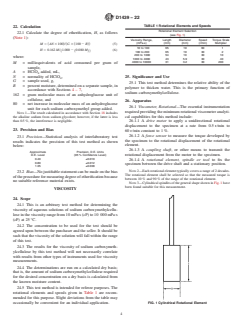
FIG. 1 Cylindrical Rotational Element
26.1.7.1 Data analysis capability to provide viscosity, stress or other useful parameters derived form measured signals.
26.1.7.2 A level to indicate the vertical plumb of the drive motor, shaft, and rotational element.
26.2 Container—Glass jar, approximately 64-mm64 mm (2 ⁄2-in.) in.) in diameter and 152 mm (6 in.) deep, unconstricted at the
top, capacity 340 g (12 oz).
26.3 Analytical Balance.
26.4 Mechanical Stirrer—Stirrer constructed of stainless steel (Fig. 2) attached to a variable speed motor capable of operating at
900900 r ⁄min 6 100 r/min under varying load conditions.
26.5 Water Bath, constant-temperature, set at 25 °C and capable of maintaining that temperature within 60.2 °C.
26.6 Temperature Measurement Device to provide an indication of specimen temperature over the range from 1919 °C to 27 °C
to within 60.1 °C.
27. Procedure
27.1 Determine moisture in accordance with Sections 4 – 9.
27.2 Calculate the dry-basis sample mass, M, in grams necessary to make 240 g of test solution as follows:
M 5 100A/ 100 2 B (7)
~ !
where:
A = desired dry mass of sample, g, and
B = moisture in the sample as received, %.
27.3 Calculate the quantity of distilled water required as follows:
D1439 − 22
FIG. 2 Stirrer
V 5 240 2 S (8)
where:
V = volume of distilled water, mL, and
S = mass of sample, g.
27.4 Add the calculated quantity of water to the jar. Position the stirrer in the jar allowing minimum clearance between the stirrer
and the bottom of the container.
27.5 Begin stirring and slowly add the sodium carboxymethylcellulose specimen. Adjust the stirring speed to approximately
900900 r ⁄min 6 100 r/min and mix for 120120 min 6 3 min.
NOTE 4—Do not allow the stirring speed to exceed 1200 r/min since higher speeds tend to affect viscosity on certain grades o
...