

ASTM F88/F88M-23
(Test Method)Standard Test Method for Seal Strength of Flexible Barrier Materials
General Information
- Abstract
SIGNIFICANCE AND USE
4.1 Seal strength is a quantitative measure for use in process validation, capability, and control. Seal strength is not only relevant to opening force and package integrity, but to measuring the packaging processes’ ability to produce consistent seals. Seal strength at some minimum level is a necessary package requirement, and at times it is also desirable to have an upper limit to the strength of the seal to facilitate opening.
Note 1: Seal strength values are a measurement of the output of the seal separation and may also involve mechanical properties of the materials that form the seal, given the potential for deformation or elongation over the course of the test. This separation is indicative of the area of the package being sampled and does not take into account simulation of a user interfacing with an entire package during the opening process.
Note 2: Lower seal strength specifications are typically utilized to provide assurance of package closure, which can contribute to seal integrity.
Note 3: Upper seal strength specifications are typically utilized to limit the amount of force required to open a package, ensuring that a user is able to open the design. Upper seal strength specifications are typically limited to seals that are intended to be peeled by the end user.
4.1.1 The maximum seal force is important information, but for some applications, average force to separate the seal may be useful, and in those cases also should be reported.
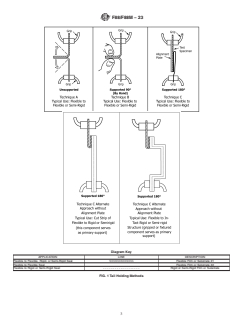
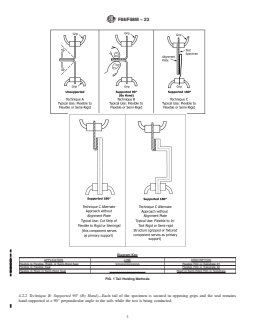
4.2 A portion of the force measured when testing materials may be a bending component and not seal strength alone. A number of fixtures and techniques have been devised to hold samples at various angles to the pull direction to control this bending force. Because the effect of each of these on test results is varied, consistent use of one technique (Technique A, Technique B, or Technique C) throughout a test series is recommended. Examples of techniques are illustrated in Fig. 1.
4.2.1 Technique A: Unsuppor...
SCOPE
1.1 This test method covers the measurement of the strength of seals in flexible barrier materials.
1.2 The test may be conducted on seals between a flexible material and another flexible material, a rigid material, or a semi-rigid material.
1.3 Seals tested in accordance with this test method may be from any source, laboratory or commercial.
1.4 This test method measures the force required to separate a test strip of material containing the seal. It also identifies the mode of specimen failure.
1.5 This test method differs from Test Method F2824. Test Method F2824 measures mechanical seal strength while separating an entire lid (cover/membrane) from a rigid or semi-rigid round container.
1.6 The values stated in either SI units or inch-pound units are to be regarded separately as standard. The values stated in each system may not be exact equivalents; therefore, each system shall be used independently of the other. Combining values from the two systems may result in non-conformance with the standard.
1.7 This standard does not purport to address all of the safety concerns, if any, associated with its use. It is the responsibility of the user of this standard to establish appropriate safety, health, and environmental practices and determine the applicability of regulatory limitations prior to use.
1.8 This international standard was developed in accordance with internationally recognized principles on standardization established in the Decision on Principles for the Development of International Standards, Guides and Recommendations issued by the World Trade Organization Technical Barriers to Trade (TBT) Committee.
- Status
- Published
- Publication Date
- 30-Apr-2023
- Technical Committee
- F02 - Primary Barrier Packaging
- Drafting Committee
- F02.20 - Physical Properties
Overview
ASTM F88/F88M-23, titled "Standard Test Method for Seal Strength of Flexible Barrier Materials," is an internationally recognized specification developed by ASTM International. It provides standardized procedures for determining the seal strength of flexible barrier materials used in packaging by measuring the force required to separate a sealed section of these materials. This test method evaluates seals between various combinations such as flexible-to-flexible, flexible-to-rigid, and flexible-to-semi-rigid materials. It plays an important role in process validation, quality control, and the integrity of packaging-ensuring consistent and reliable seal performance across materials and manufacturing processes.
Key Topics
Seal Strength Measurement
- Quantifies the force required to separate sealed materials.
- Determines both maximum seal force and (where relevant) average force to separate the seal.
Types of Seals Tested
- Flexible-to-flexible
- Flexible-to-rigid
- Flexible-to-semi-rigid
Test Methods and Techniques
- Test specimens are prepared and mounted in a tensile testing machine.
- Various sample-holding techniques are standardized, including unsupported, supported at 90°, and supported at 180°.
- Results can be influenced by factors such as sample angle, grip method, and material properties.
Interferences and Considerations
- The test can be affected by stretching, tearing, or delamination of the specimen.
- Material properties, seal location, and the method of sample preparation may impact results.
- The method recommends consistent use of one testing technique in a test series to ensure comparability.
Precision and Reporting
- Repeatability and reproducibility are established through round-robin studies.
- Test reports should include material identification, test conditions, equipment used, sample dimensions, grip details, failure modes, and statistical data such as mean and standard deviation.
Applications
ASTM F88/F88M-23 is widely utilized in industries that rely on sealed flexible barrier packaging, such as:
Medical Device Packaging
- Ensures package integrity and validated seals for sterility.
- Supports regulatory compliance in medical and pharmaceutical sectors.
Food Packaging
- Supports shelf-life validation by maintaining package closures, protecting against contamination and spoilage.
Consumer Goods Packaging
- Facilitates product safety and user experience by ensuring seals are neither too strong (difficult to open) nor too weak (prone to accidental opening).
Quality Assurance and Process Control
- Used for routine monitoring of packaging line performance.
- Assists in identifying sealing process inconsistencies and material flaws.
Research and Development
- Enables assessment of new materials, sealants, or packaging designs for compatibility and durability.
Related Standards
The following ASTM standards are closely related to or referenced in ASTM F88/F88M-23:
- ASTM D882: Test Method for Tensile Properties of Thin Plastic Sheeting
- ASTM D883: Terminology Relating to Plastics
- ASTM E171: Practice for Conditioning and Testing Flexible Barrier Packaging
- ASTM F904: Practice for Separation of Plies for Bond Strength of Laminated Flexible Materials
- ASTM F2824: Test Method for Mechanical Seal Strength Testing for Round Cups and Bowl Containers with Flexible Peelable Lids
- ASTM F3263: Guide for Packaging Test Method Validation
ASTM F88/F88M-23 remains a foundation for packaging engineers, quality control specialists, and manufacturers to ensure the integrity, safety, and usability of sealed flexible barrier packages. Its use supports compliance with international trade and safety requirements, contributing to consistent, reliable package performance across global markets.
Relations
- Effective Date
- 01-Feb-2024
- Effective Date
- 01-Nov-2023
- Effective Date
- 01-May-2020
- Effective Date
- 01-May-2020
- Effective Date
- 01-Jan-2020
- Effective Date
- 01-Aug-2019
- Effective Date
- 15-Apr-2019
- Effective Date
- 01-Feb-2019
- Effective Date
- 01-Dec-2018
- Effective Date
- 01-Nov-2018
- Effective Date
- 01-Oct-2018
- Effective Date
- 15-Aug-2018
- Effective Date
- 15-Dec-2017
- Effective Date
- 15-Aug-2017
- Effective Date
- 01-Jun-2017
Get Certified
Connect with accredited certification bodies for this standard

BRCGS (Brand Reputation Compliance Global Standards)
Global food safety and quality standards owner.
Sponsored listings
Frequently Asked Questions
ASTM F88/F88M-23 is a standard published by ASTM International. Its full title is "Standard Test Method for Seal Strength of Flexible Barrier Materials". This standard covers: SIGNIFICANCE AND USE 4.1 Seal strength is a quantitative measure for use in process validation, capability, and control. Seal strength is not only relevant to opening force and package integrity, but to measuring the packaging processes’ ability to produce consistent seals. Seal strength at some minimum level is a necessary package requirement, and at times it is also desirable to have an upper limit to the strength of the seal to facilitate opening. Note 1: Seal strength values are a measurement of the output of the seal separation and may also involve mechanical properties of the materials that form the seal, given the potential for deformation or elongation over the course of the test. This separation is indicative of the area of the package being sampled and does not take into account simulation of a user interfacing with an entire package during the opening process. Note 2: Lower seal strength specifications are typically utilized to provide assurance of package closure, which can contribute to seal integrity. Note 3: Upper seal strength specifications are typically utilized to limit the amount of force required to open a package, ensuring that a user is able to open the design. Upper seal strength specifications are typically limited to seals that are intended to be peeled by the end user. 4.1.1 The maximum seal force is important information, but for some applications, average force to separate the seal may be useful, and in those cases also should be reported. 4.2 A portion of the force measured when testing materials may be a bending component and not seal strength alone. A number of fixtures and techniques have been devised to hold samples at various angles to the pull direction to control this bending force. Because the effect of each of these on test results is varied, consistent use of one technique (Technique A, Technique B, or Technique C) throughout a test series is recommended. Examples of techniques are illustrated in Fig. 1. 4.2.1 Technique A: Unsuppor... SCOPE 1.1 This test method covers the measurement of the strength of seals in flexible barrier materials. 1.2 The test may be conducted on seals between a flexible material and another flexible material, a rigid material, or a semi-rigid material. 1.3 Seals tested in accordance with this test method may be from any source, laboratory or commercial. 1.4 This test method measures the force required to separate a test strip of material containing the seal. It also identifies the mode of specimen failure. 1.5 This test method differs from Test Method F2824. Test Method F2824 measures mechanical seal strength while separating an entire lid (cover/membrane) from a rigid or semi-rigid round container. 1.6 The values stated in either SI units or inch-pound units are to be regarded separately as standard. The values stated in each system may not be exact equivalents; therefore, each system shall be used independently of the other. Combining values from the two systems may result in non-conformance with the standard. 1.7 This standard does not purport to address all of the safety concerns, if any, associated with its use. It is the responsibility of the user of this standard to establish appropriate safety, health, and environmental practices and determine the applicability of regulatory limitations prior to use. 1.8 This international standard was developed in accordance with internationally recognized principles on standardization established in the Decision on Principles for the Development of International Standards, Guides and Recommendations issued by the World Trade Organization Technical Barriers to Trade (TBT) Committee.
SIGNIFICANCE AND USE 4.1 Seal strength is a quantitative measure for use in process validation, capability, and control. Seal strength is not only relevant to opening force and package integrity, but to measuring the packaging processes’ ability to produce consistent seals. Seal strength at some minimum level is a necessary package requirement, and at times it is also desirable to have an upper limit to the strength of the seal to facilitate opening. Note 1: Seal strength values are a measurement of the output of the seal separation and may also involve mechanical properties of the materials that form the seal, given the potential for deformation or elongation over the course of the test. This separation is indicative of the area of the package being sampled and does not take into account simulation of a user interfacing with an entire package during the opening process. Note 2: Lower seal strength specifications are typically utilized to provide assurance of package closure, which can contribute to seal integrity. Note 3: Upper seal strength specifications are typically utilized to limit the amount of force required to open a package, ensuring that a user is able to open the design. Upper seal strength specifications are typically limited to seals that are intended to be peeled by the end user. 4.1.1 The maximum seal force is important information, but for some applications, average force to separate the seal may be useful, and in those cases also should be reported. 4.2 A portion of the force measured when testing materials may be a bending component and not seal strength alone. A number of fixtures and techniques have been devised to hold samples at various angles to the pull direction to control this bending force. Because the effect of each of these on test results is varied, consistent use of one technique (Technique A, Technique B, or Technique C) throughout a test series is recommended. Examples of techniques are illustrated in Fig. 1. 4.2.1 Technique A: Unsuppor... SCOPE 1.1 This test method covers the measurement of the strength of seals in flexible barrier materials. 1.2 The test may be conducted on seals between a flexible material and another flexible material, a rigid material, or a semi-rigid material. 1.3 Seals tested in accordance with this test method may be from any source, laboratory or commercial. 1.4 This test method measures the force required to separate a test strip of material containing the seal. It also identifies the mode of specimen failure. 1.5 This test method differs from Test Method F2824. Test Method F2824 measures mechanical seal strength while separating an entire lid (cover/membrane) from a rigid or semi-rigid round container. 1.6 The values stated in either SI units or inch-pound units are to be regarded separately as standard. The values stated in each system may not be exact equivalents; therefore, each system shall be used independently of the other. Combining values from the two systems may result in non-conformance with the standard. 1.7 This standard does not purport to address all of the safety concerns, if any, associated with its use. It is the responsibility of the user of this standard to establish appropriate safety, health, and environmental practices and determine the applicability of regulatory limitations prior to use. 1.8 This international standard was developed in accordance with internationally recognized principles on standardization established in the Decision on Principles for the Development of International Standards, Guides and Recommendations issued by the World Trade Organization Technical Barriers to Trade (TBT) Committee.
ASTM F88/F88M-23 is classified under the following ICS (International Classification for Standards) categories: 55.040 - Packaging materials and accessories. The ICS classification helps identify the subject area and facilitates finding related standards.
ASTM F88/F88M-23 has the following relationships with other standards: It is inter standard links to ASTM D883-24, ASTM D883-23, ASTM F17-20, ASTM F2824-10(2020), ASTM D883-20, ASTM D883-19c, ASTM D883-19a, ASTM D883-19, ASTM D883-18a, ASTM D883-18, ASTM F17-18a, ASTM F17-18, ASTM F3263-17, ASTM D883-17, ASTM F17-17. Understanding these relationships helps ensure you are using the most current and applicable version of the standard.
ASTM F88/F88M-23 is available in PDF format for immediate download after purchase. The document can be added to your cart and obtained through the secure checkout process. Digital delivery ensures instant access to the complete standard document.
Standards Content (Sample)
This international standard was developed in accordance with internationally recognized principles on standardization established in the Decision on Principles for the
Development of International Standards, Guides and Recommendations issued by the World Trade Organization Technical Barriers to Trade (TBT) Committee.
Designation: F88/F88M − 23
Standard Test Method for
Seal Strength of Flexible Barrier Materials
This standard is issued under the fixed designation F88/F88M; the number immediately following the designation indicates the year of
original adoption or, in the case of revision, the year of last revision. A number in parentheses indicates the year of last reapproval. A
superscript epsilon (´) indicates an editorial change since the last revision or reapproval.
1. Scope 2. Referenced Documents
2.1 ASTM Standards:
1.1 This test method covers the measurement of the strength
D882 Test Method for Tensile Properties of Thin Plastic
of seals in flexible barrier materials.
Sheeting
1.2 The test may be conducted on seals between a flexible
D883 Terminology Relating to Plastics
material and another flexible material, a rigid material, or a
E171 Practice for Conditioning and Testing Flexible Barrier
semi-rigid material.
Packaging
E177 Practice for Use of the Terms Precision and Bias in
1.3 Seals tested in accordance with this test method may be
ASTM Test Methods
from any source, laboratory or commercial.
E691 Practice for Conducting an Interlaboratory Study to
Determine the Precision of a Test Method
1.4 This test method measures the force required to separate
F17 Terminology Relating to Primary Barrier Packaging
a test strip of material containing the seal. It also identifies the
F2824 Test Method for Mechanical Seal Strength Testing for
mode of specimen failure.
Round Cups and Bowl Containers with Flexible Peelable
1.5 This test method differs from Test Method F2824. Test
Lids
Method F2824 measures mechanical seal strength while sepa-
F3263 Guide for Packaging Test Method Validation
rating an entire lid (cover/membrane) from a rigid or semi-rigid
3. Terminology
round container.
3.1 Definitions:
1.6 The values stated in either SI units or inch-pound units
3.1.1 average seal strength, n—average force per unit width
are to be regarded separately as standard. The values stated in
of seal required to fully separate a flexible material from a rigid
each system may not be exact equivalents; therefore, each
material, semi-rigid material, or another flexible material,
system shall be used independently of the other. Combining
under the conditions of the test.
values from the two systems may result in non-conformance
3.1.1.1 Discussion—The average force normally is calcu-
with the standard.
lated by the testing machine from the digitized plot of force
versus grip travel. The plot starts from zero force after slack
1.7 This standard does not purport to address all of the
has been removed from the test strip. The initial ramp-up from
safety concerns, if any, associated with its use. It is the
zero to the force level required to peel the seal is not indicative
responsibility of the user of this standard to establish appro-
of seal strength, and data from that part of the curve should not
priate safety, health, and environmental practices and deter-
be included in the calculation of average strength, nor should
mine the applicability of regulatory limitations prior to use.
the return to zero following complete failure of the specimen.
1.8 This international standard was developed in accor-
The amount of data actually discarded on each end of the
dance with internationally recognized principles on standard-
measured seal-profile curve must be the same for all tests
ization established in the Decision on Principles for the
within any set of comparisons of average seal strength (see
Development of International Standards, Guides and Recom-
6.1.1 and 9.9.1).
mendations issued by the World Trade Organization Technical
3.1.2 maximum seal strength, n—maximum force per unit
Barriers to Trade (TBT) Committee.
width of seal required to fully separate a flexible material from
a rigid or semi-rigid material, or another flexible material,
under the conditions of the test.
This test method is under the jurisdiction of ASTM Committee F02 on Primary
Barrier Packaging and is the direct responsibility of Subcommittee F02.20 on
Physical Properties. For referenced ASTM standards, visit the ASTM website, www.astm.org, or
Current edition approved May 1, 2023. Published August 2023. Originally contact ASTM Customer Service at service@astm.org. For Annual Book of ASTM
approved in 1968. Last previous edition approved in 2021 as F88/F88M – 21. DOI: Standards volume information, refer to the standard’s Document Summary page on
10.1520/F0088_F0088M-23. the ASTM website.
Copyright © ASTM International, 100 Barr Harbor Drive, PO Box C700, West Conshohocken, PA 19428-2959. United States
F88/F88M − 23
flipping of the tail throughout the course of the test; this has potential to
3.1.3 flange, n—any geometric feature of a rigid or semi-
impact the measured strength and should be reported with results.
rigid component, which provides a counterpart surface to
NOTE 6—Test method validation should account for use of fixtures or
which a flexible component can form a seal.
alignment plates, as well as determination of which material is placed into
3.1.4 interferences, n—conditions that may lead to increased which grip as these factors are known to impact results, and feasibility of
each approach may vary depending on design features. Examples of
variation or challenges in obtaining consistent measurement of
optional fixtures and equipment with built in fixturing are included in
test samples.
Appendix X4 for reference. Refer to Guide F3263 for guidance on test
method validation.
4. Significance and Use
4.1 Seal strength is a quantitative measure for use in process
5. Interferences
validation, capability, and control. Seal strength is not only
5.1 The value obtained for seal strength can be affected by
relevant to opening force and package integrity, but to mea-
properties of the specimen other than seal strength. Some
suring the packaging processes’ ability to produce consistent
flexible barrier materials have properties, such as shape and
seals. Seal strength at some minimum level is a necessary
dimension, that may vary or change and need to be taken into
package requirement, and at times it is also desirable to have an
consideration when testing for seal strength. Examples include
upper limit to the strength of the seal to facilitate opening.
materials that may stretch (elongation), flexing around the
NOTE 1—Seal strength values are a measurement of the output of the
perimeter of a seal flange, or the shape/design of the rigid or
seal separation and may also involve mechanical properties of the
semi-rigid material flanges (for example, in a tray), or variation
materials that form the seal, given the potential for deformation or
in material properties such as caliper. These interferences are
elongation over the course of the test. This separation is indicative of the
area of the package being sampled and does not take into account discussed in Annex A1.
simulation of a user interfacing with an entire package during the opening
process.
6. Apparatus
NOTE 2—Lower seal strength specifications are typically utilized to
provide assurance of package closure, which can contribute to seal
6.1 Tensile Testing Machine—A testing machine of the
integrity.
constant rate-of-jaw-separation type. The machine shall be
NOTE 3—Upper seal strength specifications are typically utilized to
equipped with a device for recording the tensile load and the
limit the amount of force required to open a package, ensuring that a user
amount of separation of the grips; both of these measuring
is able to open the design. Upper seal strength specifications are typically
limited to seals that are intended to be peeled by the end user.
systems shall be accurate to 62 %. The rate of separation of
the jaws shall be uniform and capable of adjustment from
4.1.1 The maximum seal force is important information, but
approximately 8 in. to 12 in. [200 mm to 300 mm] ⁄min. The
for some applications, average force to separate the seal may
gripping system shall be capable of minimizing specimen
be useful, and in those cases also should be reported.
slippage and applying an even stress distribution to the
4.2 A portion of the force measured when testing materials
specimen.
may be a bending component and not seal strength alone. A
number of fixtures and techniques have been devised to hold NOTE 7—If the tensile testing machine utilizes a spring and hook-based
apparatus to extend the sample, it is expected to impart more variation in
samples at various angles to the pull direction to control this
results as it travels, as compared to modern equipment. When utilizing
bending force. Because the effect of each of these on test
spring and hook-based apparatus, it is recommended to take this factor
results is varied, consistent use of one technique (Technique A,
into consideration and limit the variation imparted by the weighing system
Technique B, or Technique C) throughout a test series is
movement to a maximum distance of 2 % of the specimen extension
recommended. Examples of techniques are illustrated in Fig. 1. within the range being measured.
NOTE 8—Impact of jaw-separation rate is discussed in Appendix X3.
4.2.1 Technique A: Unsupported—Each tail of the specimen
is secured in opposing grips and the seal remains unsupported
6.1.1 If calculation of average seal strength is required, the
while the test is being conducted.
testing machine system shall have the capability to calculate its
4.2.2 Technique B: Supported 90° (By Hand)—Each tail of
value over a specified range of grip travel programmable by the
the specimen is secured in opposing grips and the seal remains
operator. Preferably, the machine shall have the capability also
hand-supported at a 90° perpendicular angle to the tails while
to plot the curve of force versus grip travel.
the test is being conducted.
6.2 Specimen Cutter, conforming to the requirements of 6.5
NOTE 4—Excessive lateral forces applied via hand may impact results.
of Test Method D882, sized to cut specimens to a width of
Actual gripping of samples is not intended and will influence results;
0.984 in. [25 mm], 0.591 in. [15 mm], or 1.00 in. [25.4 mm].
contact is intended to be loose, only preventing tail movement up or down.
4.2.3 Technique C: Supported 180°—For flexible to flexible NOTE 9—Alternate specimen cutting methods and tools may be utilized
if deemed appropriate for the application.
applications, the least flexible tail is typically supported flat
NOTE 10—Any deviation from sample tolerance or width shall be
against a rigid alignment plate held in one grip. The more
supported through documented rationale and/or supportive data. Recom-
flexible tail is typically folded 180° over the seal and is held in
mended tolerance for sample cutting tool is 60.5 %. Sample cutting
the opposing grip while the test is being conducted.
method and associated variation that may support to establish alternate
Alternatively, in rigid and semi-rigid applications, the package tolerances may be assessed in validation of the test method; refer to Guide
F3263 for test method validation guidance.
structure may be maintained for the least flexible side; with this
NOTE 11—Seal strength is proportional to sample width under the same
structure gripped or fixtured.
test conditions. Impact of variation in sample width is discussed in
NOTE 5—Properties of some flexible materials may cause movement or Appendix X3.
F88/F88M − 23
Diagram Key
APPLICATION LINE DESCRIPTION
Flexible to Flexible, Rigid, or Semi-Rigid Seal \\\\\\\\\\\\\\\\\\\\\\\\\\\\\\ Flexible Film or Substrate #1
Flexible to Flexible Seal Flexible Film or Substrate #2
Flexible to Rigid or Semi-Rigid Seal - - - - - - - - - - - - - - - - - - - Rigid or Semi-Rigid Film or Substrate
FIG. 1 Tail Holding Methods
F88/F88M − 23
7. Sampling 9. Procedure
7.1 The number of test specimens shall be chosen to permit 9.1 Calibrate the tensile machine in accordance with the
an adequate determination of representative performance. manufacturer’s recommendations.
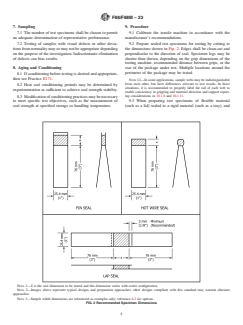
7.2 Testing of samples with visual defects or other devia- 9.2 Prepare sealed test specimens for testing by cutting to
tions from normality may or may not be appropriate depending the dimensions shown in Fig. 2. Edges shall be clean-cut and
on the purpose of the investigation. Indiscriminate elimination perpendicular to the direction of seal. Specimen legs may be
of defects can bias results. shorter than shown, depending on the grip dimensions of the
testing machine, recommended distance between grips, or the
8. Aging and Conditioning
size of the package under test. Multiple locations around the
perimeter of the package may be tested.
8.1 If conditioning before testing is desired and appropriate,
then see Practice E171.
NOTE 12—In some applications, sample webs may be indistinguishable
from each other, but have differences relevant to test results. In these
8.2 Heat seal conditioning periods may be determined by
situations, it is recommended to properly label the tail of each web to
experimentation as sufficient to achieve seal strength stability.
enable consistency in gripping and material direction and support report-
ing considerations in 10.1.8 and 10.1.11.
8.3 Modification of conditioning practices may be necessary
to meet specific test objectives, such as the measurement of 9.3 When preparing test specimens of flexible material
seal strength at specified storage or handling temperature.
(such as a lid) sealed to a rigid material (such as a tray), and
NOTE 1—X is the seal dimension to be tested and this dimension varies with sealer configuration.
NOTE 2—Images above represent typical designs and preparation approaches; other designs compliant with this standard may warrant alternate
approaches.
NOTE 3—Sample width dimensions are referenced as examples only; reference 6.2 for options.
FIG. 2 Recommended Specimen Dimensions
F88/F88M − 23
where the flange thickness and seal geometry allow, cutting test report should indicate the details of any technique used to
through the flexible material (such as a lid), while leaving the control tail orientation.
rigid material intact is acceptable. Alternatively, cutting com-
9.7 The seal shall be tested at a rate of grip separation of
pletely through the flange is another acceptable approach, as
8 in. ⁄min to 12 in. ⁄min [200 mm ⁄min to 300 mm ⁄min].
long as all subsequent seal strength data for comparison is
NOTE 13—Impact of variation in grip separation rate is discussed in
prepared and tested in the same manner. Additionally, caution
Appendix X3.
is needed to avoid damage to the seal or injury to the operator.
9.8 For each cycle, report the maximum force encountered
See A2.2 for further discussion.
as the specimen is stressed to failure and identify the mode of
9.4 Clamp each leg of the test specimen in the tensile testing
specimen failure.
machine. The sealed area of the specimen shall be approxi-
mately equidistant between the grips. Recommended distance 9.9 If the test strip peels apart in the seal area, either by
between grips for specimens comprised of a flexible material adhesive failure, cohesive failure, or delamination, the average
sealed to a rigid material (such as a tray) is dependent on the peel force may be an important index of performance and
size and the design of the rigid material (tray); see Annex A1 should be measured by the testing machine as a part of the test
and Annex A2 for further discussion. Initial grip distance may cycle.
be limited by equipment capability and structure. Consistency
9.9.1 Follow the machine manufacturer’s instructions to
in initial grip distance is subject to reporting per 10.1.6.
select the desired algorithm for calculating average seal
Recommended distance between grips (initial unconstrained
strength. Fig. 3 illustrates the effect of an algorithm that uses
specimen length) for seals between flexible material is:
data only from the central 80 % of the curve to calculate the
average.
Fin and Hot-Wire Seals
A
Highly extensible materials 0.39 in. [10 mm]
9.9.2 If the test strip does not peel significantly in the seal
A
Less extensible materials 1.0 in. [25 mm]
B area and separation is largely by breaking, tearing, or elonga-
Lap Seals X + 10 mm
tion of the substrate material, as opposed to actual separation of
A
Grip separation distance is recommended to be limited for highly extensible the seal between two materials, average force to separate may
materials (100 + % elongation at seal failure) to minimize interferences (see
have little significance in describing seal performance and
annex).
should not be reported in such cases (see Annex A1.1).
B
Refer to Fig. 2, Note 1, for definition of X.
NOTE 14—If average force reporting is conducted for a given dataset,
Warning—Caution should be exercised to avoid injury to the
but not reported for specific samples within that dataset due to interfer-
operator of the machine, or damage to the machine itself based
ences as described above, the rationale shall also be noted with the
on grip travel and potential for contact with the operator, or corresponding interferences per 10.1.13.
collision of machinery apparatus, or related fixtures.
9.10 A plot of force versus grip travel may be useful as an
aid in interpretation of results. In those cases, the testing
9.5 Center the specimen laterally in the grips. Align the
specimen in the grips so the seal line is perpendicular to the machine should be programmed to generate the plot.
direction of pull, allowing sufficient slack so the seal is not
9.11 Other properties, such as energy to cause seal
stressed prior to initiation of the test.
separation, may be appropriate in cases where grip travel
9.6 The orientation of the fin-seal tail during the test can results only in peel. When other failure modes (elongation,
have a significant impact on the measured seal strength. The break, tear, delamination (when not a designed peel seal
FIG. 3 Calculation of Average Seal Strength
F88/F88M − 23
TABLE 2 Test Equipment
separation mode) or other) are present in addition to peel of the
seal, energy, and other functions must be interpreted with Load Cell
Manufacturer Models
caution. lb N
Dillon AFG-50N 11.2 50
10. Report
Instron 4464, 5500R, 5564, 1124, 112.4, 5 kN, 500,
5565, S5R1123, 22.5, 11.2, 2 100, 50, 9
10.1 Report the following:
4442, MN-44
10.1.1 Complete identification of material being tested. Lloyd Instruments 1300-36 22.4 100
MTS Sintech Renew 4204 25 111.2
10.1.2 Equipment and test method or practice used to form
Test Resources 2000ZR 25 111.2
seals, if known.
Thwing Albert EJA 11.2 50
10.1.3 Equipment used to test seals. Vinatoru Enterprises CCT, HST 11.2 50
10.1.4 Ambient conditions during tests; temperature and
humidity.
10.1.5 Grip separation rate.
10.1.15 Maximum force encountered as each specimen is
10.1.6 Initial grip separation distance.
stressed to failure, expressed preferably in Newtons/metre or
10.1.7 Seal width.
lbf/in. of original specimen width. Gmf/in. and lbf/in. are
10.1.8 Machine direction of material in relation to direction
commonly used.
of pull may be noted, if known and relevant to the test
10.1.16 Average Peel Force, if applicable (see 9.9)—If this
outcome.
measurement is reported, a statement of the method or algo-
10.1.9 Force (strength) values to three significant figures.
rithm used to calculate the average should be included.
10.1.10 Technique of holding the tail (Technique A, B, or C)
10.1.17 Plot of force versus grip travel, if deemed signifi-
and any special fixtures used to hold specimens.
cant in interpretation of results.
NOTE 15—Variations on Technique shall also be noted (including
10.1.18 Other data not compromised by interferences, if
support mechanisms for technique C).
such data are relevant to the specific test purpose.
NOTE 16—Locations for clamping or fixturing of samples shall also be
10.1.19 Any statistical calculation deemed appropriate
noted, if known and relevant to the test outcome.
(most commonly used are mean, range, and standard devia-
10.1.11 If the seal is made between two different materials,
tion).
record which material is clamped in each grip.
10.1.12 Number of specimens tested and method of sam-
11. Precision and Bias: Flexible to Flexible Applications
pling.
11.1 Precision—A round robin was conducted using Prac-
10.1.13 Any other pertinent information that may affect test
tice E691 as a guide, involving 18 laboratories measuring a
results such as interferences as described in Annex A1.
total of 1980 samples distributed over three different test
10.1.14 Visual determination of mode of specimen failure.
groups of six laboratories each. In order to maintain a focus on
Frequently more than one mode will occur in the course of
testing the method itself, laboratory samples were used to limit
failure of an individual strip. Record all modes observed. A
the amount of variation in the seals produced. Description of
suggested classification of modes is (see Fig. 4):
materials measured and methods used are listed in Table 1.
Adhesive failure of the seal; peel.
Seven different brands of tensile testing equipment were used
Cohesive failure of the material.
Break or tear of material in seal area or at seal edge.
to collect information. The model identifications and load cell
Delamination of surface layer(s) from substrate.
sizes are listed in Table 2. Statistical summaries of repeatability
Elongation of material.
(within a laboratory) and reproducibility (between laboratories)
Break or tear of material remote from seal.
are listed in Table 4 for SI units and Table 3 in units of pounds
per inch. Fig. 5 is graphical depictions of data.
TABLE 1 Materials and Techniques
11.2 Concept of “r” and “R” in Tables 4 and 3—If S and
Test Series “1”
r
(MAXIMUM Values)
S have been calculated from a large enough body of data, and
R
Heat Seal Coated 50# Basis Weight Paper sealed to Film (48 ga. PET/2
for test results that are averages from testing 10 to 30
mil LDPE)
Supported 90° @ 12 in./min specimens (see Note 17) for each test result, then the following
Unsupported @ 12 in./min
applies:
Unsupported @ 8 in./min
Test Series “2”
NOTE 17—Repeatability and reproducibility comparisons for smaller
(Both MAXIMUM Values and AVERAGE Peel Values were reported)
sample size (n = 10) can be found in Appendix X1 and Appendix X2 of
Uncoated 1073B Tyvek® sealed to Film (48 ga. PET/2 mil LDPE)
this test method.
Supported 90° @ 12 in./min
Unsupported @ 12 in./min
11.2.1 Repeatability “r” is the interval representing the
Supported 180° @ 12 in./min
critical difference between test results for the same material
Reverse direction of materials in grips @ 12 in./min
and method, obtained by the same operator using the same
Test Series “3”
(MAXIMUM Values)
equipment on the same day in the same laboratory. Test results
Coex HDPE 3 mil film with peelable sealant layer sealed face-to-face
Foil Composite 5 mil with same peelable sealant surface sealed
face-to-face
Supporting data have been filed at ASTM International Headquarters and may
Unsupported @ 12 in./min
Supported 180° @ 12 in./min be obtained by requesting Research Report RR:F02-1023. Contact ASTM Customer
Service at service@astm.org.
F88/F88M − 23
NOTE 1—Multiple failure modes/seal separation modes and interferences can occur on a single sample.
Color Key:
NOTE 2—Typical schematic representation of seal failure modes for seals between two webs.
FIG. 4 Test Strip Failure Modes
shall be deemed to be not equivalent if they differ by more than 11.4 Bias—There are no recognized standards by which to
the “r” value for that material or method. estimate the bias of this test method.
11.2.2 Reproducibility “R” is the interval representing the
critical difference between test results for the same material 12. Precision and Bias: Flexible to Rigid Applications
and method, obtained by different operators using the different
12.1 The precision of this test method for Flexible to Rigid
equipment in different laboratories, not necessarily on the same
applications is based on an interlaboratory study of Test
day. Test results shall be deemed to be not equivalent if they
Method F88/F88M, Test Method for Seal Strength of Flexible
differ by more than the “R” value for that material or method.
Barrier Materials, conducted in 2021. Six volunteer laborato-
11.3 Any judgment in accordance with 11.2.1 or 11.2.2 will ries were asked to test four different material configurations.
have approximately 95 % (0.95) probability of being correct. Every “test result” represents an individual determination, and
F88/F88M − 23
TABLE 3 r and R Summary (Inch-Pound Units)
NOTE 1—In accordance with Practice E691, enter the larger of the values obtained by the use of (equation for S ) and (equation for S ) as the final
r R
value of S to be used for precision statements.
R
Units: lb/in. s s r R Grand
r R
Avg
1 Supported 90° 0.0396 0.0473 0.1109 0.1324 0.957
1 Unsupported at 12 in./min 0.0929 0.1286 0.2601 0.3602 1.424
1 Unsupported at 8 in./min 0.1063 0.1488 0.2977 0.4166 1.417
A
2 PEAK 90° 0.2629 0.2539 0.7361 0.7361 0.923
2 AVG 90° 0.1600 0.1599 0.4480 0.4480 0.684
A
2 PEAK Unsupported 0.2683 0.2630 0.7513 0.7513 1.709
A
2 AVG Unsupported 0.2510 0.2492 0.7029 0.7029 1.453
2 PEAK 180° 0.2977 0.3292 0.8335 0.9218 3.239
2 AVG 180° 0.3070 0.3567 0.8596 0.9988 2.990
2 PEAK 180° Reverse 0.5536 0.5971 1.5501 1.6720 1.464
A
2 AVG 180° Reverse 0.2560 0.2451 0.7167 0.7167 0.936
3 3 mil Film Unsupported 0.0605 0.1059 0.1695 0.2966 1.695
3 3 mil Film 180° 0.1786 0.3003 0.5001 0.8408 3.463
3 5 mil Foil Unsupported 0.0382 0.0272 0.1069 0.2051 1.209
3 5 mil Foil 180° 0.3164 0.3476 0.8859 0.9731 4.569
A
Per Practice E691: “Enter the larger of the values obtained by the use of (equation for s ) and (equation for s ) as the final value of s to be used for precision statements.”
r R R
TABLE 4 r and R Summary (SI Units)
NOTE 1—In accordance with Practice E691, enter the larger of the values obtained by the use of (equation for S ) and (equation for S ) as the final
r R
value of S to be used for precision statements.
R
NOTE 2—The values stated were converted from inch-pound units.
Units: N/25.4 mm s s r R Grand
r R
Avg
1 Supported 90° 0.1761 0.2103 0.4932 0.5889 4.2569
1 Unsupported at 12 in./min 0.4132 0.5722 1.1568 1.6021 6.3343
1 Unsupported at 8 in./min 0.4729 0.6618 1.3242 1.8529 6.3031
A
2 PEAK 90° 1.1694 1.1293 3.2742 3.2742 4.1057
2 AVG 90° 0.7117 0.7112 1.9927 1.9927 3.0426
A
2 PEAK Unsupported 1.1936 1.1700 3.3421 3.3421 7.6020
A
2 AVG Unsupported 1.1167 1.1084 3.1267 3.1267 6.4633
2 PEAK 180° 1.3242 1.4643 3.7077 4.1002 14.4078
2 AVG 180° 1.3656 1.5868 3.8236 4.4431 13.3002
2 PEAK 180° Reverse 2.4625 2.6562 6.8950 7.4373 6.5122
A
2 AVG 180° Reverse 1.1386 1.0901 3.1880 3.1880 4.1635
3 3 mil Film Unsupported 0.2693 0.4712 0.7539 1.3194 7.5397
3 3 mil Film 180° 0.7945 1.3357 2.2245 3.7400 15.4042
3 5 mil Foil Unsupported 0.1699 0.3203 0.4757 0.8968 5.3779
3 5 mil Foil 180° 1.4074 1.5460 3.9406 4.3287 20.3239
A
Per Practice E691: “Enter the larger of the values obtained by the use of (equation for s ) and (equation for s ) as the final value of s to be used for precision statements.”
r R R
all participants were instructed to report 30 replicate test results 12.1.1.1 Repeatability limit can be interpreted as the maxi-
for each material. Practice E691 was followed for the design of mum difference between two results, obtained under repeat-
study and analysis of the data; the details are given in Research
ability conditions, that is accepted as plausible due to random
Report RR:F02-2001.
causes under normal and correct operation of the test method.
12.1.1 Repeatability Limit (r)—The difference between re-
12.1.1.2 Repeatability limits are listed in Table 5 and Table
petitive results obtained by the same operator in a given
6 below.
laboratory applying the same test method with the same
12.1.2 Reproducibility Limit (R)—The difference between
apparatus under constant operating conditions on identical test
two single and independent results obtained by different
material within short intervals of time would in the long run, in
operators applying the same test method in different laborato-
the normal and correct operation of the test method, exceed the
ries using different ap
...
This document is not an ASTM standard and is intended only to provide the user of an ASTM standard an indication of what changes have been made to the previous version. Because
it may not be technically possible to adequately depict all changes accurately, ASTM recommends that users consult prior editions as appropriate. In all cases only the current version
of the standard as published by ASTM is to be considered the official document.
Designation: F88/F88M − 21 F88/F88M − 23
Standard Test Method for
Seal Strength of Flexible Barrier Materials
This standard is issued under the fixed designation F88/F88M; the number immediately following the designation indicates the year of
original adoption or, in the case of revision, the year of last revision. A number in parentheses indicates the year of last reapproval. A
superscript epsilon (´) indicates an editorial change since the last revision or reapproval.
1. Scope
1.1 This test method covers the measurement of the strength of seals in flexible barrier materials.
1.2 The test may be conducted on seals between a flexible material and another flexible material, a rigid material, or a semi-rigid
material.
1.3 Seals tested in accordance with this test method may be from any source, laboratory or commercial.
1.4 This test method measures the force required to separate a test strip of material containing the seal. It also identifies the mode
of specimen failure.
1.5 This test method differs from Test Method F2824. Test Method F2824 measures mechanical seal strength while separating an
entire lid (cover/membrane) from a rigid or semi-rigid round container.
1.6 This test method differs from Test Method F904. Test Method F904 measures the bond strength or ply adhesion of laminates
made from flexible materials such as cellulose, paper, plastic film, and foil.
1.6 The values stated in either SI units or inch-pound units are to be regarded separately as standard. The values stated in each
system may not be exact equivalents; therefore, each system shall be used independently of the other. Combining values from the
two systems may result in non-conformance with the standard.
1.7 This standard does not purport to address all of the safety concerns, if any, associated with its use. It is the responsibility
of the user of this standard to establish appropriate safety, health, and environmental practices and determine the applicability of
regulatory limitations prior to use.
1.8 This international standard was developed in accordance with internationally recognized principles on standardization
established in the Decision on Principles for the Development of International Standards, Guides and Recommendations issued
by the World Trade Organization Technical Barriers to Trade (TBT) Committee.
2. Referenced Documents
2.1 ASTM Standards:
This test method is under the jurisdiction of ASTM Committee F02 on Primary Barrier Packaging and is the direct responsibility of Subcommittee F02.20 on Physical
Properties.
Current edition approved Nov. 15, 2021May 1, 2023. Published December 2021August 2023. Originally approved in 1968. Last previous edition approved in 20152021
as F88/F88M – 15.F88/F88M – 21. DOI: 10.1520/F0088_F0088M-21.10.1520/F0088_F0088M-23.
For referenced ASTM standards, visit the ASTM website, www.astm.org, or contact ASTM Customer Service at service@astm.org. For Annual Book of ASTM Standards
volume information, refer to the standard’s Document Summary page on the ASTM website.
Copyright © ASTM International, 100 Barr Harbor Drive, PO Box C700, West Conshohocken, PA 19428-2959. United States
F88/F88M − 23
D882 Test Method for Tensile Properties of Thin Plastic Sheeting
D883 Terminology Relating to Plastics
E171 Practice for Conditioning and Testing Flexible Barrier Packaging
E177 Practice for Use of the Terms Precision and Bias in ASTM Test Methods
E691 Practice for Conducting an Interlaboratory Study to Determine the Precision of a Test Method
F17 Terminology Relating to Primary Barrier Packaging
F904 Practice for Separation of Plies for Bond Strength of Laminated Flexible Materials
F2824 Test Method for Mechanical Seal Strength Testing for Round Cups and Bowl Containers with Flexible Peelable Lids
F3263 Guide for Packaging Test Method Validation
3. Terminology
3.1 Definitions:
3.1.1 average seal strength, n—average force per unit width of seal required to fully separate a flexible material from a rigid
material material, semi-rigid material, or another flexible material, under the conditions of the test.
3.1.1.1 Discussion—
The average force normally is calculated by the testing machine from the digitized plot of force versus grip travel. The plot starts
from zero force after slack has been removed from the test strip. The initial ramp-up from zero to the force level required to peel
the seal is not indicative of seal strength, and data from that part of the curve should not be included in the calculation of average
strength, nor should the return to zero following complete failure of the specimen. The amount of data actually discarded on each
end of the measured seal-profile curve must be the same for all tests within any set of comparisons of average seal strength (see
6.1.1 and 9.8.19.9.1).
3.1.2 maximum seal strength, n—maximum force per unit width of seal required to completelyfully separate a flexible material
from a rigid material or semi-rigid material, or another flexible material, under the conditions of the test.
3.1.3 flange, n—any geometric feature of a rigid or semi-rigid component, which provides a counterpart surface to which a flexible
component can form a seal.
3.1.4 interferences, n—conditions that may lead to increased variation or challenges in obtaining consistent measurement of test
samples.
4. Significance and Use
4.1 Seal strength is a quantitative measure for use in process validation, process control, and capability.capability, and control. Seal
strength is not only relevant to opening force and package integrity, but to measuring the packaging processes’ ability to produce
consistent seals. Seal strength at some minimum level is a necessary package requirement, and at times it is also desirable to limit
have an upper limit to the strength of the seal to facilitate opening.
NOTE 1—Seal strength values are a measurement of the output of the seal separation and may also involve mechanical properties of the materials that
form the seal, given the potential for deformation or elongation over the course of the test. This separation is indicative of the area of the package being
sampled and does not take into account simulation of a user interfacing with an entire package during the opening process.
NOTE 2—Lower seal strength specifications are typically utilized to provide assurance of package closure, which can contribute to seal integrity.
NOTE 3—Upper seal strength specifications are typically utilized to limit the amount of force required to open a package, ensuring that a user is able to
open the design. Upper seal strength specifications are typically limited to seals that are intended to be peeled by the end user.
4.1.1 The maximum seal force is important information, but for some applications, average force to openseparate the seal may
be useful, and in those cases also should be reported.
4.2 A portion of the force measured when testing materials may be a bending component and not seal strength alone. A number
of fixtures and techniques have been devised to hold samples at various angles to the pull direction to control this bending force.
Because the effect of each of these on test results is varied, consistent use of one technique (Technique A, Technique B, or
Technique C) throughout a test series is recommended. Examples of fixtures and techniques are illustrated in Fig. 1.
4.2.1 Technique A: Unsupported—Each tail of the specimen is secured in opposing grips and the seal remains unsupported while
the test is being conducted.
F88/F88M − 23
Diagram Key
APPLICATION LINE DESCRIPTION
Flexible to Flexible, Rigid, or Semi-Rigid Seal \\\\\\\\\\\\\\\\\\\\\\\\\\\\\\ Flexible Film or Substrate #1
Flexible to Flexible Seal Flexible Film or Substrate #2
Flexible to Rigid or Semi-Rigid Seal - - - - - - - - - - - - - - - - - - - Rigid or Semi-Rigid Film or Substrate
FIG. 1 Tail Holding Methods
4.2.2 Technique B: Supported 90° (By Hand)—Each tail of the specimen is secured in opposing grips and the seal remains
hand-supported at a 90° perpendicular angle to the tails while the test is being conducted.
F88/F88M − 23
NOTE 4—Excessive lateral forces applied via hand may impact results. Actual gripping of samples is not intended and will influence results; contact is
intended to be loose, only preventing tail movement up or down.
4.2.3 Technique C: Supported 180°—The For flexible to flexible applications, the least flexible tail is typically supported flat
against a rigid alignment plate held in one grip. The more flexible tail is typically folded 180° over the seal and is held in the
opposing grip while the test is being conducted. Alternatively, in rigid and semi-rigid applications, the package structure may be
maintained for the least flexible side; with this structure gripped or fixtured.
NOTE 5—Properties of some flexible materials may cause movement or flipping of the tail throughout the course of the test; this has potential to impact
the measured strength and should be reported with results.
NOTE 6—Test method validation should account for use of fixtures or alignment plates, as well as determination of which material is placed into which
grip as these factors are known to impact results, and feasibility of each approach may vary depending on design features. Examples of optional fixtures
and equipment with built in fixturing are included in Appendix X4 for reference. Refer to Guide F3263 for guidance on test method validation.
5. Interferences
5.1 The value obtained for seal strength can be affected by properties of the specimen other than seal strength. Some flexible
barrier materials have properties, such as shape and dimension, that may vary or change and need to be taken into consideration
when testing for seal strength. Examples include materials that may stretch (elongation), flexing around the perimeter of a seal
flange, or the shape/design of the rigid or semi-rigid material flanges (for example, in a tray), or variation in material properties
such as caliper. These interferences are discussed in Annex A1the annex.
6. Apparatus
6.1 Tensile Testing Machine—A testing machine of the constant rate-of-jaw-separation type. The machine shall be equipped with
a device for recording the tensile load and the amount of separation of the grips; both of these measuring systems shall be accurate
to 62 %. The rate of separation of the jaws shall be uniform and capable of adjustment from approximately 8 to 12 in. [200 to
3008 in. to 12 in. [200 mm to 300 mm] mm]/min. ⁄min. The gripping system shall be capable of minimizing specimen slippage
and applying an even stress distribution to the specimen.
NOTE 7—If the tensile testing machine utilizes a spring and hook-based apparatus to extend the sample, it is expected to impart more variation in results
as it travels, as compared to modern equipment. When utilizing spring and hook-based apparatus, it is recommended to take this factor into consideration
and limit the variation imparted by the weighing system movement to a maximum distance of 2 % of the specimen extension within the range being
measured.
NOTE 8—Impact of jaw-separation rate is discussed in Appendix X3.
6.1.1 If calculation of average seal strength is required, the testing machine system shall have the capability to calculate its value
over a specified range of grip travel programmable by the operator. Preferably, the machine shall have the capability also to plot
the curve of force versus grip travel.
6.2 Specimen Cutter, conforming to the requirements of 6.5 of Test Method D882, sized to cut specimens to a width of 0.984 in.
[25 mm], 0.591 in. [15 mm], or 1.00 in. [25.4 mm]. Tolerance shall be 60.5 %.
NOTE 9—Alternate specimen cutting methods and tools may be utilized if deemed appropriate for the application if still in compliance with
application.F88/F88M.
NOTE 10—Any deviation from sample tolerance or width shall be supported through documented rationale and/or supportive data. Recommended
tolerance for sample cutting tool is 60.5 %. Sample cutting method and associated variation that may support to establish alternate tolerances may be
assessed in validation of the test method; refer to Guide F3263 for test method validation guidance.
NOTE 11—Seal strength is proportional to sample width under the same test conditions. Impact of variation in sample width is discussed in Appendix X3.
7. Sampling
7.1 The number of test specimens shall be chosen to permit an adequate determination of representative performance.
7.2 Testing of samples with visual defects or other deviations from normality may or may not be appropriate depending on the
purpose of the investigation. Indiscriminate elimination of defects can bias results.
F88/F88M − 23
8. Aging and Conditioning
8.1 If conditioning before testing is desired and appropriate, then see Practice E171.
8.2 Heat seal conditioning periods may be determined by experimentation as sufficient to achieve seal strength stability.
8.3 Modification of conditioning practices may be necessary to meet specific test objectives, such as the measurement of seal
strength at specified storage or handling temperature.
9. Procedure
9.1 Calibrate the tensile machine in accordance with the manufacturer’s recommendations.
9.2 Prepare sealed test specimens for testing by cutting to the dimensions shown in Fig. 2. Edges shall be clean-cut and
perpendicular to the direction of seal. Specimen legs may be shorter than shown, depending on the grip dimensions of the testing
machine, recommended distance between grips, or the size of the package under test. Multiple locations around the perimeter of
the package may be tested.
NOTE 1—X is the seal dimension to be tested and this dimension varies with sealer configuration.
NOTE 2—Images above represent typical designs and preparation approaches; other designs compliant with this standard may warrant alternate
approaches.
NOTE 3—Sample width dimensions are referenced as examples only; reference 6.2 for options.
FIG. 2 Recommended Specimen Dimensions
F88/F88M − 23
NOTE 12—In some applications, sample webs may be indistinguishable from each other, but have differences relevant to test results. In these situations,
it is recommended to properly label the tail of each web to enable consistency in gripping and material direction and support reporting considerations
in 10.1.8 and 10.1.11.
9.3 When preparing test specimens of flexible material (such as a lid) sealed to a rigid material (such as a tray), and where the
flange thickness and seal geometry allow, cutting through the flexible material (such as a lid), while leaving the rigid material intact
is acceptable. Alternatively, cutting completely through the flange is another acceptable approach, as long as all subsequent seal
strength data for comparison is prepared and tested in the same manner. Additionally, caution is needed to avoid damage to the
seal or injury to the operator. See A2.2 for further discussion.
9.4 Clamp each leg of the test specimen in the tensile testing machine. The sealed area of the specimen shall be approximately
equidistant between the grips. Recommended distance between grips for specimens comprised of a flexible material sealed to a
rigid material (such as a tray) is dependent on the size and the design of the rigid material (tray); see Annex A1 and Annex A2
for further discussion. Initial grip distance may be limited by equipment capability and structure. Consistency in initial grip
distance is subject to reporting per 10.1.6. Recommended distance between grips (initial unconstrained specimen length) for seals
between flexible material is:
Fin and Hot-Wire Seals
A
Highly extensible materials 0.39 in. [10 mm]
A
Less extensible materials 1.0 in. [25 mm]
B
Lap Seals X + 10 mm
A
Grip separation distance is recommended to be limited for highly extensible materials (100 + % elongation at seal failure) to minimize interferences (see annex).
B
Refer to Fig. 2, Note 1Note 1, , for definition of X.
Warning—Caution should be exercised to avoid injury to the operator of the machine, or damage to the machine itself based on
grip travel and potential for contact with the operator, or collision of machinery apparatus, or related fixtures.
9.5 Center the specimen laterally in the grips. Align the specimen in the grips so the seal line is perpendicular to the direction of
pull, allowing sufficient slack so the seal is not stressed prior to initiation of the test.
9.6 The orientation of the fin-seal tail during the test can have a significant impact on the measured seal strength. The test report
should indicate the details of any technique used to control tail orientation.
9.7 The seal shall be tested at a rate of grip separation of 88 in. ⁄min to 1212 in. in./min⁄min [200 mm [200 to 300 ⁄min to
300 mm mm/min].⁄min].
NOTE 13—Impact of variation in grip separation rate is discussed in Appendix X3.
9.8 For each cycle, report the maximum force encountered as the specimen is stressed to failure and identify the mode of specimen
failure.
9.9 If the test strip peels apart in the seal area, either by adhesive failure, cohesive failure, or delamination, the average peel force
may be an important index of performance and should be measured by the testing machine as a part of the test cycle.
9.9.1 Follow the machine manufacturer’s instructions to select the desired algorithm for calculating average seal strength. Fig. 3
illustrates the effect of an algorithm that uses data only from the central 80 % of the curve to calculate the average.
9.9.2 If the test strip does not peel significantly in the seal area and failureseparation is largely by breaking, tearing, or elongation
of the substrate material, as opposed to actual separation of the seal between two materials, average force to failureseparate may
have little significance in describing seal performance and should not be reported in such cases (see Annex A1.1).
NOTE 14—If average force reporting is conducted for a given dataset, but not reported for specific samples within that dataset due to interferences as
described above, the rationale shall also be noted with the corresponding interferences per 10.1.13.
F88/F88M − 23
FIG. 3 Calculation of Average Seal Strength
9.10 A plot of force versus grip travel may be useful as an aid in interpretation of results. In those cases, the testing machine should
be programmed to generate the plot.
9.11 Other properties, such as energy to cause seal separation, may be appropriate in cases where grip travel results only in peel.
When other failure modes (elongation, break, tear, delamination (when not a designed peel seal separation mode) or other) are
present in addition to peel of the seal, energy, and other functions must be interpreted with caution.
10. Report
10.1 Report the following:
10.1.1 Complete identification of material being tested.
TABLE 1 Materials and Techniques
Test Series “A”
(MAXIMUM Values)
Test Series “1”
(MAXIMUM Values)
Heat Seal Coated 50# Basis Weight Paper sealed to Film (48 ga. PET/2
mil LDPE)
Supported 90° @ 12 in./min
Unsupported @ 12 in./min
Unsupported @ 8 in./min
Test Series “B”
(Both MAXIMUM Values and AVERAGE Peel Values were reported)
Test Series “2”
(Both MAXIMUM Values and AVERAGE Peel Values were reported)
Uncoated 1073B Tyvek sealed to Film (48 ga. PET/2 mil LDPE)
Uncoated 1073B Tyvek® sealed to Film (48 ga. PET/2 mil LDPE)
Supported 90° @ 12 in./min
Unsupported @ 12 in./min
Supported 180° @ 12 in./min
Reverse direction of materials in grips @ 12 in./min
Test Series “C”
(MAXIMUM Values)
Test Series “3”
(MAXIMUM Values)
Coex HDPE 3 mil film with peelable sealant layer sealed face-to-face
Foil Composite 5 mil with same peelable sealant surface sealed
face-to-face
Unsupported @ 12 in./min
Supported 180° @ 12 in./min
F88/F88M − 23
TABLE 2 Test Equipment
Load Cell
Manufacturer Models
lb N
Dillon AFG-50N 11.2 50
Instron 4464, 5500R, 5564, 1124, 112.4, 5 kN, 500,
5565, S5R1123, 22.5, 11.2, 2 100, 50, 9
4442, MN-44
Lloyd Instruments 1300-36 22.4 100
MTS Sintech Renew 4204 25 111.2
Test Resources 2000ZR 25 111.2
Thwing Albert EJA 11.2 50
Vinatoru Enterprises CCT, HST 11.2 50
10.1.2 Equipment and test method or practice used to form seals, if known.
10.1.3 Equipment used to test seals.
10.1.4 Ambient conditions during tests; temperature and humidity.
10.1.5 Grip separation rate.
10.1.6 Initial grip separation distance.
10.1.7 Seal width.
10.1.8 Machine direction of material in relation to direction of pull may be noted, if known and relevant to the test outcome.
10.1.9 Force (strength) values to three significant figures.
10.1.10 Technique of holding the tail (Technique A, B, or C) and any special fixtures used to hold specimens.
NOTE 15—Variations on Technique shall also be noted.noted (including support mechanisms for technique C).
NOTE 16—Locations for clamping or fixturing of samples shall also be noted, if known and relevant to the test outcome.
10.1.11 If the seal is made between two different materials, record which material is clamped in each grip.
10.1.12 Number of specimens tested and method of sampling.
10.1.13 Any other pertinent information that may affect test results such as interferences as described in Annex A1.
10.1.14 Visual determination of mode of specimen failure. Frequently more than one mode will occur in the course of failure of
an individual strip. Record all modes observed. A suggested classification of modes is (see Fig. 4):
Adhesive failure of the seal; peel.
Cohesive failure of the material.
Break or tear of material in seal area or at seal edge.
Delamination of surface layer(s) from substrate.
Elongation of material.
Break or tear of material remote from seal.
10.1.15 Maximum force encountered as each specimen is stressed to failure, expressed preferably in Newtons/metre or lbf/in. of
original specimen width. Gmf/in. and lbf/in. are commonly used.
10.1.16 Average Peel Force, if applicable (see 9.89.9)—If this measurement is reported, a statement of the method or algorithm
used to calculate the average should be included.
10.1.17 Plot of force versus grip travel, if deemed significant in interpretation of results.
F88/F88M − 23
NOTE 1—Multiple failure modes/seal separation modes and interferences can occur on a single sample.
Color Key:
NOTE 2—Typical schematic representation of seal failure modes for seals between two webs.
FIG. 4 Test Strip Failure Modes
10.1.18 Other data not compromised by interferences, if such data are relevant to the specific test purpose.
10.1.19 Any statistical calculation deemed appropriate (most commonly used are mean, range, and standard deviation).
11. Precision and BiasBias: Flexible to Flexible Applications
11.1 Precision—A round robin was conducted using Practice E691 as a guide, involving 18 laboratories measuring a total of 1980
F88/F88M − 23
TABLE 3 r and R Summary (Inch-Pound Units)
NOTE 1—In accordance with Practice E691, enter the larger of the values obtained by the use of (equation for S ) and (equation for S ) as the final
r R
value of S to be used for precision statements.
R
Units: lb/in. s s r R Grand
r R
Avg
A Supported 90° 0.0396 0.0473 0.1109 0.1324 0.957
1 Supported 90° 0.0396 0.0473 0.1109 0.1324 0.957
A Unsupported at 12 in./min 0.0929 0.1286 0.2601 0.3602 1.424
1 Unsupported at 12 in./min 0.0929 0.1286 0.2601 0.3602 1.424
A Unsupported at 8 in./min 0.1063 0.1488 0.2977 0.4166 1.417
1 Unsupported at 8 in./min 0.1063 0.1488 0.2977 0.4166 1.417
A
B PEAK 90° 0.2629 0.2539 0.7361 0.7361 0.923
A
2 PEAK 90° 0.2629 0.2539 0.7361 0.7361 0.923
B AVG 90° 0.1600 0.1599 0.4480 0.4480 0.684
2 AVG 90° 0.1600 0.1599 0.4480 0.4480 0.684
A
B PEAK Unsupported 0.2683 0.2630 0.7513 0.7513 1.709
A
2 PEAK Unsupported 0.2683 0.2630 0.7513 0.7513 1.709
A
B AVG Unsupported 0.2510 0.2492 0.7029 0.7029 1.453
A
2 AVG Unsupported 0.2510 0.2492 0.7029 0.7029 1.453
B PEAK 180° 0.2977 0.3292 0.8335 0.9218 3.239
2 PEAK 180° 0.2977 0.3292 0.8335 0.9218 3.239
B AVG 180° 0.3070 0.3567 0.8596 0.9988 2.990
2 AVG 180° 0.3070 0.3567 0.8596 0.9988 2.990
B PEAK 180° Reverse 0.5536 0.5971 1.5501 1.6720 1.464
2 PEAK 180° Reverse 0.5536 0.5971 1.5501 1.6720 1.464
A
B AVG 180° Reverse 0.2560 0.2451 0.7167 0.7167 0.936
A
2 AVG 180° Reverse 0.2560 0.2451 0.7167 0.7167 0.936
C 3 mil Film Unsupported 0.0605 0.1059 0.1695 0.2966 1.695
3 3 mil Film Unsupported 0.0605 0.1059 0.1695 0.2966 1.695
C 3 mil Film 180° 0.1786 0.3003 0.5001 0.8408 3.463
3 3 mil Film 180° 0.1786 0.3003 0.5001 0.8408 3.463
C 5 mil Foil Unsupported 0.0382 0.0272 0.1069 0.2051 1.209
3 5 mil Foil Unsupported 0.0382 0.0272 0.1069 0.2051 1.209
C 5 mil Foil 180° 0.3164 0.3476 0.8859 0.9731 4.569
3 5 mil Foil 180° 0.3164 0.3476 0.8859 0.9731 4.569
A
Per Practice E691: “Enter the larger of the values obtained by the use of (equation for s ) and (equation for s ) as the final value of s to be used for precision statements.”
r R R
samples distributed over three different test groups of six laboratories each. In order to maintain a focus on testing the method
itself, laboratory samples were used to limit the amount of variation in the seals produced. Description of materials measured and
methods used are listed in Table 1. Seven different brands of tensile testing equipment were used to collect information. The model
identifications and load cell sizes are listed in Table 2. Statistical summaries of repeatability (within a laboratory) and
reproducibility (between laboratories) are listed in Table 4 for SI units and Table 3 in units of pounds per inch. Fig. 5 is graphical
depictions of data.
11.2 Concept of “r” and “R” in Tables 4 and 3—If S and S have been calculated from a large enough body of data, and for
r R
test results that are averages from testing 10 to 30 specimens (see Note 617) for each test result, then the following applies:
NOTE 17—Repeatability and reproducibility comparisons for smaller sample size (n = 10) can be found in Appendix X1 and Appendix X2 of this test
method.
11.2.1 Repeatability “r” is the interval representing the critical difference between test results for the same material and method,
obtained by the same operator using the same equipment on the same day in the same laboratory. Test results shall be deemed to
be not equivalent if they differ by more than the “r” value for that material or method.
11.2.2 Reproducibility “R” is the interval representing the critical difference between test results for the same material and method,
obtained by different operators using the different equipment in different laboratories, not necessarily on the same day. Test results
shall be deemed to be not equivalent if they differ by more than the “R” value for that material or method.
11.3 Any judgment in accordance with 11.2.1 or 11.2.2 will have approximately 95 % (0.95) probability of being correct.
Supporting data have been filed at ASTM International Headquarters and may be obtained by requesting Research Report RR:F02-1023. Contact ASTM Customer
Service at service@astm.org.
F88/F88M − 23
TABLE 4 r and R Summary (SI Units)
NOTE 1—In accordance with Practice E691, enter the larger of the values obtained by the use of (equation for S ) and (equation for S ) as the final
r R
value of S to be used for precision statements.
R
NOTE 2—The values stated were converted from inch-pound units.
Units: N/25.4 mm s s r R Grand
r R
Avg
A Supported 90° 0.1761 0.2103 0.4932 0.5889 4.2569
1 Supported 90° 0.1761 0.2103 0.4932 0.5889 4.2569
A Unsupported at 12 in./min 0.4132 0.5722 1.1568 1.6021 6.3343
1 Unsupported at 12 in./min 0.4132 0.5722 1.1568 1.6021 6.3343
A Unsupported at 8 in./min 0.4729 0.6618 1.3242 1.8529 6.3031
1 Unsupported at 8 in./min 0.4729 0.6618 1.3242 1.8529 6.3031
A
B PEAK 90° 1.1694 1.1293 3.2742 3.2742 4.1057
A
2 PEAK 90° 1.1694 1.1293 3.2742 3.2742 4.1057
B AVG 90° 0.7117 0.7112 1.9927 1.9927 3.0426
2 AVG 90° 0.7117 0.7112 1.9927 1.9927 3.0426
A
B PEAK Unsupported 1.1936 1.1700 3.3421 3.3421 7.6020
A
2 PEAK Unsupported 1.1936 1.1700 3.3421 3.3421 7.6020
A
B AVG Unsupported 1.1167 1.1084 3.1267 3.1267 6.4633
A
2 AVG Unsupported 1.1167 1.1084 3.1267 3.1267 6.4633
B PEAK 180° 1.3242 1.4643 3.7077 4.1002 14.4078
2 PEAK 180° 1.3242 1.4643 3.7077 4.1002 14.4078
B AVG 180° 1.3656 1.5868 3.8236 4.4431 13.3002
2 AVG 180° 1.3656 1.5868 3.8236 4.4431 13.3002
B PEAK 180° Reverse 2.4625 2.6562 6.8950 7.4373 6.5122
2 PEAK 180° Reverse 2.4625 2.6562 6.8950 7.4373 6.5122
A
B AVG 180° Reverse 1.1386 1.0901 3.1880 3.1880 4.1635
A
2 AVG 180° Reverse 1.1386 1.0901 3.1880 3.1880 4.1635
C 3 mil Film Unsupported 0.2693 0.4712 0.7539 1.3194 7.5397
3 3 mil Film Unsupported 0.2693 0.4712 0.7539 1.3194 7.5397
C 3 mil Film 180° 0.7945 1.3357 2.2245 3.7400 15.4042
3 3 mil Film 180° 0.7945 1.3357 2.2245 3.7400 15.4042
C 5 mil Foil Unsupported 0.1699 0.3203 0.4757 0.8968 5.3779
3 5 mil Foil Unsupported 0.1699 0.3203 0.4757 0.8968 5.3779
C 5 mil Foil 180° 1.4074 1.5460 3.9406 4.3287 20.3239
3 5 mil Foil 180° 1.4074 1.5460 3.9406 4.3287 20.3239
A
Per Practice E691: “Enter the larger of the values obtained by the use of (equation for s ) and (equation for s ) as the final value of s to be used for precision statements.”
r R R
FIG. 5 F88/F88M Round Robin r and R (at 95 % confidence) with Average Measured Values
11.4 Bias—There are no recognized standards by which to estimate the bias of this test method.
F88/F88M − 23
12. Precision and Bias: Flexible to Rigid Applications
12.1 The precision of this test method for Flexible to Rigid applications is based on an interlaboratory study of Test Method
F88/F88M, Test Method for Seal Strength of Flexible Barrier Materials, conducted in 2021. Six volunteer laboratories were asked
...