

ASTM F1115-16(2023)
(Test Method)Standard Test Method for Determining the Carbon Dioxide Loss of Beverage Containers
General Information
- Abstract
SIGNIFICANCE AND USE
5.1 Two procedures, A and B, are outlined in this test method. Procedure A is used most often for development of various beverage container designs to determine the functional characteristics of the package in regard to shelf life. Procedure B is recommended for use in beverage filling operations as a quality control tool in maintaining the desired CO2 fill pressure. A loss of CO2 will affect product taste.
5.1.1 Procedure A involves the use of sensitive pressure and temperature monitoring equipment where a high degree of accuracy is essential, for example, a micro-pressure transducer and thermocouple for measuring pressure and temperature of the package in a closed system. Alternatively, this procedure may also use bottles closed with roll-on aluminum caps containing rubber septums. The septum is pierced with a hypodermic needle attached to a pressure transducer to obtain pressure readings. This procedure should be confined to laboratories that are practiced in this type of analytical testing.
5.1.2 Procedure B is more widely used when measuring the carbonation level of the package due to the simplicity of the technique. A simple Manual pressure assembly or an Automated CO2 Analyzer is utilized.
SCOPE
1.1 The objective of this test method is to determine the carbon dioxide (CO2) loss from plastic beverage containers after a specified period of storage time.
1.2 Factors contributing to this pressure loss are volume expansion and the gas transport characteristics of the package, including permeation and leakage.
1.3 The values stated in SI units are to be regarded as standard. No other units of measurement are included in this standard.
1.4 This standard does not purport to address all of the safety concerns, if any, associated with its use. It is the responsibility of the user of this standard to establish appropriate safety, health, and environmental practices and determine the applicability of regulatory limitations prior to use.
1.5 This international standard was developed in accordance with internationally recognized principles on standardization established in the Decision on Principles for the Development of International Standards, Guides and Recommendations issued by the World Trade Organization Technical Barriers to Trade (TBT) Committee.
- Status
- Published
- Publication Date
- 30-Apr-2023
- Technical Committee
- F02 - Primary Barrier Packaging
- Drafting Committee
- F02.10 - Permeation
Overview
ASTM F1115-16(2023), Standard Test Method for Determining the Carbon Dioxide Loss of Beverage Containers, provides a recognized, standardized method for evaluating the carbon dioxide (CO₂) loss from plastic beverage containers over a designated storage period. This test method is essential in both packaging development and beverage filling operations, as it helps verify container performance regarding product shelf life and carbonation retention-a key factor for taste preservation in carbonated beverages.
Key Topics
Purpose and Scope
- Designed to quantify CO₂ loss in plastic beverage containers after storage.
- Evaluates factors such as volume expansion, gas permeation, and leakage affecting CO₂ retention.
Testing Procedures
- Procedure A: Laboratory-based, utilizes sensitive pressure and temperature monitoring instruments for high-accuracy measurements-ideal for container design and shelf-life studies.
- Procedure B: Simpler and more practical for production environments, uses manual or automated CO₂ analyzers for quality control during beverage filling operations.
Analytical Considerations
- Importance of conditioning containers to standard temperature and humidity before testing.
- Impact of bottle design, manufacturing variations, and environmental factors on measurement accuracy.
Measurement and Data Analysis
- Initial and periodic assessments of carbonation levels utilizing pressure and temperature readings.
- Calculation of carbonation loss and shelf-life predictions based on standard statistical analysis.
Applications
Packaging Design and Improvement
- Evaluate and compare the barrier performance of new plastic bottle designs or raw materials.
- Determine the expected shelf life of a package by monitoring carbonation retention over time.
- Identify and troubleshoot sources of CO₂ loss related to closures, seams, or materials.
Beverage Production Quality Control
- Monitor and maintain the desired CO₂ fill pressure to ensure product quality and consumer satisfaction.
- Implement routine checks in bottling lines using Procedure B to quickly identify out-of-spec containers that may affect shelf life or flavor.
- Aid in regulatory compliance by validating labeling claims for carbonation content.
Research and Development
- Support R&D projects aimed at developing improved container materials with reduced gas permeability.
- Perform comparative studies of different closure systems or manufacturing processes.
Related Standards
- ASTM D1129: Terminology Relating to Water-provides definitions for terms used in the industry and test methods.
- ASTM D1193: Specification for Reagent Water-outlines water quality criteria for carbonation and testing.
- International standards development-ASTM F1115-16(2023) follows principles established by the World Trade Organization Technical Barriers to Trade (TBT) Committee, promoting harmonization and global applicability.
Practical Value
Adhering to ASTM F1115-16(2023) assures stakeholders-manufacturers, bottlers, and consumers-of consistent measurement of CO₂ retention, helping optimize shelf life, ensure beverage quality, and maintain product integrity. The standard supports compliance with international trade and regulatory requirements, facilitating the distribution of carbonated beverages in global markets.
Keywords: ASTM F1115-16(2023), carbon dioxide loss, beverage containers, CO₂ retention, carbonation shelf life, PET bottle testing, beverage packaging standard, carbonation quality control, international standard, ASTM.
Relations
- Effective Date
- 01-May-2020
- Effective Date
- 01-Mar-2010
- Effective Date
- 01-Sep-2006
- Effective Date
- 01-Sep-2006
- Effective Date
- 01-Mar-2006
- Effective Date
- 15-Feb-2006
- Effective Date
- 01-Mar-2004
- Effective Date
- 01-Mar-2004
- Effective Date
- 10-Aug-2003
- Effective Date
- 10-Mar-2003
- Effective Date
- 10-Jul-2002
- Effective Date
- 10-Jul-2002
- Effective Date
- 10-Feb-2002
- Effective Date
- 10-Feb-2002
- Effective Date
- 10-Feb-1999
Get Certified
Connect with accredited certification bodies for this standard

BRCGS (Brand Reputation Compliance Global Standards)
Global food safety and quality standards owner.
Sponsored listings
Frequently Asked Questions
ASTM F1115-16(2023) is a standard published by ASTM International. Its full title is "Standard Test Method for Determining the Carbon Dioxide Loss of Beverage Containers". This standard covers: SIGNIFICANCE AND USE 5.1 Two procedures, A and B, are outlined in this test method. Procedure A is used most often for development of various beverage container designs to determine the functional characteristics of the package in regard to shelf life. Procedure B is recommended for use in beverage filling operations as a quality control tool in maintaining the desired CO2 fill pressure. A loss of CO2 will affect product taste. 5.1.1 Procedure A involves the use of sensitive pressure and temperature monitoring equipment where a high degree of accuracy is essential, for example, a micro-pressure transducer and thermocouple for measuring pressure and temperature of the package in a closed system. Alternatively, this procedure may also use bottles closed with roll-on aluminum caps containing rubber septums. The septum is pierced with a hypodermic needle attached to a pressure transducer to obtain pressure readings. This procedure should be confined to laboratories that are practiced in this type of analytical testing. 5.1.2 Procedure B is more widely used when measuring the carbonation level of the package due to the simplicity of the technique. A simple Manual pressure assembly or an Automated CO2 Analyzer is utilized. SCOPE 1.1 The objective of this test method is to determine the carbon dioxide (CO2) loss from plastic beverage containers after a specified period of storage time. 1.2 Factors contributing to this pressure loss are volume expansion and the gas transport characteristics of the package, including permeation and leakage. 1.3 The values stated in SI units are to be regarded as standard. No other units of measurement are included in this standard. 1.4 This standard does not purport to address all of the safety concerns, if any, associated with its use. It is the responsibility of the user of this standard to establish appropriate safety, health, and environmental practices and determine the applicability of regulatory limitations prior to use. 1.5 This international standard was developed in accordance with internationally recognized principles on standardization established in the Decision on Principles for the Development of International Standards, Guides and Recommendations issued by the World Trade Organization Technical Barriers to Trade (TBT) Committee.
SIGNIFICANCE AND USE 5.1 Two procedures, A and B, are outlined in this test method. Procedure A is used most often for development of various beverage container designs to determine the functional characteristics of the package in regard to shelf life. Procedure B is recommended for use in beverage filling operations as a quality control tool in maintaining the desired CO2 fill pressure. A loss of CO2 will affect product taste. 5.1.1 Procedure A involves the use of sensitive pressure and temperature monitoring equipment where a high degree of accuracy is essential, for example, a micro-pressure transducer and thermocouple for measuring pressure and temperature of the package in a closed system. Alternatively, this procedure may also use bottles closed with roll-on aluminum caps containing rubber septums. The septum is pierced with a hypodermic needle attached to a pressure transducer to obtain pressure readings. This procedure should be confined to laboratories that are practiced in this type of analytical testing. 5.1.2 Procedure B is more widely used when measuring the carbonation level of the package due to the simplicity of the technique. A simple Manual pressure assembly or an Automated CO2 Analyzer is utilized. SCOPE 1.1 The objective of this test method is to determine the carbon dioxide (CO2) loss from plastic beverage containers after a specified period of storage time. 1.2 Factors contributing to this pressure loss are volume expansion and the gas transport characteristics of the package, including permeation and leakage. 1.3 The values stated in SI units are to be regarded as standard. No other units of measurement are included in this standard. 1.4 This standard does not purport to address all of the safety concerns, if any, associated with its use. It is the responsibility of the user of this standard to establish appropriate safety, health, and environmental practices and determine the applicability of regulatory limitations prior to use. 1.5 This international standard was developed in accordance with internationally recognized principles on standardization established in the Decision on Principles for the Development of International Standards, Guides and Recommendations issued by the World Trade Organization Technical Barriers to Trade (TBT) Committee.
ASTM F1115-16(2023) is classified under the following ICS (International Classification for Standards) categories: 55.040 - Packaging materials and accessories. The ICS classification helps identify the subject area and facilitates finding related standards.
ASTM F1115-16(2023) has the following relationships with other standards: It is inter standard links to ASTM D1129-13(2020)e2, ASTM D1129-10, ASTM D1129-06a, ASTM D1129-06ae1, ASTM D1193-06, ASTM D1129-06, ASTM D1129-04e1, ASTM D1129-04, ASTM D1129-03a, ASTM D1129-03, ASTM D1129-02a, ASTM D1129-01, ASTM D1129-02, ASTM D1129-99a, ASTM D1193-99. Understanding these relationships helps ensure you are using the most current and applicable version of the standard.
ASTM F1115-16(2023) is available in PDF format for immediate download after purchase. The document can be added to your cart and obtained through the secure checkout process. Digital delivery ensures instant access to the complete standard document.
Standards Content (Sample)
This international standard was developed in accordance with internationally recognized principles on standardization established in the Decision on Principles for the
Development of International Standards, Guides and Recommendations issued by the World Trade Organization Technical Barriers to Trade (TBT) Committee.
Designation: F1115 − 16 (Reapproved 2023)
Standard Test Method for
Determining the Carbon Dioxide Loss of Beverage
Containers
This standard is issued under the fixed designation F1115; the number immediately following the designation indicates the year of
original adoption or, in the case of revision, the year of last revision. A number in parentheses indicates the year of last reapproval. A
superscript epsilon (´) indicates an editorial change since the last revision or reapproval.
1. Scope temperature and calculate volume of gas (Procedure B). There
are multiple manufacturers of these instruments.
1.1 The objective of this test method is to determine the
3.1.2 carbonation volume—the volume of CO (at 0 °C,
carbon dioxide (CO ) loss from plastic beverage containers
1 atm pressure) that is dissolved in the carbonated water,
after a specified period of storage time.
divided by the volume of the liquid (based on water volume at
1.2 Factors contributing to this pressure loss are volume
3.98 °C equals 1.000 g/cm ). The conversion of pressure to
expansion and the gas transport characteristics of the package,
carbonation volumes should be made using a carbonation
including permeation and leakage.
volumes table. A table for carbonated water would not neces-
1.3 The values stated in SI units are to be regarded as
sarily apply to liquids containing additional substances, such as
standard. No other units of measurement are included in this
carbonated beverages containing sugar.
standard.
3.1.3 finish—the threaded part of the bottle which receives
1.4 This standard does not purport to address all of the
the cap.
safety concerns, if any, associated with its use. It is the
3.1.4 initial pressure—the equilibrium pressure in the test
responsibility of the user of this standard to establish appro-
bottles as measured at 24 h after filling with carbonated water.
priate safety, health, and environmental practices and deter-
(The filled bottles are allowed to stand for 24 h to obtain
mine the applicability of regulatory limitations prior to use.
temperature equilibrium with the test environment and to allow
1.5 This international standard was developed in accor-
time for pressure adjustment and equilibration of the CO in
dance with internationally recognized principles on standard-
the headspace and liquid).
ization established in the Decision on Principles for the
3.1.5 manual pressure tester—a unit that manually pierces
Development of International Standards, Guides and Recom-
the closure and measures container pressure; an attached
mendations issued by the World Trade Organization Technical
thermometer is then used to measure temperature (Procedure
Barriers to Trade (TBT) Committee.
B).
3.1.6 pressure monitoring device—a pressure gauge or
2. Referenced Documents
transducer assembly with support electronics for indicating
2.1 ASTM Standards:
internal pressure level of the bottle. This device is used with
D1129 Terminology Relating to Water
brass closure fitting-equipped bottles.
D1193 Specification for Reagent Water
3.1.7 sample—a set of bottles produced on the same equip-
ment in a single run and using the same material and process
3. Terminology
conditions. Bottles should represent normal thickness distribu-
3.1 Definitions of Terms Specific to This Standard:
tion.
3.1.1 automated CO analyzer—an electronic unit that will
3.1.8 shelf life—the number of weeks a sample set of bottles
pierce the roll-on closure and automatically read pressure and
retain a specified carbonation level, or a percent of the initial
level.
3.1.9 support ring—a protrusion below the bottle finish
This test method is under the jurisdiction of ASTM Committee F02 on Primary
Barrier Packaging and is the direct responsibility of Subcommittee F02.10 on
which is used to support or stabilize the bottle during filling
Permeation.
and capping.
Current edition approved May 1, 2023. Published June 2023. Originally
3.1.10 temperature monitoring device—a thermocouple
approved in 1987. Last previous edition approved in 2016 as F1115 – 16. DOI:
10.1520/F1115-16R23.
with support electronics (same equipment as described in
For referenced ASTM standards, visit the ASTM website, www.astm.org, or
7.2.2). A precision glass thermometer may be used, provided a
contact ASTM Customer Service at service@astm.org. For Annual Book of ASTM
bottle filled with noncarbonated water is used as a control in
Standards volume information, refer to the standard’s Document Summary page on
the ASTM website. each sample set (Procedure A).
Copyright © ASTM International, 100 Barr Harbor Drive, PO Box C700, West Conshohocken, PA 19428-2959. United States
F1115 − 16 (2023)
3.2 For other terms used in this test method, refer to 7.1.3 Top Loading Balance, capable of weighing to 2500 g
Terminology D1129. with an accuracy of 60.01 g (optional).
7.1.4 Outside Diameter Measuring Device, π tape or similar
4. Summary of Test Method
device (optional).
4.1 Test bottles are filled with carbonated water or beverage
7.1.5 Carbonated Water or Beverage Dispensing Equip-
and, after closure application, are exposed to test environments
ment.
for specified time periods. By periodically measuring the initial
7.1.6 Micrometer or Ultrasonic Thickness Gauge, capable
and final carbonation levels in the container, the carbonation
of measuring to within 0.001 in. or less (optional).
loss and carbonation transfer rate can be calculated.
7.2 Procedure A:
5. Significance and Use 7.2.1 Machined Metal Cap (see Fig. 1).
7.2.2 Temperature-Measuring Device, capable of accurately
5.1 Two procedures, A and B, are outlined in this test
measuring temperature in increments of 0.1 °C or less in a
method. Procedure A is used most often for development of
range from 18 °C to 32 °C (65 °F to 100 °F).
various beverage container designs to determine the functional
7.2.3 Pressure-Monitoring Device.
characteristics of the package in regard to shelf life. Procedure
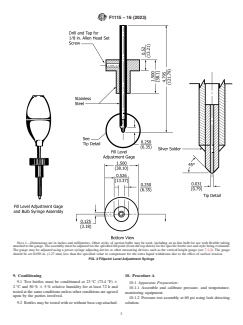
7.2.4 Fillpoint-Level Syringe Assembly (see Fig. 2).
B is recommended for use in beverage filling operations as a
quality control tool in maintaining the desired CO fill pres-
7.3 Procedure B:
sure. A loss of CO will affect product taste.
7.3.1 Pressure- and Temperature-Measuring Device.
5.1.1 Procedure A involves the use of sensitive pressure and
temperature monitoring equipment where a high degree of
8. Reagents and Materials
accuracy is essential, for example, a micro-pressure transducer
8.1 Water carbonated to a level sufficient to ensure a
and thermocouple for measuring pressure and temperature of
minimum carbonation level of 4.5 volumes in the filled bottles.
the package in a closed system. Alternatively, this procedure
Reagent water conforming to Type IV of Specification D1193
may also use bottles closed with roll-on aluminum caps
or better shall be used.
containing rubber septums. The septum is pierced with a
hypodermic needle attached to a pressure transducer to obtain 8.2 Carbon Dioxide, compressed (CO ).
pressure readings. This procedure should be confined to
8.3 Leak-Detecting Solution.
laboratories that are practiced in this type of analytical testing.
5.1.2 Procedure B is more widely used when measuring the
carbonation level of the package due to the simplicity of the
technique. A simple Manual pressure assembly or an Auto-
mated CO Analyzer is utilized.
6. Interferences
6.1 The following conditions can interfere with the test
results:
6.1.1 CO leakage at closure due to defective bottle finish or
improper sealing of closure apparatus,
6.1.2 CO leakage due to improper equipment set-up,
6.1.3 Change in ambient temperature, upsetting the equilib-
rium of the headspace and dissolved CO gas,
6.1.4 Measurement of pressure before the bottle and liquid
have reached ambient temperature,
6.1.5 Inaccurate thermocouple device used for measuring
the liquid temperature,
6.1.6 Excessive air in the bottle headspace or dissolved in
the liquid,
6.1.7 Inaccurate or erratic pressure monitoring device,
6.1.8 Ambient humidity in the test area,
6.1.9 Age of bottles, and
6.1.10 Excessive bottle-to-bottle variation in the material
distribution, which may result in a wide variation from bottle to
bottle within the sample population.
7. Apparatus
NOTE 1—Break sharp edges. All dimensions are inches unless other-
7.1 Procedures A and B:
wise stated. If conversion of dimension is desired, use standard equiva-
7.1.1 Bottle Stand, optional.
lence table.
7.1.2 Height Measuring Device, capable of measuring to
Material: Brass.
within 0.001 in. (optional). FIG. 1 Machined Metal Cap for PET Beverage Bottle Testing
F1115 − 16 (2023)
NOTE 1—Dimensions are in inches and millimetres. Other styles of suction bulbs may be used, including an in-line bulb for use with flexible tubing
attached to the gauge. The assembly must be adjusted for the specified fill point (from the top down) for the specific bottle size and style being evaluated.
The gauge may be adjusted using a preset syringe adjusting device or other measuring devices such as the vertical height gauge (see 7.1.2). The gauge
should be set 0.050 in. (1.27 mm) less than the specified value to compensate for the extra liquid withdrawn due to the effect of surface tension.
FIG. 2 Fillpoint Level Adjustment Syringe
9. Conditioning 10. Procedure A
9.1 Test bottles must be conditioned at 23 °C (73.4 °F) 6
10.1 Apparatus Preparation:
2 °C and 50 % 6 5 % relative humidity for at least 72 h and
10.1.1 Assemble and calibrate pressure- and temperature-
tested at the same conditions unless other conditions are agreed
monitoring equipment.
upon by the parties involved.
10.1.2 Pressure test assembly at 60 psi using leak detecting
9.2 Bottles may be tested with or without base cup attached. solution.
F1115 − 16 (2023)
10.1.3 Check calibration of monitoring equipment. 10.5.2 Twenty-four hours after filling, agitate each test
bottle to equilibrium pressure for at least 1 min to obtain the
10.2 Record weight and dimensions of empty and filled
initial values as outlined below:
bottles (optional).
10.5.2.1 Equilibrium pressure of each bottle,
10.2.1 Weigh each empty bottle to at least 0.01 g.
10.5.2.2 Temperature of each bottle or the control bottles,
10.2.2 Measure the outside diameter of each empty bottle
10.5.2.3 Carbonation level (from a carbonation volumes
using a π tape. Measure at the center of the label panel, or other
table),
previously agreed upon location(s).
10.5.2.4 Bottle height to the bottom of the support ring
10.2.3 Measure the height of each empty bottle to the
(optional), and
bottom of the support ring using a vertical height gauge or
10.5.2.5 Bottle outside diameter (optional).
similar equipment.
10.5.3 Repe
...