

ASTM F3300-23
(Test Method)Standard Test Method for Abrasion Resistance of Flexible Packaging Films Using a Reciprocating Weighted Stylus
General Information
- Abstract
SIGNIFICANCE AND USE
5.1 Materials such as engineered thermoplastic films are often used for flexible barrier packaging. However, handling and transportation can cause abrasion to the packaging film and possibly compromise the integrity of the contents (for example, sterility of a medical device). This test method provides a comparative ranking of material performance that can be used as an indication of relative end-use performance.
5.2 The resistance of material surfaces to abrasion, as measured on a testing machine under laboratory conditions, is only one of several factors contributing to wear performance or durability as experienced in the actual use of the material. While abrasion resistance and durability are frequently related, the relationship varies with different end uses and different factors may be necessary in any calculation of predicted durability from specific abrasion data.
5.3 The resistance of material surfaces to abrasion may be affected by factors including test conditions of temperature and humidity, type of abradant, pressure between the specimen and abradant, mounting or tension of the specimen, and type, kind, or amount of finishing materials such as coatings or additives. Other causes of variation include local material movement during testing, material direction alignment, material characteristics, and mandrel and stylus wear. For consistency, samples to be evaluated under special environmental conditions shall be conditioned under those same conditions. It is important that the test instrument be shown to operate properly under special environmental conditions.
5.4 This test method may not be suitable for all films, including the following cases:
5.4.1 Films that stretch and generate a ripple in the abraded region during testing,
5.4.2 Films that have a thickness greater than 0.25 mm (0.010 in.), or are of such rigidity that forming over the mandrel would cause internal stresses that weaken the film, and
5.4.3 Conductive films.
SCOPE
1.1 This test method covers the determination of the abrasion resistance of flexible non-conductive films and packaging materials using a weighted stylus that wears completely through a film by oscillating or reciprocating back and forth along a linear path until an electrical circuit is completed shutting down the test.
1.2 Units—The values stated in either SI units or inch-pound units are to be regarded separately as standard. The values stated in each system may not be exact equivalents; therefore, each system shall be used independently of the other. Combining values from the two systems may result in non-conformance with the standard.
1.3 This standard does not purport to address all of the safety concerns, if any, associated with its use. It is the responsibility of the user of this standard to establish appropriate safety, health, and environmental practices and determine the applicability of regulatory limitations prior to use.
1.4 This international standard was developed in accordance with internationally recognized principles on standardization established in the Decision on Principles for the Development of International Standards, Guides and Recommendations issued by the World Trade Organization Technical Barriers to Trade (TBT) Committee.
- Status
- Published
- Publication Date
- 30-Apr-2023
- Technical Committee
- F02 - Primary Barrier Packaging
- Drafting Committee
- F02.20 - Physical Properties
Buy Documents
ASTM F3300-23 - Standard Test Method for Abrasion Resistance of Flexible Packaging Films Using a Reciprocating Weighted Stylus
REDLINE ASTM F3300-23 - Standard Test Method for Abrasion Resistance of Flexible Packaging Films Using a Reciprocating Weighted Stylus
Overview
ASTM F3300-23 sets out the standard test method for measuring the abrasion resistance of flexible, non-conductive packaging films using a reciprocating weighted stylus. This method provides a comparative means of evaluating how different flexible packaging materials withstand abrasive wear, with the test simulating real-world handling and transportation conditions that could potentially compromise packaging integrity. Widely recognized in the packaging and materials industry, this method delivers quantitative and repeatable results, supporting both quality control and research applications related to the durability of thermoplastic and other flexible films.
Key Topics
- Abrasion Resistance of Flexible Films: The standard details procedures to determine how packaging films resist abrasion, a critical factor in maintaining product safety and barrier performance, especially for applications such as food or medical device packaging.
- Reciprocating Weighted Stylus Method: The test uses a hemispherical steel stylus, weighted and moved back-and-forth in a linear path until it wears through the film, providing an objective measure of cycles to breakthrough.
- Material Suitability: Not all films are suitable for this test. The method excludes:
- Films prone to stretching or rippling under test conditions,
- Thick or excessively rigid films (over 0.25 mm/0.010 in.),
- Conductive films which can interfere with the test’s electronic circuit.
- Influencing Factors: Results may be affected by:
- Test environment (temperature, humidity),
- Film mounting and tension,
- Surface treatments or coatings,
- Film orientation (machine/applicator directions),
- Stylus and mandrel wear.
- Comparative Performance Ranking: The outcome is a relative ranking of materials, guiding material selection and product development.
- Statistical Considerations: The test procedures emphasize replicability, statistical analysis, and clear reporting of results, including number of cycles, weights used, and environmental conditions.
Applications
- Flexible Packaging Quality Control: Ensures that materials meet specific durability and wear resistance benchmarks, supporting consistent product performance and customer satisfaction.
- Barrier Packaging Validation: Especially vital for packaging where integrity affects product sterility or shelf life, such as medical supplies or sensitive food products.
- Material Comparison and R&D: Offers a standardized approach for comparing new film formulations, design modifications, or manufacturing processes, accelerating product development and innovation.
- Supply Chain and Compliance: Provides data for compliance with internal, client, or regulatory durability requirements, supporting risk management in transportation and warehousing.
- Process Optimization: Used by film manufacturers and converters to optimize production parameters with a focus on abrasion resistance.
Related Standards
For comprehensive flexible packaging testing and material characterization, consider the following ASTM standards:
- ASTM D4332 - Practice for Conditioning Containers, Packages, or Packaging Components for Testing.
- ASTM D6988 - Guide for Determination of Thickness of Plastic Film Test Specimens.
- ASTM E171/E171M - Practice for Conditioning and Testing Flexible Barrier Packaging.
- ASTM E177 - Practice for Use of the Terms Precision and Bias in ASTM Test Methods.
- ASTM E691 - Practice for Conducting an Interlaboratory Study to Determine the Precision of a Test Method.
- ASTM F2251 - Test Method for Thickness Measurement of Flexible Packaging Material.
Conclusion
ASTM F3300-23 is a vital standard for ensuring the abrasion resistance of flexible packaging films, supporting product safety, and extending packaging shelf life. By following its test method, companies can ensure robust quality control, facilitate innovation in film development, and maintain compliance with industry and customer standards for packaging durability and performance.
Keywords: abrasion resistance, flexible packaging films, ASTM F3300-23, reciprocating stylus method, packaging durability, barrier packaging, packaging standards, wear resistance, packaging integrity.
Relations
- Refers
ASTM E171/E171M-11(2020) - Standard Practice for Conditioning and Testing Flexible Barrier Packaging - Effective Date
- 01-May-2020
- Refers
ASTM E171/E171M-11(2015) - Standard Practice for Conditioning and Testing Flexible Barrier Packaging - Effective Date
- 01-Oct-2015
- Effective Date
- 01-May-2014
- Effective Date
- 01-Aug-2013
- Effective Date
- 01-May-2013
- Effective Date
- 01-May-2013
- Effective Date
- 15-Mar-2013
- Refers
ASTM E171/E171M-11 - Standard Practice for Conditioning and Testing Flexible Barrier Packaging - Effective Date
- 15-Nov-2011
- Effective Date
- 01-Nov-2011
- Effective Date
- 01-Oct-2010
- Effective Date
- 01-Nov-2008
- Effective Date
- 01-Oct-2008
- Effective Date
- 01-Oct-2008
- Refers
ASTM F2251-03(2008) - Standard Test Method for Thickness Measurement of Flexible Packaging Material - Effective Date
- 01-Apr-2008
- Effective Date
- 01-Mar-2007
Buy Documents
ASTM F3300-23 - Standard Test Method for Abrasion Resistance of Flexible Packaging Films Using a Reciprocating Weighted Stylus
REDLINE ASTM F3300-23 - Standard Test Method for Abrasion Resistance of Flexible Packaging Films Using a Reciprocating Weighted Stylus
Get Certified
Connect with accredited certification bodies for this standard

BRCGS (Brand Reputation Compliance Global Standards)
Global food safety and quality standards owner.
Sponsored listings
Frequently Asked Questions
ASTM F3300-23 is a standard published by ASTM International. Its full title is "Standard Test Method for Abrasion Resistance of Flexible Packaging Films Using a Reciprocating Weighted Stylus". This standard covers: SIGNIFICANCE AND USE 5.1 Materials such as engineered thermoplastic films are often used for flexible barrier packaging. However, handling and transportation can cause abrasion to the packaging film and possibly compromise the integrity of the contents (for example, sterility of a medical device). This test method provides a comparative ranking of material performance that can be used as an indication of relative end-use performance. 5.2 The resistance of material surfaces to abrasion, as measured on a testing machine under laboratory conditions, is only one of several factors contributing to wear performance or durability as experienced in the actual use of the material. While abrasion resistance and durability are frequently related, the relationship varies with different end uses and different factors may be necessary in any calculation of predicted durability from specific abrasion data. 5.3 The resistance of material surfaces to abrasion may be affected by factors including test conditions of temperature and humidity, type of abradant, pressure between the specimen and abradant, mounting or tension of the specimen, and type, kind, or amount of finishing materials such as coatings or additives. Other causes of variation include local material movement during testing, material direction alignment, material characteristics, and mandrel and stylus wear. For consistency, samples to be evaluated under special environmental conditions shall be conditioned under those same conditions. It is important that the test instrument be shown to operate properly under special environmental conditions. 5.4 This test method may not be suitable for all films, including the following cases: 5.4.1 Films that stretch and generate a ripple in the abraded region during testing, 5.4.2 Films that have a thickness greater than 0.25 mm (0.010 in.), or are of such rigidity that forming over the mandrel would cause internal stresses that weaken the film, and 5.4.3 Conductive films. SCOPE 1.1 This test method covers the determination of the abrasion resistance of flexible non-conductive films and packaging materials using a weighted stylus that wears completely through a film by oscillating or reciprocating back and forth along a linear path until an electrical circuit is completed shutting down the test. 1.2 Units—The values stated in either SI units or inch-pound units are to be regarded separately as standard. The values stated in each system may not be exact equivalents; therefore, each system shall be used independently of the other. Combining values from the two systems may result in non-conformance with the standard. 1.3 This standard does not purport to address all of the safety concerns, if any, associated with its use. It is the responsibility of the user of this standard to establish appropriate safety, health, and environmental practices and determine the applicability of regulatory limitations prior to use. 1.4 This international standard was developed in accordance with internationally recognized principles on standardization established in the Decision on Principles for the Development of International Standards, Guides and Recommendations issued by the World Trade Organization Technical Barriers to Trade (TBT) Committee.
SIGNIFICANCE AND USE 5.1 Materials such as engineered thermoplastic films are often used for flexible barrier packaging. However, handling and transportation can cause abrasion to the packaging film and possibly compromise the integrity of the contents (for example, sterility of a medical device). This test method provides a comparative ranking of material performance that can be used as an indication of relative end-use performance. 5.2 The resistance of material surfaces to abrasion, as measured on a testing machine under laboratory conditions, is only one of several factors contributing to wear performance or durability as experienced in the actual use of the material. While abrasion resistance and durability are frequently related, the relationship varies with different end uses and different factors may be necessary in any calculation of predicted durability from specific abrasion data. 5.3 The resistance of material surfaces to abrasion may be affected by factors including test conditions of temperature and humidity, type of abradant, pressure between the specimen and abradant, mounting or tension of the specimen, and type, kind, or amount of finishing materials such as coatings or additives. Other causes of variation include local material movement during testing, material direction alignment, material characteristics, and mandrel and stylus wear. For consistency, samples to be evaluated under special environmental conditions shall be conditioned under those same conditions. It is important that the test instrument be shown to operate properly under special environmental conditions. 5.4 This test method may not be suitable for all films, including the following cases: 5.4.1 Films that stretch and generate a ripple in the abraded region during testing, 5.4.2 Films that have a thickness greater than 0.25 mm (0.010 in.), or are of such rigidity that forming over the mandrel would cause internal stresses that weaken the film, and 5.4.3 Conductive films. SCOPE 1.1 This test method covers the determination of the abrasion resistance of flexible non-conductive films and packaging materials using a weighted stylus that wears completely through a film by oscillating or reciprocating back and forth along a linear path until an electrical circuit is completed shutting down the test. 1.2 Units—The values stated in either SI units or inch-pound units are to be regarded separately as standard. The values stated in each system may not be exact equivalents; therefore, each system shall be used independently of the other. Combining values from the two systems may result in non-conformance with the standard. 1.3 This standard does not purport to address all of the safety concerns, if any, associated with its use. It is the responsibility of the user of this standard to establish appropriate safety, health, and environmental practices and determine the applicability of regulatory limitations prior to use. 1.4 This international standard was developed in accordance with internationally recognized principles on standardization established in the Decision on Principles for the Development of International Standards, Guides and Recommendations issued by the World Trade Organization Technical Barriers to Trade (TBT) Committee.
ASTM F3300-23 is classified under the following ICS (International Classification for Standards) categories: 55.040 - Packaging materials and accessories. The ICS classification helps identify the subject area and facilitates finding related standards.
ASTM F3300-23 has the following relationships with other standards: It is inter standard links to ASTM E171/E171M-11(2020), ASTM E171/E171M-11(2015), ASTM E177-14, ASTM F2251-13, ASTM E177-13, ASTM E691-13, ASTM D4332-13, ASTM E171/E171M-11, ASTM E691-11, ASTM E177-10, ASTM D6988-08, ASTM E691-08, ASTM E177-08, ASTM F2251-03(2008), ASTM D6988-07. Understanding these relationships helps ensure you are using the most current and applicable version of the standard.
ASTM F3300-23 is available in PDF format for immediate download after purchase. The document can be added to your cart and obtained through the secure checkout process. Digital delivery ensures instant access to the complete standard document.
Standards Content (Sample)
This international standard was developed in accordance with internationally recognized principles on standardization established in the Decision on Principles for the
Development of International Standards, Guides and Recommendations issued by the World Trade Organization Technical Barriers to Trade (TBT) Committee.
Designation: F3300 − 23
Standard Test Method for
Abrasion Resistance of Flexible Packaging Films Using a
Reciprocating Weighted Stylus
This standard is issued under the fixed designation F3300; the number immediately following the designation indicates the year of
original adoption or, in the case of revision, the year of last revision. A number in parentheses indicates the year of last reapproval. A
superscript epsilon (´) indicates an editorial change since the last revision or reapproval.
1. Scope E177 Practice for Use of the Terms Precision and Bias in
ASTM Test Methods
1.1 This test method covers the determination of the abra-
E691 Practice for Conducting an Interlaboratory Study to
sion resistance of flexible non-conductive films and packaging
Determine the Precision of a Test Method
materials using a weighted stylus that wears completely
F2251 Test Method for Thickness Measurement of Flexible
through a film by oscillating or reciprocating back and forth
Packaging Material
along a linear path until an electrical circuit is completed
shutting down the test.
3. Terminology
1.2 Units—The values stated in either SI units or inch-
3.1 Definitions:
pound units are to be regarded separately as standard. The
3.1.1 abrasion, n—the wearing away of any part of a
values stated in each system may not be exact equivalents;
material by rubbing against another surface.
therefore, each system shall be used independently of the other.
3.1.2 abrasion cycle, n—in abrasion testing, one or more
Combining values from the two systems may result in non-
movements of an abradant across a material surface, or the
conformance with the standard.
material surface across an abradant, that permits a return to its
1.3 This standard does not purport to address all of the
starting position.
safety concerns, if any, associated with its use. It is the
3.1.2.1 Discussion—In the case of the linear abrading
responsibility of the user of this standard to establish appro-
device, an abrasion cycle consists of one complete forward and
priate safety, health, and environmental practices and deter-
one complete backward stroke.
mine the applicability of regulatory limitations prior to use.
3.1.3 abrasion resistance, n—in abrasion testing, the ability
1.4 This international standard was developed in accor-
of a material to withstand wear caused by the rubbing of one
dance with internationally recognized principles on standard-
material against another.
ization established in the Decision on Principles for the
Development of International Standards, Guides and Recom-
3.1.4 durability, n—the ability of a material to withstand
mendations issued by the World Trade Organization Technical
deterioration from the sum of all sources.
Barriers to Trade (TBT) Committee.
3.1.5 non-conductive film, n—any film used in this test
method that allows the stylus to completely abrade through the
2. Referenced Documents
film, making a hole, and does not prematurely stop the test
2.1 ASTM Standards:
before the hole is made.
D4332 Practice for Conditioning Containers, Packages, or
Packaging Components for Testing 3.1.5.1 Discussion—The stylus (on one side of the film) and
D6988 Guide for Determination of Thickness of Plastic Film the mandrel (on the other side of the film) form part of an
Test Specimens electrical circuit that signals the end of the test. Wearing a hole
E171/E171M Practice for Conditioning and Testing Flexible through a non-conductive film closes the circuit and stops the
Barrier Packaging test. A conductive film would conduct electricity between the
stylus and the mandrel before the film completely abrades
This test method is under the jurisdiction of ASTM Committee F02 on Primary through and prematurely signal the end of the test.
Barrier Packaging and is the direct responsibility of Subcommittee F02.20 on
Physical Properties.
4. Summary of Test Method
Current edition approved May 1, 2023. Published June 2023. Originally
4.1 A specimen is abraded using a linear rubbing action. The
approved in 2018. Last previous edition approved in 2018 as F3300 – 18. DOI:
10.1520/F3300-23.
test specimen, mounted over a mandrel and held in place by
For referenced ASTM standards, visit the ASTM website, www.astm.org, or
two plates, is rubbed back and forth with the hemispherical tip
contact ASTM Customer Service at service@astm.org. For Annual Book of ASTM
of a special stylus. The hemispherical tip rubs the specimen
Standards volume information, refer to the standard’s Document Summary page on
the ASTM website. until it abrades through the film, contacts the mandrel below
Copyright © ASTM International, 100 Barr Harbor Drive, PO Box C700, West Conshohocken, PA 19428-2959. United States
F3300 − 23
the film, and the test is automatically stopped. Resistance to 5.4 This test method may not be suitable for all films,
abrasion in this test method is reported as the number of including the following cases:
back-and-forth cycles to breakthrough. Variables that influence 5.4.1 Films that stretch and generate a ripple in the abraded
the rubbing action are pressure on the specimen, temperature, region during testing,
relative humidity, and speed. 5.4.2 Films that have a thickness greater than 0.25 mm
(0.010 in.), or are of such rigidity that forming over the
5. Significance and Use
mandrel would cause internal stresses that weaken the film, and
5.1 Materials such as engineered thermoplastic films are 5.4.3 Conductive films.
often used for flexible barrier packaging. However, handling
6. Apparatus
and transportation can cause abrasion to the packaging film and
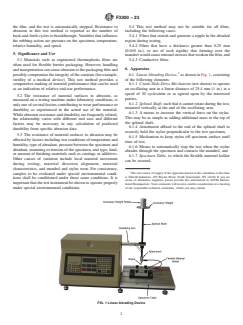
possibly compromise the integrity of the contents (for example, 6.1 Linear Abrading Device, as shown in Fig. 1, consisting
sterility of a medical device). This test method provides a
of the following elements:
comparative ranking of material performance that can be used 6.1.1 Crank-Slide Drive Mechanism (not shown) to operate
as an indication of relative end-use performance.
an oscillating arm in a linear distance of 25.4 mm (1 in.) at a
speed of 30 cycles/min or as agreed upon by the interested
5.2 The resistance of material surfaces to abrasion, as
parties,
measured on a testing machine under laboratory conditions, is
6.1.2 Splined Shaft, such that it cannot rotate during the test,
only one of several factors contributing to wear performance or
mounted vertically at the end of the oscillating arm,
durability as experienced in the actual use of the material.
6.1.3 A means to increase the vertical force on the stylus.
While abrasion resistance and durability are frequently related,
This may be as simple as adding additional mass to the top of
the relationship varies with different end uses and different
the splined shaft,
factors may be necessary in any calculation of predicted
6.1.4 Attachment affixed to the end of the splined shaft to
durability from specific abrasion data.
securely hold the stylus perpendicular to the test specimen,
5.3 The resistance of material surfaces to abrasion may be
6.1.5 Mechanism to keep stylus off specimen surface until
affected by factors including test conditions of temperature and
time of test,
humidity, type of abradant, pressure between the specimen and
6.1.6 Means to automatically stop the test when the stylus
abradant, mounting or tension of the specimen, and type, kind,
abrades through the specimen and contacts the mandrel, and
or amount of finishing materials such as coatings or additives.
6.1.7 Specimen Table, to which the flexible material holder
Other causes of variation include local material movement
can be secured.
during testing, material direction alignment, material
characteristics, and mandrel and stylus wear. For consistency,
The sole source of supply of the apparatus known to the committee at this time
samples to be evaluated under special environmental condi-
is Taber® Industries, 455 Bryant Street, North Tonawanda, NY 14120. If you are
tions shall be conditioned under those same conditions. It is
aware of alternative suppliers, please provide this information to ASTM Interna-
important that the test instrument be shown to operate properly
tional Headquarters. Your comments will receive careful consideration at a meeting
under special environmental conditions. of the responsible technical committee, which you may attend.
FIG. 1 Linear Abrading Device
F3300 − 23
6.2 Accessory Weight Holder and Weights, which can be 7.3 When testing different types of materials or film struc-
perched on top of the splined shaft to change the load applied tures for comparison purposes, it is advised to measure film
to the specimen. thickness in accordance with either Guide D6988 or Test
6.2.1 Flexible Material Holder,—as shown in Fig. 2, con- Method F2251 before the test. To simplify comparison testing,
sisting of a mandrel, base, and top plate to secure the specimen it is recommended that the same weight should be used on the
so that it is held rigidly during testing. The bottom plate shall stylus for all samples, letting the number of cycles to break-
have a 6.35 mm (0.25 in.) radius or cradle to accept the through differentiate the abrasion resistance.
mandrel and have three holes to assist with alignment and
8. Preparation of Apparatus
set-up (see Fig. 3). The top plate shall include a 6.35 mm (0.25
8.1 The pressure of the top plate against the sample should
in.) radius that is 5.60 mm (0.22 in.) deep to secure the
prevent film distortion or movement during testing.
specimen and mandrel and include a cutout center slot through
which the stylus will be able to contact the test specimen. The
NOTE 1—If there are concerns of slippage during a test, a piece of
mandrel shall have a diameter of 11.94 mm + 0.05 mm
double-sided pressure-sensitive adhesive tape, such as 3M 9492MP, may
(0.47 in. + 0.002 in.) and include a hole to insert a banana plug be applied to the recessed portion of the flexible material holder top plate
as a way to prevent specimen movement during the test.
for the automatic shut-off system.
6.2.2 Stylus, which is of sufficient length to be anchored
8.2 The stylus shall be inserted into its holder such that the
securely in the stylus holder mounted on the splined shaft with
hemispherical end is exposed.
enough exposed length for the stylus holder to avoid rubbing
NOTE 2—The condition of the abrading tip of the stylus should be
against the upper sample holder plate. The stylus shall be
monitored and the stylus replaced when test results are affected.
1.5 mm 6 0.1 mm (0.059 in. 6 0.004 in.) in diameter and have
Alternatively, the stylus may be replaced according to a preventive
a hemispherical tip of the same diameter. The stylus shall be maintenance schedule. Do not allow the stylus to rub against any hard or
rough surface. Wear may be evaluated either with the use of a microscope
made from steel heat treated to a hardness of Rockwell C55 to
or by control charting the number of cycles to breakthrough of a control
C61 and the spherical radius shall have a surface finish of
film. A control film can be any lot of film similar to those undergoing
8 rms.
abrasion testing in which the analyst has confidence in the consistency of
its abrasion resistance. This control film can be set aside and periodically
7. Specimen Preparation sampled and tested to generate a body of data that validates the confidence
in the test and the equipment.
7.1 Specimen Size—Specimens shall be cut in a rectangular
8.3 Stroke Length—Using the recommended method given
shape to a minimum of 38 mm (1.5 in.) wide and 50 mm (2 in.)
in the instrument instructions, set the stroke length as specified
long. Half of the specimens should be cut with the long side of
in 6.1.1 unless otherwise agreed upon by the interested parties.
the rectangle parallel to the film machine direction. The
remainder of the specimens should be cut with the long side
8.4 Speed—Set the speed using the recommended method
parallel to the film transverse direction. The long side of the
given in the instrument instructions. A typical starting point is
rectangle is parallel to the linear path of stylus travel. The short
30 cycles/min (see 6.1.1).
side of the rectangle must be narrow enough to allow the film
8.5 Load—The weight applied to the film sample is the sum
to lay flat on the base and not bunch up around the positioning
of the shaft-stylus assembly of the instrument and any added
pins of the flexible material holder. Material thickness shall be
weights. For the apparatus described in 6.1, the shaft-stylus
less than 0.25 mm (0.01 in.), unless otherwise agreed upon by
assembly consists of a standard weight holder, a splined shaft,
the interested parties.
a stylus holder and a stylus. One approach to the selection of a
7.2 Using an indelible marker, label each specimen with
starting weight applied to the film may be found in Appendix
sample identification, such as machine direction and sample
X1.
number. Other useful information may include, for example,
NOTE 3—The weight of the shaft-stylus assembly is provided by the
sealant versus non-sealant side and top versus bottom for
instrument manufacturer. Disassembling the spline shaft from the instru-
non-symmetric film. Markings shall not be in the path of the
ment is not recommended due to possible damage to the bearing guiding
stylus movement. the shaft.
FIG. 2 Flexible Material Holder
F3300 − 23
FIG. 3 Proper Alignment for Fixture Base
NOTE 4—Sets of weights may be obtained from the manufacturer that
specified, condition samples in accordance with either Practice
fit the standard weight holder. These have been scribed and weighed to the
E171/E171M or D4332.
nearest gram and may be used without re-weighing.
10. Procedure
8.6 Alignment of Flexible Material Holder—Sections 8.6.1
– 8.6.4 describe the alignment procedure for the base plate of
10.1 Visually inspect the test specimen to ensure it is free
the flexible material holder to a specimen table or other type of
from blemishes, imperfections, particulate matter, or debris. If
mounting fixture that is attached to or incorporated in the linear
any are found, discard and select a new test specimen.
abrading device.
10.2 Place one test specimen over the recess of the top plate
8.6.1 Position the oscillating arm so it is at the end of its
with the desired film direction parallel to the testing direction
stroke (to the right most position). Align the base plate by
and the side to be tested facing the recess. Center the mandrel
lowering the stylus into the right most alignment hole. Lift the
over the specimen, then use a gentle force to press the mandrel
stylus out of the hole (see Fig. 3).
into the recess while ensuring that there are no wrinkles in the
8.6.2 Position the oscillating arm so it is at the beginning of
specimen.
its stroke (to the left most position). Lower the stylus into the
NOTE 5—For non-symmetric laminated film structures, it is recom-
left most alignment hole. If necessary, pivot the position of the
mended to test both sides or the side where abrasion failures are likely to
base plate so the stylus can be lowered into the left alignment
occur. This approach should also be considered for films that have a
hole.
sealant.
8.6.3 Once aligned, tighten the fasteners to secure the base
10.3 Carefully place the mandrel and top plate of the
plate of the flexible material holder to the specimen table.
flexible material holder in position over the bottom plate.
8.6.4 Verify that the base plate is properly aligned by
Fasten two thumb nuts at a diagonal from each other, until all
following 8.6.1 and 8.6.2, and adjust as necessary.
four fasteners are tight and the specimen is secured in place.
8.7 Test Cycles—Set the number of cycles to breakthrough
NOTE 6—Sections 10.2 and 10.3 describe one method of mounting film.
to a number greater than 1000 unless otherwise specified. With
Other methods are possible. The goal is to mount the film securely without
the automatic shutoff, the linear abrading device will stop
w
...
This document is not an ASTM standard and is intended only to provide the user of an ASTM standard an indication of what changes have been made to the previous version. Because
it may not be technically possible to adequately depict all changes accurately, ASTM recommends that users consult prior editions as appropriate. In all cases only the current version
of the standard as published by ASTM is to be considered the official document.
Designation: F3300 − 18 F3300 − 23
Standard Test Method for
Abrasion Resistance of Flexible Packaging Films Using a
Reciprocating Weighted Stylus
This standard is issued under the fixed designation F3300; the number immediately following the designation indicates the year of
original adoption or, in the case of revision, the year of last revision. A number in parentheses indicates the year of last reapproval. A
superscript epsilon (´) indicates an editorial change since the last revision or reapproval.
1. Scope
1.1 This test method covers the determination of the abrasion resistance of flexible non-conductive films and packaging materials
using a weighted stylus that wears completely through a film by oscillating or reciprocating back and forth along a linear path until
an electrical circuit is completed shutting down the test.
1.2 Units—The values stated in either SI units or inch-pound units are to be regarded separately as standard. The values stated in
each system may not be exact equivalents; therefore, each system shall be used independently of the other. Combining values from
the two systems may result in non-conformance with the standard.
1.3 This standard does not purport to address all of the safety concerns, if any, associated with its use. It is the responsibility
of the user of this standard to establish appropriate safety, health, and environmental practices and determine the applicability of
regulatory limitations prior to use.
1.4 This international standard was developed in accordance with internationally recognized principles on standardization
established in the Decision on Principles for the Development of International Standards, Guides and Recommendations issued
by the World Trade Organization Technical Barriers to Trade (TBT) Committee.
2. Referenced Documents
2.1 ASTM Standards:
D4332 Practice for Conditioning Containers, Packages, or Packaging Components for Testing
D6988 Guide for Determination of Thickness of Plastic Film Test Specimens
E171/E171M Practice for Conditioning and Testing Flexible Barrier Packaging
E177 Practice for Use of the Terms Precision and Bias in ASTM Test Methods
E691 Practice for Conducting an Interlaboratory Study to Determine the Precision of a Test Method
F2251 Test Method for Thickness Measurement of Flexible Packaging Material
3. Terminology
3.1 Definitions:
3.1.1 abrasion—abrasion, n—the wearing away of any part of a material by rubbing against another surface.
This test method is under the jurisdiction of ASTM Committee F02 on Primary Barrier Packaging and is the direct responsibility of Subcommittee F02.20 on Physical
Properties.
Current edition approved Feb. 15, 2018May 1, 2023. Published March 2018June 2023. Originally approved in 2018. Last previous edition approved in 2018 as F3300 – 18.
DOI: 10.1520/F3300-1810.1520/F3300-23.
For referenced ASTM standards, visit the ASTM website, www.astm.org, or contact ASTM Customer Service at service@astm.org. For Annual Book of ASTM Standards
volume information, refer to the standard’s Document Summary page on the ASTM website.
Copyright © ASTM International, 100 Barr Harbor Drive, PO Box C700, West Conshohocken, PA 19428-2959. United States
F3300 − 23
3.1.2 abrasion cycle—cycle, n—in abrasion testing, one or more movements of an abradant across a material surface, or the
material surface across an abradant, that permits a return to its starting position.
3.1.2.1 Discussion—
In the case of the linear abrading device, an abrasion cycle consists of one complete forward and one complete backward stroke.
3.1.3 abrasion resistance—resistance, n—in abrasion testing, the ability of a material to withstand degradationwear caused by the
rubbing of one material against another.
3.1.4 durability—durability, n—the ability of a material to withstand deterioration from the sum of all sources.
3.1.5 non-conductive film—film, n—any film used in this test method that allows the stylus to completely abrade through the film,
making a hole, and does not prematurely stop the test before the hole is made.
3.1.5.1 Discussion—
The stylus (on one side of the film) and the mandrel (on the other side of the film) form part of an electrical circuit that signals
the end of the test. Wearing a hole through a non-conductive film closes the circuit and stops the test. A conductive film would
conduct electricity between the stylus and the mandrel before the film completely abrades through and prematurely signal the end
of the test.
4. Summary of Test Method
4.1 A specimen is abraded using a linear rubbing action. The test specimen, mounted over a mandrel and held in place by two
plates, is rubbed back and forth with the hemispherical tip of a special stylus. The hemispherical tip rubs the specimen until it
abrades through the film, contacts the mandrel below the film, and the test is automatically stopped. Resistance to abrasion in this
test method is reported as the number of back-and-forth cycles to breakthrough. Variables that influence the rubbing action are
pressure on the specimen, temperature, relative humidity, and speed.
5. Significance and Use
5.1 Materials such as engineered thermoplastic films are often used for flexible barrier packaging. However, handling and
transportation can cause abrasion to the packaging film and possibly compromise the integrity of the contents (e.g., (for example,
sterility of a medical device). This test method provides a comparative ranking of material performance that can be used as an
indication of relative end-use performance.
5.2 The resistance of material surfaces to abrasion, as measured on a testing machine under laboratory conditions, is only one of
several factors contributing to wear performance or durability as experienced in the actual use of the material. While abrasion
resistance and durability are frequently related, the relationship varies with different end uses and different factors may be
necessary in any calculation of predicted durability from specific abrasion data.
5.3 The resistance of material surfaces to abrasion may be affected by factors including test conditions of temperature and
humidity, type of abradant, pressure between the specimen and abradant, mounting or tension of the specimen, and type, kind, or
amount of finishing materials such as coatings or additives. Other causes of variation include local material movement during
testing, material direction alignment, material characteristics, and mandrel and stylus wear. For consistency, samples to be
evaluated under special environmental conditions shall be conditioned under those same conditions. It is important that the test
instrument be shown to operate properly under special environmental conditions.
5.4 This test method may not be suitable for all films, including the following cases:
5.4.1 Films that stretch and generate a ripple in the abraded region during testing,
5.4.2 Films that have a thickness greater than 0.25 mm (0.010 in.), or are of such rigidity that forming over the mandrel would
cause internal stresses that weaken the film, and
5.4.3 Conductive films.
F3300 − 23
6. Apparatus
6.1 Linear Abrading Device, as shown in Fig. 1, consisting of the following elements:
6.1.1 Crank-Slide Drive Mechanism (not shown) to operate an oscillating arm in a linear distance of 25.4 mm (1 in.) at a speed
of 30 cycles/min,cycles/min or as agreed upon by the interested parties,
6.1.2 Splined Shaft, such that it cannot rotate during the test, mounted vertically at the end of the oscillating arm,
6.1.3 A means to increase the vertical force on the stylus. This may be as simple as adding additional mass to the top of the splined
shaft,
6.1.4 Attachment affixed to the end of the splined shaft to securely hold the stylus perpendicular to the test specimen,
6.1.5 Mechanism to keep stylus off specimen surface until time of test,
6.1.6 Means to automatically stop the test when the stylus abrades through the specimen and contacts the mandrel, and
6.1.7 Specimen Table, to which the flexible material holder can be secured.
6.2 Accessory Weight Holder and Weights, which can be perched on top of the splined shaft to change the load applied to the
specimen.
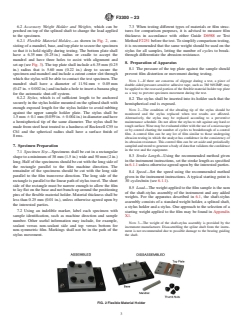
6.2.1 Flexible Material Holder,—as shown in Fig. 2, consisting of a mandrel, base, and top plate to secure the specimen so that
it is held rigidly during testing. The bottom plate shall have a 6.35 mm (0.25 in.) 6.35 mm (0.25 in.) radius or cradle to accept the
mandrel and have three holes to assist with alignment and set-up (see Fig. 3). The top plate shall include a 6.35 mm (0.25 in.) radius
that is 5.60 mm (0.22 in.) deep to secure the specimen and mandrel and include a cutout center slot through which the stylus will
be able to contact the test specimen. The mandrel shall have a diameter of 11.94 mm (0.47 in.) 11.94 mm + 0.05 mm (0.47 in. +
0.002 in.) and include a hole to insert a banana plug for the automatic shut-off system.
FIG. 1 Linear Abrading Device
The sole source of supply of the apparatus known to the committee at this time is Taber® Industries, 455 Bryant Street, North Tonawanda, NY 14120. If you are aware
of alternative suppliers, please provide this information to ASTM International Headquarters. Your comments will receive careful consideration at a meeting of the responsible
technical committee, which you may attend.
F3300 − 23
FIG. 2 Flexible Material Holder
FIG. 3 Proper Alignment for Fixture Base
6.2.2 Stylus, which is of sufficient length to be anchored securely in the stylus holder mounted on the splined shaft with enough
exposed length for the stylus holder to avoid rubbing against the upper sample holder plate. The stylus shall be 1.5 6 0.1 mm
1.5 mm 6 0.1 mm (0.059 in. 6 0.004 in.) in diameter and have a hemispherical tip of the same diameter. The stylus shall be made
from steel heat treated to a hardness of Rockwell C55 to C61 and the spherical radius shall have a surface finish of 8 rms.8 rms.
7. Specimen Preparation
7.1 Specimen Size—Specimens shall be cut in a rectangular shape to a minimum of 38 mm (1.5 in.) wide and 50 mm (2 in.) long.
Half of the specimens should be cut with the long side of the rectangle parallel to the film machine direction. The remainder of
the specimens should be cut with the long side parallel to the film transverse direction. The long side of the rectangle is parallel
to the linear path of stylus travel. The short side of the rectangle must be narrow enough to allow the film to lay flat on the base
and not bunch up around the positioning pins of the flexible material holder. Material thickness shall be less than 0.25 mm (0.01
in.). in.), unless otherwise agreed upon by the interested parties.
7.2 Using an indelible marker, label each specimen with sample identification, such as machine direction and sample number.
Other useful information may include, for example, sealant versus non-sealant side and top versus bottom for non-symmetric film.
Markings shall not be in the path of the stylus movement. .
7.3 When testing different types of materials or film structures for comparison purposes, it is advised to measure film thickness
in accordance with either Guide D6988 or Test Method F2251 before the test. To simplify comparison testing, it is recommended
that the same weight should be used on the stylus for all samples, letting the number of cycles to breakthrough differentiate the
abrasion resistance.
F3300 − 23
8. Preparation of Apparatus
8.1 The pressure of the top plate against the sample should prevent film distortion or movement during testing.
NOTE 1—If there are concerns of slippage during a test, a piece of double-sided pressure-sensitive adhesive tape, such as 3M 9492MP, may be applied
to the recessed portion of the flexible material holder top plate as a way to prevent specimen movement during the test.
8.2 The stylus shall be inserted into its holder such that the hemispherical end is exposed.
NOTE 2—The condition of the abrading tip of the stylus should be monitored and the stylus replaced when test results are affected. Alternatively, the stylus
may be replaced according to a preventive maintenance schedule. Do not allow the stylus to rub against any hard or rough surface. Wear may be evaluated
either with the use of a microscope or by control charting the number of cycles to breakthrough of a control film. A control film can be any lot of film
similar to those undergoing abrasion testing in which the analyst has confidence in the consistency of its abrasion resistance. This control film can be
set aside and periodically sampled and tested to generate a body of data that validates the confidence in the test and the equipment.
8.3 Stroke Length—Set the stroke length using the Using the recommended method given in the instrument instructions (see
instructions, set the stroke length as specified in 6.1.1). unless otherwise agreed upon by the interested parties.
8.4 Speed—Set the speed using the recommended method given in the instrument instructions. A typical starting point is 30
cycles/min (see 6.1.1).
8.5 Load—The weight applied to the film sample is the sum of the shaft-stylus assembly of the instrument and any added weights.
For the apparatus described in 6.1, the shaft-stylus assembly consists of a standard weight holder, a splined shaft, a stylus holder
and a stylus. One approach to the selection of a starting weight applied to the film may be found in Appendix X1.
NOTE 3—The weight of the shaft-stylus assembly is provided by the instrument manufacturer. Disassembling the spline shaft from the instrument is not
recommended due to possible damage to the bearing guiding the shaft.
NOTE 4—Sets of weights may be obtained from the manufacturer that fit the standard weight holder. These have been scribed and weighed to the nearest
gram and may be used without re-weighing.
8.6 Alignment of Flexible Material Holder—Sections 8.6.1 – 8.6.4 describe the alignment procedure for the base plate of the
flexible material holder to a specimen table or other type of mounting fixture that is attached to or incorporated in the linear
abrading device.
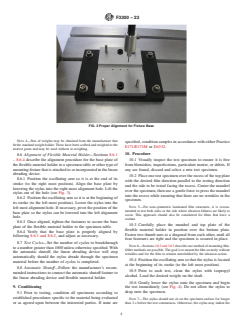
8.6.1 Position the oscillating arm so it is at the end of its stroke (to the right most position). Align the base plate by lowering the
stylus into the right most alignment hole. Lift the stylus out of the hole (see Fig. 3).
8.6.2 Position the oscillating arm so it is at the beginning of its stroke (to the left most position). Lower the stylus into the left
most alignment hole. If necessary, pivot the position of the base plate so the stylus can be lowered into the left alignment hole.
8.6.3 Once aligned, tighten the fasteners to secure the base plate of the flexible material holder to the specimen table.
8.6.4 Verify that the base plate is properly aligned by following 8.6.1 and 8.6.2, and adjust as necessary.
8.7 Test Cycles—Set the number of cycles to breakthrough to a number greater than 1000 unless otherwise specified. With the
automatic shutoff, the linear abrading device will stop automatically should the stylus abrade through the specimen material before
the number of cycles is completed.
8.8 Automatic Shutoff—Follow the manufacturer’s recommended instructions to connect the automatic shutoff feature to the linear
abrading device and flexible material holder.
9. Conditioning
9.1 Prior to testing, condition all specimens according to established procedures specific to the material being evaluated or as
agreed upon between the interested parties. If none are specified, condition samples in accordance with either Practice
E171/E171M or D4332.
F3300 − 23
10. Procedure
10.1 Visually inspect the test specimen to ensure it is free from blemishes, imperfections, particulate matter, or debris. If any are
found, discard and select a new test specimen.
10.2 Place one test specimen over the recess of the top plate with the desired film direction parallel to the testing direction and
the side to be tested facing the recess. Center the mandrel over the specimen, then use a gentle force to press the mandrel into the
recess while ensuring that there a
...