

ASTM D8183-22
(Test Method)Standard Test Method for Determination of Indicated Cetane Number (ICN) of Diesel Fuel Oils using a Constant Volume Combustion Chamber-Reference Fuels Calibration Method
General Information
- Abstract
SIGNIFICANCE AND USE
5.1 The ICN value determined by this test method provides a measure of the ignition characteristics of diesel fuel oil used in compression ignition engines.
5.2 This test can be used by engine manufacturers, petroleum refiners, fuel producers and in commerce as a specification aid to relate or match fuels and engines.
5.3 The relationship of diesel fuel ICN determinations to the full scale, variable speed, variable load diesel engine is not completely understood.
5.4 This test can be applied to non-conventional diesel fuels.
5.5 This test determines ICN; it requires a sample of approximately 40 mL and a test time of approximately 25 min.
5.6 This test method is based on the Energy Institute Test Method IP 617.
SCOPE
1.1 This test method covers the quantitative determination of the indicated cetane number (ICN) of conventional diesel fuel oils, and diesel fuel oils containing cetane number improver additives; it is applicable to products typical of Specification D975, Grades No.1-D and 2-D diesel fuel oils, European standard EN 590, and Canadian standards CAN/CGSB-3.517 and CAN/CGSB-3.520. The test method is also applicable to biodiesel, blends of diesel fuel oils containing biodiesel material (for example, materials as specified in Specifications D975, D6751, D7467 and European standards EN 14214, EN 16734, and EN 16709), diesel fuels from non-petroleum origin, hydrocarbon oils, diesel fuel oil blending components, aviation turbine fuels, and polyoxymethylene dimethyl ether (OME).
1.2 This test method utilizes a constant volume combustion chamber (CVCC) with direct fuel injection into heated compressed air. The apparatus is calibrated using blends of reference fuels. ICN is determined directly from ignition delay using an instrument specific reference fuel calibration curve.
1.3 This test method and its precision cover the calibrated range of 35 ICN to 85 ICN, inclusive. The analyzer can measure ICN outside the calibrated range, but the precision has not been determined.
1.4 The values stated in SI units are to be regarded as standard. No other units of measurement are included in this standard.
1.5 This standard does not purport to address all of the safety concerns, if any, associated with its use. It is the responsibility of the user of this standard to establish appropriate safety, health, and environmental practices and determine the applicability of regulatory limitations prior to use. Some specific hazards statements are given in Section 7 on Hazards.
1.6 This international standard was developed in accordance with internationally recognized principles on standardization established in the Decision on Principles for the Development of International Standards, Guides and Recommendations issued by the World Trade Organization Technical Barriers to Trade (TBT) Committee.
- Status
- Published
- Publication Date
- 30-Jun-2022
- Technical Committee
- D02 - Petroleum Products, Liquid Fuels, and Lubricants
- Drafting Committee
- D02.01 - Combustion Characteristics
Buy Documents
ASTM D8183-22 - Standard Test Method for Determination of Indicated Cetane Number (ICN) of Diesel Fuel Oils using a Constant Volume Combustion Chamber—Reference Fuels Calibration Method
REDLINE ASTM D8183-22 - Standard Test Method for Determination of Indicated Cetane Number (ICN) of Diesel Fuel Oils using a Constant Volume Combustion Chamber—Reference Fuels Calibration Method
Overview
ASTM D8183-22 is the standard test method for the determination of the Indicated Cetane Number (ICN) of diesel fuel oils using a constant volume combustion chamber with a reference fuel calibration approach. Developed by ASTM, this method provides a reliable quantitative measure of diesel fuel ignition quality, which is critical for performance and emissions in compression ignition (diesel) engines. It applies to conventional and alternative diesel fuels, including those with cetane improver additives, biodiesel, and various international diesel specifications.
Key Topics
- Indicated Cetane Number (ICN): The ICN is a measure of the ignition quality of diesel fuels, determined by comparing the test fuel to reference blends of n-hexadecane and 1-methylnaphthalene.
- Constant Volume Combustion Chamber (CVCC): This method uses a CVCC with direct fuel injection into heated compressed air, simulating real engine conditions.
- Reference Fuel Calibration: Calibration utilizes a series of seven blends of known ICN to create an instrument-specific calibration curve, ensuring traceable and consistent results.
- Applicable Fuel Types: Suitable for conventional diesel (including those specified by ASTM D975, EN 590, and CAN/CGSB standards), biodiesel and its blends, synthetic and non-petroleum diesel, aviation turbine fuels, and blending components.
- Test Range and Sample Requirements: The method is calibrated for fuels with ICN values from 35 to 85. Approximately 40 mL of sample is required, with test times around 25 minutes.
- Quality Control and Verification: Includes regular calibration, use of verification fluids, and statistical quality control to ensure analytical accuracy and repeatability.
Applications
- Engine Manufacturing: Provides engine designers and manufacturers with a consistent method to assess the ignition quality of diesel fuels, aiding in fuel-engine matching and performance optimization.
- Petroleum Refining and Fuel Production: Enables refiners and fuel producers to certify and adjust fuel blends to meet regulatory and market requirements for ignition quality, supporting compliance and performance assurance.
- Fuel Quality Assurance: Used in commercial transactions and regulatory compliance as a specification test for diesel fuel quality, both for traditional and non-conventional (e.g., biodiesel, synthetic) fuels.
- Research and Development: Supports R&D in fuels, additives, and engine technology by offering a standardized measurement of ignition characteristics.
- Environmental and Operational Compliance: Helps ensure fuels meet international emissions and performance standards, contributing to greener and more efficient diesel engine operation.
- Wider Applicability: Can be used for fuels from non-petroleum origins and is suitable for blends containing various modern alternative fuels and additives.
Related Standards
- ASTM D613: Standard Test Method for Cetane Number of Diesel Fuel Oil
- ASTM D975: Specification for Diesel Fuel Oils
- ASTM D6751: Specification for Biodiesel Fuel Blend Stock (B100)
- ASTM D7467: Specification for Diesel Fuel Oil, Biodiesel Blends (B6 to B20)
- EN 590: Automotive fuels - Diesel - Requirements and test methods (Europe)
- EN 14214: Fetty acid methyl esters (FAME) for use in diesel engines and heating applications
- CAN/CGSB-3.517 / 3.520: Canadian standards for diesel fuel and biodiesel blends
- Energy Institute IP 617: Method for ICN determination using constant volume combustion chamber
- ISO Guide 35: Certification of reference materials - statistical principles
Keywords: indicated cetane number, ICN, cetane number, diesel fuel, ignition quality, constant volume combustion chamber, reference fuels, ASTM D8183, diesel engine performance, fuel calibration, fuel standards, biodiesel, alternative fuels, petroleum standards.
Relations
- Effective Date
- 01-Mar-2024
- Effective Date
- 01-Mar-2024
- Effective Date
- 01-Feb-2024
- Refers
ASTM D4175-23a - Standard Terminology Relating to Petroleum Products, Liquid Fuels, and Lubricants - Effective Date
- 15-Dec-2023
- Effective Date
- 15-Dec-2023
- Effective Date
- 01-Dec-2023
- Effective Date
- 01-Dec-2023
- Effective Date
- 01-Oct-2023
- Refers
ASTM D4175-23e1 - Standard Terminology Relating to Petroleum Products, Liquid Fuels, and Lubricants - Effective Date
- 01-Jul-2023
- Effective Date
- 01-Jun-2020
- Effective Date
- 01-Jan-2020
- Effective Date
- 01-Dec-2019
- Effective Date
- 01-May-2019
- Effective Date
- 01-May-2019
- Effective Date
- 01-Feb-2019
Buy Documents
ASTM D8183-22 - Standard Test Method for Determination of Indicated Cetane Number (ICN) of Diesel Fuel Oils using a Constant Volume Combustion Chamber—Reference Fuels Calibration Method
REDLINE ASTM D8183-22 - Standard Test Method for Determination of Indicated Cetane Number (ICN) of Diesel Fuel Oils using a Constant Volume Combustion Chamber—Reference Fuels Calibration Method
Get Certified
Connect with accredited certification bodies for this standard

Element Materials Technology
Materials testing and product certification.

ABS Group Brazil
ABS Group certification services in Brazil.

ABS Quality Evaluations Inc.
American Bureau of Shipping quality certification.
Sponsored listings
Frequently Asked Questions
ASTM D8183-22 is a standard published by ASTM International. Its full title is "Standard Test Method for Determination of Indicated Cetane Number (ICN) of Diesel Fuel Oils using a Constant Volume Combustion Chamber-Reference Fuels Calibration Method". This standard covers: SIGNIFICANCE AND USE 5.1 The ICN value determined by this test method provides a measure of the ignition characteristics of diesel fuel oil used in compression ignition engines. 5.2 This test can be used by engine manufacturers, petroleum refiners, fuel producers and in commerce as a specification aid to relate or match fuels and engines. 5.3 The relationship of diesel fuel ICN determinations to the full scale, variable speed, variable load diesel engine is not completely understood. 5.4 This test can be applied to non-conventional diesel fuels. 5.5 This test determines ICN; it requires a sample of approximately 40 mL and a test time of approximately 25 min. 5.6 This test method is based on the Energy Institute Test Method IP 617. SCOPE 1.1 This test method covers the quantitative determination of the indicated cetane number (ICN) of conventional diesel fuel oils, and diesel fuel oils containing cetane number improver additives; it is applicable to products typical of Specification D975, Grades No.1-D and 2-D diesel fuel oils, European standard EN 590, and Canadian standards CAN/CGSB-3.517 and CAN/CGSB-3.520. The test method is also applicable to biodiesel, blends of diesel fuel oils containing biodiesel material (for example, materials as specified in Specifications D975, D6751, D7467 and European standards EN 14214, EN 16734, and EN 16709), diesel fuels from non-petroleum origin, hydrocarbon oils, diesel fuel oil blending components, aviation turbine fuels, and polyoxymethylene dimethyl ether (OME). 1.2 This test method utilizes a constant volume combustion chamber (CVCC) with direct fuel injection into heated compressed air. The apparatus is calibrated using blends of reference fuels. ICN is determined directly from ignition delay using an instrument specific reference fuel calibration curve. 1.3 This test method and its precision cover the calibrated range of 35 ICN to 85 ICN, inclusive. The analyzer can measure ICN outside the calibrated range, but the precision has not been determined. 1.4 The values stated in SI units are to be regarded as standard. No other units of measurement are included in this standard. 1.5 This standard does not purport to address all of the safety concerns, if any, associated with its use. It is the responsibility of the user of this standard to establish appropriate safety, health, and environmental practices and determine the applicability of regulatory limitations prior to use. Some specific hazards statements are given in Section 7 on Hazards. 1.6 This international standard was developed in accordance with internationally recognized principles on standardization established in the Decision on Principles for the Development of International Standards, Guides and Recommendations issued by the World Trade Organization Technical Barriers to Trade (TBT) Committee.
SIGNIFICANCE AND USE 5.1 The ICN value determined by this test method provides a measure of the ignition characteristics of diesel fuel oil used in compression ignition engines. 5.2 This test can be used by engine manufacturers, petroleum refiners, fuel producers and in commerce as a specification aid to relate or match fuels and engines. 5.3 The relationship of diesel fuel ICN determinations to the full scale, variable speed, variable load diesel engine is not completely understood. 5.4 This test can be applied to non-conventional diesel fuels. 5.5 This test determines ICN; it requires a sample of approximately 40 mL and a test time of approximately 25 min. 5.6 This test method is based on the Energy Institute Test Method IP 617. SCOPE 1.1 This test method covers the quantitative determination of the indicated cetane number (ICN) of conventional diesel fuel oils, and diesel fuel oils containing cetane number improver additives; it is applicable to products typical of Specification D975, Grades No.1-D and 2-D diesel fuel oils, European standard EN 590, and Canadian standards CAN/CGSB-3.517 and CAN/CGSB-3.520. The test method is also applicable to biodiesel, blends of diesel fuel oils containing biodiesel material (for example, materials as specified in Specifications D975, D6751, D7467 and European standards EN 14214, EN 16734, and EN 16709), diesel fuels from non-petroleum origin, hydrocarbon oils, diesel fuel oil blending components, aviation turbine fuels, and polyoxymethylene dimethyl ether (OME). 1.2 This test method utilizes a constant volume combustion chamber (CVCC) with direct fuel injection into heated compressed air. The apparatus is calibrated using blends of reference fuels. ICN is determined directly from ignition delay using an instrument specific reference fuel calibration curve. 1.3 This test method and its precision cover the calibrated range of 35 ICN to 85 ICN, inclusive. The analyzer can measure ICN outside the calibrated range, but the precision has not been determined. 1.4 The values stated in SI units are to be regarded as standard. No other units of measurement are included in this standard. 1.5 This standard does not purport to address all of the safety concerns, if any, associated with its use. It is the responsibility of the user of this standard to establish appropriate safety, health, and environmental practices and determine the applicability of regulatory limitations prior to use. Some specific hazards statements are given in Section 7 on Hazards. 1.6 This international standard was developed in accordance with internationally recognized principles on standardization established in the Decision on Principles for the Development of International Standards, Guides and Recommendations issued by the World Trade Organization Technical Barriers to Trade (TBT) Committee.
ASTM D8183-22 is classified under the following ICS (International Classification for Standards) categories: 75.160.20 - Liquid fuels. The ICS classification helps identify the subject area and facilitates finding related standards.
ASTM D8183-22 has the following relationships with other standards: It is inter standard links to ASTM D6300-24, ASTM D6708-24, ASTM D613-24, ASTM D4175-23a, ASTM D975-23a, ASTM D6299-23a, ASTM D6300-23a, ASTM D7467-23, ASTM D4175-23e1, ASTM D7467-20a, ASTM D7467-20, ASTM D6300-19a, ASTM D7467-19, ASTM D6708-19, ASTM D975-19. Understanding these relationships helps ensure you are using the most current and applicable version of the standard.
ASTM D8183-22 is available in PDF format for immediate download after purchase. The document can be added to your cart and obtained through the secure checkout process. Digital delivery ensures instant access to the complete standard document.
Standards Content (Sample)
This international standard was developed in accordance with internationally recognized principles on standardization established in the Decision on Principles for the
Development of International Standards, Guides and Recommendations issued by the World Trade Organization Technical Barriers to Trade (TBT) Committee.
Designation: D8183 − 22
Standard Test Method for
Determination of Indicated Cetane Number (ICN) of Diesel
Fuel Oils using a Constant Volume Combustion Chamber—
Reference Fuels Calibration Method
This standard is issued under the fixed designation D8183; the number immediately following the designation indicates the year of
original adoption or, in the case of revision, the year of last revision. A number in parentheses indicates the year of last reapproval. A
superscript epsilon (´) indicates an editorial change since the last revision or reapproval.
1. Scope* 1.6 This international standard was developed in accor-
dance with internationally recognized principles on standard-
1.1 This test method covers the quantitative determination
ization established in the Decision on Principles for the
of the indicated cetane number (ICN) of conventional diesel
Development of International Standards, Guides and Recom-
fuel oils, and diesel fuel oils containing cetane number im-
mendations issued by the World Trade Organization Technical
prover additives; it is applicable to products typical of Speci-
Barriers to Trade (TBT) Committee.
fication D975, Grades No.1-D and 2-D diesel fuel oils,
European standard EN 590, and Canadian standards CAN/
2. Referenced Documents
CGSB-3.517 and CAN/CGSB-3.520. The test method is also
2.1 ASTM Standards:
applicable to biodiesel, blends of diesel fuel oils containing
D613 Test Method for Cetane Number of Diesel Fuel Oil
biodiesel material (for example, materials as specified in
D975 Specification for Diesel Fuel
Specifications D975, D6751, D7467 and European standards
D1193 Specification for Reagent Water
EN 14214, EN 16734, and EN 16709), diesel fuels from
D3703 Test Method for Hydroperoxide Number of Aviation
non-petroleum origin, hydrocarbon oils, diesel fuel oil blend-
Turbine Fuels, Gasoline and Diesel Fuels
ing components, aviation turbine fuels, and polyoxymethylene
D4052 Test Method for Density, Relative Density, and API
dimethyl ether (OME).
Gravity of Liquids by Digital Density Meter
1.2 This test method utilizes a constant volume combustion
D4057 Practice for Manual Sampling of Petroleum and
chamber (CVCC) with direct fuel injection into heated com-
Petroleum Products
pressed air. The apparatus is calibrated using blends of refer-
D4175 Terminology Relating to Petroleum Products, Liquid
ence fuels. ICN is determined directly from ignition delay
Fuels, and Lubricants
using an instrument specific reference fuel calibration curve.
D4177 Practice for Automatic Sampling of Petroleum and
1.3 This test method and its precision cover the calibrated Petroleum Products
D5854 Practice for Mixing and Handling of Liquid Samples
range of 35 ICN to 85 ICN, inclusive. The analyzer can
measureICNoutsidethecalibratedrange,buttheprecisionhas of Petroleum and Petroleum Products
D6299 Practice for Applying Statistical Quality Assurance
not been determined.
and Control Charting Techniques to Evaluate Analytical
1.4 The values stated in SI units are to be regarded as
Measurement System Performance
standard. No other units of measurement are included in this
D6300 Practice for Determination of Precision and Bias
standard.
Data for Use in Test Methods for Petroleum Products,
1.5 This standard does not purport to address all of the
Liquid Fuels, and Lubricants
safety concerns, if any, associated with its use. It is the
D6708 Practice for StatisticalAssessment and Improvement
responsibility of the user of this standard to establish appro-
of Expected Agreement Between Two Test Methods that
priate safety, health, and environmental practices and deter-
Purport to Measure the Same Property of a Material
mine the applicability of regulatory limitations prior to use.
D6751 Specification for Biodiesel Fuel Blend Stock (B100)
Some specific hazards statements are given in Section 7 on
for Middle Distillate Fuels
Hazards.
D7467 Specification for Diesel Fuel Oil, Biodiesel Blend
(B6 to B20)
This test method is under the jurisdiction of ASTM Committee D02 on
Petroleum Products, Liquid Fuels, and Lubricants and is the direct responsibility of
Subcommittee D02.01 on Combustion Characteristics. For referenced ASTM standards, visit the ASTM website, www.astm.org, or
Current edition approved July 1, 2022. Published August 2022. Originally contact ASTM Customer Service at service@astm.org. For Annual Book of ASTM
approved in 2018. Last previous edition approved in 2018 as D8183 – 18. DOI: Standards volume information, refer to the standard’s Document Summary page on
10.1520/D8183-22. the ASTM website.
*A Summary of Changes section appears at the end of this standard
Copyright © ASTM International, 100 Barr Harbor Drive, PO Box C700, West Conshohocken, PA 19428-2959. United States
D8183 − 22
2.2 European Standards: 3.2.2 calibration and verification fluids, n—volumetric
EN 590 Automotive fuels—Diesel—Requirements and test blends of n-hexadecane and 1-methylnaphthalene, at 20 °C,
methods define an ICN scale in specific volume ratios according to the
EN 14214 Liquid petroleum products—Fatty acid methyl relationship shown in Eq 1.
esters (FAME) for use in diesel engines and heating
3.2.2.1 Discussion—Seven blends of n-hexadecane and
applications—Requirements and test methods
1-methylnaphthalene are used to create an analyzer specific
EN 16709 Automotive Fuels—High FAME diesel fuel (B20
calibration curve.Asingle blend is used to create a verification
and B30)—Requirements and test methods
fluid.
EN 16734 Automotive Fuels—Automotive B10 Fuel—
3.2.3 calibration curve, n—plot of ID versus the ICN (see
Requirements and test methods
3.2.6) of reference fuel blends obtained by making ignition
2.3 Energy Institute Standards:
delay measurements with calibration fluids for each analyzer.
IP 41 Ignition quality of diesel fuels—Cetane engine test
method 3.2.3.1 Discussion—The calibration curve comprises seven
IP 617 Determination of indicated cetane number (ICN) of calibration points covering the 35 ICN to 85 ICN range; see
fuels using a constant volume combustion chamber— research report for the format of the equation used.
Primary reference fuels calibration (PRFC) method 3.2.3.2 Discussion—Calibration curves are different for
each analyzer and can change each time calibration is carried
2.4 Canadian Standards:
CAN/CGSB-3.517 Diesel Fuel—Specification out.
3.2.4 combustion charge air, n—compressed air at a speci-
CAN/CGSB-3.520 Automotive Low-Sulphur Diesel Fuel
Containing Low Levels of Biodiesel Esters (B1-B5)— fied pressure introduced into the combustion chamber.
Specification
3.2.5 ignition delay (ID), n—periodoftime,inmilliseconds,
2.5 ISO Standards:
between the start of fuel injection and the start of combustion.
ISO868 Plasticsandebonite—Determinationofindentation
3.2.5.1 Discussion—In the context of this standard, this
hardness by means of a durometer (Shore hardness)
period is represented by the mean of ID and ID .
0 150
ISO Guide 35 Certification of reference materials—General
3.2.5.2 ID,n—the time in milliseconds (ms) between the
statistical principles (Reference materials—Guidance for
start of fuel injection and the point where the relative pressure
the characterization and the assessment of the homogene-
recovers to 0 kPa, as shown in Fig. A3.1.
ity and stability of the material).
3.2.5.3 ID ,n—the time in milliseconds (ms) between the
3. Terminology
start of fuel injection and the point where the relative pressure
reaches 150 kPa, as shown in Fig. A3.1.
3.1 Definitions:
3.1.1 cetane number, n—a measure of the ignition perfor-
3.2.5.4 Discussion—Start of fuel injection is interpreted as
manceofadieselfueloilobtainedbycomparingittoreference
the rise in the electronic signal that opens the injector for the
fuels in a standardized engine test. D4175
time given in Table 2; timings for ID and ID commence at
0 150
this start point.
3.1.1.1 Discussion—In the context of this test method,
3.2.5.5 Discussion—IDs are recorded but not reported as
cetane number is measured and reported by Methods D613/IP
they are converted into ICN by an instrument specific calibra-
41.
tion curve.
3.1.2 quality control (QC) sample, n—for use in quality
3.2.6 indicated cetane number (ICN), n—measure of the
assuranceprogramstodetermineandmonitortheprecisionand
ignition performance of a diesel fuel obtained by comparing it
stability of a measurement system, a stable and homogeneous
to reference fuels that have been blended to a scale; where 0
material having physical or chemical properties, or both,
and 100 are represented by 1-methylnaphthalene and
similar to those of typical samples tested by the analytical
n-hexadecane respectively, to create a calibration curve.
measurement system; the material is properly stored to ensure
sample integrity, and is available in sufficient quantity for
3.2.6.1 Discussion—It is in principle a number indicated
repeated, long term testing. D6299
from a calibration curve that has been generated on the
3.2 Definitions of Terms Specific to This Standard:
analyszer under test using reference fuel blend calibration
3.2.1 analyzer, n—an integrated compression ignition appa- points. The calibration curve, ICN = function of ignition delay
ratus to measure the ignition and combustion characteristics of
(ID); see research report for the format of the equation used.
diesel fuel oil. The scale is defined by the relationship shown in Eq 1:
indicated cetane number = % n-hexadecane ~volume fraction! (1)
Available from European Committee for Standardization (CEN), Rue de la
for any blends of n-hexadecane and 1-MN.
Science 23, B-1040, Brussels, Belgium, http://www.cen.eu.
3.2.7 injection time, n—the period of time, in microseconds
Available from Energy Institute, 61 New Cavendish St., London, W1G 7AR,
U.K., http://www.energyinst.org. (µs), that the fuel injector nozzle is open as determined by the
Available from Canadian General Standards Board (CGSB), 11 Laurier St.,
Phase III, Place du Portage, Gatineau, Quebec K1A0S5, Canada, http://www.tpsgc-
pwgsc.gc.ca/ongc-cgsb.
6 7
Available fromAmerican National Standards Institute (ANSI), 25 W. 43rd St., Research Report reference IP 617 (ILS): Available from Energy Institute, 61
4th Floor, New York, NY 10036, http://www.ansi.org. New Cavendish St., London, WIG 7AR, U.K., http://www.energyinst.org.uk.
D8183 − 22
length of the electronic signal (injection pulse), in 6.1.1 Exposure of these fuels and materials to UV wave-
microseconds, that opens the injector. lengths shorter than 550 nm for a short period of time can
significantly affect ignition delay measurements.
3.2.8 reference fuels, n—1-methylnaphthalene and
n-hexadecane.
NOTE1—Theformationofperoxideandfreeradicalscanaffectignition
delay. These formations are minimized when the fuel sample is stored in
3.3 Abbreviations:
the dark in a cold room at a temperature of less than 10 °C and covered by
3.3.1 ICN—indicated cetane number
a blanket of inert gas.
3.3.2 ID—ignition delay
6.2 Alimitedstudy(seeAppendixX1)demonstratedthatan
3.3.3 1–MN—reference fuel 1-methylnaphthalene unusually high purity (99 %) reference fuel (1- MN) used for
calibration can result in a positive relative bias of 0.3 ICN at a
3.3.4 QC—quality control
level of 50 ICN.
4. Summary of Test Method
7. Apparatus
4.1 A sub-sample of the sample under test is automatically
drawn from a sample vial located in the auto-sampler carousel 7.1 Automatic Auto-sampling Analyzer —The apparatus as
shown in Fig. A2.1 and outlined in 7.1.1, 7.1.2, 7.1.3, and
and heated during pressurization. At the start of a combustion
cycle, a small specimen of the sub-sample is injected into a 7.1.4, is described in more detail in Annex A2. For the
installation and set-up procedures, and for a detailed system
temperature and pressure controlled, constant volume combus-
tion chamber, which has previously been charged with com- description, refer to the manufacturer’s instructions.
pressed air of a specified quality. Each injection, and its 7.1.1 Electronics, comprising power supplies (including an
resulting combustion, causes a rapid pressure rise in the integral uninterruptable power supply) for the programmable
combustion chamber that is detected by the dynamic pressure logic controllers, data acquisition units,and associated inter-
sensor. faces.
7.1.2 Combustion Chamber Assembly, comprising the
4.2 The complete test sequence comprises a cleaning stage
heated constant volume combustion chamber, cooled dynamic
and multiple combustion cycles (see Section 13, A3.1.5, and
pressure sensor as well as regulating and shut-off valves, and
A3.1.5.1) to obtain ignition delay (ID) values. The ICN result
temperature and pressure sensors.
is determined using the mean of the combustion cycles’ IDs,
7.1.2.1 Combustion Chamber, a stainless steel combustion
and the reference fuel calibration curve.
chamber of capacity 0.390 L 6 0.010 L.
4.3 Each analyzer is calibrated with seven fluids created
7.1.3 Common Rail Injection System, comprising a cooled
from blends of reference fuels, with known ICNs calculated
piezoelectric injector, high pressure piston pump, heated
fromtheICNscale;testresultsoutsidethecalibrationrangeare
piping, and temperature and pressure sensors.
determined by extrapolating the calibration curve, but are
7.1.4 Auto Sampler/Carousel, providing space for up to 36
subject to increased uncertainty.
sample vials and cleaning fluid.
7.2 Sample Vials, 40 mL (nominal) headspace vials with
5. Significance and Use
screw caps and silicone/PTFE septa or natural rubber/PTFE
5.1 The ICN value determined by this test method provides
septa, approximately 1.3 mm thick, Shore A hardness of
a measure of the ignition characteristics of diesel fuel oil used
approximately 45 (see ISO 868). The PTFE side of the septum
in compression ignition engines.
shall be on the inside of the vial.
5.2 This test can be used by engine manufacturers, petro-
7.2.1 Thevialsshallbeamberorbrownglasstohelpprotect
leum refiners, fuel producers and in commerce as a specifica-
against the effects of UV light.
tion aid to relate or match fuels and engines.
7.3 Syringe Filter, disposable, 25 mm to 28 mm diameter
5.3 TherelationshipofdieselfuelICNdeterminationstothe
with a nominal pore size of 0.45 µm or less, PTFE filter media,
full scale, variable speed, variable load diesel engine is not
to be attached onto a syringe (7.4).
completely understood.
7.4 Syringe, disposable, ≥20 mL plastic, suitable for use
5.4 This test can be applied to non-conventional diesel
with a syringe filter (7.3).
fuels.
7.5 Recirculating Cooler, capable of recirculating coolant to
5.5 This test determines ICN; it requires a sample of
the injector assembly and the dynamic pressure sensor and
approximately 40 mLand a test time of approximately 25 min.
maintaining a bath temperature of 65 °C 6 5 °C.
5.6 This test method is based on the Energy Institute Test
7.6 Computer, for inputting and outputting data, printing
Method IP 617.
functions and interfacing with the analyzer and networks.
6. Interferences
6.1 Effects of UVlight. Minimize exposure of sample fuels,
Thesolesourceofsupplyoftheanalyzerdescribedinthismethodknowntothe
committeeatthistimeisStanhope-Seta,LondonStreet,Chertsey,SurreyKT168AP
reference fuels, calibration and verification fluids, and QC
UK. If you are aware of alternative suppliers, please provide this information to
samples to sunlight or fluorescent lamp UV emissions to
ASTM International Headquarters. Your comments will receive careful consider-
minimize induced chemical reactions that can affect the igni-
ation at a meeting of the responsible technical committee, which you may attend.
tion delay measurements.
D8183 − 22
8. Reagents and Materials 8.1.5 Calibration Fluids—A set of seven volumetric blends
of reference fuels n-hexadecane and 1-methylnaphthalene,
8.1 Calibration and Verification Fluids:
with known ICNs as shown in Table 1 covering the range
8.1.1 Calibration and verification fluids are available com-
35 ICN to 85 ICN, inclusive.
mercially. They comprise volumetric blends of reference fuels
8.1.6 Verification Fluid—A volumetric blend of reference
n-hexadecane and 1-methylnaphthalene prepared in accor-
fuels n-hexadecane and 1-methylnaphthalene, with a known
dance with Eq 1 to create fluids with known ICNs within
ICNs. The ICN of each verification fluid shall be different to
0.5 ICN of the required values to an accuracy of 60.01 ICN.
those shown in Table 1 by at least 1 ICN and be made from
8.1.2 The ICN number of the blend shall be determined by
different batches of reference fuels.
mass measurements and density (Test Method D4052 or
8.1.7 n-hexadecane, minimum purity of 99.0 % (volume
equivalent) to provide volumetric equivalence.The volumes of
fraction) with a certificate of analysis, the designated 100 ICN
referencefuelsusedshallbeaccuratelydispensedandrecorded
component. Hydroperoxide level shall be ≤1.0 mg⁄kg as
by volume so that the validity of the ICN determination can be
measured by Test Method D3703 (see 8.1.3.2).
checked by comparison with the mass/density calculation. A
8.1.7.1 Store n-hexadecane in a dark cool place to avoid
difference of greater than 0.2 ICN between the volumetric and
possible effects of UV light and temperature effects.
mass measurement methods shall be considered suspect and
n-hexadecane solidifies at temperatures below approximately
the blending process started again. If the discrepancy persists
18 °C and can require warming, to ensure it is homogeneous,
check the calibration of the measuring devices.
beforeuse.Forsamplingandhandling,followtheguidelinesof
8.1.2.1 The ICNs determined by the mass/density volumet-
Section 9.
ric equivalence shall be used for calibration and verification.
NOTE 6—n-hexadecane meeting the requirements of 8.1.7 is known to
NOTE 2—At least 40 mL of each calibration or verification fluid is
be commercially available.
required.
8.1.8 1-methylnaphthalene—(also known as alpha-
8.1.3 Calibration and verification fluids (8.1), shall also
methylnaphthalene), minimum purity of 97.0 % (volume
meet the following requirements:
fraction) with a certificate of analysis, the designated 0 ICN
8.1.3.1 Be in accordance with ISO Guide 35.
component. Hydroperoxide level shall be ≤1.0 mg⁄kg as mea-
NOTE 3—ISO Guide 35 permits and clarifies the use of reference
sured by Test Method D3703 (see 8.1.3.2). (Warning—
materials from a single source.
Flammable. Vapor harmful. Vapor may cause flash fire, skin
8.1.3.2 Be prepared from reference fuels that have been
irritant.)
checked, immediately before the blending process, for the
8.1.8.1 Store 1-methylnaphthalene in a dark cool place to
presence of hydroperoxides using Test Method D3703 or an
avoid possible effects of UV light and temperature effects.
equivalent national standard.Aresult≥1.0 mg⁄kg indicates the
8.2 Quality Control (QC) Sample—Stable and homogenous
hydroperoxide level is too high, and that a new sample from a
distillate fuel, similar to the materials under test. For sampling
different batch shall be obtained and tested. (Warning—When
and handling, see Section 9.
blending reference fuels, take appropriate safety precautions in
8.3 Combustion Charge Air—Compressed air containing
keeping with the relevant safety data sheets, such as using a
20.9 % 6 0.5 % (volume fraction) oxygen with the balance
fume hood.)
nitrogen, less than 0.003 % (volume fraction) hydrocarbons,
NOTE 4—Hydrocarbons can form peroxides and other free radical
and less than 0.025 % (volume fraction) water and capable of
formed contaminants that can influence the ID. Reference fuels meeting
delivering a regulated pressure of 2.5 MPa to 3.0 MPa, inclu-
the purity specification can contain peroxides and other free radical
sive.
formed contaminants.
8.3.1 Air compressed locally can meet the above require-
8.1.3.3 Be packaged into sealed vials of less than 100 mL
ments. Follow the manufacturer’s instructions regarding filtra-
volume under an inert gas blanket.
tion and cleanliness of the air to meet the requirements.
8.1.3.4 A record of reference fuel batch numbers, hydrop-
(Warning—Compressed gas under high pressure that supports
eroxide content, and blending details shall be kept for QC
combustion.)
purposes.
NOTE 7—The oxygen content of combustion charge air can vary
NOTE 5—Commercially available calibration and verification fluids,
betweenbatches(cylinders).Significantvariation,evenwithintheallowed
blended from reference fuels that have been analysed for purity and the
tolerance, can lead to changes in ignition delay (higher oxygen content
presence of hydroperoxides, and conform to 8.1 are available.
leads to shorter ignition delays).
8.1.4 Calibration and verification fluids shall be stored in a
8.4 Cleaning Fluid—1-decanol, minimum purity 99.0 %,
darkcoolplacetoavoidpossibleeffectsofUVlight.Theyshall
filtered through a 0.45 µm, or less, PTFE media filter.
be used within 24 h of opening the sealed vial.
8.5 Water—Unless otherwise specified, meeting the require-
ments of Specification D1193 or a similar national or interna-
tional standard.
The sole source of supply of the commercially available calibration and
verification fluids described in this method known to the committee at this time is
Stanhope-Seta, London Street, Chertsey, Surrey KT16 8APUK. If you are aware of
TABLE 1 ICN of Calibration Fluids
alternative suppliers, please provide this information to ASTM International
Headquarters.Your comments will receive careful consideration at a meeting of the ICN 35.00 40.00 46.00 53.00 60.00 70.00 85.00
responsible technical committee, which you may attend.
D8183 − 22
8.6 Coolant System Fluid—30:70 (volume fraction) mixture 10.2 System Start-up and Warm-up:
of commercial grade ethylene glycol-type, aluminium 10.2.1 Open the valve at the source of the combustion
compatible, with algae inhibitor, vehicle radiator antifreeze chargeairsupplyandadjustthepressureregulatorasneededto
with water (8.5). provide the required 2.5 MPa to 3.0 MPa pressure (see 8.3).
10.2.2 Follow the manufacturer’s instructions to switch on
8.7 Inert Gas—Argon or nitrogen, for use as a blanket over
powertotheanalyzer.Thisactivatestheelectroniccomponents
calibration and verification fluids, and samples.
in the analyzer and the uninterruptable power supply that
supplies the recirculating cooler’s (7.5) pump.
9. Sampling Handling and Preparation
10.2.3 Check that the computer and the recirculating cooler
9.1 Sampling:
are switched on.
9.1.1 Collect diesel fuel oil samples in accordance with
10.2.4 Sample vials may be loaded into the carousel at any
Practices D4057 or D4177.
time.
9.1.2 Refer to Practice D5854 for appropriate information
10.2.5 Immediately after switch on, sample details may be
relating to the mixing and handling of test samples.
entered into the computer program.
9.1.3 To minimize exposure to UV emissions that can
10.2.6 Afterthechamberwallandchamberairtemperatures
induce chemical reactions and affect ignition delay
have stabilized, the analyzer can commence testing samples in
measurement, collect and store samples in containers that are
the carousel automatically.
constructed of materials that minimize light reaching the
10.2.7 For more details and in case of error messages, refer
sample, such as dark brown/amber bottles or epoxy lined metal
to the manufacturer’s instructions.
containers or minimally-reactive plastic containers. If samples
10.2.8 Run a test using a QC sample at the beginning of
are collected in containers that do not minimize light reaching
each new operating period, before commencing routine tests.
the sample, they shall be wrapped or boxed in light-proof
10.3 Standard Operating and Test Conditions:
containers immediately after filling. If the sample is not to be
10.3.1 The operation and test conditions are pre-set and are
analyzed within 24 h, retain in a dark, cool environment, and
not user changeable. Sensors, and their tolerances, used to
preferably under an inert gas (see Interferences, Section 6).
measure these parameters are listed in Annex A2 as well as
NOTE 8—The formation of peroxides and free radicals, which affect the
other sensors used for diagnostic and safety purposes.
ignition delay, is minimized when the sample is stored in the dark, under
10.3.2 Key operator and test conditions are shown in Table
an inert gas blanket, in a cool environment. Exposure of petroleum fuels
2. If these conditions are not met, then follow the manufactur-
to UV wavelengths for even a short period of time has been shown to
affect ignition delay.
er’s instructions.
9.2 Test Sample Preparation:
11. Calibration, Verification, and Quality Control Testing
9.2.1 Sample Fuel Temperature—Condition the diesel fuel
11.1 General—Calibration uses seven reference fuel
oil sample before opening the storage container, so that it is at
blended fluids (see 8.1.1 to 8.1.6). Verification uses one or
room temperature, typically 18 °C to 32 °C.
more reference fuel blended fluids (see 8.1.1 to 8.1.6).
9.2.1.1 Fuel sample shall be homogeneous before testing. If
in doubt, fuel temperature shall be raised at least 14 °C above
11.2 Reference Fuel Calibration:
the fuel’s cloud point.
11.2.1 Calibrate the analyzer after one of the following:
9.2.2 Collect the sample in a dark brown or amber bottle,
11.2.1.1 Installation and commissioning.
suitable metal can or nonreactive plastic container.
11.2.1.2 Replacement or adjustment of critical parts or
9.2.3 Filter at least 40 mL of sample through the syringe
components of the combustion chamber assembly, fuel injec-
filter (7.3) using the syringe (7.4) at ambient temperature,
tion system, temperature or pressure sensors.
withoutvacuum,intoanewbrown/ambersamplevial(7.
...
This document is not an ASTM standard and is intended only to provide the user of an ASTM standard an indication of what changes have been made to the previous version. Because
it may not be technically possible to adequately depict all changes accurately, ASTM recommends that users consult prior editions as appropriate. In all cases only the current version
of the standard as published by ASTM is to be considered the official document.
Designation: D8183 − 18 D8183 − 22
Standard Test Method for
Determination of Indicated Cetane Number (ICN) of Diesel
Fuel Oils using a Constant Volume Combustion Chamber—
Reference Fuels Calibration Method
This standard is issued under the fixed designation D8183; the number immediately following the designation indicates the year of
original adoption or, in the case of revision, the year of last revision. A number in parentheses indicates the year of last reapproval. A
superscript epsilon (´) indicates an editorial change since the last revision or reapproval.
1. Scope Scope*
1.1 This test method covers the quantitative determination of the indicated cetane number (ICN) of conventional diesel fuel oils,
and diesel fuel oils containing cetane number improver additives; it is applicable to products typical of Specification D975, Grades
No.1-D and 2-D diesel fuel oils, European standard EN 590, and Canadian standards CAN/CGSB-3.517 and CAN/CGSB-3.520.
The test method is also applicable to biodiesel, blends of diesel fuel oils containing biodiesel material (for example, materials as
specified in Specifications D975, D6751, D7467 and European standards EN 14214, EN 16734, and EN 16709), diesel fuels from
non-petroleum origin, hydrocarbon oils, diesel fuel oil blending components, aviation turbine fuels, and polyoxymethylene
dimethyl ether (OME).
1.2 This test method utilizes a constant volume combustion chamber (CVCC) with direct fuel injection into heated compressed
air. The apparatus is calibrated using blends of reference fuels. ICN is determined directly from ignition delay using an instrument
specific reference fuel calibration curve.
1.3 This test method and its precision cover the calibrated range of 35 ICN to 85 ICN, inclusive. The analyzer can measure ICN
outside the calibrated range, but the precision has not been determined.
1.4 The values stated in SI units are to be regarded as standard. No other units of measurement are included in this standard.
1.5 This standard does not purport to address all of the safety concerns, if any, associated with its use. It is the responsibility
of the user of this standard to establish appropriate safety, health, and environmental practices and determine the applicability of
regulatory limitations prior to use. Some specific hazards statements are given in Section 7 on Hazards.
1.6 This international standard was developed in accordance with internationally recognized principles on standardization
established in the Decision on Principles for the Development of International Standards, Guides and Recommendations issued
by the World Trade Organization Technical Barriers to Trade (TBT) Committee.
2. Referenced Documents
2.1 ASTM Standards:
D613 Test Method for Cetane Number of Diesel Fuel Oil
This test method is under the jurisdiction of ASTM Committee D02 on Petroleum Products, Liquid Fuels, and Lubricants and is the direct responsibility of Subcommittee
D02.01 on Combustion Characteristics.
Current edition approved April 1, 2018July 1, 2022. Published May 2018August 2022. Originally approved in 2018. Last previous edition approved in 2018 as D8183 – 18.
DOI: 10.1520/D8183-18.10.1520/D8183-22.
For referenced ASTM standards, visit the ASTM website, www.astm.org, or contact ASTM Customer Service at service@astm.org. For Annual Book of ASTM Standards
volume information, refer to the standard’s Document Summary page on the ASTM website.
*A Summary of Changes section appears at the end of this standard
Copyright © ASTM International, 100 Barr Harbor Drive, PO Box C700, West Conshohocken, PA 19428-2959. United States
D8183 − 22
D975 Specification for Diesel Fuel
D1193 Specification for Reagent Water
D3703 Test Method for Hydroperoxide Number of Aviation Turbine Fuels, Gasoline and Diesel Fuels
D4052 Test Method for Density, Relative Density, and API Gravity of Liquids by Digital Density Meter
D4057 Practice for Manual Sampling of Petroleum and Petroleum Products
D4175 Terminology Relating to Petroleum Products, Liquid Fuels, and Lubricants
D4177 Practice for Automatic Sampling of Petroleum and Petroleum Products
D5854 Practice for Mixing and Handling of Liquid Samples of Petroleum and Petroleum Products
D6299 Practice for Applying Statistical Quality Assurance and Control Charting Techniques to Evaluate Analytical Measure-
ment System Performance
D6300 Practice for Determination of Precision and Bias Data for Use in Test Methods for Petroleum Products, Liquid Fuels, and
Lubricants
D6708 Practice for Statistical Assessment and Improvement of Expected Agreement Between Two Test Methods that Purport
to Measure the Same Property of a Material
D6751 Specification for Biodiesel Fuel Blend Stock (B100) for Middle Distillate Fuels
D7467 Specification for Diesel Fuel Oil, Biodiesel Blend (B6 to B20)
2.2 European Standards:
EN 590 Automotive fuels—Diesel—Requirements and test methods
EN 14214 Liquid petroleum products—Fatty acid methyl esters (FAME) for use in diesel engines and heating applications—
Requirements and test methods
EN 16709 Automotive Fuels—High FAME diesel fuel (B20 and B30)—Requirements and test methods
EN 16734 Automotive Fuels—Automotive B10 Fuel—Requirements and test methods
2.3 Energy Institute Standards:
IP 41 Ignition quality of diesel fuels—Cetane engine test method
IP 617 Determination of indicated cetane number (ICN) of fuels using a constant volume combustion chamber—Primary
reference fuels calibration (PRFC) method
2.4 Canadian Standards:
CAN/CGSB-3.517 Diesel Fuel—Specification
CAN/CGSB-3.520 Automotive Low-Sulphur Diesel Fuel Containing Low Levels of Biodiesel Esters (B1-B5)—Specification
2.5 ISO Standards:
ISO 868 Plastics and ebonite—Determination of indentation hardness by means of a durometer (Shore hardness)
ISO Guide 35 Certification of reference materials—General statistical principles (Reference materials—Guidance for the
characterization and the assessment of the homogeneity and stability of the material).
3. Terminology
3.1 Definitions:
3.1.1 cetane number, n—a measure of the ignition performance of a diesel fuel oil obtained by comparing it to reference fuels in
a standardized engine test. D4175
3.1.1.1 Discussion—
In the context of this test method, cetane number is measured and reported by Methods D613/IP 41.
3.1.2 quality control (QC) sample, n—for use in quality assurance programs to determine and monitor the precision and stability
of a measurement system, a stable and homogeneous material having physical or chemical properties, or both, similar to those of
typical samples tested by the analytical measurement system; the material is properly stored to ensure sample integrity, and is
available in sufficient quantity for repeated, long term testing. D6299
3.2 Definitions of Terms Specific to This Standard:
3.2.1 analyzer, n—an integrated compression ignition apparatus to measure the ignition and combustion characteristics of diesel
fuel oil.
Available from European Committee for Standardization (CEN), Rue de la Science 23, B-1040, Brussels, Belgium, http://www.cen.eu.
Available from Energy Institute, 61 New Cavendish St., London, W1G 7AR, U.K., http://www.energyinst.org.
Available from Canadian General Standards Board (CGSB), 11 Laurier St., Phase III, Place du Portage, Gatineau, Quebec K1A 0S5, Canada, http://www.tpsgc-
pwgsc.gc.ca/ongc-cgsb.
Available from American National Standards Institute (ANSI), 25 W. 43rd St., 4th Floor, New York, NY 10036, http://www.ansi.org.
D8183 − 22
3.2.2 calibration and verification fluids, n—volumetric blends of n-hexadecane and 1-methylnaphthalene, at 20 °C, define an ICN
scale in specific volume ratios according to the relationship shown in Eq 1.
3.2.2.1 Discussion—
Seven blends of n-hexadecane and 1-methylnaphthalene are used to create an analyzer specific calibration curve. A single blend
is used to create a verification fluid.
3.2.3 calibration curve, n—plot of ID versus the ICN (see 3.2.6) of reference fuel blends obtained by making ignition delay
measurements with calibration fluids for each analyzer.
3.2.3.1 Discussion—
The calibration curve comprises seven calibration points covering the 35 ICN to 85 ICN range; see research report for the format
of the equation used.
3.2.3.2 Discussion—
Calibration curves are different for each analyzer and can change each time calibration is carried out.
3.2.4 combustion charge air, n—compressed air at a specified pressure introduced into the combustion chamber.
3.2.5 ignition delay (ID), n—period of time, in milliseconds, between the start of fuel injection and the start of combustion.
3.2.5.1 Discussion—
In the context of this standard, this period is represented by the mean of ID and ID .
0 150
3.2.5.2 ID , n—the time in milliseconds (ms) between the start of fuel injection and the point where the relative pressure
recovers to 0 kPa, as shown in Fig. A3.1.
3.2.5.3 ID , n—the time in milliseconds (ms) between the start of fuel injection and the point where the relative pressure
reaches 150 kPa, as shown in Fig. A3.1.
3.2.5.4 Discussion—
Start of fuel injection is interpreted as the rise in the electronic signal that opens the injector for the time given in Table 2; timings
for ID and ID commence at this start point.
0 150
3.2.5.5 Discussion—
IDs are recorded but not reported as they are converted into ICN by an instrument specific calibration curve.
3.2.6 indicated cetane number (ICN), n—measure of the ignition performance of a diesel fuel obtained by comparing it to
reference fuels that have been blended to a scale; where 0 and 100 are represented by 1-methylnaphthalene and n-hexadecane
respectively, to create a calibration curve.
3.2.6.1 Discussion—
It is in principle a number indicated from a calibration curve that has been generated on the analyszer under test using reference
fuel blend calibration points. The calibration curve, ICN = function of ignition delay (ID); see research report for the format of
the equation used. The scale is defined by the relationship shown in Eq 1:
indicated cetane number = % n-hexadecane ~volume fraction! (1)
for any blends of n-hexadecane and 1-MN.
3.2.7 injection time, n—the period of time, in microseconds (μs), that the fuel injector nozzle is open as determined by the length
of the electronic signal (injection pulse), in microseconds, that opens the injector.
3.2.8 reference fuels, n—1-methylnaphthalene and n-hexadecane.
3.3 Abbreviations:
3.3.1 ICN—indicated cetane number
3.3.2 ID—ignition delay
Research Report reference IP 617 (ILS): Available from Energy Institute, 61 New Cavendish St., London, WIG 7AR, U.K., http://www.energyinst.org.uk.
D8183 − 22
3.3.3 1–MN—reference fuel 1-methylnaphthalene
3.3.4 QC—quality control
4. Summary of Test Method
4.1 A sub-sample of the sample under test is automatically drawn from a sample vial located in the auto-sampler carousel and
heated during pressurization. At the start of a combustion cycle, a small specimen of the sub-sample is injected into a temperature
and pressure controlled, constant volume combustion chamber, which has previously been charged with compressed air of a
specified quality. Each injection, and its resulting combustion, causes a rapid pressure rise in the combustion chamber that is
detected by the dynamic pressure sensor.
4.2 The complete test sequence comprises a cleaning stage and multiple combustion cycles (see Section 13, A3.1.5, and A3.1.5.1)
to obtain ignition delay (ID) values. The ICN result is determined using the mean of the combustion cycles’ IDs, and the reference
fuel calibration curve.
4.3 Each analyzer is calibrated with seven fluids created from blends of reference fuels, with known ICNs calculated from the ICN
scale; test results outside the calibration range are determined by extrapolating the calibration curve, but are subject to increased
uncertainty.
5. Significance and Use
5.1 The ICN value determined by this test method provides a measure of the ignition characteristics of diesel fuel oil used in
compression ignition engines.
5.2 This test can be used by engine manufacturers, petroleum refiners, fuel producers and in commerce as a specification aid to
relate or match fuels and engines.
5.3 The relationship of diesel fuel ICN determinations to the full scale, variable speed, variable load diesel engine is not
completely understood.
5.4 This test can be applied to non-conventional diesel fuels.
5.5 This test determines ICN; it requires a sample of approximately 40 mL and a test time of approximately 25 min.
5.6 This test method is based on the Energy Institute Test Method IP 617.
6. Interferences
6.1 Effects of UV light. Minimize exposure of sample fuels, reference fuels, calibration and verification fluids, and QC samples
to sunlight or fluorescent lamp UV emissions to minimize induced chemical reactions that can affect the ignition delay
measurements.
6.1.1 Exposure of these fuels and materials to UV wavelengths shorter than 550 nm for a short period of time can significantly
affect ignition delay measurements.
NOTE 1—The formation of peroxide and free radicals can affect ignition delay. These formations are minimized when the fuel sample is stored in the dark
in a cold room at a temperature of less than 10 °C and covered by a blanket of inert gas.
6.2 A limited study (see Appendix X1) demonstrated that an unusually high purity (99 %) reference fuel (1- MN) used for
calibration can result in a positive relative bias of 0.3 ICN at a level of 50 ICN.
D8183 − 22
7. Apparatus
7.1 Automatic Auto-sampling Analyzer —The apparatus as shown in Fig. A2.1 and outlined in 7.1.1, 7.1.2, 7.1.3, and 7.1.4, is
described in more detail in Annex A2. For the installation and set-up procedures, and for a detailed system description, refer to
the manufacturer’s instructions.
7.1.1 Electronics, comprising power supplies (including an integral uninterruptable power supply) for the programmable logic
controllers, data acquisition units,and associated interfaces.
7.1.2 Combustion Chamber Assembly, comprising the heated constant volume combustion chamber, cooled dynamic pressure
sensor as well as regulating and shut-off valves, and temperature and pressure sensors.
7.1.2.1 Combustion Chamber, a stainless steel combustion chamber of capacity 0.390 L 6 0.010 L.
7.1.3 Common Rail Injection System, comprising a cooled piezoelectric injector, high pressure piston pump, heated piping, and
temperature and pressure sensors.
7.1.4 Auto Sampler/Carousel, providing space for up to 36 sample vials and cleaning fluid.
7.2 Sample Vials, 40 mL (nominal) headspace vials with screw caps and silicone/PTFE septa or natural rubber/PTFE septa,
approximately 1.3 mm thick, Shore A hardness of approximately 45 (see ISO 868). The PTFE side of the septum shall be on the
inside of the vial.
7.2.1 The vials shall be amber or brown glass to help protect against the effects of UV light.
7.3 Syringe Filter, disposable, 25 mm to 28 mm diameter with a nominal pore size of 0.45 μm or less, PTFE filter media, to be
attached onto a syringe (7.4).
7.4 Syringe, disposable, ≥20 mL plastic, suitable for use with a syringe filter (7.3).
7.5 Recirculating Cooler, capable of recirculating coolant to the injector assembly and the dynamic pressure sensor and
maintaining a bath temperature of 65 °C 6 5 °C.
7.6 Computer, for inputting and outputting data, printing functions and interfacing with the analyzer and networks.
8. Reagents and Materials
8.1 Calibration and Verification Fluids:
8.1.1 Calibration and verification fluids are available commercially. They comprise volumetric blends of reference fuels
n-hexadecane and 1-methylnaphthalene prepared in accordance with Eq 1 to create fluids with known ICNs within 0.5 ICN of the
required values to an accuracy of 60.01 ICN.
8.1.2 The ICN number of the blend shall be determined by mass measurements and density (Test Method D4052 or equivalent)
to provide volumetric equivalence. The volumes of reference fuels used shall be accurately dispensed and recorded by volume so
that the validity of the ICN determination can be checked by comparison with the mass/density calculation. A difference of greater
than 0.2 ICN between the volumetric and mass measurement methods shall be considered suspect and the blending process started
again. If the discrepancy persists check the calibration of the measuring devices.
8.1.2.1 The ICNs determined by the mass/density volumetric equivalence shall be used for calibration and verification.
NOTE 2—At least 40 mL of each calibration or verification fluid is required.
The sole source of supply of the analyzer described in this method known to the committee at this time is Stanhope-Seta, London Street, Chertsey, Surrey KT16 8AP
UK. If you are aware of alternative suppliers, please provide this information to ASTM International Headquarters. Your comments will receive careful consideration at a
meeting of the responsible technical committee, which you may attend.
D8183 − 22
8.1.3 Calibration and verification fluids (8.1), shall also meet the following requirements:
8.1.3.1 Be in accordance with ISO Guide 35.
NOTE 3—ISO Guide 35 permits and clarifies the use of reference materials from a single source.
8.1.3.2 Be prepared from reference fuels that have been checked, immediately before the blending process, for the presence of
hydroperoxides using Test Method D3703 or an equivalent national standard. A result ≥1.0 mg ⁄kg indicates the hydroperoxide
level is too high, and that a new sample from a different batch shall be obtained and tested. (Warning—When blending reference
fuels, take appropriate safety precautions in keeping with the relevant safety data sheets, such as using a fume hood.)
NOTE 4—Hydrocarbons can form peroxides and other free radical formed contaminants that can influence the ID. Reference fuels meeting the purity
specification can contain peroxides and other free radical formed contaminants.
8.1.3.3 Be packaged into sealed vials of less than 100 mL volume under an inert gas blanket.
8.1.3.4 A record of reference fuel batch numbers, hydroperoxide content, and blending details shall be kept for QC purposes.
NOTE 5—Commercially available calibration and verification fluids, blended from reference fuels that have been analysed for purity and the presence
of hydroperoxides, and conform to 8.1 are available.
8.1.4 Calibration and verification fluids shall be stored in a dark cool place to avoid possible effects of UV light. They shall be
used within 24 h of opening the sealed vial.
8.1.5 Calibration Fluids—A set of seven volumetric blends of reference fuels n-hexadecane and 1-methylnaphthalene, with known
ICNs as shown in Table 1 covering the range 35 ICN to 85 ICN, inclusive.
8.1.6 Verification Fluid—A volumetric blend of reference fuels n-hexadecane and 1-methylnaphthalene, with a known ICNs. The
ICN of each verification fluid shall be different to those shown in Table 1 by at least 1 ICN and be made from different batches
of reference fuels.
8.1.7 n-hexadecane, minimum purity of 99.0 % (volume fraction) with a certificate of analysis, the designated 100 ICN
component. Hydroperoxide level shall be ≤1.0 mg ⁄kg as measured by Test Method D3703 (see 8.1.3.2).
8.1.7.1 Store n-hexadecane in a dark cool place to avoid possible effects of UV light and temperature effects. n-hexadecane
solidifies at temperatures below approximately 18 °C and can require warming, to ensure it is homogeneous, before use. For
sampling and handling, follow the guidelines of Section 9.
NOTE 6—n-hexadecane meeting the requirements of 8.1.7 is known to be commercially available.
8.1.8 1-methylnaphthalene—(also known as alpha-methylnaphthalene), minimum purity of 97.0 % (volume fraction) with a
certificate of analysis, the designated 0 ICN component. Hydroperoxide level shall be ≤1.0 mg ⁄kg as measured by Test Method
D3703 (see 8.1.3.2). (Warning—Flammable. Vapor harmful. Vapor may cause flash fire, skin irritant.)
8.1.8.1 Store 1-methylnaphthalene in a dark cool place to avoid possible effects of UV light and temperature effects.
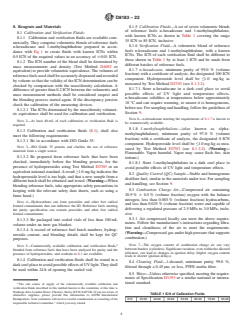
TABLE 1 ICN of Calibration Fluids
ICN 35.00 40.00 46.00 53.00 60.00 70.00 85.00
The sole source of supply of the commercially available calibration and verification fluids described in this method known to the committee at this time is Stanhope-Seta,
London Street, Chertsey, Surrey KT16 8AP UK. If you are aware of alternative suppliers, please provide this information to ASTM International Headquarters. Your comments
will receive careful consideration at a meeting of the responsible technical committee, which you may attend.
D8183 − 22
8.2 Quality Control (QC) Sample—Stable and homogenous distillate fuel, similar to the materials under test. For sampling and
handling, see Section 9.
8.3 Combustion Charge Air—Compressed air containing 20.9 % 6 0.5 % (volume fraction) oxygen with the balance nitrogen, less
than 0.003 % (volume fraction) hydrocarbons, and less than 0.025 % (volume fraction) water and capable of delivering a regulated
pressure of 2.5 MPa to 3.0 MPa, inclusive.
8.3.1 Air compressed locally can meet the above requirements. Follow the manufacturer’s instructions regarding filtration and
cleanliness of the air to meet the requirements. (Warning—Compressed gas under high pressure that supports combustion.)
NOTE 7—The oxygen content of combustion charge air can vary between batches (cylinders). Significant variation, even within the allowed tolerance,
can lead to changes in ignition delay (higher oxygen content leads to shorter ignition delays).
8.4 Cleaning Fluid—1-decanol, minimum purity 99.0 %, filtered through a 0.45 μm, or less, PTFE media filter.
8.5 Water—Unless otherwise specified, meeting the requirements of Specification D1193 or a similar national or international
standard.
8.6 Coolant System Fluid—30:70 (volume fraction) mixture of commercial grade ethylene glycol-type, aluminium compatible,
with algae inhibitor, vehicle radiator antifreeze with water (8.5).
8.7 Inert Gas—Argon or nitrogen, for use as a blanket over calibration and verification fluids, and samples.
9. Sampling Handling and Preparation
9.1 Sampling:
9.1.1 Collect diesel fuel oil samples in accordance with Practices D4057 or D4177.
9.1.2 Refer to Practice D5854 for appropriate information relating to the mixing and handling of test samples.
9.1.3 To minimize exposure to UV emissions that can induce chemical reactions and affect ignition delay measurement, collect
and store samples in containers that are constructed of materials that minimize light reaching the sample, such as dark brown/amber
bottles or epoxy lined metal containers or minimally-reactive plastic containers. If samples are collected in containers that do not
minimize light reaching the sample, they shall be wrapped or boxed in light-proof containers immediately after filling. If the
sample is not to be analyzed within 24 h, retain in a dark, cool environment, and preferably under an inert gas (see Interferences,
Section 6).
NOTE 8—The formation of peroxides and free radicals, which affect the ignition delay, is minimized when the sample is stored in the dark, under an inert
gas blanket, in a cool environment. Exposure of petroleum fuels to UV wavelengths for even a short period of time has been shown to affect ignition
delay.
9.2 Test Sample Preparation:
9.2.1 Sample Fuel Temperature—Condition the diesel fuel oil sample before opening the storage container, so that it is at room
temperature, typically 18 °C to 32 °C.
9.2.1.1 Fuel sample shall be homogeneous before testing. If in doubt, fuel temperature shall be raised at least 14 °C above the
fuel’s cloud point.
9.2.2 Collect the sample in a dark brown or amber bottle, suitable metal can or nonreactive plastic container.
9.2.3 Filter at least 40 mL of sample through the syringe filter (7.3) using the syringe (7.4) at ambient temperature, without
vacuum, into a new brown/amber sample vial (7.2) and immediately fit a new screw cap and septum (PTFE side inside the vial).
D8183 − 22
10. Basic Apparatus Settings and Standard Operating Conditions
10.1 Apparatus Installation—Follow the manufacturer’s instructions regarding apparatus assembly and installation. Annex A2
gives more details of the apparatus.
10.2 System Start-up and Warm-up:
10.2.1 Open the valve at the source of the combustion charge air supply and adjust the pressure regulator as needed to provide
the required 2.5 MPa to 3.0 MPa pressure (see 8.3).
10.2.2 Follow the manufacturer’s instructions to switch on power to the analyzer. This activates the electronic components in the
analyzer and the uninterruptable power supply that supplies the recirculating cooler’s (7.5) pump.
10.2.3 Check that the computer and the recirculating cooler are switched on.
10.2.4 Sample vials may be loaded into the carousel at any time.
10.2.5 Immediately after switch on, sample details may be entered into the computer program.
10.2.6 After the chamber wall and chamber air temperatures have stabilized, the analyzer can commence testing samples in the
carousel automatically.
10.2.7 For more details and in case of error messages, refer to the manufacturer’s instructions.
10.2.8 Run a test using a QC sample at the beginning of each new operating period, before commencing routine tests.
10.3 Standard Operating and Test Conditions:
10.3.1 The operation and test conditions are pre-set and are not user changeable. Sensors, and their tolerances, used to measure
these parameters are listed in Annex A2 as well as other sensors used for diagnostic and safety purposes.
10.3.2 Key operator and test conditions are shown in Table 2. If these conditions are not met, then follow the manufacturer’s
instructions.
11. Calibration, Verification, and Quality Control Testing
11.1 General—Calibration uses seven reference fuel blended fluids (see 8.1.1 to 8.1.6). Verification uses one or more reference
fuel blended fluids (s
...