

ASTM F1779-20
(Practice)Standard Practice for Reporting Visual Observations of Oil on Water from Aircraft
General Information
- Abstract
SIGNIFICANCE AND USE
3.1 This practice can be used by surveillance and tracking staff to report visual observations. The data produced from such observations will provide the basis for preparing maps of the oil-slick location.
3.2 This practice provides a procedure for reporting the visual observation of oil on water in a systematic manner and in a common format.
3.3 This practice deals with the possibility that materials other than oil might be confused with oil when using visual observation methods.
3.4 Local weather, including sea conditions, should be included in the reports.
SCOPE
1.1 This practice covers methods of reporting and recording visual observations of oil on water and related response activities from an airplane or helicopter. While a similar set of codes could be used for classifying oil on beaches, this subject is not discussed in this practice. It does not cover the use of remote-sensing equipment from aircraft, which is discussed in a separate standard. This does not include observations of dispersed oil.
1.2 This practice is applicable for all types of oil under a variety of environmental and geographical situations.
1.3 Visual observations of oil on water from the air involve a number of safety issues associated with the operation of airplanes or helicopters at low altitudes. These are not dealt with in this practice, but the observer should be aware of the hazards of such operations.
1.4 The values stated in SI units are to be regarded as standard. No other units of measurement are included in this standard.
1.5 This standard does not purport to address all of the safety concerns, if any, associated with its use. It is the responsibility of the user of this standard to establish appropriate safety, health, and environmental practices and determine the applicability of regulatory limitations prior to use.
1.6 This international standard was developed in accordance with internationally recognized principles on standardization established in the Decision on Principles for the Development of International Standards, Guides and Recommendations issued by the World Trade Organization Technical Barriers to Trade (TBT) Committee.
- Status
- Published
- Publication Date
- 31-Jan-2020
- Technical Committee
- F20 - Hazardous Substances and Oil Spill Response
- Drafting Committee
- F20.16 - Surveillance and Tracking
Buy Documents
ASTM F1779-20 - Standard Practice for Reporting Visual Observations of Oil on Water from Aircraft
REDLINE ASTM F1779-20 - Standard Practice for Reporting Visual Observations of Oil on Water from Aircraft
Overview
ASTM F1779-20: Standard Practice for Reporting Visual Observations of Oil on Water from Aircraft provides comprehensive guidance on the systematic reporting and recording of visual observations of oil spills from airplanes and helicopters. This standard is essential for organizations and individuals tasked with oil spill reconnaissance, surveillance, and emergency response. By establishing clear procedures and standardized codes for observations, ASTM F1779-20 ensures consistent and actionable data collection to support oil spill response efforts.
The standard outlines the required information to be recorded during overflights, addresses potential errors such as misidentifying non-oil substances, and emphasizes the need to include local weather and sea conditions in all reports. It applies to all types of oil spills occurring under various environmental and geographical circumstances.
Key Topics
ASTM F1779-20 covers the following critical elements for effective oil spill observation and reporting:
- Systematic Visual Observation: Defines procedures for aerial surveillance using helicopters or fixed-wing airplanes, focusing on key observational data such as slick size, location, shape, and characteristics.
- Standardized Reporting Format: Mandates a common format for data submission, improving clarity and utility for command centers and response teams.
- Slick Characterization: Details identification of slick color, form (e.g., windrows, tar balls), and percentage coverage, using clear codes for quick communication.
- Recording Additional Features: Includes reporting on response operations, wildlife presence, environmental conditions, and proximity to sensitive areas.
- Mapping and Documentation: Recommends the use of standardized base maps, overflight hand-drawings, and procedures for accurately plotting spill data.
- Effective Communication: Specifies protocols for real-time reporting via voice communications (radio or telephone), emphasizing sequence and data completeness.
- Considerations and Limitations: Notes that while the standard promotes best practices for observation and reporting, it does not address aircraft safety, remote-sensing instrumentation, or dispersed oil.
Applications
ASTM F1779-20 is a key reference for a variety of organizations involved in oil spill response and environmental monitoring:
- Oil Spill Response Teams: Rapidly gather and communicate critical slick information, aiding in real-time decision-making and optimal resource deployment.
- Environmental Protection Agencies: Establish consistent field procedures for documenting and tracing oil spill extents, supporting incident assessment and regulatory compliance.
- Marine and Coastal Management Authorities: Use standardized data to plan remediation, track wildlife at risk, and map the spread of pollutants.
- Aviation Operators: Integrate best-practice observation and reporting protocols into aerial surveillance missions, improving data reliability and response coordination.
- Training and Preparedness Programs: Serve as a foundation for drills and training sessions on airborne oil surveillance and reporting.
By following ASTM F1779-20, stakeholders ensure thorough, accurate, and timely records of oil on water, contributing significantly to environmental protection and effective cleanup operations.
Related Standards
For comprehensive oil spill observation and response, ASTM F1779-20 should be used alongside related standards and guides, such as:
- ASTM F2534 - Guide for Visually Estimating Oil Spill Thickness on Water: Offers guidance on determining oil layer thickness, complementing visual observation protocols.
- Remote Sensing Standards: Separate ASTM standards address the use of remote-sensing technologies from aircraft, which are not covered by F1779-20.
These standards, together with ASTM F1779-20, form a robust framework for oil spill surveillance, reporting, and response, supporting industry-wide best practices and international compatibility in environmental incident management.
Keywords: ASTM F1779-20, oil spill surveillance, airborne oil spill reporting, visual observation, oil spill reconnaissance, oil spill mapping, environmental monitoring, oil on water, overflight observation, spill response standards.
Relations
- Effective Date
- 01-Feb-2020
- Effective Date
- 01-Jan-2012
- Effective Date
- 01-Jun-2006
- Referred By
ASTM F2534-17(2022) - Standard Guide for Visually Estimating Oil Spill Thickness on Water - Effective Date
- 01-Feb-2020
- Effective Date
- 01-Feb-2020
Buy Documents
ASTM F1779-20 - Standard Practice for Reporting Visual Observations of Oil on Water from Aircraft
REDLINE ASTM F1779-20 - Standard Practice for Reporting Visual Observations of Oil on Water from Aircraft
Get Certified
Connect with accredited certification bodies for this standard

CIS Institut d.o.o.
Personal Protective Equipment (PPE) certification body. Notified Body NB-2890 for EU Regulation 2016/425 PPE.

Kiwa BDA Testing
Building and construction product certification.
Kmetijski inštitut Slovenije
Agricultural Institute of Slovenia. Soil testing, plant health, agricultural product analysis.
Sponsored listings
Frequently Asked Questions
ASTM F1779-20 is a standard published by ASTM International. Its full title is "Standard Practice for Reporting Visual Observations of Oil on Water from Aircraft". This standard covers: SIGNIFICANCE AND USE 3.1 This practice can be used by surveillance and tracking staff to report visual observations. The data produced from such observations will provide the basis for preparing maps of the oil-slick location. 3.2 This practice provides a procedure for reporting the visual observation of oil on water in a systematic manner and in a common format. 3.3 This practice deals with the possibility that materials other than oil might be confused with oil when using visual observation methods. 3.4 Local weather, including sea conditions, should be included in the reports. SCOPE 1.1 This practice covers methods of reporting and recording visual observations of oil on water and related response activities from an airplane or helicopter. While a similar set of codes could be used for classifying oil on beaches, this subject is not discussed in this practice. It does not cover the use of remote-sensing equipment from aircraft, which is discussed in a separate standard. This does not include observations of dispersed oil. 1.2 This practice is applicable for all types of oil under a variety of environmental and geographical situations. 1.3 Visual observations of oil on water from the air involve a number of safety issues associated with the operation of airplanes or helicopters at low altitudes. These are not dealt with in this practice, but the observer should be aware of the hazards of such operations. 1.4 The values stated in SI units are to be regarded as standard. No other units of measurement are included in this standard. 1.5 This standard does not purport to address all of the safety concerns, if any, associated with its use. It is the responsibility of the user of this standard to establish appropriate safety, health, and environmental practices and determine the applicability of regulatory limitations prior to use. 1.6 This international standard was developed in accordance with internationally recognized principles on standardization established in the Decision on Principles for the Development of International Standards, Guides and Recommendations issued by the World Trade Organization Technical Barriers to Trade (TBT) Committee.
SIGNIFICANCE AND USE 3.1 This practice can be used by surveillance and tracking staff to report visual observations. The data produced from such observations will provide the basis for preparing maps of the oil-slick location. 3.2 This practice provides a procedure for reporting the visual observation of oil on water in a systematic manner and in a common format. 3.3 This practice deals with the possibility that materials other than oil might be confused with oil when using visual observation methods. 3.4 Local weather, including sea conditions, should be included in the reports. SCOPE 1.1 This practice covers methods of reporting and recording visual observations of oil on water and related response activities from an airplane or helicopter. While a similar set of codes could be used for classifying oil on beaches, this subject is not discussed in this practice. It does not cover the use of remote-sensing equipment from aircraft, which is discussed in a separate standard. This does not include observations of dispersed oil. 1.2 This practice is applicable for all types of oil under a variety of environmental and geographical situations. 1.3 Visual observations of oil on water from the air involve a number of safety issues associated with the operation of airplanes or helicopters at low altitudes. These are not dealt with in this practice, but the observer should be aware of the hazards of such operations. 1.4 The values stated in SI units are to be regarded as standard. No other units of measurement are included in this standard. 1.5 This standard does not purport to address all of the safety concerns, if any, associated with its use. It is the responsibility of the user of this standard to establish appropriate safety, health, and environmental practices and determine the applicability of regulatory limitations prior to use. 1.6 This international standard was developed in accordance with internationally recognized principles on standardization established in the Decision on Principles for the Development of International Standards, Guides and Recommendations issued by the World Trade Organization Technical Barriers to Trade (TBT) Committee.
ASTM F1779-20 is classified under the following ICS (International Classification for Standards) categories: 13.060.50 - Examination of water for chemical substances. The ICS classification helps identify the subject area and facilitates finding related standards.
ASTM F1779-20 has the following relationships with other standards: It is inter standard links to ASTM F1779-08(2014), ASTM F2534-12, ASTM F2534-06, ASTM F2534-17(2022), ASTM F1686-22. Understanding these relationships helps ensure you are using the most current and applicable version of the standard.
ASTM F1779-20 is available in PDF format for immediate download after purchase. The document can be added to your cart and obtained through the secure checkout process. Digital delivery ensures instant access to the complete standard document.
Standards Content (Sample)
This international standard was developed in accordance with internationally recognized principles on standardization established in the Decision on Principles for the
Development of International Standards, Guides and Recommendations issued by the World Trade Organization Technical Barriers to Trade (TBT) Committee.
Designation: F1779 − 20
Standard Practice for
Reporting Visual Observations of Oil on Water from Aircraft
This standard is issued under the fixed designation F1779; the number immediately following the designation indicates the year of
original adoption or, in the case of revision, the year of last revision. A number in parentheses indicates the year of last reapproval. A
superscript epsilon (´) indicates an editorial change since the last revision or reapproval.
1. Scope F2534 Guide for Visually Estimating Oil Spill Thickness on
Water
1.1 This practice covers methods of reporting and recording
visual observations of oil on water and related response
3. Significance and Use
activities from an airplane or helicopter. While a similar set of
3.1 This practice can be used by surveillance and tracking
codes could be used for classifying oil on beaches, this subject
staff to report visual observations. The data produced from
is not discussed in this practice. It does not cover the use of
such observations will provide the basis for preparing maps of
remote-sensing equipment from aircraft, which is discussed in
the oil-slick location.
a separate standard. This does not include observations of
dispersed oil.
3.2 This practice provides a procedure for reporting the
visual observation of oil on water in a systematic manner and
1.2 This practice is applicable for all types of oil under a
in a common format.
variety of environmental and geographical situations.
3.3 This practice deals with the possibility that materials
1.3 Visual observations of oil on water from the air involve
other than oil might be confused with oil when using visual
a number of safety issues associated with the operation of
observation methods.
airplanes or helicopters at low altitudes. These are not dealt
with in this practice, but the observer should be aware of the
3.4 Local weather, including sea conditions, should be
hazards of such operations.
included in the reports.
1.4 The values stated in SI units are to be regarded as
4. Observational Methods
standard. No other units of measurement are included in this
4.1 The basic information needed from a visual observation
standard.
program includes the slick size and location, as well as its
1.5 This standard does not purport to address all of the
characteristics and shape. The location (preferably determined
safety concerns, if any, associated with its use. It is the
by GPS) and some aspects of the effectiveness of a response
responsibility of the user of this standard to establish appro-
operation can be easily determined from an aerial platform.
priate safety, health, and environmental practices and deter-
Reports on the presence of wildlife and the proximity of oil to
mine the applicability of regulatory limitations prior to use.
environmentally sensitive areas are useful information that can
1.6 This international standard was developed in accor-
be generated from overflights.
dance with internationally recognized principles on standard-
ization established in the Decision on Principles for the 4.2 Observers of oil on water will generally use either a
Development of International Standards, Guides and Recom- helicopter or a small fixed-wing airplane. The planes shall be
mendations issued by the World Trade Organization Technical capableofslow-speedflight(120to240km/h;60to120knots)
for extended periods of time and have good forward and side
Barriers to Trade (TBT) Committee.
visibility.The aircraft shall have adequate range and endurance
2. Referenced Documents
consistent with the size and location of the spill.
2.1 ASTM Standards:
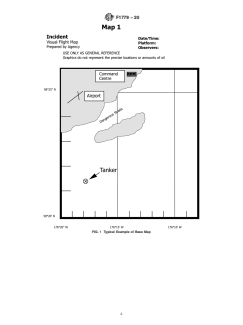
4.3 Standardmapsshallbeprovidedtotheobservers,sothat
their data can be easily transferred to a single map or map set
for reporting and dissemination. The same maps should be
This practice is under the jurisdiction of ASTM Committee F20 on Hazardous
used by the command team and the observers. These maps can
Substances and Oil Spill Responseand is the direct responsibility of Subcommittee
F20.16 on Surveillance and Tracking.
be based on marine charts, topographic maps or special maps
Current edition approved Feb. 1, 2020. Published March 2020. Originally
produced for the spill. Useful scales vary from 1:10000 to
approved in 1997. Last previous edition approved in 2014 as F1779 – 08(2014).
1:50000. It is difficult to plot information to the required
DOI: 10.1520/F1779-20.
For referenced ASTM standards, visit the ASTM website, www.astm.org, or accuracy using maps of a larger scale.
contact ASTM Customer Service at service@astm.org. For Annual Book of ASTM
4.4 The flight path shall be shown on all maps. The actual
Standards volume information, refer to the standard’s Document Summary page on
the ASTM website. flight path should be recorded on GPS and can be transferred
Copyright © ASTM International, 100 Barr Harbor Drive, PO Box C700, West Conshohocken, PA 19428-2959. United States
F1779 − 20
to the map(s) later. An initial proposed flight path should be 5.8.1 Mechanical response operations (such as booms and
prepared prior to the flight. During the flight, deviations from skimmers)—M.
this plan may be necessary in order to observe the total area of 5.8.2 Dispersant or chemical response operations—D.
the slick. 5.8.3 In-situ burning (Fire) response operations—F.
5.8.4 Shoreline cleanup in the area— S.
4.5 Typical flight altitudes range from 100 to 1000 m
5.8.5 Animals or birds seen in area— A.
depending on the type of the spill and on the cloud ceiling at
5.8.6 Wildlife Habitat in area— H.
flight time. There are flight safety considerations associated
5.8.7 Ocean features—O (such as convergences).
with low-altitude flying.
5.8.8 EXtra features such as ice, debris—X.
4.6 The best angle to observe an oil slick is directly above
5.9 Each element shall be separated by a forward slash (/)
it looking straight down. This is known as a nadir observation.
except for other properties which are included as a group.Thus
The flight path should be adjusted, wherever possible, to
a slick could be described as B/50/W/M. This can be decoded
provide observers with a nadir view of the slick. For most
as a slick containing Black oil with a 50 % coverage.The oil is
fixed-wing aircraft, it is not possible to observe directly
in Windrows and a Mechanical response operation is being
downwards, and therefore the flight path should be chosen to
undertaken.
allow for observation of the spill at as near the vertical as
possible.
6. Voice Communications
6.1 Need for Voice Communications—Since timeliness is
5. Methods of Reporting
very important, rapid communication of observations is essen-
5.1 Reporting Needs—There are a number of characteristics
tial. There are many situations that require the use of voice
of the slick that shall be reported in order to provide the user
communications, either by radio or telephone to describe an oil
of visual observations with the appropriate amount of infor-
slick. In this case, sufficient information shall be communi-
mation.Thefollowingcharacteristicsshallbereportedforeach
cated in order to allow the recipient to produce a map of the
slick that is observed during a reconnaissance flight. These
observations.
observations are a snap-shot in time. Both the location and
6.2 Location of Observation—This location shall be re-
characteristics of an oil slick change rapidly. In order to be
portedinlatitudeandlongitudeoftheapparentcenteroftheoil
useful for responders, the information should be available a
slick being observed. If the leading edge of the slick can be
short time after it is obtained (typically less than 3 h).
located, its position should be reported. This
...
This document is not an ASTM standard and is intended only to provide the user of an ASTM standard an indication of what changes have been made to the previous version. Because
it may not be technically possible to adequately depict all changes accurately, ASTM recommends that users consult prior editions as appropriate. In all cases only the current version
of the standard as published by ASTM is to be considered the official document.
Designation: F1779 − 08 (Reapproved 2014) F1779 − 20
Standard Practice for
Reporting Visual Observations of Oil on Water from Aircraft
This standard is issued under the fixed designation F1779; the number immediately following the designation indicates the year of
original adoption or, in the case of revision, the year of last revision. A number in parentheses indicates the year of last reapproval. A
superscript epsilon (´) indicates an editorial change since the last revision or reapproval.
1. Scope
1.1 This practice covers methods of reporting and recording visual observations of oil on water and related response activities.
1.1 This practice applies only to covers methods of reporting and recording visual observations of oil on water and related
response activities from an airplane or helicopter. While a similar set of codes could be used for classifying oil on beaches, this
subject is not discussed in this practice. It does not cover the use of remote-sensing equipment from aircraft, which is discussed
in a separate standard. This does not include observations of dispersed oil.
1.2 This practice is applicable for all types of oil under a variety of environmental and geographical situations.
1.3 Visual observations of oil on water from the air involve a number of safety issues associated with the operation of airplanes
or helicopters at low altitudes. These are not dealt with in this practice, but the observer should be aware of the hazards of such
operations.
1.4 The values stated in SI units are to be regarded as standard. No other units of measurement are included in this standard.
1.5 This standard does not purport to address all of the safety concerns, if any, associated with its use. It is the responsibility
of the user of this standard to establish appropriate safety safety, health, and healthenvironmental practices and determine the
applicability of regulatory limitations prior to use.
1.6 This international standard was developed in accordance with internationally recognized principles on standardization
established in the Decision on Principles for the Development of International Standards, Guides and Recommendations issued
by the World Trade Organization Technical Barriers to Trade (TBT) Committee.
2. Referenced Documents
2.1 ASTM Standards:
F2534 Guide for Visually Estimating Oil Spill Thickness on Water
3. Significance and Use
3.1 This practice can be used by surveillance and tracking staff to report visual observations. The data produced from such
observations will provide the basis for preparing maps of the oil-slick location.
3.2 This practice provides a procedure for reporting the visual observation of oil on water in a systematic manner and in a
common format.
3.3 This practice deals with the possibility that materials other than oil might be confused with oil when using visual observation
methods.
3.4 Local weather, including sea conditions, should be included in the reports.
4. Observational Methods
4.1 The basic information needed from a visual observation program includes the slick size and location, as well as its
characteristics and shape. The location (preferably determined by GPS) and some aspects of the effectiveness of a response
This practice is under the jurisdiction of ASTM Committee F20 on Hazardous Substances and Oil Spill Responseand is the direct responsibility of Subcommittee F20.16
on Surveillance and Tracking.
Current edition approved March 1, 2014Feb. 1, 2020. Published March 2014March 2020. Originally approved in 1997. Last previous edition approved in 20082014 as
F1779 – 08.F1779 – 08(2014). DOI: 10.1520/F1779-08R14.10.1520/F1779-20.
For referenced ASTM standards, visit the ASTM website, www.astm.org, or contact ASTM Customer Service at service@astm.org. For Annual Book of ASTM Standards
volume information, refer to the standard’s Document Summary page on the ASTM website.
Copyright © ASTM International, 100 Barr Harbor Drive, PO Box C700, West Conshohocken, PA 19428-2959. United States
F1779 − 20
operation can be easily determined from an aerial platform. Reports on the presence of wildlife and the proximity of oil to
environmentally sensitive areas are useful information that can be generated from overflights.
4.2 Observers of oil on water will generally use either a helicopter or a small fixed-wing airplane. The planes shall be capable
of slow-speed flight (120 to 240 km/h; 60 to 120 knots) for extended periods of time and have good forward and side visibility.
The aircraft shall have adequate range and endurance consistent with the size and location of the spill.
4.3 Standard maps shall be provided to the observers, so that their data can be easily transferred to a single map or map set for
reporting and dissemination. The same maps should be used by the command team and the observers. These maps can be based
on marine charts, topographic maps or special maps produced for the spill. Useful scales vary from 1:10000 to 1:50000. It is
difficult to plot information to the required accuracy using maps of a larger scale.
4.4 The flight path shall be shown on all maps. The actual flight path should be recorded on GPS and can be transferred to the
map(s) later. An initial proposed flight path should be prepared prior to the flight. During the flight, deviations from this plan may
be necessary in order to observe the total area of the slick.
4.5 Typical flight altitudes range from 100 to 1000 m depending on the type of the spill and on the cloud ceiling at flight time.
There are flight safety considerations associated with low-altitude flying.
4.6 The best angle to observe an oil slick is directly above it looking straight down. This is known as a nadir observation. The
flight path should be adjusted, wherever possible, to provide observers with a nadir view of the slick. For most fixed-wing aircraft,
it is not possible to observe directly downwards, and therefore the flight path should be chosen to allow for observation of the spill
at as near the vertical as possible.
5. Methods of Reporting
5.1 Reporting Needs—There are a number of characteristics of the slick that shall be reported in order to provide the user of
visual observations with the appropriate amount of information. The following characteristics shall be reported for each slick that
is observed during a reconnaissance flight. These observations are a snap-shot in time. Both the location and characteristics of an
oil slick change rapidly. In order to be useful for responders, the information should be available a short time after it is obtained
(typically less than 3 h).
5.2 Color of Slick—This shall be reported as a color code, as follows:
5.2.1 Brown or Black—B.
5.2.2 Brown or Black with a red tinge signifying presence of an Emulsion or mousse— E.
5.2.3 Rainbow sheen —R.
5.2.4 Grey or Silver Grey sheen—G.
5.3 Percentage Coverage and Character of Slick—Percentage of area as described that is covered by oil.
5.3 The character of the distribution of the slick shall be noted such as follows:
5.3.1 Windrows—W.
5.3.2 Continuous—C.
5.3.3 Tar Balls—T.
5.3.4 Pancakes—P.
5.4 Percentage Coverage—Percentage of area as discribed in terms of color and character, that is covered by oil (if possible).
5.5 The eight parameters in 5.2 and 5.45.3 give a description of the oil slick.
5.6 Slick Features—If the leading edge of the slick can be identified, is should be noted as a heavy line.
5.7 The preceding data complete the description of the slick, as it would be placed on a base map.
5.8 Other Properties—There are a number of secondary related features that can be easily observed during a reconnaissance
flight, and should be reported on the surveillance map, if appropriate. This recording of such information yields additional useful
data from a surveillance flight. These observations include:
5.8.1 Mechanical re
...