

ASTM D5731-16
(Test Method)Standard Test Method for Determination of the Point Load Strength Index of Rock and Application to Rock Strength Classifications
General Information
- Abstract
SIGNIFICANCE AND USE
5.1 The uniaxial compression test (see Test Method D7012) is used to determine compressive strength of rock specimens. However, it is a time-consuming and expensive test that requires significant specimen preparation and the results may not be available for a long time after the samples are collected. When extensive testing and/or timely information is needed for preliminary and reconnaissance information, alternative tests such as the point load test can be used to reduce the time and cost of compressive strength tests, when used in the field. Such data can be used to make timely and more informed decisions during the exploration phases and more efficient and cost effective selection of samples for more precise and expensive laboratory tests.
5.2 The point load strength test is used as an index test for strength classification of rock materials. The test results should not be used for design or analytical purposes.
5.3 This test method is performed to determine the point load strength index of rock specimens and, if required, the point load strength anisotropy index.
5.4 Rock specimens in the form of either core (the diametral and axial tests), cut blocks (the block test), or irregular lumps (the irregular lump test) are tested by application of concentrated load through a pair of truncated, conical platens. Little or no specimen preparation is needed and can therefore be tested shortly after being obtained and any influence of moisture condition on the test data minimized. However, the results can be highly influenced by how the specimen is treated from the time it is obtained until the time it is tested. Therefore, it may be necessary to handle specimens in accordance with Practice D5079 and to document moisture conditions in some manner in the data collection.
Note 1: The quality of the result produced by this standard is dependent upon the competence of the personnel performing it, and the suitability of the equipment and facilities used. Agencies th...
SCOPE
1.1 This test method covers the guidelines, requirements, and procedures for determining the point load strength index of rock. This is an index test and is intended to be used to classify rock strength.
1.2 Specimens in the form of rock cores, blocks, or irregular lumps with a test diameter from 30 to 85 mm can be tested by this test method.
1.3 This test method can be performed in either the field or laboratory. The test is typically used in the field because the testing machine is portable, little or minimal specimen preparation is required, and specimens can be tested within a short time frame of being collected.
1.4 This test method applies to medium strength rock (compressive strength over 15 MPa).
1.5 This test method does not cover which type of specimen should be tested or whether anisotropic factors should be considered. The specifics of the point load test program need to be developed prior to testing and possibly even before sampling. Such specifics would be dependent on the intended use of the data, as well as possible budgetary constraints and possible other factors, which are outside the scope of this test method.
1.6 All observed and calculated values shall conform to the guidelines for significant digits and rounding established in Practice D6026.
1.6.1 The procedures used to specify how data are collected/recorded and calculated in this standard are regarded as the industry standard. In addition, they are representative of the significant digits that generally should be retained. The procedures used do not consider material variation, purpose for obtaining data, special purpose studies, or any considerations for the user’s objectives; and it is common practice to increase or reduce significant digits of reported data to commensurate with these considerations. It is beyond the scope of these test methods to consider significant digits used in analysis methods for engineering design
1...
- Status
- Published
- Publication Date
- 30-Nov-2016
- Technical Committee
- D18 - Soil and Rock
- Drafting Committee
- D18.12 - Rock Mechanics
Buy Documents
ASTM D5731-16 - Standard Test Method for Determination of the Point Load Strength Index of Rock and Application to Rock Strength Classifications
REDLINE ASTM D5731-16 - Standard Test Method for Determination of the Point Load Strength Index of Rock and Application to Rock Strength Classifications
Overview
ASTM D5731-16 is the established standard test method for determining the point load strength index of rock and its application to rock strength classifications. Developed by ASTM International, this test method enables engineers and geoscientists to quickly obtain an index for rock strength in both field and laboratory environments. It is particularly valued for its efficiency and cost-effectiveness when compared to more time-intensive methods, such as the uniaxial compression test (ASTM D7012).
Key features of ASTM D5731-16 include:
- Provides a rapid, portable test for assessing the strength of medium strength rock (compressive strength above 15 MPa).
- Requires minimal sample preparation and can be performed on rock cores, blocks, or irregular lumps.
- Supports early decision-making in site exploration and sample selection for further, more precise testing.
Key Topics
1. Significance and Utility
- The point load strength index is used as an index test to facilitate strength classification of rock materials.
- Particularly useful during preliminary site investigations and reconnaissance, where timely information is critical.
- Reduces the time and expense associated with more elaborate compressive strength testing.
2. Applicable Specimens and Testing Environments
- Accepts a wide range of specimen shapes: cores (diametral and axial tests), cut blocks, or irregular lumps.
- Suitable for samples with diameters from 30 to 85 mm, with a preference for around 50 mm.
- Can be performed in both the field and laboratory, with the method tailored for field portability.
3. Testing and Reporting Procedures
- Relies on a point load tester consisting of a loading frame, hardened platens, and load/distance measurement systems.
- Specimens are subjected to a concentrated load through truncated, conical platens until failure occurs.
- Results are recorded consistently, with guidelines for significant digits as per ASTM D6026 and moisture documentation as per ASTM D2216.
4. Limitations
- The point load strength index is intended for classification purposes only, not for direct design or analytical applications.
- Variations in specimen preparation, shape, moisture condition, and handling can influence results.
Applications
ASTM D5731-16 is widely utilized across various geotechnical, civil, and geological engineering contexts where rock strength data is needed promptly and cost-effectively:
- Site Exploration: Rapid assessment of subsurface rock strength for preliminary design and planning.
- Strength Classification: Preliminary strength classifications guide the selection of specimens for further testing.
- Field Reconnaissance: Mobile equipment allows for on-site rock strength evaluation, accelerating project timelines.
- Mining and Construction: Assists in evaluating rock quality for tunneling, excavations, and foundation design.
The method is particularly advantageous when a large number of specimens require testing or when immediate strength information is essential to project progress.
Related Standards
- ASTM D7012 - Test Methods for Compressive Strength and Elastic Moduli of Intact Rock Core Specimens
- ASTM D5079 - Practices for Preserving and Transporting Rock Core Samples
- ASTM D653 - Terminology Relating to Soil, Rock, and Contained Fluids
- ASTM D2216 - Test Methods for Laboratory Determination of Water Content of Soil and Rock
- ASTM D6026 - Practice for Using Significant Digits in Geotechnical Data
- ISRM Suggested Methods - International Society for Rock Mechanics standards for determining point load strength
These related standards provide essential procedures, terminology, and best practices for comprehensive rock testing and data reliability in geotechnical and geological applications.
Keywords: ASTM D5731-16, point load strength index, rock strength classification, field rock testing, geotechnical engineering, rock specimen, compressive strength, laboratory test method, strength index test, ASTM rock testing standards.
Relations
- Effective Date
- 01-Dec-2016
- Effective Date
- 01-Nov-2023
- Effective Date
- 01-Oct-2019
- Effective Date
- 01-Mar-2019
- Effective Date
- 01-Jul-2018
- Effective Date
- 01-Jul-2017
- Effective Date
- 01-Aug-2014
- Effective Date
- 01-May-2014
- Effective Date
- 15-Nov-2013
- Effective Date
- 01-Dec-2012
- Effective Date
- 01-May-2012
- Effective Date
- 01-Mar-2012
- Effective Date
- 01-Nov-2011
- Effective Date
- 01-Sep-2011
- Effective Date
- 01-Sep-2011
Buy Documents
ASTM D5731-16 - Standard Test Method for Determination of the Point Load Strength Index of Rock and Application to Rock Strength Classifications
REDLINE ASTM D5731-16 - Standard Test Method for Determination of the Point Load Strength Index of Rock and Application to Rock Strength Classifications
Get Certified
Connect with accredited certification bodies for this standard

Zavod za gradbeništvo Slovenije (ZAG) - Inšpekcija
ZAG inspection body for construction products, structures, and materials.
Sponsored listings
Frequently Asked Questions
ASTM D5731-16 is a standard published by ASTM International. Its full title is "Standard Test Method for Determination of the Point Load Strength Index of Rock and Application to Rock Strength Classifications". This standard covers: SIGNIFICANCE AND USE 5.1 The uniaxial compression test (see Test Method D7012) is used to determine compressive strength of rock specimens. However, it is a time-consuming and expensive test that requires significant specimen preparation and the results may not be available for a long time after the samples are collected. When extensive testing and/or timely information is needed for preliminary and reconnaissance information, alternative tests such as the point load test can be used to reduce the time and cost of compressive strength tests, when used in the field. Such data can be used to make timely and more informed decisions during the exploration phases and more efficient and cost effective selection of samples for more precise and expensive laboratory tests. 5.2 The point load strength test is used as an index test for strength classification of rock materials. The test results should not be used for design or analytical purposes. 5.3 This test method is performed to determine the point load strength index of rock specimens and, if required, the point load strength anisotropy index. 5.4 Rock specimens in the form of either core (the diametral and axial tests), cut blocks (the block test), or irregular lumps (the irregular lump test) are tested by application of concentrated load through a pair of truncated, conical platens. Little or no specimen preparation is needed and can therefore be tested shortly after being obtained and any influence of moisture condition on the test data minimized. However, the results can be highly influenced by how the specimen is treated from the time it is obtained until the time it is tested. Therefore, it may be necessary to handle specimens in accordance with Practice D5079 and to document moisture conditions in some manner in the data collection. Note 1: The quality of the result produced by this standard is dependent upon the competence of the personnel performing it, and the suitability of the equipment and facilities used. Agencies th... SCOPE 1.1 This test method covers the guidelines, requirements, and procedures for determining the point load strength index of rock. This is an index test and is intended to be used to classify rock strength. 1.2 Specimens in the form of rock cores, blocks, or irregular lumps with a test diameter from 30 to 85 mm can be tested by this test method. 1.3 This test method can be performed in either the field or laboratory. The test is typically used in the field because the testing machine is portable, little or minimal specimen preparation is required, and specimens can be tested within a short time frame of being collected. 1.4 This test method applies to medium strength rock (compressive strength over 15 MPa). 1.5 This test method does not cover which type of specimen should be tested or whether anisotropic factors should be considered. The specifics of the point load test program need to be developed prior to testing and possibly even before sampling. Such specifics would be dependent on the intended use of the data, as well as possible budgetary constraints and possible other factors, which are outside the scope of this test method. 1.6 All observed and calculated values shall conform to the guidelines for significant digits and rounding established in Practice D6026. 1.6.1 The procedures used to specify how data are collected/recorded and calculated in this standard are regarded as the industry standard. In addition, they are representative of the significant digits that generally should be retained. The procedures used do not consider material variation, purpose for obtaining data, special purpose studies, or any considerations for the user’s objectives; and it is common practice to increase or reduce significant digits of reported data to commensurate with these considerations. It is beyond the scope of these test methods to consider significant digits used in analysis methods for engineering design 1...
SIGNIFICANCE AND USE 5.1 The uniaxial compression test (see Test Method D7012) is used to determine compressive strength of rock specimens. However, it is a time-consuming and expensive test that requires significant specimen preparation and the results may not be available for a long time after the samples are collected. When extensive testing and/or timely information is needed for preliminary and reconnaissance information, alternative tests such as the point load test can be used to reduce the time and cost of compressive strength tests, when used in the field. Such data can be used to make timely and more informed decisions during the exploration phases and more efficient and cost effective selection of samples for more precise and expensive laboratory tests. 5.2 The point load strength test is used as an index test for strength classification of rock materials. The test results should not be used for design or analytical purposes. 5.3 This test method is performed to determine the point load strength index of rock specimens and, if required, the point load strength anisotropy index. 5.4 Rock specimens in the form of either core (the diametral and axial tests), cut blocks (the block test), or irregular lumps (the irregular lump test) are tested by application of concentrated load through a pair of truncated, conical platens. Little or no specimen preparation is needed and can therefore be tested shortly after being obtained and any influence of moisture condition on the test data minimized. However, the results can be highly influenced by how the specimen is treated from the time it is obtained until the time it is tested. Therefore, it may be necessary to handle specimens in accordance with Practice D5079 and to document moisture conditions in some manner in the data collection. Note 1: The quality of the result produced by this standard is dependent upon the competence of the personnel performing it, and the suitability of the equipment and facilities used. Agencies th... SCOPE 1.1 This test method covers the guidelines, requirements, and procedures for determining the point load strength index of rock. This is an index test and is intended to be used to classify rock strength. 1.2 Specimens in the form of rock cores, blocks, or irregular lumps with a test diameter from 30 to 85 mm can be tested by this test method. 1.3 This test method can be performed in either the field or laboratory. The test is typically used in the field because the testing machine is portable, little or minimal specimen preparation is required, and specimens can be tested within a short time frame of being collected. 1.4 This test method applies to medium strength rock (compressive strength over 15 MPa). 1.5 This test method does not cover which type of specimen should be tested or whether anisotropic factors should be considered. The specifics of the point load test program need to be developed prior to testing and possibly even before sampling. Such specifics would be dependent on the intended use of the data, as well as possible budgetary constraints and possible other factors, which are outside the scope of this test method. 1.6 All observed and calculated values shall conform to the guidelines for significant digits and rounding established in Practice D6026. 1.6.1 The procedures used to specify how data are collected/recorded and calculated in this standard are regarded as the industry standard. In addition, they are representative of the significant digits that generally should be retained. The procedures used do not consider material variation, purpose for obtaining data, special purpose studies, or any considerations for the user’s objectives; and it is common practice to increase or reduce significant digits of reported data to commensurate with these considerations. It is beyond the scope of these test methods to consider significant digits used in analysis methods for engineering design 1...
ASTM D5731-16 is classified under the following ICS (International Classification for Standards) categories: 93.020 - Earthworks. Excavations. Foundation construction. Underground works. The ICS classification helps identify the subject area and facilitates finding related standards.
ASTM D5731-16 has the following relationships with other standards: It is inter standard links to ASTM D5731-08, ASTM D3740-23, ASTM D3740-19, ASTM D2216-19, ASTM E18-18, ASTM E18-17, ASTM D653-14, ASTM D7012-14, ASTM D7012-13, ASTM E18-12, ASTM D3740-12a, ASTM D3740-12, ASTM E18-11, ASTM D653-11, ASTM D3740-11. Understanding these relationships helps ensure you are using the most current and applicable version of the standard.
ASTM D5731-16 is available in PDF format for immediate download after purchase. The document can be added to your cart and obtained through the secure checkout process. Digital delivery ensures instant access to the complete standard document.
Standards Content (Sample)
This international standard was developed in accordance with internationally recognized principles on standardization established in the Decision on Principles for the
Development of International Standards, Guides and Recommendations issued by the World Trade Organization Technical Barriers to Trade (TBT) Committee.
Designation:D5731 −16
Standard Test Method for
Determination of the Point Load Strength Index of Rock and
Application to Rock Strength Classifications
This standard is issued under the fixed designation D5731; the number immediately following the designation indicates the year of
original adoption or, in the case of revision, the year of last revision. A number in parentheses indicates the year of last reapproval. A
superscript epsilon (´) indicates an editorial change since the last revision or reapproval.
1. Scope* methods to consider significant digits used in analysis methods
for engineering design
1.1 This test method covers the guidelines, requirements,
andproceduresfordeterminingthepointloadstrengthindexof
1.7 The values stated in the SI units are to be regarded as
rock.This is an index test and is intended to be used to classify
standard.
rock strength.
1.8 This standard does not purport to address all of the
1.2 Specimensintheformofrockcores,blocks,orirregular
safety concerns, if any, associated with its use. It is the
lumps with a test diameter from 30 to 85 mm can be tested by
responsibility of the user of this standard to establish appro-
this test method.
priate safety and health practices and determine the applica-
bility of regulatory limitations prior to use.
1.3 This test method can be performed in either the field or
laboratory. The test is typically used in the field because the
2. Referenced Documents
testing machine is portable, little or minimal specimen prepa-
ration is required, and specimens can be tested within a short
2.1 ASTM Standards:
time frame of being collected.
D653 Terminology Relating to Soil, Rock, and Contained
1.4 This test method applies to medium strength rock
Fluids
(compressive strength over 15 MPa).
D2216 Test Methods for Laboratory Determination of Water
(Moisture) Content of Soil and Rock by Mass
1.5 This test method does not cover which type of specimen
D3740 Practice for Minimum Requirements for Agencies
should be tested or whether anisotropic factors should be
Engaged in Testing and/or Inspection of Soil and Rock as
considered.Thespecificsofthepointloadtestprogramneedto
Used in Engineering Design and Construction
be developed prior to testing and possibly even before sam-
D5079 Practices for Preserving and Transporting Rock Core
pling. Such specifics would be dependent on the intended use
Samples
of the data, as well as possible budgetary constraints and
D6026 Practice for Using Significant Digits in Geotechnical
possible other factors, which are outside the scope of this test
Data
method.
D7012 Test Methods for Compressive Strength and Elastic
1.6 All observed and calculated values shall conform to the
Moduli of Intact Rock Core Specimens under Varying
guidelines for significant digits and rounding established in
States of Stress and Temperatures
Practice D6026.
E18 Test Methods for Rockwell Hardness of Metallic Ma-
1.6.1 Theproceduresusedtospecifyhowdataarecollected/
terials
recorded and calculated in this standard are regarded as the
E122 Practice for Calculating Sample Size to Estimate,With
industry standard. In addition, they are representative of the
Specified Precision, the Average for a Characteristic of a
significant digits that generally should be retained. The proce-
Lot or Process
dures used do not consider material variation, purpose for
2.2 ISRM Standard:
obtaining data, special purpose studies, or any considerations
Suggested Methods for Determining Point Load Strength
for the user’s objectives; and it is common practice to increase
or reduce significant digits of reported data to commensurate
with these considerations. It is beyond the scope of these test
For referenced ASTM standards, visit the ASTM website, www.astm.org, or
contact ASTM Customer Service at service@astm.org. For Annual Book of ASTM
ThistestmethodisunderthejurisdictionofASTMCommitteeD18onSoiland Standards volume information, refer to the standard’s Document Summary page on
Rock and is the direct responsibility of Subcommittee D18.12 on Rock Mechanics. the ASTM website.
Current edition approved Dec. 1, 2016. Published January 2017. Originally “Suggested Methods for Determining Point Load Strength”, International
approved in 1995. Last previous edition approved in 2008 as D5731 – 08. DOI: Society for Rock Mechanics Commission on Testing Methods, Int. J. Rock. Mech.
10.1520/D5731-16. Min. Sci. and Geomechanical Abstr., Vol 22, No. 2, 1985, pp. 51–60.
*A Summary of Changes section appears at the end of this standard
Copyright © ASTM International, 100 Barr Harbor Drive, PO Box C700, West Conshohocken, PA 19428-2959. United States
D5731−16
3. Terminology (the irregular lump test) are tested by application of concen-
tratedloadthroughapairoftruncated,conicalplatens.Littleor
3.1 Definitions—For definitions of common technical terms
no specimen preparation is needed and can therefore be tested
used in this standard refer to Terminology D653.
shortly after being obtained and any influence of moisture
3.2 Definitions of Terms Specific to This Standard:
condition on the test data minimized. However, the results can
3.2.1 diameter, n—D, for point load tests, the measured
be highly influenced by how the specimen is treated from the
dimension of the specimen between the opposing conical test
time it is obtained until the time it is tested. Therefore, it may
platens when placed in the test machine
be necessary to handle specimens in accordance with Practice
3.2.2 point load strength anisotropy index, n—I , the
a(D)
D5079andtodocumentmoistureconditionsinsomemannerin
strength anisotropy index is defined as the ratio of mean I
s(D)
the data collection.
values measured perpendicular and parallel to planes of weak-
NOTE 1—The quality of the result produced by this standard is
ness. That is, the ratio of greatest to least point load strength
dependent upon the competence of the personnel performing it, and the
indices on different axes that result in the greatest and least
suitability of the equipment and facilities used. Agencies that meet the
ratio of point load strengths values.
criteria of Practice D3740 are generally considered capable of competent
3.2.3 size-corrected point load strength index, n—I , the
and objective testing and sampling. Users of this standard are cautioned
s(D)
that compliance with Practice D3740 does not in itself assure reliable
original point load strength index value multiplied by a factor
results. Reliable results depend on many factors; Practice D3740 provides
to normalize the value that would have been obtained with
a means of evaluating some of those factors.
diametral test of diameter (D).
3.2.4 uncorrected point load strength index, n—(I ), an
s
6. Apparatus
indicator of strength (see 10.1) obtained by subjecting a rock
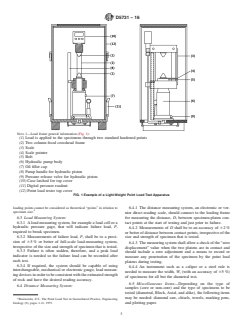
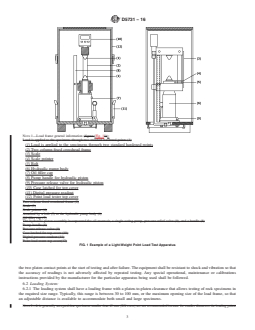
6.1 General—A basic point load tester (see Fig. 1) consists
specimen to an increasingly concentrated point load, applied
of a loading system typically comprised of a loading frame,
through a pair of truncated, conical platens, until failure
platens, a measuring system for indicating load, P, (required to
occurs.
break the specimen), and a means for measuring the distance,
4. Summary of Test Method
D, between the two platen contact points at the start of testing
4.1 This index test is performed by subjecting a rock and after failure. The equipment shall be resistant to shock and
specimen to an increasingly concentrated load until failure
vibration so that the accuracy of readings is not adversely
occurs by splitting the specimen. The concentrated load is affected by repeated testing. Any special operational, mainte-
applied through coaxial, truncated conical platens. The failure
nanceorcalibrationsinstructionsprovidedbythemanufacturer
load is used to calculate the point load strength index.
for the particular apparatus being used shall be followed.
4.2 The point load strength index can be used to classify the
6.2 Loading System:
rocks and provide a preliminary or reconnaissance-level evalu-
6.2.1 The loading system shall have a loading frame with a
ation of spatial variability in rock strength.Acommon method
platen-to-platenclearancethatallowstestingofrockspecimens
used is by estimating the uniaxial compressive strength.
in the required size range. Typically, this range is between 30
5. Significance and Use to 100 mm, or the maximum opening size of the load frame, so
that an adjustable distance is available to accommodate both
5.1 The uniaxial compression test (see Test Method D7012)
small and large specimens.
is used to determine compressive strength of rock specimens.
6.2.2 The loading capacity shall be sufficient to break the
However, it is a time-consuming and expensive test that
largest and strongest specimens to be tested. Point load
requires significant specimen preparation and the results may
strengthofrockisusuallyanorderofmagnitudelowerthanthe
not be available for a long time after the samples are collected.
compressive strength of rock.
Whenextensivetestingand/ortimelyinformationisneededfor
preliminary and reconnaissance information, alternative tests
6.2.3 The load frame shall be designed and constructed so
such as the point load test can be used to reduce the time and
that it does not permanently distort during repeated applica-
cost of compressive strength tests, when used in the field. Such
tions of the maximum test load, and so that the platens remain
data can be used to make timely and more informed decisions
coaxial within 60.2 mm throughout testing. No spherical seat
during the exploration phases and more efficient and cost
or other nonrigid component is permitted in the loading
effective selection of samples for more precise and expensive
system. Loading system rigidity is advised to avoid slippage
laboratory tests.
when specimens of irregular geometry are tested.
5.2 The point load strength test is used as an index test for
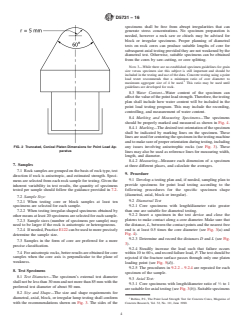
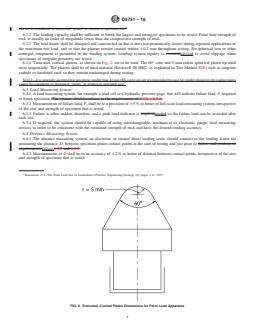
6.2.4 Truncated, conical platens, as shown on Fig. 2, are to
strength classification of rock materials.The test results should
be used. The 60° cone and 5-mm radius spherical platen tip
not be used for design or analytical purposes.
shall meet tangentially. The platens shall be of hard material
(Rockwell 58 HRC, as explained in Test Method E18) such as
5.3 This test method is performed to determine the point
tungsten carbide or hardened steel so they remain undamaged
load strength index of rock specimens and, if required, the
during testing.
point load strength anisotropy index.
5.4 Rockspecimensintheformofeithercore(thediametral
NOTE 2—It is generally accepted that specimens smaller than 42 mm
and axial tests), cut blocks (the block test), or irregular lumps (BX cores) are not recommended because for smaller diameters the
D5731−16
NOTE 1—Load frame general information (Fig. 1):
(1) Load is applied to the specimens through two standard hardened points
(2) Two column fixed crosshead frame
(3) Scale
(4) Scale pointer
(5) Bolt
(6) Hydraulic pump body
(7) Oil filler cap
(8) Pump handle for hydraulic piston
(9) Pressure release valve for hydraulic piston
(10) Case latched for top cover
(11) Digital pressure readout
(12) Point load tester top cover
FIG. 1Example of a Light-Weight Point Load Test Apparatus
loading points cannot be considered as theoretical “points” in relation to
6.4.1 The distance measuring system, an electronic or ver-
specimen size.
nier direct reading scale, should connect to the loading frame
6.3 Load Measuring System: for measuring the distance, D, between specimen-platen con-
6.3.1 Aload measuring system, for example a load cell or a tact points at the start of testing and just prior to failure.
hydraulic pressure gage, that will indicate failure load, P,
6.4.2 Measurements of D shall be to an accuracy of 62%
required to break specimen.
or better of distance between contact points, irrespective of the
6.3.2 Measurements of failure load, P, shall be to a preci-
size and strength of specimen that is tested.
sion of 65 % or better of full-scale load-measuring system,
6.4.3 The measuring system shall allow a check of the “zero
irrespective of the size and strength of specimen that is tested.
displacement” value when the two platens are in contact and
6.3.3 Failure is often sudden, therefore, and a peak load
should include a zero adjustment and a means to record or
indicator is needed so the failure load can be recorded after
measure any penetration of the specimen by the point load
each test.
platens during testing.
6.3.4 If required, the system should be capable of using
6.4.4 An instrument such as a caliper or a steel rule is
interchangeable, mechanical or electronic gauge, load measur-
needed to measure the width, W, (with an accuracy of 65%)
ingdevicesinordertobeconsistentwiththeestimatedstrength
of specimens for all but the diametral test.
of rock and have the desired reading accuracy.
6.5 Miscellaneous Items—Depending on the type of
6.4 Distance Measuring System:
samples (core or non-core) and the type of specimens to be
tested (diametral, Block,Axial, and alike), the following items
may be needed: diamond saw, chisels, towels, marking pens,
Bieniawski, Z.T., The Point Load Test in Geotechnical Practice, Engineering
Geology (9), pages 1-11, 1975. and plotting paper.
D5731−16
specimens shall be free from abrupt irregularities that can
generate stress concentrations. No specimen preparation is
needed, however a rock saw or chisels may be advised for
block or irregular specimens. Proper planning of diametral
tests on rock cores can produce suitable lengths of core for
subsequent axial testing provided they are not weakened by the
diametral test. Otherwise, suitable specimens can be obtained
from the cores by saw-cutting, or core splitting.
NOTE 3—While there are no established specimen guidelines for grain
size versus specimen size this subject is still important and should be
included in the testing and use of the data. Concrete testing using a point
load tester recommends that a minimum ratio of core diameter to
maximum aggregate size of 4 be used. This ratio may be used until
guidelines are developed for rock.
8.3 Water Content—Water content of the specimen can
affectthevalueofthepointloadstrength.Therefore,thetesting
plan shall include how water content will be included in the
point load testing program. This may include the recording,
controlling, and measurement of water content.
8.4 Marking and Measuring Specimens—The specimens
should be properly marked and measured as shown in Fig. 4.
8.4.1 Marking—Thedesiredtestorientationofthespecimen
shall be indicated by marking lines on the specimen. These
linesareusedforcenteringthespecimeninthetestingmachine
andtomakesureofproperorientationduringtesting,including
FIG. 2 Truncated, Conical Platen Dimensions for Point Load Ap- any issues involving anisotrophic rocks (see Fig. 3). These
paratus
lines may also be used as reference lines for measuring width,
length, and diameter.
8.4.2 Measuring—Measure each dimension of a specimen
7. Samples
at three different places, and calculate the averages.
7.1 Rock samples are grouped on the basis of rock type, test
9. Procedure
direction if rock is anisotropic, and estimated strength. Speci-
9.1 Develop a testing plan and, if needed, sampling plan to
mens are selected from each rock sample for testing. Given the
provide specimens for point load testing according to the
inherent variability in test results, the quantity of specimens
following procedures for the specific specimen shape
tested per sample should follow the guidance provided in 7.2.
(diametral, axial, block or irregular).
7.2 Sample Size:
9.2 Diametral Test
7.2.1 When testing core or block samples at least ten
9.2.1 Core specimens with length/diameter ratio greater
specimens are selected for each sample.
than one are suitable for diametral testing.
7.2.2 When testing irregular-shaped specimens obtained by
9.2.2 Insert a specimen in the test device and close the
othermeansatleast20specimensareselectedforeachsample.
platens to make contact along a core diameter. Make sure that
7.2.3 Sample sizes (number of specimens per sample) may
the distance, L, between the contact points and the nearest free
need to be larger if the rock is anisotropic or heterogeneous.
end is at least 0.5 times the core diameter (see Fig. 3(a) and
7.2.4 Ifneeded,PracticeE122canbeusedtomoreprecisely
Fig. 4).
determine the sample size.
9.2.3 Determine and record the distances D and L (see Fig.
7.3 Samples in the form of core are preferred for a more
3).
precise classification.
9.2.4 Steadily increase the load such that failure occurs
7.4 Foranisotropicrocks,betterresultsareobtainedforcore
within 10 to 60 s, and record failure load, P.The test should be
samples when the core axis is perpendicular to the plane of
rejected if the fracture surface passes through only one platen
weakness.
loading point (see Fig. 5(d)).
9.2.5 The procedures in 9.2.2 – 9.2.4 are repeated for each
8. Test Specimens
specimen of the sample.
8.1 Test Diameter—The specimen’s external test diameter
9.3 Axial Test:
shallnotbelessthan30mmandnotmorethan85mmwiththe
9.3.1 Core specimens with length/diameter ratio of ⁄3 to 1
preferred test diameter of about 50 mm.
are suitable for ax
...
This document is not an ASTM standard and is intended only to provide the user of an ASTM standard an indication of what changes have been made to the previous version. Because
it may not be technically possible to adequately depict all changes accurately, ASTM recommends that users consult prior editions as appropriate. In all cases only the current version
of the standard as published by ASTM is to be considered the official document.
Designation: D5731 − 08 D5731 − 16
Standard Test Method for
Determination of the Point Load Strength Index of Rock and
Application to Rock Strength Classifications
This standard is issued under the fixed designation D5731; the number immediately following the designation indicates the year of
original adoption or, in the case of revision, the year of last revision. A number in parentheses indicates the year of last reapproval. A
superscript epsilon (´) indicates an editorial change since the last revision or reapproval.
1. Scope*
1.1 This test method covers the guidelines, requirements, and procedures for determining the point load strength index of rock.
This is an index test and is intended to be used to classify rock strength.
1.2 Specimens in the form of rock cores, blocks, or irregular lumps with a test diameter from 30 to 85 mm can be tested by
this test method.
1.3 This test method can be performed in either the field or laboratory. The test is typically used in the field because the testing
machine is portable, little or minimal specimen preparation is required, and specimens can be tested within a short time frame of
being collected.
1.4 This test method applies to medium strength rock (compressive strength over 15 MPa (2200 psi)).MPa).
1.5 This test method does not cover which type of specimen should be tested or whether anisotropic factors should be
considered. The specifics of the point load test program need to be developed prior to testing and possibly even before sampling.
Such specifics would be dependent on the intended use of the data, as well as possible budgetary constraints and possible other
factors, which are outside the scope of this test method.
1.6 All observed and calculated values shall conform to the guidelines for significant digits and rounding established in Practice
D6026.
1.6.1 The procedures used to specify how data are collected/recorded and calculated in this standard are regarded as the industry
standard. In addition, they are representative of the significant digits that generally should be retained. The procedures used do not
consider material variation, purpose for obtaining data, special purpose studies, or any considerations for the user’s objectives; and
it is common practice to increase or reduce significant digits of reported data to commensurate with these considerations. It is
beyond the scope of these test methods to consider significant digits used in analysis methods for engineering design
1.7 The method used to specify how data are collected, calculated, or recorded in this standard is not directly related to the
accuracy to which the data can be applied in design or other uses, or both. How one applies the results obtained using this standard
is beyond its scope.
1.7 The values stated in the SI units are to be regarded as standard.
1.8 This standard does not purport to address all of the safety concerns, if any, associated with its use. It is the responsibility
of the user of this standard to establish appropriate safety and health practices and determine the applicability of regulatory
limitations prior to use.
2. Referenced Documents
2.1 ASTM Standards:
D653 Terminology Relating to Soil, Rock, and Contained Fluids
D2216 Test Methods for Laboratory Determination of Water (Moisture) Content of Soil and Rock by Mass
D3740 Practice for Minimum Requirements for Agencies Engaged in Testing and/or Inspection of Soil and Rock as Used in
Engineering Design and Construction
D5079 Practices for Preserving and Transporting Rock Core Samples
This test method is under the jurisdiction of ASTM Committee D18 on Soil and Rock and is the direct responsibility of Subcommittee D18.12 on Rock Mechanics.
Current edition approved Jan. 1, 2008Dec. 1, 2016. Published February 2008January 2017. Originally approved in 1995. Last previous edition approved in 20072008 as
D5731 – 07.D5731 – 08. DOI: 10.1520/D5731-08.10.1520/D5731-16.
For referenced ASTM standards, visit the ASTM website, www.astm.org, or contact ASTM Customer Service at service@astm.org. For Annual Book of ASTM Standards
volume information, refer to the standard’s Document Summary page on the ASTM website.
*A Summary of Changes section appears at the end of this standard
Copyright © ASTM International, 100 Barr Harbor Drive, PO Box C700, West Conshohocken, PA 19428-2959. United States
D5731 − 16
D6026 Practice for Using Significant Digits in Geotechnical Data
D7012 Test Methods for Compressive Strength and Elastic Moduli of Intact Rock Core Specimens under Varying States of
Stress and Temperatures
E18 Test Methods for Rockwell Hardness of Metallic Materials
E122 Practice for Calculating Sample Size to Estimate, With Specified Precision, the Average for a Characteristic of a Lot or
Process
2.2 ISRM Standard:
Suggested Methods for Determining Point Load Strength
3. Terminology
3.1 Definitions—For definitions of common technical terms used in this test method standard refer to Terminology D653.
3.2 Definitions of Terms Specific to This Standard:
3.2.1 diameter—diameter, n—D,for point load tests, the measured dimension of the specimen between the opposing
conical,conical test platens when placed in the test machine
3.2.2 point load strength anisotropy index—index, n—I , the strength anisotropy index is defined as the ratio of mean I
a(D) s(D)
values measured perpendicular and parallel to planes of weakness, thatweakness. That is, the ratio of greatest to least point load
strength indices on different axes that result in the greatest and least ratio of point load strengths values.
3.2.3 size-corrected point load strength index—index, n—I , the original point load strength index value multiplied by a factor
s(D)
to normalize the value that would have been obtained with diametral test of diameter (D).
3.2.4 uncorrected point load strength index—index, n—(I ), an indicator of strength (see 10.1) obtained by subjecting a rock
s
specimen to an increasingly concentrated point load, applied through a pair of truncated, conical platens, until failure occurs.
4. Summary of Test Method
4.1 This index test is performed by subjecting a rock specimen to an increasingly concentrated load until failure occurs by
splitting the specimen. The concentrated load is applied through coaxial, truncated conical platens. The failure load is used to
calculate the point load strength index.
4.2 The point load strength index can be used to classify the rocks. rocks and provide a preliminary or reconnaissance-level
evaluation of spatial variability in rock strength. A common method used is by estimating the uniaxial compressive strength.
5. Significance and Use
5.1 The uniaxial compression test (see Test Method D7012) is used to determine compressive strength of rock specimens.
However, it is a time-consuming and expensive test that requires significant specimen preparation and the results may not be
available for a long time after the samples are collected. When extensive testing and/or timely information is requiredneeded for
preliminary and reconnaissance information, alternative tests such as the point load test can be used to reduce the time and cost
of compressive strength tests, when used in the field. Such data can be used to make timely and more informed decisions during
the exploration phases and more efficient and cost effective selection of samples for more precise and expensive laboratory tests.
5.2 The point load strength test is used as an index test for strength classification of rock materials. The test results should not
be used for design or analytical purposes.
5.3 This test method is performed to determine the point load strength index of rock specimens and, if required, the point load
strength anisotropy index.
5.4 Rock specimens in the form of either core (the diametral and axial tests), cut blocks (the block test), or irregular lumps (the
irregular lump test) are tested by application of concentrated load through a pair of truncated, conical platens. Little or no specimen
preparation is requiredneeded and can therefore be tested shortly after being obtained and any influence of moisture condition on
the test data minimized. However, the results can be highly influenced by how the specimen is treated from the time it is obtained
until the time it is tested. Therefore, it may be necessary to handle specimens in accordance with Practice D5079 and to document
moisture conditions in some manner in the data collection.
NOTE 1—The quality of the result produced by this standard is dependent upon the competence of the personnel performing it, and the suitability of
the equipment and facilities used. Agencies that meet the criteria of Practice D3740 are generally considered capable of competent and objective testing
and sampling. Users of this standard are cautioned that compliance with Practice D3740 does not in itself assure reliable results. Reliable results depend
on many factors; Practice D3740 provides a means of evaluating some of those factors.
6. Apparatus
6.1 General—A basic point load tester (see Fig. 1) consists of a loading system typically comprised of a loading frame, platens,
a measuring system for indicating load, P, (required to break the specimen), and a means for measuring the distance, D, between
“Suggested Methods for Determining Point Load Strength”, International Society for Rock Mechanics Commission on Testing Methods, Int. J. Rock. Mech. Min. Sci.
and Geomechanical Abstr., Vol 22, No. 2, 1985, pp. 51–60.
D5731 − 16
NOTE 1—Load frame general information (figure (Fig. 11)):
Load is applied to the specimens through two standard hardened points (1)
(1) Load is applied to the specimens through two standard hardened points
(2) Two column fixed crosshead frame
(3) Scale
(4) Scale pointer
(5) Bolt
(6) Hydraulic pump body
(7) Oil filler cap
(8) Pump handle for hydraulic piston
(9) Pressure release valve for hydraulic piston
(10) Case latched for top cover
(11) Digital pressure readout
(12) Point load tester top cover
Two column fixed crosshead frame (2)
Scale (3)
Scale pointer (4)
Attached by a bolt (5) to the hydraulic pump body (6)
Oil filler cap (7)
The hydraulic piston assembly incorporated the oil reservoir, a single acting pump, pressure relief valve (9), and a handle (8)
Pump handle (8)
Pressure release valve (9)
Case latched for top cover (10)
Digital pressure readout (11)
Point load tester top cover(12)
FIG. 1 Example of a Light-Weight Point Load Test Apparatus
the two platen contact points at the start of testing and after failure. The equipment shall be resistant to shock and vibration so that
the accuracy of readings is not adversely affected by repeated testing. Any special operational, maintenance or calibrations
instructions provided by the manufacturer for the particular apparatus being used shall be followed.
6.2 Loading System:
6.2.1 The loading system shall have a loading frame with a platen-to-platen clearance that allows testing of rock specimens in
the required size range. Typically, this range is between 30 to 100 mm, or the maximum opening size of the load frame, so that
an adjustable distance is available to accommodate both small and large specimens.
NOTE 2—It is generally accepted that specimens smaller than 42 mm (BX cores) are not recommended because for smaller diameters the loading points
D5731 − 16
can not be considered as theoretical “points” in relation to specimen size.
6.2.2 The loading capacity shall be sufficient to break the largest and strongest specimens to be tested. Point load strength of
rock is usually an order of magnitude lower than the compressive strength of rock.
6.2.3 The load frame shall be designed and constructed so that it does not permanently distort during repeated applications of
the maximum test load, and so that the platens remain coaxial within 60.2 mm throughout testing. No spherical seat or other
nonrigid component is permitted in the loading system. Loading system rigidity is essentialadvised to avoid slippage when
specimens of irregular geometry are tested.
6.2.4 Truncated, conical platens, as shown on Fig. 2, are to be used. The 60° cone and 5-mm radius spherical platen tip shall
meet tangentially. The platens shall be of hard material (Rockwell 58 HRC, as explained in Test Method E18) such as tungsten
carbide or hardened steel so they remain undamaged during testing.
NOTE 2—It is generally accepted that specimens smaller than 42 mm (BX cores) are not recommended because for smaller diameters the loading points
cannot be considered as theoretical “points” in relation to specimen size.
6.3 Load Measuring System:
6.3.1 A load measuring system, for example a load cell or a hydraulic pressure gage, that will indicate failure load, P, required
to break specimen. The system should conform to the requirements of 6.3.2 – 6.3.4.
6.3.2 Measurements of failure load, P, shall be to a precision of 65 % or better of full-scale load-measuring system, irrespective
of the size and strength of specimen that is tested.
6.3.3 Failure is often sudden, therefore, and a peak load indicator is requiredneeded so the failure load can be recorded after
each test.
6.3.4 If required, the system should be capable of using interchangeable, mechanical or electronic gauge, load measuring
devices in order to be consistent with the estimated strength of rock and have the desired reading accuracy.
6.4 Distance Measuring System:
6.4.1 The distance measuring system, an electronic or vernier direct reading scale, should connect to the loading frame for
measuring the distance, D, between specimen-platen contact points at the start of testing and just prior to failure and conform to
requirements failure.6.4.2 and 6.4.3.
6.4.2 Measurements of D shall be to an accuracy of 62 % or better of distance between contact points, irrespective of the size
and strength of specimen that is tested.
Bieniawski, Z.T., The Point Load Test in Geotechnical Practice, Engineering Geology (9), pages 1-11, 1975.
FIG. 2 Truncated, Conical Platen Dimensions for Point Load Apparatus
D5731 − 16
6.4.3 The measuring system shall allow a check of the “zero displacement” value when the two platens are in contact and should
include a zero adjustment and a means to record or measure any penetration of the specimen by the point load platens during
testing.
6.4.4 An instrument such as a caliper or a steel rule is requiredneeded to measure the width, W, (with an accuracy of 65 %)
of specimens for all but the diametral test.
6.5 Miscellaneous Items—Depending on the type of samples (core or non core) non-core) and the type of specimens to be tested
(diametral, Block, Axial, etc.), and alike), the following items may be needed: diamond saw, chisels, towels, marking pens, and
plotting paper.
7. Test Samples
7.1 Rock samples are grouped on the basis of rock type, test direction if rock is aniasotropic,anisotropic, and estimated strength.
Specimens are selected from each rock sample for testing. Given the inherent variability in test results, the quantity of specimens
tested per sample should follow the guidance provided in 7.2.
7.2 Sample SizeSize:
7.2.1 When testing core or block samples at least ten specimens are selected for the samples.each sample.
7.2.2 When testing irregular-shaped specimens obtained by other means at least 20 specimens are selected for the samples.each
sample.
7.2.3 Sample sizes (number of specimens per sample) may need to be larger if the rock is anisotropic or heterogeneous.
7.2.4 If needed, Practice E122 can be used to more precisely determine the sample size.
7.3 Samples in the form of core are preferred for a more precise classification.
7.4 For anisotropic rocks the best results rocks, better results are obtained for core samples is when the core axis is perpendicular
to the plane of weakness.
8. Test Specimens
8.1 Test Diameter—The specimen’sspecimen’s external test diameter shall not be less than 30 mm and not more than 85 mm
with the preferred test diameter of about 50 mm.
8.2 Size and Shape—The size and shape requirements for diametral, axial, block, or irregular lump testing shall conform with
the recommendations shown on Fig. 3. The sides of the specimens shall be free from abrupt irregularities that can generate stress
concentrations. No specimen preparation is required,needed, however a rock saw or chisels may be requiredadvised for block or
irregular specimens. Proper planning of diametral tests on rock cores can produce suitable lengths of core for subsequent axial
testing provided they are not weakened by the diametral test. Otherwise, suitable specimens can be obtained from the cores by
saw-cutting, or core splitting.
NOTE 3—While there are no established specimen guidelines for grain size versus specimen size this subject is still important and mustshould be
included in the testing and use of the data. Concrete testing using a point load tester recommends that a minimum ratio of core diameter to maximum
aggregate size of 4 be used. This ratio may be used until guidelines are developed for rock.
8.3 Water Content—Water content of the specimen can affect the value of the point load strength. Therefore, the testing plan
shall include how water content will be included in the point load testing program. This may include the recording, controlling,
and measurement of water content.
8.4 Marking and Measuring Specimens—The specimens should be properly marked and measured as shown in Fig. 4.
8.4.1 Marking—The desired test orientation of the specimen shall be indicated by marking lines on the specimen. These lines
are used for centering the specimen in the testing machine,machine and to ensure make sure of proper orientation during testing,
including any issues involving anisotrophic rocks (see Fig. 3). These lines may also be used as reference lines for measuring width,
length, and diameter.
8.4.2 Measuring—Measure each dimension of a specimen at three different places, and calculate the averages.
9. Procedure
9.1 Develop a testing plan and, if needed, sampling plan to provide specimens for point load testing according to the following
procedures for the specific specimen shape (diametral, axial, block or irregular).
9.2 Diametral Test
9.2.1 Core specimens with length/diameter ratio greater than one are suitable for diametral testing.
9.2.2 Insert a specimen in the test device and close the platens to make contact along a core diameter. Ensure Make sure that
the distance, L, between the contact points and the nearest free end is at least 0.5 times the core diameter (see Fig. 3(a) and Fig.
4().a)).
Robins, P.J., The Point Load Strength Test for Concrete Cores, Magazine of Concrete Research, Vol. 32, No. 111, June 1980.
D5731 − 16
NOTE 1—Legend: L = distance between contact points and nearest free face, and D = equivalent core diameter (see 10.1).
e
FIG. 3 Load Configurations and Specimen Shape Requirement for (a) the Diametral Test, (b) the Axial Test, (c) the Block Test, and (d)
the Irregular Lump Test
FIG. 4 Anisotropy measurements and testing for maximum and minimum indices
9.2.3 Determine and record the distances D and L (see Fig. 3).
9.2.4 Steadily increase the load such that failure occurs within 10 to 60 s, and record failure load, P. The test should be rejected
if the fracture surface passes through only one platen loading point (see Fig. 5(d)).
9.2.5 The procedures in 9.2.2 – 9.2.4 are repeated for each specimen of the rock type.sample.
9.3 Axial TestTest:
9.3.1 Co
...