

ASTM D4612-16
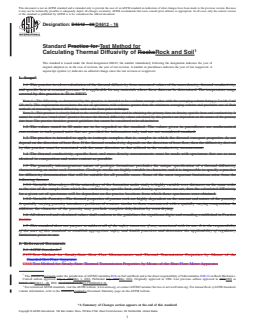
(Test Method)Standard Test Method for Calculating Thermal Diffusivity of Rock and Soil
General Information
- Abstract
SIGNIFICANCE AND USE
5.1 The thermal diffusivity is a parameter that arises in the solution of transient heat conduction problems. It generally characterizes the rate at which a heat pulse will diffuse through a solid material.
5.2 The number of parameters required for solution of a transient heat conduction problem depends on both the geometry and imposed boundary conditions. In a few special cases, only the thermal diffusivity of the material is required. In most cases, separate values of k, ρ, and cp are required in addition to α. This test method provides a consistent set of parameters for numerical or analytical heat conduction calculations related to heat transport through rocks.
5.3 In order to use this test method for determination of the thermal diffusivity, the parameters (k, ρ, cp) must be determined under as near identical specimen conditions as possible.
5.4 The diffusivity determined by this test method can only be used to analyze heat transport in rock under thermal conditions identical to those existing for the k, ρ, and cp measurements.
Note 2: The quality of the result produced by this standard is dependent on the competence of the personnel performing it, and the suitability of the equipment and facilities used. Agencies that meet the criteria of Practice D3740 are generally considered capable of competent and objective testing/sampling/inspection/etc. Users of this standard are cautioned that compliance with Practice D3740 does not in itself assure reliable results. Reliable results depend on many factors; Practice D3740 provides a means of evaluating some of those factors.
SCOPE
1.1 This test method involves calculation of the thermal diffusivity from measured values of the mass density, thermal conductivity, and specific heat at constant pressure. It is applicable for any materials where these data can be determined. The temperature range covered by this test method is 293 to 573 K. This test method is closely linked to the overall test procedure used in obtaining the primary data on density, specific heat, and thermal conductivity. It cannot be used as a “stand alone” test method because the thermal diffusivity values calculated by this test method are dependent on the nature of the primary data base. The test method furnishes general guidelines to calculate the thermal diffusivity but cannot be considered to be all-inclusive to capture issues related to the density, specific heat, and thermal conductivity
Note 1: The diffusivity, as determined by this test method, is intended to be a volume average value, with the averaging volume being ≥ 2 × 10⁻⁵ m3 (20 cm3). This requirement necessitates the use of specimens with volumes greater than the minimum averaging volume and precludes use of flash methods of measuring thermal diffusivity, such as the laser pulse technique.
1.2 The values stated in SI units are to be regarded as the standard. No other units of measurements are included in this standard.
1.3 This test method is intended to apply to isotropic samples; that is, samples in which the thermal transport properties do not depend on the direction of heat flow. If the thermal conductivity depends on the direction of heat flow, then the diffusivity derived by this test method must be associated with the same direction as that utilized in the conductivity measurement.
1.4 The thermal conductivity, specific heat, and mass density measurements must be made with specimens that are as near identical in composition and water content as possible.
1.5 The generally inhomogeneous nature of geologic formations precludes the unique specification of a thermal diffusivity characterizing an entire rock formation or soil layer. Geologic media are highly variable in character, and it is impossible to specify a test method for diffusivity determination that will be suitable for all possible cases. Some of the most important limitations arise from the following factors:
1.5.1 Vari...
- Status
- Published
- Publication Date
- 30-Apr-2016
- Technical Committee
- D18 - Soil and Rock
- Drafting Committee
- D18.12 - Rock Mechanics
Overview
ASTM D4612-16: Standard Test Method for Calculating Thermal Diffusivity of Rock and Soil is an internationally recognized method developed by ASTM International to aid professionals in determining the thermal diffusivity of geological materials. This standard outlines procedures for calculating thermal diffusivity using measured values of mass density, thermal conductivity, and specific heat at constant pressure. Thermal diffusivity is a key property that influences how a heat pulse will move through soil or rock and is central to understanding transient heat conduction problems in geotechnical and civil engineering applications.
This method is essential for accurate heat transport analysis in projects involving subsurface energy storage, geothermal systems, and underground infrastructure. ASTM D4612-16 applies to isotropic materials within the temperature range of 293 to 573 K and relies on the use of primary data that adheres to related ASTM procedures to ensure consistency and reproducibility.
Key Topics
- Thermal Diffusivity Determination: Involves calculation from directly measured values of mass density (ρ), thermal conductivity (k), and specific heat capacity at constant pressure (cp). The key equation is α = k/(ρ·cp).
- Specimen Preparation: Requirements for specimens to be as near identical as possible in terms of composition and water content, ensuring meaningful comparative results.
- Applicability: The method is designed for isotropic specimens-materials where heat conduction is not directionally dependent. If material properties vary with direction, calculations must reflect the corresponding direction.
- Volume Requirements: Results represent a volume-averaged value; specimen sizes must exceed 20 cm³, restricting use of certain techniques such as flash methods or laser pulse.
- Temperature Range: The method is valid for temperatures between 293 K and 573 K (20°C to 300°C), suitable for most geological and engineering applications.
- Quality Control and Limitations:
- Results depend on the quality of the measuring equipment, the procedure, and the competency of the personnel.
- The method may not yield a unique value for an entire geologic formation due to inherent inhomogeneity in mineralogy and porosity.
- Compliance with ASTM D3740 is recommended for agencies performing this test.
Applications
ASTM D4612-16 is broadly applicable for engineering disciplines and industries that model or design systems based on underground heat transfer:
- Geothermal Energy: Designing systems for heat extraction and storage.
- Civil Engineering: Assessing thermal response of soil and rock in tunneling, foundations, and buried utilities.
- Environmental Engineering: Predicting the behavior of heat in contaminated sites or during soil remediation.
- Resource Exploration: Evaluating the thermal characteristics of rock formations in oil, gas, and mineral exploration.
- Energy Storage: Designing subsurface thermal energy storage in rock or soil matrices.
- Research and Development: Academic and industrial research on soil and rock thermal properties.
Proper application ensures reliable data for numerical modeling, analytical solutions, and risk assessments involving heat conduction.
Related Standards
To ensure accurate and compliant measurements, the following ASTM standards are referenced within D4612-16:
- ASTM C177: Test Method for Steady-State Heat Flux Measurements by Means of the Guarded-Hot-Plate Apparatus
- ASTM C518: Test Method for Steady-State Thermal Transmission via Heat Flow Meter
- ASTM C642: Test Method for Density, Absorption, and Voids in Hardened Concrete
- ASTM D4611: Test Method for Specific Heat of Rock and Soil
- ASTM D5334: Test Method for Determination of Thermal Conductivity of Soil and Soft Rock by the Thermal Needle Probe Procedure
- ASTM D2216: Test Methods for Determination of Water Content of Soil and Rock by Mass
- ASTM D3740: Practice for Minimum Requirements for Testing/Inspection Agencies
By adhering to ASTM D4612-16 and its related standards, practitioners ensure credible, reproducible, and industry-aligned thermal property data for rock and soil characterization.
Keywords: ASTM D4612-16, thermal diffusivity, rock, soil, heat conduction, mass density, specific heat, thermal conductivity, geotechnical engineering, thermal analysis, standard test method.
Relations
- Effective Date
- 01-May-2016
- Effective Date
- 01-Feb-2024
- Effective Date
- 01-Nov-2023
- Effective Date
- 01-Oct-2022
- Effective Date
- 01-Oct-2019
- Effective Date
- 01-Mar-2019
- Effective Date
- 01-Mar-2019
- Effective Date
- 01-May-2016
- Effective Date
- 01-Sep-2015
- Effective Date
- 01-May-2015
- Effective Date
- 01-Aug-2014
- Effective Date
- 01-May-2012
- Effective Date
- 01-Mar-2012
- Refers
ASTM E145-94(2011) - Standard Specification for Gravity-Convection and Forced-Ventilation Ovens - Effective Date
- 01-Dec-2011
- Effective Date
- 01-Sep-2011
Get Certified
Connect with accredited certification bodies for this standard

Zavod za gradbeništvo Slovenije (ZAG) - Inšpekcija
ZAG inspection body for construction products, structures, and materials.
Sponsored listings
Frequently Asked Questions
ASTM D4612-16 is a standard published by ASTM International. Its full title is "Standard Test Method for Calculating Thermal Diffusivity of Rock and Soil". This standard covers: SIGNIFICANCE AND USE 5.1 The thermal diffusivity is a parameter that arises in the solution of transient heat conduction problems. It generally characterizes the rate at which a heat pulse will diffuse through a solid material. 5.2 The number of parameters required for solution of a transient heat conduction problem depends on both the geometry and imposed boundary conditions. In a few special cases, only the thermal diffusivity of the material is required. In most cases, separate values of k, ρ, and cp are required in addition to α. This test method provides a consistent set of parameters for numerical or analytical heat conduction calculations related to heat transport through rocks. 5.3 In order to use this test method for determination of the thermal diffusivity, the parameters (k, ρ, cp) must be determined under as near identical specimen conditions as possible. 5.4 The diffusivity determined by this test method can only be used to analyze heat transport in rock under thermal conditions identical to those existing for the k, ρ, and cp measurements. Note 2: The quality of the result produced by this standard is dependent on the competence of the personnel performing it, and the suitability of the equipment and facilities used. Agencies that meet the criteria of Practice D3740 are generally considered capable of competent and objective testing/sampling/inspection/etc. Users of this standard are cautioned that compliance with Practice D3740 does not in itself assure reliable results. Reliable results depend on many factors; Practice D3740 provides a means of evaluating some of those factors. SCOPE 1.1 This test method involves calculation of the thermal diffusivity from measured values of the mass density, thermal conductivity, and specific heat at constant pressure. It is applicable for any materials where these data can be determined. The temperature range covered by this test method is 293 to 573 K. This test method is closely linked to the overall test procedure used in obtaining the primary data on density, specific heat, and thermal conductivity. It cannot be used as a “stand alone” test method because the thermal diffusivity values calculated by this test method are dependent on the nature of the primary data base. The test method furnishes general guidelines to calculate the thermal diffusivity but cannot be considered to be all-inclusive to capture issues related to the density, specific heat, and thermal conductivity Note 1: The diffusivity, as determined by this test method, is intended to be a volume average value, with the averaging volume being ≥ 2 × 10⁻⁵ m3 (20 cm3). This requirement necessitates the use of specimens with volumes greater than the minimum averaging volume and precludes use of flash methods of measuring thermal diffusivity, such as the laser pulse technique. 1.2 The values stated in SI units are to be regarded as the standard. No other units of measurements are included in this standard. 1.3 This test method is intended to apply to isotropic samples; that is, samples in which the thermal transport properties do not depend on the direction of heat flow. If the thermal conductivity depends on the direction of heat flow, then the diffusivity derived by this test method must be associated with the same direction as that utilized in the conductivity measurement. 1.4 The thermal conductivity, specific heat, and mass density measurements must be made with specimens that are as near identical in composition and water content as possible. 1.5 The generally inhomogeneous nature of geologic formations precludes the unique specification of a thermal diffusivity characterizing an entire rock formation or soil layer. Geologic media are highly variable in character, and it is impossible to specify a test method for diffusivity determination that will be suitable for all possible cases. Some of the most important limitations arise from the following factors: 1.5.1 Vari...
SIGNIFICANCE AND USE 5.1 The thermal diffusivity is a parameter that arises in the solution of transient heat conduction problems. It generally characterizes the rate at which a heat pulse will diffuse through a solid material. 5.2 The number of parameters required for solution of a transient heat conduction problem depends on both the geometry and imposed boundary conditions. In a few special cases, only the thermal diffusivity of the material is required. In most cases, separate values of k, ρ, and cp are required in addition to α. This test method provides a consistent set of parameters for numerical or analytical heat conduction calculations related to heat transport through rocks. 5.3 In order to use this test method for determination of the thermal diffusivity, the parameters (k, ρ, cp) must be determined under as near identical specimen conditions as possible. 5.4 The diffusivity determined by this test method can only be used to analyze heat transport in rock under thermal conditions identical to those existing for the k, ρ, and cp measurements. Note 2: The quality of the result produced by this standard is dependent on the competence of the personnel performing it, and the suitability of the equipment and facilities used. Agencies that meet the criteria of Practice D3740 are generally considered capable of competent and objective testing/sampling/inspection/etc. Users of this standard are cautioned that compliance with Practice D3740 does not in itself assure reliable results. Reliable results depend on many factors; Practice D3740 provides a means of evaluating some of those factors. SCOPE 1.1 This test method involves calculation of the thermal diffusivity from measured values of the mass density, thermal conductivity, and specific heat at constant pressure. It is applicable for any materials where these data can be determined. The temperature range covered by this test method is 293 to 573 K. This test method is closely linked to the overall test procedure used in obtaining the primary data on density, specific heat, and thermal conductivity. It cannot be used as a “stand alone” test method because the thermal diffusivity values calculated by this test method are dependent on the nature of the primary data base. The test method furnishes general guidelines to calculate the thermal diffusivity but cannot be considered to be all-inclusive to capture issues related to the density, specific heat, and thermal conductivity Note 1: The diffusivity, as determined by this test method, is intended to be a volume average value, with the averaging volume being ≥ 2 × 10⁻⁵ m3 (20 cm3). This requirement necessitates the use of specimens with volumes greater than the minimum averaging volume and precludes use of flash methods of measuring thermal diffusivity, such as the laser pulse technique. 1.2 The values stated in SI units are to be regarded as the standard. No other units of measurements are included in this standard. 1.3 This test method is intended to apply to isotropic samples; that is, samples in which the thermal transport properties do not depend on the direction of heat flow. If the thermal conductivity depends on the direction of heat flow, then the diffusivity derived by this test method must be associated with the same direction as that utilized in the conductivity measurement. 1.4 The thermal conductivity, specific heat, and mass density measurements must be made with specimens that are as near identical in composition and water content as possible. 1.5 The generally inhomogeneous nature of geologic formations precludes the unique specification of a thermal diffusivity characterizing an entire rock formation or soil layer. Geologic media are highly variable in character, and it is impossible to specify a test method for diffusivity determination that will be suitable for all possible cases. Some of the most important limitations arise from the following factors: 1.5.1 Vari...
ASTM D4612-16 is classified under the following ICS (International Classification for Standards) categories: 93.020 - Earthworks. Excavations. Foundation construction. Underground works. The ICS classification helps identify the subject area and facilitates finding related standards.
ASTM D4612-16 has the following relationships with other standards: It is inter standard links to ASTM D4612-08, ASTM D4753-24, ASTM D3740-23, ASTM D5334-22ae1, ASTM D3740-19, ASTM D2216-19, ASTM E145-19, ASTM D4611-16, ASTM C518-15, ASTM D4753-15, ASTM D653-14, ASTM D3740-12a, ASTM D3740-12, ASTM E145-94(2011), ASTM D653-11. Understanding these relationships helps ensure you are using the most current and applicable version of the standard.
ASTM D4612-16 is available in PDF format for immediate download after purchase. The document can be added to your cart and obtained through the secure checkout process. Digital delivery ensures instant access to the complete standard document.
Standards Content (Sample)
This international standard was developed in accordance with internationally recognized principles on standardization established in the Decision on Principles for the
Development of International Standards, Guides and Recommendations issued by the World Trade Organization Technical Barriers to Trade (TBT) Committee.
Designation: D4612 − 16
Standard Test Method for
Calculating Thermal Diffusivity of Rock and Soil
This standard is issued under the fixed designation D4612; the number immediately following the designation indicates the year of
original adoption or, in the case of revision, the year of last revision.Anumber in parentheses indicates the year of last reapproval.A
superscript epsilon (´) indicates an editorial change since the last revision or reapproval.
1. Scope* 1.5 Thegenerallyinhomogeneousnatureofgeologicforma-
tionsprecludestheuniquespecificationofathermaldiffusivity
1.1 This test method involves calculation of the thermal
characterizing an entire rock formation or soil layer. Geologic
diffusivity from measured values of the mass density, thermal
media are highly variable in character, and it is impossible to
conductivity, and specific heat at constant pressure. It is
specify a test method for diffusivity determination that will be
applicable for any materials where these data can be deter-
suitable for all possible cases. Some of the most important
mined. The temperature range covered by this test method is
limitations arise from the following factors:
293 to 573 K. This test method is closely linked to the overall
1.5.1 Variable Mineralogy—If the mineralogy of the forma-
test procedure used in obtaining the primary data on density,
tion under study is highly variable over distances on the same
specific heat, and thermal conductivity. It cannot be used as a
order as the size of the sample from which the conductivity,
“stand alone” test method because the thermal diffusivity
specificheat,anddensityspecimensarecut,thenthecalculated
values calculated by this test method are dependent on the
diffusivity for a given set of specimens will be dependent on
nature of the primary data base. The test method furnishes
the precise locations from which these specimens were ob-
general guidelines to calculate the thermal diffusivity but
tained.
cannot be considered to be all-inclusive to capture issues
1.5.2 Variable Porosity—The thermal properties of porous
related to the density, specific heat, and thermal conductivity
rock or soil are highly dependent on the amount and nature of
NOTE1—Thediffusivity,asdeterminedbythistestmethod,isintended
the porosity. A spatially varying porosity introduces problems
−5
tobeavolumeaveragevalue,withtheaveragingvolumebeing≥2×10
3 3 ofanaturesimilartothoseencounteredwithaspatiallyvarying
m (20 cm ). This requirement necessitates the use of specimens with
composition. In addition, the character of the porosity may
volumesgreaterthantheminimumaveragingvolumeandprecludesuseof
flash methods of measuring thermal diffusivity, such as the laser pulse
preclude complete dehydration by oven drying.
technique.
1.6 All observed and calculated values shall conform to the
1.2 The values stated in SI units are to be regarded as the
guidelines for significant digits and rounding established in
standard. No other units of measurements are included in this
Practice D6026.
standard.
1.6.1 The procedure used to specify how data are collected/
1.3 This test method is intended to apply to isotropic
recorded or calculated in this standard are regarded as the
samples; that is, samples in which the thermal transport
industry standard. In addition, they are representative of the
properties do not depend on the direction of heat flow. If the
significant digits that generally should be retained. The proce-
thermal conductivity depends on the direction of heat flow,
dures used do not consider material variation, purpose for
then the diffusivity derived by this test method must be
obtaining the data, special purpose studies, or any consider-
associated with the same direction as that utilized in the
ations for the user’s objectives; and it is common practice to
conductivity measurement.
increase or reduce significant digits of reported data to be
commensuratewiththeseconsiderations.Itisbeyondthescope
1.4 The thermal conductivity, specific heat, and mass den-
of this standard to consider significant digits used in analytical
sity measurements must be made with specimens that are as
methods for engineering design.
near identical in composition and water content as possible.
1.7 This standard does not purport to address all of the
This test metis under the jurisdiction of ASTM Committee D18 on Soil and
safety concerns, if any, associated with its use. It is the
Rock and is the direct responsibility of Subcommittee D18.12 on Rock Mechanics.
responsibility of the user of this standard to establish appro-
Current edition approved May 1, 2016. Published May 2016. Originally
priate safety and health practices and determine the applica-
approved in 1986. Last previous edition approved in 2008 as D4612–08. DOI:
10.1520/D4612-16. bility of regulatory limitations prior to use.
*A Summary of Changes section appears at the end of this standard
Copyright © ASTM International, 100 Barr Harbor Drive, PO Box C700, West Conshohocken, PA 19428-2959. United States
D4612 − 16
2. Referenced Documents 5. Significance and Use
5.1 The thermal diffusivity is a parameter that arises in the
2.1 ASTM Standards:
solution of transient heat conduction problems. It generally
C177Test Method for Steady-State Heat Flux Measure-
characterizestherateatwhichaheatpulsewilldiffusethrough
ments and Thermal Transmission Properties by Means of
a solid material.
the Guarded-Hot-Plate Apparatus
C518Test Method for Steady-State Thermal Transmission
5.2 The number of parameters required for solution of a
Properties by Means of the Heat Flow Meter Apparatus
transient heat conduction problem depends on both the geom-
C642Test Method for Density, Absorption, and Voids in
etry and imposed boundary conditions. In a few special cases,
Hardened Concrete only the thermal diffusivity of the material is required. In most
D653Terminology Relating to Soil, Rock, and Contained
cases,separatevaluesof k, ρ,and c arerequiredinadditionto
p
Fluids α. This test method provides a consistent set of parameters for
D2216TestMethodsforLaboratoryDeterminationofWater numerical or analytical heat conduction calculations related to
(Moisture) Content of Soil and Rock by Mass heat transport through rocks.
D3740Practice for Minimum Requirements for Agencies
5.3 In order to use this test method for determination of the
Engaged in Testing and/or Inspection of Soil and Rock as
thermal diffusivity, the parameters (k, ρ, c ) must be deter-
p
Used in Engineering Design and Construction
mined under as near identical specimen conditions as possible.
D4611Test Method for Specific Heat of Rock and Soil
5.4 The diffusivity determined by this test method can only
D4753Guide for Evaluating, Selecting, and Specifying Bal-
be used to analyze heat transport in rock under thermal
ances and Standard Masses for Use in Soil, Rock, and
conditions identical to those existing for the k, ρ, and c
p
Construction Materials Testing
measurements.
D5334Test Method for Determination of Thermal Conduc-
NOTE 2—The quality of the result produced by this standard is
tivity of Soil and Soft Rock by Thermal Needle Probe
dependent on the competence of the personnel performing it, and the
Procedure
suitability of the equipment and facilities used. Agencies that meet the
criteria of Practice D3740 are generally considered capable of competent
D6026Practice for Using Significant Digits in Geotechnical
and objective testing/sampling/inspection/etc. Users of this standard are
Data
cautioned that compliance with Practice D3740 does not in itself assure
E145Specification for Gravity-Convection and Forced-
reliable results. Reliable results depend on many factors; Practice D3740
Ventilation Ovens
provides a means of evaluating some of those factors.
3. Terminology 6. Apparatus
6.1 Analytical Balance—A class GP5 balance meeting the
3.1 Definitions:
requirements of Specification D4753 for a balance of 1-g
3.1.1 Fordefinitionsofcommontechnicaltermsusedinthis
readability.
standard, refer to Terminology D653.
6.2 Drying Oven—Vented, thermostatically-controlled,
3.2 Symbols:
preferablyoftheforced-drafttype,meetingtherequirementsof
3.2.1 mass density—ρ (kg/m ).
Specification E145 and capable of maintaining a uniform
temperature of 110 6 5°C throughout the drying chamber.
3.2.2 instantaneous specific heat—c (J/kgK).
p
6.3 Vernier caliper, with an accuracy of 60.025 mm.
3.2.3 thermal conductivity—k (W/mK).
6.4 Waterproof Flexible Container—A waterproof, flexible
3.2.4 thermal diffusivity—α (m /s).
container suitable for encapsulating soil specimens for deter-
3.2.5 enthalpy—h.
mining dimensions by immersion.
6.5 Container, suitable for immersing the specimen and
4. Summary of Test Method
suitable wire for suspending the specimen in water.
4.1 The thermal diffusivity is determined from the equation
7. Specimen
in 9.3. The data for k and c must be available over the
p
temperature range of interest. For density, ρ, a single measure-
7.1 Intact Soil Specimens:
ment at room temperature may be used because the density is
7.1.1 Thin-Walled Tube or Drive Specimens—Cut a 200 6
approximately constant over the 293 to 573 K temperature
30mmlongsectionofasamplingtubecontaininganintactsoil
range covered by this test method.
specimen. The tube section shall have a minimum diameter of
50 mm.
4.2 The measurements of k, ρ, and c are to be performed
p
7.1.2 Determine and record the mass of the specimen in a
using the test methods in Section 8.
sampling tube or brass ring to the nearest 0.1 g.
7.1.3 Measure and record the length and diameter of the
specimen to 0.025 mm. Take a minimum of three length
For referenced ASTM standards, visit the ASTM website, www.astm.org, or
measurements 120° apart and at least three diameter measure-
contact ASTM Customer Service at service@astm.org. For Annual Book of ASTM
mentsatthequarterpointsoftheheight.Determinetheaverage
Standards volume information, refer to the standard’s Document Summary page on
the ASTM website. length and diameter of the specimen.
D4612 − 16
7.2 Reconstituted Soil Specimens: the accuracies associated with the bulk specific gravity and the
7.2.1 Compact the specimen to the desired dry density and working fluid measurements.
8.2.2 MeasurethespecimenspecificheatusingTestMethod
gravimetricwatercontentinathin-walledmetalorplastictube
using an appropriate compaction technique. D4611 to the prescribed accuracy.
8.2.3 Measurethespecimenthermalconductivityusin
...
This document is not an ASTM standard and is intended only to provide the user of an ASTM standard an indication of what changes have been made to the previous version. Because
it may not be technically possible to adequately depict all changes accurately, ASTM recommends that users consult prior editions as appropriate. In all cases only the current version
of the standard as published by ASTM is to be considered the official document.
Designation: D4612 − 08 D4612 − 16
Standard Practice for Test Method for
Calculating Thermal Diffusivity of RocksRock and Soil
This standard is issued under the fixed designation D4612; the number immediately following the designation indicates the year of
original adoption or, in the case of revision, the year of last revision. A number in parentheses indicates the year of last reapproval. A
superscript epsilon (´) indicates an editorial change since the last revision or reapproval.
1. Scope*
1.1 This practice involves calculation of the thermal diffusivity from measured values of the mass density, thermal conductivity,
and specific heat at constant pressure. It is applicable for any materials where these data can be determined. The temperature range
covered by this practice is 20 to 300°C.
−5 3
NOTE 1—The diffusivity, as determined by this practice, is intended to be a volume average value, with the averaging volume being ≥ 2 × 10 m
(20 cm ). This requirement necessitates the use of specimens with volumes greater than the minimum averaging volume and precludes use of flash
methods of measuring thermal diffusivity, such as the laser pulse technique.
NOTE 2—This practice is closely linked to the overall test procedure used in obtaining the primary data on density, specific heat, and conductivity. It
cannot be used as a “stand alone” practice because the thermal diffusivity values calculated by this practice are dependent on the nature of the primary
data base. The practice furnishes general guidelines but cannot be considered to be all-inclusive.
1.2 The values stated in SI units are to be regarded as the standard. The values given in parentheses are mathematical
conversions to inch-pound units that are provided for information only and are not considered standard.
1.3 The practice is intended to apply to isotropic samples; that is, samples in which the thermal transport properties do not
depend on the direction of heat flow. If the thermal conductivity depends on the direction of heat flow, then the diffusivity derived
by this practice must be associated with the same direction as that utilized in the conductivity measurement.
1.4 The thermal conductivity, specific heat, and mass density measurements must be made with specimens that are as near
identical in composition and water content as possible.
1.5 The generally inhomogeneous nature of geologic formations precludes the unique specification of a thermal diffusivity
characterizing an entire rock formation. Geologic media are highly variable in character, and it is impossible to specify a practice
for diffusivity determination that will be suitable for all possible cases. Some of the most important limitations arise from the
following factors:
1.5.1 Variable Mineralogy—If the mineralogy of the formation under study is highly variable over distances on the same order
as the size of the sample from which the conductivity, specific heat, and density specimens are cut, then the calculated diffusivity
for a given set of specimens will be dependent on the precise locations from which these specimens were obtained.
1.5.2 Variable Porosity—The thermal properties of porous rock are highly dependent on the amount and nature of the porosity.
A spatially varying porosity introduces problems of a nature similar to those encountered with a spatially varying composition. In
addition, the character of the porosity may preclude complete dehydration by oven drying.
1.6 All observed and calculated values shall conform to the guidelines for significant digits and rounding established in Practice
D6026.
1.7 This standard does not purport to address all of the safety concerns, if any, associated with its use. It is the responsibility
of the user of this standard to establish appropriate safety and health practices and determine the applicability of regulatory
limitations prior to use.
2. Referenced Documents
2.1 ASTM Standards:
C177 Test Method for Steady-State Heat Flux Measurements and Thermal Transmission Properties by Means of the
Guarded-Hot-Plate Apparatus
C518 Test Method for Steady-State Thermal Transmission Properties by Means of the Heat Flow Meter Apparatus
This practice istest metis under the jurisdiction of ASTM Committee D18 on Soil and Rock and is the direct responsibility of Subcommittee D18.12 on Rock Mechanics.
Current edition approved July 1, 2008May 1, 2016. Published July 2008May 2016. Originally approved in 1986. Last previous edition approved in 20032008 as
D4612 – 03.D4612 – 08. DOI: 10.1520/D4612-08.10.1520/D4612-16.
For referenced ASTM standards, visit the ASTM website, www.astm.org, or contact ASTM Customer Service at service@astm.org. For Annual Book of ASTM Standards
volume information, refer to the standard’sstandard’s Document Summary page on the ASTM website.
*A Summary of Changes section appears at the end of this standard
Copyright © ASTM International, 100 Barr Harbor Drive, PO Box C700, West Conshohocken, PA 19428-2959. United States
D4612 − 16
C642 Test Method for Density, Absorption, and Voids in Hardened Concrete
D3740 Practice for Minimum Requirements for Agencies Engaged in Testing and/or Inspection of Soil and Rock as Used in
Engineering Design and Construction
D4611 Test Method for Specific Heat of Rock and Soil
D6026 Practice for Using Significant Digits in Geotechnical Data
3. Terminology
3.1 Parameter Definitions:
3.1.1 mass density—the mass of the sample per unit volume of sample, ρ(kg/m ).
3.1.2 instantaneous specific heat—the rate of change of specimen enthalpy per unit mass, h, with respect to temperature, T, at
constant pressure,
p, c 5 δh/δT
~ !
p
p
3.1.3 thermal conductivity—the constant of proportionality, k, relating the vector heat flux, → Φ expressed in watts per square
metre, to the temperature gradient, πT, → Φ = −kπT. The thermal conductivity may be a function of the direction of → Φ and
the temperature, T. The units of k are W/m − K.
3.1.4 thermal diffusivity—the thermal diffusivity, α, is a derived parameter. It is related to ρ, c , and k by the relation,
p
α5 k/ρc
p
The units of α are m /s.
3.2 Definitions of Terms Specific to This Standard:
3.2.1 sample—a sample is a large piece of rock from which the specimens used in the k, ρ, and c measurements are obtained.
p
Usually the samples are obtained in the form of cores from a drilling operation.
3.2.2 specimens—the specimens are pieces cut from the sample for the k, ρ, and c measurements. Their sizes and shapes are
p
governed by the applicable ASTM standards listed in 2.1.
4. Summary of Practice
4.1 The thermal diffusivity is determined from the equation in 3.1.4. The data for k and c must be available over the temperature
p
range of interest. For density, ρ, a single measurement at room temperature may be used because the density is approximately
constant over the 20 to 300°C temperature range covered by this practice.
4.2 The measurements of k, ρ, and c are to be performed using the test methods in Section 6.
p
5. Significance and Use
5.1 The thermal diffusivity is a parameter that arises in the solution of transient heat conduction problems. It generally
characterizes the rate at which a heat pulse will diffuse through a solid material.
5.2 The number of parameters required for solution of a transient heat conduction problem depends on both the geometry and
imposed boundary conditions. In a few special cases, only the thermal diffusivity of the material is required. In most cases, separate
values of k, ρ, and c are required in addition to α. This practice provides a consistent set of parameters for numerical or analytical
p
heat conduction calculations related to heat transport through rocks.
5.3 In order to use this practice for determination of the thermal diffusivity, all of the required parameters ( k, ρ, c ) must be
p
determined under as near identical specimen conditions as possible.
5.4 The diffusivity determined by this practice can only be used to analyze heat transport in rock under thermal conditions
identical to those existing for the k, ρ, and c measurements.
p
NOTE 3—Notwithstanding the statements on precision and bias contained in this test method; the precision of this test method is dependent on the
competence of the personnel performing it, and the suitability of the equipment and facilities used. Agencies that meet the criteria of Practice D3740 are
generally considered capable of competent and objective testing. Users of this test method are cautioned that compliance with Practice D3740 does not
in itself assure reliable testing. Reliable testing depends on many factors; Practice D3740 provides a means of evaluating some of these factors.
6. Procedure
6.1 General:
6.1.1 Obtain the data for k, ρ, and c as a function of temperature using the appropriate ASTM standard for the given test as
p
qualified below. If possible, make all measurements with specimens obtained from the same general location in the sample in order
to ensure that the specimens are as near identical in composition and morphology as possible.
6.1.2 To minimize water content variation among specimens, vacuum dry all specimens at 105°C until mass loss is constant to
60.5 %.
6.2 Parameter Test Procedures:
6.2.1 Measure the specimen density in one of the two following ways:
D4612 − 16
6.2.1.1 Determine the mass of the specimen, m , on an analytical balance and the volume, V , by measurement of sample
s s
dimensions or by water displacement (immersion). If the volume is measured by immersion, the specimen must be encapsulated
in a waterproof flexible container of negligible volume compared to the specimen volume. Record the density, as follows,
ρ5 m /V (1)
s s
where:
m = specimen mass, and
s
V = specimen volume.
s
Also estimate the accuracy of the ρ determination from the uncertainties associated with the m and V measurements.
s s
6.2.1.2 Measure the specimen bulk specific gravity using Test Method C642. In situations where the measurement is to be made
at temperatures near or above the boiling point of water, a suitable oil working fluid may be substituted for water in this procedure.
Determine the density, ρ, by multiplying the bulk specific gravity by the density of the working fluid at the immersion temperature.
6.2.2 Measure the specimen specific heat using Test Method D4611.
6.2.3 Measure the specimen conductivity using Test Method C518 or Test Method C177.
7. Calculations
7.1 General—The following method of calculation is recommended for deriving the temperature dependent diffusivity, α(T),
from data from k, ρ, and c .
p
NOTE 4—The recommended data analysis technique is not intended to preclude the use of other methods of data analysis which may be more suitable
in certain cases. It does provide a method by which a consistent set of temperature dependent parameters may be derived from the primary data base,
and also a method by which the uncertainties in each parameter may be estimated. The results of the calculations for the temperature dependent parameters
will be in a form which is useful for most thermal analysis computer programs.
7.2 Description of the Method—The parameter data for an associated set of specimens will usually be in the form of tables
giving the measured parameter value versus the measurement temperature. Each parameter should be fit to an equation of the
following form:
N
n
γ~T! 5 c ~T 2 T ! (2)
( n o
n5o
where:
γ = parameter (k, ρ, or, c ),
p
T = 293 K,
o
T = temperature (K), and
N = maximum power used in the fit.
7.2.1 The fit shall be performed using ordinary least squares techniques. The value of Nshould be as small as possible,
consistent with obtaining a reasonable fit to the data. The result of this fit will be a set of coefficients, ( c ), and the estimated
n
standard error in the parameter, given by the following equation:
M 1/2
s T 2 T (3)
H @ ~ ! ~ !# J
γ γ i γi i
(
i51
where:
M = number of temperatures at whichγ is measured, and
γ = measured value of the parameter at temperature T .
i i
NOTE 5—In the case of density, a measurement is usually available only at room temperature, T . In this situation, take ρ(T) = ρ(T ), corresponding
o o
to c = ρ(T ), c = 0 for n > 0. The associated error, s , is the estimated error for the single measurement.
o o n ρ
7.3 Calculate the diffusivity from the curve fit relation determined in 7.1 and 7.2 as follows:
α~T! 5 k~T!/ ρ~T!c ~T!
@ #
p
or α T 5 k T / ρ T c T
~ ! ~ ! @ ~ ! ~ !#
o p
7.4 Fit α(T) to an equation of the form of Eq 2, and calculate s from (Eq 3).
α
7.5 Estimate the error in α, δα, caused by measurement errors in k, ρ, and c from the equation,
p
2 2 2 2
δα/α 5 δk/k 1 δρ/ρ 1 δc /c (4)
~ ! ~ ! ~ ! ~ !
p p
7.5.1 The relative parameter errors; δk/k, δρ/ρ , and δc /c , are determined or estimated, or both, in each of the separate
p p
parameter measurements where the appropriate ASTM procedures are used.
Beck, J. V., and Arnold, K. J. Parameter Estimation in Engineering and Science, John Wiley, NY, 1977, pp. 234–237.
D4612 − 16
8. Report
8.1 The report shall contain the following information:
8.1.1 Data base used for the diffusivity calculation giving k, ρ, and c versus the temperatures at which each parameter was
p
measured.
8.1.2 The methods used to obtain the data and any deviations from ASTM procedures in these methods. If one or more of the
parameters was determined from literature values in lieu of direct measurement, then a complete reference should be given and,
in addition, the following information should be quoted directly from the cited references:
8.1.2.1 Raw parameter versus temperature data unless the parameter was determined from a recommended curve.
8.1.2.2 The estimated relative error in the reported value, δγ/γ, where γ = k, ρ, or c , and the method of determining this error,
p
if reported.
8.1.3 The method used to derive the diffusivity from the data in 8.1.2.1. If the recommended method in 7.2 to 7.4 is not
followed, a complete description of the alternate method used should be given. In the case where the recommended method is
employed, the following calculated results should be reported:
8.1.3.1 The coefficients, c ; n = 0, 1, ., N characterizing the fit of each parameter as a function of temperature, Eq 2, and the
n
estimated standard error for each fit, s , from Eq 3.
γ
8.1.3.2 The coefficients characterizing α( T) from 7.4 and the estimated standard error of the fit s .
α
8.1.3.3 The estimated relative error in α, as found in 7.5.
8.1.4 Sample identification and characterization information.
8.1.4.1 Identification of block or core sample from which the specimens were cut, including geographic location and depth from
which the sample was obtained.
8.1.4.2 Qualitative description of sample mineralogy, morphology, isotropy.
8.1.4.3 Sample dimensions.
8.1.4.4 Dimensions of specimens used in each parameter measurement and location relative to the sample from which each
specimen was taken.
8.1.4.5 Specimen porosity, if measured, and method of determination.
8.1.4.6 Specimen residual saturation, if measured, and method of determination.
9. Keywords
9.1 density; heating tests-specific heat; enthalpy; isotropic content; porosity; rock; temperature tests; thermal analysis-diffusivity
SUMMARY OF CHANGES
Committee D18 has identified the location of selected changes to this standard since the last issue
(D4612 – 03) that may impact the use of this standard. (Approved July 1, 2008.)
(1) Inserted Section 1.2
ASTM International takes no position respecting the validity of any patent rights asserted in connection with any item mentioned
in this standard. Users of this standard are expressly advised that determination of the validity of any such patent rights, and the risk
of infringement of such rights, are entirely their own responsibility.
This standard is subject to revision at any time by the responsible technical committee and must be reviewed every five years and
if not revised, either reapproved or withdrawn. Your comments are invited either for revision of this standard or for additional standards
and should be addressed to ASTM International Headquarters. Your comments will receive careful consideration at a meeting of the
responsible technical committee, which you may attend. If you feel that your comments have not received a fair hearing you should
make your views known to the ASTM Committee on Standards, at the address shown below.
This standard is copyrighted by ASTM International, 100 Barr Harbor Drive, PO Box C700, West Conshohocken, PA 19428-2959,
United States. Individual reprints (single or multiple copies) of this standard may be obtained by contacting ASTM at the above
address or at 610-832-9585 (phone), 610-832-9555 (fax), or service@astm.org (e-mail); or through the ASTM website
(www.astm.org). Permission rights to photocopy the standard may also be secured from the Copyright Clearance Center, 222
Rosewood Drive, Danvers, MA 01923, Tel: (978) 646-2600; http://www.copyright.com/
1. Scope*
1.1 This test method involves calculation of the thermal diffusivity from measured values of the mass density, thermal
conductivity, and specific heat at constant pressure. It is applicable for any materials where these data can be determined. The
temperature range covered by this test method is 293 to 573 K. This test method is closely linked to the overall test procedure used
in obtaining the primary data on density, specific heat, and thermal conductivity. It cannot be used as a “stand alone” test method
because the thermal diffusivity values calculated by this test method are dependent on the nature of the primary data base. The test
D4612 − 16
method furnishes general guidelines to calculate the thermal diffusivity but cannot be considered to be all-inclusive to capture
issues related to the density, specific heat, and thermal conductivity
−5
NOTE 1—The diffusivity, as determined by this test method, is intended to be a volume average value, with the averaging volume being ≥ 2 × 10
3 3
m (20 cm ). This requirement necessitates the use of specimens with volumes greater than the minimum averaging volume and precludes use of flash
methods of measuring thermal diffusivity, such as the laser pulse technique.
1.2 The values stated in SI units are to be regarded as the standard. No other units of measurements are included in this standard.
1.3 This test method is intended to apply to isotropic samples; tha
...