

ASTM D602-81(2019)
(Specification)Standard Specification for Barium Sulfate Pigments
General Information
- Abstract
ABSTRACT
This specification covers the barium sulfate pigments commercially known as barytes and blanc fixe. The pigment shall consist of barium sulfate (BaSO4) without any admixture of other materials in the case of blanc fixe, and without any admixture of other materials not naturally occurring in the barite ore in the case of barytes. The pigments shall be subjected to the following tests: coarse particle test, moisture test, barium sulfate test, ferric oxide test, free silica test, hydrogen ion concentration, and matter water solubility test.
SCOPE
1.1 This specification covers the barium sulfate pigments commercially known as barytes and blanc fixe.
1.2 The values stated in SI units are to be regarded as the standard. The values given in parentheses are for information only.
1.3 This international standard was developed in accordance with internationally recognized principles on standardization established in the Decision on Principles for the Development of International Standards, Guides and Recommendations issued by the World Trade Organization Technical Barriers to Trade (TBT) Committee.
- Status
- Published
- Publication Date
- 31-May-2019
- Technical Committee
- D01 - Paint and Related Coatings, Materials, and Applications
- Drafting Committee
- D01.31 - Pigment Specifications
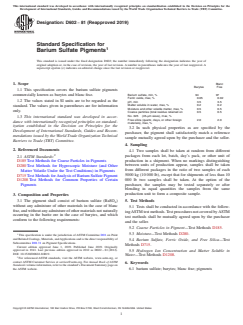


Overview
ASTM D602-81(2019), Standard Specification for Barium Sulfate Pigments, establishes the quality and performance requirements for barium sulfate pigments, specifically the commercially recognized types: barytes and blanc fixe. Developed and maintained by ASTM International, this standard serves as a critical benchmark for manufacturers, suppliers, and end-users in industries that rely on barium sulfate pigments for their chemical purity, brightness, and inertness.
This international standard supports global trade and ensures the pigments’ consistency by following principles set by the World Trade Organization’s Technical Barriers to Trade (TBT) Committee. The specification includes detailed requirements for chemical composition, physical properties, acceptable impurities, and related testing procedures to ensure product quality.
Key Topics
Types of Barium Sulfate Pigments Covered:
- Barytes: Natural form, must be free from non-native substances not found in barite ore.
- Blanc Fixe: Synthetic form, required to consist solely of pure barium sulfate without admixtures.
Essential Properties and Limits:
- Minimum barium sulfate content: 94% for barytes, 97% for blanc fixe
- Maximum ferric oxide content: 0.05% for barytes, 0.02% for blanc fixe
- pH minimum: 3.5 for both types
- Maximum matter soluble in water: 0.2%
- Maximum volatile matter (incl. moisture): 0.5%
- Maximum coarse particle residue (45-µm sieve): 0.5%
- Maximum free silica (quartz, clays, or foreign material): 2.0%
Testing and Compliance:
- Required tests include: coarse particle test, moisture test, chemical composition (barium sulfate, ferric oxide, free silica), hydrogen ion concentration (pH), and water solubility.
- Reference ASTM test methods: D185, D280, D715, D1208.
Sampling Protocol:
- Systematic sampling for quality control, with guidance on frequency and batch handling.
Applications
Barium sulfate pigments meeting ASTM D602-81(2019) are valued in multiple industries for their unique physical and chemical characteristics, such as high density, chemical inertness, and optimal particle size distribution. Key application areas include:
- Paints and Coatings: Used as white pigments to enhance opacity, brightness, and chemical durability.
- Plastics and Rubber: Incorporated to improve product strength, density, and weather resistance.
- Paper Industry: Enhances brightness and printability in high-grade paper products.
- Radiology: Utilized in medical imaging for contrast applications due to its radiopacity.
- Cosmetics: Selected for inclusion in formulations requiring non-reactive, color-stable white pigments.
ASTM D602 ensures consistency and safety of supplied pigments across these applications through stringent testing and certification requirements.
Related Standards
- ASTM D185 - Test Methods for Coarse Particles in Pigments: Establishes procedures for evaluating particle size distribution.
- ASTM D280 - Test Methods for Hygroscopic Moisture and Other Volatiles in Pigments: Defines moisture/volatile matter analysis methods.
- ASTM D715 - Test Methods for Analysis of Barium Sulfate Pigment: Specifies chemical analysis requirements.
- ASTM D1208 - Test Methods for Common Properties of Certain Pigments: Includes procedures for pH and water solubility.
- ISO 9001 - Not specific to pigments, but relevant for manufacturers adhering to quality management systems.
By complying with ASTM D602-81(2019), organizations can ensure their barium sulfate pigments align with internationally recognized performance benchmarks, supporting product quality, market access, and regulatory confidence.
Relations
- Effective Date
- 01-Jun-2019
- Effective Date
- 01-Jun-2020
- Effective Date
- 01-Jun-2019
- Effective Date
- 01-Dec-2014
- Effective Date
- 01-Nov-2012
- Effective Date
- 01-Nov-2012
- Effective Date
- 01-Feb-2008
- Effective Date
- 01-Jul-2007
- Effective Date
- 01-Jun-2007
- Effective Date
- 01-Feb-2007
- Effective Date
- 01-Oct-2003
- Effective Date
- 10-May-2001
- Effective Date
- 10-May-2001
- Effective Date
- 10-Jul-1999
- Refers
ASTM D185-84(1999) - Standard Test Methods for Coarse Particles in Pigments, Pastes, and Paints - Effective Date
- 10-May-1999
Frequently Asked Questions
ASTM D602-81(2019) is a technical specification published by ASTM International. Its full title is "Standard Specification for Barium Sulfate Pigments". This standard covers: ABSTRACT This specification covers the barium sulfate pigments commercially known as barytes and blanc fixe. The pigment shall consist of barium sulfate (BaSO4) without any admixture of other materials in the case of blanc fixe, and without any admixture of other materials not naturally occurring in the barite ore in the case of barytes. The pigments shall be subjected to the following tests: coarse particle test, moisture test, barium sulfate test, ferric oxide test, free silica test, hydrogen ion concentration, and matter water solubility test. SCOPE 1.1 This specification covers the barium sulfate pigments commercially known as barytes and blanc fixe. 1.2 The values stated in SI units are to be regarded as the standard. The values given in parentheses are for information only. 1.3 This international standard was developed in accordance with internationally recognized principles on standardization established in the Decision on Principles for the Development of International Standards, Guides and Recommendations issued by the World Trade Organization Technical Barriers to Trade (TBT) Committee.
ABSTRACT This specification covers the barium sulfate pigments commercially known as barytes and blanc fixe. The pigment shall consist of barium sulfate (BaSO4) without any admixture of other materials in the case of blanc fixe, and without any admixture of other materials not naturally occurring in the barite ore in the case of barytes. The pigments shall be subjected to the following tests: coarse particle test, moisture test, barium sulfate test, ferric oxide test, free silica test, hydrogen ion concentration, and matter water solubility test. SCOPE 1.1 This specification covers the barium sulfate pigments commercially known as barytes and blanc fixe. 1.2 The values stated in SI units are to be regarded as the standard. The values given in parentheses are for information only. 1.3 This international standard was developed in accordance with internationally recognized principles on standardization established in the Decision on Principles for the Development of International Standards, Guides and Recommendations issued by the World Trade Organization Technical Barriers to Trade (TBT) Committee.
ASTM D602-81(2019) is classified under the following ICS (International Classification for Standards) categories: 87.060.10 - Pigments and extenders. The ICS classification helps identify the subject area and facilitates finding related standards.
ASTM D602-81(2019) has the following relationships with other standards: It is inter standard links to ASTM D602-81(2012), ASTM D715-86(2020), ASTM D1208-96(2019), ASTM D715-86(2014), ASTM D280-01(2012), ASTM D1208-96(2012), ASTM D715-86(2008), ASTM D185-07, ASTM D1208-96(2007), ASTM D280-01(2007), ASTM D715-86(2003), ASTM D280-01, ASTM D280-81(1995), ASTM D715-86(1999), ASTM D185-84(1999). Understanding these relationships helps ensure you are using the most current and applicable version of the standard.
ASTM D602-81(2019) is available in PDF format for immediate download after purchase. The document can be added to your cart and obtained through the secure checkout process. Digital delivery ensures instant access to the complete standard document.
Standards Content (Sample)
This international standard was developed in accordance with internationally recognized principles on standardization established in the Decision on Principles for the
Development of International Standards, Guides and Recommendations issued by the World Trade Organization Technical Barriers to Trade (TBT) Committee.
Designation: D602 −81 (Reapproved 2019)
Standard Specification for
Barium Sulfate Pigments
This standard is issued under the fixed designation D602; the number immediately following the designation indicates the year of
original adoption or, in the case of revision, the year of last revision. A number in parentheses indicates the year of last reapproval. A
superscript epsilon (´) indicates an editorial change since the last revision or reapproval.
1. Scope
Blanc
Barytes Fixe
1.1 This specification covers the barium sulfate pigments
commercially known as barytes and blanc fixe. Barium sulfate, min, % 94 97
Ferric oxide, max, % 0.05 0.02
1.2 The values stated in SI units are to be regarded as the
pH, min 3.5 3.5
Matter soluble in water, max, % 0.2 0.2
standard. The values given in parentheses are for information
Moisture and other volatile matter, max, % 0.5 0.5
only.
Coarse particles (total residue retained on 0.5 0.5
No. 325 (45-µm sieve), max, %
1.3 This international standard was developed in accor-
Free silica (quartz, clays, or other foreign 2.0 2.0
dance with internationally recognized principles on standard-
materials), max, %
ization established in the Decision on Principles for the
3.2 In such physical properties as are specified by the
Development of International Standards, Guides and Recom-
purchaser, the pigment shall satisfactorily match a reference
mendations issued by the World Trade Organization Technical
sample mutually agreed upon by the purchaser and the seller.
Barriers to Trade (TBT) Committee.
4. Sampling
2. Referenced Documents
4.1 Two samples shall be taken at random from different
packages from each lot, batch, day’s pack, or other unit of
2.1 ASTM Standards:
production in a shipment. When no markings distinguishing
D185 Test Methods for Coarse Particles in Pigments
between units of production appear, samples shall be taken
D280 Test Methods for Hygroscopic Moisture (and Other
from different packages in the ratio of two samples of each
Matter Volatile Under the Test Conditions) in Pigments
5000 kg (10 000 lb), except that for shipments of less than 10
D715 Test Methods for Analysis of Barium Sulfate Pigment
000 lb two samples shall be taken. At the option of the
D1208 Test Methods for Common Properties of Certain
purchaser, the samples may be tested separately or after
Pigments
blending in equal quantities the samples from the same
production unit to form a composite sample.
3. Composition and Properties
3.1 The pigment shall consist of barium sulfate (BaSO )
5. Test Methods
without any admixture of other materials in the case of blanc
5.1 Tests shall be conducted in accordance wit
...