

ASTM B655/B655M-10(2018)
(Specification)Standard Specification for Niobium-Hafnium Alloy Bar and Wire
General Information
- Abstract
ABSTRACT
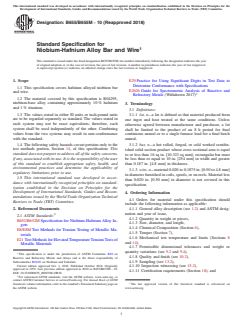
This specification covers hafnium alloyed niobium bar, rod, and wire. The material covered by this specification is R04295, a niobium-base alloy containing hafnium and titanium. The alloy shall conform to the required chemical composition for carbon, oxygen, nitrogen, hydrogen, hafnium, titanium, zirconium, tungsten, tantalum, and niobium. Materials in the annealed condition supplied under this specification shall conform to the required mechanical properties such as tensile strength, yield strength, and elongation. The alloy shall undergo the following test methods: room temperature tension test; elevated temperature tension test; and chemical test.
SIGNIFICANCE AND USE
12.1 The following applies to all specified limits in this standard for purposes of determining conformance with this specification. The observed value or a calculated value shall be rounded off to the nearest unit in the last right-hand digit used in expressing the specification limit, in accordance with the rounding-off method of Practice E29.
SCOPE
1.1 This specification covers hafnium alloyed niobium bar and wire.
1.2 The material covered by this specification is R04295, niobium-base alloy containing approximately 10 % hafnium and 1 % titanium.
1.3 The values stated in either SI units or inch-pound units are to be regarded separately as standard. The values stated in each system may not be exact equivalents; therefore, each system shall be used independently of the other. Combining values from the two systems may result in non-conformance with the standard.
1.4 The following safety hazards caveat pertains only to the test methods portion, Section 14, of this specification: This standard does not purport to address all of the safety concerns, if any, associated with its use. It is the responsibility of the user of this standard to establish appropriate safety, health, and environmental practices and determine the applicability of regulatory limitations prior to use.
1.5 This international standard was developed in accordance with internationally recognized principles on standardization established in the Decision on Principles for the Development of International Standards, Guides and Recommendations issued by the World Trade Organization Technical Barriers to Trade (TBT) Committee.
- Status
- Published
- Publication Date
- 30-Sep-2018
- Technical Committee
- B10 - Reactive and Refractory Metals and Alloys
- Drafting Committee
- B10.03 - Niobium, Tantalum, and Vanadium

Overview
ASTM B655/B655M-10(2018) - Standard Specification for Niobium-Hafnium Alloy Bar and Wire defines the requirements for bars, rods, and wires composed of a niobium-base alloy that contains approximately 10% hafnium and 1% titanium, designated as alloy R04295. This international standard ensures the chemical composition, mechanical properties, dimensions, quality, and testing procedures are consistent for niobium-hafnium alloy products. These materials are widely used in demanding applications where high purity, strength, and corrosion resistance are essential.
Key Topics
- Material Coverage: The standard applies to niobium-hafnium alloy products in the forms of bar, rod, and wire, specifically grade R04295.
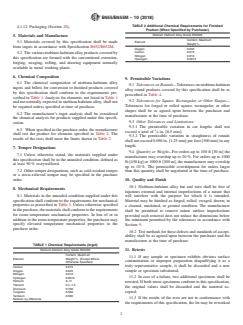
- Chemical Composition: Specifies limits for important elements including carbon, oxygen, nitrogen, hydrogen, hafnium, titanium, zirconium, tungsten, tantalum, and niobium by difference.
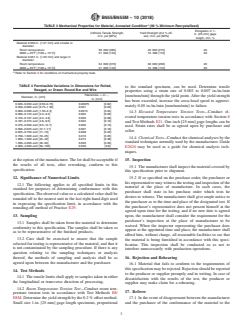
- Mechanical Properties: Covers minimum requirements for tensile strength, yield strength, and elongation for materials supplied in the annealed or other specified conditions.
- Dimensional Tolerances: Establishes precise permissible variations in diameter, straightness, and length for both round and shaped products.
- Sampling and Testing: Describes procedures for representative sampling, room temperature and elevated temperature tension testing, and chemical analysis.
- Quality and Finish: Material must be free of injurious defects and can be supplied in various finishes as specified by purchaser and manufacturer agreement.
- Certification and Marking: Requires producer certification and proper marking for traceability and verification.
- Dual Units: Recognizes both SI and inch-pound units, which must be used independently to ensure conformance.
Applications
Niobium-hafnium alloy bar and wire specified by ASTM B655/B655M are critical in industries that require materials capable of performing under extreme conditions. Typical applications include:
- Aerospace Components: Used in jet engine and rocket propulsion systems where high temperature performance and structural integrity are essential.
- Nuclear Technology: Preferred for components exposed to radiation and high heat, owing to niobium’s low neutron absorption cross-section and stability.
- Electronics and Superconducting Equipment: Utilized in advanced electronics, MRI systems, and particle accelerators for their high electrical conductivity and purity.
- Chemical Processing Equipment: Selected for resistance to corrosive environments and aggressive chemicals.
By adhering to ASTM B655/B655M, manufacturers and purchasers ensure that niobium-hafnium alloy bar and wire products meet global quality and performance standards.
Related Standards
Several ASTM standards complement or are referenced by ASTM B655/B655M, providing a comprehensive framework for quality assurance in reactive and refractory metals:
- ASTM B652/B652M: Specification for Niobium-Hafnium Alloy Ingots
- ASTM E8/E8M: Test Methods for Tension Testing of Metallic Materials
- ASTM E21: Test Methods for Elevated Temperature Tension Tests of Metallic Materials
- ASTM E29: Practice for Using Significant Digits in Test Data to Determine Conformance with Specifications
Practical Value
Following ASTM B655/B655M brings significant advantages:
- Reliability: Ensures material properties and traceability for critical components.
- Consistency: Standardized chemical and mechanical requirements facilitate global supply chain integration.
- Performance: Guarantees suitability for severe environments in aerospace, nuclear, and advanced technologies.
- Compliance: Assures adherence to internationally recognized quality principles and trade agreements.
By referencing this specification, engineers, quality managers, and procurement professionals can confidently specify niobium-hafnium bar and wire, aligning projects with industry best practices and simplifying certification processes.
Keywords: ASTM B655, niobium-hafnium alloy, R04295, alloy bar, alloy wire, mechanical properties, chemical composition, aerospace materials, nuclear components, reactive metals.
Relations
- Effective Date
- 01-Oct-2018
- Effective Date
- 01-Jan-2024
- Effective Date
- 01-Oct-2018
- Effective Date
- 15-Jul-2016
- Effective Date
- 01-Feb-2015
- Effective Date
- 01-Jun-2013
- Effective Date
- 01-Dec-2011
- Effective Date
- 01-May-2010
- Refers
ASTM E21-09 - Standard Test Methods for Elevated Temperature Tension Tests of Metallic Materials - Effective Date
- 01-Apr-2009
- Effective Date
- 01-Oct-2008
- Effective Date
- 15-Jun-2008
- Effective Date
- 15-Jun-2008
- Effective Date
- 15-Nov-2006
- Effective Date
- 15-Sep-2006
- Effective Date
- 01-May-2006
Get Certified
Connect with accredited certification bodies for this standard

Element Materials Technology
Materials testing and product certification.

Inštitut za kovinske materiale in tehnologije
Institute of Metals and Technology. Materials testing, metallurgical analysis, NDT.
Sponsored listings
Frequently Asked Questions
ASTM B655/B655M-10(2018) is a technical specification published by ASTM International. Its full title is "Standard Specification for Niobium-Hafnium Alloy Bar and Wire". This standard covers: ABSTRACT This specification covers hafnium alloyed niobium bar, rod, and wire. The material covered by this specification is R04295, a niobium-base alloy containing hafnium and titanium. The alloy shall conform to the required chemical composition for carbon, oxygen, nitrogen, hydrogen, hafnium, titanium, zirconium, tungsten, tantalum, and niobium. Materials in the annealed condition supplied under this specification shall conform to the required mechanical properties such as tensile strength, yield strength, and elongation. The alloy shall undergo the following test methods: room temperature tension test; elevated temperature tension test; and chemical test. SIGNIFICANCE AND USE 12.1 The following applies to all specified limits in this standard for purposes of determining conformance with this specification. The observed value or a calculated value shall be rounded off to the nearest unit in the last right-hand digit used in expressing the specification limit, in accordance with the rounding-off method of Practice E29. SCOPE 1.1 This specification covers hafnium alloyed niobium bar and wire. 1.2 The material covered by this specification is R04295, niobium-base alloy containing approximately 10 % hafnium and 1 % titanium. 1.3 The values stated in either SI units or inch-pound units are to be regarded separately as standard. The values stated in each system may not be exact equivalents; therefore, each system shall be used independently of the other. Combining values from the two systems may result in non-conformance with the standard. 1.4 The following safety hazards caveat pertains only to the test methods portion, Section 14, of this specification: This standard does not purport to address all of the safety concerns, if any, associated with its use. It is the responsibility of the user of this standard to establish appropriate safety, health, and environmental practices and determine the applicability of regulatory limitations prior to use. 1.5 This international standard was developed in accordance with internationally recognized principles on standardization established in the Decision on Principles for the Development of International Standards, Guides and Recommendations issued by the World Trade Organization Technical Barriers to Trade (TBT) Committee.
ABSTRACT This specification covers hafnium alloyed niobium bar, rod, and wire. The material covered by this specification is R04295, a niobium-base alloy containing hafnium and titanium. The alloy shall conform to the required chemical composition for carbon, oxygen, nitrogen, hydrogen, hafnium, titanium, zirconium, tungsten, tantalum, and niobium. Materials in the annealed condition supplied under this specification shall conform to the required mechanical properties such as tensile strength, yield strength, and elongation. The alloy shall undergo the following test methods: room temperature tension test; elevated temperature tension test; and chemical test. SIGNIFICANCE AND USE 12.1 The following applies to all specified limits in this standard for purposes of determining conformance with this specification. The observed value or a calculated value shall be rounded off to the nearest unit in the last right-hand digit used in expressing the specification limit, in accordance with the rounding-off method of Practice E29. SCOPE 1.1 This specification covers hafnium alloyed niobium bar and wire. 1.2 The material covered by this specification is R04295, niobium-base alloy containing approximately 10 % hafnium and 1 % titanium. 1.3 The values stated in either SI units or inch-pound units are to be regarded separately as standard. The values stated in each system may not be exact equivalents; therefore, each system shall be used independently of the other. Combining values from the two systems may result in non-conformance with the standard. 1.4 The following safety hazards caveat pertains only to the test methods portion, Section 14, of this specification: This standard does not purport to address all of the safety concerns, if any, associated with its use. It is the responsibility of the user of this standard to establish appropriate safety, health, and environmental practices and determine the applicability of regulatory limitations prior to use. 1.5 This international standard was developed in accordance with internationally recognized principles on standardization established in the Decision on Principles for the Development of International Standards, Guides and Recommendations issued by the World Trade Organization Technical Barriers to Trade (TBT) Committee.
ASTM B655/B655M-10(2018) is classified under the following ICS (International Classification for Standards) categories: 77.150.99 - Other products of non-ferrous metals. The ICS classification helps identify the subject area and facilitates finding related standards.
ASTM B655/B655M-10(2018) has the following relationships with other standards: It is inter standard links to ASTM B655/B655M-10, ASTM E8/E8M-24, ASTM B652/B652M-10(2018), ASTM E8/E8M-16, ASTM E8/E8M-15, ASTM E8/E8M-13, ASTM E8/E8M-11, ASTM B652/B652M-10, ASTM E21-09, ASTM E29-08, ASTM E2626-08, ASTM E2626-08e1, ASTM E29-06b, ASTM E29-06a, ASTM E29-06. Understanding these relationships helps ensure you are using the most current and applicable version of the standard.
ASTM B655/B655M-10(2018) is available in PDF format for immediate download after purchase. The document can be added to your cart and obtained through the secure checkout process. Digital delivery ensures instant access to the complete standard document.
Standards Content (Sample)
This international standard was developed in accordance with internationally recognized principles on standardization established in the Decision on Principles for the
Development of International Standards, Guides and Recommendations issued by the World Trade Organization Technical Barriers to Trade (TBT) Committee.
Designation:B655/B655M −10 (Reapproved 2018)
Standard Specification for
Niobium-Hafnium Alloy Bar and Wire
This standard is issued under the fixed designation B655/B655M; the number immediately following the designation indicates the year
of original adoption or, in the case of revision, the year of last revision. A number in parentheses indicates the year of last reapproval.
A superscript epsilon (´) indicates an editorial change since the last revision or reapproval.
1. Scope E29 Practice for Using Significant Digits in Test Data to
Determine Conformance with Specifications
1.1 This specification covers hafnium alloyed niobium bar
E2626 Guide for Spectrometric Analysis of Reactive and
and wire.
Refractory Metals (Withdrawn 2017)
1.2 The material covered by this specification is R04295,
niobium-base alloy containing approximately 10 % hafnium
3. Terminology
and 1 % titanium.
3.1 Definitions:
1.3 The values stated in either SI units or inch-pound units
3.1.1 lot, n—a lot is defined as that material produced from
are to be regarded separately as standard. The values stated in
one ingot and heat treated at the same conditions. Unless
each system may not be exact equivalents; therefore, each
otherwise agreed between manufacturer and purchaser, a lot
system shall be used independently of the other. Combining
shall be limited to the product of an 8 h period for final
values from the two systems may result in non-conformance
continuous anneal or to a single furnace load for a final batch
with the standard.
anneal.
1.4 The following safety hazards caveat pertains only to the
3.1.2 bar, n—a hot rolled, forged, or cold worked semifin-
test methods portion, Section 14, of this specification: This
ished solid section product whose cross sectional area is equal
standard does not purport to address all of the safety concerns,
to or less than 16 sq in. [10.323 sq mm]; rectangular bar must
if any, associated with its use. It is the responsibility of the user
be less than or equal to 10 in. [254 mm] in width and greater
of this standard to establish appropriate safety, health, and
than 0.187 in. [4.8 mm] in thickness.
environmental practices and determine the applicability of
3.1.3 wire, n—material 0.020 to 0.1875 in. [0.50 to 4.8 mm]
regulatory limitations prior to use.
in diameter furnished in coils, spools, or on reels. Material less
1.5 This international standard was developed in accor-
than 0.020 in. [0.50 mm] in diameter is not covered in this
dance with internationally recognized principles on standard-
specification.
ization established in the Decision on Principles for the
Development of International Standards, Guides and Recom-
4. Ordering Information
mendations issued by the World Trade Organization Technical
4.1 Orders for material under this specification should
Barriers to Trade (TBT) Committee.
include the following information as applicable:
2. Referenced Documents 4.1.1 General alloy description (see 1.2) and ASTM desig-
nation and year of issue,
2.1 ASTM Standards:
4.1.2 Quantity in weight or pieces,
B652/B652M Specification for Niobium-Hafnium Alloy In-
4.1.3 Size, diameter, and length,
gots
4.1.4 Chemical Composition (Section 6),
E8/E8M Test Methods for Tension Testing of Metallic Ma-
4.1.5 Temper (Section 7),
terials
4.1.6 Mechanical test temperature and limits (Sections 8
E21 TestMethodsforElevatedTemperatureTensionTestsof
and 14),
Metallic Materials
4.1.7 Permissible dimensional tolerances and weight or
quantity variations (see 9.2 and 9.4),
This specification is under the jurisdiction of ASTM Committee B10 on
4.1.8 Quality and finish (see 10.2),
Reactive and Refractory Metals and Alloys and is the direct responsibility of
Subcommittee B10.03 on Niobium and Tantalum. 4.1.9 Sampling (see 13.2),
Current edition approved Oct. 1, 2018. Published October 2018. Originally
4.1.10 Inspection witnessing (see 15.2),
approved in 1979. Last previous edition approved in 2010 as B655/B655M – 10.
4.1.11 Certification requirements (Section 18), and
DOI: 10.1520/B0655_B0655M-10R18.
For referenced ASTM standards, visit the ASTM website, www.astm.org, or
contact ASTM Customer Service at service@astm.org. For Annual Book of ASTM
Standards volume information, refer to the standard’s Document Summary page on The last approved version of this historical standard is referenced on
the ASTM website. www.astm.org.
Copyright © ASTM International, 100 Barr Harbor Drive, PO Box C700, West Conshohocken, PA 19428-2959. United States
B655/B655M−10 (2018)
TABLE 2 Additional Chemical Requirements for Finished
4.1.12 Packaging (Section 20),
Product (When Specified by Purchaser)
Niobium-Hafnium Alloy Grade R04295
5. Materials and Manufacture
Content, Maximum
Element
5.1 Materials covered by this specification shall be made
Weight %
from ingots in accordance with Specification B652/B652M.
Oxygen 0.035
Carbon 0.015
5.2 The various niobium-hafnium alloy products covered by
Nitrogen 0.010
this specification are formed with the conventional extrusion,
Hydrogen 0.0015
forging, swaging, rolling, and drawing equipment normally
available in metal working plants.
6. Chemical Composition
9. Permissible Variations
6.1 The chemical composition of niobium-hafnium alloy
9.1 Tolerances on Rounds—Tolerances on niobium-hafnium
ingots and billets for conversion to finished products covered
alloy round products covered by this specification shall be as
by this specification shall conform to the requirements pre-
prescribed in Table 4.
scribed in Table 1. Analysis for elements, not listed in Table 1
9.2 Tolerances for Square, Rectangular, or Other Shapes—
and not normally expected in niobium-hafnium alloy, shall not
Tolerances for forged or rolled square, rectangular, or other
be required unless specified at time of purchase.
shapes shall be as agreed upon between the purchaser and
6.2 The manufacturer’s ingot analysis shall be considered
manufacturer at the time of purchase.
the chemical analysis for products supplied under this specifi-
9.3 Other Tolerances and Limitations:
cation.
9.3.1 The permissible variation in cut lengths shall not
6.3 When specified in the purchase order, the manufacturer
exceed a total of ⁄4 in. [6.5 mm].
shall test the product for elements specified in Table 2. The
9.3.2 The permissible variation in straightness of rounds
results of the tests shall meet the limits shown in Table 2.
shall not exceed 0.050 in. [1.25 mm] per foot [300 mm] in any
length.
7. Temper Designations
9.4 Quantity or Weight—For orders up to 100 ft [30 m] the
7.1 Unless otherwise stated, the materials supplied under
manufacturer may overship up to 20 %. For orders up to 1000
this specification shall be in the annealed condition, defined as
lb [450 kg] or 1000 ft [300 m], the manufacturer may overship
at least 90 % recrystallized.
up to 10 %. The permissible overshipment for orders larger
7.2 Other temper designations, such as cold-worked temper
than this quantity shall be negotiated at the time of purchase.
or a stress-relieved temper may be specified in the purchase
order.
10. Quality and Finish
10.1 Niobium-hafnium alloy bar and wire shall be free of
8. Mechanical Requirements
injurious external and internal imperfections of a nature that
8.1 Materials in the annealed condition supplied under this
will interfere with the purpose for which it is intended.
specification shall conform to the requirements for mechanical
Material may be finished as forged, rolled, swaged, drawn; in
properties as prescribed in Table 3. Unless otherwise specified
a cleaned, machined, or ground condition. The manufacturer
inthepurchase,thematerialsshallconformtotherequirements
shall be permitted to remove minor surface imperfections
for room temperature mechanical properties. In lieu of or in
provided such removal does not reduce the dimensions below
addition to the room temperature properties, the purchaser may
the minimum permitted by the tolerances in accordance with
specify elevated temperature mechanical properties in the
Section 9.
purchase order.
10.2 Test methods for these defects and standards of accept-
ability shall be as agreed upon between the purchaser and the
manufacturer at the time of purchase.
TABLE 1 Chemical Requirements (Ingot)
11. Retests
Niobium-Hafnium Alloy Grade R04295
Content, Maximum
11.1 If any sample or specimen exhibits obvious surface
Element Weight %,
...