

ASTM D5988-18
(Test Method)Standard Test Method for Determining Aerobic Biodegradation of Plastic Materials in Soil
General Information
- Abstract
SIGNIFICANCE AND USE
5.1 The degree and rate of aerobic biodegradability of a plastic material in the environment determines the extent to which and time period over which plastic materials are mineralized by soil microorganisms. Disposal is becoming a major issue with the increasing use of plastics, and the results of this test method permit an estimation of the degree of biodegradability and the time period over which plastics will remain in an aerobic soil environment. This test method determines the degree of aerobic biodegradation by measuring evolved carbon dioxide as a function of time that the plastic is exposed to soil.
5.2 Soil is an extremely species-rich source of inoculum for evaluation of the biodegradability of plastics in the environment. When maintained appropriately with regard to moisture content and oxygen availability, the biological activity is quite considerable, although lower than other biologically active environments, such as activated sewage-sludge or compost.
SCOPE
1.1 This test method covers determination under laboratory conditions of the degree and rate of aerobic biodegradation of plastic materials, including formulation additives, in contact with soil.
1.2 This test method is designed to measure the biodegradability of plastic materials relative to a reference material in an aerobic environment.
1.3 This test method is designed to be applicable to all plastic materials that are not inhibitory to the bacteria and fungi present in soil.
1.4 Claims of performance shall be limited to the numerical result obtained in the test and not be used for unqualified “biodegradable” claims. Reports shall clearly state the percentage of net gaseous carbon generation for both the test and reference samples at the completion of the test. Results shall not be extrapolated beyond the actual duration of the test.
1.5 The values stated in SI units are to be regarded as the standard.
1.6 This standard does not purport to address all of the safety concerns, if any, associated with its use. It is the responsibility of the user of this standard to establish appropriate safety, health, and environmental practices and determine the applicability of regulatory limitations prior to use. A specific hazard statement is given in Section 8.
1.7 This ASTM test method is equivalent to ISO 17556.
1.8 This international standard was developed in accordance with internationally recognized principles on standardization established in the Decision on Principles for the Development of International Standards, Guides and Recommendations issued by the World Trade Organization Technical Barriers to Trade (TBT) Committee.
- Status
- Published
- Publication Date
- 31-Mar-2018
- Technical Committee
- D20 - Plastics
- Drafting Committee
- D20.96 - Environmentally Degradable Plastics and Biobased Products
Buy Documents
ASTM D5988-18 - Standard Test Method for Determining Aerobic Biodegradation of Plastic Materials in Soil
REDLINE ASTM D5988-18 - Standard Test Method for Determining Aerobic Biodegradation of Plastic Materials in Soil
Overview
ASTM D5988-18 is the internationally recognized standard test method for determining the aerobic biodegradation of plastic materials in soil. Issued by ASTM International, this method provides a reliable, laboratory-based procedure for assessing the degree and rate at which plastics and their additives break down via microbial activity in an aerobic (oxygen-rich) soil environment. The relevance of this test is underscored by increasing global attention to plastic disposal and its environmental impact. By following ASTM D5988-18, stakeholders can obtain accurate, reproducible data on how long plastics persist in soil and their potential for mineralization.
Key Topics
- Aerobic Biodegradation Measurement: The standard evaluates both the extent and rate of biodegradation by monitoring the carbon dioxide evolved as plastic interacts with soil microbes.
- Applicability: Suitable for all plastic materials and formulations that are not inhibitory to the native soil microbial community (bacteria and fungi).
- Comparative Assessment: Results are measured relative to a reference biodegradable material under the same conditions.
- Numerical Reporting: The method emphasizes reporting quantitative results-such as the percentage of carbon converted to carbon dioxide-and prohibits unqualified “biodegradable” claims.
- Test Conditions: Testing is carried out under controlled laboratory conditions, mimicking natural aerobic soil environments with precise regulation of temperature, soil composition, and moisture content.
- Soil Inoculum: Requires a mixture of fresh, biodiverse soils from at least three distinct locations, optimizing the microbial diversity necessary for meaningful results.
Applications
- Product Development & R&D: Enables manufacturers to screen plastic materials and formulations for their ability to biodegrade in soil, informing design choices for environmentally responsible products.
- Regulatory Compliance: Provides documented, standardized biodegradation data needed for environmental claims, waste management policies, and eco-label certification.
- Comparative Studies: Supports comparative life cycle analyses, performance benchmarking, and validation of “biodegradable” technologies by offering a robust, widely-accepted test platform.
- Academic & Industrial Research: Facilitates studies on polymer science, soil chemistry, and microbial ecology by offering a clear framework to measure plastic decomposition and its environmental impacts.
Related Standards
This standard is regularly referenced alongside other critical methods and terminology, including:
- ISO 17556: Plastics-Determination of the ultimate aerobic biodegradability of plastic materials in soil by measuring oxygen demand or carbon dioxide evolution (internationally equivalent to ASTM D5988-18).
- ASTM D883: Terminology relating to plastics.
- ASTM D5338: Determining aerobic biodegradation under controlled composting conditions.
- ASTM D5511: Testing anaerobic biodegradation of plastics under high-solids anaerobic-digestion conditions.
- ASTM D618: Practice for conditioning plastics for testing.
- ASTM D425, D1193, D1293, D2974, D4972, D2980, D2989, D4129: Supporting methods for soil and plastic characterization necessary for the test process.
Practical Value
ASTM D5988-18 delivers a science-based approach to understanding the environmental profile of plastic materials. By following this standard, organizations gain credible test data that support responsible decision-making, product labeling, and innovation in biodegradable plastics. This rigorous method forms the foundation for constructing environmental claims and contributes significantly to sustainable materials development and environmental stewardship across diverse sectors.
Keywords: aerobic biodegradation, plastic materials in soil, ASTM D5988-18, environmental compliance, biodegradable plastics, laboratory testing, sustainability, carbon dioxide evolution, soil microbial activity, standard test method.
Relations
- Effective Date
- 01-Apr-2018
- Effective Date
- 01-Feb-2024
- Effective Date
- 01-Nov-2023
- Effective Date
- 15-Jan-2020
- Effective Date
- 15-Jan-2020
- Effective Date
- 01-Jan-2020
- Effective Date
- 01-Jan-2020
- Effective Date
- 01-Aug-2019
- Effective Date
- 01-May-2019
- Effective Date
- 15-Apr-2019
- Effective Date
- 01-Feb-2019
- Effective Date
- 01-Dec-2018
- Effective Date
- 01-Nov-2018
- Effective Date
- 01-Jul-2018
- Effective Date
- 15-Jan-2018
Buy Documents
ASTM D5988-18 - Standard Test Method for Determining Aerobic Biodegradation of Plastic Materials in Soil
REDLINE ASTM D5988-18 - Standard Test Method for Determining Aerobic Biodegradation of Plastic Materials in Soil
Get Certified
Connect with accredited certification bodies for this standard

CIS Institut d.o.o.
Personal Protective Equipment (PPE) certification body. Notified Body NB-2890 for EU Regulation 2016/425 PPE.

Kiwa BDA Testing
Building and construction product certification.
Kmetijski inštitut Slovenije
Agricultural Institute of Slovenia. Soil testing, plant health, agricultural product analysis.
Sponsored listings
Frequently Asked Questions
ASTM D5988-18 is a standard published by ASTM International. Its full title is "Standard Test Method for Determining Aerobic Biodegradation of Plastic Materials in Soil". This standard covers: SIGNIFICANCE AND USE 5.1 The degree and rate of aerobic biodegradability of a plastic material in the environment determines the extent to which and time period over which plastic materials are mineralized by soil microorganisms. Disposal is becoming a major issue with the increasing use of plastics, and the results of this test method permit an estimation of the degree of biodegradability and the time period over which plastics will remain in an aerobic soil environment. This test method determines the degree of aerobic biodegradation by measuring evolved carbon dioxide as a function of time that the plastic is exposed to soil. 5.2 Soil is an extremely species-rich source of inoculum for evaluation of the biodegradability of plastics in the environment. When maintained appropriately with regard to moisture content and oxygen availability, the biological activity is quite considerable, although lower than other biologically active environments, such as activated sewage-sludge or compost. SCOPE 1.1 This test method covers determination under laboratory conditions of the degree and rate of aerobic biodegradation of plastic materials, including formulation additives, in contact with soil. 1.2 This test method is designed to measure the biodegradability of plastic materials relative to a reference material in an aerobic environment. 1.3 This test method is designed to be applicable to all plastic materials that are not inhibitory to the bacteria and fungi present in soil. 1.4 Claims of performance shall be limited to the numerical result obtained in the test and not be used for unqualified “biodegradable” claims. Reports shall clearly state the percentage of net gaseous carbon generation for both the test and reference samples at the completion of the test. Results shall not be extrapolated beyond the actual duration of the test. 1.5 The values stated in SI units are to be regarded as the standard. 1.6 This standard does not purport to address all of the safety concerns, if any, associated with its use. It is the responsibility of the user of this standard to establish appropriate safety, health, and environmental practices and determine the applicability of regulatory limitations prior to use. A specific hazard statement is given in Section 8. 1.7 This ASTM test method is equivalent to ISO 17556. 1.8 This international standard was developed in accordance with internationally recognized principles on standardization established in the Decision on Principles for the Development of International Standards, Guides and Recommendations issued by the World Trade Organization Technical Barriers to Trade (TBT) Committee.
SIGNIFICANCE AND USE 5.1 The degree and rate of aerobic biodegradability of a plastic material in the environment determines the extent to which and time period over which plastic materials are mineralized by soil microorganisms. Disposal is becoming a major issue with the increasing use of plastics, and the results of this test method permit an estimation of the degree of biodegradability and the time period over which plastics will remain in an aerobic soil environment. This test method determines the degree of aerobic biodegradation by measuring evolved carbon dioxide as a function of time that the plastic is exposed to soil. 5.2 Soil is an extremely species-rich source of inoculum for evaluation of the biodegradability of plastics in the environment. When maintained appropriately with regard to moisture content and oxygen availability, the biological activity is quite considerable, although lower than other biologically active environments, such as activated sewage-sludge or compost. SCOPE 1.1 This test method covers determination under laboratory conditions of the degree and rate of aerobic biodegradation of plastic materials, including formulation additives, in contact with soil. 1.2 This test method is designed to measure the biodegradability of plastic materials relative to a reference material in an aerobic environment. 1.3 This test method is designed to be applicable to all plastic materials that are not inhibitory to the bacteria and fungi present in soil. 1.4 Claims of performance shall be limited to the numerical result obtained in the test and not be used for unqualified “biodegradable” claims. Reports shall clearly state the percentage of net gaseous carbon generation for both the test and reference samples at the completion of the test. Results shall not be extrapolated beyond the actual duration of the test. 1.5 The values stated in SI units are to be regarded as the standard. 1.6 This standard does not purport to address all of the safety concerns, if any, associated with its use. It is the responsibility of the user of this standard to establish appropriate safety, health, and environmental practices and determine the applicability of regulatory limitations prior to use. A specific hazard statement is given in Section 8. 1.7 This ASTM test method is equivalent to ISO 17556. 1.8 This international standard was developed in accordance with internationally recognized principles on standardization established in the Decision on Principles for the Development of International Standards, Guides and Recommendations issued by the World Trade Organization Technical Barriers to Trade (TBT) Committee.
ASTM D5988-18 is classified under the following ICS (International Classification for Standards) categories: 13.030.10 - Solid wastes. The ICS classification helps identify the subject area and facilitates finding related standards.
ASTM D5988-18 has the following relationships with other standards: It is inter standard links to ASTM D5988-12, ASTM D883-24, ASTM D883-23, ASTM D2974-20e1, ASTM D2974-20, ASTM D4129-05(2020), ASTM D883-20, ASTM D883-19c, ASTM D4972-19, ASTM D883-19a, ASTM D883-19, ASTM D883-18a, ASTM D883-18, ASTM D4972-18, ASTM D5511-18. Understanding these relationships helps ensure you are using the most current and applicable version of the standard.
ASTM D5988-18 is available in PDF format for immediate download after purchase. The document can be added to your cart and obtained through the secure checkout process. Digital delivery ensures instant access to the complete standard document.
Standards Content (Sample)
This international standard was developed in accordance with internationally recognized principles on standardization established in the Decision on Principles for the
Development of International Standards, Guides and Recommendations issued by the World Trade Organization Technical Barriers to Trade (TBT) Committee.
Designation: D5988 − 18
Standard Test Method for
Determining Aerobic Biodegradation of Plastic Materials in
Soil
This standard is issued under the fixed designation D5988; the number immediately following the designation indicates the year of
original adoption or, in the case of revision, the year of last revision.Anumber in parentheses indicates the year of last reapproval.A
superscript epsilon (´) indicates an editorial change since the last revision or reapproval.
1. Scope* 2. Referenced Documents
2.1 ASTM Standards:
1.1 This test method covers determination under laboratory
D425Test Method for Centrifuge Moisture Equivalent of
conditions of the degree and rate of aerobic biodegradation of
Soils
plastic materials, including formulation additives, in contact
D618Practice for Conditioning Plastics for Testing
with soil.
D883Terminology Relating to Plastics
1.2 This test method is designed to measure the biodegrad-
D1193Specification for Reagent Water
abilityofplasticmaterialsrelativetoareferencematerialinan
D1293Test Methods for pH of Water
aerobic environment.
D2974Test Methods for Moisture,Ash, and Organic Matter
of Peat and Other Organic Soils
1.3 This test method is designed to be applicable to all
D2980 Test Method for Saturated Density, Moisture-
plasticmaterialsthatarenotinhibitorytothebacteriaandfungi
Holding Capacity, and Porosity of Saturated Peat Materi-
present in soil.
als
1.4 Claims of performanceshallbelimitedtothenumerical
D2989Test Method for Acidity-Alkalinity of Halogenated
result obtained in the test and not be used for unqualified
Organic Solvents and Their Admixtures
“biodegradable”claims.Reportsshallclearlystatethepercent-
D4129Test Method for Total and Organic Carbon in Water
age of net gaseous carbon generation for both the test and
by High Temperature Oxidation and by Coulometric
reference samples at the completion of the test. Results shall
Detection
not be extrapolated beyond the actual duration of the test.
D4972Test Method for pH of Soils
D5338Test Method for Determining Aerobic Biodegrada-
1.5 The values stated in SI units are to be regarded as the
tion of Plastic Materials Under Controlled Composting
standard.
Conditions, Incorporating Thermophilic Temperatures
1.6 This standard does not purport to address all of the
D5511TestMethodforDeterminingAnaerobicBiodegrada-
safety concerns, if any, associated with its use. It is the
tion of Plastic Materials Under High-Solids Anaerobic-
responsibility of the user of this standard to establish appro-
Digestion Conditions
priate safety, health, and environmental practices and deter- 3
2.2 APHA-AWWA-WPCF Standards:
mine the applicability of regulatory limitations prior to use. A
2540D Total Suspended Solids Dried at 103°–105°C
specific hazard statement is given in Section 8.
2540G Total, Fixed, and Volatile Solids in Solids and
1.7 This ASTM test method is equivalent to ISO 17556.
Semi-Solid Samples
1.8 This international standard was developed in accor-
2.3 ISO Standard:
dance with internationally recognized principles on standard-
ISO11261SoilQuality—DeterminationofTotalNitrogen—
ization established in the Decision on Principles for the
Modified Kjeldahl Method
Development of International Standards, Guides and Recom-
ISO 17556Plastics—Determination of the UltimateAerobic
mendations issued by the World Trade Organization Technical
Barriers to Trade (TBT) Committee.
For referenced ASTM standards, visit the ASTM website, www.astm.org, or
contactASTM Customer Service at service@astm.org. ForAnnual Book ofASTM
Standards volume information, refer to the standard’s Document Summary page on
ThistestmethodisunderthejurisdictionofASTMCommitteeD20onPlastics the ASTM website.
and is the direct responsibility of Subcommittee D20.96 on Environmentally Standard Methods for the Examination ofWater andWastewater, 17th Edition,
Degradable Plastics and Biobased Products. 1989,Available fromAmerican Public HealthAssociation (APHA), 800 I St., NW,
Current edition approved April 1, 2018. Published April 2018. Originally Washington, DC 20001, http://www.apha.org.
approved in 1996. Last previous edition approved in 2012 as D5988-12. DOI: Available fromAmerican National Standards Institute (ANSI), 25 W. 43rd St.,
10.1520/D5988-18. 4th Floor, New York, NY 10036, http://www.ansi.org.
*A Summary of Changes section appears at the end of this standard
Copyright © ASTM International, 100 Barr Harbor Drive, PO Box C700, West Conshohocken, PA 19428-2959. United States
D5988 − 18
BiodegradabilityofPlasticMaterialsinSoilbyMeasuring
the Oxygen Demand in a Respirometer or theAmount of
Carbon Dioxide Evolved
3. Terminology
3.1 Definitions—Definitions of terms applicable to this test
method appear in Terminology D883.
4. Summary of Test Method
4.1 The test method described consists of the selection of
plastic material for the determination of aerobic
biodegradability, obtaining soil as a matrix and source of
inoculum, exposing the plastic material to the soil, measuring
NOTE 1—(1) Barium hydroxide solution or potassium hydroxide
the carbon dioxide evolved by the microorganisms as a
solution, (2) soil, (3) water, and (4) perforated plate.
function of time, and assessing the degree of biodegradability.
FIG. 1 Soil-Contact Incubation Apparatus
4.2 The CO production measured for a material, expressed
as a fraction of the measured or calculated carbon content, is
reported with respect to time, from which the degree of
biodegradability is assessed.
tors. Provide three vessels for soil only (known as “blanks” or
“controls,” these vessels show the background activity of the
4.3 Alternatively, it is possible to determine the consump-
soil), three vessels for a positive reference material (these
tion of oxygen, or biochemical oxygen demand (BOD), for
vessels show the viability of the soil microbial community),
example, by measuring the amount of oxygen required to
three vessels per test material, and three vessels as technical
maintainaconstantgasvolumeintherespirometerflask,orby
controls. The technical controls contain only the absorbing
measuring the change in volume or pressure (or a combination
solution and no soil.The ambient air which fills the headspace
of the two) either automatically or manually. The level of
of all the vessels introduces carbon dioxide into the system.
biodegradation expressed in percent is determined by compar-
The technical controls allow accounting for and subtracting
ing the BOD with the theoretical oxygen demand (ThOD). In
this introduced carbon dioxide. Additionally, the technical
using this alternative approach, however, the influence of
controls indicate the air-tightness of the vessel system by
possible nitrification processes on the BOD must be consid-
showing possible infiltration of carbon dioxide into the sealed
ered.
vessel.
6.1.2 Beakers,setsof150-mLand100-mL,equalinnumber
5. Significance and Use
to the soil incubation vessels.
5.1 The degree and rate of aerobic biodegradability of a
6.1.3 Perforated Plates or Other Support, a set to hold the
plastic material in the environment determines the extent to
beakers above the soil inside each vessel.The support must be
which and time period over which plastic materials are
made from a material that will not absorb carbon dioxide.
mineralized by soil microorganisms. Disposal is becoming a
6.1.4 Darkened Chamber or Cabinet, which allows selec-
major issue with the increasing use of plastics, and the results
tion of a temperature between 20°C to 28°C, and allows
of this test method permit an estimation of the degree of
maintaining the selected temperature at 62°C.
biodegradability and the time period over which plastics will
6.2 Analytical Equipment:
remain in an aerobic soil environment. This test method
6.2.1 Analytical Instrument, to measure the total carbon
determines the degree of aerobic biodegradation by measuring
content of the test specimen.
evolved carbon dioxide as a function of time that the plastic is
6.2.2 Analytical Balance, to weigh the test specimen.
exposed to soil.
6.2.3 Burette, 100 mL.
5.2 Soil is an extremely species-rich source of inoculum for
6.2.4 Bench-Top Centrifuge, for moisture-holding capacity
evaluation of the biodegradability of plastics in the environ-
(MHC) determination.
ment. When maintained appropriately with regard to moisture
6.2.5 Oven, set to 104 6 1°C for moisture determinations.
content and oxygen availability, the biological activity is quite
6.2.6 Muffle Furnace, set to 550°C for ash determinations.
considerable, although lower than other biologically active
6.2.7 pH Meter.
environments, such as activated sewage-sludge or compost.
6.3 Alternatively, it is acceptable to use a flow-through
6. Apparatus
apparatus or manometric apparatus as described in ISO 17566.
6.1 Soil-Contact IncubationApparatus(seeFig.1;biometer
7. Reagents and Materials
flasks are also appropriate). Ensure that all glassware is
thoroughly cleaned and, in particular, free from organic or 7.1 Purity of Reagents—Reagent grade chemicals shall be
toxic matter. used in all tests. Unless otherwise indicated, it is intended that
6.1.1 Vessels,asetofvesselswithapproximately2to4-Lof all reagents conform to the specifications of the Committee on
internal volume with air-tight seal, such as 150-mm desicca- Analytical Reagents of theAmerican Chemical Society where
D5988 − 18
such specifications are available. It is acceptable to use other 9.4 Analyze the soil for MHC by Test Method D425, Test
grades, provided it is first ascertained that the reagent is of Method D2980, or another analogous test method for MHC or
sufficiently high purity to permit its use without lessening the field capacity.
accuracy of the determination.
9.5 Determine the pH of the soil on a 5:1 (distilled water-
7.2 Ammonium Phosphate, ((NH ) HPO ), 4.72 g/L.
:soil)slurryusingaglasscombinationelectrodecalibratedwith
4 2 4
standardbuffers,followingtheguidelinesgiveninTestMethod
7.3 Barium Hydroxide Solution (0.025 N), prepared by
D1293.Alternatively, it is acceptable to determine the soil pH
dissolving4.0ganhydrousBa(OH) /Lofdistilledwater.Filter
byTest Method D4972.The pH must fall between 6.0 and 8.0.
free of solid material, confirm normality by titration with
(Soil with a pH above 8.0 retains more of the CO evolved by
standard acid, and store sealed as a clear solution to prevent
the microorganisms than a neutral soil, while a soil with a pH
absorption of CO from the air. It is recommended that 5 to 20
below 6.0 has the potential to contain an atypical microbial
L be prepared at a time when running a series of tests. When
population.)
using Ba(OH) , however, care must be taken that a film of
BaCO does not form on the surface of the solution in the
9.6 Determine the moisture (total solids—dry solids) and
beaker, which would inhibit CO diffusion into the absorbing
ash (total solids—volatile solids) contents of the soil in
medium. Alternatively, it is acceptable to use potassium
accordancewithTestMethodD2974orAPHA-AWWA-WPCF
hydroxide solution (KOH, 0.5 N), prepared by dissolving 28 g
2540 D and G, respectively.
of anhydrous KOH/L of distilled water and proceeding in the
9.7 Determine total nitrogen in accordance with ISO11261
same way as for the Ba(OH) .
or equivalent method.
7.4 Hydrochloric Acid, 0.05 N HCl when using 0.025 N
9.8 It is acceptable for the test matrix to be a mixture of
Ba(OH) , or 0.25 N HCl when using 0.5 N KOH.
natural soil, as described in 9.1, and mature compost, such as
obtained at the end of Test Method D5338, at a ratio of 1 g
8. Hazards
compost to 25 g soil, which corresponds to a typical applica-
8.1 This test method includes the use of hazardous chemi-
tion in agriculture of approximately 120 tons of compost per
cals.Avoid contact with chemicals and follow the manufactur- hectare of agricultural land (assuming 20 cm of soil depth and
–3
er’s instructions and material safety data sheets.
a bulk density of 1.5 Mg m ).
9. Soil 10. Test Specimen
9.1 Usenatural,fertilesoilcollectedfromthesurfacelayers
10.1 Test specimens shall be of known weight and have
of fields and forests. Make a laboratory mixture of equal parts sufficient carbon content to yield enough carbon dioxide that
(byweight)ofsoilsamplesobtainedfromatleastthreediverse
can be measured accurately by the trapping procedure de-
locations (for example, an agricultural field, a forest, and a scribed in this test method (see 11.7 and 11.9). Determine the
pasture or meadow). Taking soil from multiple and diverse
carbon content of the test material by calculation or elemental
locations will maximize biodiversity. It is advisable to avoid analysis, in accordance with Test Method D4129.
soilsthathavebeenexposedtopollutantsthatcausesignificant
10.2 It is acceptable for test specimens to be in the form of
perturbations of the microbial population. The soils are pref-
films, pieces, fragments, powders, or formed articles, or in
erably used fresh from the field to assure acti
...
This document is not an ASTM standard and is intended only to provide the user of an ASTM standard an indication of what changes have been made to the previous version. Because
it may not be technically possible to adequately depict all changes accurately, ASTM recommends that users consult prior editions as appropriate. In all cases only the current version
of the standard as published by ASTM is to be considered the official document.
Designation: D5988 − 12 D5988 − 18
Standard Test Method for
Determining Aerobic Biodegradation of Plastic Materials in
Soil
This standard is issued under the fixed designation D5988; the number immediately following the designation indicates the year of
original adoption or, in the case of revision, the year of last revision. A number in parentheses indicates the year of last reapproval. A
superscript epsilon (´) indicates an editorial change since the last revision or reapproval.
1. Scope*
1.1 This test method covers determination under laboratory conditions of the degree and rate of aerobic biodegradation of plastic
materials, including formulation additives, in contact with soil.
1.2 This test method is designed to measure the biodegradability of plastic materials relative to a reference material in an aerobic
environment.
1.3 This test method is designed to be applicable to all plastic materials that are not inhibitory to the bacteria and fungi present
in soil.
1.4 Claims of performance shall be limited to the numerical result obtained in the test and not be used for unqualified
“biodegradable” claims. Reports shall clearly state the percentage of net gaseous carbon generation for both the test and reference
samples at the completion of the test. Results shall not be extrapolated beyond the actual duration of the test.
1.5 The values stated in SI units are to be regarded as the standard.
1.6 This standard does not purport to address all of the safety concerns, if any, associated with its use. It is the responsibility
of the user of this standard to establish appropriate safety safety, health, and healthenvironmental practices and determine the
applicability of regulatory limitations prior to use. A specific hazard statement is given in Section 8.
1.7 This ASTM test method is equivalent to ISO 17556.
1.8 This international standard was developed in accordance with internationally recognized principles on standardization
established in the Decision on Principles for the Development of International Standards, Guides and Recommendations issued
by the World Trade Organization Technical Barriers to Trade (TBT) Committee.
2. Referenced Documents
2.1 ASTM Standards:
D425 Test Method for Centrifuge Moisture Equivalent of Soils
D618 Practice for Conditioning Plastics for Testing
D883 Terminology Relating to Plastics
D1193 Specification for Reagent Water
D1293 Test Methods for pH of Water
D2974 Test Methods for Moisture, Ash, and Organic Matter of Peat and Other Organic Soils
D2980 Test Method for Saturated Density, Moisture-Holding Capacity, and Porosity of Saturated Peat Materials
D2989 Test Method for Acidity-Alkalinity of Halogenated Organic Solvents and Their Admixtures
D4129 Test Method for Total and Organic Carbon in Water by High Temperature Oxidation and by Coulometric Detection
D4972 Test Method for pH of Soils
D5338 Test Method for Determining Aerobic Biodegradation of Plastic Materials Under Controlled Composting Conditions,
Incorporating Thermophilic Temperatures
D5511 Test Method for Determining Anaerobic Biodegradation of Plastic Materials Under High-Solids Anaerobic-Digestion
Conditions
This test method is under the jurisdiction of ASTM Committee D20 on Plastics and is the direct responsibility of Subcommittee D20.96 on Environmentally Degradable
Plastics and Biobased Products.
Current edition approved May 1, 2012April 1, 2018. Published June 2012April 2018. Originally approved in 1996. Last previous edition approved in 20032012 as
D5988 - 03.D5988 - 12. DOI: 10.1520/D5988-12.10.1520/D5988-18.
For referenced ASTM standards, visit the ASTM website, www.astm.org, or contact ASTM Customer Service at service@astm.org. For Annual Book of ASTM Standards
volume information, refer to the standard’s Document Summary page on the ASTM website.
*A Summary of Changes section appears at the end of this standard
Copyright © ASTM International, 100 Barr Harbor Drive, PO Box C700, West Conshohocken, PA 19428-2959. United States
D5988 − 18
2.2 APHA-AWWA-WPCF Standards:
2540 D Total Suspended Solids Dried at 103°–105°C
2540 G Total, Fixed, and Volatile Solids in Solids and Semi-Solid Samples
2.3 ISO Standard:
ISO 11261 Soil Quality—Determination of Total Nitrogen—Modified Kjeldahl Method
ISO 17556 Plastics—Determination of the Ultimate Aerobic Biodegradability of Plastic Materials in Soil by Measuring the
Oxygen Demand in a Respirometer or the Amount of Carbon Dioxide Evolved
3. Terminology
3.1 Definitions—Definitions of terms applicable to this test method appear in Terminology D883.
4. Summary of Test Method
4.1 The test method described consists of the selection of plastic material for the determination of aerobic biodegradability,
obtaining soil as a matrix and source of inoculum, exposing the plastic material to the soil, measuring the carbon dioxide evolved
by the microorganisms as a function of time, and assessing the degree of biodegradability.
4.2 The CO production measured for a material, expressed as a fraction of the measured or calculated carbon content, is
reported with respect to time, from which the degree of biodegradability is assessed.
4.3 Alternatively, it is possible to determine the consumption of oxygen, or biochemical oxygen demand (BOD), for example,
by measuring the amount of oxygen required to maintain a constant gas volume in the respirometer flask, or by measuring the
change in volume or pressure (or a combination of the two) either automatically or manually. The level of biodegradation expressed
in percent is determined by comparing the BOD with the theoretical oxygen demand (ThOD). In using this alternative approach,
however, the influence of possible nitrification processes on the BOD must be considered.
5. Significance and Use
5.1 The degree and rate of aerobic biodegradability of a plastic material in the environment determines the extent to which and
time period over which plastic materials are mineralized by soil microorganisms. Disposal is becoming a major issue with the
increasing use of plastics, and the results of this test method permit an estimation of the degree of biodegradability and the time
period over which plastics will remain in an aerobic soil environment. This test method determines the degree of aerobic
biodegradation by measuring evolved carbon dioxide as a function of time that the plastic is exposed to soil.
5.2 Soil is an extremely species-rich source of inoculum for evaluation of the biodegradability of plastics in the environment.
When maintained appropriately with regard to moisture content and oxygen availability, the biological activity is quite
considerable, although lower than other biologically active environments, such as activated sewage-sludge or compost.
6. Apparatus
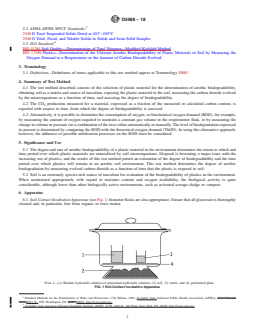
6.1 Soil-Contact Incubation Apparatus (see Fig. 1; biometer flasks are also appropriate). Ensure that all glassware is thoroughly
cleaned and, in particular, free from organic or toxic matter.
NOTE 1—(1) Barium hydroxide solution or potassium hydroxide solution, (2) soil, (3) water, and (4) perforated plate.
FIG. 1 Soil-Contact Incubation Apparatus
Standard Methods for the Examination of Water and Wastewater, 17th Edition, 1989, Available from American Public Health Association (APHA), 1015 Fifteenth
Street800 I St., NW, Washington, DC 20005.20001, http://www.apha.org.
Available from American National Standards Institute (ANSI), 25 W. 43rd St., 4th Floor, New York, NY 10036, http://www.ansi.org.
D5988 − 18
6.1.1 Vessels, a set of vessels with approximately 2 to 4-L of internal volume with air-tight seal, such as 150-mm desiccators.
Provide three vessels for soil only (known as “blanks” or “controls,” these vessels show the background activity of the soil), three
vessels for a positive reference material (these vessels show the viability of the soil microbial community), three vessels per test
material, and three vessels as technical controls. The technical controls contain only the absorbing solution and no soil. The
ambient air which fills the headspace of all the vessels introduces carbon dioxide into the system. The technical controls allow
accounting for and subtracting this introduced carbon dioxide. Additionally, the technical controls indicate the air-tightness of the
vessel system by showing possible infiltration of carbon dioxide into the sealed vessel.
6.1.2 Beakers, sets of 150-mL and 100-mL, equal in number to the soil incubation vessels.
6.1.3 Perforated Plates or Other Support, a set to hold the beakers above the soil inside each vessel. The support must be made
from a material that will not absorb carbon dioxide.
6.1.4 Darkened Chamber or Cabinet, which allows selection of a temperature between 20°C to 28°C, and allows maintaining
the selected temperature at 62°C.
6.2 Analytical Equipment:
6.2.1 Analytical Instrument, to measure the total carbon content of the test specimen.
6.2.2 Analytical Balance, to weigh the test specimen.
6.2.3 Burette, 100 mL.
6.2.4 Bench-Top Centrifuge, for moisture-holding capacity (MHC) determination.
6.2.5 Oven, set to 104 6 1°C for moisture determinations.
6.2.6 Muffle Furnace, set to 550°C for ash determinations.
6.2.7 pH Meter.
6.3 Alternatively, it is acceptable to use a flow-through apparatus or manometric apparatus as described in ISO 17566.
7. Reagents and Materials
7.1 Purity of Reagents—Reagent grade chemicals shall be used in all tests. Unless otherwise indicated, it is intended that all
reagents conform to the specifications of the Committee on Analytical Reagents of the American Chemical Society where such
specifications are available. It is acceptable to use other grades, provided it is first ascertained that the reagent is of sufficiently
high purity to permit its use without lessening the accuracy of the determination.
7.2 Ammonium Phosphate, ((NH ) HPO ), 4.72 g/L.
4 2 4
7.3 Barium Hydroxide Solution (0.025 N), prepared by dissolving 4.0 g anhydrous Ba(OH) /L of distilled water. Filter free of
solid material, confirm normality by titration with standard acid, and store sealed as a clear solution to prevent absorption of CO
from the air. It is recommended that 5 to 20 L be prepared at a time when running a series of tests. When using Ba(OH) , however,
care must be taken that a film of BaCO does not form on the surface of the solution in the beaker, which would inhibit CO
3 2
diffusion into the absorbing medium. Alternatively, it is acceptable to use potassium hydroxide solution (KOH, 0.5 N), prepared
by dissolving 28 g of anhydrous KOH/L of distilled water and proceeding in the same way as for the Ba(OH) .
7.4 Hydrochloric Acid, 0.05 N HCl when using 0.025 N Ba(OH) , or 0.25 N HCl when using 0.5 N KOH.
8. Hazards
8.1 This test method includes the use of hazardous chemicals. Avoid contact with chemicals and follow the manufacturer’s
instructions and material safety data sheets.
9. Soil
9.1 Use natural, fertile soil collected from the surface layers of fields and forests. Make a laboratory mixture of equal parts (by
weight) of soil samples obtained from at least three diverse locations (for example, an agricultural field, a forest, and a pasture or
meadow). Taking soil from multiple and diverse locations will maximize biodiversity. It is advisable to avoid soils that have been
exposed to pollutants that cause significant perturbations of the microbial population. The soils are preferably used fresh from the
field to assure active microbiota. Air-dried or frozen soils must be reactivated before use in this test. It is preferable to use fertile
soil classified as “sandy loam” in accordance with USDA classification, or “silty sand” in accordance with the German DIN
classification.
9.2 The sources of the soils must be reported (see 14.1.1). Record the sampling site, its location, the presence of plants or crops,
the sampling date, the sampling depth, and, if possible, the history such as details of fertilizer and pesticide application.
9.3 Sieve the soil to less than 2-mm particle size, and remove obvious plant material, stones, or other inert materials. Store the
soil in a sealed container at 4 6 1°C for a maximum of one month.
Reagent Chemicals, American Chemical Society Specifications, American Chemical Society, Washington, DC. For suggestions on the testing of reagents not listed by
the American Chemical Society, see Analar Standards for Laboratory Chemicals, BDH Ltd., Poole, Dorset, U.K., and the United States Pharmacopeia and National
Formulary, U.S. Pharmacopeial Convention, Inc. (USPC), Rockville, MD.
D5988 − 18
9.4 Analyze the soil for MHC by Test Method D425, Test Method D2980, or another analogous test method for MHC or field
capacity.
9.5 Determine the pH of the soil on a 5:1 (distilled water:soil) slurry using a glass combination electrode calibrated with
standard buffers, following the guidelines given in Test Method D1293. Alternatively, it is acceptable to determine the soil pH by
Test Method D4972. The pH must fall between 6.0 and 8.0. (Soil with a pH above 8.0 retains more of the CO evolved by the
microorganisms than a neutral soil, while a soil with a pH below 6.0 has the potential to contain an atypical microbial population.)
9.6 Determine the moisture (total solids—dry solids) and ash (total solids—volatile solids) contents of the soil in accordance
with Test Method D2974 or APHA-AWWA-WPCF 2540 D and G, respectively.
9.7 Determine total nitrogen in accordance with ISO 11261 or equivalent method.
9.8 It is accept
...