

ASTM D5198-17
(Practice)Standard Practice for Nitric Acid Digestion of Solid Waste
General Information
- Abstract
SIGNIFICANCE AND USE
5.1 A knowledge of the inorganic composition of a waste is often required for the selection of appropriate waste disposal practices. Solid waste may exist in a variety of forms and contain a range of organic and inorganic constituents. This practice describes a digestion procedure which dissolves many of the toxic inorganic constituents and produces a solution suitable for determination of total recoverable contents by such techniques as atomic absorption spectroscopy, atomic emission spectroscopy, and so forth. The relatively large sample size aids representative sampling of heterogenous wastes. The relatively small dilution factor allows lower detection limits than most other sample digestion methods. Volatile metals, such as lead and mercury, are not lost during this digestion procedure, however organo-lead and organo-mercury may not be completely digested. Hydride-forming elements, such as arsenic and selenium, may be partially lost. Samples with total metal contents greater than 5 % may give low results. The analyst is responsible for determining whether this practice is applicable to the solid waste being tested.
SCOPE
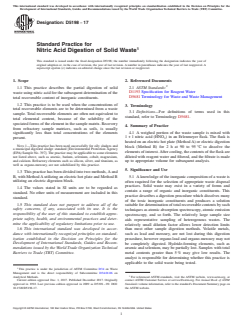
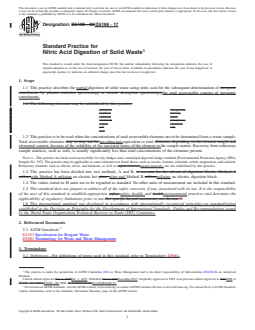
1.1 This practice describes the partial digestion of solid waste using nitric acid for the subsequent determination of the total recoverable content of inorganic constituents.
1.2 This practice is to be used when the concentrations of total recoverable elements are to be determined from a waste sample. Total recoverable elements are often not equivalent to total elemental content, because of the solubility of the speciated forms of the element in the sample matrix. Recovery from refractory sample matrices, such as soils, is usually significantly less than total concentrations of the elements present.
Note 1: This practice has been used successfully for oily sludges and a municipal digested sludge standard [Environmental Protection Agency (EPA) Sample No. 397]. The practice may be applicable to some elements not listed above, such as arsenic, barium, selenium, cobalt, magnesium, and calcium. Refractory elements such as silicon, silver, and titanium, as well as organo-mercury, are not solubilized by this practice.
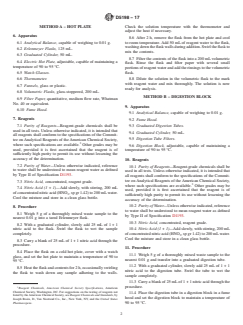
1.3 This practice has been divided into two methods, A and B, with Method A utilizing an electric hot plate and Method B utilizing an electric digestion block.
1.4 The values stated in SI units are to be regarded as standard. No other units of measurement are included in this standard.
1.5 This standard does not purport to address all of the safety concerns, if any, associated with its use. It is the responsibility of the user of this standard to establish appropriate safety, health, and environmental practices and determine the applicability of regulatory limitations prior to use.
1.6 This international standard was developed in accordance with internationally recognized principles on standardization established in the Decision on Principles for the Development of International Standards, Guides and Recommendations issued by the World Trade Organization Technical Barriers to Trade (TBT) Committee.
- Status
- Published
- Publication Date
- 30-Nov-2017
- Technical Committee
- D34 - Waste Management
- Drafting Committee
- D34.01.06 - Analytical Methods

Overview
ASTM D5198-17: Standard Practice for Nitric Acid Digestion of Solid Waste is an internationally recognized procedure established by ASTM International for the preparation of solid waste samples via nitric acid digestion. The primary purpose of this practice is to partially dissolve inorganic constituents in solid waste, allowing for the subsequent analysis and determination of total recoverable elements using instrumental techniques such as atomic absorption spectroscopy (AAS) and plasma emission spectroscopy (AES).
This standard practice is essential for professionals in environmental science, waste management, and analytical laboratories who require reliable data on the inorganic content of heterogeneous waste materials, including oily sludges and municipal sludges.
Key Topics
- Purpose and Scope: Provides guidelines for the partial digestion of solid waste using nitric acid to prepare samples for analysis of total recoverable inorganic elements.
- Applicability: Designed for solid waste samples where knowledge of inorganic composition is critical for waste disposal decisions.
- Methods:
- Method A: Utilizes an electric hot plate.
- Method B: Utilizes an electric digestion block.
- Elements Analyzed: Enables the recoverable quantification of metals and elements such as aluminum, beryllium, cadmium, chromium, copper, iron, lead, manganese, mercury, nickel, phosphorus, vanadium, and zinc. May be applicable to arsenic, barium, selenium, cobalt, magnesium, and calcium, although some elements like silicon, silver, titanium, and organo-mercury are not solubilized.
- Sample Preparation: Emphasizes representative sampling through large sample sizes and limited dilution, resulting in lower detection limits when compared to other digestion methods.
- Safety Considerations: Requires use of fume hoods, proper ventilation, and careful handling of nitric acid due to toxic fumes and potential violent reactions with organic materials.
- Limitations: Not all forms of elements are quantitatively recovered; refractory matrices and organometallic compounds may not be fully digested. Hydride-forming elements (e.g., arsenic, selenium) may be partially lost, and samples with metal content above 5% may yield low recoveries.
Applications
ASTM D5198-17 is widely utilized in:
- Environmental Monitoring: Preparation of waste samples for regulatory compliance and environmental impact assessment.
- Waste Management: Characterization of solid waste to aid in disposal method selection, treatment design, and landfilling criteria.
- Industrial and Municipal Analysis: Treatment plants, laboratories, and environmental engineers use this standard to analyze sludges, oily wastes, contaminated soils, and industrial by-products.
- Research and Development: Used in studies focusing on heavy metal contamination, remediation strategies, and fate of metals in solid waste matrices.
By using ASTM D5198-17, laboratories benefit from standardized procedures, improved sample representativeness, and enhanced reliability in analytical results, supporting informed decisions in environmental health and safety.
Related Standards
- ASTM D1193: Specification for Reagent Water - Ensures water purity for sample dilution and reagent preparation.
- ASTM D5681: Terminology for Waste and Waste Management - Provides definitions relevant to solid waste analysis and management.
- Other Relevant Standards:
- Methods for atomic absorption spectroscopy (AAS) and atomic emission spectroscopy (AES).
- Industry and regulatory methods for trace metals in environmental samples.
Keywords: ASTM D5198, nitric acid digestion, solid waste analysis, total recoverable elements, heavy metals, sample preparation, waste management, environmental monitoring, inorganic composition, atomic absorption spectroscopy.
For laboratories, environmental consultants, and regulatory agencies, employing ASTM D5198-17 ensures consistent, accurate preparation of solid waste samples for inorganic analysis, supporting robust environmental stewardship and regulatory compliance.
Relations
- Effective Date
- 01-Dec-2017
- Effective Date
- 01-Nov-2023
- Effective Date
- 01-Nov-2018
- Effective Date
- 01-Sep-2017
- Effective Date
- 01-Nov-2016
- Effective Date
- 01-Feb-2016
- Effective Date
- 01-Feb-2013
- Effective Date
- 01-Jul-2009
- Effective Date
- 01-Sep-2008
- Effective Date
- 01-Mar-2006
- Effective Date
- 01-Sep-2004
- Effective Date
- 01-Sep-2004
- Effective Date
- 10-Feb-1999
- Effective Date
- 10-Feb-1999
- Effective Date
- 10-Jun-1998
Get Certified
Connect with accredited certification bodies for this standard

CIS Institut d.o.o.
Personal Protective Equipment (PPE) certification body. Notified Body NB-2890 for EU Regulation 2016/425 PPE.

Kiwa BDA Testing
Building and construction product certification.
Kmetijski inštitut Slovenije
Agricultural Institute of Slovenia. Soil testing, plant health, agricultural product analysis.
Sponsored listings
Frequently Asked Questions
ASTM D5198-17 is a standard published by ASTM International. Its full title is "Standard Practice for Nitric Acid Digestion of Solid Waste". This standard covers: SIGNIFICANCE AND USE 5.1 A knowledge of the inorganic composition of a waste is often required for the selection of appropriate waste disposal practices. Solid waste may exist in a variety of forms and contain a range of organic and inorganic constituents. This practice describes a digestion procedure which dissolves many of the toxic inorganic constituents and produces a solution suitable for determination of total recoverable contents by such techniques as atomic absorption spectroscopy, atomic emission spectroscopy, and so forth. The relatively large sample size aids representative sampling of heterogenous wastes. The relatively small dilution factor allows lower detection limits than most other sample digestion methods. Volatile metals, such as lead and mercury, are not lost during this digestion procedure, however organo-lead and organo-mercury may not be completely digested. Hydride-forming elements, such as arsenic and selenium, may be partially lost. Samples with total metal contents greater than 5 % may give low results. The analyst is responsible for determining whether this practice is applicable to the solid waste being tested. SCOPE 1.1 This practice describes the partial digestion of solid waste using nitric acid for the subsequent determination of the total recoverable content of inorganic constituents. 1.2 This practice is to be used when the concentrations of total recoverable elements are to be determined from a waste sample. Total recoverable elements are often not equivalent to total elemental content, because of the solubility of the speciated forms of the element in the sample matrix. Recovery from refractory sample matrices, such as soils, is usually significantly less than total concentrations of the elements present. Note 1: This practice has been used successfully for oily sludges and a municipal digested sludge standard [Environmental Protection Agency (EPA) Sample No. 397]. The practice may be applicable to some elements not listed above, such as arsenic, barium, selenium, cobalt, magnesium, and calcium. Refractory elements such as silicon, silver, and titanium, as well as organo-mercury, are not solubilized by this practice. 1.3 This practice has been divided into two methods, A and B, with Method A utilizing an electric hot plate and Method B utilizing an electric digestion block. 1.4 The values stated in SI units are to be regarded as standard. No other units of measurement are included in this standard. 1.5 This standard does not purport to address all of the safety concerns, if any, associated with its use. It is the responsibility of the user of this standard to establish appropriate safety, health, and environmental practices and determine the applicability of regulatory limitations prior to use. 1.6 This international standard was developed in accordance with internationally recognized principles on standardization established in the Decision on Principles for the Development of International Standards, Guides and Recommendations issued by the World Trade Organization Technical Barriers to Trade (TBT) Committee.
SIGNIFICANCE AND USE 5.1 A knowledge of the inorganic composition of a waste is often required for the selection of appropriate waste disposal practices. Solid waste may exist in a variety of forms and contain a range of organic and inorganic constituents. This practice describes a digestion procedure which dissolves many of the toxic inorganic constituents and produces a solution suitable for determination of total recoverable contents by such techniques as atomic absorption spectroscopy, atomic emission spectroscopy, and so forth. The relatively large sample size aids representative sampling of heterogenous wastes. The relatively small dilution factor allows lower detection limits than most other sample digestion methods. Volatile metals, such as lead and mercury, are not lost during this digestion procedure, however organo-lead and organo-mercury may not be completely digested. Hydride-forming elements, such as arsenic and selenium, may be partially lost. Samples with total metal contents greater than 5 % may give low results. The analyst is responsible for determining whether this practice is applicable to the solid waste being tested. SCOPE 1.1 This practice describes the partial digestion of solid waste using nitric acid for the subsequent determination of the total recoverable content of inorganic constituents. 1.2 This practice is to be used when the concentrations of total recoverable elements are to be determined from a waste sample. Total recoverable elements are often not equivalent to total elemental content, because of the solubility of the speciated forms of the element in the sample matrix. Recovery from refractory sample matrices, such as soils, is usually significantly less than total concentrations of the elements present. Note 1: This practice has been used successfully for oily sludges and a municipal digested sludge standard [Environmental Protection Agency (EPA) Sample No. 397]. The practice may be applicable to some elements not listed above, such as arsenic, barium, selenium, cobalt, magnesium, and calcium. Refractory elements such as silicon, silver, and titanium, as well as organo-mercury, are not solubilized by this practice. 1.3 This practice has been divided into two methods, A and B, with Method A utilizing an electric hot plate and Method B utilizing an electric digestion block. 1.4 The values stated in SI units are to be regarded as standard. No other units of measurement are included in this standard. 1.5 This standard does not purport to address all of the safety concerns, if any, associated with its use. It is the responsibility of the user of this standard to establish appropriate safety, health, and environmental practices and determine the applicability of regulatory limitations prior to use. 1.6 This international standard was developed in accordance with internationally recognized principles on standardization established in the Decision on Principles for the Development of International Standards, Guides and Recommendations issued by the World Trade Organization Technical Barriers to Trade (TBT) Committee.
ASTM D5198-17 is classified under the following ICS (International Classification for Standards) categories: 13.030.10 - Solid wastes. The ICS classification helps identify the subject area and facilitates finding related standards.
ASTM D5198-17 has the following relationships with other standards: It is inter standard links to ASTM D5198-09, ASTM D5681-23, ASTM D5681-18, ASTM D5681-17, ASTM D5681-16a, ASTM D5681-16, ASTM D5681-13, ASTM D5681-09, ASTM D5681-08, ASTM D1193-06, ASTM D5681-98a(2004), ASTM D5681-98a(2004)e1, ASTM D1193-99e1, ASTM D1193-99, ASTM D5681-98a. Understanding these relationships helps ensure you are using the most current and applicable version of the standard.
ASTM D5198-17 is available in PDF format for immediate download after purchase. The document can be added to your cart and obtained through the secure checkout process. Digital delivery ensures instant access to the complete standard document.
Standards Content (Sample)
This international standard was developed in accordance with internationally recognized principles on standardization established in the Decision on Principles for the
Development of International Standards, Guides and Recommendations issued by the World Trade Organization Technical Barriers to Trade (TBT) Committee.
Designation: D5198 − 17
Standard Practice for
Nitric Acid Digestion of Solid Waste
This standard is issued under the fixed designation D5198; the number immediately following the designation indicates the year of
original adoption or, in the case of revision, the year of last revision. A number in parentheses indicates the year of last reapproval. A
superscript epsilon (´) indicates an editorial change since the last revision or reapproval.
1. Scope 2. Referenced Documents
2.1 ASTM Standards:
1.1 This practice describes the partial digestion of solid
D1193 Specification for Reagent Water
waste using nitric acid for the subsequent determination of the
D5681 Terminology for Waste and Waste Management
total recoverable content of inorganic constituents.
1.2 This practice is to be used when the concentrations of
3. Terminology
total recoverable elements are to be determined from a waste
3.1 Definitions—For definitions of terms used in this
sample. Total recoverable elements are often not equivalent to
standard, refer to Terminology D5681.
total elemental content, because of the solubility of the
speciated forms of the element in the sample matrix. Recovery
4. Summary of Practice
from refractory sample matrices, such as soils, is usually
4.1 A weighed portion of the waste sample is mixed with
significantly less than total concentrations of the elements
1 + 1 nitric acid (HNO ) in an Erlenmeyer flask. The flask is
present.
heated on an electric hot plate (MethodA) or electric digestion
NOTE 1—This practice has been used successfully for oily sludges and
block (Method B) for2hat90to95°Cto dissolve the
a municipal digested sludge standard [Environmental Protection Agency
elements of interest.After cooling, the contents of the flask are
(EPA) Sample No. 397].The practice may be applicable to some elements
diluted with reagent water and filtered, and the filtrate is made
not listed above, such as arsenic, barium, selenium, cobalt, magnesium,
and calcium. Refractory elements such as silicon, silver, and titanium, as up to appropriate volume for subsequent analysis.
well as organo-mercury, are not solubilized by this practice.
5. Significance and Use
1.3 This practice has been divided into two methods,Aand
B, with MethodAutilizing an electric hot plate and Method B 5.1 Aknowledge of the inorganic composition of a waste is
utilizing an electric digestion block.
often required for the selection of appropriate waste disposal
practices. Solid waste may exist in a variety of forms and
1.4 The values stated in SI units are to be regarded as
contain a range of organic and inorganic constituents. This
standard. No other units of measurement are included in this
practice describes a digestion procedure which dissolves many
standard.
of the toxic inorganic constituents and produces a solution
1.5 This standard does not purport to address all of the
suitable for determination of total recoverable contents by such
safety concerns, if any, associated with its use. It is the
techniques as atomic absorption spectroscopy, atomic emission
responsibility of the user of this standard to establish appro-
spectroscopy, and so forth. The relatively large sample size
priate safety, health, and environmental practices and deter-
aids representative sampling of heterogenous wastes. The
mine the applicability of regulatory limitations prior to use.
relatively small dilution factor allows lower detection limits
1.6 This international standard was developed in accor- than most other sample digestion methods. Volatile metals,
dance with internationally recognized principles on standard-
such as lead and mercury, are not lost during this digestion
ization established in the Decision on Principles for the procedure, however organo-lead and organo-mercury may not
Development of International Standards, Guides and Recom-
be completely digested. Hydride-forming elements, such as
mendations issued by the World Trade Organization Technical arsenic and selenium, may be partially lost. Samples with total
Barriers to Trade (TBT) Committee.
metal contents greater than 5 % may give low results. The
analyst is responsible for determining whether this practice is
applicable to the solid waste being tested.
This practice is under the jurisdiction of ASTM Committee D34 on Waste
Management and is the direct responsibility of Subcommittee D34.01.06 on
Analytical Methods. For referenced ASTM standards, visit the ASTM website, www.astm.org, or
Current edition approved Dec. 1, 2017. Published December 2017. Originally contact ASTM Customer Service at service@astm.org. For Annual Book of ASTM
approved in 1992. Last previous edition approved in 2009 as D5198 – 09. DOI: Standards volume information, refer to the standard’s Document Summary page on
10.1520/D5198-17. the ASTM website.
Copyright © ASTM International, 100 Barr Harbor Drive, PO Box C700, West Conshohocken, PA 19428-2959. United States
D5198 − 17
METHOD A – HOT PLATE Check the solution temperature with the thermometer and
adjust the heat if necessary.
6. Apparatus
8.6 After 2 h, remove the flask from the hot plate and cool
6.1 Analytical Balance, capable of weighing to 0.01 g.
to room temperature.Add 50 mL of reagent water to the flask,
washingdowntheflaskwallsduringaddition.Swirltheflaskto
6.2 Erlenmeyer Flasks, 125 mL.
mix the contents.
6.3 Graduated Cylinder, 50 mL.
8.7 Filter the contents of the flask into a 200 mLvolumetric
6.4 Electric Hot Plate, adjustable, capable of maintaining a
flask. Rinse the flask and filter paper with several small
temperature of 90 to 95 °C.
portionsofreagentwaterandaddtherinsingstothevolumetric
6.5 Watch Glasses. flask.
6.6 Thermometer. 8.8 Dilute the solution in the volumetric flask to the mark
with reagent water and mix thoroughly. The solution is now
6.7 Funnels, glass or plastic.
ready for analysis.
6.8 Volumetric Flasks, glass-stoppered, 200 mL.
METHOD B – DIGESTION BLOCK
6.9 Filter Paper, quantitative, medium flow rate, Whatman
No. 40 or equivalent.
9. Apparatus
6.10 Fume Hood.
9.1 Analytical Balance, capable of weighing to 0.01 g.
7. Reagents
9.2 Fume Hood.
7.1 Purity of Reagents—Reagent-grade chemicals shall be 9.3 Graduated Digestion Tubes.
used in all tests. Unless otherwise indicated, it
...
This document is not an ASTM standard and is intended only to provide the user of an ASTM standard an indication of what changes have been made to the previous version. Because
it may not be technically possible to adequately depict all changes accurately, ASTM recommends that users consult prior editions as appropriate. In all cases only the current version
of the standard as published by ASTM is to be considered the official document.
Designation: D5198 − 09 D5198 − 17
Standard Practice for
Nitric Acid Digestion of Solid Waste
This standard is issued under the fixed designation D5198; the number immediately following the designation indicates the year of
original adoption or, in the case of revision, the year of last revision. A number in parentheses indicates the year of last reapproval. A
superscript epsilon (´) indicates an editorial change since the last revision or reapproval.
1. Scope
1.1 This practice describes the partial digestion of solid waste using nitric acid for the subsequent determination of inorganic
constituents by plasma emission spectroscopy or atomic absorption spectroscopy.the total recoverable content of inorganic
constituents.
1.2 The following elements may be solubilized by this practice:
aluminum manganese
beryllium mercury
cadmium nickel
chromium phosphorus
copper vanadium
iron zinc
lead
1.2 This practice is to be used when the concentrations of total recoverable elements are to be determined from a waste sample.
Total recoverable elements may or may not be are often not equivalent to total elements, depending on the element sought and
elemental content, because of the solubility of the speciated forms of the element in the sample matrix. Recovery from refractory
sample matrices, such as soils, is usually significantly less than total concentrations of the elements present.
NOTE 1—This practice has been used successfully for oily sludges and a municipal digested sludge standard [Environmental Protection Agency (EPA)
Sample No. 397]. The practice may be applicable to some elements not listed above, such as arsenic, barium, selenium, cobalt, magnesium, and calcium.
Refractory elements such as silicon, silver, and titanium, as well as organo-mercuryorgano-mercury, are not solubilized by this practice.
1.3 This practice has been divided into two methods, A and B, to account for the advent of digestion blocks. Method A
utilizeswith Method A utilizing an electric hot plate; plate and Method B utilizesutilizing an electric digestion block.
1.4 The values stated in SI units are to be regarded as standard. No other units of measurement are included in this standard.
1.5 This standard does not purport to address all of the safety concerns, if any, associated with its use. It is the responsibility
of the user of this standard to establish appropriate safety safety, health, and healthenvironmental practices and determine the
applicability of regulatory limitations prior to use.For specific hazard statements, see Section 7.
1.6 This international standard was developed in accordance with internationally recognized principles on standardization
established in the Decision on Principles for the Development of International Standards, Guides and Recommendations issued
by the World Trade Organization Technical Barriers to Trade (TBT) Committee.
2. Referenced Documents
2.1 ASTM Standards:
D1193 Specification for Reagent Water
D5681 Terminology for Waste and Waste Management
3. Terminology
3.1 Definitions—For definitions of terms used in this standard, refer to Terminology D5681.
This practice is under the jurisdiction of ASTM Committee D34 on Waste Management and is the direct responsibility of Subcommittee D34.01.06 on Analytical
Methods.
Current edition approved Feb. 1, 2009Dec. 1, 2017. Published March 2009December 2017. Originally approved in 1992. Last previous edition approved in 20032009 as
D5198 – 92 (2003).D5198 – 09. DOI: 10.1520/D5198-09.10.1520/D5198-17.
For referenced ASTM standards, visit the ASTM website, www.astm.org, or contact ASTM Customer Service at service@astm.org. For Annual Book of ASTM Standards
volume information, refer to the standard’s Document Summary page on the ASTM website.
Copyright © ASTM International, 100 Barr Harbor Drive, PO Box C700, West Conshohocken, PA 19428-2959. United States
D5198 − 17
4. Summary of Practice
4.1 A weighed portion of the waste sample is mixed with 1 + 1 nitric acid (HNO ) in an Erlenmeyer flask. The flask is heated
on an electric hot plate (Method A) or electric digestion block (Method B) for 2 h at 90 to 95°C95 °C to dissolve the elements of
interest. After cooling, the contents of the flask are diluted with reagent water and filtered, and the filtrate is made up to appropriate
volume for subsequent analysis.
5. Significance and Use
5.1 A knowledge of the inorganic composition of a waste is often required for the selection of appropriate waste disposal
practices. Solid waste may exist in a variety of forms and contain a range of organic and inorganic constituents. This practice
describes a digestion procedure which dissolves many of the toxic inorganic constituents and produces a solution suitable for
determination of total recoverable contents by such techniques as atomic absorption spectroscopy, atomic emission spectroscopy,
and so forth. The relatively large sample size aids representative sampling of heterogenous wastes. The relatively small dilution
factor allows lower detection limits than most other sample digestion methods. Volatile metals, such as lead and mercury, are not
lost during this digestion procedure, however organo-lead and organo-mercury may not be completely digested. Hydride-forming
elements, such as arsenic and selenium, may be partially lost. Samples with total metal contents greater than 5 % may give low
results. The analyst is responsible for determining whether this practice is applicable to the solid waste being tested.
METHOD A – HOT PLATE
6. Apparatus
6.1 Analytical Balance, capable of weighing to 0.01 g.
6.2 Erlenmeyer Flasks, 125 mL.
6.3 Graduated Cylinder, 50 mL.
6.4 Electric Hot Plate, adjustable, capable of maintaining a temperature of 90 to 95°C.95 °C.
6.5 Watch Glasses.
6.6 Thermometer.
6.7 Funnels, glass or plastic.
6.8 Volumetric Flasks, glass-stoppered, 200 mL.
6.9 Filter Paper, quantitative, medium flow rate, Whatman No. 40 or equivalent.
6.10 Fume Hood.
7. Reagents
7.1 Purity of Reagents—Reagent grade Reagent-grade chemicals shall be used in all tests. Unless otherwise indicated, it is
intended that all reagents shall conform to the specifications of the Committee on Analytical Reagents of the American Chemical
Society, where such specifications are available. Other grades may be used, provided it is first ascertained that the reagent is of
sufficiently high purity to permit its use without lessening the accuracy of the determination.
7.2 Purity of Water—Unless otherwise indicated, reference to water shall be understood to mean reagent water as defined by
Type II of Specification D1193.
7.3 Nitric Acid, concentrated, reagent grade.
7.4 Nitric Acid (1+1)(1 +— 1)—Add slowly, with stirring, 200 mL of concentrated nitric acid (HNO , sp gr 1.42) to 200 mL
water. Cool the mixture and store in a clean pint glass bottle.
7. Hazards
7.1 Add the nitric acid mixture slowly, with swirling, to the sample. Samples containing carbonates may foam excessively
during acid addition and result in loss of sample. Nitric acid may react violently with some samples containing
...