

ASTM D8272-19
(Guide)Standard Guide for Development and Optimization of D19 Chemical Analysis Methods Intended for EPA Compliance Reporting
General Information
- Abstract
SIGNIFICANCE AND USE
4.1 The ASTM guidance manual, Form and Style for ASTM Standards,4 Section A21, requires a precision and bias statement in all ASTM test methods. Section A21.2.2 states:
Precision shall be estimated in accordance with the interlaboratory test program prescribed in Practice E691, Conducting an Interlaboratory Study to Determine the Precision of a Test Method, or by an interlaboratory test program that yields equivalent information, for example, a standard practice developed by an ASTM technical committee.
4.2 Practice D2777, Section 1.1, states:
This practice establishes uniform standards for estimating and expressing the precision and bias of applicable test methods for Committee D19 on Water. Statements of precision and bias in test methods are required by the Form and Style for ASTM Standards, “Section A21. Precision and Bias (Mandatory).” In principle, all (ASTM Committee D19) test methods are covered by this practice.
4.3 Practice D2777, Section 1.2, requires a task group proposing a new test method to carry out a collaborative study from which concentration limits, repeatability and reproducibility precision and bias statements are developed.
4.3.1 This guide describes options for developing and optimizing chemical test methods for Committee D19, not implementation of a test method by a laboratory. Refer to Guide E2857 for procedures used in validating existing test methods for your laboratory.
4.3.2 The collaborative study described in Practice D2777 is not the test method validation. The collaborative study verifies the new test method is reproducible among different laboratories, different instruments/apparatus, and different analysts.
4.3.3 Practice D2777, Section 6.1, assumes the test method has already been optimized prior to conducting the collaborative study.
4.4 Practice D2777, Section 4 (Summary of Practice), requires, a collaborative study only after the task group has assured itself that preliminary evaluation ...
SCOPE
1.1 This guide identifies procedures for use in developing and optimizing new or modified Subcommitees D19.05 and D19.06 test methods intended for regulatory compliance reporting in EPA drinking water and wastewater programs. This guide may also be useful for developing test methods for emerging contaminants that may not yet have regulatory requirements.
1.2 This guide also cites statistical procedures that are useful in the single laboratory characterization and optimization and in the inter-laboratory studies (ILSs).
1.3 The values stated in SI units are to be regarded as standard. No other units of measurement are included in this standard.
1.4 This guide offers an organized collection of information or a series of options and does not recommend a specific course of action. This document cannot replace education or experience and should be used in conjunction with professional judgment. Not all aspects of this guide may be applicable in all circumstances. This ASTM standard is not intended to represent or replace the standard of care by which the adequacy of a given professional service must be judged, nor should this document be applied without consideration of a project’s many unique aspects. The word “Standard” in the title of this document means only that the document has been approved through the ASTM consensus process.
1.5 This standard does not purport to address all of the safety concerns, if any, associated with its use. It is the responsibility of the user of this standard to establish appropriate safety, health, and environmental practices and determine the applicability of regulatory limitations prior to use.
1.6 This international standard was developed in accordance with internationally recognized principles on standardization established in the Decision on Principles for the Development of International Standards, Guides and Recommendations issued by the World Trade Organization Technical...
- Status
- Published
- Publication Date
- 30-Nov-2019
- Technical Committee
- D19 - Water
- Drafting Committee
- D19.02 - Quality Systems, Specification, and Statistics
Overview
ASTM D8272-19 is the Standard Guide for Development and Optimization of D19 Chemical Analysis Methods Intended for EPA Compliance Reporting, published by ASTM International. This guide outlines standardized procedures for developing and optimizing test methods for chemical analysis, focusing especially on those intended to support regulatory compliance in EPA drinking water and wastewater programs. It offers options and recommendations for both developing new test methods and modifying existing ones, with an emphasis on ensuring that methods meet necessary performance, precision, and bias requirements for environmental monitoring and EPA reporting.
While structured for Subcommittees D19.05 and D19.06, this standard is also valuable for the development of test methods targeting emerging contaminants that may not yet be regulated. In addition, statistical procedures for single-laboratory and interlaboratory studies are referenced, aiding both method optimization and collaborative research.
Key Topics
- Development and Optimization of Test Methods
- Guidance on the empirical steps to set up and run chemical operations for new or significantly modified test methods.
- Outlines the roles of task groups, including design, development, optimization, and evaluation phases.
- Precision, Bias, and Validation
- Details requirements for precision and bias statements in all ASTM test methods, referencing Practice E691 and Practice D2777 for interlaboratory studies and determining precision.
- Distinguishes between method validation and collaborative studies, clarifying their individual purposes and methodologies.
- Recommends single laboratory and interlaboratory studies (ILS) to characterize and optimize method performance.
- Regulatory Compliance for EPA Programs
- Ensures that developed methods align with EPA requirements for compliance reporting in drinking water and wastewater monitoring.
- Calls for robust method performance evaluation across relevant matrices, including selectivity, calibration, repeatability, reproducibility, quantitation limits, and method detection limits.
- Statistical and Quality Control Procedures
- Incorporates robust statistical practices for method development, optimization, and evaluation.
- Stresses the importance of quality control, including laboratory control sample recovery, duplicate precision, and matrix spike recovery across test runs.
Applications
- Regulatory Compliance in Water Analysis
- Used by analytical laboratories, method developers, and quality managers who need to develop, optimize, or modify test methods for EPA compliance reporting.
- Supports robust and defensible chemical analysis methods for monitoring drinking water and wastewater, which is critical for public health and environmental protection.
- Development of Methods for Emerging Contaminants
- Provides a framework for adapting test methods to identify and quantify emerging or unregulated contaminants in environmental samples.
- Interlaboratory Collaboration
- Facilitates harmonized procedures and performance characterization across multiple laboratories and analysts, ensuring reproducibility essential for regulatory acceptance.
- Single Lab and Multi-Lab Research
- Aids in the design and execution of both single laboratory optimization studies and larger interlaboratory collaborative studies, supporting the validation and refinement of analytical methods.
- Standard Operating Procedures (SOP) Foundation
- Forms the basis for internal SOPs and method documentation required in accredited testing facilities for ISO, EPA, and ASTM compliance.
Related Standards
- ASTM D2777 - Practice for Determination of Precision and Bias of Applicable Test Methods of Committee D19 on Water.
- ASTM E691 - Practice for Conducting an Interlaboratory Study to Determine the Precision of a Test Method.
- ASTM E2857 - Guide for Validating Analytical Methods.
- ASTM D1129 - Terminology Relating to Water.
- ASTM D4841 - Practice for Estimation of Holding Time for Water Samples Containing Organic and Inorganic Constituents.
- ASTM D5847 - Practice for Writing Quality Control Specifications for Standard Test Methods for Water Analysis.
- ASTM E178, E1169, E1488, E1601, E2935, E3080 - Various practices covering statistical procedures, ruggedness tests, equivalence testing, and regression analysis relevant to analytical method development and validation.
- 40 CFR Part 136, Appendix B - EPA procedures for determining Method Detection Limits (MDL) in compliance monitoring.
By following ASTM D8272-19, laboratories and method task groups can ensure their chemical analysis methods are scientifically rigorous, reproducible, and fit for EPA compliance reporting, supporting high standards in environmental analysis.
Relations
- Effective Date
- 01-Nov-2023
- Effective Date
- 01-Nov-2023
- Effective Date
- 01-May-2020
- Effective Date
- 01-Nov-2019
- Effective Date
- 01-Sep-2019
- Effective Date
- 01-Sep-2018
- Effective Date
- 01-Nov-2017
- Effective Date
- 01-Oct-2017
- Effective Date
- 01-Oct-2017
- Refers
ASTM E2935-17 - Standard Practice for Conducting Equivalence Testing in Laboratory Applications - Effective Date
- 01-Oct-2017
- Refers
ASTM E2935-16 - Standard Practice for Conducting Equivalence Testing in Laboratory Applications - Effective Date
- 15-Nov-2016
- Effective Date
- 01-Nov-2016
- Effective Date
- 01-Jun-2016
- Refers
ASTM E2935-15 - Standard Practice for Conducting Equivalence Testing in Laboratory Applications - Effective Date
- 01-Oct-2015
- Refers
ASTM E2935-14 - Standard Practice for Conducting Equivalence Testing in Laboratory Applications - Effective Date
- 01-Oct-2014
Get Certified
Connect with accredited certification bodies for this standard

CIS Institut d.o.o.
Personal Protective Equipment (PPE) certification body. Notified Body NB-2890 for EU Regulation 2016/425 PPE.

Kiwa BDA Testing
Building and construction product certification.
Kmetijski inštitut Slovenije
Agricultural Institute of Slovenia. Soil testing, plant health, agricultural product analysis.
Sponsored listings
Frequently Asked Questions
ASTM D8272-19 is a guide published by ASTM International. Its full title is "Standard Guide for Development and Optimization of D19 Chemical Analysis Methods Intended for EPA Compliance Reporting". This standard covers: SIGNIFICANCE AND USE 4.1 The ASTM guidance manual, Form and Style for ASTM Standards,4 Section A21, requires a precision and bias statement in all ASTM test methods. Section A21.2.2 states: Precision shall be estimated in accordance with the interlaboratory test program prescribed in Practice E691, Conducting an Interlaboratory Study to Determine the Precision of a Test Method, or by an interlaboratory test program that yields equivalent information, for example, a standard practice developed by an ASTM technical committee. 4.2 Practice D2777, Section 1.1, states: This practice establishes uniform standards for estimating and expressing the precision and bias of applicable test methods for Committee D19 on Water. Statements of precision and bias in test methods are required by the Form and Style for ASTM Standards, “Section A21. Precision and Bias (Mandatory).” In principle, all (ASTM Committee D19) test methods are covered by this practice. 4.3 Practice D2777, Section 1.2, requires a task group proposing a new test method to carry out a collaborative study from which concentration limits, repeatability and reproducibility precision and bias statements are developed. 4.3.1 This guide describes options for developing and optimizing chemical test methods for Committee D19, not implementation of a test method by a laboratory. Refer to Guide E2857 for procedures used in validating existing test methods for your laboratory. 4.3.2 The collaborative study described in Practice D2777 is not the test method validation. The collaborative study verifies the new test method is reproducible among different laboratories, different instruments/apparatus, and different analysts. 4.3.3 Practice D2777, Section 6.1, assumes the test method has already been optimized prior to conducting the collaborative study. 4.4 Practice D2777, Section 4 (Summary of Practice), requires, a collaborative study only after the task group has assured itself that preliminary evaluation ... SCOPE 1.1 This guide identifies procedures for use in developing and optimizing new or modified Subcommitees D19.05 and D19.06 test methods intended for regulatory compliance reporting in EPA drinking water and wastewater programs. This guide may also be useful for developing test methods for emerging contaminants that may not yet have regulatory requirements. 1.2 This guide also cites statistical procedures that are useful in the single laboratory characterization and optimization and in the inter-laboratory studies (ILSs). 1.3 The values stated in SI units are to be regarded as standard. No other units of measurement are included in this standard. 1.4 This guide offers an organized collection of information or a series of options and does not recommend a specific course of action. This document cannot replace education or experience and should be used in conjunction with professional judgment. Not all aspects of this guide may be applicable in all circumstances. This ASTM standard is not intended to represent or replace the standard of care by which the adequacy of a given professional service must be judged, nor should this document be applied without consideration of a project’s many unique aspects. The word “Standard” in the title of this document means only that the document has been approved through the ASTM consensus process. 1.5 This standard does not purport to address all of the safety concerns, if any, associated with its use. It is the responsibility of the user of this standard to establish appropriate safety, health, and environmental practices and determine the applicability of regulatory limitations prior to use. 1.6 This international standard was developed in accordance with internationally recognized principles on standardization established in the Decision on Principles for the Development of International Standards, Guides and Recommendations issued by the World Trade Organization Technical...
SIGNIFICANCE AND USE 4.1 The ASTM guidance manual, Form and Style for ASTM Standards,4 Section A21, requires a precision and bias statement in all ASTM test methods. Section A21.2.2 states: Precision shall be estimated in accordance with the interlaboratory test program prescribed in Practice E691, Conducting an Interlaboratory Study to Determine the Precision of a Test Method, or by an interlaboratory test program that yields equivalent information, for example, a standard practice developed by an ASTM technical committee. 4.2 Practice D2777, Section 1.1, states: This practice establishes uniform standards for estimating and expressing the precision and bias of applicable test methods for Committee D19 on Water. Statements of precision and bias in test methods are required by the Form and Style for ASTM Standards, “Section A21. Precision and Bias (Mandatory).” In principle, all (ASTM Committee D19) test methods are covered by this practice. 4.3 Practice D2777, Section 1.2, requires a task group proposing a new test method to carry out a collaborative study from which concentration limits, repeatability and reproducibility precision and bias statements are developed. 4.3.1 This guide describes options for developing and optimizing chemical test methods for Committee D19, not implementation of a test method by a laboratory. Refer to Guide E2857 for procedures used in validating existing test methods for your laboratory. 4.3.2 The collaborative study described in Practice D2777 is not the test method validation. The collaborative study verifies the new test method is reproducible among different laboratories, different instruments/apparatus, and different analysts. 4.3.3 Practice D2777, Section 6.1, assumes the test method has already been optimized prior to conducting the collaborative study. 4.4 Practice D2777, Section 4 (Summary of Practice), requires, a collaborative study only after the task group has assured itself that preliminary evaluation ... SCOPE 1.1 This guide identifies procedures for use in developing and optimizing new or modified Subcommitees D19.05 and D19.06 test methods intended for regulatory compliance reporting in EPA drinking water and wastewater programs. This guide may also be useful for developing test methods for emerging contaminants that may not yet have regulatory requirements. 1.2 This guide also cites statistical procedures that are useful in the single laboratory characterization and optimization and in the inter-laboratory studies (ILSs). 1.3 The values stated in SI units are to be regarded as standard. No other units of measurement are included in this standard. 1.4 This guide offers an organized collection of information or a series of options and does not recommend a specific course of action. This document cannot replace education or experience and should be used in conjunction with professional judgment. Not all aspects of this guide may be applicable in all circumstances. This ASTM standard is not intended to represent or replace the standard of care by which the adequacy of a given professional service must be judged, nor should this document be applied without consideration of a project’s many unique aspects. The word “Standard” in the title of this document means only that the document has been approved through the ASTM consensus process. 1.5 This standard does not purport to address all of the safety concerns, if any, associated with its use. It is the responsibility of the user of this standard to establish appropriate safety, health, and environmental practices and determine the applicability of regulatory limitations prior to use. 1.6 This international standard was developed in accordance with internationally recognized principles on standardization established in the Decision on Principles for the Development of International Standards, Guides and Recommendations issued by the World Trade Organization Technical...
ASTM D8272-19 is classified under the following ICS (International Classification for Standards) categories: 13.060.50 - Examination of water for chemical substances. The ICS classification helps identify the subject area and facilitates finding related standards.
ASTM D8272-19 has the following relationships with other standards: It is inter standard links to ASTM E1488-23, ASTM E3080-23, ASTM D1129-13(2020)e2, ASTM E1601-19, ASTM E3080-19, ASTM E1169-18, ASTM E3080-17, ASTM E1169-17e1, ASTM E1169-17, ASTM E2935-17, ASTM E2935-16, ASTM E3080-16, ASTM E178-16, ASTM E2935-15, ASTM E2935-14. Understanding these relationships helps ensure you are using the most current and applicable version of the standard.
ASTM D8272-19 is available in PDF format for immediate download after purchase. The document can be added to your cart and obtained through the secure checkout process. Digital delivery ensures instant access to the complete standard document.
Standards Content (Sample)
This international standard was developed in accordance with internationally recognized principles on standardization established in the Decision on Principles for the
Development of International Standards, Guides and Recommendations issued by the World Trade Organization Technical Barriers to Trade (TBT) Committee.
Designation: D8272 − 19
Standard Guide for
Development and Optimization of D19 Chemical Analysis
Methods Intended for EPA Compliance Reporting
This standard is issued under the fixed designation D8272; the number immediately following the designation indicates the year of
original adoption or, in the case of revision, the year of last revision. A number in parentheses indicates the year of last reapproval. A
superscript epsilon (´) indicates an editorial change since the last revision or reapproval.
1. Scope mendations issued by the World Trade Organization Technical
Barriers to Trade (TBT) Committee.
1.1 This guide identifies procedures for use in developing
and optimizing new or modified Subcommitees D19.05 and
2. Referenced Documents
D19.06 test methods intended for regulatory compliance re-
2.1 ASTM Standards:
porting in EPA drinking water and wastewater programs. This
D1129 Terminology Relating to Water
guide may also be useful for developing test methods for
D1141 Practice for the Preparation of Substitute Ocean
emerging contaminants that may not yet have regulatory
Water
requirements.
D2777 Practice for Determination of Precision and Bias of
1.2 This guide also cites statistical procedures that are
Applicable Test Methods of Committee D19 on Water
useful in the single laboratory characterization and optimiza-
D4841 Practice for Estimation of Holding Time for Water
tion and in the inter-laboratory studies (ILSs).
Samples Containing Organic and Inorganic Constituents
1.3 The values stated in SI units are to be regarded as
D5847 Practice for Writing Quality Control Specifications
standard. No other units of measurement are included in this
for Standard Test Methods for Water Analysis
standard.
E178 Practice for Dealing With Outlying Observations
E691 Practice for Conducting an Interlaboratory Study to
1.4 This guide offers an organized collection of information
Determine the Precision of a Test Method
or a series of options and does not recommend a specific
E1169 Practice for Conducting Ruggedness Tests
course of action. This document cannot replace education or
E1488 GuideforStatisticalProcedurestoUseinDeveloping
experienceandshouldbeusedinconjunctionwithprofessional
and Applying Test Methods
judgment. Not all aspects of this guide may be applicable in all
E1601 Practice for Conducting an Interlaboratory Study to
circumstances. This ASTM standard is not intended to repre-
Evaluate the Performance of an Analytical Method
sent or replace the standard of care by which the adequacy of
E2857 Guide for Validating Analytical Methods
a given professional service must be judged, nor should this
E2935 Practice for Conducting Equivalence Testing in
document be applied without consideration of a project’s many
Laboratory Applications
unique aspects. The word “Standard” in the title of this
E3080 Practice for Regression Analysis
document means only that the document has been approved
2.2 Code of Federal Regulations (CFR) Standard:
through the ASTM consensus process.
1.5 This standard does not purport to address all of the 40 CFR Part 136, Appendix B Definition and Procedure for
the Determination of the Method Detection Limit
safety concerns, if any, associated with its use. It is the
responsibility of the user of this standard to establish appro-
3. Terminology
priate safety, health, and environmental practices and deter-
mine the applicability of regulatory limitations prior to use.
3.1 Definitions:
1.6 This international standard was developed in accor-
3.1.1 For definitions of terms used in this standard, refer to
dance with internationally recognized principles on standard-
Terminology D1129.
ization established in the Decision on Principles for the
Development of International Standards, Guides and Recom-
For referenced ASTM standards, visit the ASTM website, www.astm.org, or
contact ASTM Customer Service at service@astm.org. For Annual Book of ASTM
This guide is under the jurisdiction ofASTM Committee D19 on Water and is Standards volume information, refer to the standard’s Document Summary page on
thedirectresponsibilityofSubcommitteeD19.02onQualitySystems,Specification, the ASTM website.
and Statistics. Available from U.S. Government Printing Office, Superintendent of
Current edition approved Dec. 1, 2019. Published January 2020. DOI: 10.1520/ Documents, 732 N. Capitol St., NW, Washington, DC 20401-0001, http://
D8272-19. www.access.gpo.gov.
Copyright © ASTM International, 100 Barr Harbor Drive, PO Box C700, West Conshohocken, PA 19428-2959. United States
D8272 − 19
3.2 Definitions of Terms Specific to This Standard: 4.3 Practice D2777, Section 1.2, requires a task group
3.2.1 technical change, n—modification to a test method, proposing a new test method to carry out a collaborative study
that could affect the outcome of a result. from which concentration limits, repeatability and reproduc-
ibility precision and bias statements are developed.
3.2.2 certified reference material, n—reference material,
4.3.1 This guide describes options for developing and opti-
accompanied by a certificate, having a value, measurement
mizing chemical test methods for Committee D19, not imple-
uncertainty, and stated metrological traceability chain to a
mentation of a test method by a laboratory. Refer to Guide
national metrology institute.
E2857 for procedures used in validating existing test methods
3.2.3 characterization, n—a combination of the distinctive
for your laboratory.
things that make up a test method.
4.3.2 ThecollaborativestudydescribedinPracticeD2777is
3.2.4 development (of a method), n—an empirical series of
not the test method validation. The collaborative study verifies
steps that determine how to set up and run a chemical
the new test method is reproducible among different
operation.
laboratories, different instruments/apparatus, and different ana-
3.2.5 formulation, n—defined mixture or blend of reagents
lysts.
used to perform a chemical test.
4.3.3 Practice D2777, Section 6.1, assumes the test method
has already been optimized prior to conducting the collabora-
3.2.5.1 Discussion—It often happens that two analysts, after
tive study.
preparing the same mixture, will get different results. This is
due to variability of raw materials, or intricacies of technique.
4.4 Practice D2777, Section 4 (Summary of Practice),
Small modifications of a formulary that seem insignificant but
requires, a collaborative study only after the task group has
could have a significant impact on results.
assured itself that preliminary evaluation work is complete and
3.2.6 optimization (of a method), n—a series of experiments
the test method has been written in its final form.
consisting of systematic variations in an attempt to define
4.5 Practice D2777, Section 5.2 (Significance and Use),
critical steps of a new or modified test method in which
requires the collaborative test corroborates the test method
important errors can be made.
write up (preliminary evaluation) within the limits of the test
3.2.6.1 Discussion—Optimization helps define the exact design.
steps an analyst should take to ensure data obtained meets the 4.5.1 The assumption is that the collaborative study is a fair
accuracy and precision requirements of the test method. evaluation of the inter-laboratory variability when using the
3.2.7 validation (of an analytical method), n—confirmation, test method to analyze the matrices, and concentration ranges
by the provision of objective evidence and examination, that a specified in the test method.
testmethodmeetsperformancerequirementsandissuitablefor
4.6 Practice D2777, Section 6 (Preliminary Studies), re-
its intended use.
quires considerable pilot work on a test method should precede
the determination of precision and bias (collaborative study).
3.2.7.1 Discussion—Test method validation is a practice
This pilot work evaluates such variables as:
performed by laboratories to demonstrate their capability of
obtainingresultsthatmeetthespecificationsofthetestmethod. 4.6.1 Representative Sampling,
In environmental testing, test method validation usually con-
4.6.2 Suitability of containers,
sists of establishing the calibration range, determination of
4.6.3 Preservation requirements,
minimum detectable concentration, and determination of pre-
4.6.4 Identification of interferences,
cision and bias.
4.6.5 Holding times (Practice D4841),
4.6.6 Concentration range,
4. Significance and Use
4.6.7 Quantitation ranges,
4.1 TheASTM guidance manual, Form and Style for ASTM
4.6.8 Concentration and preparation of reagents,
Standards, Section A21, requires a precision and bias state-
4.6.9 Reagent standardization,
ment in all ASTM test methods. Section A21.2.2 states:
4.6.10 Shelf life of reagents,
Precision shall be estimated in accordance with the interlaboratory test
4.6.11 Calibration,
program prescribed in Practice E691, Conducting an Interlaboratory Study
to Determine the Precision of a Test Method, or by an interlaboratory test
4.6.12 QC, and
program that yields equivalent information, for example, a standard prac-
4.6.13 Sample size.
tice developed by an ASTM technical committee.
4.2 Practice D2777, Section 1.1, states: 4.7 Potentially significant factors are investigated in ad-
vance and are controlled in the written test method that is
This practice establishes uniform standards for estimating and expressing
the precision and bias of applicable test methods for Committee D19 on
distributed for the collaborative test.
Water. Statements of precision and bias in test methods are required by
the Form and Style for ASTM Standards, “Section A21. Precision and Bias 4.8 Onlyaftertheproposedtestmethodhasbeenthoroughly
(Mandatory).” In principle, all (ASTM Committee D19) test methods are
tried and proved and reduced to unequivocal written form
covered by this practice.
should a collaborative test be conducted.
4.9 The Committee D19 test method is written in two steps:
ASTM guidance manual, Form and Style for ASTM Standards (the “Blue
4.9.1 Step I—Single laboratory characterization or optimi-
Book”), available from ASTM International Headquarters, 100 Barr Harbor Drive,
PO Box C700, West Conshohocken, PA 19428-2959. zation (Practice D2777, Section 6.3.1.1).
D8272 − 19
4.9.2 Step II—Collaborative study (Practice D2777, Section laboratory study comparing the pre- and post- modified test
6.3.1.2). method and a new collaborative study is required.
5.1.1.5 Demonstrate equivalence according to Practice
4.10 This document is a guide to Committee D19 task
D2777, Section 7.7, or establish equivalence using Practice
groups developing chemical test methods.
E2935. Summarize results in a research report.
5. Summary of Guide
5.2 New Test Method Development is an empirical process
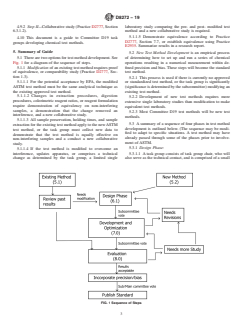
5.1 There are two options for test method development. See of determining how to set up and run a series of chemical
Fig. 1 for a diagram of the sequence of steps. operations resulting in a numerical measurement within de-
5.1.1 Modification of an existing test method requires proof fined precision and bias. These steps will become the standard
of equivalence, or comparability study (Practice D2777, Sec- test method.
tion 1.3).
5.2.1 This process is used if there is currently no approved
5.1.1.1 For the potential acceptance by EPA, the modified
or standardized test method, or the task group is significantly
ASTM test method must be the same analytical technique as
(significanceisdeterminedbythesubcommittee)modifyingan
the existing approved test method.
existing test method.
5.1.1.2 Changes in extraction procedures, digestion
5.2.2 Development of new test methods requires more
procedures, colorimetric reagent ratios, or reagent formulation
extensive single laboratory studies than modification to make
require demonstration of equivalency on non-interfering
equivalent test methods.
samples, a demonstration that the change removed an
5.2.3 Most Committee D19 test methods will be new test
interference, and a new collaborative study.
methods.
5.1.1.3 All sample preservation, holding times, and sample
5.3 Asummary of a sequence of four phases in test method
extraction for the existing test method apply to the newASTM
development is outlined below. (The sequence may be modi-
test method, or the task group must collect new data to
fied to adapt to specific situations. A test method may have
demonstrate that the test method is equally effective on
already passed through some of the phases prior to involve-
non-interfering samples and a conduct a new collaborative
ment of ASTM.
study.
5.3.1 Design Phase:
5.1.1.4 If the test method is modified to overcome an
interference, updates apparatus, or comprises a technical 5.3.1.1 A task group consists of task group chair, who will
change as determined by the task group, a limited single also serve as the technical contact, and is comprised of a small
FIG. 1 Sequence of Steps
D8272 − 19
number of individual experts who volunteer or are appointed study data in the draft test method. Alternatively, use the ILS
by the subcommittee to work on the specific project is data as shown in Table X1.4 to calculate matrix spike recovery
established. per matrix and across matrices. Table X1.4 also shows how to
5.3.1.2 The task group decides the Scope and the Signifi- calculateprecisionandbiasusingtheILSdata.Compileresults
cance and Use sections of the test method. in a proposal for a collaborative study.
5.3.1.3 The design phase includes the formalization of the 5.3.3.6 The draft standard should now be of sufficient form
Scope and the Significance and Use sections. for use in an ILS. Instruct laboratories that they must meet the
5.3.1.4 The design phase may describe a general approach QC and bias acceptance criteria.
to a test method, but does not involve any statistical studies.
5.3.3.7 Ballot at sub-committee level to approve the draft
5.3.1.5 The design phase is discussed further in Section 6. standard prior to conducting an ILS. The subcommittee chair
5.3.2 Development Phase:
may use an administrative negative to restrict automatic
5.3.2.1 Conduct studies to determine the appropriate advancement to main committee balloting.
operations, instruments, reagents, and variables to study or not
5.3.3.8 The test method may be approved with a single
to study further on various matrices and concentration ranges laboratory or preliminary multiple laboratory variability stud-
as defined in the Scope section.
ies in accordance with Practice D2777, Section 1.7, and the
5.3.2.2 These studies may be single laboratory studies
Form and Style for ASTM Standards, Section A21.2.3.
consisting of a series of smaller experiments in sequential
5.3.4 Evaluation Phase, or Inter-Laboratory Study (ILS):
order. Or preferably, several members of the task group
5.3.4.1 The purpose of the evaluation phase is to measure
laboratories study and test available options.
howwellthenewtestmethodoperatesatdifferentlaboratories/
5.3.2.3 The draft test method is prepared in ASTM format
locations and to quantify acceptable differences in different
with sampling requirements and preliminary test results on
laboratories.
samples and known reference materials presented at a meeting
5.3.4.2 The data collected provides guidance to users of the
or during a subcommittee ballot.
test method on how well different instrument setups and users
5.3.2.4 Some task groups may choose to complete this
function on various materials.
phase using the ASTM collaboration site and not take a
5.3.4.3 For some standard test methods, it may also be
standard to ballot until after the validation phase.
useful to collect data on variation associated with day-to-day
5.3.3 Optimization Phase:
effects or for different calibration times.
5.3.3.1 This phase includes statistically controlled proce-
5.3.4.4 TheILSshouldincludeawiderangeofmatricesand
5, 6
dures described in references and Guide E1488 that sys-
analyteconcentrations.Compiletheresultsinaresearchreport.
tematically and progressively record and compare the outcome
5.3.4.5 Ballot the draft at subcommittee and main commit-
of experiments to create a series of steps/operations. These
tee concurrently.
operational steps compile into a written test method. These
5.3.4.6 All ASTM test methods require an ILS by Practice
steps may include, but are not limited to the collection and
E691 or an equivalent, committee specific procedure. Commit-
documentation of sample collection, preservation and preser-
tee D19 typically performs ILSs according to Practice D2777,
vation checks, holding time, reagent preparation and shelf life,
Section 1.2, within the first re-approval cycle.
contributions to variability, interferences, and interference
checks with and without analyte(s) present, calibration range,
6. Design Phase — Proposing Modified and New Test
and method detection limit (MDL) studies.
Methods and Assignment of Task Group
5.3.3.2 Perform repeatability tests consisting of seven rep-
6.1 Proposal of a New Test Method at Committee D19:
licate injections of standards and spikes (Practice D2777,
6.1.1 AnASTM member, a visitor, or a task group proposes
Section 7.6.1) at a minimum of three concentrations in all
new test methods to the appropriate subcommittee chair or at
applicable matrices (Practice D2777, Section 7.6.4).
an ASTM subcommittee meeting. The assigned technical
5.3.3.3 If two or more task group laboratories are available,
contact opens a work item with ASTM. If approved, ASTM
conduct preliminary multiple laboratory variability studies.
will assign a work item number.
Fewerthansevenreplicatesmaybemadebyeachlaboratoryas
6.1.2 The subcommittee determines whether the request is
long as there are at least six “degrees of freedom” for
for an equivalent test method or a new test method and creates
repeatability (Practice D2777, Section 7.6.5).
a task group if the test method is needed.
5.3.3.4 Prepare provisional precision and bias statements
6.1.2.1 Prior to subcommittee approval to work on a new
based on the smaller study. Perform ruggedness testing (Prac-
standard, a rationale for the standard is prepared. The rationale
tice E1169), eliminating flexibility for a user to modify
should include:
significant variables in the written test method.
(1) The need for the standard,
5.3.3.5 Use Practice D5847 and include a quality control
(2) The intended use of the standard,
(QC) section with acceptance limits based on single laboratory
(3) A list of potential stakeholders, and
(4) An invitation to all members to join and take part in
Youden, W. J., and Steiner, E. H., Statistical Manual of the Association of
development of the standard.
Offıcial Analytical Chemists, Association of Official Analytical Chemists,
6.1.3 The ASTM task group will determine the specifica-
Washington, DC, 1975.
tions of new test methods during the design, development, and
Wernimont, G. T, Use of Statistics to Develop and Evaluate Analytical
Methods, AOAC International, Gaithersburg MD, 1985. validation phases.
D8272 − 19
TABLE 1 Examples of Representative Wastewater Matrices
7.1.1.2 Instrument Calibration—Definethecalibrationtech-
POTW effluent nique and calibration model.Allow the calibration model to fit
Synthetic Ocean Water (Practice D1141)
the data. If feasible, measure each calibration level in triplicate
Soil Extract (if soil extracts may be analyzed by the test method or else add
(replicated) to evaluate random error associated with instru-
another POTW)
Groundwater (>500 ppm TDS), may be 500 mg/L TDS of Synthetic Ocean Wa- ment response.
ter in Reagent Water
Surface water (>2 ppm TOC), may be Reagent Water with 2 ppm TOC from
NOTE 1—If a titration or gravimetric test method, describe necessary
humic acid
steps to standardize reagents, or obtain accurate weights on the balance.
Drinking Water
For example, the average of four replicate determinations of Normality
Municipal POTW Pretreatment
resultsinavaluewith ⁄2therandomerrorofasingletitration.Inaddition,
Industrial Effluent — Treated
test different volumes of sample to document effect on sample size.
Industrial Effluent — Treated
7.1.1.3 Bias/Trueness—Evaluate reference materials (if
available). Evaluate systematic errors by comparing the aver-
TABLE 2 Representative Matrices for Drinking Water
age of multiple replicates with the certified value. If reference
Finished Tap Water
materials are not available, then plot method results of up to
Surface Water (containing about 2 mg/L organic matter as humic acid).
nine different matrices analyzed at up to five different concen-
Assumes target analyte not a constituent of humic acid.
Ground Water (containing about 500 mg/L TDS) trations against known spiked values. Prepare a scatter plot for
each matrix, and insert a regression line with equations
(Practice E3080). Slopes should be normally distributed with
no outliers (Practice E178). Another option is to overlay each
regression line in one plot. The lines from each matrix should
6.1.4 The test method scope, purpose, applicability, and
overlay within the precision of replicates from a clean matrix.
performance characteristics are decided by the task group and
An outlying slope is easily detected visually. See Fig. 2 for an
documented prior to commencing development or validation
overlay plot of nitrate spikes of three concentrations in eleven
work.
matrices. Calculate spiked concentration after subtracting the
6.1.5 Literature Search:
un-spikedconcentration.Excludematriceswithhighun-spiked
6.1.5.1 Locate all current and previous versions and refer-
concentration because dilution removes matrix effects. The
ences for the proposed test method. Search for reference
matrices in Fig. 2 included known CRMs, drinking water, and
methods from databases for NEMI,ASTM, Standard Methods,
wastewater.
EPA, or other similar sources.
7.1.1.4 Repeatability—Analyze three to eight consecutive
6.1.5.2 Consult with other ASTM task group members and
measurements (preferably at least seven) (Practice D2777,
establish a collaboration site to gather and compile historical
Section7.6.1)fromeachcalibrationstandardencompassingthe
information about the test method.
entire range of the test method and expressed as standard
6.1.5.3 Review all versions of the test method (if
deviation or percentage relative standard deviation to evaluate
applicable), noting previous changes and previously noted
the repeatability of the test method in an interference free
problem areas.
matrix. Then analyze three to eight consecutive measurements
(same as used for bias determination) of up to nine different
7. Development and Optimization of Modified and New
representative matrices to evaluate repeatability in real
Test Methods
samples. Use an F test to compare standard deviations between
7.1 Test Method Performance Characteristics:
matrices. For a better comparison, use as many replicates as
5, 6
7.1.1 Conduct statistically designed single laboratory
possible.
studiesorstudiesamongafewlaboratoriestoestablishmethod
7.1.1.5 Reproducibility—Carry out the repeatability mea-
performance. These studies determine specific operational and
surements in triplicate on a minimum of six consecutive (or
analytical steps that, once in written form, become the test
nonconsecutive) days. Use the differences in the means to
method. Two or more task group members can share work to
estimate the reproducibility of the test method. Use this test if
speed the process. They can also get a sense of reproducibility
a collaborative study is not practical (such as short holding
between their laboratories by analyzing the same samples.
time analytes, or on-line analyzers). Calculate according to
Following are items that should be evaluated for each test
Table X1.3 substituting laboratories with days. Otherwise, the
method.
collaborative study evaluates reproducibility.
7.1.1.1 Selectivity—Determine what other constituents in a
7.1.1.6 Quantitation Limit and Range—The lower limit of
sample may cause a response in addition to the analyte. Test
the quantitation range (called limit of quantitation (LOQ), or
matrix blanks and fortified matrix blanks preferably at three or
minimum level (ML)) should be equal or close to the lowest
more different concentrations spanning the expected range of
calibration standard in the test method. A quantitation range
the test method. Repeat with synthetic or actual matrices
may be wider than the calibration range due to dilution or
containing expected interferences. If possible, devise spot tests
concentration steps.
enabling rapid checks for interferences. Use Table 1 and Table
2 for e
...