

ASTM C881/C881M-20a
(Specification)Standard Specification for Epoxy-Resin-Base Bonding Systems for Concrete
General Information
- Abstract
ABSTRACT
This specification covers two-component, epoxy-resin bonding systems for application to Portland-cement concrete, which are able to cure under humid conditions and bond to damp surfaces. The epoxy-resin bonding systems are classified according to type, grade, class, and color. The bonding systems can be classified as Type I, Type II, Type III, Type IV, Type V, Type VI, and Type VII according to their physical requirements. According to their flow characteristics and viscosity, the bonding systems can be classified as Grade 1, Grade 2, and Grade 3. Also, in accordance with the range of temperatures for which they are suitable, these materials can be designated as Class A, Class B, Class C, Class D, Class E, and Class F. Classes A, B, and C are defined for Types I through V, and Classes D, E, and F are defined for Types VI and VII. Epoxy resin systems are normally unpigmented, but they can be colored or darkened. These bonding systems shall be furnished in two components for combining immediately prior to use in accordance with written instructions formulated Component A shall contain an epoxy resin with or without a reactive diluent. Component B shall contain one or more curing agents, which on mixing with Component A shall cause the mixture to harden. A suitable inert filler may be uniformly incorporated in one or both components. The filler shall be either nonsettling or readily dispersible in any component in which it is incorporated. All systems shall cure under humid conditions, and bond to damp surfaces. Different test methods shall be performed to determine the following properties: consistency, gel time, filler content, epoxy equivalent, viscosity, absorption, bond strength, thermal compatibility, heat deflection temperature, linear coefficient of shrinkage, compressive yield strength and modulus, tensile strength and elongation at break, and contact strength.
SCOPE
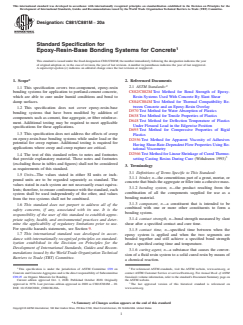
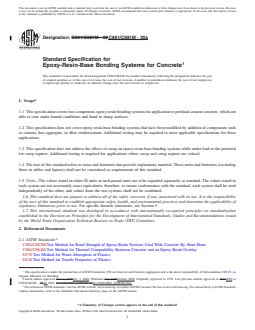
1.1 This specification covers two-component, epoxy-resin bonding systems for application to portland-cement concrete, which are able to cure under humid conditions and bond to damp surfaces.
1.2 This specification does not cover epoxy-resin-base bonding systems that have been modified by addition of components such as cement, fine aggregate, or fiber reinforcement. Additional testing may be required to meet applicable specifications for these applications.
1.3 This specification does not address the effects of creep on epoxy-resin-base bonding systems while under load or the potential for creep rupture. Additional testing is required for applications where creep and creep rupture are critical.
1.4 The text of this standard refers to notes and footnotes that provide explanatory material. These notes and footnotes (excluding those in tables and figures) shall not be considered as requirements of this standard.
1.5 Units—The values stated in either SI units or inch-pound units are to be regarded separately as standard. The values stated in each system are not necessarily exact equivalents; therefore, to ensure conformance with the standard, each system shall be used independently of the other, and values from the two systems shall not be combined.
1.6 This standard does not purport to address all of the safety concerns, if any, associated with its use. It is the responsibility of the user of this standard to establish appropriate safety, health, and environmental practices and determine the applicability of regulatory limitations prior to use. For specific hazards statements, see Section 9.
1.7 This international standard was developed in accordance with internationally recognized principles on standardization established in the Decision on Principles for the Development of International Standards, Guides and Recommendations issued by the World Trade Organization Technical Barriers to Trade (TBT) Committee.
- Status
- Published
- Publication Date
- 30-Sep-2020
- Technical Committee
- C09 - Concrete and Concrete Aggregates
- Drafting Committee
- C09.25 - Organic Materials for Bonding
Buy Documents
ASTM C881/C881M-20a - Standard Specification for Epoxy-Resin-Base Bonding Systems for Concrete
REDLINE ASTM C881/C881M-20a - Standard Specification for Epoxy-Resin-Base Bonding Systems for Concrete
Overview
ASTM C881/C881M-20a is the standard specification developed by ASTM International for two-component, epoxy-resin-base bonding systems intended for application to portland-cement concrete. These epoxy resin systems are notable for their ability to cure in humid environments and adhere effectively to damp surfaces, making them highly suitable for a wide range of concrete bonding applications. The standard covers classification, test methods, and packaging requirements to ensure the quality, reliability, and safety of epoxy-resin bonding systems in the construction industry.
Key Topics
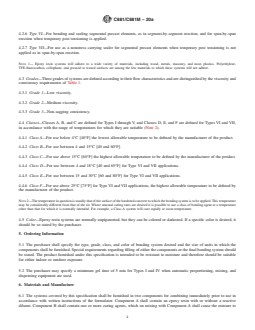
Classification: Epoxy-resin bonding systems are classified by type, grade, class, and color:
- Types: Seven types (I-VII) distinguished by their intended use (e.g., bonding hardened concrete to concrete, bonding skid-resistant materials, use in load-bearing or non-load-bearing applications, and segmental precast element bonding or sealing).
- Grades: Three grades, based on viscosity and flow characteristics (Grade 1 - low viscosity, Grade 2 - medium viscosity, Grade 3 - non-sag).
- Classes: Defined by the temperature range suitable for use (Classes A, B, C, D, E, and F).
- Color: Usually unpigmented, but coloring options are available upon request.
Product Composition: All bonding systems consist of two components:
- Component A: Contains the epoxy resin (with or without a reactive diluent).
- Component B: Contains one or more curing agents which, when mixed with Component A, initiate the hardening process.
- Inert fillers may be added, provided they are nonsettling or easily dispersible.
Physical & Chemical Properties:
- Must cure under humid conditions and bond to damp concrete surfaces.
- Rigorous quality checks on properties such as consistency, gel time, viscosity, epoxy equivalent, bond strength, thermal compatibility, heat deflection temperature, shrinkage, compressive and tensile strength, elongation, and contact strength.
Testing & Compliance:
- Specific ASTM test methods apply (e.g., ASTM C882/C882M for bond strength, ASTM C884/C884M for thermal compatibility, ASTM D570 for absorption, ASTM D638 for tensile properties).
- All test values must be met independently in SI or inch-pound units.
Health & Safety: Users must adopt appropriate protective measures, as epoxy resin systems can be irritants to skin, eyes, and respiratory system.
Applications
Epoxy-resin bonding systems specified by ASTM C881/C881M-20a are widely used in:
- Structural Concrete Repairs: Bonding new concrete to old concrete, structural crack injection, and restoration of damaged infrastructure.
- Bridge and Road Maintenance: As binders for skid-resistant overlays, providing durable surfaces for vehicular and pedestrian traffic.
- Precast Construction: Sealing and bonding of segmental precast elements in bridges and tunnels, especially in environments exposed to moisture.
- Industrial Flooring: Ensuring strong adhesion of coatings and overlays to concrete substrates.
- General Construction: As adhesives for bonding concrete to metals, masonry, or other materials in both indoor and outdoor environments.
These systems are specified to perform reliably in various temperature conditions and service environments, making them integral to civil engineering, transportation infrastructure, and building construction projects.
Related Standards
For comprehensive practice and testing, users of ASTM C881/C881M-20a may also reference:
- ASTM C882/C882M - Test Method for Bond Strength of Epoxy-Resin Systems Used with Concrete by Slant Shear
- ASTM C884/C884M - Test Method for Thermal Compatibility Between Concrete and an Epoxy-Resin Overlay
- ASTM D570 - Test Method for Water Absorption of Plastics
- ASTM D638 - Test Method for Tensile Properties of Plastics
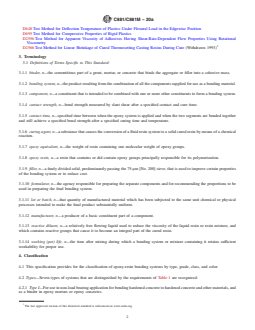
- ASTM D648 - Test Method for Deflection Temperature of Plastics Under Flexural Load
- ASTM D695 - Test Method for Compressive Properties of Rigid Plastics
- ASTM D2556 - Test Method for Apparent Viscosity of Adhesives
These referenced standards provide further detail on the physical and mechanical testing of epoxy and composite bonding systems, supporting consistent, high-quality practice in the field.
Keywords: ASTM C881, epoxy-resin bonding, concrete adhesive, epoxy concrete repair, humid curing, damp surface bonding, bonding system standards, infrastructure repair, epoxy-resin specification.
Relations
- Effective Date
- 15-Dec-2023
- Effective Date
- 01-Nov-2018
- Effective Date
- 01-Apr-2018
- Effective Date
- 01-Mar-2014
- Effective Date
- 01-Dec-2013
- Effective Date
- 15-Jun-2013
- Effective Date
- 01-May-2012
- Effective Date
- 01-Dec-2011
- Effective Date
- 15-Dec-2010
- Effective Date
- 15-May-2010
- Effective Date
- 01-Apr-2010
- Effective Date
- 01-Aug-2008
- Effective Date
- 15-Mar-2006
- Effective Date
- 01-Nov-2005
- Effective Date
- 01-Nov-2005
Buy Documents
ASTM C881/C881M-20a - Standard Specification for Epoxy-Resin-Base Bonding Systems for Concrete
REDLINE ASTM C881/C881M-20a - Standard Specification for Epoxy-Resin-Base Bonding Systems for Concrete
Get Certified
Connect with accredited certification bodies for this standard

DIBt (Deutsches Institut für Bautechnik)
German Institute for Building Technology.
DIN CERTCO
DIN Group product certification.

Aboma Certification B.V.
Specialized in construction, metal, and transport sectors.
Sponsored listings
Frequently Asked Questions
ASTM C881/C881M-20a is a technical specification published by ASTM International. Its full title is "Standard Specification for Epoxy-Resin-Base Bonding Systems for Concrete". This standard covers: ABSTRACT This specification covers two-component, epoxy-resin bonding systems for application to Portland-cement concrete, which are able to cure under humid conditions and bond to damp surfaces. The epoxy-resin bonding systems are classified according to type, grade, class, and color. The bonding systems can be classified as Type I, Type II, Type III, Type IV, Type V, Type VI, and Type VII according to their physical requirements. According to their flow characteristics and viscosity, the bonding systems can be classified as Grade 1, Grade 2, and Grade 3. Also, in accordance with the range of temperatures for which they are suitable, these materials can be designated as Class A, Class B, Class C, Class D, Class E, and Class F. Classes A, B, and C are defined for Types I through V, and Classes D, E, and F are defined for Types VI and VII. Epoxy resin systems are normally unpigmented, but they can be colored or darkened. These bonding systems shall be furnished in two components for combining immediately prior to use in accordance with written instructions formulated Component A shall contain an epoxy resin with or without a reactive diluent. Component B shall contain one or more curing agents, which on mixing with Component A shall cause the mixture to harden. A suitable inert filler may be uniformly incorporated in one or both components. The filler shall be either nonsettling or readily dispersible in any component in which it is incorporated. All systems shall cure under humid conditions, and bond to damp surfaces. Different test methods shall be performed to determine the following properties: consistency, gel time, filler content, epoxy equivalent, viscosity, absorption, bond strength, thermal compatibility, heat deflection temperature, linear coefficient of shrinkage, compressive yield strength and modulus, tensile strength and elongation at break, and contact strength. SCOPE 1.1 This specification covers two-component, epoxy-resin bonding systems for application to portland-cement concrete, which are able to cure under humid conditions and bond to damp surfaces. 1.2 This specification does not cover epoxy-resin-base bonding systems that have been modified by addition of components such as cement, fine aggregate, or fiber reinforcement. Additional testing may be required to meet applicable specifications for these applications. 1.3 This specification does not address the effects of creep on epoxy-resin-base bonding systems while under load or the potential for creep rupture. Additional testing is required for applications where creep and creep rupture are critical. 1.4 The text of this standard refers to notes and footnotes that provide explanatory material. These notes and footnotes (excluding those in tables and figures) shall not be considered as requirements of this standard. 1.5 Units—The values stated in either SI units or inch-pound units are to be regarded separately as standard. The values stated in each system are not necessarily exact equivalents; therefore, to ensure conformance with the standard, each system shall be used independently of the other, and values from the two systems shall not be combined. 1.6 This standard does not purport to address all of the safety concerns, if any, associated with its use. It is the responsibility of the user of this standard to establish appropriate safety, health, and environmental practices and determine the applicability of regulatory limitations prior to use. For specific hazards statements, see Section 9. 1.7 This international standard was developed in accordance with internationally recognized principles on standardization established in the Decision on Principles for the Development of International Standards, Guides and Recommendations issued by the World Trade Organization Technical Barriers to Trade (TBT) Committee.
ABSTRACT This specification covers two-component, epoxy-resin bonding systems for application to Portland-cement concrete, which are able to cure under humid conditions and bond to damp surfaces. The epoxy-resin bonding systems are classified according to type, grade, class, and color. The bonding systems can be classified as Type I, Type II, Type III, Type IV, Type V, Type VI, and Type VII according to their physical requirements. According to their flow characteristics and viscosity, the bonding systems can be classified as Grade 1, Grade 2, and Grade 3. Also, in accordance with the range of temperatures for which they are suitable, these materials can be designated as Class A, Class B, Class C, Class D, Class E, and Class F. Classes A, B, and C are defined for Types I through V, and Classes D, E, and F are defined for Types VI and VII. Epoxy resin systems are normally unpigmented, but they can be colored or darkened. These bonding systems shall be furnished in two components for combining immediately prior to use in accordance with written instructions formulated Component A shall contain an epoxy resin with or without a reactive diluent. Component B shall contain one or more curing agents, which on mixing with Component A shall cause the mixture to harden. A suitable inert filler may be uniformly incorporated in one or both components. The filler shall be either nonsettling or readily dispersible in any component in which it is incorporated. All systems shall cure under humid conditions, and bond to damp surfaces. Different test methods shall be performed to determine the following properties: consistency, gel time, filler content, epoxy equivalent, viscosity, absorption, bond strength, thermal compatibility, heat deflection temperature, linear coefficient of shrinkage, compressive yield strength and modulus, tensile strength and elongation at break, and contact strength. SCOPE 1.1 This specification covers two-component, epoxy-resin bonding systems for application to portland-cement concrete, which are able to cure under humid conditions and bond to damp surfaces. 1.2 This specification does not cover epoxy-resin-base bonding systems that have been modified by addition of components such as cement, fine aggregate, or fiber reinforcement. Additional testing may be required to meet applicable specifications for these applications. 1.3 This specification does not address the effects of creep on epoxy-resin-base bonding systems while under load or the potential for creep rupture. Additional testing is required for applications where creep and creep rupture are critical. 1.4 The text of this standard refers to notes and footnotes that provide explanatory material. These notes and footnotes (excluding those in tables and figures) shall not be considered as requirements of this standard. 1.5 Units—The values stated in either SI units or inch-pound units are to be regarded separately as standard. The values stated in each system are not necessarily exact equivalents; therefore, to ensure conformance with the standard, each system shall be used independently of the other, and values from the two systems shall not be combined. 1.6 This standard does not purport to address all of the safety concerns, if any, associated with its use. It is the responsibility of the user of this standard to establish appropriate safety, health, and environmental practices and determine the applicability of regulatory limitations prior to use. For specific hazards statements, see Section 9. 1.7 This international standard was developed in accordance with internationally recognized principles on standardization established in the Decision on Principles for the Development of International Standards, Guides and Recommendations issued by the World Trade Organization Technical Barriers to Trade (TBT) Committee.
ASTM C881/C881M-20a is classified under the following ICS (International Classification for Standards) categories: 91.100.30 - Concrete and concrete products. The ICS classification helps identify the subject area and facilitates finding related standards.
ASTM C881/C881M-20a has the following relationships with other standards: It is inter standard links to ASTM C882/C882M-23, ASTM D2556-14(2018), ASTM D648-18, ASTM D2556-14, ASTM C882/C882M-13a, ASTM C882/C882M-13, ASTM C882/C882M-12, ASTM D2556-11, ASTM C884/C884M-98(2010), ASTM D638-10, ASTM D695-10, ASTM D695-08, ASTM D648-06, ASTM C884/C884M-98(2005), ASTM D570-98(2005). Understanding these relationships helps ensure you are using the most current and applicable version of the standard.
ASTM C881/C881M-20a is available in PDF format for immediate download after purchase. The document can be added to your cart and obtained through the secure checkout process. Digital delivery ensures instant access to the complete standard document.
Standards Content (Sample)
This international standard was developed in accordance with internationally recognized principles on standardization established in the Decision on Principles for the
Development of International Standards, Guides and Recommendations issued by the World Trade Organization Technical Barriers to Trade (TBT) Committee.
Designation: C881/C881M −20a
Standard Specification for
Epoxy-Resin-Base Bonding Systems for Concrete
This standard is issued under the fixed designation C881/C881M; the number immediately following the designation indicates the year
of original adoption or, in the case of revision, the year of last revision. A number in parentheses indicates the year of last reapproval.
A superscript epsilon (´) indicates an editorial change since the last revision or reapproval.
1. Scope* 2. Referenced Documents
2.1 ASTM Standards:
1.1 This specification covers two-component, epoxy-resin
bonding systems for application to portland-cement concrete, C882/C882M Test Method for Bond Strength of Epoxy-
which are able to cure under humid conditions and bond to Resin Systems Used With Concrete By Slant Shear
damp surfaces. C884/C884M Test Method for Thermal Compatibility Be-
tween Concrete and an Epoxy-Resin Overlay
1.2 This specification does not cover epoxy-resin-base
D570 Test Method for Water Absorption of Plastics
bonding systems that have been modified by addition of
D638 Test Method for Tensile Properties of Plastics
components such as cement, fine aggregate, or fiber reinforce-
D648 Test Method for Deflection Temperature of Plastics
ment. Additional testing may be required to meet applicable
Under Flexural Load in the Edgewise Position
specifications for these applications.
D695 Test Method for Compressive Properties of Rigid
1.3 This specification does not address the effects of creep
Plastics
on epoxy-resin-base bonding systems while under load or the
D2556 Test Method for Apparent Viscosity of Adhesives
potential for creep rupture. Additional testing is required for
Having Shear-Rate-Dependent Flow Properties Using Ro-
applications where creep and creep rupture are critical.
tational Viscometry
D2566 Test Method for Linear Shrinkage of Cured Thermo-
1.4 The text of this standard refers to notes and footnotes
setting Casting Resins During Cure (Withdrawn 1993)
that provide explanatory material. These notes and footnotes
(excluding those in tables and figures) shall not be considered
3. Terminology
as requirements of this standard.
3.1 Definitions of Terms Specific to This Standard:
1.5 Units—The values stated in either SI units or inch-
3.1.1 binder, n—the cementitious part of a grout, mortar, or
pound units are to be regarded separately as standard. The
concrete that binds the aggregate or filler into a cohesive mass.
values stated in each system are not necessarily exact equiva-
3.1.2 bonding system, n—the product resulting from the
lents; therefore, to ensure conformance with the standard, each
combination of all the components supplied for use as a
system shall be used independently of the other, and values
bonding material.
from the two systems shall not be combined.
3.1.3 component, n—a constituent that is intended to be
1.6 This standard does not purport to address all of the
combined with one or more other constituents to form a
safety concerns, if any, associated with its use. It is the
bonding system.
responsibility of the user of this standard to establish appro-
3.1.4 contact strength, n—bond strength measured by slant
priate safety, health, and environmental practices and deter-
mine the applicability of regulatory limitations prior to use. shear after a specified contact and cure time.
For specific hazards statements, see Section 9.
3.1.5 contact time, n—specified time between when the
1.7 This international standard was developed in accor-
epoxy system is applied and when the two segments are
dance with internationally recognized principles on standard-
bonded together and still achieve a specified bond strength
ization established in the Decision on Principles for the
after a specified curing time and temperature.
Development of International Standards, Guides and Recom-
3.1.6 curing agent, n—a substance that causes the conver-
mendations issued by the World Trade Organization Technical
sion of a fluid resin system to a solid cured resin by means of
Barriers to Trade (TBT) Committee.
a chemical reaction.
1 2
This specification is under the jurisdiction of ASTM Committee C09 on For referenced ASTM standards, visit the ASTM website, www.astm.org, or
Concrete and ConcreteAggregates and is the direct responsibility of Subcommittee contact ASTM Customer Service at service@astm.org. For Annual Book of ASTM
C09.25 on Organic Materials for Bonding. Standards volume information, refer to the standard’s Document Summary page on
Current edition approved Oct. 1, 2020. Published October 2020. Originally the ASTM website.
approved in 1978. Last previous edition approved in 2020 as C881/C881M – 20. The last approved version of this historical standard is referenced on
DOI: 10.1520/C0881_C0881M-20A. www.astm.org.
*A Summary of Changes section appears at the end of this standard
Copyright © ASTM International, 100 Barr Harbor Drive, PO Box C700, West Conshohocken, PA 19428-2959. United States
C881/C881M − 20a
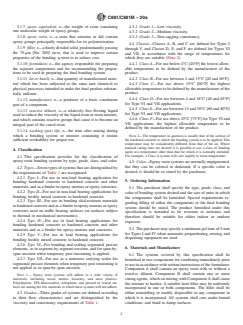
3.1.7 epoxy equivalent, n—the weight of resin containing 4.3.1 Grade 1—Low viscosity.
one molecular weight of epoxy groups.
4.3.2 Grade 2—Medium viscosity.
3.1.8 epoxy resin, n—a resin that contains or did contain 4.3.3 Grade 3—Non-sagging consistency.
epoxy groups principally responsible for its polymerization.
4.4 Classes—Classes A, B, and C are defined for Types I
3.1.9 filler, n—a finely divided solid, predominantly passing
through V, and Classes D, E, and F are defined for Types VI
the 75-µm [No. 200] sieve, that is used to improve certain
and VII, in accordance with the range of temperatures for
properties of the bonding system or to reduce cost.
which they are suitable (Note 2).
4.4.1 Class A—For use below 4°C [40°F] the lowest allow-
3.1.10 formulator, n—the agency responsible for preparing
the separate components and for recommending the propor- able temperature to be defined by the manufacturer of the
product.
tions to be used in preparing the final bonding system.
4.4.2 Class B—For use between 4 and 15°C [40 and 60°F].
3.1.11 lot or batch, n—that quantity of manufactured mate-
4.4.3 Class C—For use above 15°C [60°F] the highest
rial which has been subjected to the same unit chemical or
allowable temperature to be defined by the manufacturer of the
physical processes intended to make the final product substan-
tially uniform. product.
4.4.4 Class D—For use between 4 and 18°C [40 and 65°F]
3.1.12 manufacturer, n—a producer of a basic constituent
for Type VI and VII applications.
part of a component.
4.4.5 Class E—For use between 15 and 30°C [60 and 80°F]
3.1.13 reactive diluent, n—a relatively free flowing liquid
for Type VI and VII applications.
used to reduce the viscosity of the liquid resin or resin mixture,
4.4.6 Class F—For use above 25°C [75°F] for Type VI and
and which contains reactive groups that cause it to become an
VII applications, the highest allowable temperature to be
integral part of the cured resin.
defined by the manufacturer of the product.
3.1.14 working (pot) life, n—the time after mixing during
which a bonding system or mixture containing it retains
NOTE 2—The temperature in question is usually that of the surface of
the hardened concrete to which the bonding system is to be applied. This
sufficient workability for proper use.
temperature may be considerably different from that of the air. Where
unusual curing rates are desired it is possible to use a class of bonding
4. Classification
agent at a temperature other than that for which it is normally intended.
For example, a Class A system will cure rapidly at room temperature.
4.1 This specification provides for the classification of
epoxy-resin bonding systems by type, grade, class, and color.
4.5 Color—Epoxy resin systems are normally unpigmented,
but they can be colored or darkened. If a specific color is
4.2 Types—Seven types of systems that are distinguished by
desired, it should be so stated by the purchaser.
the requirements of Table 1 are recognized:
4.2.1 Type I—For use in non-load bearing application for
5. Ordering Information
bonding hardened concrete to hardened concrete and other
materials, and as a binder in epoxy mortars or epoxy concretes.
5.1 The purchaser shall specify the type, grade, class, and
4.2.2 Type II—For use in non-load bearing applications for
color of bonding system desired and the size of units in which
bonding freshly mixed concrete to hardened concrete.
the components shall be furnished. Special requirements re-
4.2.3 Type III—For use in bonding skid-resistant materials
garding filling of either the components or the final bonding
tohardenedconcreteandasabinderinepoxymortarsorepoxy
system should be stated. The product furnished under this
concretes used on traffic bearing surfaces (or surfaces subject
specification is intended to be resistant to moisture and
to thermal or mechanical movements).
therefore should be suitable for either indoor or outdoor
4.2.4 Type IV—For use in load bearing applications for
exposure.
bonding hardened concrete to hardened concrete and other
5.2 Thepurchasermayspecifyaminimumgeltimeof5min
materials and as a binder for epoxy mortars and concretes.
for Types I and IV when automatic proportioning, mixing, and
4.2.5 Type V—For use in load bearing applications for
dispensing equipment are used.
bonding freshly mixed concrete to hardened concrete.
4.2.6 Type VI—For bonding and sealing segmental precast
6. Materials and Manufacture
elements, as in segment-by-segment erection, and for span-by-
span erection when temporary post tensioning is applied.
6.1 The systems covered by this specification shall be
4.2.7 Type VII—For use as a nonstress carrying sealer for
furnished in two components for combining immediately prior
segmental precast elements when temporary post tensioning is
touseinaccordancewithwritteninstructionsoftheformulator.
not applied as in span-by-span erection.
Component A shall contain an epoxy resin with or without a
reactive diluent. Component B shall contain one or more
NOTE 1— Epoxy resin systems will adhere to a wide variety of
curing agents, which on mixing with ComponentAshall cause
materials, including wood, metals, masonry, and most plastics.
Polyethylene, TFE-fluorocarbon, cellophane, and greased or waxed sur-
the mixture to harden. A suitable inert filler may be uniformly
faces are among the few materials to which these systems will not adhere.
incorporated in one or both components. The filler shall be
4.3 Grades—Three grades of systems are defined according either nonsettling or readily dispersible in any component in
to their flow characteristics and are distinguished by the which it is incorporated. All systems shall cure under humid
viscosity and consistency requirements of Table 1. conditions, and bond to damp surfaces.
C881/C881M − 20a
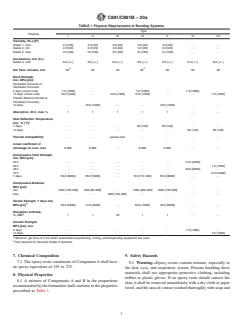
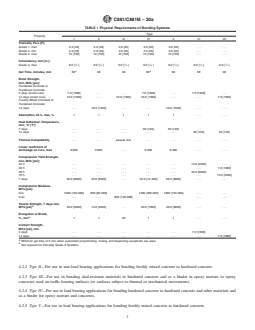
TABLE 1 Physical Requirements of Bonding Systems
Type
Property
I II III IV V VI VII
Viscosity, Pa·s [P]:
Grade 1, max 2.0 [20] 2.0 [20] 2.0 [20] 2.0 [20] 2.0 [20] . . . . . .
Grade 2, min 2.0 [20] 2.0 [20] 2.0 [20] 2.0 [20] 2.0 [20] . . . . . .
Grade 2, max 10 [100] 10 [100] 10 [100] 10 [100] 10 [100] . . . . . .
Consistency, mm [in.]:
1 1 1 1 1 1 1
Grade 3, max 6.0 [ ⁄4 ] 6.0 [ ⁄4 ] 6.0 [ ⁄4 ] 6.0 [ ⁄4 ] 6.0 [ ⁄4 ] 6.0 [ ⁄4 ] 6.0 [ ⁄4 ]
A A
Gel Time, minutes, min 30 30 30 30 30 30 30
Bond Strength,
min, MPa [psi]:
Hardened Concrete to
Hardened Concrete:
2 days (moist cure) 7.0 [1000] . . . . . . 7.0 [1000] . . . 7.0 [1000] . . .
14 days (moist cure) 10.0 [1500] . . . 10.0 [1500] 10.0 [1500] . . . . . . 7.0 [1000]
Freshly Mixed Concrete to
Hardened Concrete:
14 days . . . 10.0 [1500] . . . . . . 10.0 [1500] . . . . . .
Absorption, 24 h, max, % 1 1 1 1 1 . .
Heat Deflection Temperature,
min, °C [°F]:
7 days . . . . . . . . . 50 [120] 50 [120] . . . . . .
14 days . . . . . . . . . . . . . . . 50 [120] 50 [120]
Thermal Compatibility . . . . . . passes test . . . . . . . . . . . .
Linear coefficient of
shrinkage on cure, max 0.005 0.005 . . . 0.005 0.005 . . . . . .
Compressive Yield Strength,
min, MPa [psi]:
24 h . . . . . . . . . . . . . . . 14.0 [2000] . . .
36 h . . . . . . . . . . . . . . . . . . 7.0 [1000]
48 h . . . . . . . . . . . . . . . 40.0 [6000] . . .
72 h . . . . . . . . . . . . . . . . . . 14.0 [2000]
7 days 55.0 [8000] 35.0 [5000] . . . 70.0 [10 000] 55.0 [8000] . . . . . .
Compressive Modulus,
MPa [psi]:
min 1000 [150 000] 600 [90 000] . . . 1400 [200 000] 1000 [150 000] . . . . . .
max . . . . . . 896 [130 000] . . . . . . . . . . . .
Tensile Strength, 7 days min,
B
MPa [psi] 35.0 [5000] 14.0 [2000] . . . 50.0 [7000] 40.0 [6000] . . . . . .
Elongation at Break,
B
%, min 1 1 30 1 1 . .
Contact Strength,
MPa [psi], min
2 days . . . . . . . . . . . . . . . 7.0 [1000] . . .
14 days . . . . . . . . . . . . . . . . . . 7.0 [1000]
A
Minimum gel time of 5 min when automated proportioning, mixing, and dispensing equipment are used.
B
Not required for Viscosity Grade 3 Systems.
7. Chemical Composition 9. Safety Hazards
7.1 The epoxy resin constituent of ComponentAshall have
9.1 Warning—Epoxy resins contain irritants, especially to
an epoxy equivalent of 155 to 275.
the skin, eyes, and respiratory system. Persons handling these
materials shall use appropriate protective clothing, including
8. Physical Properties
rubber or plastic gloves. If an epoxy resin should contact the
8.1 A mixture of Components A and B in the propo
...
This document is not an ASTM standard and is intended only to provide the user of an ASTM standard an indication of what changes have been made to the previous version. Because
it may not be technically possible to adequately depict all changes accurately, ASTM recommends that users consult prior editions as appropriate. In all cases only the current version
of the standard as published by ASTM is to be considered the official document.
Designation: C881/C881M − 20 C881/C881M − 20a
Standard Specification for
Epoxy-Resin-Base Bonding Systems for Concrete
This standard is issued under the fixed designation C881/C881M; the number immediately following the designation indicates the year
of original adoption or, in the case of revision, the year of last revision. A number in parentheses indicates the year of last reapproval.
A superscript epsilon (´) indicates an editorial change since the last revision or reapproval.
1. Scope*
1.1 This specification covers two-component, epoxy-resin bonding systems for application to portland-cement concrete, which are
able to cure under humid conditions and bond to damp surfaces.
1.2 This specification does not cover epoxy-resin-base bonding systems that have been modified by addition of components such
as cement, fine aggregate, or fiber reinforcement. Additional testing may be required to meet applicable specifications for these
applications.
1.3 This specification does not address the effects of creep on epoxy-resin-base bonding systems while under load or the potential
for creep rupture. Additional testing is required for applications where creep and creep rupture are critical.
1.4 The text of this standard refers to notes and footnotes that provide explanatory material. These notes and footnotes (excluding
those in tables and figures) shall not be considered as requirements of this standard.
1.5 Units—The values stated in either SI units or inch-pound units are to be regarded separately as standard. The values stated in
each system are not necessarily exact equivalents; therefore, to ensure conformance with the standard, each system shall be used
independently of the other, and values from the two systems shall not be combined.
1.6 This standard does not purport to address all of the safety concerns, if any, associated with its use. It is the responsibility
of the user of this standard to establish appropriate safety, health, and environmental practices and determine the applicability of
regulatory limitations prior to use. For specific hazards statements, see Section 9.
1.7 This international standard was developed in accordance with internationally recognized principles on standardization
established in the Decision on Principles for the Development of International Standards, Guides and Recommendations issued
by the World Trade Organization Technical Barriers to Trade (TBT) Committee.
2. Referenced Documents
2.1 ASTM Standards:
C882/C882M Test Method for Bond Strength of Epoxy-Resin Systems Used With Concrete By Slant Shear
C884/C884M Test Method for Thermal Compatibility Between Concrete and an Epoxy-Resin Overlay
D570 Test Method for Water Absorption of Plastics
D638 Test Method for Tensile Properties of Plastics
This specification is under the jurisdiction of ASTM Committee C09 on Concrete and Concrete Aggregates and is the direct responsibility of Subcommittee C09.25 on
Organic Materials for Bonding.
Current edition approved June 1, 2020Oct. 1, 2020. Published July 2020October 2020. Originally approved in 1978. Last previous edition approved in 20152020 as
C881/C881M – 15.20. DOI: 10.1520/C0881_C0881M-20.10.1520/C0881_C0881M-20A.
For referenced ASTM standards, visit the ASTM website, www.astm.org, or contact ASTM Customer Service at service@astm.org. For Annual Book of ASTM Standards
volume information, refer to the standard’s Document Summary page on the ASTM website.
*A Summary of Changes section appears at the end of this standard
Copyright © ASTM International, 100 Barr Harbor Drive, PO Box C700, West Conshohocken, PA 19428-2959. United States
C881/C881M − 20a
D648 Test Method for Deflection Temperature of Plastics Under Flexural Load in the Edgewise Position
D695 Test Method for Compressive Properties of Rigid Plastics
D2556 Test Method for Apparent Viscosity of Adhesives Having Shear-Rate-Dependent Flow Properties Using Rotational
Viscometry
D2566 Test Method for Linear Shrinkage of Cured Thermosetting Casting Resins During Cure (Withdrawn 1993)
3. Terminology
3.1 Definitions of Terms Specific to This Standard:
3.1.1 binder, n—the cementitious part of a grout, mortar, or concrete that binds the aggregate or filler into a cohesive mass.
3.1.2 bonding system, n—the product resulting from the combination of all the components supplied for use as a bonding material.
3.1.3 component, n—a constituent that is intended to be combined with one or more other constituents to form a bonding system.
3.1.4 contact strength, n—bond strength measured by slant shear after a specified contact and cure time.
3.1.5 contact time, n—specified time between when the epoxy system is applied and when the two segments are bonded together
and still achieve a specified bond strength after a specified curing time and temperature.
3.1.6 curing agent, n—a substance that causes the conversion of a fluid resin system to a solid cured resin by means of a chemical
reaction.
3.1.7 epoxy equivalent, n—the weight of resin containing one molecular weight of epoxy groups.
3.1.8 epoxy resin, n—a resin that contains or did contain epoxy groups principally responsible for its polymerization.
3.1.9 filler, n—a finely divided solid, predominantly passing the 75-μm [No. 200] sieve, that is used to improve certain properties
of the bonding system or to reduce cost.
3.1.10 formulator, n—the agency responsible for preparing the separate components and for recommending the proportions to be
used in preparing the final bonding system.
3.1.11 lot or batch, n—that quantity of manufactured material which has been subjected to the same unit chemical or physical
processes intended to make the final product substantially uniform.
3.1.12 manufacturer, n—a producer of a basic constituent part of a component.
3.1.13 reactive diluent, n—a relatively free flowing liquid used to reduce the viscosity of the liquid resin or resin mixture, and
which contains reactive groups that cause it to become an integral part of the cured resin.
3.1.14 working (pot) life, n—the time after mixing during which a bonding system or mixture containing it retains sufficient
workability for proper use.
4. Classification
4.1 This specification provides for the classification of epoxy-resin bonding systems by type, grade, class, and color.
4.2 Types—Seven types of systems that are distinguished by the requirements of Table 1 are recognized:
4.2.1 Type I—For use in non-load bearing application for bonding hardened concrete to hardened concrete and other materials, and
as a binder in epoxy mortars or epoxy concretes.
The last approved version of this historical standard is referenced on www.astm.org.
C881/C881M − 20a
TABLE 1 Physical Requirements of Bonding Systems
Type
Property
I II III IV V VI VII
Viscosity, Pa·s [P]:
Grade 1, max 2.0 [20] 2.0 [20] 2.0 [20] 2.0 [20] 2.0 [20] . . . . . .
Grade 2, min 2.0 [20] 2.0 [20] 2.0 [20] 2.0 [20] 2.0 [20] . . . . . .
Grade 2, max 10 [100] 10 [100] 10 [100] 10 [100] 10 [100] . . . . . .
Consistency, mm [in.]:
1 1 1 1 1 1 1
Grade 3, max 6.0 [ ⁄4 ] 6.0 [ ⁄4 ] 6.0 [ ⁄4 ] 6.0 [ ⁄4 ] 6.0 [ ⁄4 ] 6.0 [ ⁄4 ] 6.0 [ ⁄4 ]
A A
Gel Time, minutes, min 30 30 30 30 30 30 30
Bond Strength,
min, MPa [psi]:
Hardened Concrete to
Hardened Concrete:
2 days (moist cure) 7.0 [1000] . . . . . . 7.0 [1000] . . . 7.0 [1000] . . .
14 days (moist cure) 10.0 [1500] . . . 10.0 [1500] 10.0 [1500] . . . . . . 7.0 [1000]
Freshly Mixed Concrete to
Hardened Concrete:
14 days . . . 10.0 [1500] . . . . . . 10.0 [1500] . . . . . .
Absorption, 24 h, max, % 1 1 1 1 1 . . . . . .
Heat Deflection Temperature,
min, °C [°F]:
7 days . . . . . . . . . 50 [120] 50 [120] . . . . . .
14 days . . . . . . . . . . . . . . . 50 [120] 50 [120]
Thermal Compatibility . . . . . . passes test . . . . . . . . . . . .
Linear coefficient of
shrinkage on cure, max 0.005 0.005 . . . 0.005 0.005 . . . . . .
Compressive Yield Strength,
min, MPa [psi]:
24 h . . . . . . . . . . . . . . . 14.0 [2000] . . .
36 h . . . . . . . . . . . . . . . . . . 7.0 [1000]
48 h . . . . . . . . . . . . . . . 40.0 [6000] . . .
72 h . . . . . . . . . . . . . . . . . . 14.0 [2000]
7 days 55.0 [8000] 35.0 [5000] . . . 70.0 [10 000] 55.0 [8000] . . . . . .
Compressive Modulus,
MPa [psi]:
min 1000 [150 000] 600 [90 000] . . . 1400 [200 000] 1000 [150 000] . . . . . .
max . . . . . . 896 [130 000] . . . . . . . . . . . .
Tensile Strength, 7 days min,
B
MPa [psi] 35.0 [5000] 14.0 [2000] . . . 50.0 [7000] 40.0 [6000] . . . . . .
Elongation at Break,
B
%, min 1 1 30 1 1 . . . . . .
Contact Strength,
MPa [psi], min
2 days . . . . . . . . . . . . . . . 7.0 [1000] . . .
14 days . . . . . . . . . . . . . . . . . . 7.0 [1000]
A
Minimum gel time of 5 min when automated proportioning, mixing, and dispensing equipment are used.
B
Not required for Viscosity Grade 3 Systems.
4.2.2 Type II—For use in non-load bearing applications for bonding freshly mixed concrete to hardened concrete.
4.2.3 Type III—For use in bonding skid-resistant materials to hardened concrete and as a binder in epoxy mortars or epoxy
concretes used on traffic bearing surfaces (or surfaces subject to thermal or mechanical movements).
4.2.4 Type IV—For use in load bearing applications for bonding hardened concrete to hardened concrete and other materials and
as a binder for epoxy mortars and concretes.
4.2.5 Type V—For use in load bearing applications for bonding freshly mixed concrete to hardened concrete.
C881/C881M − 20a
4.2.6 Type VI—For bonding and sealing segmental precast elements, as in segment-by-segment erection, and for span-by-span
erection when temporary post tensioning is applied.
4.2.7 Type VII—For use as a nonstress carrying sealer for segmental precast elements when temporary post tensioning is not
applied as in span-by-span erection.
NOTE 1— Epoxy resin systems will adhere to a wide variety of materials, including wood, metals, masonry, and most plastics. Polyethylene,
TFE-fluorocarbon, cellophane, and greased or waxed surfaces are among the few materials to which these systems will not adhere.
4.3 Grades—Three grades of systems are defined according to their flow characteristics and are distinguished by the viscosity and
consistency requirements of Table 1.
4.3.1 Grade 1—Low viscosity.
4.3.2 Grade 2—Medium viscosity.
4.3.3 Grade 3—Non-sagging consistency.
4.4 Classes—Classes A, B, and C are defined for Types I through V, and Classes D, E, and F are defined for Types VI and VII,
in accordance with the range of temperatures for which they are suitable (Note 2).
4.4.1 Class A—For use below 4°C [40°F] the lowest allowable temperature to be defined by the manufacturer of the product.
4.4.2 Class B—For use between 4 and 15°C [40 and 60°F].
4.4.3 Class C—For use above 15°C [60°F] the highest allowable temperature to be defined by the manufacturer of the product.
4.4.4 Class D—For use between 4 and 18°C [40 and 65°F] for Type VI and VII applications.
4.4.5 Class E—For use between 15 and 30°C [60 and 80°F] for Type VI and VII applications.
4.4.6 Class F—For use above 25°C [75°F] for Type VI and VII applications, the highest allowable temperature to be defined by
the manufacturer of the product.
NOTE 2—The temperature in question is usually that of the surface of the hardened concrete to which the bonding system is to be applied. This temperature
may be considerably different from that of the air. Where unusual curing rates are desired it is possible to use a class of bonding agent at a temperature
other than that for which it is normally intended. For example, a Class A system will cure rapidly at room temperature.
4.5 Color—Epoxy resin systems are normally unpigmented, but they can be colored or darkened. If a specific color is desired, it
should be so stated by the purchaser.
5. Ordering Information
5.1 The purchaser shall specify the type, grade, class, and color of bonding system desired and the size of units in which the
components shall be furnished. Special requirements regarding filling of either the components or the final bonding system should
be stated. The product furnished under this specification is intended to be resistant to moisture and therefore should be suitable
for either indoor or outdoor exposure.
5.2 The purchaser may specify a minimum gel time of 5 min for Types I and IV when automatic proportioning, mixing, and
dispensing equipment are used.
6. Materials and Manufacture
6.1 The systems covered by this specification shall be furnished in two components for combining immediately prior to use in
accordance with written instructions of the formulator. Component A shall contain an epoxy resin with or without a reactive
diluent. Component B shall contain one or more curing agents, which on mixing with Component A shall cause the mixture to
C881/C881M − 20a
harden. A suitable inert filler may be uniformly incorporated in one or both components. The filler shall be either nonsettling or
readily dispersible in any component in which it is incorporated. All systems shall cure under humid conditions, and bond to damp
surfaces.
7. Chemical Composition
7.1 The epoxy resin constituent of Component A shall have an epoxy equivalent of 155 to 275.
8. Physical Properties
8.1 A mixture of Components A and B in the proportions recommended by the formulator shall conform to the properties
prescribed in Table 1.
9. Safety Hazards
9.1 Warning—Caution:Epoxy resins contain irritants, especially to th
...