

ASTM F3260-18
(Test Method)Standard Test Method for Determining the Flexural Stiffness of Medical Textiles
General Information
- Abstract
SIGNIFICANCE AND USE
5.1 Consideration of the flexural stiffness of medical textiles is important, as these devices often need to possess properties that allow them to conform readily to the anatomic structures they are designed to support or protect. This test method outlines the materials and methods for the determination of flexural properties along the different textile directions (that is, machine and cross-machine) and for the effects of textile surface orientation (that is, face and back orientations).
5.2 This test method can be used for quality control purposes.
5.3 This test method can be used for non-absorbable, absorbable, and partially absorbable medical textiles including films and membranes. Testing should be performed on both dry and appropriately conditioned specimens. If the specimen is fabricated from a hydrolytically degradable absorbable material or contains an absorbable component, testing after hydrolytic conditioning at appropriate time intervals should be undertaken using Test Method F1635. For partially absorbable textiles, testing should be performed through at least two time intervals that exceed the point where the absorbable component no longer contributes to the specimen’s measurable mechanical properties.
5.4 If flexural rigidity values are found to show effects related to planar and surface orientation, results from this test method could potentially help in determining if devices should be implanted or used only at specific textile directions and surface orientations. Considerations for determining device planar and surface orientations for use would include, but are not limited to, primary direction of bending once implanted or during use, anatomic structures that will interact with the device, and physiologic loads (normal, pathological, and worst-case) the device would experience during use.
5.5 No evidence has been found showing that bending length is dependent on the width. However, the tendency for specimens to curl or twist can affect...
SCOPE
1.1 This test method covers the measurement of flexural stiffness properties of medical textiles (for example, surgical mesh, films, and membranes). Bending length is measured and flexural rigidity is calculated.
1.2 This test method may be used for absorbable or non-absorbable medical textiles.
1.3 This test method measures the flexural stiffness at room temperature in air and, if used directly, may not provide an accurate measure of in-vivo behavior for implantable medical textiles.
1.4 This test method is not suitable for testing tubular samples.
1.5 The values stated in SI units are to be regarded as standard. Values in parentheses are for information only.
1.6 This standard does not purport to address all of the safety concerns, if any, associated with its use. It is the responsibility of the user of this standard to establish appropriate safety, health, and environmental practices and determine the applicability of regulatory limitations prior to use.
1.7 This international standard was developed in accordance with internationally recognized principles on standardization established in the Decision on Principles for the Development of International Standards, Guides and Recommendations issued by the World Trade Organization Technical Barriers to Trade (TBT) Committee.
- Status
- Published
- Publication Date
- 28-Feb-2018
- Technical Committee
- F04 - Medical and Surgical Materials and Devices
- Drafting Committee
- F04.15 - Material Test Methods
Buy Documents
ASTM F3260-18 - Standard Test Method for Determining the Flexural Stiffness of Medical Textiles
REDLINE ASTM F3260-18 - Standard Test Method for Determining the Flexural Stiffness of Medical Textiles
Overview
ASTM F3260-18 is a standard test method developed by ASTM International for determining the flexural stiffness of medical textiles, such as surgical mesh, films, and membranes. As medical textiles are often required to conform to anatomical structures for optimal support and protection, understanding their resistance to bending-known as flexural stiffness-is crucial in the evaluation and quality control of these materials. This test method applies to both absorbable and non-absorbable medical textiles and is designed for materials such as woven, knit, braided, or nonwoven structures. The method provides guidance for measuring flexural properties along various fabric directions and surface orientations, supporting effective product development and regulatory compliance in the medical device industry.
Key Topics
- Flexural Stiffness Assessment: Measurement of a medical textile's resistance to bending by determining its bending length and flexural rigidity.
- Directional and Surface Analysis: Evaluation in both machine (MD) and cross-machine (CD) directions, as well as on both face and back surfaces, to capture anisotropic properties.
- Material Applicability: Suitable for non-absorbable, absorbable, and partially absorbable materials, including those that degrade hydrolytically.
- Conditioning Requirements: Testing on both dry and conditioned specimens; for absorbable materials, tests after hydrolytic conditioning may be required.
- Quality Control: Provides a reliable method for quality control during production of medical textiles and related products.
- Reporting: Detailed documentation of test conditions, specimen orientation, and results is emphasized for consistency and traceability.
Applications
ASTM F3260-18 is widely used in various sectors of the medical device industry, where precise measurement of textile flexural stiffness is essential:
- Surgical Mesh Evaluation: Ensures that meshes intended for implantation will conform to physiological loads without compromising patient safety or comfort.
- Film and Membrane Testing: Assesses thin, flexible medical barriers for appropriate stiffness and handling characteristics, impacting usability in surgical and wound care applications.
- R&D and Product Development: Guides engineers and designers in optimizing textile properties for specific clinical applications, such as soft tissue support or wound coverage.
- Implant Orientation Decisions: Provides valuable data for determining optimal placement and orientation of medical textiles during surgical procedures.
- Absorbable Material Assessment: Enables performance tracking of materials over time, especially those designed to degrade within the body.
Related Standards
The following ASTM standards are commonly referenced or complement ASTM F3260-18:
- ASTM D747: Test Method for Apparent Bending Modulus of Plastics by Means of a Cantilever Beam; useful for stiffer materials.
- ASTM D1388: Test Method for Stiffness of Fabrics; similar in scope but with different requirements for specimen preparation and orientation.
- ASTM F1635: Test Method for In Vitro Degradation Testing of Hydrolytically Degradable Polymer Resins; recommended for conditioning absorbable materials before flexural testing.
- ASTM E141: Practice for Acceptance of Evidence Based on the Results of Probability Sampling; aids in sample size determination for testing consistency.
ASTM F3260-18 provides essential guidance for the reliable assessment of flexural stiffness in medical textiles, supporting safer, more effective, and well-characterized medical devices from development through to clinical use. This standard ensures consistency, facilitates regulatory compliance, and ultimately contributes to the advancement of medical textile technology.
Relations
- Replaces
ASTM F3260-17 - Standard Test Method for Determining the Flexural Stiffness of Medical Textiles - Effective Date
- 01-Mar-2018
- Effective Date
- 01-Nov-2023
- Effective Date
- 01-Apr-2018
- Effective Date
- 01-Dec-2016
- Effective Date
- 01-Jul-2014
- Effective Date
- 01-Jul-2012
- Effective Date
- 01-Mar-2011
- Effective Date
- 15-May-2010
- Effective Date
- 01-Apr-2010
- Effective Date
- 01-Aug-2008
- Effective Date
- 01-Jul-2008
- Effective Date
- 01-Dec-2007
- Effective Date
- 01-Jul-2007
- Effective Date
- 01-Oct-2004
- Effective Date
- 01-May-2004
Buy Documents
ASTM F3260-18 - Standard Test Method for Determining the Flexural Stiffness of Medical Textiles
REDLINE ASTM F3260-18 - Standard Test Method for Determining the Flexural Stiffness of Medical Textiles
Get Certified
Connect with accredited certification bodies for this standard

BSI Group
BSI (British Standards Institution) is the business standards company that helps organizations make excellence a habit.

TÜV Rheinland
TÜV Rheinland is a leading international provider of technical services.

TÜV SÜD
TÜV SÜD is a trusted partner of choice for safety, security and sustainability solutions.
Sponsored listings
Frequently Asked Questions
ASTM F3260-18 is a standard published by ASTM International. Its full title is "Standard Test Method for Determining the Flexural Stiffness of Medical Textiles". This standard covers: SIGNIFICANCE AND USE 5.1 Consideration of the flexural stiffness of medical textiles is important, as these devices often need to possess properties that allow them to conform readily to the anatomic structures they are designed to support or protect. This test method outlines the materials and methods for the determination of flexural properties along the different textile directions (that is, machine and cross-machine) and for the effects of textile surface orientation (that is, face and back orientations). 5.2 This test method can be used for quality control purposes. 5.3 This test method can be used for non-absorbable, absorbable, and partially absorbable medical textiles including films and membranes. Testing should be performed on both dry and appropriately conditioned specimens. If the specimen is fabricated from a hydrolytically degradable absorbable material or contains an absorbable component, testing after hydrolytic conditioning at appropriate time intervals should be undertaken using Test Method F1635. For partially absorbable textiles, testing should be performed through at least two time intervals that exceed the point where the absorbable component no longer contributes to the specimen’s measurable mechanical properties. 5.4 If flexural rigidity values are found to show effects related to planar and surface orientation, results from this test method could potentially help in determining if devices should be implanted or used only at specific textile directions and surface orientations. Considerations for determining device planar and surface orientations for use would include, but are not limited to, primary direction of bending once implanted or during use, anatomic structures that will interact with the device, and physiologic loads (normal, pathological, and worst-case) the device would experience during use. 5.5 No evidence has been found showing that bending length is dependent on the width. However, the tendency for specimens to curl or twist can affect... SCOPE 1.1 This test method covers the measurement of flexural stiffness properties of medical textiles (for example, surgical mesh, films, and membranes). Bending length is measured and flexural rigidity is calculated. 1.2 This test method may be used for absorbable or non-absorbable medical textiles. 1.3 This test method measures the flexural stiffness at room temperature in air and, if used directly, may not provide an accurate measure of in-vivo behavior for implantable medical textiles. 1.4 This test method is not suitable for testing tubular samples. 1.5 The values stated in SI units are to be regarded as standard. Values in parentheses are for information only. 1.6 This standard does not purport to address all of the safety concerns, if any, associated with its use. It is the responsibility of the user of this standard to establish appropriate safety, health, and environmental practices and determine the applicability of regulatory limitations prior to use. 1.7 This international standard was developed in accordance with internationally recognized principles on standardization established in the Decision on Principles for the Development of International Standards, Guides and Recommendations issued by the World Trade Organization Technical Barriers to Trade (TBT) Committee.
SIGNIFICANCE AND USE 5.1 Consideration of the flexural stiffness of medical textiles is important, as these devices often need to possess properties that allow them to conform readily to the anatomic structures they are designed to support or protect. This test method outlines the materials and methods for the determination of flexural properties along the different textile directions (that is, machine and cross-machine) and for the effects of textile surface orientation (that is, face and back orientations). 5.2 This test method can be used for quality control purposes. 5.3 This test method can be used for non-absorbable, absorbable, and partially absorbable medical textiles including films and membranes. Testing should be performed on both dry and appropriately conditioned specimens. If the specimen is fabricated from a hydrolytically degradable absorbable material or contains an absorbable component, testing after hydrolytic conditioning at appropriate time intervals should be undertaken using Test Method F1635. For partially absorbable textiles, testing should be performed through at least two time intervals that exceed the point where the absorbable component no longer contributes to the specimen’s measurable mechanical properties. 5.4 If flexural rigidity values are found to show effects related to planar and surface orientation, results from this test method could potentially help in determining if devices should be implanted or used only at specific textile directions and surface orientations. Considerations for determining device planar and surface orientations for use would include, but are not limited to, primary direction of bending once implanted or during use, anatomic structures that will interact with the device, and physiologic loads (normal, pathological, and worst-case) the device would experience during use. 5.5 No evidence has been found showing that bending length is dependent on the width. However, the tendency for specimens to curl or twist can affect... SCOPE 1.1 This test method covers the measurement of flexural stiffness properties of medical textiles (for example, surgical mesh, films, and membranes). Bending length is measured and flexural rigidity is calculated. 1.2 This test method may be used for absorbable or non-absorbable medical textiles. 1.3 This test method measures the flexural stiffness at room temperature in air and, if used directly, may not provide an accurate measure of in-vivo behavior for implantable medical textiles. 1.4 This test method is not suitable for testing tubular samples. 1.5 The values stated in SI units are to be regarded as standard. Values in parentheses are for information only. 1.6 This standard does not purport to address all of the safety concerns, if any, associated with its use. It is the responsibility of the user of this standard to establish appropriate safety, health, and environmental practices and determine the applicability of regulatory limitations prior to use. 1.7 This international standard was developed in accordance with internationally recognized principles on standardization established in the Decision on Principles for the Development of International Standards, Guides and Recommendations issued by the World Trade Organization Technical Barriers to Trade (TBT) Committee.
ASTM F3260-18 is classified under the following ICS (International Classification for Standards) categories: 11.040.30 - Surgical instruments and materials. The ICS classification helps identify the subject area and facilitates finding related standards.
ASTM F3260-18 has the following relationships with other standards: It is inter standard links to ASTM F3260-17, ASTM E141-10(2023), ASTM E141-10(2018), ASTM F1635-16, ASTM D1388-14, ASTM D1388-08(2012), ASTM F1635-11, ASTM E141-10, ASTM D747-10, ASTM D747-08, ASTM D1388-08, ASTM D1388-07a, ASTM D1388-07, ASTM F1635-04a, ASTM F1635-04. Understanding these relationships helps ensure you are using the most current and applicable version of the standard.
ASTM F3260-18 is available in PDF format for immediate download after purchase. The document can be added to your cart and obtained through the secure checkout process. Digital delivery ensures instant access to the complete standard document.
Standards Content (Sample)
This international standard was developed in accordance with internationally recognized principles on standardization established in the Decision on Principles for the
Development of International Standards, Guides and Recommendations issued by the World Trade Organization Technical Barriers to Trade (TBT) Committee.
Designation: F3260 − 18
Standard Test Method for
Determining the Flexural Stiffness of Medical Textiles
This standard is issued under the fixed designation F3260; the number immediately following the designation indicates the year of
original adoption or, in the case of revision, the year of last revision. A number in parentheses indicates the year of last reapproval. A
superscript epsilon (´) indicates an editorial change since the last revision or reapproval.
1. Scope E141 Practice for Acceptance of Evidence Based on the
Results of Probability Sampling
1.1 This test method covers the measurement of flexural
F1635 Test Method for in vitro Degradation Testing of
stiffness properties of medical textiles (for example, surgical
HydrolyticallyDegradablePolymerResinsandFabricated
mesh, films, and membranes). Bending length is measured and
Forms for Surgical Implants
flexural rigidity is calculated.
1.2 This test method may be used for absorbable or non-
3. Terminology
absorbable medical textiles.
3.1 Definitions:
1.3 This test method measures the flexural stiffness at room
3.1.1 flexural stiffness, n—resistance to bending, measured
temperature in air and, if used directly, may not provide an as bending length and flexural rigidity.
accurate measure of in-vivo behavior for implantable medical
3.1.2 medical textile, n—a fabric, film, or membrane used
textiles.
for medical purposes that may be woven, knit, braided, felted,
1.4 This test method is not suitable for testing tubular or nonwoven.
samples.
3.2 Definitions of Terms Specific to This Standard:
3.2.1 back, n—with regard to textile orientation, (1) the
1.5 The values stated in SI units are to be regarded as
downward facing surface of the textile during manufacture; (2)
standard. Values in parentheses are for information only.
the inward or downward facing surface of the textile during
1.6 This standard does not purport to address all of the
normal use.
safety concerns, if any, associated with its use. It is the
3.2.2 bending length, n—general—the length of textile that
responsibility of the user of this standard to establish appro-
will bend under its own weight to a definite extent; specific—
priate safety, health, and environmental practices and deter-
the measured length of overhang divided by two (per 11.2)at
mine the applicability of regulatory limitations prior to use.
1.7 This international standard was developed in accor- which the edge of the specimen touches the bend angle
indicator per the test method (per 10.6).
dance with internationally recognized principles on standard-
ization established in the Decision on Principles for the
3.2.3 cross-machine direction, CD, n—the direction in the
Development of International Standards, Guides and Recom-
plane of the textile perpendicular to the direction of
mendations issued by the World Trade Organization Technical
manufacture, analogous to the weft direction for knit and
Barriers to Trade (TBT) Committee.
woven textiles.
3.2.4 face, n—with regard to textile orientation, (1) the
2. Referenced Documents
upwardfacingsurfaceofthetextileduringmanufacture;(2)the
2.1 ASTM Standards:
outward or upward facing surface of the textile during normal
D747 Test Method for Apparent Bending Modulus of Plas-
use.
tics by Means of a Cantilever Beam
3.2.5 flexural rigidity, n—the couple on either end of a
D1388 Test Method for Stiffness of Fabrics
textile strip of unit width bent into unit curvature.
3.2.6 machine direction, MD, n—the direction in the plane
of the textile parallel to the direction of manufacture, analo-
This test method is under the jurisdiction ofASTM Committee F04 on Medical
gous to the warp direction for knit and woven textiles.
and Surgical Materials and Devices and is the direct responsibility of Subcommittee
F04.15 on Material Test Methods.
3.2.7 weight, n—with regard to textiles, mass per unit area.
Current edition approved March 1, 2018. Published April 2018. Originally
approved in 2017. Last previous edition approved in 2017 as F3260–17. DOI:
4. Summary of Test Method
10.1520/F3260-18.
For referenced ASTM standards, visit the ASTM website, www.astm.org, or
4.1 A specimen is slid at a specified rate in a direction
contact ASTM Customer Service at service@astm.org. For Annual Book of ASTM
parallel to its long dimension, until its leading edge projects
Standards volume information, refer to the standard’s Document Summary page on
the ASTM website. from the edge of a horizontal surface. The length of the
Copyright © ASTM International, 100 Barr Harbor Drive, PO Box C700, West Conshohocken, PA 19428-2959. United States
F3260 − 18
overhang is measured when the tip of the specimen is de- 5.5 No evidence has been found showing that bending
pressed under its own mass to the point where the line joining length is dependent on the width. However, the tendency for
the top to the edge of the platform makes a 0.724 rad (41.5°) specimens to curl or twist can affect the result through the
angle with the horizontal. From this measured length and the rigidity provided at the edge. Consequently, use of test speci-
specimen’s weight, the bending length and flexural rigidity are mens with greater width can help to reduce this edge effect.
calculated.
5.6 ThistestmethoddiffersfromTestMethodD1388inthat
it requires tracking of sample surface orientation and includes
5. Significance and Use
absorbable and partially absorbable medical textiles. Medical
5.1 Considerationoftheflexuralstiffnessofmedicaltextiles
textiles with stiffness higher than is measureable using this
is important, as these devices often need to possess properties
cantilever bending method should consider evaluation using
that allow them to conform readily to the anatomic structures
the cantilever beam method described in Test Method D747.
they are designed to support or protect. This test method
outlines the materials and methods for the determination of
6. Apparatus
flexural properties along the different textile directions (that is,
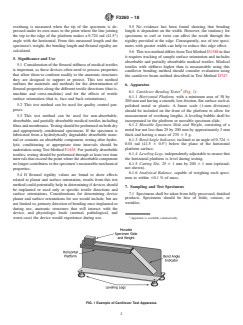
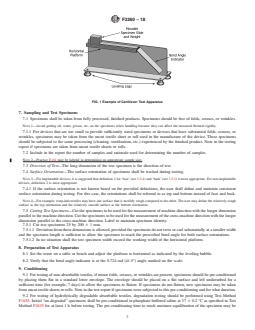
6.1 Cantilever Bending Tester (Fig. 1):
machine and cross-machine) and for the effects of textile
6.1.1 Horizontal Platform, with a minimum area of 38 by
surface orientation (that is, face and back orientations).
200 mm and having a smooth, low-friction, flat surface such as
5.2 This test method can be used for quality control pur-
polished metal or plastic. A linear scale (1-mm divisions)
poses.
should be included on the front of the platform to allow for
measurement of overhang lengths. A leveling bubble shall be
5.3 This test method can be used for non-absorbable,
incorporated in the platform or movable specimen slide.
absorbable, and partially absorbable medical textiles including
6.1.2 Movable Specimen Slide and Weight, consisting of a
filmsandmembranes.Testingshouldbeperformedonbothdry
metal bar not less than 25 by 200 mm by approximately 3 mm
and appropriately conditioned specimens. If the specimen is
thick and having a mass of 270 65g.
fabricated from a hydrolytically degradable absorbable mate-
6.1.3 Bend Angle Indicator, inclined at an angle of 0.724 6
rial or contains an absorbable component, testing after hydro-
0.01 rad (41.5 6 0.5°) below the plane of the horizontal
lytic conditioning at appropriate time intervals should be
platform surface.
undertaken using Test Method F1635. For partially absorbable
6.1.4 Leveling Legs, independently adjustable to ensure that
textiles, testing should be performed through at least two time
the horizontal platform is level during testing.
intervalsthatexceedthepointwheretheabsorbablecomponent
6.1.5 Cutting Die, 25 61mmby200 6 1 mm (optional;
nolongercontributestothespecimen’smeasurablemechanical
not shown).
properties.
6.1.6 Analytical Balance, capable of weighing each speci-
5.4 If flexural rigidity values are found to show effects
men to within 60.1 % of mass.
related to planar and surface orientation, results from this test
method could potentially help in determining if devices should
7. Sampling and Test Specimens
be implanted or used only at specific textile directions and
7.1 Specimens shall be taken from fully processed, finished
surface orientations. Considerations for determining device
products. Specimens should be free of folds, creases, or
planar and surface orientations for use would include, but are
wrinkles.
not limited to, primary direction of bending once implanted or
during use, anatomic structures that will interact with the
device, and physiologic loads (normal, pathological, and
worst-case) the device would experience during use. Apparatus is available commercially.
FIG. 1 Example of Cantilever Test Apparatus
F3260 − 18
NOTE 1—Avoid getting oil, water, grease, etc. on the specimens when
undisturbed for a sufficient time (for example, 7 days) to allow
handling because they can affect the measured flexural rigidity.
the specimens to flatten. If specimens do not flatten, new
7.1.1 For devices that are too small to provide sufficiently specimensmaybetakenfromuncuttextilesheetsorrolls.Note
sized specimens or devices that have substantial folds, creases, in the test report if specimens were subjected to this pre-
or wrinkles, specimens may be taken from the uncut textile conditioning and for what duration.
sheet or roll used in the manufacture of the device. These
9.2 For testing of hydrolytically degradable absorbable
specimens should be subjected to the same processing
textiles, degradation testing should be performed using Test
(cleaning, sterilization, etc.) experienced by the finished prod-
Method F1635. Initial “un-degraded” specimens shall be pre-
uct. Note in the testing report if specimens are taken from
conditioned in phosphate buffered saline at 37 6 0.2 °C as
uncut textile sheets or rolls.
specified in Test Method F1635 for at least 1 h before testing.
7.2 Include in the report the number of samples and ratio- The pre-conditioning time to reach moisture equilibration of
the specimen may be as long as 24 h (or more), depending on
nale used for determining the number of samples.
both the fiber cross-section and the hydrophobic nature of the
NOTE 2—Practice E141 may be helpful in determining an appropriate
polymer. Include in the test report the length of the pre-
sample size.
conditioning time period before testing and a rationale for the
7.3 Direction of Test—The long dimension of the test
chosen time period. For partially and fully absorbable textiles,
specimen is the direction of test.
testing should be done on un-degraded specimens and on
7.4 Surface Orientation—The surface orientation of speci-
specimens at intermediate levels of degradation. Note all
mens shall be tracked during testing.
degradation time points in the test report. Partially absorbable
textiles should be tested through at least two time intervals that
NOTE 3—For implantable devices, it is suggested that definition 1 for
exceed the point where the absorbable component no longer
‘face’ (see 3.2.4) and ‘back’ (see 3.2.1) is most appropriate. For non-
implantable devices, definition 2 is most appropriate. contributes to the specimen’s measurable mechanical proper-
ties. The same sample forms (that is, raw material, processing
7.4.1 If the surface orientation is not known based on the
methods, as-cut dimensions, etc.) should be used for both the
provided definitions, the user shall define and maintain consis-
dry and appropriately conditioned test specimens.
tent surface orientation during testing. For this case, the
...
This document is not an ASTM standard and is intended only to provide the user of an ASTM standard an indication of what changes have been made to the previous version. Because
it may not be technically possible to adequately depict all changes accurately, ASTM recommends that users consult prior editions as appropriate. In all cases only the current version
of the standard as published by ASTM is to be considered the official document.
Designation: F3260 − 17 F3260 − 18
Standard Test Method for
Determining the Flexural Stiffness of Medical Textiles
This standard is issued under the fixed designation F3260; the number immediately following the designation indicates the year of
original adoption or, in the case of revision, the year of last revision. A number in parentheses indicates the year of last reapproval. A
superscript epsilon (´) indicates an editorial change since the last revision or reapproval.
1. Scope
1.1 This test method covers the measurement of flexural stiffness properties of medical textiles (for example, surgical mesh,
films, and membranes). Bending length is measured and flexural rigidity is calculated.
1.2 This test method may be used for absorbable or non-absorbable medical textiles.
1.3 This test method measures the flexural stiffness at room temperature in air and, if used directly, may not provide an accurate
measure of in-vivo behavior for implantable medical textiles.
1.4 This test method is not suitable for testing tubular samples.
1.5 The values stated in SI units are to be regarded as standard. Values in parentheses are for information only.
1.6 This standard does not purport to address all of the safety concerns, if any, associated with its use. It is the responsibility
of the user of this standard to establish appropriate safety, health, and environmental practices and determine the applicability of
regulatory limitations prior to use.
1.7 This international standard was developed in accordance with internationally recognized principles on standardization
established in the Decision on Principles for the Development of International Standards, Guides and Recommendations issued
by the World Trade Organization Technical Barriers to Trade (TBT) Committee.
2. Referenced Documents
2.1 ASTM Standards:
D747 Test Method for Apparent Bending Modulus of Plastics by Means of a Cantilever Beam
D1388 Test Method for Stiffness of Fabrics
E141 Practice for Acceptance of Evidence Based on the Results of Probability Sampling
F1635 Test Method for in vitro Degradation Testing of Hydrolytically Degradable Polymer Resins and Fabricated Forms for
Surgical Implants
3. Terminology
3.1 Definitions:
3.1.1 flexural stiffness, n—resistance to bending, measured as bending length and flexural rigidity.
3.1.2 medical textile, n—a fabric, film, or membrane used for medical purposes that may be woven, knit, braided, felted, or
nonwoven.
3.2 Definitions of Terms Specific to This Standard:
3.2.1 back, n—with regard to textile orientation,(1) the downward facing surface of the textile during manufacture; (2) the
inward or downward facing surface of the textile during normal use.
3.2.2 bending length, n—general—the length of textile that will bend under its own weight to a definite extent; specific—the
measured length of overhang divided by two (per 11.2) at which the edge of the specimen touches the bend angle indicator per
the test method (per 10.6).
This test method is under the jurisdiction of ASTM Committee F04 on Medical and Surgical Materials and Devices and is the direct responsibility of Subcommittee
F04.15 on Material Test Methods.
Current edition approved Aug. 1, 2017March 1, 2018. Published September 2017April 2018. Originally approved in 2017. Last previous edition approved in 2017 as
F3260–17. DOI: 10.1520/F3260-17.10.1520/F3260-18.
For referenced ASTM standards, visit the ASTM website, www.astm.org, or contact ASTM Customer Service at service@astm.org. For Annual Book of ASTM Standards
volume information, refer to the standard’s Document Summary page on the ASTM website.
Copyright © ASTM International, 100 Barr Harbor Drive, PO Box C700, West Conshohocken, PA 19428-2959. United States
F3260 − 18
3.2.3 cross-machine direction, CD, n—the direction in the plane of the textile perpendicular to the direction of manufacture,
analogous to the weft direction for knit and woven textiles.
3.2.4 face, n—with regard to textile orientation,(1) the upward facing surface of the textile during manufacture; (2) the outward
or upward facing surface of the textile during normal use.
3.2.5 flexural rigidity, n—the couple on either end of a textile strip of unit width bent into unit curvature.
3.2.6 machine direction, MD, n—the direction in the plane of the textile parallel to the direction of manufacture, analogous to
the warp direction for knit and woven textiles.
3.2.7 weight, n—with regard to textiles, mass per unit area.
4. Summary of Test Method
4.1 A specimen is slid at a specified rate in a direction parallel to its long dimension, until its leading edge projects from the
edge of a horizontal surface. The length of the overhang is measured when the tip of the specimen is depressed under its own mass
to the point where the line joining the top to the edge of the platform makes a 0.724 rad (41.5°) angle with the horizontal. From
this measured length and the specimen’s weight, the bending length and flexural rigidity are calculated.
5. Significance and Use
5.1 Consideration of the flexural stiffness of medical textiles is important, as these devices often need to possess properties that
allow them to conform readily to the anatomic structures they are designed to support or protect. This test method outlines the
materials and methods for the determination of flexural properties along the different textile directions (that is, machine and
cross-machine) and for the effects of textile surface orientation (that is, face and back orientations).
5.2 This test method can be used for quality control purposes.
5.3 This test method can be used for non-absorbable, absorbable, and partially absorbable medical textiles including films and
membranes. Testing should be performed on both dry and appropriately conditioned specimens. If the specimen is fabricated from
a hydrolytically degradable absorbable material or contains an absorbable component, testing after hydrolytic conditioning at
appropriate time intervals should be undertaken using Test Method F1635. For partially absorbable textiles, testing should be
performed through at least two time intervals that exceed the point where the absorbable component no longer contributes to the
specimen’s measurable mechanical properties.
5.4 If flexural rigidity values are found to show effects related to planar and surface orientation, results from this test method
could potentially help in determining if devices should be implanted or used only at specific textile directions and surface
orientations. Considerations for determining device planar and surface orientations for use would include, but are not limited to,
primary direction of bending once implanted or during use, anatomic structures that will interact with the device, and physiologic
loads (normal, pathological, and worst-case) the device would experience during use.
5.5 No evidence has been found showing that bending length is dependent on the width. However, the tendency for specimens
to curl or twist can affect the result through the rigidity provided at the edge. Consequently, use of test specimens with greater width
can help to reduce this edge effect.
5.6 This test method differs from Test Method D1388 in that it requires tracking of sample surface orientation and includes
absorbable and partially absorbable medical textiles. Medical textiles with stiffness higher than is measureable using this cantilever
bending method should consider evaluation using the cantilever beam method described in Test Method D747.
6. Apparatus
6.1 Cantilever Bending Tester (Fig. 1):
6.1.1 Horizontal Platform, with a minimum area of 38 by 200 mm and having a smooth, low-friction, flat surface such as
polished metal or plastic. A linear scale (1-mm divisions) should be included on the front of the platform to allow for measurement
of overhang lengths. A leveling bubble shall be incorporated in the platform or movable specimen slide.
6.1.2 Movable Specimen Slide and Weight, consisting of a metal bar not less than 25 by 200 mm by approximately 3 mm thick
and having a mass of 270 6 5 g.
6.1.3 Bend Angle Indicator, inclined at an angle of 0.724 6 0.01 rad (41.5 6 0.5°) below the plane of the horizontal platform
surface.
6.1.4 Leveling Legs, independently adjustable to ensure that the horizontal platform is level during testing.
6.1.5 Cutting Die, 25 6 1 mm by 200 6 1 mm (optional; not shown).
6.1.6 Analytical Balance, capable of weighing each specimen to within 60.1 % of mass.
Apparatus is available commercially.
F3260 − 18
FIG. 1 Example of Cantilever Test Apparatus
7. Sampling and Test Specimens
7.1 Specimens shall be taken from fully processed, finished products. Specimens should be free of folds, creases, or wrinkles.
NOTE 1—Avoid getting oil, water, grease, etc. on the specimens when handling because they can affect the measured flexural rigidity.
7.1.1 For devices that are too small to provide sufficiently sized specimens or devices that have substantial folds, creases, or
wrinkles, specimens may be taken from the uncut textile sheet or roll used in the manufacture of the device. These specimens
should be subjected to the same processing (cleaning, sterilization, etc.) experienced by the finished product. Note in the testing
report if specimens are taken from uncut textile sheets or rolls.
7.2 Include in the report the number of samples and rationale used for determining the number of samples.
NOTE 2—Practice E141 may be helpful in determining an appropriate sample size.
7.3 Direction of Test—The long dimension of the test specimen is the direction of test.
7.4 Surface Orientation—The surface orientation of specimens shall be tracked during testing.
NOTE 3—For implantable devices, it is suggested that definition 1 for ‘face’ (see 3.2.4) and ‘back’ (see 3.2.1) is most appropriate. For non-implantable
devices, definition 2 is most appropriate.
7.4.1 If the surface orientation is not known based on the provided definitions, the user shall define and maintain consistent
surface orientation during testing. For this case, the orientations shall be referred to as top and bottom instead of face and back.
NOTE 4—For example, warp-knit textiles may have one surface that is tactilely rough compared to the other. The user may define the relatively rough
surface as the top orientation and the relatively smooth surface as the bottom orientation.
7.5 Cutting Test Specimens—Cut the specimens to be used for the measurement of machine direction with the longer dimension
parallel to the machine direction. Cut the specimens to be used for the measurement of the cross-machine direction with the longer
dimension parallel to the cross-machine direction. Label to maintain specimen identity.
7.5.1 Cut test specimens 25 by 200 6 1 mm.
7.5.1.1 Deviation from these dimensions is allowed, provided the specimens do not twist or curl substantially at a smaller width
and the specimen length is sufficient to allow the specimen to reach the prescribed bend angle for both surface orientations.
7.5.1.2 In no situation shall the test specimen width exceed the working width of the horizontal platform.
8. Preparation of Test Apparatus
8.1 Set the tester on a table or bench and adjust the platform to horizontal as indicated by the leveling bubble.
8.2 Verify that the bend angle indicator is at the 0.724 rad (41.5°) angle marked on the scale.
9. Conditioning
9.1 For testing of non-absorbable textiles, if minor folds, creases, or wrinkles are present, specimens should be pre-condition
...