

ASTM D1632-17e1
(Practice)Standard Practice for Making and Curing Soil-Cement Compression and Flexure Test Specimens in the Laboratory
General Information
- Abstract
SIGNIFICANCE AND USE
4.1 This practice is used to prepare soil-cement specimens for compressive and flexural strength testing in accordance with Method B of Test Methods D1633, Test Method D1634, and Test Method D1635.
4.2 This practice does not apply to soil-cement specimens prepared in commonly available molds, which are 4.0 in. (101.6 mm) in diameter and 4.584 in. (116.4 mm) in height. For these size specimens, Methods D559 or Methods D560 should be used for sample preparation. Compressive strength testing should be in accordance with Method A of Test Method D1633.
4.3 This practice offers a set of instructions for performing one or more specific operations. This document cannot replace education or experience and should be used in conjunction with professional judgment. Not all aspects of this practice may be applicable in all circumstances. This ASTM standard is not intended to represent or replace the standard of care by which the adequacy of a given professional service must be judged, nor should this document be applied without consideration of a project’s many unique aspects. The word “standard” in the title of this document means only that the document has been approved through the ASTM consensus process.
Note 1: The quality of the result produced by this standard is dependent on the competence of the personnel performing it, and the suitability of the equipment and facilities used. Agencies that meet the criteria of Practice D3740 are generally considered capable of competent and objective testing/sampling/inspection/etc. Users of this standard are cautioned that compliance with Practice D3740 does not in itself assure reliable results. Reliable results depend on many factors; Practice D3740 provides a means of evaluating some of those factors.
SCOPE
1.1 This practice covers the procedure for making and curing compression and flexure test specimens of soil-cement in the laboratory under accurate control of quantities of materials and test conditions.
1.2 Units—The values stated in inch-pound units are to be regarded as standard, except as noted below. The values given in parentheses are mathematical conversions to SI units, which are provided for information only and are not considered standard. Sieve sizes are identified by the standard designation in Specification E11. The alternative sieve size designation given in parentheses is for information only and does not represent a different standard sieve size.
1.2.1 The gravitational system of inch-pound units is used when dealing with inch-pound units. In this system, the pound (lbf) represents a unit of force (weight) while the unit for mass is slugs.
1.2.2 The slug unit of mass is almost never used in commercial practice; that is, density, balances, etc. Therefore, the standard unit for mass in this standard is either kilogram (kg) or gram (g), or both. Also, the equivalent inch-pound unit (slug) is not given/presented in parantheses.
1.2.3 It is common practice in the engineering/construction profession to concurrently use pounds to represent both a unit of mass (lbm) and of force (lbf). This implicitly combines two separate systems of units; that is, the absolute system and the gravitational system. It is scientifically undesirable to combine the use of two separate sets of inch-pound units within a single standard. As stated, this standard includes the gravitational system of inch-pound units and does not use/present the slug unit for mass. However the use of balances or scales, recording pounds of mass (lbm) or recording in lbm/ft3 shall not be regarded as nonconformance with this standard.
1.3 All observed and calculated values shall conform to the guidelines for significant digits and rounding established in Practice D6026 unless superseded by this test method.
1.3.1 The procedures used to specify how data are collected/recorded and calculated in the standard are regarded as the industry standard. In addition, they are...
- Status
- Published
- Publication Date
- 31-Oct-2017
- Technical Committee
- D18 - Soil and Rock
- Drafting Committee
- D18.15 - Stabilization With Admixtures
Overview
ASTM D1632-17e1 is the Standard Practice for Making and Curing Soil-Cement Compression and Flexure Test Specimens in the Laboratory. Developed by ASTM International, this standard outlines the laboratory procedures for producing and curing soil-cement specimens accurately for subsequent compressive and flexural strength testing. These practices ensure precise control over material quantities, mixing, molding, and curing processes, which are fundamental for reliable soil-cement evaluation and construction material quality control.
This standard is crucial for lab personnel, materials engineers, and quality assurance professionals involved in soil stabilization and civil construction projects. Following ASTM D1632-17e1 supports the creation of consistent, comparable soil-cement test results necessary for infrastructure projects, road base construction, and geotechnical investigations.
Key Topics
- Preparation and Mixing: ASTM D1632-17e1 details the procedures for preparing soil, cement, and water materials before mixing to achieve uniform soil-cement mixtures.
- Specimen Molding: Guidance is provided on properly molding both compression and flexure specimens, including dimensions, mold types, and compaction techniques.
- Curing Procedures: The standard describes conditions for moist curing, timing, and protection of specimens to ensure suitability for strength testing.
- Testing Applicability: The practice is explicitly for laboratory preparation of specimens used in compressive and flexural strength tests in accordance with Method B of ASTM D1633, D1634, and D1635.
- Unit Systems and Measurement: The standard defines the use of inch-pound units, SI unit references, and highlights significant digits and rounding per ASTM D6026.
- Limitations and Professional Judgment: It emphasizes the need for experienced personnel and appropriate facilities, and acknowledges that not all procedures may be suitable for every application.
- Quality and Competence: The outcome of tests depends on both the competence of the testing agency and the equipment quality, referencing ASTM D3740 for laboratory evaluation.
Applications
- Soil Stabilization Projects: The standard is essential in quality control for soil-cement mixtures used in stabilizing subgrades and subbases for highways, airfields, and other pavements.
- Laboratory Testing: Materials testing laboratories use ASTM D1632-17e1 to prepare specimens for evaluating soil-cement compressive and flexural strength.
- Construction Quality Assurance: Civil engineering professionals use this standard to ensure soil-cement mixtures meet performance criteria before they are used in construction.
- Material Research and Development: Researchers rely on consistent specimen preparation and curing practices to compare different soil-cement blends and their properties.
- Specification Compliance: Following ASTM D1632-17e1 supports contractual and regulatory compliance in both public and private construction projects.
Related Standards
- ASTM D1633 - Test Methods for Compressive Strength of Molded Soil-Cement Cylinders
- ASTM D1634 - Test Method for Compressive Strength of Soil-Cement Using Portions of Beams Broken in Flexure (Modified Cube Method)
- ASTM D1635 - Test Method for Flexural Strength of Soil-Cement Using Simple Beam with Third-Point Loading
- ASTM D559 - Test Methods for Wetting and Drying Compacted Soil-Cement Mixtures
- ASTM D560 - Test Methods for Freezing and Thawing Compacted Soil-Cement Mixtures
- ASTM D3740 - Practice for Minimum Requirements for Agencies Engaged in Testing and/or Inspection of Soil and Rock
- ASTM D6026 - Practice for Using Significant Digits in Geotechnical Data
Adhering to ASTM D1632-17e1 ensures consistent and reliable laboratory methods for preparing soil-cement specimens, which is vital for the integrity of soil-cement strength testing and broader construction quality assurance. For a comprehensive soil-cement testing regime, this standard should be used alongside related ASTM standards.
Relations
- Effective Date
- 01-Nov-2017
- Effective Date
- 01-Feb-2024
- Effective Date
- 01-Nov-2023
- Effective Date
- 01-Oct-2019
- Effective Date
- 01-May-2015
- Effective Date
- 01-Aug-2014
- Effective Date
- 01-Oct-2013
- Effective Date
- 01-May-2012
- Effective Date
- 01-Apr-2012
- Effective Date
- 01-Mar-2012
- Effective Date
- 01-Sep-2011
- Effective Date
- 01-Sep-2011
- Effective Date
- 01-Jan-2011
- Effective Date
- 01-Mar-2010
- Effective Date
- 01-May-2009
Get Certified
Connect with accredited certification bodies for this standard

Zavod za gradbeništvo Slovenije (ZAG) - Inšpekcija
ZAG inspection body for construction products, structures, and materials.
Sponsored listings
Frequently Asked Questions
ASTM D1632-17e1 is a standard published by ASTM International. Its full title is "Standard Practice for Making and Curing Soil-Cement Compression and Flexure Test Specimens in the Laboratory". This standard covers: SIGNIFICANCE AND USE 4.1 This practice is used to prepare soil-cement specimens for compressive and flexural strength testing in accordance with Method B of Test Methods D1633, Test Method D1634, and Test Method D1635. 4.2 This practice does not apply to soil-cement specimens prepared in commonly available molds, which are 4.0 in. (101.6 mm) in diameter and 4.584 in. (116.4 mm) in height. For these size specimens, Methods D559 or Methods D560 should be used for sample preparation. Compressive strength testing should be in accordance with Method A of Test Method D1633. 4.3 This practice offers a set of instructions for performing one or more specific operations. This document cannot replace education or experience and should be used in conjunction with professional judgment. Not all aspects of this practice may be applicable in all circumstances. This ASTM standard is not intended to represent or replace the standard of care by which the adequacy of a given professional service must be judged, nor should this document be applied without consideration of a project’s many unique aspects. The word “standard” in the title of this document means only that the document has been approved through the ASTM consensus process. Note 1: The quality of the result produced by this standard is dependent on the competence of the personnel performing it, and the suitability of the equipment and facilities used. Agencies that meet the criteria of Practice D3740 are generally considered capable of competent and objective testing/sampling/inspection/etc. Users of this standard are cautioned that compliance with Practice D3740 does not in itself assure reliable results. Reliable results depend on many factors; Practice D3740 provides a means of evaluating some of those factors. SCOPE 1.1 This practice covers the procedure for making and curing compression and flexure test specimens of soil-cement in the laboratory under accurate control of quantities of materials and test conditions. 1.2 Units—The values stated in inch-pound units are to be regarded as standard, except as noted below. The values given in parentheses are mathematical conversions to SI units, which are provided for information only and are not considered standard. Sieve sizes are identified by the standard designation in Specification E11. The alternative sieve size designation given in parentheses is for information only and does not represent a different standard sieve size. 1.2.1 The gravitational system of inch-pound units is used when dealing with inch-pound units. In this system, the pound (lbf) represents a unit of force (weight) while the unit for mass is slugs. 1.2.2 The slug unit of mass is almost never used in commercial practice; that is, density, balances, etc. Therefore, the standard unit for mass in this standard is either kilogram (kg) or gram (g), or both. Also, the equivalent inch-pound unit (slug) is not given/presented in parantheses. 1.2.3 It is common practice in the engineering/construction profession to concurrently use pounds to represent both a unit of mass (lbm) and of force (lbf). This implicitly combines two separate systems of units; that is, the absolute system and the gravitational system. It is scientifically undesirable to combine the use of two separate sets of inch-pound units within a single standard. As stated, this standard includes the gravitational system of inch-pound units and does not use/present the slug unit for mass. However the use of balances or scales, recording pounds of mass (lbm) or recording in lbm/ft3 shall not be regarded as nonconformance with this standard. 1.3 All observed and calculated values shall conform to the guidelines for significant digits and rounding established in Practice D6026 unless superseded by this test method. 1.3.1 The procedures used to specify how data are collected/recorded and calculated in the standard are regarded as the industry standard. In addition, they are...
SIGNIFICANCE AND USE 4.1 This practice is used to prepare soil-cement specimens for compressive and flexural strength testing in accordance with Method B of Test Methods D1633, Test Method D1634, and Test Method D1635. 4.2 This practice does not apply to soil-cement specimens prepared in commonly available molds, which are 4.0 in. (101.6 mm) in diameter and 4.584 in. (116.4 mm) in height. For these size specimens, Methods D559 or Methods D560 should be used for sample preparation. Compressive strength testing should be in accordance with Method A of Test Method D1633. 4.3 This practice offers a set of instructions for performing one or more specific operations. This document cannot replace education or experience and should be used in conjunction with professional judgment. Not all aspects of this practice may be applicable in all circumstances. This ASTM standard is not intended to represent or replace the standard of care by which the adequacy of a given professional service must be judged, nor should this document be applied without consideration of a project’s many unique aspects. The word “standard” in the title of this document means only that the document has been approved through the ASTM consensus process. Note 1: The quality of the result produced by this standard is dependent on the competence of the personnel performing it, and the suitability of the equipment and facilities used. Agencies that meet the criteria of Practice D3740 are generally considered capable of competent and objective testing/sampling/inspection/etc. Users of this standard are cautioned that compliance with Practice D3740 does not in itself assure reliable results. Reliable results depend on many factors; Practice D3740 provides a means of evaluating some of those factors. SCOPE 1.1 This practice covers the procedure for making and curing compression and flexure test specimens of soil-cement in the laboratory under accurate control of quantities of materials and test conditions. 1.2 Units—The values stated in inch-pound units are to be regarded as standard, except as noted below. The values given in parentheses are mathematical conversions to SI units, which are provided for information only and are not considered standard. Sieve sizes are identified by the standard designation in Specification E11. The alternative sieve size designation given in parentheses is for information only and does not represent a different standard sieve size. 1.2.1 The gravitational system of inch-pound units is used when dealing with inch-pound units. In this system, the pound (lbf) represents a unit of force (weight) while the unit for mass is slugs. 1.2.2 The slug unit of mass is almost never used in commercial practice; that is, density, balances, etc. Therefore, the standard unit for mass in this standard is either kilogram (kg) or gram (g), or both. Also, the equivalent inch-pound unit (slug) is not given/presented in parantheses. 1.2.3 It is common practice in the engineering/construction profession to concurrently use pounds to represent both a unit of mass (lbm) and of force (lbf). This implicitly combines two separate systems of units; that is, the absolute system and the gravitational system. It is scientifically undesirable to combine the use of two separate sets of inch-pound units within a single standard. As stated, this standard includes the gravitational system of inch-pound units and does not use/present the slug unit for mass. However the use of balances or scales, recording pounds of mass (lbm) or recording in lbm/ft3 shall not be regarded as nonconformance with this standard. 1.3 All observed and calculated values shall conform to the guidelines for significant digits and rounding established in Practice D6026 unless superseded by this test method. 1.3.1 The procedures used to specify how data are collected/recorded and calculated in the standard are regarded as the industry standard. In addition, they are...
ASTM D1632-17e1 is classified under the following ICS (International Classification for Standards) categories: 93.020 - Earthworks. Excavations. Foundation construction. Underground works. The ICS classification helps identify the subject area and facilitates finding related standards.
ASTM D1632-17e1 has the following relationships with other standards: It is inter standard links to ASTM D1632-17, ASTM D4753-24, ASTM D3740-23, ASTM D3740-19, ASTM D4753-15, ASTM D653-14, ASTM E11-13, ASTM D3740-12a, ASTM C127-12, ASTM D3740-12, ASTM D653-11, ASTM D3740-11, ASTM D558-11, ASTM D3740-10, ASTM E11-09e1. Understanding these relationships helps ensure you are using the most current and applicable version of the standard.
ASTM D1632-17e1 is available in PDF format for immediate download after purchase. The document can be added to your cart and obtained through the secure checkout process. Digital delivery ensures instant access to the complete standard document.
Standards Content (Sample)
This international standard was developed in accordance with internationally recognized principles on standardization established in the Decision on Principles for the
Development of International Standards, Guides and Recommendations issued by the World Trade Organization Technical Barriers to Trade (TBT) Committee.
´1
Designation: D1632 − 17
Standard Practice for
Making and Curing Soil-Cement Compression and Flexure
Test Specimens in the Laboratory
This standard is issued under the fixed designation D1632; the number immediately following the designation indicates the year of
original adoption or, in the case of revision, the year of last revision.Anumber in parentheses indicates the year of last reapproval.A
superscript epsilon (´) indicates an editorial change since the last revision or reapproval.
This standard has been approved for use by agencies of the U.S. Department of Defense.
ε NOTE—DOD statement was added editorially in March 2020.
1. Scope* pounds of mass (lbm) or recording in lbm/ft shall not be
regarded as nonconformance with this standard.
1.1 This practice covers the procedure for making and
curing compression and flexure test specimens of soil-cement 1.3 All observed and calculated values shall conform to the
guidelines for significant digits and rounding established in
in the laboratory under accurate control of quantities of
materials and test conditions. Practice D6026 unless superseded by this test method.
1.3.1 Theproceduresusedtospecifyhowdataarecollected/
1.2 Units—The values stated in inch-pound units are to be
recorded and calculated in the standard are regarded as the
regarded as standard, except as noted below. The values given
industry standard. In addition, they are representative of the
in parentheses are mathematical conversions to SI units, which
significant digits that generally should be retained. The proce-
are provided for information only and are not considered
dures used do not consider material variation, purpose for
standard. Sieve sizes are identified by the standard designation
obtaining the data, special purpose studies, or any consider-
in Specification E11. The alternative sieve size designation
ations for the user’s objectives; and it is common practice to
given in parentheses is for information only and does not
increase or reduce significant digits of reported data to be
represent a different standard sieve size.
commensuratewiththeseconsiderations.Itisbeyondthescope
1.2.1 The gravitational system of inch-pound units is used
of these test methods to consider significant digits used in
when dealing with inch-pound units. In this system, the pound
analysis methods for engineering data.
(lbf) represents a unit of force (weight) while the unit for mass
1.4 This standard does not purport to address all of the
is slugs.
safety concerns, if any, associated with its use. It is the
1.2.2 The slug unit of mass is almost never used in
responsibility of the user of this standard to establish appro-
commercial practice; that is, density, balances, etc. Therefore,
priate safety, health, and environmental practices and deter-
the standard unit for mass in this standard is either kilogram
mine the applicability of regulatory limitations prior to use.
(kg) or gram (g), or both.Also, the equivalent inch-pound unit
1.5 This international standard was developed in accor-
(slug) is not given/presented in parantheses.
dance with internationally recognized principles on standard-
1.2.3 It is common practice in the engineering/construction
ization established in the Decision on Principles for the
profession to concurrently use pounds to represent both a unit
Development of International Standards, Guides and Recom-
of mass (lbm) and of force (lbf). This implicitly combines two
mendations issued by the World Trade Organization Technical
separate systems of units; that is, the absolute system and the
Barriers to Trade (TBT) Committee.
gravitational system. It is scientifically undesirable to combine
the use of two separate sets of inch-pound units within a single
2. Referenced Documents
standard. As stated, this standard includes the gravitational
system of inch-pound units and does not use/present the slug 2.1 ASTM Standards:
unitformass.Howevertheuseofbalancesorscales,recording C127Test Method for Relative Density (Specific Gravity)
and Absorption of Coarse Aggregate
D558Test Methods for Moisture-Density (Unit Weight)
Relations of Soil-Cement Mixtures
This practice is under the jurisdiction of ASTM Committee D18 on Soil and
Rock and is the direct responsibility of Subcommittee D18.15 on StabilizationWith
Admixtures.
Current edition approved Nov. 1, 2017. Published November 2017. Originally For referenced ASTM standards, visit the ASTM website, www.astm.org, or
approved in 1959. Last previous edition approved in 2007 as D1632–07, which contact ASTM Customer Service at service@astm.org. For Annual Book of ASTM
was withdrawn in July 2016 and reinstated in November 2017. DOI: 10.1520/ Standards volume information, refer to the standard’s Document Summary page on
D1632-17E01. the ASTM website.
*A Summary of Changes section appears at the end of this standard
Copyright © ASTM International, 100 Barr Harbor Drive, PO Box C700, West Conshohocken, PA 19428-2959. United States
´1
D1632 − 17
reliable results. Reliable results depend on many factors; Practice D3740
D559Test Methods for Wetting and Drying Compacted
provides a means of evaluating some of those factors.
Soil-Cement Mixtures
D560Test Methods for Freezing and Thawing Compacted
5. Apparatus
Soil-Cement Mixtures
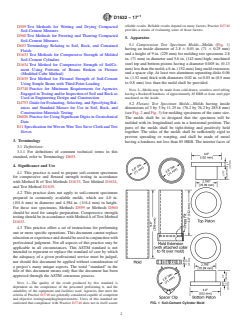
5.1 Compression Test Specimen Molds—Molds (Fig. 1)
D653Terminology Relating to Soil, Rock, and Contained
having an inside diameter of 2.8 6 0.01 in. (71 6 0.25 mm)
Fluids
and a height of 9 in. (229 mm) for molding test specimens 2.8
D1633Test Methods for Compressive Strength of Molded
in. (71 mm) in diameter and 5.6 in. (142 mm) high; machined
Soil-Cement Cylinders
steel top and bottom pistons having a diameter 0.005 in. (0.13
D1634Test Method for Compressive Strength of SoilCe-
mm)lessthanthemold;a6-in.(152-mm)longmoldextension;
ment Using Portions of Beams Broken in Flexure
and a spacer clip.At least two aluminum separating disks 0.06
(Modified Cube Method)
in. (1.52 mm) thick with diameters 0.02 in. to 0.03 in (0.5 mm
D1635Test Method for Flexural Strength of Soil-Cement
to 0.8 mm) less than the mold shall be provided.
Using Simple Beam with Third-Point Loading
D3740Practice for Minimum Requirements for Agencies
NOTE 2—Molds may be made from cold-drawn, seamless steel tubing
Engaged in Testing and/or Inspection of Soil and Rock as having a Rockwell hardness of approximately 85 HRB or from steel pipe
machined on the inside.
Used in Engineering Design and Construction
D4753Guide for Evaluating, Selecting, and Specifying Bal-
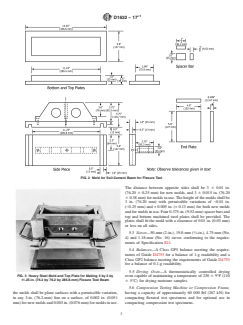
5.2 Flexure Test Specimen Molds—Molds having inside
ances and Standard Masses for Use in Soil, Rock, and
dimensions of 3 by 3 by 11.25 in. (76.2 by 76.2 by 285.8 mm)
Construction Materials Testing
(seeFig.2andFig.3)formoldingspecimensofthesamesize.
D6026Practice for Using Significant Digits in Geotechnical
The molds shall be so designed that the specimen will be
Data
molded with its longitudinal axis in a horizontal position. The
E11Specification forWovenWireTest Sieve Cloth andTest
parts of the molds shall be tight-fitting and positively held
Sieves
together. The sides of the molds shall be sufficiently rigid to
prevent spreading or warping, and shall be made of metal
3. Terminology
having a hardness not less than 85 HRB. The interior faces of
3.1 Definitions:
3.1.1 For definitions of common technical terms in this
standard, refer to Terminology D653.
4. Significance and Use
4.1 This practice is used to prepare soil-cement specimens
for compressive and flexural strength testing in accordance
with Method B of Test Methods D1633, Test Method D1634,
and Test Method D1635.
4.2 This practice does not apply to soil-cement specimens
prepared in commonly available molds, which are 4.0 in.
(101.6 mm) in diameter and 4.584 in. (116.4 mm) in height.
For these size specimens, Methods D559 or Methods D560
should be used for sample preparation. Compressive strength
testing should be in accordance with MethodAofTest Method
D1633.
4.3 This practice offers a set of instructions for performing
one or more specific operations.This document cannot replace
educationorexperienceandshouldbeusedinconjunctionwith
professional judgment. Not all aspects of this practice may be
applicable in all circumstances. This ASTM standard is not
intended to represent or replace the standard of care by which
the adequacy of a given professional service must be judged,
nor should this document be applied without consideration of
a project’s many unique aspects. The word “standard” in the
title of this document means only that the document has been
approved through the ASTM consensus process.
NOTE 1—The quality of the result produced by this standard is
dependent on the competence of the personnel performing it, and the
suitability of the equipment and facilities used. Agencies that meet the
criteria of Practice D3740 are generally considered capable of competent
and objective testing/sampling/inspection/etc. Users of this standard are
cautioned that compliance with Practice D3740 does not in itself assure FIG. 1 Soil-Cement Cylinder Mold
´1
D1632 − 17
FIG. 2 Mold for Soil-Cement Beam for Flexure Test
The distance between opposite sides shall be 3 6 0.01 in.
(76.20 6 0.25 mm) for new molds, and 3 6 0.015 in. (76.20
6 0.38 mm) for molds in use.The height of the molds shall be
3 in. (76.20 mm) with permissible variations of −0.01 in.
(−0.25 mm) and +0.005 in. (+0.13 mm) for both new molds
andformoldsinuse.Four0.375-in.(9.52-mm)spacerbarsand
top and bottom machined steel plates shall be provided. The
plates shall fit the mold with a clearance of 0.01 in. (0.03 mm)
or less on all sides.
5.3 Sieves—50-mm(2-in.),19.0-mm( ⁄4-in.),4.75-mm(No.
4) and 1.18-mm (No. 16) sieves conforming to the require-
ments of Specification E11.
5.4 Balances—A Class GP5 balance meeting the require-
ments of Guide D4753 for a balance of 1-g readability and a
Class GP2 balance meeting the requirements of Guide D4753
for a balance of 0.1-g readability.
5.5 Drying Oven—A thermostatically controlled drying
FIG. 3 Heavy Steel Mold and Top Plate for Making 3 by 3 by oven capable of maintaining a temperature of 230 6 9°F (110
11.25-in. (76.2 by 76.2 by 285.8-mm) Flexure Test Beam
6 5°C) for drying moisture samples.
5.6 Compression Testing Machine or Compression Frame,
the molds shall be plane surfaces with a permissible variation, having a capacity of approximately 60 000 lbf (267 kN) for
in any 3-in. (76.2-mm) line on a surface, of 0.002 in. (0.051 compacting flexural test specimens and for optional use in
mm)fornewmoldsand0.003in.(0.076mm)formoldsinuse. compacting compression test specimens.
´1
D1632 − 17
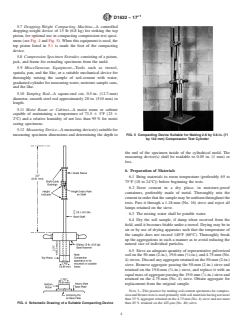
5.7 Dropping-Weight Compacting Machine—A controlled
dropping-weight device of 15 lb (6.8 kg) for striking the top
piston, for optional use in compacting compression test speci-
mens (see Fig. 4 and Fig. 5).When this equipment is used, the
top piston listed in 5.1 is made the foot of the compacting
device.
5.8 Compression Specimen Extruder, consisting of a piston,
jack, and frame for extruding specimens from the mold.
5.9 Miscellaneous Equipment—Tools such as trowel,
spatula, pan, and the like, or a suitable mechanical device for
thoroughly mixing the sample of soil-cement with water;
graduated cylinder for measuring water, moisture sample cans,
and the like.
5.10 Tamping Rod—A square-end cut, 0.5-in. (12.7-mm)
diameter, smooth steel rod approximately 20 in. (510 mm) in
length.
5.11 Moist Room or Cabinet—A moist room or cabinet
capable of maintaining a temperature of 73.5 6 3°F (23 6
2°C) and a relative humidity of not less than 95% for moist
curing specimens.
5.12 Measuring Device—Ameasuringdevice(s)suitablefor
measuring specimen dimensions and determining the depth to FIG. 5 Compacting Device Suitable for Making 2.8 by 5.6-in. (71
by 142 mm) Compression Test Cylinder
the end of the specimen inside of the cylindrical mold. The
measuring device(s) shall be readable to 0.05 in. (1 mm) or
less.
6. Preparation of Materials
6.1 Bring materials to room temperature (preferably 65 to
75°F (18 to 24°C)) before beginning the tests.
6.2 Store cement in a dry place, in moisture-proof
containers, preferably made of metal. Thoroughly mix the
cementinorderthatthesamplemaybeuniformthroughoutthe
tests. Pass it through a 1.18-mm (No. 16) sieve and reject all
lumps retained on the sieve.
6.3 The mixing water shall be potable water.
6.4 Dry the soil sample, if damp when received from the
field, until it becomes friable under a trowel. Drying may be in
air or by use of drying apparatus such that the temperature of
the sample does not exceed 140°F (60°C). Thoroughly break
up the aggregations in such a manner as to avoid reducing the
natural size of individual particles.
6.5 Sieve an adequate quantity of representative pulverized
soilonthe50-mm(2-in.),19.0-mm( ⁄4-in.),and4.75-mm(No.
4) sieves. Discard any aggregate retained on the 50-mm (2-in.)
sieve. Remove aggregate passing the 50-mm (2-in.) sieve and
retained on the 19.0-mm ( ⁄4-in.) sieve, and replace it with an
equalmassofaggregatepassingthe19.0-mm( ⁄4-in.)sieveand
retained on the 4.75-mm (No. 4) sieve. Obtain aggregate for
replacement from the original sample.
NOTE 3—This practice for making soil-cement specimens for compres-
sionandflexuretestsisusedprimarilywithsoilmaterialshavingnotmore
than 35% aggregate retained on the 4.75-mm (No. 4) sieve and not more
FIG. 4 Schematic Drawing of a Suitable Compacting Device than 85% retained on the 425-µm (No. 40) sieve.
´1
D1632 − 17
6.6 Soak the aggregate passing the 19.0-mm ( ⁄4-in.) sieve 8.2.3 Add the saturated surface-dry coarse aggregate and
and retained on the 4.75-mm (No. 4) sieve in water for 24 64 mix the entire batch until the coarse aggregate is uniformly
h, remo
...