

ASTM C1712-20
(Test Method)Standard Test Method for Rapid Assessment of Static Segregation Resistance of Self-Consolidating Concrete Using Penetration Test
General Information
- Abstract
SIGNIFICANCE AND USE
5.1 This test method is for the rapid assessment of the static segregation resistance of self-consolidating concrete.
5.2 The method is useful for rapid assessment of the static segregation resistance of self-consolidating concrete during mixture development in the laboratory as well as prior to placement of the mixture in the field. Test Method C1610/C1610M for static segregation of SCC is not sufficiently rapid, and the non-mandatory Visual Stability Index as determined through the procedure described in Appendix X1 of Test Method C1611/C1611M is highly subjective and qualitative.
5.3 Appendix X1 provides non-mandatory criteria that may be used to indicate the degree of static segregation resistance of self-consolidating concrete mixtures.
SCOPE
1.1 This test method covers the rapid assessment of static segregation resistance of normal-weight self-consolidating concrete (SCC). The test does not measure static segregation resistance directly, but provides an assessment of whether static segregation is likely to occur.
1.2 The test apparatus and protocol were developed based on tests with SCC mixtures containing saturated surface dry (SSD) coarse aggregates ranging in relative density from 2.67 to 2.79 and in nominal maximum size from 9.5 mm to 25 mm. For SCC mixtures outside these ranges, testing is recommended to establish a correlation between penetration depth and static segregation measured in accordance with Test Method C1610/C1610M. This test method shall not be used to assess the static segregation resistance of self-consolidating concrete containing lightweight aggregates or heavyweight aggregates without prior testing to establish a correlation.
1.3 The values stated in SI units are to be regarded as standard. No other units of measurement are included in this standard.
1.4 The text of this standard references notes and footnotes that provide explanatory material. These notes and footnotes shall not be considered as requirements of the standard.
1.5 This standard does not purport to address all of the safety concerns, if any, associated with its use. It is the responsibility of the user of this standard to establish appropriate safety, health, and environmental practices and determine the applicability of regulatory limitations prior to use. (Warning—Fresh hydraulic cementitious mixtures are caustic and may cause chemical burns to skin and tissue upon prolonged exposure.2)
1.6 This international standard was developed in accordance with internationally recognized principles on standardization established in the Decision on Principles for the Development of International Standards, Guides and Recommendations issued by the World Trade Organization Technical Barriers to Trade (TBT) Committee.
- Status
- Published
- Publication Date
- 31-Mar-2020
- Technical Committee
- C09 - Concrete and Concrete Aggregates
- Drafting Committee
- C09.47 - Self-Consolidating Concrete
Buy Documents
ASTM C1712-20 - Standard Test Method for Rapid Assessment of Static Segregation Resistance of Self-Consolidating Concrete Using Penetration Test
REDLINE ASTM C1712-20 - Standard Test Method for Rapid Assessment of Static Segregation Resistance of Self-Consolidating Concrete Using Penetration Test
Overview
ASTM C1712-20, "Standard Test Method for Rapid Assessment of Static Segregation Resistance of Self-Consolidating Concrete Using Penetration Test," provides a standardized method to quickly evaluate the static segregation resistance of self-consolidating concrete (SCC). This test method serves a critical role during both the mixture development phase in the laboratory and immediately prior to SCC placement in the field, ensuring quality and consistency. By utilizing a penetration apparatus and an inverted slump mold, this procedure assesses the likelihood of static segregation-where mortar separates from coarse aggregate-without the need for time-intensive or highly subjective testing.
Key Topics
- Rapid Assessment: The test method enables quick determination of whether a fresh SCC mixture is susceptible to static segregation, streamlining mix design and quality control.
- Penetration Test Principle: A specialized apparatus measures the penetration depth of a hollow cylinder into the SCC, from which the resistance to segregation is inferred.
- Applicability: This method applies specifically to normal-weight SCC containing saturated surface dry (SSD) coarse aggregates within specific density and size ranges.
- Practical Criteria: Non-mandatory categories of segregation resistance (resistant, moderately resistant, not resistant) are available based on penetration depth, following supporting guidance in Appendix X1.
- Objectivity and Speed: The penetration test addresses the need for a less subjective and more rapid evaluation than methods such as visual stability indexing or the column technique.
Applications
The ASTM C1712-20 penetration test has significant practical applications in the construction and precast concrete industries:
- SCC Mix Design Optimization: Laboratories utilize this method during the development of SCC mixtures to quickly screen for resistance to static segregation, ensuring effective self-consolidation without aggregate separation.
- Field Quality Control: On-site testing with this penetration method allows for rapid go/no-go assessment, reducing delays in construction processes and preventing placement of unstable mixes.
- Precast and Ready-Mix Production: Quality assurance teams in precast and ready-mix sectors use the test to regularly validate SCC batches, maintaining compliance with performance specifications.
- Research and Development: The method supports academic and industry research efforts aimed at improving SCC stability, offering a repeatable and standardized technique for experimental comparisons.
Related Standards
Several ASTM standards complement or are referenced by ASTM C1712-20, providing additional guidance for SCC assessment and handling:
- ASTM C1610/C1610M – Standard Test Method for Static Segregation of SCC Using Column Technique (provides a more comprehensive but less rapid evaluation)
- ASTM C1611/C1611M – Standard Test Method for Slump Flow of SCC (addresses flowability and provides an optional visual stability index)
- ASTM C125 – Terminology Relating to Concrete and Aggregates
- ASTM C143/C143M – Test Method for Slump of Hydraulic-Cement Concrete (specifies slump mold requirements)
- ASTM C172/C172M – Practice for Sampling Freshly Mixed Concrete
- ASTM C192/C192M – Practice for Making and Curing Concrete Test Specimens in the Laboratory
- ASTM C1758/C1758M – Practice for Fabricating Test Specimens with SCC
Practical Value
Using ASTM C1712-20 improves the quality and reliability of self-consolidating concrete, ensuring structures benefit from uniform strength, appearance, and durability. The method’s rapid turnaround is essential for continuous production environments, while its objectivity reduces risk of operator bias. As self-consolidating concrete continues to gain popularity for its ease of placement and finishing, adherence to ASTM C1712-20 supports standardization and global best practices in concrete construction.
Keywords: segregation resistance, self-consolidating concrete, penetration test, SCC stability, ASTM C1712-20, rapid test for concrete, concrete quality control, concrete segregation assessment.
Relations
- Effective Date
- 01-Jan-2024
- Effective Date
- 01-Oct-2023
- Effective Date
- 01-Sep-2023
- Effective Date
- 15-Dec-2019
- Effective Date
- 01-Jan-2019
- Effective Date
- 01-Oct-2018
- Effective Date
- 01-Jul-2018
- Effective Date
- 01-Jan-2018
- Effective Date
- 15-Jun-2017
- Effective Date
- 15-Dec-2016
- Effective Date
- 01-Feb-2016
- Effective Date
- 15-Dec-2015
- Effective Date
- 01-Jul-2015
- Effective Date
- 01-Feb-2015
- Effective Date
- 01-Aug-2014
Buy Documents
ASTM C1712-20 - Standard Test Method for Rapid Assessment of Static Segregation Resistance of Self-Consolidating Concrete Using Penetration Test
REDLINE ASTM C1712-20 - Standard Test Method for Rapid Assessment of Static Segregation Resistance of Self-Consolidating Concrete Using Penetration Test
Get Certified
Connect with accredited certification bodies for this standard

DIBt (Deutsches Institut für Bautechnik)
German Institute for Building Technology.
DIN CERTCO
DIN Group product certification.

Aboma Certification B.V.
Specialized in construction, metal, and transport sectors.
Sponsored listings
Frequently Asked Questions
ASTM C1712-20 is a standard published by ASTM International. Its full title is "Standard Test Method for Rapid Assessment of Static Segregation Resistance of Self-Consolidating Concrete Using Penetration Test". This standard covers: SIGNIFICANCE AND USE 5.1 This test method is for the rapid assessment of the static segregation resistance of self-consolidating concrete. 5.2 The method is useful for rapid assessment of the static segregation resistance of self-consolidating concrete during mixture development in the laboratory as well as prior to placement of the mixture in the field. Test Method C1610/C1610M for static segregation of SCC is not sufficiently rapid, and the non-mandatory Visual Stability Index as determined through the procedure described in Appendix X1 of Test Method C1611/C1611M is highly subjective and qualitative. 5.3 Appendix X1 provides non-mandatory criteria that may be used to indicate the degree of static segregation resistance of self-consolidating concrete mixtures. SCOPE 1.1 This test method covers the rapid assessment of static segregation resistance of normal-weight self-consolidating concrete (SCC). The test does not measure static segregation resistance directly, but provides an assessment of whether static segregation is likely to occur. 1.2 The test apparatus and protocol were developed based on tests with SCC mixtures containing saturated surface dry (SSD) coarse aggregates ranging in relative density from 2.67 to 2.79 and in nominal maximum size from 9.5 mm to 25 mm. For SCC mixtures outside these ranges, testing is recommended to establish a correlation between penetration depth and static segregation measured in accordance with Test Method C1610/C1610M. This test method shall not be used to assess the static segregation resistance of self-consolidating concrete containing lightweight aggregates or heavyweight aggregates without prior testing to establish a correlation. 1.3 The values stated in SI units are to be regarded as standard. No other units of measurement are included in this standard. 1.4 The text of this standard references notes and footnotes that provide explanatory material. These notes and footnotes shall not be considered as requirements of the standard. 1.5 This standard does not purport to address all of the safety concerns, if any, associated with its use. It is the responsibility of the user of this standard to establish appropriate safety, health, and environmental practices and determine the applicability of regulatory limitations prior to use. (Warning—Fresh hydraulic cementitious mixtures are caustic and may cause chemical burns to skin and tissue upon prolonged exposure.2) 1.6 This international standard was developed in accordance with internationally recognized principles on standardization established in the Decision on Principles for the Development of International Standards, Guides and Recommendations issued by the World Trade Organization Technical Barriers to Trade (TBT) Committee.
SIGNIFICANCE AND USE 5.1 This test method is for the rapid assessment of the static segregation resistance of self-consolidating concrete. 5.2 The method is useful for rapid assessment of the static segregation resistance of self-consolidating concrete during mixture development in the laboratory as well as prior to placement of the mixture in the field. Test Method C1610/C1610M for static segregation of SCC is not sufficiently rapid, and the non-mandatory Visual Stability Index as determined through the procedure described in Appendix X1 of Test Method C1611/C1611M is highly subjective and qualitative. 5.3 Appendix X1 provides non-mandatory criteria that may be used to indicate the degree of static segregation resistance of self-consolidating concrete mixtures. SCOPE 1.1 This test method covers the rapid assessment of static segregation resistance of normal-weight self-consolidating concrete (SCC). The test does not measure static segregation resistance directly, but provides an assessment of whether static segregation is likely to occur. 1.2 The test apparatus and protocol were developed based on tests with SCC mixtures containing saturated surface dry (SSD) coarse aggregates ranging in relative density from 2.67 to 2.79 and in nominal maximum size from 9.5 mm to 25 mm. For SCC mixtures outside these ranges, testing is recommended to establish a correlation between penetration depth and static segregation measured in accordance with Test Method C1610/C1610M. This test method shall not be used to assess the static segregation resistance of self-consolidating concrete containing lightweight aggregates or heavyweight aggregates without prior testing to establish a correlation. 1.3 The values stated in SI units are to be regarded as standard. No other units of measurement are included in this standard. 1.4 The text of this standard references notes and footnotes that provide explanatory material. These notes and footnotes shall not be considered as requirements of the standard. 1.5 This standard does not purport to address all of the safety concerns, if any, associated with its use. It is the responsibility of the user of this standard to establish appropriate safety, health, and environmental practices and determine the applicability of regulatory limitations prior to use. (Warning—Fresh hydraulic cementitious mixtures are caustic and may cause chemical burns to skin and tissue upon prolonged exposure.2) 1.6 This international standard was developed in accordance with internationally recognized principles on standardization established in the Decision on Principles for the Development of International Standards, Guides and Recommendations issued by the World Trade Organization Technical Barriers to Trade (TBT) Committee.
ASTM C1712-20 is classified under the following ICS (International Classification for Standards) categories: 91.100.30 - Concrete and concrete products. The ICS classification helps identify the subject area and facilitates finding related standards.
ASTM C1712-20 has the following relationships with other standards: It is inter standard links to ASTM C173/C173M-24, ASTM C1758/C1758M-23, ASTM C173/C173M-23, ASTM C125-19a, ASTM C125-19, ASTM C125-18b, ASTM C125-18a, ASTM C125-18, ASTM C1610/C1610M-17, ASTM C125-16, ASTM C192/C192M-16, ASTM C125-15b, ASTM C125-15a, ASTM C125-15, ASTM C192/C192M-14. Understanding these relationships helps ensure you are using the most current and applicable version of the standard.
ASTM C1712-20 is available in PDF format for immediate download after purchase. The document can be added to your cart and obtained through the secure checkout process. Digital delivery ensures instant access to the complete standard document.
Standards Content (Sample)
This international standard was developed in accordance with internationally recognized principles on standardization established in the Decision on Principles for the
Development of International Standards, Guides and Recommendations issued by the World Trade Organization Technical Barriers to Trade (TBT) Committee.
Designation: C1712 − 20
Standard Test Method for
Rapid Assessment of Static Segregation Resistance of Self-
Consolidating Concrete Using Penetration Test
This standard is issued under the fixed designation C1712; the number immediately following the designation indicates the year of
original adoption or, in the case of revision, the year of last revision. A number in parentheses indicates the year of last reapproval. A
superscript epsilon (´) indicates an editorial change since the last revision or reapproval.
1. Scope* 1.6 This international standard was developed in accor-
dance with internationally recognized principles on standard-
1.1 This test method covers the rapid assessment of static
ization established in the Decision on Principles for the
segregation resistance of normal-weight self-consolidating
Development of International Standards, Guides and Recom-
concrete (SCC). The test does not measure static segregation
mendations issued by the World Trade Organization Technical
resistance directly, but provides an assessment of whether
Barriers to Trade (TBT) Committee.
static segregation is likely to occur.
1.2 The test apparatus and protocol were developed based
2. Referenced Documents
on tests with SCC mixtures containing saturated surface dry
2.1 ASTM Standards:
(SSD) coarse aggregates ranging in relative density from 2.67
C125 Terminology Relating to Concrete and Concrete Ag-
to 2.79 and in nominal maximum size from 9.5 mm to 25 mm.
gregates
For SCC mixtures outside these ranges, testing is recom-
C143/C143M Test Method for Slump of Hydraulic-Cement
mended to establish a correlation between penetration depth
Concrete
and static segregation measured in accordance with Test
C172/C172M Practice for Sampling Freshly Mixed Con-
Method C1610/C1610M. This test method shall not be used to
crete
assess the static segregation resistance of self-consolidating
C173/C173M Test Method for Air Content of Freshly Mixed
concrete containing lightweight aggregates or heavyweight
Concrete by the Volumetric Method
aggregates without prior testing to establish a correlation.
C192/C192M Practice for Making and Curing Concrete Test
1.3 The values stated in SI units are to be regarded as
Specimens in the Laboratory
standard. No other units of measurement are included in this
C1610/C1610M Test Method for Static Segregation of Self-
standard.
Consolidating Concrete Using Column Technique
C1611/C1611M Test Method for Slump Flow of Self-
1.4 The text of this standard references notes and footnotes
Consolidating Concrete
that provide explanatory material. These notes and footnotes
C1758/C1758M Practice for Fabricating Test Specimens
shall not be considered as requirements of the standard.
with Self-Consolidating Concrete
1.5 This standard does not purport to address all of the
safety concerns, if any, associated with its use. It is the
3. Terminology
responsibility of the user of this standard to establish appro-
3.1 Definitions:
priate safety, health, and environmental practices and deter-
3.1.1 For definitions of terms used in this test method, refer
mine the applicability of regulatory limitations prior to use.
to Terminology C125.
(Warning—Fresh hydraulic cementitious mixtures are caustic
3.2 Definitions of Terms Specific to This Standard:
and may cause chemical burns to skin and tissue upon
3.2.1 static segregation resistance, n—resistance of a con-
prolonged exposure. )
crete mixture to segregation of the mortar component from the
coarse aggregate while the concrete is at rest and before initial
This test method is under the jurisdiction of ASTM Committee C09 on
setting.
Concrete and Concrete Aggregates and is the direct responsibility of Subcommittee
C09.47 on Self-Consolidating Concrete.
Current edition approved April 1, 2020. Published May 2020. Originally
approved in 2009. Last previous edition approved in 2017 as C1712 – 17. DOI: For referenced ASTM standards, visit the ASTM website, www.astm.org, or
10.1520/C1712-20. contact ASTM Customer Service at service@astm.org. For Annual Book of ASTM
Section on Safety Precautions, Manual of Aggregate and Concrete Testing, Standards volume information, refer to the standard’s Document Summary page on
Annual Book of ASTM Standards, Vol. 04.02. the ASTM website.
*A Summary of Changes section appears at the end of this standard
Copyright © ASTM International, 100 Barr Harbor Drive, PO Box C700, West Conshohocken, PA 19428-2959. United States
C1712 − 20
4. Summary of Test Method 5.3 Appendix X1 provides non-mandatory criteria that may
be used to indicate the degree of static segregation resistance of
4.1 This test method uses a penetration apparatus (shown in
self-consolidating concrete mixtures.
Figs. 1 and 2) and an inverted slump mold (Fig. 3). A sample
of freshly mixed self-consolidating concrete is placed in an
6. Apparatus
inverted slump mold without tamping or vibration. The hollow
cylinder attached to a metal rod is aligned in the center of the
6.1 Mold—The slump mold is used in this test method and
inverted slump mold as shown in Fig. 3. The hollow cylinder
shall conform to Test Method C143/C143M.
is then lowered onto the surface of the concrete and released to
freely penetrate into the fresh concrete. The penetration depth 6.2 Penetration Apparatus—The penetration apparatus,
(Pd) is determined and used to assess the static segregation shown in Fig. 1, consists of a support frame, a metal sleeve, a
resistance of the self-consolidating concrete mixture (1-5).
set screw, a penetration head and a reading scale. The penetra-
tion head, consisting of a non-corrosive hollow cylinder and a
5. Significance and Use
metal rod, has a mass of 45 6 1 g. The rod is bolted vertically
into the center of the top of the hollow cylinder and acts as a
5.1 This test method is for the rapid assessment of the static
unit with the cylinder. The inner diameter, wall thickness, and
segregation resistance of self-consolidating concrete.
height of the hollow cylinder are 75 6 1 mm, 1.5 6 0.1 mm,
5.2 The method is useful for rapid assessment of the static
and 50 6 1 mm, respectively. Holes are symmetrically drilled
segregation resistance of self-consolidating concrete during
on the top surface of the hollow cylinder to allow air to escape
mixture development in the laboratory as well as prior to
during the penetration test. At least two holes with a minimum
placement of the mixture in the field. Test Method C1610/
diameter of 6 mm must be provided (see Note 1). The reading
C1610M for static segregation of SCC is not sufficiently rapid,
scale shall be 55 mm long and marked in 1 mm increments.
and the non-mandatory Visual Stability Index as determined
The scale is mounted on the support frame and adjacent to the
through the procedure described in Appendix X1 of Test
metal rod, as shown in Figs. 1 and 2. With both the support
Method C1611/C1611M is highly subjective and qualitative.
frame and the hollow cylinder resting on a flat surface, the top
of the metal rod shall be 5 mm below the top of the reading
scale (see Note 2). The diameter of the metal rod shall be 4.5
6 0.5 mm. The inner diameter of the metal sleeve shall be 0.7
The boldface numbers in parentheses refer to a list of references at the end of
this standard.
FIG. 1 Dimension of Penetration Apparatus
C1712 − 20
FIG. 2 Penetration Apparatus
FIG. 3 Penetration Test
6 0.1 mm larger than the diameter of the metal rod to minimize 6.3 Base Plate (Optional)—As described in Test Method
friction as the rod slides. C1611/C1611M.
NOTE 1—The number and size of the holes may be chosen to be greater
6.4 Strike-off Bar—As described in Test Method C173/
than the minimum stated in 6.2 to achieve the required mass (45 6 1 g)
of the penetration head. The hollow cylinder shown in Fig. 2 is made of
C173M.
Polyvinyl Chloride (PVC) and has six holes on the top surface; each hole
has a diameter of approximately 10 mm. 6.5 Sample Receptacle—A pan or wheelbarrow that is
NOTE 2—This enables the top of the metal rod to be used as the mark
water-tight, has a nonabsorbent surface, and is large enough to
for taking both the initial and final readings since it will always lie within
allow both remixing
...
This document is not an ASTM standard and is intended only to provide the user of an ASTM standard an indication of what changes have been made to the previous version. Because
it may not be technically possible to adequately depict all changes accurately, ASTM recommends that users consult prior editions as appropriate. In all cases only the current version
of the standard as published by ASTM is to be considered the official document.
Designation: C1712 − 17 C1712 − 20
Standard Test Method for
Rapid Assessment of Static Segregation Resistance of Self-
Consolidating Concrete Using Penetration Test
This standard is issued under the fixed designation C1712; the number immediately following the designation indicates the year of
original adoption or, in the case of revision, the year of last revision. A number in parentheses indicates the year of last reapproval. A
superscript epsilon (´) indicates an editorial change since the last revision or reapproval.
1. Scope*
1.1 This test method covers the rapid assessment of static segregation resistance of normal-weight self-consolidating concrete
(SCC). The test does not measure static segregation resistance directly, but provides an assessment of whether static segregation
is likely to occur.
1.2 The test apparatus and protocol were developed based on tests with SCC mixtures containing saturated surface dry (SSD)
coarse aggregates ranging in relative density from 2.67 to 2.79 and in nominal maximum size from 9.5 mm to 25 mm. For SCC
mixtures outside these ranges, testing is recommended to establish a correlation between penetration depth and static segregation
measured in accordance with Test Method C1610/C1610M. This test method shall not be used to assess the static segregation
resistance of self-consolidating concrete containing lightweight aggregates or heavyweight aggregates without prior testing to
establish a correlation.
1.3 The values stated in SI units are to be regarded as standard. No other units of measurement are included in this standard.
1.4 The text of this standard references notes and footnotes that provide explanatory material. These notes and footnotes shall
not be considered as requirements of the standard.
1.5 This standard does not purport to address all of the safety concerns, if any, associated with its use. It is the responsibility
of the user of this standard to establish appropriate safety, health, and environmental practices and determine the applicability of
regulatory limitations prior to use. (Warning—Fresh hydraulic cementitious mixtures are caustic and may cause chemical burns
to skin and tissue upon prolonged exposure. )
1.6 This international standard was developed in accordance with internationally recognized principles on standardization
established in the Decision on Principles for the Development of International Standards, Guides and Recommendations issued
by the World Trade Organization Technical Barriers to Trade (TBT) Committee.
2. Referenced Documents
2.1 ASTM Standards:
C125 Terminology Relating to Concrete and Concrete Aggregates
C143/C143M Test Method for Slump of Hydraulic-Cement Concrete
C172/C172M Practice for Sampling Freshly Mixed Concrete
C173/C173M Test Method for Air Content of Freshly Mixed Concrete by the Volumetric Method
C192/C192M Practice for Making and Curing Concrete Test Specimens in the Laboratory
C1610/C1610M Test Method for Static Segregation of Self-Consolidating Concrete Using Column Technique
C1611/C1611M Test Method for Slump Flow of Self-Consolidating Concrete
C1758/C1758M Practice for Fabricating Test Specimens with Self-Consolidating Concrete
3. Terminology
3.1 Definitions:
3.1.1 For definitions of terms used in this test method, refer to Terminology C125.
This test method is under the jurisdiction of ASTM Committee C09 on Concrete and Concrete Aggregates and is the direct responsibility of Subcommittee C09.47 on
Self-Consolidating Concrete.
Current edition approved Aug. 1, 2017April 1, 2020. Published August 2017May 2020. Originally approved in 2009. Last previous edition approved in 20142017 as
C1712 – 14.C1712 – 17. DOI: 10.1520/C1712-17.10.1520/C1712-20.
Section on Safety Precautions, Manual of Aggregate and Concrete Testing, Annual Book of ASTM Standards, Vol. 04.02.
For referenced ASTM standards, visit the ASTM website, www.astm.org, or contact ASTM Customer Service at service@astm.org. For Annual Book of ASTM Standards
volume information, refer to the standard’s Document Summary page on the ASTM website.
*A Summary of Changes section appears at the end of this standard
Copyright © ASTM International, 100 Barr Harbor Drive, PO Box C700, West Conshohocken, PA 19428-2959. United States
C1712 − 20
3.2 Definitions of Terms Specific to This Standard:
3.2.1 static segregation resistance, n—resistance of a concrete mixture to segregation of the mortar component from the coarse
aggregate while the concrete is at rest and before initial setting.
C1712 − 20
4. Summary of Test Method
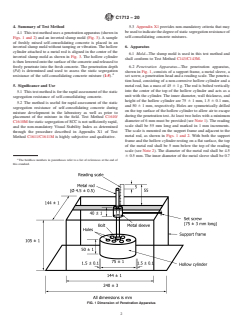
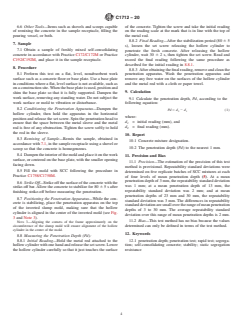
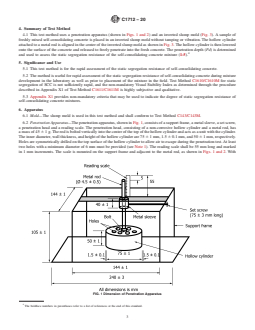
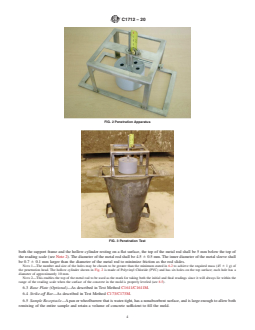
4.1 This test method uses a penetration apparatus (shown in Figs. 1 and 2) and an inverted slump mold (Fig. 3). A sample of
freshly mixed self-consolidating concrete is placed in an inverted slump mold without tamping or vibration. The hollow cylinder
attached to a metal rod is aligned in the center of the inverted slump mold as shown in Fig. 3. The hollow cylinder is then lowered
onto the surface of the concrete and released to freely penetrate into the fresh concrete. The penetration depth (Pd) is determined
and used to assess the static segregation resistance of the self-consolidating concrete mixture (1-5).
5. Significance and Use
5.1 This test method is for the rapid assessment of the static segregation resistance of self-consolidating concrete.
5.2 The method is useful for rapid assessment of the static segregation resistance of self-consolidating concrete during mixture
development in the laboratory as well as prior to placement of the mixture in the field. Test Method C1610/C1610M for static
segregation of SCC is not sufficiently rapid, and the non-mandatory Visual Stability Index as determined through the procedure
described in Appendix X1 of Test Method C1611/C1611M is highly subjective and qualitative.
5.3 Appendix X1 provides non-mandatory criteria that may be used to indicate the degree of static segregation resistance of
self-consolidating concrete mixtures.
6. Apparatus
6.1 Mold—The slump mold is used in this test method and shall conform to Test Method C143/C143M.
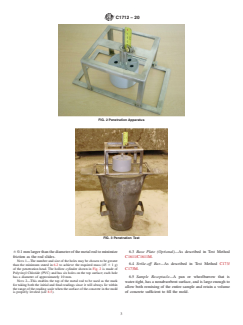
6.2 Penetration Apparatus—The penetration apparatus, shown in Fig. 1, consists of a support frame, a metal sleeve, a set screw,
a penetration head and a reading scale. The penetration head, consisting of a non-corrosive hollow cylinder and a metal rod, has
a mass of 45 6 1 g. The rod is bolted vertically into the center of the top of the hollow cylinder and acts as a unit with the cylinder.
The inner diameter, wall thickness, and height of the hollow cylinder are 75 6 1 mm, 1.5 6 0.1 mm, and 50 6 1 mm, respectively.
Holes are symmetrically drilled on the top surface of the hollow cylinder to allow air to escape during the penetration test. At least
two holes with a minimum diameter of 6 mm must be provided (see Note 1). The reading scale shall be 55 mm long and marked
in 1 mm increments. The scale is mounted on the support frame and adjacent to the metal rod, as shown in Figs. 1 and 2. With
FIG. 1 Dimension of Penetration Apparatus
The boldface numbers in parentheses refer to a list of references at the end of this standard.
C1712 − 20
FIG. 2 Penetration Apparatus
FIG. 3 Penetration Test
both the support frame and the hollow cylinder resting on a flat surface, the top of the metal rod shall be 5 mm below the top of
the reading scale (see Note 2). The diameter of the metal rod shall be 4.5 6 0.5 mm. The inner diameter of the metal sleeve shall
be 0.7 6 0.1 mm larger than the diameter of the metal rod to minimize friction as the rod slides.
NOTE 1—The number and size of the holes may be chosen to be greater than the minimum stated in 6.2 to achieve the required mass (45 6 1 g) of
the penetration head. The hollow cylinder shown in Fig. 2 is made of Polyvinyl Chloride (PVC) and has six holes on the top surface; each hole has a
diameter of approximately 10 mm.
NOTE 2—This enables the top of the metal rod to be used as the mark for taking both the initial and final readings since it will always lie within the
range of the reading scale when the surface of the concrete in the mold is properly leveled (see 8.5).
6.3 Base Plate (Optional)—As described in Test Method C1611/C1611M.
6.4 Strike-off Bar—As described in Test Method C173/C173M.
6.5 Sample Receptacle—A pan or wheelbarrow that is water-tight, has a nonabsorbent surface, and is large enough to allow both
remixing of the entire sample and retain a volume of concrete sufficient to fill the mold.
---------------------- P
...