

ASTM D2978-23
(Test Method)Standard Test Method for Volume of Peat and Peat-Based Growing Media
General Information
- Abstract
SIGNIFICANCE AND USE
5.1 This test method is used to quantify the volume of peat and peat-based growing media under consideration in commercial transactions to determine if the package contains the labeled quantity. As such, material comes into the test area in an “as sold” condition.
5.2 Peat and peat-based growing media are used by amateur gardeners and professional growers on a volume basis. Failure to follow this standard procedure as written can lead to inaccurate results.
Note 1: The quality of the result produced by this standard is dependent on the competence of the personnel performing it, and the suitability of the equipment and facilities used. Agencies that meet the criteria of Practice D3740 are generally considered capable of competent and objective testing/sampling/inspection/etc. Users of this standard are cautioned that compliance with Practice D3740 does not in itself ensure reliable results. Reliable results depend on many factors; Practice D3740 provides a means of evaluating some of those factors.
SCOPE
1.1 This test method covers the measurement of the volume of uncompressed (loose) and compressed (baled) peat and peat-based growing media and is used as a quality control measurement to determine if the package contains the labeled amount of material. The results of this test method is highly dependent on the experience of the personnel running the procedure.
1.2 This standard is for peat and peat-based growing media only. While it is possible for other types of growing media to use this standard it is outside the scope and the methodology may have to be altered to accommodate a different growing media.
1.3 The values stated in inch-pound units are to be regarded as standard. The values given in parentheses are mathematical conversions to SI units that are provided for information only and are not considered standard. Except, that the sieve designations are typically identified using the “alternative” system in accordance with Practice E11, such as 3 in. and No. 200, instead of the “standard” of 75 mm and 75 µm, respectively.
1.4 All observed and calculated values shall conform to the guidelines for significant digits and rounding established in Practice D6026.
1.4.1 The procedures used to specify how data are collected/recorded or calculated in this standard are regarded as the industry standard. In addition, they are representative of the significant digits that generally should be retained. The procedures used do not consider material variation, purpose for obtaining the data, special purpose studies, or any considerations for the user’s objectives; and it is common practice to increase or reduce significant digits of reported data to be commensurate with these considerations. It is beyond the scope of this standard to consider significant digits used in analysis methods for engineering design.
1.5 This standard does not purport to address all of the safety concerns, if any, associated with its use. It is the responsibility of the user of this standard to establish appropriate safety, health, and environmental practices and determine the applicability of regulatory limitations prior to use.
1.6 This international standard was developed in accordance with internationally recognized principles on standardization established in the Decision on Principles for the Development of International Standards, Guides and Recommendations issued by the World Trade Organization Technical Barriers to Trade (TBT) Committee.
- Status
- Published
- Publication Date
- 30-Jun-2023
- Technical Committee
- D18 - Soil and Rock
- Drafting Committee
- D18.22 - Media for Plant Growth


Overview
ASTM D2978-23: Standard Test Method for Volume of Peat and Peat-Based Growing Media establishes precise procedures for measuring the volume of both uncompressed (loose) and compressed (baled) peat and peat-based growing media. Developed by ASTM Committee D18.22, this standard is essential for ensuring that packaging matches the labeled volume in commercial transactions. By providing clear guidance on volume determination, ASTM D2978-23 supports transparent business practices, reliable quality control, and uniformity across the horticultural and agricultural supply chain.
Key Topics
- Volume Measurement Methods: The standard details two methods - Method A for loose (uncompressed) peat, and Method B for baled (compressed) peat. Each method specifies the appropriate measuring equipment and procedures for accurate results.
- Quality Assurance: By defining procedures for sample preparation, measurement, and data recording, ASTM D2978-23 allows manufacturers, distributors, and purchasers to verify that shipped or purchased peat products meet stated volume specifications.
- Significance of Competence: The standard emphasizes that the quality of results depends on the proficiency of personnel and the adequacy of equipment and facilities. It refers to the use of competent agencies meeting ASTM D3740 for objective testing and inspection.
- Units of Measurement: Volume measurements are primarily made using inch-pound units, with SI conversions provided for informational purposes.
- Reporting and Data Integrity: Guidelines are provided for recording key data such as sample identification, test method used, labeled and measured volume, as well as container sizes and measurement corrections.
Applications
ASTM D2978-23 is highly valuable in various practical scenarios:
- Commercial Verification: Used by both suppliers and buyers to ensure that bags and bales of peat or peat-based growing media contain the quantity stated on packaging, thus fostering fair trade and regulatory compliance.
- Horticultural Supply Chain: Producers, retailers, and commercial growers rely on the standard to maintain trust in volumetric labeling, critical for large-scale greenhouse operations and landscaping projects.
- Quality Control: Testing laboratories and quality assurance professionals employ ASTM D2978-23 for routine audits and investigations of product complaints related to underfilled or mislabeled packages.
- Regulatory Compliance: Adhering to this test method allows businesses to meet national and international requirements for packaging truth-in-labeling and standard measurement practices.
- Gardening and Agriculture: Both amateur and professional users benefit from accurate volume measurement, ensuring sufficient supply for planting, soil conditioning, or crop enhancement.
Related Standards
For a robust approach to testing and data integrity, reference the following ASTM standards:
- ASTM D653 - Terminology Relating to Soil, Rock, and Contained Fluids: Provides definitions for terms used in soil and growing media standards.
- ASTM D3740 - Practice for Minimum Requirements for Agencies Engaged in Testing and/or Inspection of Soil and Rock: Ensures competent agency performance.
- ASTM D6026 - Practice for Using Significant Digits and Data Records in Geotechnical Data: Defines the required precision and rounding rules for data reporting.
- ASTM E11 - Specification for Woven Wire Test Sieve Cloth and Test Sieves: Establishes specifications for sieves used in sample preparation.
Practical Value
By adopting ASTM D2978-23, organizations engaged in the production, distribution, or purchase of peat and peat-based growing media can:
- Verify volume accuracy and product consistency
- Support transparent, fair trade in the growing media market
- Establish clear quality control benchmarks
- Facilitate claims resolution and regulatory audits
- Promote confidence among consumers and professionals in horticultural and agricultural products
Keywords: ASTM D2978-23, peat volume measurement, peat-based growing media, horticultural quality control, growing media packaging, commercial peat standards, volume determination method.
Relations
- Effective Date
- 01-Nov-2023
- Effective Date
- 01-Oct-2019
- Effective Date
- 01-Aug-2014
- Effective Date
- 01-Oct-2013
- Effective Date
- 01-May-2012
- Effective Date
- 01-Mar-2012
- Effective Date
- 01-Sep-2011
- Effective Date
- 01-Sep-2011
- Effective Date
- 01-Mar-2010
- Effective Date
- 01-May-2009
- Effective Date
- 01-Jan-2009
- Effective Date
- 01-Dec-2008
- Effective Date
- 01-Nov-2008
- Effective Date
- 01-Mar-2008
- Effective Date
- 15-Dec-2007
Get Certified
Connect with accredited certification bodies for this standard

Control Union Certifications
Global certification for agriculture and sustainability.

ECOCERT
Organic and sustainability certification.

FSC International
Forest Stewardship Council certification.
Sponsored listings
Frequently Asked Questions
ASTM D2978-23 is a standard published by ASTM International. Its full title is "Standard Test Method for Volume of Peat and Peat-Based Growing Media". This standard covers: SIGNIFICANCE AND USE 5.1 This test method is used to quantify the volume of peat and peat-based growing media under consideration in commercial transactions to determine if the package contains the labeled quantity. As such, material comes into the test area in an “as sold” condition. 5.2 Peat and peat-based growing media are used by amateur gardeners and professional growers on a volume basis. Failure to follow this standard procedure as written can lead to inaccurate results. Note 1: The quality of the result produced by this standard is dependent on the competence of the personnel performing it, and the suitability of the equipment and facilities used. Agencies that meet the criteria of Practice D3740 are generally considered capable of competent and objective testing/sampling/inspection/etc. Users of this standard are cautioned that compliance with Practice D3740 does not in itself ensure reliable results. Reliable results depend on many factors; Practice D3740 provides a means of evaluating some of those factors. SCOPE 1.1 This test method covers the measurement of the volume of uncompressed (loose) and compressed (baled) peat and peat-based growing media and is used as a quality control measurement to determine if the package contains the labeled amount of material. The results of this test method is highly dependent on the experience of the personnel running the procedure. 1.2 This standard is for peat and peat-based growing media only. While it is possible for other types of growing media to use this standard it is outside the scope and the methodology may have to be altered to accommodate a different growing media. 1.3 The values stated in inch-pound units are to be regarded as standard. The values given in parentheses are mathematical conversions to SI units that are provided for information only and are not considered standard. Except, that the sieve designations are typically identified using the “alternative” system in accordance with Practice E11, such as 3 in. and No. 200, instead of the “standard” of 75 mm and 75 µm, respectively. 1.4 All observed and calculated values shall conform to the guidelines for significant digits and rounding established in Practice D6026. 1.4.1 The procedures used to specify how data are collected/recorded or calculated in this standard are regarded as the industry standard. In addition, they are representative of the significant digits that generally should be retained. The procedures used do not consider material variation, purpose for obtaining the data, special purpose studies, or any considerations for the user’s objectives; and it is common practice to increase or reduce significant digits of reported data to be commensurate with these considerations. It is beyond the scope of this standard to consider significant digits used in analysis methods for engineering design. 1.5 This standard does not purport to address all of the safety concerns, if any, associated with its use. It is the responsibility of the user of this standard to establish appropriate safety, health, and environmental practices and determine the applicability of regulatory limitations prior to use. 1.6 This international standard was developed in accordance with internationally recognized principles on standardization established in the Decision on Principles for the Development of International Standards, Guides and Recommendations issued by the World Trade Organization Technical Barriers to Trade (TBT) Committee.
SIGNIFICANCE AND USE 5.1 This test method is used to quantify the volume of peat and peat-based growing media under consideration in commercial transactions to determine if the package contains the labeled quantity. As such, material comes into the test area in an “as sold” condition. 5.2 Peat and peat-based growing media are used by amateur gardeners and professional growers on a volume basis. Failure to follow this standard procedure as written can lead to inaccurate results. Note 1: The quality of the result produced by this standard is dependent on the competence of the personnel performing it, and the suitability of the equipment and facilities used. Agencies that meet the criteria of Practice D3740 are generally considered capable of competent and objective testing/sampling/inspection/etc. Users of this standard are cautioned that compliance with Practice D3740 does not in itself ensure reliable results. Reliable results depend on many factors; Practice D3740 provides a means of evaluating some of those factors. SCOPE 1.1 This test method covers the measurement of the volume of uncompressed (loose) and compressed (baled) peat and peat-based growing media and is used as a quality control measurement to determine if the package contains the labeled amount of material. The results of this test method is highly dependent on the experience of the personnel running the procedure. 1.2 This standard is for peat and peat-based growing media only. While it is possible for other types of growing media to use this standard it is outside the scope and the methodology may have to be altered to accommodate a different growing media. 1.3 The values stated in inch-pound units are to be regarded as standard. The values given in parentheses are mathematical conversions to SI units that are provided for information only and are not considered standard. Except, that the sieve designations are typically identified using the “alternative” system in accordance with Practice E11, such as 3 in. and No. 200, instead of the “standard” of 75 mm and 75 µm, respectively. 1.4 All observed and calculated values shall conform to the guidelines for significant digits and rounding established in Practice D6026. 1.4.1 The procedures used to specify how data are collected/recorded or calculated in this standard are regarded as the industry standard. In addition, they are representative of the significant digits that generally should be retained. The procedures used do not consider material variation, purpose for obtaining the data, special purpose studies, or any considerations for the user’s objectives; and it is common practice to increase or reduce significant digits of reported data to be commensurate with these considerations. It is beyond the scope of this standard to consider significant digits used in analysis methods for engineering design. 1.5 This standard does not purport to address all of the safety concerns, if any, associated with its use. It is the responsibility of the user of this standard to establish appropriate safety, health, and environmental practices and determine the applicability of regulatory limitations prior to use. 1.6 This international standard was developed in accordance with internationally recognized principles on standardization established in the Decision on Principles for the Development of International Standards, Guides and Recommendations issued by the World Trade Organization Technical Barriers to Trade (TBT) Committee.
ASTM D2978-23 is classified under the following ICS (International Classification for Standards) categories: 65.080 - Fertilizers. The ICS classification helps identify the subject area and facilitates finding related standards.
ASTM D2978-23 has the following relationships with other standards: It is inter standard links to ASTM D3740-23, ASTM D3740-19, ASTM D653-14, ASTM E11-13, ASTM D3740-12a, ASTM D3740-12, ASTM D3740-11, ASTM D653-11, ASTM D3740-10, ASTM E11-09e1, ASTM D653-09, ASTM D653-08a, ASTM D653-08, ASTM D3740-08, ASTM D653-07f. Understanding these relationships helps ensure you are using the most current and applicable version of the standard.
ASTM D2978-23 is available in PDF format for immediate download after purchase. The document can be added to your cart and obtained through the secure checkout process. Digital delivery ensures instant access to the complete standard document.
Standards Content (Sample)
This international standard was developed in accordance with internationally recognized principles on standardization established in the Decision on Principles for the
Development of International Standards, Guides and Recommendations issued by the World Trade Organization Technical Barriers to Trade (TBT) Committee.
Designation: D2978 − 23
Standard Test Method for
Volume of Peat and Peat-Based Growing Media
This standard is issued under the fixed designation D2978; the number immediately following the designation indicates the year of
original adoption or, in the case of revision, the year of last revision. A number in parentheses indicates the year of last reapproval. A
superscript epsilon (´) indicates an editorial change since the last revision or reapproval.
1. Scope* responsibility of the user of this standard to establish appro-
priate safety, health, and environmental practices and deter-
1.1 This test method covers the measurement of the volume
mine the applicability of regulatory limitations prior to use.
of uncompressed (loose) and compressed (baled) peat and
1.6 This international standard was developed in accor-
peat-based growing media and is used as a quality control
dance with internationally recognized principles on standard-
measurement to determine if the package contains the labeled
ization established in the Decision on Principles for the
amount of material. The results of this test method is highly
Development of International Standards, Guides and Recom-
dependent on the experience of the personnel running the
mendations issued by the World Trade Organization Technical
procedure.
Barriers to Trade (TBT) Committee.
1.2 This standard is for peat and peat-based growing media
only. While it is possible for other types of growing media to
2. Referenced Documents
use this standard it is outside the scope and the methodology
2.1 ASTM Standards:
may have to be altered to accommodate a different growing
D653 Terminology Relating to Soil, Rock, and Contained
media.
Fluids
1.3 The values stated in inch-pound units are to be regarded
D3740 Practice for Minimum Requirements for Agencies
as standard. The values given in parentheses are mathematical
Engaged in Testing and/or Inspection of Soil and Rock as
conversions to SI units that are provided for information only
Used in Engineering Design and Construction
and are not considered standard. Except, that the sieve desig-
D6026 Practice for Using Significant Digits and Data Re-
nations are typically identified using the “alternative” system in
cords in Geotechnical Data
accordance with Practice E11, such as 3 in. and No. 200,
E11 Specification for Woven Wire Test Sieve Cloth and Test
instead of the “standard” of 75 mm and 75 μm, respectively.
Sieves
1.4 All observed and calculated values shall conform to the
3. Terminology
guidelines for significant digits and rounding established in
Practice D6026.
3.1 Definitions:
1.4.1 The procedures used to specify how data are collected/
3.1.1 For definitions of common technical terms in this
recorded or calculated in this standard are regarded as the
standard, refer to Terminology D653.
industry standard. In addition, they are representative of the
significant digits that generally should be retained. The proce-
4. Summary of Test Method
dures used do not consider material variation, purpose for
4.1 This test method consists of dividing the particles of
obtaining the data, special purpose studies, or any consider-
peat or peat-based growing media by passing them through a
ations for the user’s objectives; and it is common practice to
0.5 in. (12.5 mm) sieve by allowing them to fall into a
increase or reduce significant digits of reported data to be
volume-measuring container and if required, measuring the
commensurate with these considerations. It is beyond the scope
outer dimensions of uncompressed peat.
of this standard to consider significant digits used in analysis
methods for engineering design.
5. Significance and Use
1.5 This standard does not purport to address all of the
5.1 This test method is used to quantify the volume of peat
safety concerns, if any, associated with its use. It is the
and peat-based growing media under consideration in commer-
cial transactions to determine if the package contains the
This test method is under the jurisdiction of ASTM Committee D18 on Soil and
Rock and is the direct responsibility of Subcommittee D18.22 on Media for Plant
Growth. For referenced ASTM standards, visit the ASTM website, www.astm.org, or
Current edition approved July 1, 2023. Published July 2023. Originally approved contact ASTM Customer Service at service@astm.org. For Annual Book of ASTM
ɛ1
in 1971. Last previous edition approved in 2015 as D2978 – 15 . DOI: 10.1520/ Standards volume information, refer to the standard’s Document Summary page on
D2978-23. the ASTM website.
*A Summary of Changes section appears at the end of this standard
Copyright © ASTM International, 100 Barr Harbor Drive, PO Box C700, West Conshohocken, PA 19428-2959. United States
D2978 − 23
labeled quantity. As such, material comes into the test area in (19.1 mm) are in place, correct the measurements to account
an “as sold” condition. for the thickness of the outside wrapper.
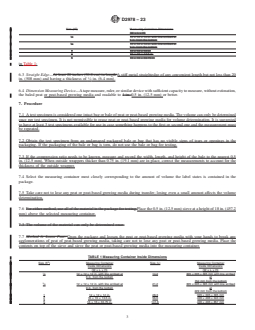
5.2 Peat and peat-based growing media are used by amateur 7.4 Select the measuring container most closely correspond-
ing to the amount of volume the label states is contained in the
gardeners and professional growers on a volume basis. Failure
to follow this standard procedure as written can lead to package.
inaccurate results.
7.5 Take care not to lose any peat or peat-based growing
NOTE 1—The quality of the result produced by this standard is
media during transfer; losing even a small amount affects the
dependent on the competence of the personnel performing it, and the
volume determination.
suitability of the equipment and facilities used. Agencies that meet the
criteria of Practice D3740 are generally considered capable of competent
7.6 Place the 0.5 in. (12.5 mm) sieve at a height of 18 in.
and objective testing/sampling/inspection/etc. Users of this standard are
(457.2 mm) above the selected measuring container.
cautioned that compliance with Practice D3740 does not in itself ensure
reliable results. Reliable results depend on many factors; Practice D3740 7.7 Open the package and loosen the peat or peat-based
provides a means of evaluating some of those factors.
growing media with your hands to break any agglomerations of
peat of peat-based growing media, taking care not to lose any
6. Apparatus
peat or peat-based growing media. Place the contents on top of
6.1 Sieve—A 0.5 in. (12.5 mm) sieve conforming to Speci- the sieve and sieve the peat or peat-based growing media into
fication E11. the measuring container.
6.2 Measuring Container—A steel or wood bound container 7.8 Add peat or peat-based growing media that is retained
on the sieve and cannot be loosened by hand to the measuring
with metal having one of the sets of inside dimensions in Table
1: container beneath the screen.
7.9 When the measuring container is filled to the top of the
6.3 Straight Edge—A stiff metal straightedge of any conve-
container, level off the measuring container using the
nient length but not less than 20 in. (508 mm) and having a
straightedge, at a 45 degree angle with the leading edge being
thickness of ⁄4 in. (6.4 mm).
the small
...
This document is not an ASTM standard and is intended only to provide the user of an ASTM standard an indication of what changes have been made to the previous version. Because
it may not be technically possible to adequately depict all changes accurately, ASTM recommends that users consult prior editions as appropriate. In all cases only the current version
of the standard as published by ASTM is to be considered the official document.
´1
Designation: D2978 − 15 D2978 − 23
Standard Test MethodsMethod for
Volume of Processed Peat MaterialsPeat and Peat-Based
Growing Media
This standard is issued under the fixed designation D2978; the number immediately following the designation indicates the year of
original adoption or, in the case of revision, the year of last revision. A number in parentheses indicates the year of last reapproval. A
superscript epsilon (´) indicates an editorial change since the last revision or reapproval.
ε NOTE—Editorially updated units of measurement statement in April 2018.
1. Scope*
1.1 These test methods coverThis test method covers the measurement of the volume of loose and baled processed peat expressed
as cubic feetuncompressed (loose) and compressed (baled) peat and peat-based growing media and is used as a quality control
measurement to determine if the package contains the labeled amount of material. The results of these test methods arethis test
method is highly dependent on the experience of the personnel running the procedure.
1.2 There are two test methods, Method A for Loose Peat and Method B for Baled Peat. Method A is used when the material is
uncompacted and Method B is used when the material is compacted.This standard is for peat and peat-based growing media only.
While it is possible for other types of growing media to use this standard it is outside the scope and the methodology may have
to be altered to accommodate a different growing media.
1.3 The values stated in inch-pound units are to be regarded as standard. The values given in parentheses after inch-pound units
are mathematical conversions to SI units that are provided for information only and are not considered standard. Except, that the
sieve designations are typically identified using the “alternative” system in accordance with Practice E11, such as 3-in. 3 in. and
No. 200, instead of the “standard” of 75-mm and 75-μm, 75 mm and 75 μm, respectively.
1.4 All observed and calculated values shall conform to the guidelines for significant digits and rounding established in Practice
D6026.
1.4.1 The procedures used to specify how data are collected/recorded or calculated in this standard are regarded as the industry
standard. In addition, they are representative of the significant digits that generally should be retained. The procedures used do not
consider material variation, purpose for obtaining the data, special purpose studies, or any considerations for the user’s objectives;
and it is common practice to increase or reduce significant digits of reported data to be commensurate with these considerations.
It is beyond the scope of this standard to consider significant digits used in analysis methods for engineering design.
1.5 This standard does not purport to address all of the safety concerns, if any, associated with its use. It is the responsibility
of the user of this standard to establish appropriate safety, health, and environmental practices and determine the applicability of
regulatory limitations prior to use.
1.6 This international standard was developed in accordance with internationally recognized principles on standardization
established in the Decision on Principles for the Development of International Standards, Guides and Recommendations issued
by the World Trade Organization Technical Barriers to Trade (TBT) Committee.
This test method is under the jurisdiction of ASTM Committee D18 on Soil and Rock and is the direct responsibility of Subcommittee D18.22 on Media for Plant Growth.
Current edition approved May 1, 2015July 1, 2023. Published June 2015July 2023. Originally approved in 1971. Last previous edition approved in 20102015 as
ɛ1
D2978 – 03D2978 – 15 (2010). DOI: 10.1520/D2978-15E01. DOI: 10.1520/D2978-23.
*A Summary of Changes section appears at the end of this standard
Copyright © ASTM International, 100 Barr Harbor Drive, PO Box C700, West Conshohocken, PA 19428-2959. United States
D2978 − 23
2. Referenced Documents
2.1 ASTM Standards:
D653 Terminology Relating to Soil, Rock, and Contained Fluids
D3740 Practice for Minimum Requirements for Agencies Engaged in Testing and/or Inspection of Soil and Rock as Used in
Engineering Design and Construction
D6026 Practice for Using Significant Digits and Data Records in Geotechnical Data
E11 Specification for Woven Wire Test Sieve Cloth and Test Sieves
3. Terminology
3.1 Definitions:
3.1.1 For definitions of common technical terms in this standard, refer to Terminology D653.
3.2 Definitions of Terms Specific to This Standard:
3.2.1 loose peat, n—uncompacted peat in air-dried, granulated or crumb form.
4. Summary of Test Method
4.1 These test methods consist of either measuring the outer dimensions of compacted peat (Method B) or This test method
consists of dividing the particles of uncompacted peat (Method A) peat or peat-based growing media by passing them through a
⁄2-in. (12.5-mm) sieve and0.5 in. (12.5 mm) sieve by allowing them to fall into a volume-measuring container.container and if
required, measuring the outer dimensions of uncompressed peat.
5. Significance and Use
5.1 These test methods areThis test method is used to quantify the volume of peats peat and peat-based growing media under
consideration in commercial transactions to determine if the package contains the labeled quantity. As such, material comes into
the test area in an “as sold” condition.
NOTE 1—The quality of the result produced by this standard is dependent on the competence of the personnel performing it, and the suitability of the
equipment and facilities used. Agencies that meet the criteria of Practice D3740 are generally considered capable of competent and objective
testing/sampling/inspection/etc. Users of this standard are cautioned that compliance with Practice D3740 does not in itself ensure reliable results.
Reliable results depend on many factors; Practice D3740 provides a means of evaluating some of those factors.
5.2 Peat and peat-based growing media are used by amateur gardeners and professional growers on a volume basis. Failure to
follow this standard procedure as written can lead to inaccurate results.
NOTE 1—The quality of the result produced by this standard is dependent on the competence of the personnel performing it, and the suitability of the
equipment and facilities used. Agencies that meet the criteria of Practice D3740 are generally considered capable of competent and objective
testing/sampling/inspection/etc. Users of this standard are cautioned that compliance with Practice D3740 does not in itself ensure reliable results.
Reliable results depend on many factors; Practice D3740 provides a means of evaluating some of those factors.
6. Apparatus
6.1 Sieve, Sieve— ⁄2-in. (12.5-mm), A 0.5 in. (12.5 mm) sieve conforming to Specification E11.
6.2 Measuring Container—A steel or wood bound container with metal having one of the following sets of inside
dimensions:dimensions
For referenced ASTM standards, visit the ASTM website, www.astm.org, or contact ASTM Customer Service at service@astm.org. For Annual Book of ASTM Standards
volume information, refer to the standard’s Document Summary page on the ASTM website.
D2978 − 23
Size (ft ) Measuring Container Dimensions
(W × L × H)
⁄2 12 × 12 × 12 in. with line scribed at
6 in. from the bottom
⁄4 12 × 12 × 12 in. with line scribed at
9 in. from the bottom
1 12 × 12 × 12 in.
2 16 × 16 × 13.5 in.
5 16 × 16 × 33.75 in.
in Table 1:
6.3 Straight Edge—At least 20 inches (50.8 cm) in length A stiff metal straightedge of any convenient length but not less than 20
in. (508 mm) and having a thickness of ⁄4 in. (6.4 mm).
6.4 Dimension Measuring Device—A tape measure, ruler, or similar device with sufficient capacity to measure, without estimation,
the baled peat or peat-based growing media and readable to 1 in. 0.5 in. (12.5 mm) or better.
7. Procedure
7.1 A test specimen is considered one intact bag or bale of peat or peat-based growing media. The volume can only be determined
once per test specimen. It is not permissible to reuse peat or peat-based growing media for volume determination. It is suggested
to have at least 3 test specimens available for use in case something happens to the first or second one and the measurement must
be repeated.
7.2 Obtain the test specimen from an undamaged packaged bale or bag that has no visible signs of tears or openings in the
packaging. If the packaging of the bale or bag is torn, do not use the bale or bag for testing.
7.3 If the compression ratio needs to be known, measure and record the width, length, and height of the bale to the nearest 0.5
in. (12.5 mm). When outside wrappers thicker than 0.75 in. (19.1 mm) are in place, correct the measurements to account for the
thickness of the outside wrapper.
7.4 Select the measuring container most closely corresponding to the amount of volume the label states is contained in the
p
...