

ASTM D2973-23
(Test Method)Standard Test Method for Total Nitrogen in Peat Materials
General Information
- Abstract
SIGNIFICANCE AND USE
5.1 Nitrogen content is important as it is one of the primary plant food elements necessary for plant growth. Nitrogen content of peat is necessary to make sure an adequate, but not excessive amount of fertility is supplied to the target plant. Nitrogen is present in peat as organic nitrogen, and therefore, does not release nitrogen to plants as quickly as chemical fertilizers. However, nitrogen from peat continues to be released for several years as the organic matter decomposes.
5.2 This information is particularly useful to people working in industries where plant health, sustainability, and viability are important.
Note 1: The quality of the result produced by this standard is dependent on the competence of the personnel performing it, and the suitability of the equipment and facilities used. Agencies that meet the criteria of Practice D3740 are generally considered capable of competent and objective testing/sampling/inspection/etc. Users of this standard are cautioned that compliance with Practice D3740 does not in itself ensure reliable results. Reliable results depend on many factors; Practice D3740 provides a means of evaluating some of those factors.
SCOPE
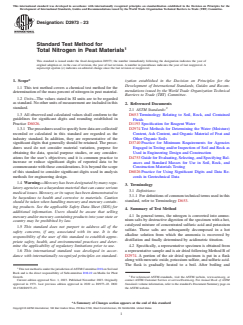
1.1 This test method covers a chemical test method for the determination of the mass percent of nitrogen in peat material.
1.2 Units—The values stated in SI units are to be regarded as standard. No other units of measurement are included in this standard.
1.3 All observed and calculated values shall conform to the guidelines for significant digits and rounding established in Practice D6026.
1.3.1 The procedures used to specify how data are collected/recorded or calculated in this standard are regarded as the industry standard. In addition, they are representative of the significant digits that generally should be retained. The procedures used do not consider material variation, purpose for obtaining the data, special purpose studies, or any considerations for the user’s objectives; and it is common practice to increase or reduce significant digits of reported data to be commensurate with these considerations. It is beyond the scope of this standard to consider significant digits used in analysis methods for engineering design.
1.4 Warning—Mercury has been designated by many regulatory agencies as a hazardous material that can cause serious medical issues. Mercury, or its vapor, has been demonstrated to be hazardous to health and corrosive to materials. Caution should be taken when handling mercury and mercury containing products. See the applicable Safety Data Sheet (SDS) for additional information. Users should be aware that selling mercury and/or mercury containing products into your state or country may be prohibited by law.
1.5 This standard does not purport to address all of the safety concerns, if any, associated with its use. It is the responsibility of the user of this standard to establish appropriate safety, health, and environmental practices and determine the applicability of regulatory limitations prior to use.
1.6 This international standard was developed in accordance with internationally recognized principles on standardization established in the Decision on Principles for the Development of International Standards, Guides and Recommendations issued by the World Trade Organization Technical Barriers to Trade (TBT) Committee.
- Status
- Published
- Publication Date
- 31-Oct-2023
- Technical Committee
- D18 - Soil and Rock
- Drafting Committee
- D18.22 - Media for Plant Growth

Overview
ASTM D2973-23: Standard Test Method for Total Nitrogen in Peat Materials establishes a chemical testing procedure to determine the mass percent of nitrogen in peat samples. Nitrogen is a vital nutrient for healthy plant growth, and peat is widely used in horticulture and agriculture as a growing medium. Knowing the nitrogen content in peat helps assess its long-term fertility and suitability for supporting sustainable plant health. This standard is published by ASTM International and is aligned with internationally recognized testing and reporting principles.
Key Topics
Nitrogen Determination in Peat
The standard outlines a comprehensive method for detecting organic nitrogen, which is an essential nutrient in plant growth substrates and decomposes to release nitrogen over multiple years.Importance of Plant Nutrition
Understanding total nitrogen content ensures that peat-based media provide adequate nutrients for optimal plant growth, avoiding both deficiency and excess.Analytical Process
The methodology involves converting nitrogen to ammonium salts via digestion, followed by distillation and titration to measure nitrogen content.Data Accuracy and Reporting
The procedure mandates adherence to significant digits and established rounding practices to ensure consistent and reliable data within the industry.Safety Measures
The use of hazardous chemicals such as mercury in testing requires proper safety protocols, including personal protective equipment and compliance with regulatory guidelines.
Applications
Horticulture and Nursery Management
Growers and suppliers use this standard to evaluate peat's suitability as a plant growth medium, contributing to efficient fertilizer planning.Soil and Environmental Testing Laboratories
Testing facilities apply this method as part of broader soil-health assessments, helping their clients meet quality and compliance requirements.Research and Academic Institutions
Researchers utilize the test results to study nutrient release rates, peat decomposition, and long-term impacts on agricultural productivity.Quality Assurance for Peat Producers
Peat manufacturers employ this standard to document product quality and support transparency for buyers, regulators, and certification schemes.
Related Standards
- ASTM D2974 - Test Methods for Water (Moisture) Content, Ash Content, and Organic Material of Peat and Other Organic Soils
- ASTM D653 - Terminology Relating to Soil, Rock, and Contained Fluids
- ASTM D1193 - Specification for Reagent Water
- ASTM D3740 - Practice for Minimum Requirements for Agencies Engaged in Testing and/or Inspection of Soil and Rock
- ASTM D4753 - Guide for Evaluating, Selecting, and Specifying Balances and Standard Masses
- ASTM D6026 - Practice for Using Significant Digits and Data Records in Geotechnical Data
Practical Value
- Ensures Sustainable Plant Growth: By accurately determining total nitrogen, users can deliver reliable growing conditions for both commercial and environmental applications.
- Supports Regulatory Compliance: Laboratories and producers meet international and local regulations for soil and organic media analysis.
- Enhances Product Consistency: Standardized testing helps maintain consistent quality across different producers and batches of peat.
- Facilitates Research and Innovation: Consistency in nitrogen measurement enables comparative research and development in the agriculture and horticulture sectors.
By adhering to ASTM D2973-23, stakeholders gain a precise, industry-accepted methodology for assessing total nitrogen in peat, supporting both plant productivity and environmental responsibility.
Relations
- Effective Date
- 01-Nov-2023
- Effective Date
- 01-Feb-2024
- Effective Date
- 01-Nov-2023
- Effective Date
- 01-Oct-2019
- Effective Date
- 01-May-2015
Get Certified
Connect with accredited certification bodies for this standard

Control Union Certifications
Global certification for agriculture and sustainability.

ECOCERT
Organic and sustainability certification.

FSC International
Forest Stewardship Council certification.
Sponsored listings
Frequently Asked Questions
ASTM D2973-23 is a standard published by ASTM International. Its full title is "Standard Test Method for Total Nitrogen in Peat Materials". This standard covers: SIGNIFICANCE AND USE 5.1 Nitrogen content is important as it is one of the primary plant food elements necessary for plant growth. Nitrogen content of peat is necessary to make sure an adequate, but not excessive amount of fertility is supplied to the target plant. Nitrogen is present in peat as organic nitrogen, and therefore, does not release nitrogen to plants as quickly as chemical fertilizers. However, nitrogen from peat continues to be released for several years as the organic matter decomposes. 5.2 This information is particularly useful to people working in industries where plant health, sustainability, and viability are important. Note 1: The quality of the result produced by this standard is dependent on the competence of the personnel performing it, and the suitability of the equipment and facilities used. Agencies that meet the criteria of Practice D3740 are generally considered capable of competent and objective testing/sampling/inspection/etc. Users of this standard are cautioned that compliance with Practice D3740 does not in itself ensure reliable results. Reliable results depend on many factors; Practice D3740 provides a means of evaluating some of those factors. SCOPE 1.1 This test method covers a chemical test method for the determination of the mass percent of nitrogen in peat material. 1.2 Units—The values stated in SI units are to be regarded as standard. No other units of measurement are included in this standard. 1.3 All observed and calculated values shall conform to the guidelines for significant digits and rounding established in Practice D6026. 1.3.1 The procedures used to specify how data are collected/recorded or calculated in this standard are regarded as the industry standard. In addition, they are representative of the significant digits that generally should be retained. The procedures used do not consider material variation, purpose for obtaining the data, special purpose studies, or any considerations for the user’s objectives; and it is common practice to increase or reduce significant digits of reported data to be commensurate with these considerations. It is beyond the scope of this standard to consider significant digits used in analysis methods for engineering design. 1.4 Warning—Mercury has been designated by many regulatory agencies as a hazardous material that can cause serious medical issues. Mercury, or its vapor, has been demonstrated to be hazardous to health and corrosive to materials. Caution should be taken when handling mercury and mercury containing products. See the applicable Safety Data Sheet (SDS) for additional information. Users should be aware that selling mercury and/or mercury containing products into your state or country may be prohibited by law. 1.5 This standard does not purport to address all of the safety concerns, if any, associated with its use. It is the responsibility of the user of this standard to establish appropriate safety, health, and environmental practices and determine the applicability of regulatory limitations prior to use. 1.6 This international standard was developed in accordance with internationally recognized principles on standardization established in the Decision on Principles for the Development of International Standards, Guides and Recommendations issued by the World Trade Organization Technical Barriers to Trade (TBT) Committee.
SIGNIFICANCE AND USE 5.1 Nitrogen content is important as it is one of the primary plant food elements necessary for plant growth. Nitrogen content of peat is necessary to make sure an adequate, but not excessive amount of fertility is supplied to the target plant. Nitrogen is present in peat as organic nitrogen, and therefore, does not release nitrogen to plants as quickly as chemical fertilizers. However, nitrogen from peat continues to be released for several years as the organic matter decomposes. 5.2 This information is particularly useful to people working in industries where plant health, sustainability, and viability are important. Note 1: The quality of the result produced by this standard is dependent on the competence of the personnel performing it, and the suitability of the equipment and facilities used. Agencies that meet the criteria of Practice D3740 are generally considered capable of competent and objective testing/sampling/inspection/etc. Users of this standard are cautioned that compliance with Practice D3740 does not in itself ensure reliable results. Reliable results depend on many factors; Practice D3740 provides a means of evaluating some of those factors. SCOPE 1.1 This test method covers a chemical test method for the determination of the mass percent of nitrogen in peat material. 1.2 Units—The values stated in SI units are to be regarded as standard. No other units of measurement are included in this standard. 1.3 All observed and calculated values shall conform to the guidelines for significant digits and rounding established in Practice D6026. 1.3.1 The procedures used to specify how data are collected/recorded or calculated in this standard are regarded as the industry standard. In addition, they are representative of the significant digits that generally should be retained. The procedures used do not consider material variation, purpose for obtaining the data, special purpose studies, or any considerations for the user’s objectives; and it is common practice to increase or reduce significant digits of reported data to be commensurate with these considerations. It is beyond the scope of this standard to consider significant digits used in analysis methods for engineering design. 1.4 Warning—Mercury has been designated by many regulatory agencies as a hazardous material that can cause serious medical issues. Mercury, or its vapor, has been demonstrated to be hazardous to health and corrosive to materials. Caution should be taken when handling mercury and mercury containing products. See the applicable Safety Data Sheet (SDS) for additional information. Users should be aware that selling mercury and/or mercury containing products into your state or country may be prohibited by law. 1.5 This standard does not purport to address all of the safety concerns, if any, associated with its use. It is the responsibility of the user of this standard to establish appropriate safety, health, and environmental practices and determine the applicability of regulatory limitations prior to use. 1.6 This international standard was developed in accordance with internationally recognized principles on standardization established in the Decision on Principles for the Development of International Standards, Guides and Recommendations issued by the World Trade Organization Technical Barriers to Trade (TBT) Committee.
ASTM D2973-23 is classified under the following ICS (International Classification for Standards) categories: 65.080 - Fertilizers. The ICS classification helps identify the subject area and facilitates finding related standards.
ASTM D2973-23 has the following relationships with other standards: It is inter standard links to ASTM D2973-22, ASTM D4753-24, ASTM D3740-23, ASTM D3740-19, ASTM D4753-15. Understanding these relationships helps ensure you are using the most current and applicable version of the standard.
ASTM D2973-23 is available in PDF format for immediate download after purchase. The document can be added to your cart and obtained through the secure checkout process. Digital delivery ensures instant access to the complete standard document.
Standards Content (Sample)
This international standard was developed in accordance with internationally recognized principles on standardization established in the Decision on Principles for the
Development of International Standards, Guides and Recommendations issued by the World Trade Organization Technical Barriers to Trade (TBT) Committee.
Designation: D2973 − 23
Standard Test Method for
Total Nitrogen in Peat Materials
This standard is issued under the fixed designation D2973; the number immediately following the designation indicates the year of
original adoption or, in the case of revision, the year of last revision. A number in parentheses indicates the year of last reapproval. A
superscript epsilon (´) indicates an editorial change since the last revision or reapproval.
1. Scope* ization established in the Decision on Principles for the
Development of International Standards, Guides and Recom-
1.1 This test method covers a chemical test method for the
mendations issued by the World Trade Organization Technical
determination of the mass percent of nitrogen in peat material.
Barriers to Trade (TBT) Committee.
1.2 Units—The values stated in SI units are to be regarded
as standard. No other units of measurement are included in this 2. Referenced Documents
standard. 2
2.1 ASTM Standards:
1.3 All observed and calculated values shall conform to the D653 Terminology Relating to Soil, Rock, and Contained
guidelines for significant digits and rounding established in
Fluids
Practice D6026. D1193 Specification for Reagent Water
1.3.1 The procedures used to specify how data are collected/ D2974 Test Methods for Determining the Water (Moisture)
recorded or calculated in this standard are regarded as the Content, Ash Content, and Organic Material of Peat and
industry standard. In addition, they are representative of the Other Organic Soils
significant digits that generally should be retained. The proce- D3740 Practice for Minimum Requirements for Agencies
dures used do not consider material variation, purpose for Engaged in Testing and/or Inspection of Soil and Rock as
obtaining the data, special purpose studies, or any consider- Used in Engineering Design and Construction
ations for the user’s objectives; and it is common practice to D4753 Guide for Evaluating, Selecting, and Specifying Bal-
increase or reduce significant digits of reported data to be ances and Standard Masses for Use in Soil, Rock, and
commensurate with these considerations. It is beyond the scope Construction Materials Testing
of this standard to consider significant digits used in analysis D6026 Practice for Using Significant Digits and Data Re-
methods for engineering design. cords in Geotechnical Data
1.4 Warning—Mercury has been designated by many regu-
3. Terminology
latory agencies as a hazardous material that can cause serious
3.1 Definitions:
medical issues. Mercury, or its vapor, has been demonstrated to
3.1.1 For definitions of common technical terms used in this
be hazardous to health and corrosive to materials. Caution
standard, refer to Terminology D653.
should be taken when handling mercury and mercury contain-
ing products. See the applicable Safety Data Sheet (SDS) for
4. Summary of Test Method
additional information. Users should be aware that selling
4.1 In general terms, the nitrogen is converted into ammo-
mercury and/or mercury containing products into your state or
nium salts by destructive digestion of the specimen with a hot,
country may be prohibited by law.
catalyzed mixture of concentrated sulfuric acid and potassium
1.5 This standard does not purport to address all of the
sulfate. These salts are subsequently decomposed in a hot
safety concerns, if any, associated with its use. It is the
alkaline solution from which the ammonia is recovered by
responsibility of the user of this standard to establish appro-
distillation and finally determined by acidimetric titration.
priate safety, health, and environmental practices and deter-
4.2 Specifically, a representative specimen is obtained from
mine the applicability of regulatory limitations prior to use.
a representative sample and is air dried following Method B of
1.6 This international standard was developed in accor-
D2974. A portion of the air dried specimen is put in a flask
dance with internationally recognized principles on standard-
along with mercuric oxide, potassium sulfate, and sulfuric acid.
The flask is gradually heated to a boil. After boiling and
This test method is under the jurisdiction of ASTM Committee D18 on Soil and
Rock and is the direct responsibility of Subcommittee D18.22 on Media for Plant
Growth. For referenced ASTM standards, visit the ASTM website, www.astm.org, or
Current edition approved Nov. 1, 2023. Published November 2023. Originally contact ASTM Customer Service at service@astm.org. For Annual Book of ASTM
approved in 1971. Last previous edition approved in 2022 as D2973–22. DOI: Standards volume information, refer to the standard’s Document Summary page on
10.1520/D2973-23. the ASTM website.
*A Summary of Changes section appears at the end of this standard
Copyright © ASTM International, 100 Barr Harbor Drive, PO Box C700, West Conshohocken, PA 19428-2959. United States
D2973 − 23
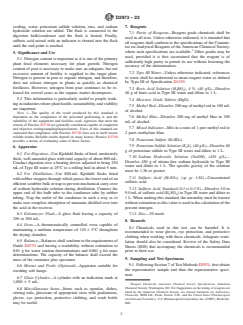
cooling, water, potassium sulfide solution, zinc, and sodium 7. Reagents
hydroxide solution are added. The flask is connected to the
7.1 Purity of Reagents—Reagent grade chemicals shall be
digestion bulk/condenser and the flask is heated. Finally,
used in all tests. Unless otherwise indicated, it is intended that
sulfuric acid mixed with an indicator is titrated into the flask
all reagents shall conform to the specifications of the Commit-
until the end point is reached.
tee on Analytical Reagents of the American Chemical Society,
where such specifications are available. Other grades may be
5. Significance and Use
used, provided it is first ascertained that the reagent is of
5.1 Nitrogen content is important as it is one of the primary
sufficiently high purity to permit its use without lessening the
plant food elements necessary for plant growth. Nitrogen
accuracy of the determination.
content of peat is necessary to make sure an adequate, but not
7.2 Type III Water—Unless otherwise indicated, references
excessive amount of fertility is supplied to the target plant.
to water shall be understood to mean reagent water as defined
Nitrogen is present in peat as organic nitrogen, and therefore,
by Type III of Specification D1193.
does not release nitrogen to plants as quickly as chemical
fertilizers. However, nitrogen from peat continues to be re-
7.3 Boric Acid Solution (H BO ), 4 %, (40 g/L)—Dissolve
3 3
leased for several years as the organic matter decomposes.
40 g of boric acid in Type III water and dilute to 1 L.
5.2 This information is particularly useful to people work-
7.4 Mercuric Oxide Tablets (HgO).
ing in industries where plant health, sustainability, and viability
7.5 Methyl Red—Dissolve 200 mg of methyl red in 100 mL
are important.
of alcohol.
NOTE 1—The quality of the result produced by this standard is
dependent on the competence of the personnel performing it, and the
7.6 Methyl Blue—Dissolve 200 mg of methyl blue in 100
suitability of the equipment and facilities used. Agencies that meet the
mL of alcohol.
criteria of Practice D3740 are generally considered capable of competent
7.7 Mixed Indicator—Mix in a ratio of 1 part methyl red to
and objective testing/sampling/inspection/etc. Users of this standard are
cautioned that compliance with Practice D3740 does not in itself ensure
2 parts methylene blue.
reliable results. Reliable results depend on many factors; Practice D3740
7.8 Potassium Sulfate (K SO ).
provides a means of evaluating some of those factors. 2 4
7.9 Potassium Sulfide Solution (K S), (40 g/L)—Dissolve 40
6. Apparatus
g of potassium sulfide in Type III water and dilute to 1 L.
6.1 For Digestion—Use Kjeldahl flasks of hard, moderately
7.10 Sodium Hydroxide Solution (NaOH), (450 g/L)—
thick, well-annealed glass with total capacity of about 800 mL.
Dissolve 450 g of nitrate-free sodium hydroxide in Type III
Conduct digestion over a heating device adjusted to bring 250
water and dilute to 1 L. The specific gravity of the solution
mL of Type III water at 25°C to a rolling boil in about 5 min.
must be 1.36 or greater.
6.2
...
This document is not an ASTM standard and is intended only to provide the user of an ASTM standard an indication of what changes have been made to the previous version. Because
it may not be technically possible to adequately depict all changes accurately, ASTM recommends that users consult prior editions as appropriate. In all cases only the current version
of the standard as published by ASTM is to be considered the official document.
Designation: D2973 − 22 D2973 − 23
Standard Test Method for
Total Nitrogen in Peat Materials
This standard is issued under the fixed designation D2973; the number immediately following the designation indicates the year of
original adoption or, in the case of revision, the year of last revision. A number in parentheses indicates the year of last reapproval. A
superscript epsilon (´) indicates an editorial change since the last revision or reapproval.
1. Scope*
1.1 This test method covers a chemical test method for the determination of the mass percent of nitrogen in peat material.
1.2 Units—The values stated in SI units are to be regarded as standard. No other units of measurement are included in this
standard.
1.3 All observed and calculated values shall conform to the guidelines for significant digits and rounding established in Practice
D6026.
1.3.1 The procedures used to specify how data are collected/recorded or calculated in this standard are regarded as the industry
standard. In addition, they are representative of the significant digits that generally should be retained. The procedures used do not
consider material variation, purpose for obtaining the data, special purpose studies, or any considerations for the user’s objectives;
and it is common practice to increase or reduce significant digits of reported data to be commensurate with these considerations.
It is beyond the scope of this standard to consider significant digits used in analysis methods for engineering design.
1.4 Warning—Mercury has been designated by many regulatory agencies as a hazardous material that can cause serious medical
issues. Mercury, or its vapor, has been demonstrated to be hazardous to health and corrosive to materials. Caution should be taken
when handling mercury and mercury containing products. See the applicable Safety Data Sheet (SDS) for additional information.
Users should be aware that selling mercury and/or mercury containing products into your state or country may be prohibited by
law.
1.5 This standard does not purport to address all of the safety concerns, if any, associated with its use. It is the responsibility
of the user of this standard to establish appropriate safety, health, and environmental practices and determine the applicability of
regulatory limitations prior to use.
1.6 This international standard was developed in accordance with internationally recognized principles on standardization
established in the Decision on Principles for the Development of International Standards, Guides and Recommendations issued
by the World Trade Organization Technical Barriers to Trade (TBT) Committee.
2. Referenced Documents
2.1 ASTM Standards:
D653 Terminology Relating to Soil, Rock, and Contained Fluids
D1193 Specification for Reagent Water
This test method is under the jurisdiction of ASTM Committee D18 on Soil and Rock and is the direct responsibility of Subcommittee D18.22 on Media for Plant Growth.
Current edition approved June 15, 2022Nov. 1, 2023. Published June 2022November 2023. Originally approved in 1971. Last previous edition approved in 20162022 as
D2973–16. DOI: 10.1520/D2973-22.–22. DOI: 10.1520/D2973-23.
For referenced ASTM standards, visit the ASTM website, www.astm.org, or contact ASTM Customer Service at service@astm.org. For Annual Book of ASTM Standards
volume information, refer to the standard’s Document Summary page on the ASTM website.
*A Summary of Changes section appears at the end of this standard
Copyright © ASTM International, 100 Barr Harbor Drive, PO Box C700, West Conshohocken, PA 19428-2959. United States
D2973 − 23
D2974 Test Methods for Determining the Water (Moisture) Content, Ash Content, and Organic Material of Peat and Other
Organic Soils
D3740 Practice for Minimum Requirements for Agencies Engaged in Testing and/or Inspection of Soil and Rock as Used in
Engineering Design and Construction
D4753 Guide for Evaluating, Selecting, and Specifying Balances and Standard Masses for Use in Soil, Rock, and Construction
Materials Testing
D6026 Practice for Using Significant Digits and Data Records in Geotechnical Data
3. Terminology
3.1 Definitions:
3.1.1 For definitions of common technical terms used in this standard, refer to Terminology D653.
4. Summary of Test Method
4.1 In general terms, the nitrogen is converted into ammonium salts by destructive digestion of the specimen with a hot, catalyzed
mixture of concentrated sulfuric acid and potassium sulfate. These salts are subsequently decomposed in a hot alkaline solution
from which the ammonia is recovered by distillation and finally determined by acidimetric titration.
4.2 Specifically, a representative specimen is obtained from a representative sample and is air dried following Method B of D2974.
A portion of the air dried specimen is put in a flask along with mercuric oxide, potassium sulfate, and sulfuric acid. The flask is
gradually heated to a boil. After boiling and cooling, water, potassium sulfide solution, zinc, and sodium hydroxide solution are
added. The flask is connected to the digestion bulk/condenser and the flask is heated. Finally, sulfuric acid mixed with an indicator
is titrated into the flask until the end point is reached.
5. Significance and Use
5.1 Nitrogen content is important as it is one of the primary plant food elements necessary for plant growth. Nitrogen content of
peat is necessary to make sure an adequate, but not excessive amount of fertility is supplied to the target plant. Nitrogen is present
in peat as organic nitrogen, and therefore, does not release nitrogen to plants as quickly as chemical fertilizers. However, nitrogen
from peat continues to be released for several years as the organic matter decomposes.
5.2 This information is particularly useful to people working in industries where plant health, sustainability, and viability are
important.
NOTE 1—The quality of the result produced by this standard is dependent on the competence of the personnel performing it, and the suitability of the
equipment and facilities used. Agencies that meet the criteria of Practice D3740 are generally considered capable of competent and objective
testing/sampling/inspection/etc. Users of this standard are cautioned that compliance with Practice D3740 does not in itself ensure reliable results.
Reliable results depend on many factors; Practice D3740 provides a means of evaluating some of those factors.
6. Apparatus
6.1 For Digestion—Use Kjeldahl flasks of hard, moderately thick, well-annealed glass with total capacity of about 800 mL.
Conduct digestion over a heating device adjusted to bring 250 mL of Type III water at 25°C to a rolling boil in about 5 min.
6.2 For Distillation—Use 800-mL Kjeldahl flasks fitted with rubber stoppers through which passes the lower end of an efficient
scrubber bulk or trap to prevent mechanical carry-over of sodium hydroxide solution during distillation. Connect the upper end
of the bulb tube to the condenser tube by rubber tubing. Trap the outlet of the condenser in such a way as to make sure complete
absorption of ammonia distilled over into the acid in the receiver.
6.3 Erlenmeyer Flask—A glass flask having a capacity of 250 or 300 mL.
6.4 Oven—A thermostatically controlled oven capable of maintaining a uniform temperature of 110 6 5°C throughout the drying
chamber.
D2973 − 23
6.5 Balance—Balances shall conform to the requirements of Guide D4753 and having a readability without estimation to 0.01 g
for water content determinations and 0.001 g for mass determinations. The capacity of the balance shall exceed the mass of the
container plus specimen.
6.6 Mortar and Pestle (Optional)—Apparatus suitable for crushing soft lumps.
6.7 Glass Cylinder—A cylinder with an indication mark at 1,000 6 5 mL.
6.8 Miscellaneous Items—Items such as spatulas, dishes, stirring rods, glassware of appropriate sizes with graduations, gloves, eye
protection, protective clothing, and wash bottle may be usef
...