

ASTM C602-23
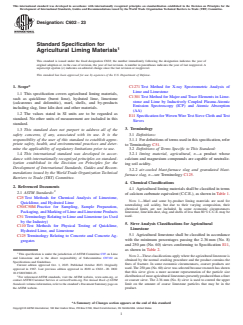
(Specification)Standard Specification for Agricultural Liming Materials
General Information
- Abstract
ABSTRACT
This specification covers agricultural liming materials, such as quicklime (burnt lime), hydrated lime, limestone, (calcitic and dolomitic), marl, shells, and by-products including slag, and other materials. Agricultural liming materials shall be classified in terms of calcium carbonate equivalent. Hydrated lime, quicklime, and agricultural slag shall be classified depending on the particle size. In sieve analysis of agricultural liming materials, the amount of liming material passing the sieves to the nearest whole percentage of the total weight of the dry sample shall be calculated. Air-cooled blast-furnace slag shall be classified the same as agricultural limestone. The following results for agricultural liming materials shall be reported: percentage calcium carbonate equivalent, percentage moisture, percentage calcium and magnesium, and sieve analysis.
SCOPE
1.1 This specification covers agricultural liming materials, such as quicklime (burnt lime), hydrated lime, limestone (calcareous and dolomitic), marl, shells, and by-products including slag, lime kiln dust and other materials.
1.2 The values stated in SI units are to be regarded as standard. No other units of measurement are included in this standard.
1.3 This standard does not purport to address all of the safety concerns, if any, associated with its use. It is the responsibility of the user of this standard to establish appropriate safety, health, and environmental practices and determine the applicability of regulatory limitations prior to use.
1.4 This international standard was developed in accordance with internationally recognized principles on standardization established in the Decision on Principles for the Development of International Standards, Guides and Recommendations issued by the World Trade Organization Technical Barriers to Trade (TBT) Committee.
- Status
- Published
- Publication Date
- 30-Sep-2023
- Technical Committee
- C07 - Lime and Limestone
- Drafting Committee
- C07.02 - Specifications and Guidelines


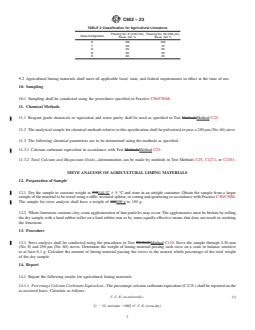

Overview
ASTM C602-23: Standard Specification for Agricultural Liming Materials establishes requirements for materials used to neutralize soil acidity, supporting optimal soil health and agricultural productivity. Developed by ASTM International, this specification covers agricultural liming products including quicklime (burnt lime), hydrated lime, limestone (calcareous and dolomitic), marl, shells, agricultural slag, lime kiln dust, and similar by-products. The standard assists manufacturers, suppliers, regulatory bodies, and end-users in ensuring that liming materials meet essential quality and classification criteria, promoting consistent and effective results in soil management applications.
Key Topics
- Materials Covered: Includes quicklime, hydrated lime, limestone (calcitic and dolomitic), marl, shells, slag, lime kiln dust, and other calcium or magnesium-based by-products.
- Classification:
- All materials are classified by calcium carbonate equivalent (CCE), a key measure of their ability to neutralize soil acidity.
- Hydrated lime, quicklime, and agricultural slag are also classified based on defined particle size distribution.
- Chemical and Physical Requirements:
- Sets minimum values for CCE for different liming materials.
- Specifies requirements for moisture content and the levels of calcium and magnesium.
- Details sieve analysis procedures to ensure appropriate particle sizes for effective soil amendment.
- Sampling and Testing:
- Cites standardized sampling, sample preparation, and testing practices, such as ASTM C25, C50/C50M, C110, and C125 to ensure accurate and reproducible results.
- Reporting:
- Requires reporting on CCE, moisture content, calcium and magnesium content, and particle size distribution.
Applications
- Agricultural Liming: The standard supports the selection and quality assurance of liming materials intended for agricultural fields, pastures, and other soil-based applications. Correct use of liming products improves soil pH, nutrient availability, and overall crop and pasture productivity.
- Soil Amendment Selection: Buyers, agronomists, and regulatory bodies use this standard to evaluate the suitability of various liming products and by-products, such as agricultural limestone, quicklime, or slag, for specific soil or regulatory needs.
- Compliance and Supply Chain: Producers and suppliers reference ASTM C602-23 to demonstrate product compliance, facilitate trade, and meet local, state, and federal regulatory requirements.
- Environmental Management: By prescribing detailed testing and reporting protocols, the standard encourages responsible use of materials and contributes to sustainable soil management practices.
Related Standards
For comprehensive compliance and testing, ASTM C602-23 should be used alongside related standards, including:
- ASTM C25: Test Methods for Chemical Analysis of Limestone, Quicklime, and Hydrated Lime
- ASTM C50/C50M: Practice for Sampling, Sample Preparation, Packaging, and Marking of Lime and Limestone Products
- ASTM C51: Terminology Relating to Lime and Limestone (as Used by the Industry)
- ASTM C110: Test Methods for Physical Testing of Quicklime, Hydrated Lime, and Limestone
- ASTM C125: Terminology Relating to Concrete and Concrete Aggregates
- ASTM C1271: Test Method for X-ray Spectrometric Analysis of Lime and Limestone
- ASTM C1301: Test Method for Major and Trace Elements in Limestone and Lime by ICP and AA
- ASTM E11: Specification for Woven Wire Test Sieve Cloth and Test Sieves
These standards collectively support the accurate classification, analysis, and application of agricultural liming materials, enabling consistent product quality and effective agronomic practice.
Keywords: agricultural liming materials, ASTM C602-23, aglime, limestone, hydrated lime, quicklime, lime kiln dust, calcium carbonate equivalent, agricultural slag, soil amendment, soil pH, soil management, standard specification, particle size, moisture content, chemical analysis.
Relations
- Effective Date
- 01-Oct-2023
- Effective Date
- 01-Oct-2023
- Effective Date
- 15-Jun-2021
- Refers
ASTM C25-19 - Standard Test Methods for Chemical Analysis of Limestone, Quicklime, and Hydrated Lime - Effective Date
- 01-May-2019
- Effective Date
- 01-May-2019
- Effective Date
- 01-Oct-2023
- Effective Date
- 01-Oct-2023
- Effective Date
- 01-Oct-2023
Get Certified
Connect with accredited certification bodies for this standard

Control Union Certifications
Global certification for agriculture and sustainability.

ECOCERT
Organic and sustainability certification.

FSC International
Forest Stewardship Council certification.
Sponsored listings
Frequently Asked Questions
ASTM C602-23 is a technical specification published by ASTM International. Its full title is "Standard Specification for Agricultural Liming Materials". This standard covers: ABSTRACT This specification covers agricultural liming materials, such as quicklime (burnt lime), hydrated lime, limestone, (calcitic and dolomitic), marl, shells, and by-products including slag, and other materials. Agricultural liming materials shall be classified in terms of calcium carbonate equivalent. Hydrated lime, quicklime, and agricultural slag shall be classified depending on the particle size. In sieve analysis of agricultural liming materials, the amount of liming material passing the sieves to the nearest whole percentage of the total weight of the dry sample shall be calculated. Air-cooled blast-furnace slag shall be classified the same as agricultural limestone. The following results for agricultural liming materials shall be reported: percentage calcium carbonate equivalent, percentage moisture, percentage calcium and magnesium, and sieve analysis. SCOPE 1.1 This specification covers agricultural liming materials, such as quicklime (burnt lime), hydrated lime, limestone (calcareous and dolomitic), marl, shells, and by-products including slag, lime kiln dust and other materials. 1.2 The values stated in SI units are to be regarded as standard. No other units of measurement are included in this standard. 1.3 This standard does not purport to address all of the safety concerns, if any, associated with its use. It is the responsibility of the user of this standard to establish appropriate safety, health, and environmental practices and determine the applicability of regulatory limitations prior to use. 1.4 This international standard was developed in accordance with internationally recognized principles on standardization established in the Decision on Principles for the Development of International Standards, Guides and Recommendations issued by the World Trade Organization Technical Barriers to Trade (TBT) Committee.
ABSTRACT This specification covers agricultural liming materials, such as quicklime (burnt lime), hydrated lime, limestone, (calcitic and dolomitic), marl, shells, and by-products including slag, and other materials. Agricultural liming materials shall be classified in terms of calcium carbonate equivalent. Hydrated lime, quicklime, and agricultural slag shall be classified depending on the particle size. In sieve analysis of agricultural liming materials, the amount of liming material passing the sieves to the nearest whole percentage of the total weight of the dry sample shall be calculated. Air-cooled blast-furnace slag shall be classified the same as agricultural limestone. The following results for agricultural liming materials shall be reported: percentage calcium carbonate equivalent, percentage moisture, percentage calcium and magnesium, and sieve analysis. SCOPE 1.1 This specification covers agricultural liming materials, such as quicklime (burnt lime), hydrated lime, limestone (calcareous and dolomitic), marl, shells, and by-products including slag, lime kiln dust and other materials. 1.2 The values stated in SI units are to be regarded as standard. No other units of measurement are included in this standard. 1.3 This standard does not purport to address all of the safety concerns, if any, associated with its use. It is the responsibility of the user of this standard to establish appropriate safety, health, and environmental practices and determine the applicability of regulatory limitations prior to use. 1.4 This international standard was developed in accordance with internationally recognized principles on standardization established in the Decision on Principles for the Development of International Standards, Guides and Recommendations issued by the World Trade Organization Technical Barriers to Trade (TBT) Committee.
ASTM C602-23 is classified under the following ICS (International Classification for Standards) categories: 65.080 - Fertilizers. The ICS classification helps identify the subject area and facilitates finding related standards.
ASTM C602-23 has the following relationships with other standards: It is inter standard links to ASTM C602-20, ASTM C51-23, ASTM C51-21, ASTM C25-19, ASTM C25-19e1, ASTM D5050-08(2023), ASTM D5759-12(2020), ASTM C911-19. Understanding these relationships helps ensure you are using the most current and applicable version of the standard.
ASTM C602-23 is available in PDF format for immediate download after purchase. The document can be added to your cart and obtained through the secure checkout process. Digital delivery ensures instant access to the complete standard document.
Standards Content (Sample)
This international standard was developed in accordance with internationally recognized principles on standardization established in the Decision on Principles for the
Development of International Standards, Guides and Recommendations issued by the World Trade Organization Technical Barriers to Trade (TBT) Committee.
Designation: C602 − 23
Standard Specification for
Agricultural Liming Materials
This standard is issued under the fixed designation C602; the number immediately following the designation indicates the year of
original adoption or, in the case of revision, the year of last revision. A number in parentheses indicates the year of last reapproval. A
superscript epsilon (´) indicates an editorial change since the last revision or reapproval.
This standard has been approved for use by agencies of the U.S. Department of Defense.
1. Scope* C1271 Test Method for X-ray Spectrometric Analysis of
Lime and Limestone
1.1 This specification covers agricultural liming materials,
C1301 Test Method for Major and Trace Elements in Lime-
such as quicklime (burnt lime), hydrated lime, limestone
stone and Lime by Inductively Coupled Plasma-Atomic
(calcareous and dolomitic), marl, shells, and by-products
Emission Spectroscopy (ICP) and Atomic Absorption
including slag, lime kiln dust and other materials.
(AA)
1.2 The values stated in SI units are to be regarded as
E11 Specification for Woven Wire Test Sieve Cloth and Test
standard. No other units of measurement are included in this
Sieves
standard.
3. Terminology
1.3 This standard does not purport to address all of the
safety concerns, if any, associated with its use. It is the
3.1 Definitions:
responsibility of the user of this standard to establish appro-
3.1.1 For definitions of terms used in this specification, refer
priate safety, health, and environmental practices and deter-
to Terminology C51.
mine the applicability of regulatory limitations prior to use. 3.2 Definitions of Terms Specific to This Standard:
1.4 This international standard was developed in accor-
3.2.1 liming material, agricultural, n—a product whose
dance with internationally recognized principles on standard- calcium and magnesium compounds are capable of neutraliz-
ization established in the Decision on Principles for the
ing soil acidity.
Development of International Standards, Guides and Recom-
3.2.2 air-cooled blast-furnace slag and granulated blast-
mendations issued by the World Trade Organization Technical
furnace slag, n—see Terminology C125.
Barriers to Trade (TBT) Committee.
4. Chemical Classifications
2. Referenced Documents
4.1 Agricultural liming materials shall be classified in terms
2.1 ASTM Standards:
of calcium carbonate equivalent (C.C.E.), as shown in Table 1.
C25 Test Methods for Chemical Analysis of Limestone,
NOTE 1—Marl and some by-product liming materials are used for
Quicklime, and Hydrated Lime
neutralizing soil acidity, but due to their varying composition, their
C50/C50M Practice for Sampling, Sample Preparation,
chemical limits are not included. In some economic circumstances
Packaging, and Marking of Lime and Limestone Products
limestone, lime kiln dust, slag, and shells of less than 80 % C.C.E. may be
used.
C51 Terminology Relating to Lime and Limestone (as Used
by the Industry)
5. Sieve Analysis Classifications for Agricultural
C110 Test Methods for Physical Testing of Quicklime,
Limestone
Hydrated Lime, and Limestone
5.1 Agricultural limestone shall be classified in accordance
C125 Terminology Relating to Concrete and Concrete Ag-
with the minimum percentages passing the 2.36 mm (No. 8)
gregates
and 250 μm (No. 60) sieves conforming to Specification E11,
as shown in Table 2.
This specification is under the jurisdiction of ASTM Committee C07 on Lime
NOTE 2—These classifications apply where the agricultural limestone is
and Limestone and is the direct responsibility of Subcommittee C07.02 on
obtained by the normal crushing procedure and the product contains the
Specifications and Guidelines.
fines of fracture. In some economic circumstances, coarser products are
Current edition approved Oct. 1, 2023. Published October 2023. Originally
used. The 250 μm (No. 60) sieve was selected because research has shown
approved in 1967. Last previous edition approved in 2020 as C602 – 20. DOI:
that this sieve gives a more accurate representation of the particle size
10.1520/C0602-23.
distribution of most agricultural limestones presently produced than a finer
For referenced ASTM standards, visit the ASTM website, www.astm.org, or
or coarser sieve. The 2.36 mm (No. 8) sieve is used to control the upper
contact ASTM Customer Service at service@astm.org. For Annual Book of ASTM
Standards volume information, refer to the standard’s Document Summary page on limit on the amount of coarse limestone particles that may be in the
the ASTM website. product.
*A Summary of Changes section appears at the end of this standard
Copyright © ASTM International, 100 Barr Harbor Drive, PO Box C700, West Conshohocken, PA 19428-2959. United States
C602 − 23
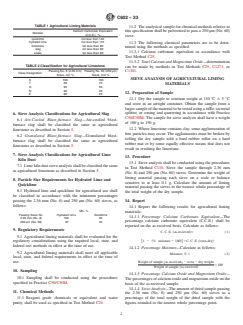
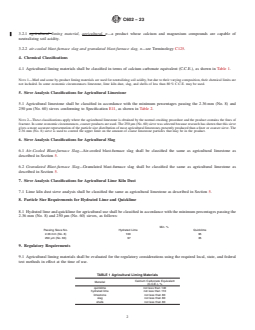
TABLE 1 Agricultural Liming Materials
11.2 The analytical sample for chemical methods relative to
Calcium Carbonate Equivalent this specification shall be pulverized to pass a 250 μm (No. 60)
Material
(C.C.E.), %
sieve.
quicklime not less than 140
hydrated lime not less than 110
11.3 The following chemical parameters are to be deter-
limestone not less than 80
mined using the methods as specified.
slag not less than 80
11.3.1 Calcium carbonate equivalent in accordance with
shells not less than 80
Test Method C25.
11.3.2 Total Calcium and Magnesium Oxide—determinat
...
This document is not an ASTM standard and is intended only to provide the user of an ASTM standard an indication of what changes have been made to the previous version. Because
it may not be technically possible to adequately depict all changes accurately, ASTM recommends that users consult prior editions as appropriate. In all cases only the current version
of the standard as published by ASTM is to be considered the official document.
Designation: C602 − 20 C602 − 23
Standard Specification for
Agricultural Liming Materials
This standard is issued under the fixed designation C602; the number immediately following the designation indicates the year of
original adoption or, in the case of revision, the year of last revision. A number in parentheses indicates the year of last reapproval. A
superscript epsilon (´) indicates an editorial change since the last revision or reapproval.
This standard has been approved for use by agencies of the U.S. Department of Defense.
1. Scope*
1.1 This specification covers agricultural liming materials, such as quicklime (burnt lime), hydrated lime, limestone, (calciti-
climestone (calcareous and dolomitic), marl, shells, and by-products including slag, lime kiln dust and other materials.
1.2 The values stated in SI units are to be regarded as standard. No other units of measurement are included in this standard.
1.3 This standard does not purport to address all of the safety concerns, if any, associated with its use. It is the responsibility
of the user of this standard to establish appropriate safety, health, and environmental practices and determine the applicability of
regulatory limitations prior to use.
1.4 This international standard was developed in accordance with internationally recognized principles on standardization
established in the Decision on Principles for the Development of International Standards, Guides and Recommendations issued
by the World Trade Organization Technical Barriers to Trade (TBT) Committee.
2. Referenced Documents
2.1 ASTM Standards:
C25 Test Methods for Chemical Analysis of Limestone, Quicklime, and Hydrated Lime
C50/C50M Practice for Sampling, Sample Preparation, Packaging, and Marking of Lime and Limestone Products
C51 Terminology Relating to Lime and Limestone (as Used by the Industry)
C110 Test Methods for Physical Testing of Quicklime, Hydrated Lime, and Limestone
C125 Terminology Relating to Concrete and Concrete Aggregates
C1271 Test Method for X-ray Spectrometric Analysis of Lime and Limestone
C1301 Test Method for Major and Trace Elements in Limestone and Lime by Inductively Coupled Plasma-Atomic Emission
Spectroscopy (ICP) and Atomic Absorption (AA)
E11 Specification for Woven Wire Test Sieve Cloth and Test Sieves
3. Terminology
3.1 Definitions:
3.1.1 For definitions of terms used in this specification, refer to Terminology C51.
3.2 Definitions of Terms Specific to This Standard:
This specification is under the jurisdiction of ASTM Committee C07 on Lime and Limestone and is the direct responsibility of Subcommittee C07.02 on Specifications
and Guidelines.
Current edition approved May 1, 2020Oct. 1, 2023. Published June 2020October 2023. Originally approved in 1967. Last previous edition approved in 20192020 as
C602 – 19.C602 – 20. DOI: 10.1520/C0602-20.10.1520/C0602-23.
For referenced ASTM standards, visit the ASTM website, www.astm.org, or contact ASTM Customer Service at service@astm.org. For Annual Book of ASTM Standards
volume information, refer to the standard’s Document Summary page on the ASTM website.
*A Summary of Changes section appears at the end of this standard
Copyright © ASTM International, 100 Barr Harbor Drive, PO Box C700, West Conshohocken, PA 19428-2959. United States
C602 − 23
3.2.1 agricultural liming material, agricultural, n—a product whose calcium and magnesium compounds are capable of
neutralizing soil acidity.
3.2.2 air-cooled blast-furnace slag and granulated blast-furnace slag, n—see Terminology C125.
4. Chemical Classifications
4.1 Agricultural liming materials shall be classified in terms of calcium carbonate equivalent (C.C.E.), as shown in Table 1.
NOTE 1—Marl and some by-product liming materials are used for neutralizing soil acidity, but due to their varying composition, their chemical limits are
not included. In some economic circumstances limestone, lime kiln dust, slag, and shells of less than 80 % C.C.E. may be used.
5. Sieve Analysis Classifications for Agricultural Limestone
5.1 Agricultural limestone shall be classified in accordance with the minimum percentages passing the 2.36 mm (No. 8) and
250 μm (No. 60) sieves conforming to Specification E11, as shown in Table 2.
NOTE 2—These classifications apply where the agricultural limestone is obtained by the normal crushing procedure and the product contains the fines of
fracture. In some economic circumstances, coarser products are used. The 250 μm (No. 60) sieve was selected because research has shown that this sieve
gives a more accurate representation of the particle size distribution of most agricultural limestones presently produced than a finer or coarser sieve. The
2.36 mm (No. 8) sieve is used to control the upper limit on the amount of coarse limestone particles that may be in the product.
6. Sieve Analysis Classifications for Agricultural Slag
6.1 Air-Cooled Blast-furnace Slag—Air-cooled blast-furnace slag shall be classified the same as agricultural limestone as
described in Section 5.
6.2 Granulated Blast-furnace Slag—Granulated blast-furnace slag shall be classified the same as agricultural limestone as
described in Section 5.
7. Sieve Analysis Classifications for Agricultural Lime Kiln Dust
7.1 Lime kiln dust sieve analysis shall be classified the same as agricultural limestone as described in Section 5.
8. Particle Size Requirements for Hydrated Lime and Quicklime
8.1 Hydrated lime and quicklime for agricultural use shall be classified in accordance with the minimum percentages passing the
2.36 mm (No. 8) and 250 μm (No. 60) sieves, as follows:
Min. %
Passing Sieve No. Hydrated Lime Quicklime
2.36 mm (No. 8
...