

ASTM B972-10(2020)e1
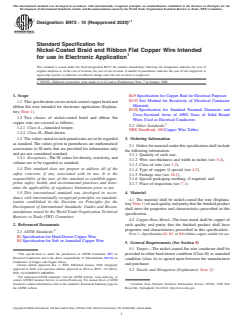
(Specification)Standard Specification for Nickel-Coated Braid and Ribbon Flat Copper Wire Intended for use in Electronic Application
General Information
- Abstract
ABSTRACT
This specification covers nickel-coated copper braid and ribbon flat wire intended for electronic application. Two classes of nickel-coated braid and ribbon flat copper wire are covered: Class A (annealed temper) and Class H (hard-drawn). The material shall be nickel-coated flat wire of such quality and purity that the finished product shall meet the properties and characteristics prescribed in this specification. The specification covers tensile properties, electrical resistivity requirements, permissible variations in thickness, and permissible variations in width.
SCOPE
1.1 This specification covers nickel-coated copper braid and ribbon flat wire intended for electronic application (Explanatory Note 1).
1.2 Two classes of nickel-coated braid and ribbon flat copper wire are covered as follows:
1.2.1 Class A—Annealed temper.
1.2.2 Class H—Hard-drawn.
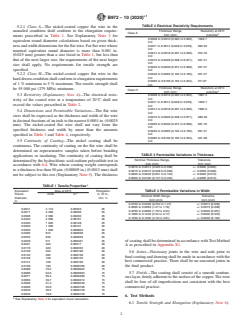
1.3 The values stated in inch-pound units are to be regarded as standard. The values given in parentheses are mathematical conversions to SI units that are provided for information only and are not considered standard.
1.3.1 Exceptions—The SI values for density, resistivity, and volume are to be regarded as standard.
1.4 This standard does not purport to address all of the safety concerns, if any, associated with its use. It is the responsibility of the user of this standard to establish appropriate safety, health, and environmental practices and determine the applicability of regulatory limitations prior to use.
1.5 This international standard was developed in accordance with internationally recognized principles on standardization established in the Decision on Principles for the Development of International Standards, Guides and Recommendations issued by the World Trade Organization Technical Barriers to Trade (TBT) Committee.
- Status
- Published
- Publication Date
- 31-Dec-2019
- Technical Committee
- B01 - Electrical Conductors
- Drafting Committee
- B01.04 - Conductors of Copper and Copper Alloys
Overview
ASTM B972-10(2020)e1 is the internationally recognized standard specification for nickel-coated braid and ribbon flat copper wire intended for use in electronic applications. Developed by ASTM International, this standard covers nickel-coated copper conductors supplied as either braid or ribbon flat wire, with the primary purpose of ensuring consistent quality and performance in electronic equipment manufacturing. The standard outlines material requirements, mechanical and electrical properties, testing methods, permissible dimensional variations, and inspection protocols for these specialized electrical conductors.
Key Topics
Material Classes:
ASTM B972 describes two main classes:- Class A: Annealed temper nickel-coated flat copper wire
- Class H: Hard-drawn nickel-coated flat copper wire
Material Requirements:
- Wire must be made of copper with a uniform nickel coating, meeting strict criteria for purity and surface finish.
- Copper base metal quality must conform to defined specifications.
Mechanical and Electrical Properties:
- Elongation and tensile strength requirements differ by class to meet diverse application needs.
- Electrical resistivity limits at 20°C assure performance in precision electronic circuitry.
Dimensional Tolerances:
- Limits are set for thickness and width variations to guarantee consistency across batches.
- Specific measurement protocols for dimensional inspections.
Nickel Coating Integrity:
- Requirements for continuous, adherent nickel coating.
- Mandatory testing for coating continuity and minimum thickness to prevent exposed copper.
Testing and Inspection:
- Standardized methods for tensile strength, elongation, resistivity, and coating evaluation.
- Defined sampling and inspection practices for conformance determination.
Packaging and Shipping:
- Requirements for agreed packaging sizes and protection of products against handling and transportation damage.
Applications
Nickel-coated braid and ribbon flat copper wire, as defined by ASTM B972, is specifically designed for electronic applications where environmental durability, conductivity, and reliable performance are crucial. Key uses include:
Electronic circuits and equipment:
Utilized as conductors in high-reliability and high-performance systems where resistance to oxidation, stable electrical properties, and high-temperature capability are required.Electrical connectors and cable assemblies:
Nickel coating serves as a barrier, protecting copper conductors from adverse effects during insulation curing processes that exceed tin’s temperature tolerance.Shielding and grounding:
Flat copper wire in braid or ribbon form is commonly applied in EMI/RFI shielding for cables and enclosures, thanks to the combination of conductivity and surface protection.Precision and custom electronic components:
Suitable for use in custom-designed electronics where tight dimensional tolerances and consistent coating are critical.
Adoption of ASTM B972 ensures product quality, addressing the needs of manufacturers and designers in aerospace, telecommunications, instrumentation, and other technology-driven sectors.
Related Standards
For those working with nickel-coated and copper conductors, the following related standards provide important supplementary information:
- ASTM B1: Specification for Hard-Drawn Copper Wire
- ASTM B3: Specification for Soft or Annealed Copper Wire
- ASTM B49: Specification for Copper Rod for Electrical Purposes
- ASTM B193: Test Method for Resistivity of Electrical Conductor Materials
- ASTM B258: Standard Nominal Diameters and Cross-Sectional Areas of AWG Sizes
- NBS Handbook 100: Copper Wire Tables
By aligning with ASTM B972 and associated standards, manufacturers and users ensure compliance with internationally recognized quality and performance benchmarks for nickel-coated flat copper conductors. This supports consistent reliability in sensitive electronic applications and helps facilitate global trade in electronic components.
Relations
- Effective Date
- 01-Jan-2020
- Effective Date
- 01-Apr-2024
- Effective Date
- 15-Apr-2020
- Effective Date
- 01-Oct-2018
- Effective Date
- 01-Oct-2018
- Effective Date
- 01-Oct-2018
- Effective Date
- 01-Apr-2017
- Effective Date
- 01-Apr-2016
- Effective Date
- 01-Apr-2016
- Effective Date
- 15-Sep-2015
- Effective Date
- 01-May-2015
- Effective Date
- 01-Apr-2014
- Effective Date
- 01-Oct-2013
- Effective Date
- 01-Oct-2013
- Effective Date
- 15-Nov-2012
Get Certified
Connect with accredited certification bodies for this standard

IMQ S.p.A. (Certification)
Italian electrical product certification.

SLG Prüf- und Zertifizierungs GmbH
German testing and certification body.

UL Solutions
Global safety science company with testing, inspection and certification.
Sponsored listings
Frequently Asked Questions
ASTM B972-10(2020)e1 is a technical specification published by ASTM International. Its full title is "Standard Specification for Nickel-Coated Braid and Ribbon Flat Copper Wire Intended for use in Electronic Application". This standard covers: ABSTRACT This specification covers nickel-coated copper braid and ribbon flat wire intended for electronic application. Two classes of nickel-coated braid and ribbon flat copper wire are covered: Class A (annealed temper) and Class H (hard-drawn). The material shall be nickel-coated flat wire of such quality and purity that the finished product shall meet the properties and characteristics prescribed in this specification. The specification covers tensile properties, electrical resistivity requirements, permissible variations in thickness, and permissible variations in width. SCOPE 1.1 This specification covers nickel-coated copper braid and ribbon flat wire intended for electronic application (Explanatory Note 1). 1.2 Two classes of nickel-coated braid and ribbon flat copper wire are covered as follows: 1.2.1 Class A—Annealed temper. 1.2.2 Class H—Hard-drawn. 1.3 The values stated in inch-pound units are to be regarded as standard. The values given in parentheses are mathematical conversions to SI units that are provided for information only and are not considered standard. 1.3.1 Exceptions—The SI values for density, resistivity, and volume are to be regarded as standard. 1.4 This standard does not purport to address all of the safety concerns, if any, associated with its use. It is the responsibility of the user of this standard to establish appropriate safety, health, and environmental practices and determine the applicability of regulatory limitations prior to use. 1.5 This international standard was developed in accordance with internationally recognized principles on standardization established in the Decision on Principles for the Development of International Standards, Guides and Recommendations issued by the World Trade Organization Technical Barriers to Trade (TBT) Committee.
ABSTRACT This specification covers nickel-coated copper braid and ribbon flat wire intended for electronic application. Two classes of nickel-coated braid and ribbon flat copper wire are covered: Class A (annealed temper) and Class H (hard-drawn). The material shall be nickel-coated flat wire of such quality and purity that the finished product shall meet the properties and characteristics prescribed in this specification. The specification covers tensile properties, electrical resistivity requirements, permissible variations in thickness, and permissible variations in width. SCOPE 1.1 This specification covers nickel-coated copper braid and ribbon flat wire intended for electronic application (Explanatory Note 1). 1.2 Two classes of nickel-coated braid and ribbon flat copper wire are covered as follows: 1.2.1 Class A—Annealed temper. 1.2.2 Class H—Hard-drawn. 1.3 The values stated in inch-pound units are to be regarded as standard. The values given in parentheses are mathematical conversions to SI units that are provided for information only and are not considered standard. 1.3.1 Exceptions—The SI values for density, resistivity, and volume are to be regarded as standard. 1.4 This standard does not purport to address all of the safety concerns, if any, associated with its use. It is the responsibility of the user of this standard to establish appropriate safety, health, and environmental practices and determine the applicability of regulatory limitations prior to use. 1.5 This international standard was developed in accordance with internationally recognized principles on standardization established in the Decision on Principles for the Development of International Standards, Guides and Recommendations issued by the World Trade Organization Technical Barriers to Trade (TBT) Committee.
ASTM B972-10(2020)e1 is classified under the following ICS (International Classification for Standards) categories: 29.060.20 - Cables. The ICS classification helps identify the subject area and facilitates finding related standards.
ASTM B972-10(2020)e1 has the following relationships with other standards: It is inter standard links to ASTM B972-10(2014), ASTM B3-13(2024), ASTM B49-20, ASTM B3-13(2018), ASTM B258-18, ASTM B1-13(2018), ASTM B49-17, ASTM B193-16, ASTM B49-16, ASTM B49-15a, ASTM B49-15, ASTM B193-02(2014), ASTM B3-13, ASTM B1-13, ASTM B3-12. Understanding these relationships helps ensure you are using the most current and applicable version of the standard.
ASTM B972-10(2020)e1 is available in PDF format for immediate download after purchase. The document can be added to your cart and obtained through the secure checkout process. Digital delivery ensures instant access to the complete standard document.
Standards Content (Sample)
This international standard was developed in accordance with internationally recognized principles on standardization established in the Decision on Principles for the
Development of International Standards, Guides and Recommendations issued by the World Trade Organization Technical Barriers to Trade (TBT) Committee.
´1
Designation:B972 −10 (Reapproved 2020)
Standard Specification for
Nickel-Coated Braid and Ribbon Flat Copper Wire Intended
for use in Electronic Application
This standard is issued under the fixed designation B972; the number immediately following the designation indicates the year of
original adoption or, in the case of revision, the year of last revision.Anumber in parentheses indicates the year of last reapproval.A
superscript epsilon (´) indicates an editorial change since the last revision or reapproval.
ε NOTE—Editorial corrections were made to 6.4.2 and to Explanatory Note 7 in January 2020.
1. Scope B49Specification for Copper Rod for Electrical Purposes
B193Test Method for Resistivity of Electrical Conductor
1.1 Thisspecificationcoversnickel-coatedcopperbraidand
Materials
ribbon flat wire intended for electronic application (Explana-
B258Specification for Standard Nominal Diameters and
tory Note 1).
Cross-Sectional Areas of AWG Sizes of Solid Round
1.2 Two classes of nickel-coated braid and ribbon flat
Wires Used as Electrical Conductors
copper wire are covered as follows:
2.2 Other Standards:
1.2.1 Class A—Annealed temper.
NBS Handbook 100Copper Wire Tables
1.2.2 Class H—Hard-drawn.
1.3 Thevaluesstatedininch-poundunitsaretoberegarded 3. Ordering Information
as standard. The values given in parentheses are mathematical
3.1 Ordersformaterialunderthisspecificationshallinclude
conversions to SI units that are provided for information only
the following information:
and are not considered standard.
3.1.1 Quantity of each size,
1.3.1 Exceptions—The SI values for density, resistivity, and
3.1.2 Wire size-thickness and width in inches (see 5.4),
volume are to be regarded as standard.
3.1.3 Class of wire (see 1.2),
1.4 This standard does not purport to address all of the
3.1.4 Type of copper, if special (see 4.2),
safety concerns, if any, associated with its use. It is the
3.1.5 Package size (see 10.1),
responsibility of the user of this standard to establish appro-
3.1.6 Special packaging marking, if required, and
priate safety, health, and environmental practices and deter-
3.1.7 Place of inspection (see 7.1).
mine the applicability of regulatory limitations prior to use.
1.5 This international standard was developed in accor- 4. Material
dance with internationally recognized principles on standard-
4.1 The material shall be nickel-coated flat wire (Explana-
ization established in the Decision on Principles for the
toryNote1)ofsuchqualityandpuritythatthefinishedproduct
Development of International Standards, Guides and Recom-
shall meet the properties and characteristics prescribed in this
mendations issued by the World Trade Organization Technical
specification.
Barriers to Trade (TBT) Committee.
4.2 Copper-Base Metal—The base metal shall be copper of
such quality and purity that the finished product shall have
2. Referenced Documents
2 properties and characteristics prescribed in this specification.
2.1 ASTM Standards:
NOTE 1—Specifications B1, B3,or B49 defines copper suitable for use.
B1Specification for Hard-Drawn Copper Wire
B3Specification for Soft or Annealed Copper Wire
5. General Requirements (See Section 8)
5.1 Temper—The nickel-coated flat wire conductor shall be
This specification is under the jurisdiction of ASTM Committee B01 on provided in either hard-drawn condition (Class H) or annealed
Electrical Conductors and is the direct responsibility of Subcommittee B01.04 on
condition (class A) as agreed upon between the manufacturer
Conductors of Copper and Copper Alloys.
and purchaser.
Current edition approved Jan. 1, 2020. Published January 2020. Originally
approved in 2010. Last previous edition approved in 2014 as B972–10 (2014).
5.2 Tensile and Elongation (Explanatory Note 2):
DOI: 10.1520/B0972-10R20E01.
For referenced ASTM standards, visit the ASTM website, www.astm.org, or
contact ASTM Customer Service at service@astm.org. For Annual Book of ASTM
Standards volume information, refer to the standard’s Document Summary page on Available from National Technical Information Service (NTIS), 5285 Port
the ASTM website. Royal Rd., Springfield, VA 22161, http://www.ntis.gov.
Copyright © ASTM International, 100 Barr Harbor Drive, PO Box C700, West Conshohocken, PA 19428-2959. United States
´1
B972−10 (2020)
TABLE 2 Electrical Resistivity Requirements
5.2.1 Class A—The nickel-coated copper flat wire in the
annealed condition shall conform to the elongation require- Thickness Range, Resistivity at 20°C
Class A
Inch (mm) Ω·lb/mile
ments prescribed in Table 1. See Explanatory Note 3 for
0.0008 to 0.0010 (0.020 to 0.025), 1029.7
equivalent round diameter calculations based on given thick-
incl
nessandwidthdimensionsfortheflatwire.Forflatwirewhose 0.0011 to 0.0013 (0.028 to 0.033), 994.55
incl
nominal equivalent round diameter is more than 0.001 in.
0.0014 to 0.0018 (0.037 to 0.046), 972.45
(0.025 mm) greater than a size listed in Table 1, but less than
incl
0.0019 to 0.0028 (0.048 to 0.071), 951.31
that of the next larger size, the requirements of the next larger
incl
size shall apply. No requirements for tensile strength are
0.0029 to 0.0039 (0.074 to 0.099), 931.07
specified.
incl
0.0040 to 0.0065 (0.102 to 0.165), 921.27
5.2.2 Class H—The nickel-coated copper flat wire in the
incl
harddrawnconditionshallconformtoelongationrequirements
0.0065 to 0.0100 (0.165 to 0.254), 911.67
of 1% minimum to 5% maximum. The tensile strength shall
incl
Thickness Range, Resistivity at 20°C
be 55 000 psi (379 MPa) minimum.
Class H
Inch (mm) Ω·lb/mile
5.3 Resistivity (Explanatory Note 4)—The electrical resis- 0.0008 to 0.0010 (0.020 to 0.025), 1067.3
incl
tivity of the coated wire at a temperature of 20°C shall not
0.0011 to 0.0013 (0.028 to 0.033), 1029.7
exceed the values prescribed in Table 2.
incl
0.0014 to 0.0018 (0.037 to 0.046), 1006.0
5.4 Dimensions and Permissible Variations—The flat wire
incl
sizes shall be expressed as the thickness and width of the wire
0.0019 to 0.0028 (0.048 to 0.071), 983.38
incl
indecimalfractionsofaninchtothenearest0.0001in.(0.0025
0.0029 to 0.0039 (0.074 to 0.099), 961.76
mm). The nickel-coated flat wire shall not vary from the
incl
specified thickness and width by more than the amounts
0.0040 to 0.0065 (0.102 to 0.165), 951.31
incl
specified in Table 3 and Table 4, respectively.
0.0065 to 0.0100 (0.165 to 0.254), 941.08
5.5 Continuity of Coating—The nickel coating shall be incl
continuous. The continuity of coating on the flat wire shall be
determined on representative samples taken before braiding
TABLE 3 Permissible Variations in Thickness
applications or insulating. The continuity of coating shall be
Nominal Thickness Range, Tolerance,
determinedbythehydrochloricacid-sodiumpolysulfidetestin
Inch (mm) Inch (mm)
accordance with 6.4. Wire whose coating weight corresponds
0.0010 to 0.0014 (0.025 to 0.036) +/- 0.0002 (0.005)
toathicknesslessthan50µin.(0.00005in.)(0.0013mm)shall
0.0015 to 0.0019 (0.038 to 0.048) +/- 0.0003 (0.008)
0.0020 to 0.0049 (0.051 to 0.124) +/- 0.0004 (0.010)
not be subject to this test (Explanatory Note 5). The thickness
0.0050 to 0.0100 (0.127 to 0.254) +/- 0.0005 (0.013)
A
TABLE 1 Tensile Properties
Equivalent Area at 20°C Elongation TABLE 4 Permissible Variations in Width
Round cmils in. in 10 in.,
Nominal Width Range, Tolerance,
Diameter, min, %
Inch (mm) Inch (mm)
in.
0.0100 to 0.0499 (0.254 to 1.27) +/- 0.0013 (0.033)
0.0500 to 0.0699 (1.27 to 1.78) +/- 0.0015 (0.038)
0.0641 4 110 0.00323 25
0.0700 to 0.0999 (1.78 to 2.54) +/- 0.0020 (0.051)
0.0571 3 260 0.00256 25
0.1000 to 0.1249 (2.54 to 3.17) +/- 0.0030 (0.076)
0.0508 2 580 0.00203 25
0.1250 to 0.1500 (3.18 to 3.81) +/- 0.0040 (0.102)
0.0453 2 050 0.00161 25
0.0403 1 620 0.00128 25
0.0359 1 290 0.00101 25
0.0320 1 020 0.000804 25
0.0285 812 0.000638 25
0.0253 640 0.000503 25
ofcoatingshallbedeterminedinaccordancewithTestMethod
0.0226 511 0.000401 25
0.0201 404 0.00317 20
A as prescribed in Appendix X1.
0.0179 320 0.000252 20
0.0159 253 0.000199 20
5.6 Joints—Necessary joints in the wire and rods prior to
0.0142 202 0.000158 20
finalcoatinganddrawingshallbemadeinaccordancewiththe
0.0126 159 0.000125 20
best commercial practice. There shall be no uncoated joints in
0.0113 128 0.000100 20
0.0100 100 0.0000785 20
the final product.
0.0089 79.2 0.0000622 15
5.7 Finish—The coating shall consist of a smooth continu-
0.0080 64.0 0.0000503 15
0.0071 50.4 0.0000396 15
ouslayer,firmlyadherenttothesurfaceofthecopper.Thewire
0.0063 39.7 0.0000312 15
shall be free of all imperfections not consistent with the best
0.0056 31.4 0.0000246 15
0.0050 25.0 0.0000196 15 commercial practice.
0.0045 20.2 0.0000159 15
0.0040 16.0 0.0000126 15
6. Test Methods
A
See Explanatory Note 3 for equivalent round calculation.
6.1 Tensile Strength and Elongation (Explanatory Note 6):
´1
B972−10 (2020)
6.1.1 The tensile strength, expressed in pounds per square 6.4.4 Procedure—Immerse a length of at least 4.5 in. (114
inch, shall be obtained by dividing the maximum load carried mm) from each of the clean specimens for 30 s in the sodium
polysulfide solution (see 6.4.3) maintained at a temperature
by the specimen during the tension test by the original
cross-sectional area of the specimen. Tensile strength and between 15.6 and 21°C. After the immersion, immediately
wash the specimens in clean water and wipe dry with a clean,
elongation may be determined simultaneously on the same
soft cloth or tissue.After immersion and washing, examine the
specimen.
specimens to ascertain if copper exposed through openings in
6.1.2 The elongation of the flat wire may be determined by
the nickel coating has been blackened by action of the sodium
measurements made between the jaws of the tensile testing
polysulfide.Examinethespecimenwiththenormaleyeagainst
machine. The zero length shall be the distance between the
a white background. Consider the specimens to have failed if,
jaws at the start of the tension test and be as near 10 in. (254
by such blackening, exposed copper is revealed. No attention
mm) as practicable. The final length shall be the distance
shall be paid to blackening within 0.5 in. (12.7 mm) of the cut
between the jaws at the time of rupture. The fracture shall be
end.
between the jaws of the testing machine and not closer than 1
6.5 Finish—Surface-finishinspectionshallbemadewiththe
in. (25.4 mm) to the jaw.
unaided eye (normal spectacles excepted).
6.2 Resistivity (Explanatory Note 4)—The electrical resis-
tivity of the material shall be determined in accordance with
7. Inspection
TestMethodB193.Thepurchasermayacceptcertificationthat
7.1 General (Explanatory Note 9)—Unless otherwise speci-
the wire was drawn from rod stock meeting the international
fied in the contract or purchaser order, the manufacturer shall
standard for annealed copper instead of resistivity tests on the
be responsible for the performance of all inspection and test
finished wire.
requirements specified.
7.1.1 All inspections and tests shall be made at the place of
6.3 Dimensional Measurements—Dimensional measure-
manufacture unless otherwise especially agreed upon between
mentsforwidthandthicknessshallbemadewithamicrometer
the manufacturer and the purchaser at the time of purchase.
caliperequippedwithaverniergraduatedin0.0001in.(0.0025
7.1.2 The manufacturer shall afford the inspector represent-
mm). Measurements shall be made on at least three places on
ing the purchaser all reasonable manufacturer’s facilities to
each unit selected for this test. Any measurement taken
satisfy him that the material is being furnished in accordance
exceeding the dimensions and permissible variation require-
with this specification.
ments in 5.4 shall constitute failure to meet the dimensional
7.1.3 Unless otherwise agreed upon between the purchaser
conformance criterion.
and the manufacturer, conformance of the wire to the various
6.4 Continuity of Coating:
requirementslistedinSection5shallbedeterminedonsamples
taken from each lot of wire presented for acceptance.
6.4.1 Length of Specimens—Test specimens shall each have
a length of about 6 in. (152 mm). They shall be tagged or 7.1.4 The manufacturer shall, if requested prior to
inspection, certify that all wire in the lot was made under such
marked to correspond with the coil, spool, or reel from which
conditions that the product as a whole conforms to the
they were cut.
requirements of this specification as determined by regularly
6.4.2 Treatment of Specimens—The specimens shall be
made and recorded tests.
thoroughly cleaned by immersion in a suitable organic solvent
for at least 3 min, then removed and wiped dry with a clean, 7.2 Definitions Applicable to Inspection:
soft cloth or tissue (Warning—See Explanatory Note 7). The 7.2.1 lot—any amount of wire of one type and size pre-
specimens thus cleaned shall be kept wrapped in a clean, dry sented for acceptance at one time.
cloth or tissue until tested. That part of the specimen to be 7.2.2 sample—a quantity of production units (coils, reels,
immersed in the test solution shall not be handled. Care shall andsoforth)selectedatrandomfromthelotforthepurposeof
be taken to avoid abrasion by the cut ends. determining conformance of the lot to the requirements of this
specification.
6.4.3 Special Solution (sp gr 1.142)—A concentrated solu-
7.2.3 specimen—a length of wire removed for test purposes
tionshallbemadebydissolvingsodiumsulfidecrystals(cp)in
from any individual production unit of the sample.
distilledwateruntilthesolutionissaturatedatabout21°C,and
adding sufficient flowers of sulfur (in excess of 250 g/L of
7.3 Sample Size (Explanatory Note 9)—The number of
solution) to provide complete saturation, as shown by the
production units in a sample shall be as follows:
presenceinthesolutionofanexcessofsulfurafterthesolution
7.3.1 A full (100% inspection) will be completed at every
has been allowed to stand for at least 24 h. The test solution
set-up prior to running the order.
shallbemadebydilutingaportionoftheconcentratedsolution
7.3.2 Forelongation,resistivity,dimensionalmeasurements,
w
...