

ASTM B787/B787M-04(2020)
(Specification)Standard Specification for 19 Wire Combination Unilay-Stranded Copper Conductors for Subsequent Insulation
General Information
- Abstract
ABSTRACT
This specification covers electrical contact alloys with the nominal composition of 75% silver, 24.5% copper, and 0.5% nickel in the form of rods, wires, strips, and sheets. Raw materials shall be of such quality and purity that the products, which shall be finished by such operations as cold working, heat treatment, annealing, turning, grinding, or pickling, shall adhere to the chemical composition and mechanical property requirements prescribed here. Besides analysis for the elements silver, copper, and nickel, further analysis is to be made for suspected or indicated impurities, such as zinc, iron, cadmium, and lead, to make sure that their total does not exceed specified limits. Mechanical tests, which are to be conducted at room temperature, shall evaluate the materials' tensile strength, elongation, Rockwell hardness, and area and thickness reduction.
SCOPE
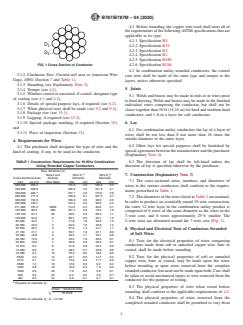
1.1 This specification covers bare combination unilay-stranded conductors made from round copper wires, either uncoated or coated with tin or lead alloy for insulated conductors for electrical purposes. These conductors shall be constructed with a central core wire surrounded by two layers of helically laid wires, resulting in an outer diameter equal to the compressed-stranded equivalent conductor. (See Explanatory Note 1 and Note 2.)
Note 1: For the purpose of this specification, combination unilay conductor is defined as follows: a central core wire surrounded by a layer of six helically laid wires of the same diameter as the core wire with a helically laid outer layer containing six smaller wires alternated between six wires of the same diameter as the wires in the layer underneath. Both layers have a common length and direction of lay (see Fig. 1).
FIG. 1 Cross Section of Conductor
1.2 For the purpose of this specification, normal conductor classification (Class AA, A, B, C) is not applicable as these conductors are intended for subsequent insulation. The descriptive term combination unilay-stranded shall be used in place of conductor classification.
1.3 The values stated in either SI units or inch-pound units are to be regarded separately as standard. The values stated in each system may not be exact equivalents; therefore, each system shall be used independently of the other. Combining values from the two systems may result in non-conformance with the standard.
1.3.1 For conductor sizes designated by AWG or kcmil, the requirements in SI units have been numerically converted from corresponding values, stated or derived, in inch-pound units.
1.3.2 For conductor sizes designated by SI units only, the requirements are stated or derived in SI units.
1.3.3 For density, resistivity, and temperature, the values stated in SI units are to be regarded as standard.
1.4 This standard does not purport to address all of the safety concerns, if any, associated with its use. It is the responsibility of the user of this standard to establish appropriate safety, health, and environmental practices and determine the applicability of regulatory limitations prior to use.
1.5 This international standard was developed in accordance with internationally recognized principles on standardization established in the Decision on Principles for the Development of International Standards, Guides and Recommendations issued by the World Trade Organization Technical Barriers to Trade (TBT) Committee.
- Status
- Published
- Publication Date
- 31-Dec-2019
- Technical Committee
- B01 - Electrical Conductors
- Drafting Committee
- B01.04 - Conductors of Copper and Copper Alloys
Overview
ASTM B787/B787M-04(2020) is the standard specification developed by ASTM International for 19 wire combination unilay-stranded copper conductors designed for subsequent insulation. This specification is crucial for the electrical industry, as it defines requirements for bare copper conductors made from round wires that are either uncoated or coated with tin or lead alloy. These conductors are specifically constructed to provide a reliable base for later insulation, supporting their use in a wide range of electrical and power applications.
Key Topics
Conductor Construction: The standard specifies a combination unilay structure, where a central core wire is surrounded by two layers of helically laid wires. The outer layer alternates between wires of the same and smaller diameters, ensuring the completed conductor matches the outer diameter of a compressed-stranded equivalent.
Applicable Wire Types: Conductors can be assembled from hard-drawn, medium-hard-drawn, or annealed copper wires. Coatings, if specified, may include tin or lead alloy, depending on project requirements.
Physical and Electrical Testing: The specification details testing procedures for tensile strength, elongation, and resistance, both for individual wires and completed strands. Methods for evaluating coated and uncoated wires are included to ensure compliance with the standard.
Dimensional Requirements: The document sets minimum cross-sectional area requirements and references calculations for diameters and masses based on conductor size, ensuring consistency and reliability in electrical performance.
Order and Marking Guidelines: Includes instructions for specifying conductor characteristics in purchase orders, as well as rules for marking and packaging to support traceability and efficient logistics.
Applications
The scope of ASTM B787/B787M-04(2020) encompasses bare copper conductors specifically intended for further insulation as part of the manufacturing process. Typical application areas include:
- Electrical Power Cables: These stranded copper conductors serve as the core of insulated power cables used in power distribution and industrial wiring systems.
- Control and Instrumentation Cables: The unilay construction offers flexibility, making these conductors ideal for cables requiring subsequent fabrication and insulation.
- Custom Cable Manufacturing: Provides a standard for copper conductors destined for specialized applications, supporting product consistency and quality control.
- Infrastructure and Utility Projects: Widely used in electric utility networks where insulated copper conductors are specified for durability and conductivity.
By adhering to this standard, manufacturers ensure their conductors meet recognized quality, mechanical, and electrical performance expectations, creating a reliable foundation for subsequent insulation and end use.
Related Standards
- ASTM B1: Specification for Hard-Drawn Copper Wire
- ASTM B2: Specification for Medium-Hard-Drawn Copper Wire
- ASTM B3: Specification for Soft or Annealed Copper Wire
- ASTM B33: Specification for Tin-Coated Soft or Annealed Copper Wire
- ASTM B189: Specification for Lead-Coated and Lead-Alloy-Coated Soft Copper Wire
- ASTM B246: Specification for Tinned Hard-Drawn and Medium-Hard-Drawn Copper Wire
- ASTM B263: Test Method for Determination of Cross-Sectional Area of Stranded Conductors
- ASTM B354: Terminology Relating to Uninsulated Metallic Electrical Conductors
- NBS Handbook 100: Copper Wire Tables (National Institute of Standards and Technology)
These related standards provide supporting definitions, test methods, and additional specifications for copper wires and their properties, ensuring full compliance and interoperability within the broader scope of electrical conductor standards.
Keywords: 19 wire copper conductor, combination unilay stranded, ASTM B787 B787M, stranded copper conductors, electrical cable standards, copper conductor specification, conductor for insulation, ASTM electrical standards, tin-coated copper, lead-coated copper, unilay construction
Relations
- Effective Date
- 01-Jan-2020
- Effective Date
- 01-Apr-2024
- Effective Date
- 01-Jan-2020
- Effective Date
- 01-Oct-2018
- Effective Date
- 01-Oct-2018
- Effective Date
- 01-Oct-2018
- Effective Date
- 01-Sep-2016
- Effective Date
- 01-Sep-2014
- Effective Date
- 01-Oct-2013
- Effective Date
- 01-Oct-2013
- Effective Date
- 01-Oct-2013
- Effective Date
- 01-Dec-2012
- Effective Date
- 15-Nov-2012
- Effective Date
- 15-Nov-2012
- Effective Date
- 15-Nov-2012
Get Certified
Connect with accredited certification bodies for this standard

IMQ S.p.A. (Certification)
Italian electrical product certification.

SLG Prüf- und Zertifizierungs GmbH
German testing and certification body.

UL Solutions
Global safety science company with testing, inspection and certification.
Sponsored listings
Frequently Asked Questions
ASTM B787/B787M-04(2020) is a technical specification published by ASTM International. Its full title is "Standard Specification for 19 Wire Combination Unilay-Stranded Copper Conductors for Subsequent Insulation". This standard covers: ABSTRACT This specification covers electrical contact alloys with the nominal composition of 75% silver, 24.5% copper, and 0.5% nickel in the form of rods, wires, strips, and sheets. Raw materials shall be of such quality and purity that the products, which shall be finished by such operations as cold working, heat treatment, annealing, turning, grinding, or pickling, shall adhere to the chemical composition and mechanical property requirements prescribed here. Besides analysis for the elements silver, copper, and nickel, further analysis is to be made for suspected or indicated impurities, such as zinc, iron, cadmium, and lead, to make sure that their total does not exceed specified limits. Mechanical tests, which are to be conducted at room temperature, shall evaluate the materials' tensile strength, elongation, Rockwell hardness, and area and thickness reduction. SCOPE 1.1 This specification covers bare combination unilay-stranded conductors made from round copper wires, either uncoated or coated with tin or lead alloy for insulated conductors for electrical purposes. These conductors shall be constructed with a central core wire surrounded by two layers of helically laid wires, resulting in an outer diameter equal to the compressed-stranded equivalent conductor. (See Explanatory Note 1 and Note 2.) Note 1: For the purpose of this specification, combination unilay conductor is defined as follows: a central core wire surrounded by a layer of six helically laid wires of the same diameter as the core wire with a helically laid outer layer containing six smaller wires alternated between six wires of the same diameter as the wires in the layer underneath. Both layers have a common length and direction of lay (see Fig. 1). FIG. 1 Cross Section of Conductor 1.2 For the purpose of this specification, normal conductor classification (Class AA, A, B, C) is not applicable as these conductors are intended for subsequent insulation. The descriptive term combination unilay-stranded shall be used in place of conductor classification. 1.3 The values stated in either SI units or inch-pound units are to be regarded separately as standard. The values stated in each system may not be exact equivalents; therefore, each system shall be used independently of the other. Combining values from the two systems may result in non-conformance with the standard. 1.3.1 For conductor sizes designated by AWG or kcmil, the requirements in SI units have been numerically converted from corresponding values, stated or derived, in inch-pound units. 1.3.2 For conductor sizes designated by SI units only, the requirements are stated or derived in SI units. 1.3.3 For density, resistivity, and temperature, the values stated in SI units are to be regarded as standard. 1.4 This standard does not purport to address all of the safety concerns, if any, associated with its use. It is the responsibility of the user of this standard to establish appropriate safety, health, and environmental practices and determine the applicability of regulatory limitations prior to use. 1.5 This international standard was developed in accordance with internationally recognized principles on standardization established in the Decision on Principles for the Development of International Standards, Guides and Recommendations issued by the World Trade Organization Technical Barriers to Trade (TBT) Committee.
ABSTRACT This specification covers electrical contact alloys with the nominal composition of 75% silver, 24.5% copper, and 0.5% nickel in the form of rods, wires, strips, and sheets. Raw materials shall be of such quality and purity that the products, which shall be finished by such operations as cold working, heat treatment, annealing, turning, grinding, or pickling, shall adhere to the chemical composition and mechanical property requirements prescribed here. Besides analysis for the elements silver, copper, and nickel, further analysis is to be made for suspected or indicated impurities, such as zinc, iron, cadmium, and lead, to make sure that their total does not exceed specified limits. Mechanical tests, which are to be conducted at room temperature, shall evaluate the materials' tensile strength, elongation, Rockwell hardness, and area and thickness reduction. SCOPE 1.1 This specification covers bare combination unilay-stranded conductors made from round copper wires, either uncoated or coated with tin or lead alloy for insulated conductors for electrical purposes. These conductors shall be constructed with a central core wire surrounded by two layers of helically laid wires, resulting in an outer diameter equal to the compressed-stranded equivalent conductor. (See Explanatory Note 1 and Note 2.) Note 1: For the purpose of this specification, combination unilay conductor is defined as follows: a central core wire surrounded by a layer of six helically laid wires of the same diameter as the core wire with a helically laid outer layer containing six smaller wires alternated between six wires of the same diameter as the wires in the layer underneath. Both layers have a common length and direction of lay (see Fig. 1). FIG. 1 Cross Section of Conductor 1.2 For the purpose of this specification, normal conductor classification (Class AA, A, B, C) is not applicable as these conductors are intended for subsequent insulation. The descriptive term combination unilay-stranded shall be used in place of conductor classification. 1.3 The values stated in either SI units or inch-pound units are to be regarded separately as standard. The values stated in each system may not be exact equivalents; therefore, each system shall be used independently of the other. Combining values from the two systems may result in non-conformance with the standard. 1.3.1 For conductor sizes designated by AWG or kcmil, the requirements in SI units have been numerically converted from corresponding values, stated or derived, in inch-pound units. 1.3.2 For conductor sizes designated by SI units only, the requirements are stated or derived in SI units. 1.3.3 For density, resistivity, and temperature, the values stated in SI units are to be regarded as standard. 1.4 This standard does not purport to address all of the safety concerns, if any, associated with its use. It is the responsibility of the user of this standard to establish appropriate safety, health, and environmental practices and determine the applicability of regulatory limitations prior to use. 1.5 This international standard was developed in accordance with internationally recognized principles on standardization established in the Decision on Principles for the Development of International Standards, Guides and Recommendations issued by the World Trade Organization Technical Barriers to Trade (TBT) Committee.
ASTM B787/B787M-04(2020) is classified under the following ICS (International Classification for Standards) categories: 29.060.20 - Cables. The ICS classification helps identify the subject area and facilitates finding related standards.
ASTM B787/B787M-04(2020) has the following relationships with other standards: It is inter standard links to ASTM B787/B787M-04(2014), ASTM B3-13(2024), ASTM B33-10(2020)e1, ASTM B3-13(2018), ASTM B1-13(2018), ASTM B2-13(2018), ASTM B354-16, ASTM B33-10(2014), ASTM B2-13, ASTM B1-13, ASTM B3-13, ASTM B354-12, ASTM B3-12, ASTM B2-12, ASTM B1-12. Understanding these relationships helps ensure you are using the most current and applicable version of the standard.
ASTM B787/B787M-04(2020) is available in PDF format for immediate download after purchase. The document can be added to your cart and obtained through the secure checkout process. Digital delivery ensures instant access to the complete standard document.
Standards Content (Sample)
This international standard was developed in accordance with internationally recognized principles on standardization established in the Decision on Principles for the
Development of International Standards, Guides and Recommendations issued by the World Trade Organization Technical Barriers to Trade (TBT) Committee.
Designation: B787/B787M −04 (Reapproved 2020)
Standard Specification for
19 Wire Combination Unilay-Stranded Copper Conductors
for Subsequent Insulation
This standard is issued under the fixed designation B787/B787M; the number immediately following the designation indicates the year
of original adoption or, in the case of revision, the year of last revision.Anumber in parentheses indicates the year of last reapproval.
A superscript epsilon (´) indicates an editorial change since the last revision or reapproval.
1. Scope responsibility of the user of this standard to establish appro-
priate safety, health, and environmental practices and deter-
1.1 This specification covers bare combination unilay-
mine the applicability of regulatory limitations prior to use.
stranded conductors made from round copper wires, either
1.5 This international standard was developed in accor-
uncoated or coated with tin or lead alloy for insulated conduc-
dance with internationally recognized principles on standard-
tors for electrical purposes. These conductors shall be con-
ization established in the Decision on Principles for the
structed with a central core wire surrounded by two layers of
Development of International Standards, Guides and Recom-
helically laid wires, resulting in an outer diameter equal to the
mendations issued by the World Trade Organization Technical
compressed-stranded equivalent conductor. (See Explanatory
Barriers to Trade (TBT) Committee.
Note 1 and Note 2.)
NOTE 1—For the purpose of this specification, combination unilay 2. Referenced Documents
conductor is defined as follows: a central core wire surrounded by a layer
2.1 The following documents of the issue in effect on date
of six helically laid wires of the same diameter as the core wire with a
of material purchase form a part of this specification to the
helically laid outer layer containing six smaller wires alternated between
six wires of the same diameter as the wires in the layer underneath. Both extent referenced herein.
layers have a common length and direction of lay (see Fig. 1).
2.2 ASTM Standards:
1.2 For the purpose of this specification, normal conductor
B1Specification for Hard-Drawn Copper Wire
classification (Class AA, A, B, C) is not applicable as these
B2Specification for Medium-Hard-Drawn Copper Wire
conductorsareintendedforsubsequentinsulation.Thedescrip-
B3Specification for Soft or Annealed Copper Wire
tivetermcombinationunilay-strandedshallbeusedinplaceof
B33Specification for Tin-Coated Soft or Annealed Copper
conductor classification.
Wire for Electrical Purposes
B189Specification for Lead-Coated and Lead-Alloy-Coated
1.3 The values stated in either SI units or inch-pound units
Soft Copper Wire for Electrical Purposes
are to be regarded separately as standard. The values stated in
B246Specification for Tinned Hard-Drawn and Medium-
each system may not be exact equivalents; therefore, each
Hard-Drawn Copper Wire for Electrical Purposes
system shall be used independently of the other. Combining
B263Test Method for Determination of Cross-Sectional
values from the two systems may result in non-conformance
Area of Stranded Conductors
with the standard.
B354Terminology Relating to Uninsulated Metallic Electri-
1.3.1 For conductor sizes designated byAWG or kcmil, the
cal Conductors
requirementsinSIunitshavebeennumericallyconvertedfrom
corresponding values, stated or derived, in inch-pound units. 2.3 Other Standard:
NBS Handbook 100Copper Wire Tables of the National
1.3.2 For conductor sizes designated by SI units only, the
requirements are stated or derived in SI units. Bureau of Standards
1.3.3 For density, resistivity, and temperature, the values
3. Ordering Information
stated in SI units are to be regarded as standard.
3.1 Orders for materials under this specification shall in-
1.4 This standard does not purport to address all of the
clude the following information:
safety concerns, if any, associated with its use. It is the
3.1.1 Quantity of each size,
1 2
This specification is under the jurisdiction of ASTM Committee B01 on For referenced ASTM standards, visit the ASTM website, www.astm.org, or
Electrical Conductors and is the direct responsibility of Subcommittee B01.04 on contact ASTM Customer Service at service@astm.org. For Annual Book of ASTM
Conductors of Copper and Copper Alloys. Standards volume information, refer to the standard’s Document Summary page on
Current edition approved Jan. 1, 2020. Published January 2020. Originally the ASTM website.
approved in 1988. Last previous edition approved in 2014 as B787/B787M–04 Available from National Institute of Standards and Technology (NIST), 100
(2014). DOI: 10.1520/B0787_B0787M-04R20. Bureau Dr., Stop 1070, Gaithersburg, MD 20899-1070, http://www.nist.gov.
Copyright © ASTM International, 100 Barr Harbor Drive, PO Box C700, West Conshohocken, PA 19428-2959. United States
B787/B787M − 04 (2020)
4.2 Before stranding, the copper wire used shall meet all of
therequirementsofthefollowingASTMspecificationsthatare
applicable to its type:
4.2.1 Specification B3.
4.2.2 Specification B33.
4.2.3 Specification B2.
4.2.4 Specification B1.
4.2.5 Specification B189.
FIG. 1 Cross Section of Conductor
4.2.6 Specification B246.
4.3 In combination unilay stranded conductors, the central
3.1.2 Conductor Size: Circular-mil area or American Wire
core wire shall be made of the same type and temper as the
Gage, AWG (Section 7 and Table 1),
layers, unless otherwise specified.
3.1.3 Stranding (see Explanatory Note 3),
3.1.4 Temper (see 4.2), 5. Joints
3.1.5 Whether coated or uncoated; if coated, designate type
5.1 Welds and brazes may be made in rods or in wires prior
of coating (see 4.1 and 4.2),
tofinaldrawing.Weldsandbrazesmaybemadeinthefinished
3.1.6 Details of special-purpose lays, if required (see 6.2),
individual wires composing the conductor, but shall not be
3.1.7 When physical tests shall be made (see 9.2 and 9.3),
closer together than 50 ft (15.24 m) for hard and medium-hard
3.1.8 Package size (see 15.1),
conductors, and 1 ft in a layer for soft conductors.
3.1.9 Lagging, if required (see 15.2),
3.1.10 Special package marking, if required (Section 15),
6. Lay
and
6.1 For combination unilay conductors the lay of a layer of
3.1.11 Place of inspection (Section 13).
wires shall be not less than 8 nor more than 16 times the
outside diameter of the outer layer.
4. Requirements for Wires
6.2 Other lays for special purposes shall be furnished by
4.1 The purchaser shall designate the type of wire and the
specialagreementbetweenthemanufacturerandthepurchaser
kind of coating, if any, to be used in the conductor.
(Explanatory Note 4).
TABLE 1 Construction Requirements for 19-Wire Combination 6.3 The direction of lay shall be left-hand unless the
Unilay Stranded Copper Conductors
direction of lay is specified otherwise by the purchaser.
Size, American (or
A B
Brown and 7. Construction (Explanatory Note 3)
Wire D Wire D
1 2
Cross-Sectional Area Sharpe) Diameter, Diameter,
7.1 The cross-sectional areas, numbers, and diameters of
cmil sq mm Wire Gage mils mm mils mm
500 000 253.4 175.6 4.5 128.5 3.3
wires in the various conductors shall conform to the require-
450 000 228.0 166.6 4.2 121.9 3.1
ments prescribed in Table 1.
400 000 202.7 157.1 4.0 115.0 2.9
350 000 177.3 146.9 3.7 107.5 2.7
7.2 ThediametersofthewireslistedinTable2arenominal.
300 000 152.0 136.0 3.5 99.6 2.5
In order to produce an essentially round 19-wire construction,
250 000 126.7 124.2 3.2 90.9 2.3
211 600 107.2 0000 114.2 2.4 83.6 2.1 the outer 12-wire layer in the combination unilay product is
167 800 85.0 000 101.7 2.6 74.5 1.9
comprised of 6 wires of the same diameter as the wires in the
133 100 67.4 00 90.6 2.3 66.3 1.7
7-wire core, and 6 wires approximately 25% smaller. The
105 600 53.5 0 80.7 2.0 59.1 1.5
2-wire sizes are alternated around the 7-wire core (Fig. 1).
83 690 42.4 1 71.8 1.8 52.6 1.3
66 360 33.6 2 64.0 1.6 46.8 1.2
52 620 26.7 3 57.0 1.4 41.7 1.1
8. Physical and Electrical Tests of Conductors Stranded
41 740 21.1 4 50.7 1.3 37.1 0.9
of Soft Wires
33 090 16.8 5 45.2 1.1 33.1 0.8
26 240 13.3 6 40.2 1.0 29.4 0.7
8.1 Tests for the electrical properties of wires composing
20 820 10.5 7 35.8 0.9 26.2 0.7
conductors made from soft or annealed copper wire, bare or
16 510 8.4 8 31.9 0.8 23.4 0.6
13 090 6.6 9 28.4 0.7 20.8 0.5
coated, shall be made before stranding.
10 380 5.3 10 25.3 0.6 18.5 0.5
6530 3.3 12 20.1 0.5 14.7 0.4 8.2 Tests for the physical properties of soft or annealed
4110 2.1 14 15.9 0.4 11.7 0.3
copper wire, bare or coated, may be made upon the wires
2580 1.3 16 12.6 0.3 9.2 0.2
before stranding or upon wires removed from the complete
1620 0.8 18 10.0 0.3 7.3 0.2
1020 0.5 20 7.9 0.2 5.8 0.1 strandedconductor,butneednotbemadeuponboth.Careshall
640 0.3 22 6.3 0.2 4.6 0.1
be taken to avoid mechanical injury to wire removed from the
404 0.2 24 5.0 0.1 3.7 0.1
conductor for the purpose of testing.
A
Equation to calculate D :
8.3 The physical properties of wire when tested before
Cross2Sectional Area
stranding shall conform to the applicable requirements of 4.2.
Œ
16.2149
B 8.4 The physical properties of wires removed from the
Equation to calculate D : D × 0.732.
2 1
completed stranded conductor shall be permitted to vary from
B787/B787M − 04 (2020)
TABLE 2 Diameters, Areas, and Masses of 19-Wire Combination Unilay Stranded Copper Conductors
Nominal Area Mass
Size of Conductor
A 2 2
cmil or AWG sq mm Nominal Diameter, in. Conductor, mm in. mm lbs/1000 ft lbs/mile g/m
500 000 253.4 0.784 19.914 0.392700 253.35 1544 8151 2297
450 000 228.0 0.744 18.878 0.353400 228.02 1389 7336 2067
400 000 202.7 0.701 17.805 0.314000 202.68 1235 6521 1838
350 000 177.3 0.656 16.662 0.274900 177.35 1081 5706 1609
300 000 152.0 0.607 15.418 0.235600 152.01 926.3 4891 1378
250 000 126.7 0.554 14.072 0.196300 126.68 771.9 4076 1149
0000 107.2 0.510 12.954 0.166200 107.22 653.3 3450 972.1
000 85.0 0.454 11.532 0.131800 85.02 518.1 2736 770.9
00 67.4 0.404 10.262 0.104500 67.44 410.9 2169 611.4
0 53.5 0.360 9.144 0.082910 53.51 325.8 1720 684.8
1 42.4 0.321 8.153 0.065730 42.41 258.4 1364 384.5
2 33.6 0.286 7.264 0.052120 33.62 204.9 1082 304.9
3 26.7 0.254 6.452 0.041330 26.77 162.5 858.1 241.8
4 21.1 0.226 5.740 0.032780 21.15 128.9 680.5 191.8
5 16.8 0.202 5.131 0.025990 16.77 102.2 539.6 152.1
6 13.3 0.179 4.547 0.020610 13.30 81.05 428.0 120.6
7 15.6 0.160 4.064 0.016350 10.55 64.28 339.4 95.65
8 8.4 0.143 3.632 0.012970 8.37 50.97 269.1 75.84
9 6.6 0.127 3.226 0.010280 6.63 40.42 213.4 60.14
10 5.3 0.113 2.870 0.008155 5.26 32.06 169.3 47.71
12 3.3 0.090 2.286 0.005130 3.31 20.16 106.5 30.00
14 2.1 0.071 1.803 0.003230 2.08 12.68 66.95 18.87
16 1.3 0.056 1.422 0.002030 1.31 7.974 42.10 11.87
18 0.8 0.045 1.143 0.001280 0.82 5.015 26.48 7.462
20 0.5 0.035 0.809 0.000804 0.52 3.154 16.65 4.693
22 0.3 0.028 0.703 0.000503 0.32 1.992 10.52 2.964
24 0.2 0.022 0.558 0.000317 0.20 1.249 6.59 1.859
A
To calculate the diameter, multiply the large wire diameter in Table 1 by 3 and add two times the small wire diameter.
Example: AWG 4/0 diameter = [(3(114.2) + 2 (83.6)] = 509.8
the applicable requirements of 4.2 by the amounts as follows hard-drawnandmedium-hard-drawnconductorsmaybetested
(Explanatory Note 5): asaunit.Thebreakingstrengthofthebareconductorssotested
8.4.1 AverageofResultsObtainedonAllWiresTested—The shall be at least 90% of the total of the specified minimum
minimum elongation required shall be reduced in numerical breaking strengths of the component wires. The maximum
value 5 (for example, from 30 to 25%) from the numerical breaking strength of conductors made from medium-hard-
requirements for the wire before stranding. drawn wires, uncoated or co
...