

ASTM D8052/D8052M-22
(Test Method)Standard Test Method for Quantification of Air Leakage in Low-Sloped Membrane Roof Assemblies
General Information
- Abstract
SIGNIFICANCE AND USE
5.1 This test method can be useful in understanding the response of low-sloped membrane roof assemblies to air pressure differences induced across the assembly.
5.2 This test method can be useful in understanding the role of different roofing components in providing resistance to air leakage through the roof assembly.
5.3 When applying the results of tests by this test method, note that the performance of a roof or its components, or both, depends on proper installation.
5.4 This test method does not purport to establish all criteria necessary for the consideration of air movement in the design of a roof assembly. Air intrusion in roofing systems is separate and distinct from air leakage in roofing systems. Test Method D7586/D7586M provides an air intrusion test method for mechanically attached roof assemblies. The results are intended to be used for comparison purposes and likely do not represent the field-installed performance of the roof assembly.
SCOPE
1.1 This test method provides a laboratory technique for determining air leakage in low-sloped membrane roof assemblies under specified negative air pressure differences.
1.2 This test method is intended to measure air leakage of a roof assembly with rooftop penetrations.
1.3 The values stated in either SI units or inch-pound units are to be regarded separately as standard. The values stated in each system may not be exact equivalents; therefore, each system shall be used independently of the other. Combining values from the two systems may result in nonconformance with the standard.
1.4 This standard does not purport to address all of the safety concerns, if any, associated with its use. It is the responsibility of the user of this standard to establish appropriate safety, health, and environmental practices and determine the applicability of regulatory limitations prior to use.
1.5 This international standard was developed in accordance with internationally recognized principles on standardization established in the Decision on Principles for the Development of International Standards, Guides and Recommendations issued by the World Trade Organization Technical Barriers to Trade (TBT) Committee.
- Status
- Published
- Publication Date
- 31-Jul-2022
- Technical Committee
- D08 - Roofing and Waterproofing
- Drafting Committee
- D08.20 - Roofing Membrane Systems
Buy Documents
ASTM D8052/D8052M-22 - Standard Test Method for Quantification of Air Leakage in Low-Sloped Membrane Roof Assemblies
REDLINE ASTM D8052/D8052M-22 - Standard Test Method for Quantification of Air Leakage in Low-Sloped Membrane Roof Assemblies
Overview
ASTM D8052/D8052M-22: Standard Test Method for Quantification of Air Leakage in Low-Sloped Membrane Roof Assemblies provides a laboratory-based method for measuring the rate of air leakage through low-sloped membrane roof assemblies, including common rooftop penetrations, when subjected to specified negative air pressures. Developed by ASTM Committee D08 on Roofing and Waterproofing, this standard is designed to help evaluate how various roofing components and installation practices influence air leakage performance in controlled conditions.
Understanding and quantifying air leakage in low-sloped membrane roof assemblies is essential for building owners, roofing manufacturers, designers, and contractors aiming to optimize energy efficiency, durability, and weather resistance in modern roof systems. While the test is conducted in the laboratory, results are valuable for comparing product performance and for research, quality assurance, and roof system design.
Key Topics
- Air Leakage Measurement: This test method focuses on laboratory quantification of air leakage rates through fully constructed low-sloped roof assemblies under controlled negative pressure differentials.
- Representative Assemblies: Assemblies tested include key rooftop penetrations such as curbs, plumbing vents, and drains, simulating real-world construction and installation practices.
- Pressure Protocol: The standard prescribes a series of increasing pressure differentials to measure air leakage at various intensities.
- Precision and Repeatability: The methodology includes controls for precision, reproducibility, and calibration, enabling consistent results across laboratories.
- Significance of Installation: Results depend strongly on correct installation of all membrane roofing components, emphasizing real-world applicability and the importance of workmanship.
- Distinction from Air Intrusion: Air leakage is distinct from air intrusion; the standard specifies this and refers to other test methods for air intrusion in roofing systems.
Applications
ASTM D8052/D8052M-22 is primarily applicable in the following scenarios:
- Product Qualification: Manufacturers use this method to benchmark air leakage performance of new and existing low-sloped membrane roofing products and assemblies.
- Quality Assurance: Roofing contractors and consultants employ the test to ensure assemblies meet project specifications for air barrier performance before installation.
- Design Optimization: Designers and architects utilize air leakage data to compare systems and optimize specification choices for building envelope energy efficiency and resilience.
- Research and Development: Laboratories use the standard to compare how different material combinations, membrane types, or installation methods affect air tightness and overall system performance.
- Regulatory and Code Compliance: The method supports the evaluation of roof assemblies in relation to air barrier requirements set by codes such as the International Energy Conservation Code (IECC), though its scope is focused on laboratory testing rather than direct field validation.
Related Standards
Several other standards complement or are referenced by ASTM D8052/D8052M-22:
- ASTM D1079 - Terminology Relating to Roofing and Waterproofing
- ASTM E283/E283M - Test Method for Determining Rate of Air Leakage Through Exterior Windows, Skylights, Curtain Walls, and Doors
- ASTM E631 - Terminology of Building Constructions
- ASTM D7586/D7586M - Test Method for Quantification of Air Intrusion in Low-Sloped Mechanically Attached Membrane Roof Assemblies (Withdrawn 2020)
- ASTM E691 - Practice for Interlaboratory Precision Assessment
- ASTM E1677 - Specification for Air Barrier (AB) Material or Assemblies for Low-Rise Framed Building Walls
- ASTM E1680 - Test Method for Rate of Air Leakage through Exterior Metal Roof Panel Systems
- ASTM E2357 - Test Method for Determining Air Leakage Rate of Air Barrier Assemblies
- CAN/CSA-A123.21-14 - Standard Test Method for the Dynamic Wind Uplift Resistance of Membrane-roofing Systems
Practical Value
By providing a rigorous, repeatable method for quantifying air leakage in low-sloped membrane roof assemblies, ASTM D8052/D8052M-22 supports:
- Improved roofing system design and selection
- Informed decision-making for energy efficiency upgrades
- Enhanced durability and moisture control in new and existing buildings
- Credible product and assembly comparisons for manufacturers, specifiers, and building owners
For anyone responsible for building envelope performance, this standard is a critical tool for understanding and controlling air infiltration in flat membrane roof assemblies.
Relations
- Refers
ASTM E2357-24 - Standard Test Method for Determining Air Leakage Rate of Air Barrier Assemblies - Effective Date
- 01-Jan-2024
- Effective Date
- 01-May-2020
- Effective Date
- 15-Dec-2018
- Effective Date
- 15-Dec-2018
- Effective Date
- 01-Jun-2017
- Effective Date
- 01-Feb-2016
- Effective Date
- 01-Mar-2015
- Effective Date
- 01-Nov-2014
- Effective Date
- 01-May-2013
- Effective Date
- 01-Mar-2013
- Effective Date
- 01-Mar-2013
- Effective Date
- 01-Nov-2011
- Effective Date
- 01-Nov-2011
- Effective Date
- 01-Sep-2011
- Effective Date
- 01-Sep-2011
Buy Documents
ASTM D8052/D8052M-22 - Standard Test Method for Quantification of Air Leakage in Low-Sloped Membrane Roof Assemblies
REDLINE ASTM D8052/D8052M-22 - Standard Test Method for Quantification of Air Leakage in Low-Sloped Membrane Roof Assemblies
Get Certified
Connect with accredited certification bodies for this standard

DIBt (Deutsches Institut für Bautechnik)
German Institute for Building Technology.
DIN CERTCO
DIN Group product certification.

Aboma Certification B.V.
Specialized in construction, metal, and transport sectors.
Sponsored listings
Frequently Asked Questions
ASTM D8052/D8052M-22 is a standard published by ASTM International. Its full title is "Standard Test Method for Quantification of Air Leakage in Low-Sloped Membrane Roof Assemblies". This standard covers: SIGNIFICANCE AND USE 5.1 This test method can be useful in understanding the response of low-sloped membrane roof assemblies to air pressure differences induced across the assembly. 5.2 This test method can be useful in understanding the role of different roofing components in providing resistance to air leakage through the roof assembly. 5.3 When applying the results of tests by this test method, note that the performance of a roof or its components, or both, depends on proper installation. 5.4 This test method does not purport to establish all criteria necessary for the consideration of air movement in the design of a roof assembly. Air intrusion in roofing systems is separate and distinct from air leakage in roofing systems. Test Method D7586/D7586M provides an air intrusion test method for mechanically attached roof assemblies. The results are intended to be used for comparison purposes and likely do not represent the field-installed performance of the roof assembly. SCOPE 1.1 This test method provides a laboratory technique for determining air leakage in low-sloped membrane roof assemblies under specified negative air pressure differences. 1.2 This test method is intended to measure air leakage of a roof assembly with rooftop penetrations. 1.3 The values stated in either SI units or inch-pound units are to be regarded separately as standard. The values stated in each system may not be exact equivalents; therefore, each system shall be used independently of the other. Combining values from the two systems may result in nonconformance with the standard. 1.4 This standard does not purport to address all of the safety concerns, if any, associated with its use. It is the responsibility of the user of this standard to establish appropriate safety, health, and environmental practices and determine the applicability of regulatory limitations prior to use. 1.5 This international standard was developed in accordance with internationally recognized principles on standardization established in the Decision on Principles for the Development of International Standards, Guides and Recommendations issued by the World Trade Organization Technical Barriers to Trade (TBT) Committee.
SIGNIFICANCE AND USE 5.1 This test method can be useful in understanding the response of low-sloped membrane roof assemblies to air pressure differences induced across the assembly. 5.2 This test method can be useful in understanding the role of different roofing components in providing resistance to air leakage through the roof assembly. 5.3 When applying the results of tests by this test method, note that the performance of a roof or its components, or both, depends on proper installation. 5.4 This test method does not purport to establish all criteria necessary for the consideration of air movement in the design of a roof assembly. Air intrusion in roofing systems is separate and distinct from air leakage in roofing systems. Test Method D7586/D7586M provides an air intrusion test method for mechanically attached roof assemblies. The results are intended to be used for comparison purposes and likely do not represent the field-installed performance of the roof assembly. SCOPE 1.1 This test method provides a laboratory technique for determining air leakage in low-sloped membrane roof assemblies under specified negative air pressure differences. 1.2 This test method is intended to measure air leakage of a roof assembly with rooftop penetrations. 1.3 The values stated in either SI units or inch-pound units are to be regarded separately as standard. The values stated in each system may not be exact equivalents; therefore, each system shall be used independently of the other. Combining values from the two systems may result in nonconformance with the standard. 1.4 This standard does not purport to address all of the safety concerns, if any, associated with its use. It is the responsibility of the user of this standard to establish appropriate safety, health, and environmental practices and determine the applicability of regulatory limitations prior to use. 1.5 This international standard was developed in accordance with internationally recognized principles on standardization established in the Decision on Principles for the Development of International Standards, Guides and Recommendations issued by the World Trade Organization Technical Barriers to Trade (TBT) Committee.
ASTM D8052/D8052M-22 is classified under the following ICS (International Classification for Standards) categories: 91.100.50 - Binders. Sealing materials. The ICS classification helps identify the subject area and facilitates finding related standards.
ASTM D8052/D8052M-22 has the following relationships with other standards: It is inter standard links to ASTM E2357-24, ASTM D1079-20, ASTM D1079-18e1, ASTM D1079-18, ASTM E2357-17, ASTM D1079-16, ASTM E631-15, ASTM E631-14, ASTM E691-13, ASTM D1079-13e1, ASTM D1079-13, ASTM E691-11, ASTM E1680-11, ASTM E2357-11, ASTM E1677-11. Understanding these relationships helps ensure you are using the most current and applicable version of the standard.
ASTM D8052/D8052M-22 is available in PDF format for immediate download after purchase. The document can be added to your cart and obtained through the secure checkout process. Digital delivery ensures instant access to the complete standard document.
Standards Content (Sample)
This international standard was developed in accordance with internationally recognized principles on standardization established in the Decision on Principles for the
Development of International Standards, Guides and Recommendations issued by the World Trade Organization Technical Barriers to Trade (TBT) Committee.
Designation:D8052/D8052M −22
Standard Test Method for
Quantification of Air Leakage in Low-Sloped Membrane
Roof Assemblies
This standard is issued under the fixed designation D8052/D8052M; the number immediately following the designation indicates the
year of original adoption or, in the case of revision, the year of last revision. A number in parentheses indicates the year of last
reapproval. A superscript epsilon (´) indicates an editorial change since the last revision or reapproval.
1. Scope E283/E283M Test Method for Determining Rate of Air
Leakage Through Exterior Windows, Skylights, Curtain
1.1 This test method provides a laboratory technique for
Walls, and Doors Under Specified Pressure Differences
determining air leakage in low-sloped membrane roof assem-
Across the Specimen
blies under specified negative air pressure differences.
E631 Terminology of Building Constructions
1.2 This test method is intended to measure air leakage of a
E691 Practice for Conducting an Interlaboratory Study to
roof assembly with rooftop penetrations.
Determine the Precision of a Test Method
E1677 SpecificationforAirBarrier(AB)MaterialorAssem-
1.3 The values stated in either SI units or inch-pound units
are to be regarded separately as standard. The values stated in blies for Low-Rise Framed Building Walls
E1680 Test Method for Rate of Air Leakage through Exte-
each system may not be exact equivalents; therefore, each
system shall be used independently of the other. Combining rior Metal Roof Panel Systems
E2357 TestMethodforDeterminingAirLeakageRateofAir
values from the two systems may result in nonconformance
with the standard. Barrier Assemblies
2.2 CAN/CSA Standard:
1.4 This standard does not purport to address all of the
CAN/CSA-A123.21-14 Standard Test Method for the Dy-
safety concerns, if any, associated with its use. It is the
namic Wind Uplift Resistance of Membrane-roofing Sys-
responsibility of the user of this standard to establish appro-
tems
priate safety, health, and environmental practices and deter-
mine the applicability of regulatory limitations prior to use.
3. Terminology
1.5 This international standard was developed in accor-
dance with internationally recognized principles on standard-
3.1 Definitions—Terms used in this test method are defined
ization established in the Decision on Principles for the
inTerminology D1079,Terminology E631,Test Method E283/
Development of International Standards, Guides and Recom-
E283M, and Test Method D7586/D7586M.
mendations issued by the World Trade Organization Technical
Barriers to Trade (TBT) Committee.
4. Summary of Test Method
4.1 The air leakage test consists of installing a roof assem-
2. Referenced Documents
bly with five typical rooftop penetrations between two
2.1 ASTM Standards:
chambers, a bottom chamber where the roof assembly is
D1079 Terminology Relating to Roofing and Waterproofing
installedinahorizontalplane,atopchamberthroughwhichair
D7586/D7586M Test Method for Quantification of Air In-
is exhausted at a rate required to maintain the specified
trusion in Low-Sloped Mechanically Attached Membrane
pressuredifferenceacrosstheroofassembly,andmeasuringthe
Roof Assemblies (Withdrawn 2020)
resultant air flow through the specimen. Although the roof
assemblyistestedinhorizontalplane,theresultsareapplicable
to low-sloped roofs as defined in Terminology D1079.
This test method is under the jurisdiction ofASTM Committee D08 on Roofing
and Waterproofing and is the direct responsibility of Subcommittee D08.20 on
5. Significance and Use
Roofing Membrane Systems.
Current edition approved Aug. 1, 2022. Published September 2022. Originally
5.1 This test method can be useful in understanding the
approved in 2017. Last previous edition approved in 2017 as D8052/D8052M – 17.
response of low-sloped membrane roof assemblies to air
DOI: 10.1520/D8052_D8052M-22.
For referenced ASTM standards, visit the ASTM website, www.astm.org, or
pressure differences induced across the assembly.
contact ASTM Customer Service at service@astm.org. For Annual Book of ASTM
Standards volume information, refer to the standard’s Document Summary page on
the ASTM website.
3 4
The last approved version of this historical standard is referenced on Available from Canadian Standards Association (CSA), 178 Rexdale Blvd.,
www.astm.org. Toronto, ON M9W 1R3, Canada, http://www.csagroup.org.
Copyright © ASTM International, 100 Barr Harbor Drive, PO Box C700, West Conshohocken, PA 19428-2959. United States
D8052/D8052M−22
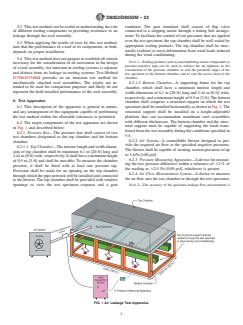
5.2 This test method can be useful in understanding the role simulator. The gust simulator shall consist of flap valve
of different roofing components in providing resistance to air connected to a stepping motor through a timing belt arrange-
leakage through the roof assembly. ment. To facilitate the control of test pressures that are applied
over the test specimen, the top chamber shall be well sealed by
5.3 When applying the results of tests by this test method,
appropriate sealing products. The top chamber shall be struc-
note that the performance of a roof or its components, or both,
turally resilient to resist deformation from wind loads induced
depends on proper installation.
during the wind conditioning.
5.4 This test method does not purport to establish all criteria
NOTE 1—Sealing products such as non-hardening mastic compounds or
necessary for the consideration of air movement in the design
pressure-sensitive tape can be used to achieve the air tightness in the
of a roof assembly.Air intrusion in roofing systems is separate
construction of the pressure chamber, to seal the perimeter edges of the
and distinct from air leakage in roofing systems. Test Method
test specimen to the bottom chamber, and to seal the access door to the
D7586/D7586M provides an air intrusion test method for chamber.
mechanically attached roof assemblies. The results are in-
6.2.1.2 Bottom Chamber—A supporting frame for the top
tended to be used for comparison purposes and likely do not
chamber, which shall have a minimum interior length and
represent the field-installed performance of the roof assembly.
width dimension of 6.1 m [20 ft] long and 2.44 m [8 ft] wide,
respectively, and a minimum height of 0.9 m [3 ft].The bottom
6. Test Apparatus
chamber shall comprise a structural support on which the test
6.1 This description of the apparatus is general in nature, specimenshallbeinstalledhorizontallyasshowninFig.1.The
and any arrangement of the equipment capable of performing structural support shall be installed on a height-adjustable
the test method within the allowable tolerances is permitted. platform that can accommodate membrane roof assemblies
with different thicknesses. The bottom chamber and the struc-
6.2 The major components of the test apparatus are shown
tural support must be capable of supporting the loads trans-
in Fig. 1 and described below:
ferred from the test assembly during the conditions specified in
6.2.1 Pressure Box—The pressure box shall consist of two
9.8.
test chambers designated as the top chamber and the bottom
6.2.2 Air System—A controllable blower designed to pro-
chamber.
vide the required air flow at the specified negative pressures.
6.2.1.1 Top Chamber—Theinteriorlengthandwidthdimen-
The blower shall be capable of creating suction pressures of up
sion of top chamber shall be minimum 6.1 m [20 ft] long and
to 5 kPa [100 psf].
2.44m[8ft]wide,respectively.Itshallhaveaminimumheight
6.2.3 Pressure Measuring Apparatus—Adevice for measur-
of 0.9 m [3 ft] and shall be movable. To measure the chamber
ing the test pressure difference within a tolerance of 62%of
pressure, it shall be fitted with at least one pressure tap.
the reading or 62.5 Pa [0.05 psf], whichever is greater.
Provision shall be made for an opening on the top chamber
6.2.4 Air Flow Measurement System—A device to measure
throughwhichthepipenetworkwillbeinstalledandconnected
the air flow into the test chamber or through the test specimen.
to the blower. The top chamber shall be provided with window
openings to view the test specimen response and a gust NOTE 2—The accuracy of the specimen leakage flow measurement is
FIG. 1Air Leakage Test Apparatus
D8052/D8052M−22
affected by the accuracy of the flow meter and amount of extraneous
9. Test Procedure
leakage of the apparatus (see Annex A1 of Test Method E283/E283M).
9.1 With the test specimen constructed in the bottom cham-
6.2.5 Data Acquisition System—A computer-based system
ber and covered with the top chamber, the test procedure
capable of reading and recording the pressure and air flow
comprises of measuring the extraneous leakage of the top
measurements.
chamber and air leakage of the test specimen.
7. Test Specimen
9.2 Ensure that the top chamber is tightly fixed to the
7.1 The specimens tested shall be representative of the bottom chamber during the test to make sure that no membrane
slippage occurs. (See Note 3.)
field-built roofing assemblies. Therefore, the test specimens
shall be fabricated as prescribed by the proponent in providing
NOTE 3—Clamping devices or gaskets may be used for tightening the
for the specimen construction required herein.
top chamber to the bottom chamber.
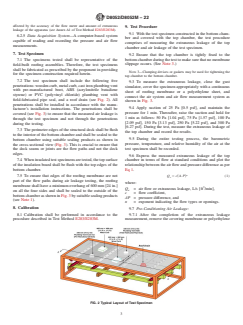
7.2 The test specimen shall include the following five
9.3 To measure the extraneous leakage, close the gust
penetrations:woodencurb,metalcurb,castironplumbingvent
simulator, cover the specimen appropriately with a continuous
with pre-manufactured boot, ABS (acrylonitrile butadiene
sheet of roofing membrane or a polyethylene sheet, and
styrene) or PVC (polyvinyl chloride) plumbing vent with
connect the air system and air flow measurement system as
field-fabricated pipe seal, and a roof drain (see Fig. 2). All
shown in Fig. 3.
penetrations shall be installed in accordance with the manu-
9.4 Apply suction of 25 Pa [0.5 psf], and maintain the
facturer’s installation instructions. The penetrations shall be
pressure for 1 min. Thereafter, raise the suction and hold for
covered (see Fig. 3) to ensure that the measured air leakage is
1 min as follows: 50 Pa [1.04 psf], 75 Pa [1.57 psf], 100 Pa
through the test specimen and not through the penetrations
[2.09 psf], 150 Pa [3.13 psf], 250 Pa [5.22 psf], and 300 Pa
during the testing.
[6.27 psf]. During the test, measure the extraneous leakage of
7.3 The perimeter edges of the structural deck shall be flush
the top chamber and record the results.
to the interior of the bottom chamber and shall be sealed to the
9.5 During the entire testing process, the barometric
bottom chamber using suitable sealing products as shown in
pressure, temperature, and relative humidity of the air at the
the cross-sectional view (Fig. 3). This is crucial to ensure that
test specimen shall be recorded.
the deck seams or joints are the flow paths and not the deck
edges.
9.6 Express the measured extraneous leakage of the top
chamber in terms of flow at standard conditions and plot the
7.4 Wheninsulatedtestspecimensaretested,thetopsurface
of the insulation board shall be flush with the top edges of the relationship between the air flow and pressure difference as per
Eq 1.
bottom chamber.
n
7.5 To ensure that edges of the roofing membrane are not Q 5 c~∆ P! (1)
e
part of the flow paths during air leakage testing, the roofing
where:
membrane shall have a minimum overhang of 600 mm [24 in.]
Q = air flow or extraneous leakage, L/s [ft /min],
e
on all the four sides and shall be sealed to the outside of the
c = flow coefficient,
bottomchamberasshowninFig.3bysuitablesealingproducts
∆P = pressure difference, and
(see Note 1).
n = exponent indicating the flow types or openings.
8. Calibration
9.7 Pre-Conditioning Air Leakage:
8.1 Calibration shall be performed in accordance to the 9.7.1 After the completion of the extraneous leakage
procedure described in Test Method E283/E283M. measurement, remove the covering membrane or polyethylene
FIG. 2Typical Layout of Test Specimen
D8052/D8052M−22
FIG. 3General Arrangement of the Air Leakage Setup
sheet, and repeat the procedure in 9.4 to measure the pre- 10. Calculation
conditioning air leakage of the test specimen. If the measured
10.1 At each pressure level, the flow rate through the test
air leakage is same as the extraneous leakage of specimen from
specimen (Q ) shall be determined by subtracting the extrane-
s
9.6, proceed to 9.8; otherwise identify the air flow paths that
ous air flow (Q ) from the total air leakage (Q).
e t
could be the result of workmanship and seal them
Q 5 Q 2 Q (2)
s t e
appropriately, and repeat 9.4. Designate this measured air flow
as the extraneous air flow, Q . 10.2 Calculate the rate of air leakage in accordance with the
e
following method:
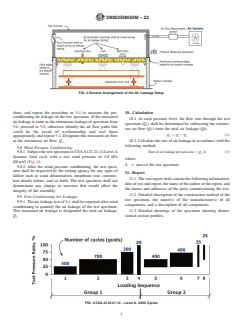
9.8 Wind Pressure Conditioning:
9.8.1 Subject the test specimen to CSAA123.21-14 LevelA Rate of air leakage per unit area 5 Q ⁄A (3)
s
dynamic load cycle with a test wind pressure of 2.8 kPa
where:
[60 psf] (Fig. 4).
A = area of the test specimen.
9.8.2 After the wind pressure conditioning, the test speci-
men shall be inspected by the testing agency for any signs of
11. Report
failure such as seam delamination, membrane tear, construc-
11.1 The test report shall contain the following information:
tion details failure, and so forth. The test specimen shall not
date of test and report, the name of the author of the report, and
demonstrate any change
...
This document is not an ASTM standard and is intended only to provide the user of an ASTM standard an indication of what changes have been made to the previous version. Because
it may not be technically possible to adequately depict all changes accurately, ASTM recommends that users consult prior editions as appropriate. In all cases only the current version
of the standard as published by ASTM is to be considered the official document.
Designation: D8052/D8052M − 17 D8052/D8052M − 22
Standard Test Method for
Quantification of Air Leakage in Low-Sloped Membrane
Roof Assemblies
This standard is issued under the fixed designation D8052/D8052M; the number immediately following the designation indicates the
year of original adoption or, in the case of revision, the year of last revision. A number in parentheses indicates the year of last
reapproval. A superscript epsilon (´) indicates an editorial change since the last revision or reapproval.
1. Scope
1.1 This test method provides a laboratory technique for determining air leakage in low-sloped membrane roof assemblies under
specified negative air pressurespressure differences.
1.2 This test method is intended to measure air leakage of a roof assembly with rooftop penetrations.
1.3 The values stated in either SI units or inch-pound units are to be regarded separately as standard. The values stated in each
system may not be exact equivalents; therefore, each system shall be used independently of the other. Combining values from the
two systems may result in non-conformancenonconformance with the standard.
1.4 This standard does not purport to address all of the safety concerns, if any, associated with its use. It is the responsibility
of the user of this standard to establish appropriate safety safety, health, and healthenvironmental practices and determine the
applicability of regulatory limitations prior to use.
1.5 This international standard was developed in accordance with internationally recognized principles on standardization
established in the Decision on Principles for the Development of International Standards, Guides and Recommendations issued
by the World Trade Organization Technical Barriers to Trade (TBT) Committee.
2. Referenced Documents
2.1 ASTM Standards:
D1079 Terminology Relating to Roofing and Waterproofing
D7586/D7586M Test Method for Quantification of Air Intrusion in Low-Sloped Mechanically Attached Membrane Roof
Assemblies (Withdrawn 2020)
E283E283/E283M Test Method for Determining Rate of Air Leakage Through Exterior Windows, Skylights, Curtain Walls, and
Doors Under Specified Pressure Differences Across the Specimen
E631 Terminology of Building Constructions
E691 Practice for Conducting an Interlaboratory Study to Determine the Precision of a Test Method
E1677 Specification for Air Barrier (AB) Material or Assemblies for Low-Rise Framed Building Walls
E1680 Test Method for Rate of Air Leakage through Exterior Metal Roof Panel Systems
E2357 Test Method for Determining Air Leakage Rate of Air Barrier Assemblies
This test method is under the jurisdiction of ASTM Committee D08 on Roofing and Waterproofing and is the direct responsibility of Subcommittee D08.20 on Roofing
Membrane Systems.
Current edition approved Jan. 15, 2017Aug. 1, 2022. Published February 2017September 2022. Originally approved in 2017. Last previous edition approved in 2017 as
D8052/D8052M – 17. DOI: 10.1520/D8052_D8052M-17.10.1520/D8052_D8052M-22.
For referenced ASTM standards, visit the ASTM website, www.astm.org, or contact ASTM Customer Service at service@astm.org. For Annual Book of ASTM Standards
volume information, refer to the standard’s Document Summary page on the ASTM website.
The last approved version of this historical standard is referenced on www.astm.org.
Copyright © ASTM International, 100 Barr Harbor Drive, PO Box C700, West Conshohocken, PA 19428-2959. United States
D8052/D8052M − 22
2.2 CAN/CSA Standard:
CAN/CSA-A123.21-14 Standard Test Method for the Dynamic Wind Uplift Resistance of Membrane-roofing Systems
3. Terminology
3.1 Definitions—Terms used in this test method are defined in Terminology D1079, Terminology E631, Test Method
E283E283/E283M, and Test Method D7586/D7586M.
4. Summary of Test Method
4.1 The air leakage test consists of installing a roof assembly with five typical rooftop penetrations between two chambers, a
bottom chamber where the roof assembly is installed in a horizontal plane and plane, a top chamber through which air is exhausted
at a rate required to maintain the specified pressure difference across the roof assembly, and measuring the resultant air flow
through the specimen. Although the roof assembly is tested in horizontal plane, the results are applicable to low slope low-sloped
roofs as defined in Terminology D1079.
5. Significance and Use
5.1 This test method can be useful in understanding the response of low-sloped membrane roof assemblies to air pressure
differences induced across the assembly.
5.2 This test method can be useful in understanding the role of different roofing components in providing resistance to air leakage
through the roof assembly.
5.3 When applying the results of tests by this test method, note that the performance of a roof or its components, or both, depends
on proper installation.
5.4 This test method does not purport to establish all criteria necessary for the consideration of air movement in the design of a
roof assembly. Air intrusion in roofing systems is separate and distinct from air leakage in roofing systems. Test Method
D7586/D7586M provides an air intrusion test method for mechanically attached roof assemblies. The results are intended to be
used for comparison purposes and likely do not represent the field installed field-installed performance of the roof assembly.
6. Test Apparatus
6.1 This description of the apparatus is general in nature, and any arrangement of the equipment capable of performing the test
method within the allowable tolerances is permitted.
6.2 The major components of the test apparatus are shown in Fig. 1 and described below:
6.2.1 Pressure Box—The pressure box shall consist of two test chambers designated as the top chamber and the bottom chamber.
6.2.1.1 Top Chamber—The interior length and width dimension of top chamber shall be minimum 6.1 m [20 ft] long and 2.44 m
[8 ft] wide, respectively. It shall have a minimum height of 0.9 m [3 ft] and shall be movable. To measure the chamber pressure,
it shall be fitted with at least one pressure tap. Provision shall be made for an opening on the top chamber through which the pipe
network will be installed and connected to the blower. The top chamber shall be provided with window openings to view the test
specimen response and a gust simulator. The gust simulator shall consist of flap valve connected to a stepping motor through a
timing belt arrangement. To facilitate the control of test pressures that isare applied over the test specimen, the top chamber shall
be well sealed by appropriate sealing products. The top chamber shall be structurally resilient to resist deformation from wind loads
induced during the wind conditioning.
NOTE 1—Sealing products such as non-hardening mastic compounds or pressure-sensitive tape can be used to achieve the air tightness in the construction
of the pressure chamber, to seal the perimeter edges of the test specimen to the bottom chamber, and to seal the access door to the chamber.
6.2.1.2 Bottom Chamber—A supporting frame for the top chamber, which shall have a minimum interior length and width
Available from Canadian Standards Association (CSA), 178 Rexdale Blvd., Toronto, ON M9W 1R3, Canada, http://www.csagroup.org.
D8052/D8052M − 22
FIG. 1 Air Leakage Test Apparatus
dimension of 6.1 m [20 ft] long and 2.44 m [8 ft] wide, respectively, and a minimum height of 0.9 m [3 ft]. The bottom chamber
shall comprise a structural support on which the test specimen shall be installed horizontally as shown in Fig. 1. The structural
support shall be installed on a height adjustable height-adjustable platform that can accommodate membrane roof assemblies with
different thickness.thicknesses. The bottom chamber and the structural support must be capable of supporting the loads transferred
from the test assembly during the conditionedconditions specified in 9.8.
6.2.2 Air System—A controllable blower designed to provide the required airflow air flow at the specified negative pressures. The
blower shall be capable of creating suction pressures of up to 5 kPa [100 psf].
6.2.3 Pressure Measuring Apparatus—A device for measuring the test pressure difference within a tolerance of 62 % of the
reading or 62.5 Pa [0.05 psf], whichever is greater.
6.2.4 Airflow Air Flow Measurement System—A device to measure the air flow into the test chamber or through the test specimen.
NOTE 2—The accuracy of the specimen leakage flow measurement is affected by the accuracy of the flowmeter flow meter and amount of extraneous
leakage of the apparatus (see Annex A1 of Test Method E283E283/E283M).
6.2.5 Data Acquisition System—A computer based computer-based system capable of reading and recording the pressure and
airflow air flow measurements.
7. Test Specimen
7.1 The specimens tested shall be representative of the field built field-built roofing assemblies. Therefore, the test specimens shall
be fabricated as prescribed by the proponent in providing for the specimen construction required herein.
7.2 The test specimen shall include the following five penetrations: wooden curb, metal curb, cast iron plumbing vent with
pre-manufactured boot, ABS (Acrylonitrile(acrylonitrile butadiene styrene),styrene) or PVC (Polyvinyl Chloride)(polyvinyl
chloride) plumbing vent with field fabricated field-fabricated pipe seal, and a roof drain (see Fig. 2). All penetrations shall be
installed in accordance with the manufacturer’s installation instructions. The penetrations shall be covered (see Fig. 3) to ensure
that the measured air leakage is through the test specimen and not through the penetrations during the testing.
7.3 The perimeter edges of the structural deck shall be flush to the interior of the bottom chamber and shall be sealed to the bottom
D8052/D8052M − 22
FIG. 2 Typical Layout of Test Specimen
FIG. 3 General Arrangement of the Air Leakage Setup
chamber using suitable sealing products as shown in the cross-sectional view (Fig. 3). This is crucial to ensure that the deck seams
or joints are the flow paths and not the deck edges.
7.4 When insulated test specimens are tested, the top surface of the insulation board shall be flush with the top edges of the bottom
chamber.
7.5 To ensure that edges of the roofing membrane are not part of the flow paths during air leakage testing, the roofing membrane
shall have a minimum overhang of 600 mm [24 in.] on all the four sides and shall be sealed to the outside of the bottom chamber
as shown in Fig. 3 by suitable sealing products (see Note 1).
8. Calibration
8.1 Calibration shall be performed in accordance to the procedure described in Test Method E283E283/E283M.
9. Test Procedure
9.1 With the test specimen constructed in the bottom chamber and covered with the top chamber, the test procedure comprises of
measuring the extraneous leakage of the top chamber and air leakage of the test specimen.
9.2 Ensure that the top chamber is tightly fixed to the bottom chamber during the test to make sure that no membrane slippage
occurs. (See Note 3.)
NOTE 3—Clamping devices or gaskets may be used for tightening the top chamber to the bottom chamber.
D8052/D8052M − 22
9.3 To measure the extraneous leakage, close the gust simulator, cover the specimen appropriately with a continuous sheet of
roofing membrane or a polyethylene sheet, and connect the air system and airflow air flow measurement system as shown in Fig.
3.
9.4 Apply suction of 25 Pa [0.5 psf], and maintain the pressure for one minute.1 min. Thereafter, raise the suction and hold for
one minute 1 min as follows: 50 Pa [1.04 psf], 75 Pa [1.57 psf], 100 Pa [2.09 psf], 150 Pa [3.13 psf], 250 Pa [5.22 psf], and 300
Pa [6.27 psf]. During the test, measure the extraneous leakage of the top chamber and record the results.
9.5 During the entire testing process, the barometric pressure, temperature, and relative humidity of the air at the test specimen
shall be recorded.
9.6 Express the measured extraneous leakage of the top chamber in terms of flow at standard conditions and plot the relationship
between the air flow and pressure difference as per Eq 1.
n
Q 5 c~Δ P! (1)
e
where:
Q = air flow or extraneous leakage, L/s [ft /min],
e
c = flow coefficient,
ΔP = pressure difference, and
n = exponent indicating the flow types or openings.
9.7 Pre-Conditioning Air Leakage:
9.7.1 After the completion of the extraneous leakage measurement, remove the covering membrane or polyethylene sheet, and
repeat the procedure in 9.4 to measure the pre-conditioning air leakage of the test specimen. If the measured air leakage is same
as the extraneous leakage of specimen from 9.6, proceed to 9.8,; otherwise identify the air flow paths that could be the result of
workmanship and seal them appropriately, and repeat 9.4. Designate this measured air flow as the extraneous air flow, Q .
e
9.8 Wind Pressure Conditioning:
9.8.1 Subject the test specimen to CSA A123.21-14 Level A dynamic load cycle with a test wind pressure of 2.8 kPa [60 psf]
[60 psf] (Fig. 4).
9.8.2 After the wind pressure conditioning, the test specimen shall be inspected by the testing agency for any signs of failure such
as seam delamination, membrane tear, construction details failure, and so forth. The test specimen shall not demonstrate any
change in structure that would affect the integrity of the assembly.
9.9 Post Conditioning Post-Conditioning Air Leakage:
FIG. 4 CSA A123.21-14 – Level A: 2200 Cycles
D8052/D8052M − 22
9.9.1 The air leakage test of 9.4 shall be repeated after wind conditioning to quantify the air leakage of the test specimen. This
measured air leakage is designated the total air leakage, Q .
t
10. Calculation
10.1 At each pressure level, the flow rate through the test sp
...