

ASTM C1427-21
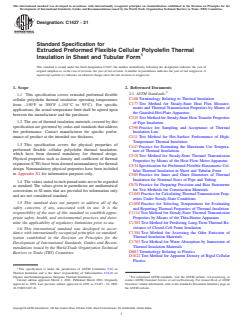
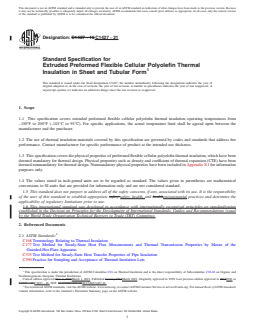
(Specification)Standard Specification for Extruded Preformed Flexible Cellular Polyolefin Thermal Insulation in Sheet and Tubular Form
General Information
- Abstract
ABSTRACT
This specification covers the standard for two grades of extruded preformed flexible cellular polyolefin thermal insulation. Physical properties of preformed flexible cellular polyofelin thermal insulation which are mandatory for thermal design are also covered. Properties such as density and coefficient of thermal expansion (CTE) have been deemed nonmandatory for thermal design. The thermal insulation shall comply with physical requirements. Such physical requirements include thermal conductivity, water vapor permeability, and linear shrinkage and shall be determined by test methods specified here.
SCOPE
1.1 This specification covers extruded preformed flexible cellular polyolefin thermal insulation operating temperatures from –150°F to 200°F (–101°C to 93°C). For specific applications, the actual temperature limit shall be agreed upon between the manufacturer and the purchaser.
1.2 The use of thermal insulation materials covered by this specification are governed by codes and standards that address fire performance. Contact manufacturer for specific performance of product at the intended use thickness.
1.3 This specification covers the physical properties of preformed flexible cellular polyolefin thermal insulation, which have been deemed mandatory for thermal design. Physical properties such as density and coefficient of thermal expansion (CTE) have been deemed nonmandatory for thermal design. Nonmandatory physical properties have been included in Appendix X1 for information purposes only.
1.4 The values stated in inch-pound units are to be regarded as standard. The values given in parentheses are mathematical conversions to SI units that are provided for information only and are not considered standard.
1.5 This standard does not purport to address all of the safety concerns, if any, associated with its use. It is the responsibility of the user of this standard to establish appropriate safety, health, and environmental practices and determine the applicability of regulatory limitations prior to use.
1.6 This international standard was developed in accordance with internationally recognized principles on standardization established in the Decision on Principles for the Development of International Standards, Guides and Recommendations issued by the World Trade Organization Technical Barriers to Trade (TBT) Committee.
- Status
- Published
- Publication Date
- 28-Feb-2021
- Technical Committee
- C16 - Thermal Insulation
- Drafting Committee
- C16.22 - Organic and Nonhomogeneous Inorganic Thermal Insulations
Buy Documents
ASTM C1427-21 - Standard Specification for Extruded Preformed Flexible Cellular Polyolefin Thermal Insulation in Sheet and Tubular Form
REDLINE ASTM C1427-21 - Standard Specification for Extruded Preformed Flexible Cellular Polyolefin Thermal Insulation in Sheet and Tubular Form
Overview
ASTM C1427-21 sets the standard specification for extruded preformed flexible cellular polyolefin thermal insulation, available in both sheet and tubular forms. Developed by ASTM International, this standard outlines requirements for material performance, testing methods, dimensions, and suitable operating temperature ranges. ASTM C1427-21 is essential for ensuring reliable and effective insulation in applications requiring thermal management, particularly where flexible, closed-cell polyolefin materials are used.
This specification addresses two grades of insulation and specifies mandatory physical properties critical for effective thermal design. Key properties covered include thermal conductivity, water vapor permeability, water absorption, linear shrinkage, and fire performance as governed by local building codes and referenced test standards. The standard is applicable internationally and was developed according to principles established by the World Trade Organization’s Technical Barriers to Trade (TBT) Committee.
Key Topics
- Material Types:
- Type I: Tubular insulation
- Type II: Sheet insulation
- Operating Temperature Range:
- From –150°F to 200°F (–101°C to 93°C), with application-specific limits as agreed upon between manufacturer and purchaser.
- Mandatory Physical Properties:
- Thermal conductivity: Ensures efficiency in thermal insulation applications.
- Water vapor permeability: Addresses potential for moisture ingress, essential for long-term insulation performance.
- Linear shrinkage: Evaluates in-use dimensional stability across a wide temperature range.
- Water absorption: Ensures closed-cell structure limits water uptake during service.
- Fire Performance:
- Compliance with fire safety codes is required. Testing follows ASTM E84 or CAN/ULC-S102.2 for surface burning characteristics, depending on jurisdiction.
- Product Forms and Sizes:
- Offers flexible sheet or tubular insulation with standard and agreed-upon dimensions and tolerances.
Applications
Polyolefin thermal insulation specified under ASTM C1427-21 is widely used in:
- HVAC and Refrigeration: Thermal insulation for piping and duct systems in commercial, industrial, and residential buildings, helping to minimize energy loss and condensation.
- Plumbing and Mechanical Systems: Insulating pipes carrying cold or hot fluids to control heat transfer and prevent freezing or overheating.
- Industrial Process Piping: Used in facilities where a wide range of temperatures are encountered, offering reliable long-term performance in challenging environments.
- Building Envelope Applications: Where flexible, lightweight, moisture-resistant insulation is required for optimal energy efficiency.
This standard supports manufacturers, engineers, and specifiers in selecting the appropriate insulation by providing consistent criteria for product evaluation, purchasing, and installation.
Related Standards
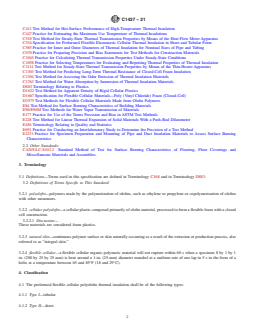
ASTM C1427-21 references several important standards for terminology, testing, and material evaluation, including:
- ASTM C168: Terminology Relating to Thermal Insulation
- ASTM C177: Test Method for Steady-State Heat Flux Measurements
- ASTM C518: Test Method for Steady-State Thermal Transmission Properties
- ASTM E84: Test Method for Surface Burning Characteristics
- ASTM E96/E96M: Water Vapor Transmission of Materials
- ASTM C1304: Odor Emission of Thermal Insulation Materials
- ASTM C390: Sampling and Acceptance of Thermal Insulation Lots
Compliance with ASTM C1427-21 promotes consistent product quality, safety, and performance across industries using thermal insulating materials such as polyolefin foam, ensuring that installed systems efficiently manage energy and resist environmental stresses.
For full details and the latest version of this standard, visit the ASTM International website.
Relations
- Effective Date
- 15-Apr-2024
- Effective Date
- 01-Mar-2024
- Effective Date
- 01-Mar-2024
- Effective Date
- 01-Feb-2024
- Effective Date
- 01-Feb-2024
- Effective Date
- 01-Jan-2024
- Effective Date
- 01-Dec-2023
- Effective Date
- 15-Nov-2023
- Effective Date
- 01-Nov-2023
- Effective Date
- 01-Sep-2023
- Effective Date
- 01-Apr-2022
- Effective Date
- 15-Jul-2020
- Effective Date
- 01-May-2020
- Refers
ASTM D3575-20 - Standard Test Methods for Flexible Cellular Materials Made from Olefin Polymers - Effective Date
- 01-Feb-2020
- Effective Date
- 01-Jan-2020
Buy Documents
ASTM C1427-21 - Standard Specification for Extruded Preformed Flexible Cellular Polyolefin Thermal Insulation in Sheet and Tubular Form
REDLINE ASTM C1427-21 - Standard Specification for Extruded Preformed Flexible Cellular Polyolefin Thermal Insulation in Sheet and Tubular Form
Get Certified
Connect with accredited certification bodies for this standard

DNV
DNV is an independent assurance and risk management provider.

Lloyd's Register
Lloyd's Register is a global professional services organisation specialising in engineering and technology.
DNV Energy Systems
Energy and renewable energy certification.
Sponsored listings
Frequently Asked Questions
ASTM C1427-21 is a technical specification published by ASTM International. Its full title is "Standard Specification for Extruded Preformed Flexible Cellular Polyolefin Thermal Insulation in Sheet and Tubular Form". This standard covers: ABSTRACT This specification covers the standard for two grades of extruded preformed flexible cellular polyolefin thermal insulation. Physical properties of preformed flexible cellular polyofelin thermal insulation which are mandatory for thermal design are also covered. Properties such as density and coefficient of thermal expansion (CTE) have been deemed nonmandatory for thermal design. The thermal insulation shall comply with physical requirements. Such physical requirements include thermal conductivity, water vapor permeability, and linear shrinkage and shall be determined by test methods specified here. SCOPE 1.1 This specification covers extruded preformed flexible cellular polyolefin thermal insulation operating temperatures from –150°F to 200°F (–101°C to 93°C). For specific applications, the actual temperature limit shall be agreed upon between the manufacturer and the purchaser. 1.2 The use of thermal insulation materials covered by this specification are governed by codes and standards that address fire performance. Contact manufacturer for specific performance of product at the intended use thickness. 1.3 This specification covers the physical properties of preformed flexible cellular polyolefin thermal insulation, which have been deemed mandatory for thermal design. Physical properties such as density and coefficient of thermal expansion (CTE) have been deemed nonmandatory for thermal design. Nonmandatory physical properties have been included in Appendix X1 for information purposes only. 1.4 The values stated in inch-pound units are to be regarded as standard. The values given in parentheses are mathematical conversions to SI units that are provided for information only and are not considered standard. 1.5 This standard does not purport to address all of the safety concerns, if any, associated with its use. It is the responsibility of the user of this standard to establish appropriate safety, health, and environmental practices and determine the applicability of regulatory limitations prior to use. 1.6 This international standard was developed in accordance with internationally recognized principles on standardization established in the Decision on Principles for the Development of International Standards, Guides and Recommendations issued by the World Trade Organization Technical Barriers to Trade (TBT) Committee.
ABSTRACT This specification covers the standard for two grades of extruded preformed flexible cellular polyolefin thermal insulation. Physical properties of preformed flexible cellular polyofelin thermal insulation which are mandatory for thermal design are also covered. Properties such as density and coefficient of thermal expansion (CTE) have been deemed nonmandatory for thermal design. The thermal insulation shall comply with physical requirements. Such physical requirements include thermal conductivity, water vapor permeability, and linear shrinkage and shall be determined by test methods specified here. SCOPE 1.1 This specification covers extruded preformed flexible cellular polyolefin thermal insulation operating temperatures from –150°F to 200°F (–101°C to 93°C). For specific applications, the actual temperature limit shall be agreed upon between the manufacturer and the purchaser. 1.2 The use of thermal insulation materials covered by this specification are governed by codes and standards that address fire performance. Contact manufacturer for specific performance of product at the intended use thickness. 1.3 This specification covers the physical properties of preformed flexible cellular polyolefin thermal insulation, which have been deemed mandatory for thermal design. Physical properties such as density and coefficient of thermal expansion (CTE) have been deemed nonmandatory for thermal design. Nonmandatory physical properties have been included in Appendix X1 for information purposes only. 1.4 The values stated in inch-pound units are to be regarded as standard. The values given in parentheses are mathematical conversions to SI units that are provided for information only and are not considered standard. 1.5 This standard does not purport to address all of the safety concerns, if any, associated with its use. It is the responsibility of the user of this standard to establish appropriate safety, health, and environmental practices and determine the applicability of regulatory limitations prior to use. 1.6 This international standard was developed in accordance with internationally recognized principles on standardization established in the Decision on Principles for the Development of International Standards, Guides and Recommendations issued by the World Trade Organization Technical Barriers to Trade (TBT) Committee.
ASTM C1427-21 is classified under the following ICS (International Classification for Standards) categories: 27.220 - Heat recovery. Thermal insulation. The ICS classification helps identify the subject area and facilitates finding related standards.
ASTM C1427-21 has the following relationships with other standards: It is inter standard links to ASTM C168-24, ASTM C390-08(2024), ASTM E96/E96M-24, ASTM D883-24, ASTM C670-24a, ASTM C670-24, ASTM E84-23d, ASTM E96/E96M-23, ASTM D883-23, ASTM E84-23c, ASTM E456-13a(2022)e1, ASTM D1622-20, ASTM C1763-20, ASTM D3575-20, ASTM D883-20. Understanding these relationships helps ensure you are using the most current and applicable version of the standard.
ASTM C1427-21 is available in PDF format for immediate download after purchase. The document can be added to your cart and obtained through the secure checkout process. Digital delivery ensures instant access to the complete standard document.
Standards Content (Sample)
This international standard was developed in accordance with internationally recognized principles on standardization established in the Decision on Principles for the
Development of International Standards, Guides and Recommendations issued by the World Trade Organization Technical Barriers to Trade (TBT) Committee.
Designation: C1427 −21
Standard Specification for
Extruded Preformed Flexible Cellular Polyolefin Thermal
Insulation in Sheet and Tubular Form
This standard is issued under the fixed designation C1427; the number immediately following the designation indicates the year of
original adoption or, in the case of revision, the year of last revision. A number in parentheses indicates the year of last reapproval. A
superscript epsilon (´) indicates an editorial change since the last revision or reapproval.
1. Scope 2. Referenced Documents
2.1 ASTM Standards:
1.1 This specification covers extruded preformed flexible
C168 Terminology Relating to Thermal Insulation
cellular polyolefin thermal insulation operating temperatures
C177 Test Method for Steady-State Heat Flux Measure-
from –150°F to 200°F (–101°C to 93°C). For specific
ments and Thermal Transmission Properties by Means of
applications, the actual temperature limit shall be agreed upon
the Guarded-Hot-Plate Apparatus
between the manufacturer and the purchaser.
C335 Test Method for Steady-State Heat Transfer Properties
1.2 The use of thermal insulation materials covered by this
of Pipe Insulation
specification are governed by codes and standards that address
C390 Practice for Sampling and Acceptance of Thermal
fire performance. Contact manufacturer for specific perfor- Insulation Lots
mance of product at the intended use thickness. C411 Test Method for Hot-Surface Performance of High-
Temperature Thermal Insulation
1.3 This specification covers the physical properties of
C447 Practice for Estimating the Maximum Use Tempera-
preformed flexible cellular polyolefin thermal insulation,
ture of Thermal Insulations
which have been deemed mandatory for thermal design.
C518 Test Method for Steady-State Thermal Transmission
Physical properties such as density and coefficient of thermal
Properties by Means of the Heat Flow Meter Apparatus
expansion (CTE) have been deemed nonmandatory for thermal
C534 Specification for Preformed Flexible Elastomeric Cel-
design. Nonmandatory physical properties have been included
lular Thermal Insulation in Sheet and Tubular Form
in Appendix X1 for information purposes only.
C585 Practice for Inner and Outer Diameters of Thermal
Insulation for Nominal Sizes of Pipe and Tubing
1.4 The values stated in inch-pound units are to be regarded
C670 Practice for Preparing Precision and Bias Statements
as standard. The values given in parentheses are mathematical
for Test Methods for Construction Materials
conversions to SI units that are provided for information only
C1045 Practice for Calculating Thermal Transmission Prop-
and are not considered standard.
erties Under Steady-State Conditions
1.5 This standard does not purport to address all of the
C1058 Practice for Selecting Temperatures for Evaluating
safety concerns, if any, associated with its use. It is the
and Reporting Thermal Properties of Thermal Insulation
responsibility of the user of this standard to establish appro-
C1114 Test Method for Steady-State Thermal Transmission
priate safety, health, and environmental practices and deter-
Properties by Means of the Thin-Heater Apparatus
mine the applicability of regulatory limitations prior to use. C1303 Test Method for Predicting Long-Term Thermal Re-
sistance of Closed-Cell Foam Insulation
1.6 This international standard was developed in accor-
C1304 Test Method for Assessing the Odor Emission of
dance with internationally recognized principles on standard-
Thermal Insulation Materials
ization established in the Decision on Principles for the
C1763 Test Method for Water Absorption by Immersion of
Development of International Standards, Guides and Recom-
Thermal Insulation Materials
mendations issued by the World Trade Organization Technical
D883 Terminology Relating to Plastics
Barriers to Trade (TBT) Committee.
D1622 Test Method for Apparent Density of Rigid Cellular
Plastics
This specification is under the jurisdiction of ASTM Committee C16 on
Thermal Insulation and is the direct responsibility of Subcommittee C16.22 on
Organic and Nonhomogeneous Inorganic Thermal Insulations. For referenced ASTM standards, visit the ASTM website, www.astm.org, or
Current edition approved March 1, 2021. Published March 2021. Originally contact ASTM Customer Service at service@astm.org. For Annual Book of ASTM
approved in 1999. Last previous edition approved in 2016 as C1427 – 16. DOI: Standards volume information, refer to the standard’s Document Summary page on
10.1520/C1427-21. the ASTM website.
Copyright © ASTM International, 100 Barr Harbor Drive, PO Box C700, West Conshohocken, PA 19428-2959. United States
C1427 − 21
D1667 Specification for Flexible Cellular Materials—Poly chemical blowing agents, atmospheric gases, or combinations
(Vinyl Chloride) Foam (Closed-Cell) thereof. These gases will diffuse from the insulation with time
D3575 Test Methods for Flexible Cellular Materials Made after production.
from Olefin Polymers
5.3 Extruded flexible cellular polyolefin materials shall be
E84 Test Method for Surface Burning Characteristics of
of uniform density. Even though these materials will have a
Building Materials
smooth skin surface on one or both sides, they are to be
E96/E96M Test Methods for Water Vapor Transmission of
considered homogeneous for the purposes of determining
Materials
thermal performance.
E177 Practice for Use of the Terms Precision and Bias in
ASTM Test Methods
6. Physical Requirements
E228 Test Method for Linear Thermal Expansion of Solid
6.1 Qualification Requirements:
Materials With a Push-Rod Dilatometer
6.1.1 Thermal conductivity, water vapor permeability, and
E456 Terminology Relating to Quality and Statistics
linear shrinkage, physical properties listed in Table 1 are
E691 Practice for Conducting an Interlaboratory Study to
defined as qualification requirements (refer to Practice C390,
Determine the Precision of a Test Method
Section 5).
E2231 Practice for Specimen Preparation and Mounting of
Pipe and Duct Insulation Materials to Assess Surface 6.2 Inspection Requirements:
Burning Characteristics
6.2.1 The requirements for water absorption listed in Table
1 is defined as inspection requirements (refer to Practice C390,
2.2 Other Standards:
Sections 5 Classification of Requirements and Section 7,
CAN/ULC-S102.2 Standard Method of Test for Surface
Acceptance for Inspection Requirements.)
Burning Characteristics of Flooring, Floor Coverings and
6.2.2 All dimensional requirements shall be as described in
Miscellaneous Materials and Assemblies.
Section 7 and Table 2.
6.2.3 All workmanship, finish and appearance requirements
3. Terminology
shall be as described in Section 8.
3.1 Definitions—Terms used in this specification are defined
6.2.4 Compliance with inspection requirements shall be in
in Terminology C168 and in Terminology D883.
accordance with Practice C390.
6.2.5 Both Type I and Type II insulations shall conform to
3.2 Definitions of Terms Specific to This Standard:
the respective physical property requirements listed in Table 1.
3.2.1 polyolefin—polymers made by the polymerization of
olefins, such as ethylene or propylene or copolymerization of
6.3 The material shall be free of objectionable odors at all
olefins with other monomers.
temperatures within the recommended use range when tested
according to Test Method C1304.
3.2.2 cellular polyolefin—a cellular plastic composed pri-
marily of olefin material, processed to form a flexible foam
6.4 Surface Burning Characteristics:
with a closed cell construction.
3.2.2.1 Discussion—These materials are considered foam
plastics.
TABLE 1 Physical Property Requirements (Type I—Tubular and
3.2.3 natural skin—continuous polymer surface or skin
Type II—Sheet)
naturally occurring as a result of the extrusion or production
NOTE 1—The values stated in Table 1 are not always appropriate as
process, also referred to as “integral skin.”
design values. For specific design recommendations using a particular
3.2.4 flexible cellular—a flexible cellular organic polymeric product and for supporting documentation, consult the manufacturer.
material will not rupture within 60 s when a specimen 8 by 1
Property Unit Requirement
by 1 in. (200 by 25 by 25 mm) is bent around a 1-in. (25-mm)
Use temperature, max °F (°C) 200 (93)
diameter mandrel at a uniform rate of one lap in5sinthe form
Use temperature, min °F (°C) –150 (–101)
ofahelixatatemperaturebetween65and85°F(18and29°C).
Thermal conductivity, max.
4. Classification
At a mean temperature of:
–120°F (–84°C) Btu-in./hr-ft -°F 0.29 (0.042)
4.1 The preformed flexible cellular polyolefin thermal insu-
0°F (–18°C) (W/m K) 0.33 (0.048)
lation shall be of the following types:
75°F (24°C) 0.35 (0.050)
120°F (49°C) 0.37 (0.053)
4.1.1 Type I—tubular.
Water-vapor permeability, perm-in 0.05
–9
4.1.2 Type II—sheet.
max. (g/Pa s m) (7.29 × 10 )
5. Material
Water absorption, max., % by volume 0.2
5.1 These products shall be extruded flexible cellular poly-
olefin materials.
linear shrinkage, % linear change 7.0
at maxiumum
5.2 These products are expanded with hydrochlorofluoro-
use temperature.
carbon gases, hydrofluorocarbon gases, hydrocarbon gases,
C1427 − 21
TABLE 2 Dimensional Tolerances, in. (mm)
7.4 The insulation dimensions shall conform to Table 2
Type I unless otherwise agreed upon between the supplier and the
Inside diameter:
purchaser.
5 1
Up to ⁄8 (16) incl. + ⁄8 (+ 3) –0 (–0)
3 1 3
⁄4 (19) to 1- ⁄2 (38) incl. + ⁄16 (+ 5) –0 (–0)
8. Surface
5 3 1
1- ⁄8 (41) to 2- ⁄8 (60) incl. + ⁄4 (+ 6) –0 (–0)
3 3
Over 2- ⁄8 (60) + ⁄8 (+ 10) –0 (–0)
8.1 Type I—All surfaces (except ends and slits that are
mechanically cut) shall have natural skins.
Wall thicknesses:
3 1
Up to ⁄4 (19) + ⁄8 (+ 3) –0 (–0)
8.2 Type II—Sheet material is manufactured either without
3 3
⁄4 and over (19) + ⁄16 (+ 5) –0 (–0)
skins, with skin on one side or with skin on two sides. The
Length: +3 (+ 75) –1 (–25)
surface shall be at the manufacturer’s option, unless otherwise
specified.
Type II
9. Workmanship, Finish, and Appearance
Thickness:
1 1
Up to ⁄2 (13) incl. ± ⁄16(2)
9.1 The insulation shall be free of visual defects that will
1 3
Over ⁄2 (13) ± ⁄32(3)
adversely affect the service performance.
Length and width: ± 3 %
10. Sampling
10.1 The insulation shall be sampled in accordance with
Practice C390. Details shall be agreed upon between the
purchaser and the supplier.
6.4.1 Surface burning characteristics shall be tested for the
10.2 When possible, the insulation shall be tested in the
thickness supplied in accordance with Test Method E84. For
form supplied. However, when Type I does not lend itself to
applications in Canada test to CAN/ULC-S102.2. When the
testing or to making of test specimens because of its shape,
referenced Canadian document in this specification is referred
standard test specimen sheets shall be prepared from material
to in applicable Canadian building codes, the editions, refer-
having equivalent physical characteristics to Type I (see
encedbythosebuildingcodesshallgovern.Theresultsshallbe
11.1.1).
reported. See Section 1 of Test Method E84 for information
regarding the applicability of this test method for use with
11. Test Methods
cellular plastics and Practice E2231 for specimen mounting
11.1 The physical requirements enumerated in this specifi-
methods. This test does not always define the hazard poten-
cation shall be determined in accordance with the following
tially resulting from burning of preformed flexible cellular
methods:
polyolefin thermal insulation under actual fire conditions. It is
11.1.1 When standard test specimen sheets are required for
retained for reference in this specification as laboratory test
tubular material, they shall be prepared from tubular specimen
data required by applicable codes and regulations.
having a minimum inner diameter of 3 in. by longitudinally
6.4.2 Preformed flexible cellular polyolefin thermal insula-
slitting the tubular specimens along one wall thickness, open-
tion is an organic material and is combustible. Do not expose
ing and laying the specimen flat.
it to flames or other ignition sources. The fire performance of
11.1.2 These products are manufactured with either skin on
the material shall be addressed through fire test requirements
one side or skin on both sides. Testing shall be done in the as
established by the appropriate governing documents.
sold form.
6.4.3 It is possible the surface burning characteristics of the
materials are different in the vertical orientation from those in
11.2 Apparent Thermal Conductivity:
the horizontal orientatio
...
This document is not an ASTM standard and is intended only to provide the user of an ASTM standard an indication of what changes have been made to the previous version. Because
it may not be technically possible to adequately depict all changes accurately, ASTM recommends that users consult prior editions as appropriate. In all cases only the current version
of the standard as published by ASTM is to be considered the official document.
Designation: C1427 − 16 C1427 − 21
Standard Specification for
Extruded Preformed Flexible Cellular Polyolefin Thermal
Insulation in Sheet and Tubular Form
This standard is issued under the fixed designation C1427; the number immediately following the designation indicates the year of
original adoption or, in the case of revision, the year of last revision. A number in parentheses indicates the year of last reapproval. A
superscript epsilon (´) indicates an editorial change since the last revision or reapproval.
1. Scope
1.1 This specification covers extruded preformed flexible cellular polyolefin thermal insulation operating temperatures from
–150°F to 200°F (–101°C to 93°C). For specific applications, the actual temperature limit shall be agreed upon between the
manufacturer and the purchaser.
1.2 The use of thermal insulation materials covered by this specification are governed by codes and standards that address fire
performance. Contact manufacturer for specific performance of product at the intended use thickness.
1.3 This specification covers the physical properties of preformed flexible cellular polyolefin thermal insulation, which have been
deemed mandatory for thermal design. Physical properties such as density and coefficient of thermal expansion (CTE) have been
deemed nonmandatory for thermal design. Nonmandatory physical properties have been included in Appendix X1 for information
purposes only.
1.4 The values stated in inch-pound units are to be regarded as standard. The values given in parentheses are mathematical
conversions to SI units that are provided for information only and are not considered standard.
1.5 This standard does not purport to address all of the safety concerns, if any, associated with its use. It is the responsibility
of the user of this standard to establish appropriate safety safety, health, and healthenvironmental practices and determine the
applicability of regulatory limitations prior to use.
1.6 This international standard was developed in accordance with internationally recognized principles on standardization
established in the Decision on Principles for the Development of International Standards, Guides and Recommendations issued
by the World Trade Organization Technical Barriers to Trade (TBT) Committee.
2. Referenced Documents
2.1 ASTM Standards:
C168 Terminology Relating to Thermal Insulation
C177 Test Method for Steady-State Heat Flux Measurements and Thermal Transmission Properties by Means of the
Guarded-Hot-Plate Apparatus
C335 Test Method for Steady-State Heat Transfer Properties of Pipe Insulation
C390 Practice for Sampling and Acceptance of Thermal Insulation Lots
This specification is under the jurisdiction of ASTM Committee C16 on Thermal Insulation and is the direct responsibility of Subcommittee C16.22 on Organic and
Nonhomogeneous Inorganic Thermal Insulations.
Current edition approved Dec. 1, 2016March 1, 2021. Published January 2017March 2021. Originally approved in 1999. Last previous edition approved in 20132016 as
C1427 – 13.C1427 – 16. DOI: 10.1520/C1427-16.10.1520/C1427-21.
For referenced ASTM standards, visit the ASTM website, www.astm.org, or contact ASTM Customer Service at service@astm.org. For Annual Book of ASTM Standards
volume information, refer to the standard’s Document Summary page on the ASTM website.
Copyright © ASTM International, 100 Barr Harbor Drive, PO Box C700, West Conshohocken, PA 19428-2959. United States
C1427 − 21
C411 Test Method for Hot-Surface Performance of High-Temperature Thermal Insulation
C447 Practice for Estimating the Maximum Use Temperature of Thermal Insulations
C518 Test Method for Steady-State Thermal Transmission Properties by Means of the Heat Flow Meter Apparatus
C534 Specification for Preformed Flexible Elastomeric Cellular Thermal Insulation in Sheet and Tubular Form
C585 Practice for Inner and Outer Diameters of Thermal Insulation for Nominal Sizes of Pipe and Tubing
C670 Practice for Preparing Precision and Bias Statements for Test Methods for Construction Materials
C1045 Practice for Calculating Thermal Transmission Properties Under Steady-State Conditions
C1058 Practice for Selecting Temperatures for Evaluating and Reporting Thermal Properties of Thermal Insulation
C1114 Test Method for Steady-State Thermal Transmission Properties by Means of the Thin-Heater Apparatus
C1303 Test Method for Predicting Long-Term Thermal Resistance of Closed-Cell Foam Insulation
C1304 Test Method for Assessing the Odor Emission of Thermal Insulation Materials
C1763 Test Method for Water Absorption by Immersion of Thermal Insulation Materials
D883 Terminology Relating to Plastics
D1622 Test Method for Apparent Density of Rigid Cellular Plastics
D1667 Specification for Flexible Cellular Materials—Poly (Vinyl Chloride) Foam (Closed-Cell)
D3575 Test Methods for Flexible Cellular Materials Made from Olefin Polymers
E84 Test Method for Surface Burning Characteristics of Building Materials
E96/E96M Test Methods for Water Vapor Transmission of Materials
E177 Practice for Use of the Terms Precision and Bias in ASTM Test Methods
E228 Test Method for Linear Thermal Expansion of Solid Materials With a Push-Rod Dilatometer
E456 Terminology Relating to Quality and Statistics
E691 Practice for Conducting an Interlaboratory Study to Determine the Precision of a Test Method
E2231 Practice for Specimen Preparation and Mounting of Pipe and Duct Insulation Materials to Assess Surface Burning
Characteristics
2.2 Other Standards:
CAN/ULC-S102.2 Standard Method of Test for Surface Burning Characteristics of Flooring, Floor Coverings and
Miscellaneous Materials and Assemblies.
3. Terminology
3.1 Definitions—Terms used in this specification are defined in Terminology C168 and in Terminology D883.
3.2 Definitions of Terms Specific to This Standard:
3.2.1 polyolefin—polymers made by the polymerization of olefins, such as ethylene or propylene or copolymerization of olefins
with other monomers.
3.2.2 cellular polyolefin—a cellular plastic composed primarily of olefin material, processed to form a flexible foam with a closed
cell construction.
3.2.2.1 Discussion—
These materials are considered foam plastics.
3.2.3 natural skin—continuous polymer surface or skin naturally occurring as a result of the extrusion or production process, also
referred to as “integral skin.”
3.2.4 flexible cellular—a flexible cellular organic polymeric material will not rupture within 60 s when a specimen 8 by 1 by 1
in. (200 by 25 by 25 mm) is bent around a 1-in. (25-mm) diameter mandrel at a uniform rate of one lap in 5 s in the form of a
helix at a temperature between 65 and 85°F (18 and 29°C).
4. Classification
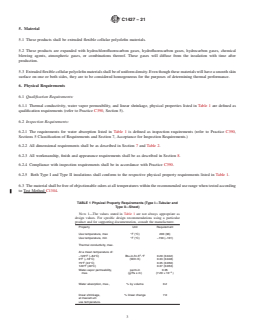
4.1 The preformed flexible cellular polyolefin thermal insulation shall be of the following types:
4.1.1 Type I—tubular.
4.1.2 Type II—sheet.
C1427 − 21
5. Material
5.1 These products shall be extruded flexible cellular polyolefin materials.
5.2 These products are expanded with hydrochlorofluorocarbon gases, hydrofluorocarbon gases, hydrocarbon gases, chemical
blowing agents, atmospheric gases, or combinations thereof. These gases will diffuse from the insulation with time after
production.
5.3 Extruded flexible cellular polyolefin materials shall be of uniform density. Even though these materials will have a smooth skin
surface on one or both sides, they are to be considered homogeneous for the purposes of determining thermal performance.
6. Physical Requirements
6.1 Qualification Requirements:
6.1.1 Thermal conductivity, water vapor permeability, and linear shrinkage, physical properties listed in Table 1 are defined as
qualification requirements (refer to Practice C390, Section 5).
6.2 Inspection Requirements:
6.2.1 The requirements for water absorption listed in Table 1 is defined as inspection requirements (refer to Practice C390,
Sections 5 Classification of Requirements and Section 7, Acceptance for Inspection Requirements.)
6.2.2 All dimensional requirements shall be as described in Section 7 and Table 2.
6.2.3 All workmanship, finish and appearance requirements shall be as described in Section 8.
6.2.4 Compliance with inspection requirements shall be in accordance with Practice C390.
6.2.5 Both Type I and Type II insulations shall conform to the respective physical property requirements listed in Table 1.
6.3 The material shall be free of objectionable odors at all temperatures within the recommended use range when tested according
to Test Method C1304.
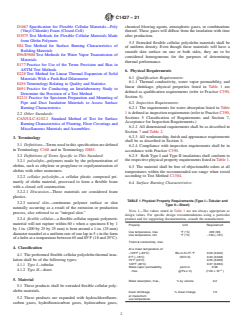
TABLE 1 Physical Property Requirements (Type I—Tubular and
Type II—Sheet)
NOTE 1—The values stated in Table 1 are not always appropriate as
design values. For specific design recommendations using a particular
product and for supporting documentation, consult the manufacturer.
Property Unit Requirement
Use temperature, max °F (°C) 200 (93)
Use temperature, min °F (°C) –150 (–101)
Thermal conductivity, max.
At a mean temperature of:
–120°F (–84°C) Btu-in./hr-ft -°F 0.29 (0.042)
0°F (–18°C) (W/m K) 0.33 (0.048)
75°F (24°C) 0.35 (0.050)
120°F (49°C) 0.37 (0.053)
Water-vapor permeability, perm-in 0.05
–9
max. (g/Pa s m) (7.29 × 10 )
Water absorption, max., % by volume 0.2
linear shrinkage, % linear change 7.0
at maxiumum
use temperature.
C1427 − 21
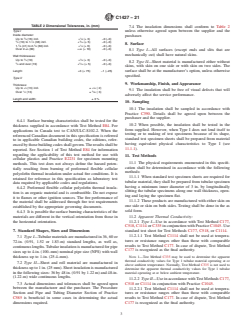
TABLE 2 Dimensional Tolerances, in. (mm)
Type I
Inside diameter:
5 1
Up to ⁄8 (16) incl. + ⁄8 (+ 3) –0 (–0)
3 1 3
⁄4 (19) to 1- ⁄2 (38) incl. + ⁄16 (+ 5) –0 (–0)
5 3 1
1- ⁄8 (41) to 2- ⁄8 (60) incl. + ⁄4 (+ 6) –0 (–0)
3 3
Over 2- ⁄8 (60) + ⁄8 (+ 10) –0 (–0)
Wall thicknesses:
3 1
Up to ⁄4 (19) + ⁄8 (+ 3) –0 (–0)
3 3
⁄4 and over (19) + ⁄16 (+ 5) –0 (–0)
Length: +3 (+ 75) –1 (–25)
Type II
Thickness:
1 1
Up to ⁄2 (13) incl. ± ⁄16 ( 2)
1 3
Over ⁄2 (13) ± ⁄32 ( 3)
Length and width: ± 3 %
6.4 Surface Burning Characteristics:
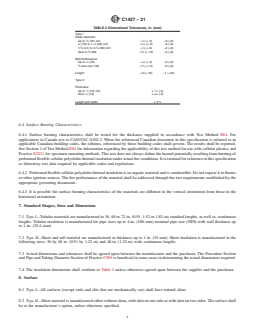
6.4.1 Surface burning characteristics shall be tested for the thickness supplied in accordance with Test Method E84. For
applications in Canada test to CAN/ULC-S102.2. When the referenced Canadian document in this specification is referred to in
applicable Canadian building codes, the editions, referenced by those building codes shall govern. The results shall be reported.
See Section 1 of Test Method E84 for information regarding the applicability of this test method for use with cellular plastics and
Practice E2231 for specimen mounting methods. This test does not always define the hazard potentially resulting from burning of
preformed flexible cellular polyolefin thermal insulation under actual fire conditions. It is retained for reference in this specification
as laboratory test data required by applicable codes and regulations.
6.4.2 Preformed flexible cellular polyolefin thermal insulation is an organic material and is combustible. Do not expose it to flames
or other ignition sources. The fire performance of the material shall be addressed through fire test requirements established by the
appropriate governing documents.
6.4.3 It is possible the surface burning characteristics of the materials are different in the vertical orientation from those in the
horizontal orientation.
7. Standard Shapes, Sizes and Dimensions
7.1 Type I—Tubular materials are manufactured in 36, 60 or 72-in. (0.91, 1.52 or 1.83-m) standard lengths, as well as, continuous
lengths. Tubular insulation is manufactured for pipe sizes up to 4-in. (100–mm) nominal pipe size (NPS) with wall thickness up
to 1-in. (25.4–mm).
7.2 Type II—Sheet and roll material are manufactured in thickness up to 1 in. (25 mm). Sheet insulation is manufactured in the
following sizes: 36 by 48 in. (0.91 by 1.22 m) and 48-in. (1.22-m) wide continuous lengths.
7.3 Actual dimensions and tolerances shall be agreed upon between the manufacturer and the purchaser. The Procedure Section
and Pipe and Tubing Diameter Section of Practice C585 is beneficial in some cases in determining the actual dimensions required.
7.4 The insulation dimensions shall conform to Table 2 unless otherwise agreed upon between the supplier and the purchaser.
8. Surface
8.1 Type I—All surfaces (except ends and slits that are mechanically cut) shall have natural skins.
8.2 Type II—Sheet material is manufactured either without skins, with skin on one side or with skin on two sides. The surface shall
be at the manufacturer’s option, unless otherwise specified.
C1427 − 21
9. Workmanship, Finish, and Appearance
9.1 The insulation shall be free of visual defects that will adversely affect the service performance.
10. Sampling
10.1 The insulation shall be sampled in accordance with Practice C390. Details shall be agreed upon between the purchaser and
the supplier.
10.2 When possible, the insulation shall be tested in the fo
...