

ASTM F1611-20
(Specification)Standard Specification for Intramedullary Reamers
General Information
- Abstract
ABSTRACT
This specification provides requirements for material, dimensions and tolerances, finish and marking, and care and handling for reamers intended to cut a cylindrical path along the medullary canal of diaphyseal bone. Intramedullary reamers are commonly used to prepare the medullary canal for the insertion of intramedullary fixation devices (IMFD). As such, the relationship between the intramedullary reamer diameter and the IMFD's diameter are considered. In general, intramedullary reamers consist of two types: one-piece reamer—a design where the reamer shaft and cutting head are permanently attached to each other; and Modular Reamer—a design where the reamer shaft and cutting head are two separate components, fixed to each other temporarily at the time of use via a geometric connection, for example, dovetail joint.
SCOPE
1.1 This specification provides requirements for material, dimensions and tolerances, finish and marking, and care and handling for reamers intended to cut a cylindrical path along the medullary canal of diaphyseal bone.
1.2 Intramedullary reamers are commonly used to prepare the medullary canal for the insertion of intramedullary fixation devices (IMFDs). As such, the relationship between the intramedullary reamer diameter and the IMFD's diameter are considered.
1.3 Units—The values stated in SI units are to be regarded as standard. No other units of measurement are included in this standard.
1.4 This international standard was developed in accordance with internationally recognized principles on standardization established in the Decision on Principles for the Development of International Standards, Guides and Recommendations issued by the World Trade Organization Technical Barriers to Trade (TBT) Committee.
- Status
- Published
- Publication Date
- 31-Jan-2020
- Technical Committee
- F04 - Medical and Surgical Materials and Devices
- Drafting Committee
- F04.21 - Osteosynthesis




Overview
ASTM F1611-20: Standard Specification for Intramedullary Reamers provides comprehensive requirements for the manufacture and use of intramedullary reamers-specialized surgical instruments designed to cut a cylindrical path along the medullary canal of diaphyseal bone. These reamers are critical in orthopedic surgery for preparing the canal for intramedullary fixation devices (IMFDs). The standard addresses material selection, dimensional requirements, tolerances, surface finish, marking, and guidelines for care and handling. Adherence to ASTM F1611-20 ensures compatibility, safety, and quality in orthopedic surgical procedures.
Key Topics
Material Requirements
- Specifies surgical-grade materials with adequate strength, hardness, and corrosion resistance
- Biocompatibility of materials is essential
- References ASTM standards for suitable stainless steels and alloys
Dimensions & Tolerances
- Reamer diameter measured at the largest section of the cutting head, to the nearest 0.2 mm
- Tolerances ensure precise fit with intramedullary fixation devices
- Accurate measurement methods enhance consistency and interchangeability
Types of Intramedullary Reamers
- One-piece reamer: Shaft and cutting head are permanently connected
- Modular reamer: Shaft and cutting head are detachable, joined temporarily for use
Finish and Marking
- Surfaces must be free from burrs, nicks, and other imperfections
- Flutes must have geometry suitable for efficient bone reaming
- Marking includes diameter, manufacturer details, catalog number, shaft diameter, and lot number, as space permits
- Permanent marking practices as per ASTM F983
Care and Handling
- Follows ASTM F565 for orthopedic instrument management
- Regular inspection for wear and functional performance is necessary
Applications
Intramedullary reamers compliant with ASTM F1611-20 are vital in:
- Orthopedic Trauma Surgery: Preparing bone canals for IMFDs, such as nails and rods, which stabilize fractures of long bones
- Joint Reconstruction: Ensuring precise reaming for secure implant fit, reducing surgical complications
- Device Manufacturing: Standardizing product quality for manufacturers of surgical instruments and implants worldwide
- Hospital Procurement: Guiding selection and acceptance of intramedullary reamers based on material and dimensional requirements
Proper reamer-to-implant fit, as stipulated in the standard, minimizes risks such as inadequate fixation or bone damage during surgery, promoting better patient outcomes and cross-compatibility between reamers and fixation devices.
Related Standards
ASTM F1611-20 references and aligns with several key ASTM and international standards to ensure comprehensive coverage and compatibility, including:
- ASTM F1264 - Specification and Test Methods for Intramedullary Fixation Devices
- ASTM F86 - Practice for Surface Preparation and Marking of Metallic Surgical Implants
- ASTM F565 - Practice for Care and Handling of Orthopedic Implants and Instruments
- ASTM F899 - Specification for Wrought Stainless Steels for Surgical Instruments
- ASTM F983 - Practice for Permanent Marking of Orthopaedic Implant Components
- ASTM A564, A693, A705 - Standards for surgical stainless steel materials
Additionally, ASTM F1611-20 was developed under internationally recognized standardization principles, ensuring global relevance and compatibility for medical device manufacturers, healthcare facilities, and regulatory bodies.
Keywords: intramedullary reamers, ASTM F1611-20, orthopedic surgical instruments, medullary canal, fixation device, surgical implant standards, reamer specifications, medical device compliance
Relations
- Effective Date
- 01-Feb-2020
- Effective Date
- 01-Nov-2023
- Effective Date
- 01-Feb-2020
- Effective Date
- 15-Sep-2019
- Effective Date
- 01-May-2019
- Refers
ASTM F983-86(2018) - Standard Practice for Permanent Marking of Orthopaedic Implant Components - Effective Date
- 01-Feb-2018
- Effective Date
- 15-Nov-2017
- Effective Date
- 01-May-2016
- Effective Date
- 01-May-2016
- Effective Date
- 01-Nov-2014
- Refers
ASTM F983-86(2013) - Standard Practice for Permanent Marking of Orthopaedic Implant Components - Effective Date
- 01-Oct-2013
- Refers
ASTM F565-04(2013) - Standard Practice for Care and Handling of Orthopedic Implants and Instruments - Effective Date
- 01-Oct-2013
- Effective Date
- 01-May-2013
- Effective Date
- 01-May-2013
- Effective Date
- 01-May-2013
Get Certified
Connect with accredited certification bodies for this standard

BSI Group
BSI (British Standards Institution) is the business standards company that helps organizations make excellence a habit.

TÜV Rheinland
TÜV Rheinland is a leading international provider of technical services.

TÜV SÜD
TÜV SÜD is a trusted partner of choice for safety, security and sustainability solutions.
Sponsored listings
Frequently Asked Questions
ASTM F1611-20 is a technical specification published by ASTM International. Its full title is "Standard Specification for Intramedullary Reamers". This standard covers: ABSTRACT This specification provides requirements for material, dimensions and tolerances, finish and marking, and care and handling for reamers intended to cut a cylindrical path along the medullary canal of diaphyseal bone. Intramedullary reamers are commonly used to prepare the medullary canal for the insertion of intramedullary fixation devices (IMFD). As such, the relationship between the intramedullary reamer diameter and the IMFD's diameter are considered. In general, intramedullary reamers consist of two types: one-piece reamer—a design where the reamer shaft and cutting head are permanently attached to each other; and Modular Reamer—a design where the reamer shaft and cutting head are two separate components, fixed to each other temporarily at the time of use via a geometric connection, for example, dovetail joint. SCOPE 1.1 This specification provides requirements for material, dimensions and tolerances, finish and marking, and care and handling for reamers intended to cut a cylindrical path along the medullary canal of diaphyseal bone. 1.2 Intramedullary reamers are commonly used to prepare the medullary canal for the insertion of intramedullary fixation devices (IMFDs). As such, the relationship between the intramedullary reamer diameter and the IMFD's diameter are considered. 1.3 Units—The values stated in SI units are to be regarded as standard. No other units of measurement are included in this standard. 1.4 This international standard was developed in accordance with internationally recognized principles on standardization established in the Decision on Principles for the Development of International Standards, Guides and Recommendations issued by the World Trade Organization Technical Barriers to Trade (TBT) Committee.
ABSTRACT This specification provides requirements for material, dimensions and tolerances, finish and marking, and care and handling for reamers intended to cut a cylindrical path along the medullary canal of diaphyseal bone. Intramedullary reamers are commonly used to prepare the medullary canal for the insertion of intramedullary fixation devices (IMFD). As such, the relationship between the intramedullary reamer diameter and the IMFD's diameter are considered. In general, intramedullary reamers consist of two types: one-piece reamer—a design where the reamer shaft and cutting head are permanently attached to each other; and Modular Reamer—a design where the reamer shaft and cutting head are two separate components, fixed to each other temporarily at the time of use via a geometric connection, for example, dovetail joint. SCOPE 1.1 This specification provides requirements for material, dimensions and tolerances, finish and marking, and care and handling for reamers intended to cut a cylindrical path along the medullary canal of diaphyseal bone. 1.2 Intramedullary reamers are commonly used to prepare the medullary canal for the insertion of intramedullary fixation devices (IMFDs). As such, the relationship between the intramedullary reamer diameter and the IMFD's diameter are considered. 1.3 Units—The values stated in SI units are to be regarded as standard. No other units of measurement are included in this standard. 1.4 This international standard was developed in accordance with internationally recognized principles on standardization established in the Decision on Principles for the Development of International Standards, Guides and Recommendations issued by the World Trade Organization Technical Barriers to Trade (TBT) Committee.
ASTM F1611-20 is classified under the following ICS (International Classification for Standards) categories: 11.040.30 - Surgical instruments and materials. The ICS classification helps identify the subject area and facilitates finding related standards.
ASTM F1611-20 has the following relationships with other standards: It is inter standard links to ASTM F1611-00(2018), ASTM F899-23, ASTM F899-20, ASTM F899-19, ASTM A564/A564M-19, ASTM F983-86(2018), ASTM A705/A705M-17, ASTM F1264-16, ASTM F1264-16e1, ASTM F1264-14, ASTM F983-86(2013), ASTM F565-04(2013), ASTM A693-13, ASTM A705/A705M-13, ASTM A564/A564M-13e1. Understanding these relationships helps ensure you are using the most current and applicable version of the standard.
ASTM F1611-20 is available in PDF format for immediate download after purchase. The document can be added to your cart and obtained through the secure checkout process. Digital delivery ensures instant access to the complete standard document.
Standards Content (Sample)
This international standard was developed in accordance with internationally recognized principles on standardization established in the Decision on Principles for the
Development of International Standards, Guides and Recommendations issued by the World Trade Organization Technical Barriers to Trade (TBT) Committee.
Designation: F1611 −20
Standard Specification for
Intramedullary Reamers
This standard is issued under the fixed designation F1611; the number immediately following the designation indicates the year of
original adoption or, in the case of revision, the year of last revision. A number in parentheses indicates the year of last reapproval. A
superscript epsilon (´) indicates an editorial change since the last revision or reapproval.
1. Scope F983 Practice for Permanent Marking of Orthopaedic Im-
plant Components
1.1 This specification provides requirements for material,
F1264 Specification and Test Methods for Intramedullary
dimensions and tolerances, finish and marking, and care and
Fixation Devices
handling for reamers intended to cut a cylindrical path along
the medullary canal of diaphyseal bone.
3. Terminology
1.2 Intramedullary reamers are commonly used to prepare
3.1 Definitions of Terms Specific to This Standard:
the medullary canal for the insertion of intramedullary fixation
3.1.1 cutting head, n—the portion of the reamer, which
devices (IMFDs). As such, the relationship between the in-
consists of flutes, or edges, which cuts the bone.
tramedullary reamer diameter and the IMFD’s diameter are
3.1.2 reamer diameter, n—thediameterofthecircumscribed
considered.
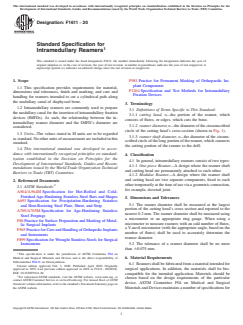
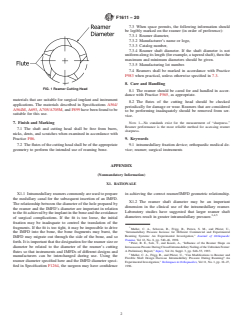
circle of the cutting head’s cross-section (shown in Fig. 1).
1.3 Units—The values stated in SI units are to be regarded
3.1.3 reamer shaft diameter, n—the diameter of the circum-
as standard. No other units of measurement are included in this
scribed circle of the long portion of the reamer, which connects
standard.
the cutting portion of the reamer to the drill.
1.4 This international standard was developed in accor-
dance with internationally recognized principles on standard-
4. Classification
ization established in the Decision on Principles for the
4.1 In general, intramedullary reamers consist of two types:
Development of International Standards, Guides and Recom-
4.1.1 One-piece Reamer—A design where the reamer shaft
mendations issued by the World Trade Organization Technical
and cutting head are permanently attached to each other.
Barriers to Trade (TBT) Committee.
4.1.2 Modular Reamer—A design where the reamer shaft
and cutting head are two separate components, fixed to each
2. Referenced Documents
othertemporarilyatthetimeofuseviaageometricconnection,
2.1 ASTM Standards:
for example, dovetail joint.
A564/A564M Specification for Hot-Rolled and Cold-
Finished Age-Hardening Stainless Steel Bars and Shapes
5. Dimensions and Tolerances
A693 Specification for Precipitation-Hardening Stainless
5.1 The reamer diameter shall be measured at the largest
and Heat-Resisting Steel Plate, Sheet, and Strip
portion of the cutting head’s cross section and reported to the
A705/A705M Specification for Age-Hardening Stainless
nearest 0.2 mm. The reamer diameter shall be measured using
Steel Forgings
a micrometer or an appropriate ring gauge. When using a
F86 Practice for Surface Preparation and Marking of Metal-
micrometer to measure reamers with an odd number of flutes,
lic Surgical Implants
a V-anvil micrometer (with the appropriate angle, based on the
F565 Practice for Care and Handling of Orthopedic Implants
number of flutes) shall be used to accurately determine the
and Instruments
reamer diameter.
F899 Specification for Wrought Stainless Steels for Surgical
Instruments 5.2 The tolerance of a reamer diameter shall be no more
than 60.075 mm.
This specification is under the jurisdiction of ASTM Committee F04 on
6. Material Requirements
Medical and Surgical Materials and Devices and is the direct responsibliltiy of
Subcommittee F04.21 on Osteosynthesis.
6.1 Reamers shall be fabricated from a material intended for
Current edition approved Feb. 1, 2020. Published April 2020. Originally
surgical applications. In addition, the materials shall be bio-
approved in 1995. Last previous edition approved in 2018 as F1611 – 00(2018).
DOI: 10.1520/F1611-20.
compatible for the intended application. Materials should be
For referenced ASTM standards, visit the ASTM website, www.astm.org, or
chosen based on the design requirements of the particular
contact ASTM Customer Service at service@astm.org. For Annual Book of ASTM
device. ASTM Committee F04 on Medical and Surgical
Standards volume information, refer to the standard’s Document Summary page on
the ASTM website. Materials and Devices maintains a number of specifications for
Copyright © ASTM International, 100 Barr Harbor Drive, PO Box C700, West Conshohocken, PA 19428-2959. United States
F1611 − 20
7.3 When space permits, the following information should
be legibly marked on the reamer (in order of preference):
7.3.1 Rea
...
This document is not an ASTM standard and is intended only to provide the user of an ASTM standard an indication of what changes have been made to the previous version. Because
it may not be technically possible to adequately depict all changes accurately, ASTM recommends that users consult prior editions as appropriate. In all cases only the current version
of the standard as published by ASTM is to be considered the official document.
Designation: F1611 − 00 (Reapproved 2018) F1611 − 20
Standard Specification for
Intramedullary Reamers
This standard is issued under the fixed designation F1611; the number immediately following the designation indicates the year of
original adoption or, in the case of revision, the year of last revision. A number in parentheses indicates the year of last reapproval. A
superscript epsilon (´) indicates an editorial change since the last revision or reapproval.
1. Scope
1.1 This specification provides requirements for material, dimensions and tolerances, finish and marking, and care and handling
for reamers intended to cut a cylindrical path along the medullary canal of diaphyseal bone.
1.2 Intramedullary reamers are commonly used to prepare the medullary canal for the insertion of intramedullary fixation
devices (IMFD).(IMFDs). As such, the relationship between the intramedullary reamer diameter and the IMFD’s diameter are
considered.
1.3 Units—The values stated in SI units are to be regarded as standard. No other units of measurement are included in this
standard.
1.4 This international standard was developed in accordance with internationally recognized principles on standardization
established in the Decision on Principles for the Development of International Standards, Guides and Recommendations issued
by the World Trade Organization Technical Barriers to Trade (TBT) Committee.
2. Referenced Documents
2.1 ASTM Standards:
A564/A564M Specification for Hot-Rolled and Cold-Finished Age-Hardening Stainless Steel Bars and Shapes
A693 Specification for Precipitation-Hardening Stainless and Heat-Resisting Steel Plate, Sheet, and Strip
A705/A705M Specification for Age-Hardening Stainless Steel Forgings
F86 Practice for Surface Preparation and Marking of Metallic Surgical Implants
F565 Practice for Care and Handling of Orthopedic Implants and Instruments
F899 Specification for Wrought Stainless Steels for Surgical Instruments
F983 Practice for Permanent Marking of Orthopaedic Implant Components
F1264 Specification and Test Methods for Intramedullary Fixation Devices
3. Terminology
3.1 Definitions of Terms Specific to This Standard:
3.1.1 cutting head, n—the portion of the reamer, which consists of flutes, or edges, which cutcuts the bone.
3.1.2 reamer diameter, n—the diameter of the circumscribed circle of the cutting head’s cross-section (shown in Fig. 1).
3.1.3 reamer shaft diameter, n—the diameter of the circumscribed circle of the long portion of the reamer, which connects the
cutting portion of the reamer to the drill.
4. Classification
4.1 In general, intramedullary reamers consist of two types:
4.1.1 One-piece reamer—Reamer—A design where the reamer shaft and cutting head are permanently attached to each other.
4.1.2 Modular Reamer—A design where the reamer shaft and cutting head are two separate components, fixed to each other
temporarily at the time of use via a geometric connection, for example, dovetail joint.
This specification is under the jurisdiction of ASTM Committee F04 on Medical and Surgical Materials and Devices and is the direct responsibliltiy of Subcommittee
F04.21 on Osteosynthesis.
Current edition approved Feb. 1, 2018Feb. 1, 2020. Published April 2018April 2020. Originally approved in 1995. Last previous edition approved in 20132018 as
F1611 – 00(2013).(2018). DOI: 10.1520/F1611-00R18.10.1520/F1611-20.
For referenced ASTM standards, visit the ASTM website, www.astm.org, or contact ASTM Customer Service at service@astm.org. For Annual Book of ASTM Standards
volume information, refer to the standard’s Document Summary page on the ASTM website.
Copyright © ASTM International, 100 Barr Harbor Drive, PO Box C700, West Conshohocken, PA 19428-2959. United States
F1611 − 20
FIG. 1 Reamer Cutting Head
5. Dimensions and Tolerances
5.1 The reamer diameter shall be measured at the largest portion of the cutting head’s cross section and reported to the nearest
0.2 mm. The reamer diameter shall be measured using a micrometer or an appropriate ring gage.gauge. When using a micrometer
to measure reamers with an odd number of flutes, a V-anvil micrometer (with the appropriate angle, based on the number of flutes)
willshall be used to accurately determine the reamer diameter.
5.2 The tolerance of a reamer diameter shall be no more than 60.075 mm.
6. Material Requirements
6.1 The reamer’s shaft and cutting head Reamers shall be fabricated from materials with suitable strength, hardness, and
corrosion resistance.a material intended for surgical applications. In addition, the materials shall be biocompatible for the intended
application. Materials should be chosen based on the design requirements of the particular device. ASTM Committee F04 on
Medical and Surgical Materials and Devices maintains a num
...