

ASTM A626/A626M-22
(Specification)Standard Specification for Tin Mill Products, Electrolytic Tin Plate, Double Reduced
General Information
- Abstract
ABSTRACT
This specification covers double-reduced electrolytic tin plate produced from low-carbon cold-reduced steel furnished in coils and cut sizes for use predominately in the manufacture of cans. Double-reduced plate is relatively brittle and has very distinct directional properties. The rolling direction shall be specified on cut sizes and will be indicated by underlining the slit (rolling width) dimension. In sampling for tin coating weights [masses], the following procedure shall be used: a test strip shall be taken at random from a representative section of each coil across its width; from one or two coil lots, each coil shall be sampled; and a sheet shall be taken at random from each packages, each taken from different bundles from any one item of a specific shipment. X-ray fluorescence method shall be performed to determine the tin coating weight. Surface appearance shall be bright or matte depending on coating processes and the base metal finish shall have a smooth finish with grit lines. Chemical treatments for tin plate shall be cathodic sodium dichromate (CDC) treatment or sodium dichromate dip (SDCD/SDD) treatment. Electrolytic tin plate is furnished with an oil film applied to both surfaces.
SCOPE
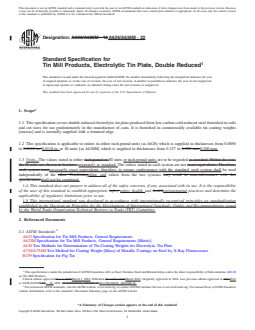
1.1 This specification covers double-reduced electrolytic tin plate produced from low-carbon cold-reduced steel furnished in coils and cut sizes for use predominately in the manufacture of cans. It is furnished in commercially available tin coating weights [masses] and is normally supplied with a trimmed edge.
1.2 This specification is applicable to orders in either inch-pound units (as A626) which is supplied in thicknesses from 0.0050 to 0.0118 in. or SI units [as A626M] which is supplied in thicknesses from 0.127 to 0.300 mm.
1.3 Units—The values stated in either SI units or inch-pound units are to be regarded separately as standard. The values stated in each system are not necessarily exact equivalents; therefore, to ensure conformance with the standard, each system shall be used independently of the other, and values from the two systems shall not be combined.
1.4 This standard does not purport to address all of the safety concerns, if any, associated with its use. It is the responsibility of the user of this standard to establish appropriate safety, health, and environmental practices and determine the applicability of regulatory limitations prior to use.
1.5 This international standard was developed in accordance with internationally recognized principles on standardization established in the Decision on Principles for the Development of International Standards, Guides and Recommendations issued by the World Trade Organization Technical Barriers to Trade (TBT) Committee.
- Status
- Published
- Publication Date
- 28-Feb-2022
- Technical Committee
- A01 - Steel, Stainless Steel and Related Alloys
- Drafting Committee
- A01.20 - Tin Mill Products
Buy Documents
ASTM A626/A626M-22 - Standard Specification for Tin Mill Products, Electrolytic Tin Plate, Double Reduced
REDLINE ASTM A626/A626M-22 - Standard Specification for Tin Mill Products, Electrolytic Tin Plate, Double Reduced
Overview
ASTM A626/A626M-22 is the international standard specification developed by ASTM for double-reduced electrolytic tin plate. This standard covers tin mill products produced from low-carbon, cold-reduced steel provided in coils and cut sizes, specifically designed for the manufacture of cans and other packaging applications. The document details requirements for tin coating weights, surface appearance, finish, chemical treatment, and oiling, ensuring consistent quality and performance of electrolytic tin plate used in industrial settings.
Double-reduced electrolytic tin plate features increased strength, lower ductility, and pronounced directional properties compared to single-reduced grades. Given these characteristics, this tin plate type is particularly suited for the commercial canning industry, providing durable and reliable material for food, beverage, and general line cans.
Key Topics
Product Scope
- Applies to double-reduced electrolytic tin plate made from low-carbon cold-reduced steel.
- Supplied in coils and cut sizes within set thickness ranges: 0.0050 to 0.0118 in. (inch-pound) or 0.127 to 0.300 mm (SI).
- Both inch-pound and SI units are covered; usage must be consistent within orders.
Quality and Ordering
- Requirements include specifying the product, tin coating weight, marking, surface finish, chemical treatment, oiling, and physical dimensions like thickness and coil width.
- Orders should specify rolling direction due to the material’s directional properties.
Tin Coating Weight
- Covers both uniform and differentially coated (one side heavier) tin plates.
- Testing involves random sampling and spot tests to ensure compliance with designated classes and average/spot coating weights.
- X-ray fluorescence is a typical method for determining tin coating mass.
Surface and Finish
- Surface appearance may be bright (melted) or matte (unmelted) based on process and customer requirements.
- Ground finishes are typical, providing a smooth surface with controlled roughness suitable for can applications.
Chemical Treatment and Oiling
- Chemical passivation treatments such as cathodic sodium dichromate (CDC) and sodium dichromate dip (SDCD/SDD) are commonly applied to inhibit tin oxide growth and improve storage, solderability, and resistance to discoloration.
- Oil film (commonly dioctyl sebacate or acetyl tributyl citrate) is applied to both surfaces for protection and process facilitation.
Applications
The main application for double-reduced electrolytic tin plate under ASTM A626/A626M-22 is in the manufacture of food and beverage cans and related metal packaging. Key practical benefits include:
Enhanced Material Strength
Double-reduction rolling increases the tin plate’s strength, making it ideal for can bodies that require high durability with minimal thickness.Consistent Corrosion Resistance
Uniform tin coatings and optional passivation treatments provide superior resistance to corrosion, critical for food safety and shelf-stability.Reliable Surface for Coating and Welding
Specified surface finishes and oil treatments ensure effective application of organic coatings, printing, and secure weld seams during can fabrication.
Industries using this standard benefit from predictable material properties, traceability, and compliance with international trade and regulatory requirements.
Related Standards
Professionals working with ASTM A626/A626M-22 may reference several related ASTM standards, including:
- ASTM A623 / A623M - General requirements for tin mill products.
- ASTM A630 - Test methods for determining tin coating weights.
- ASTM A754/A754M - X-ray fluorescence test method for coating weight.
- ASTM B339 - Specification for pig tin.
Utilizing these related standards alongside ASTM A626/A626M-22 supports comprehensive quality assurance and process control for tin mill product applications across the packaging industry.
Relations
- Effective Date
- 01-Mar-2024
- Effective Date
- 01-Nov-2019
- Effective Date
- 01-Dec-2016
- Effective Date
- 01-Dec-2016
- Effective Date
- 01-May-2016
- Effective Date
- 01-Oct-2014
- Effective Date
- 01-May-2012
- Effective Date
- 01-Oct-2011
- Effective Date
- 01-Oct-2011
- Effective Date
- 01-Oct-2010
- Effective Date
- 01-Oct-2010
- Effective Date
- 01-Apr-2010
- Effective Date
- 01-Oct-2009
- Effective Date
- 01-Oct-2009
- Effective Date
- 01-Apr-2009
Buy Documents
ASTM A626/A626M-22 - Standard Specification for Tin Mill Products, Electrolytic Tin Plate, Double Reduced
REDLINE ASTM A626/A626M-22 - Standard Specification for Tin Mill Products, Electrolytic Tin Plate, Double Reduced
Get Certified
Connect with accredited certification bodies for this standard

Element Materials Technology
Materials testing and product certification.

Inštitut za kovinske materiale in tehnologije
Institute of Metals and Technology. Materials testing, metallurgical analysis, NDT.
Sponsored listings
Frequently Asked Questions
ASTM A626/A626M-22 is a technical specification published by ASTM International. Its full title is "Standard Specification for Tin Mill Products, Electrolytic Tin Plate, Double Reduced". This standard covers: ABSTRACT This specification covers double-reduced electrolytic tin plate produced from low-carbon cold-reduced steel furnished in coils and cut sizes for use predominately in the manufacture of cans. Double-reduced plate is relatively brittle and has very distinct directional properties. The rolling direction shall be specified on cut sizes and will be indicated by underlining the slit (rolling width) dimension. In sampling for tin coating weights [masses], the following procedure shall be used: a test strip shall be taken at random from a representative section of each coil across its width; from one or two coil lots, each coil shall be sampled; and a sheet shall be taken at random from each packages, each taken from different bundles from any one item of a specific shipment. X-ray fluorescence method shall be performed to determine the tin coating weight. Surface appearance shall be bright or matte depending on coating processes and the base metal finish shall have a smooth finish with grit lines. Chemical treatments for tin plate shall be cathodic sodium dichromate (CDC) treatment or sodium dichromate dip (SDCD/SDD) treatment. Electrolytic tin plate is furnished with an oil film applied to both surfaces. SCOPE 1.1 This specification covers double-reduced electrolytic tin plate produced from low-carbon cold-reduced steel furnished in coils and cut sizes for use predominately in the manufacture of cans. It is furnished in commercially available tin coating weights [masses] and is normally supplied with a trimmed edge. 1.2 This specification is applicable to orders in either inch-pound units (as A626) which is supplied in thicknesses from 0.0050 to 0.0118 in. or SI units [as A626M] which is supplied in thicknesses from 0.127 to 0.300 mm. 1.3 Units—The values stated in either SI units or inch-pound units are to be regarded separately as standard. The values stated in each system are not necessarily exact equivalents; therefore, to ensure conformance with the standard, each system shall be used independently of the other, and values from the two systems shall not be combined. 1.4 This standard does not purport to address all of the safety concerns, if any, associated with its use. It is the responsibility of the user of this standard to establish appropriate safety, health, and environmental practices and determine the applicability of regulatory limitations prior to use. 1.5 This international standard was developed in accordance with internationally recognized principles on standardization established in the Decision on Principles for the Development of International Standards, Guides and Recommendations issued by the World Trade Organization Technical Barriers to Trade (TBT) Committee.
ABSTRACT This specification covers double-reduced electrolytic tin plate produced from low-carbon cold-reduced steel furnished in coils and cut sizes for use predominately in the manufacture of cans. Double-reduced plate is relatively brittle and has very distinct directional properties. The rolling direction shall be specified on cut sizes and will be indicated by underlining the slit (rolling width) dimension. In sampling for tin coating weights [masses], the following procedure shall be used: a test strip shall be taken at random from a representative section of each coil across its width; from one or two coil lots, each coil shall be sampled; and a sheet shall be taken at random from each packages, each taken from different bundles from any one item of a specific shipment. X-ray fluorescence method shall be performed to determine the tin coating weight. Surface appearance shall be bright or matte depending on coating processes and the base metal finish shall have a smooth finish with grit lines. Chemical treatments for tin plate shall be cathodic sodium dichromate (CDC) treatment or sodium dichromate dip (SDCD/SDD) treatment. Electrolytic tin plate is furnished with an oil film applied to both surfaces. SCOPE 1.1 This specification covers double-reduced electrolytic tin plate produced from low-carbon cold-reduced steel furnished in coils and cut sizes for use predominately in the manufacture of cans. It is furnished in commercially available tin coating weights [masses] and is normally supplied with a trimmed edge. 1.2 This specification is applicable to orders in either inch-pound units (as A626) which is supplied in thicknesses from 0.0050 to 0.0118 in. or SI units [as A626M] which is supplied in thicknesses from 0.127 to 0.300 mm. 1.3 Units—The values stated in either SI units or inch-pound units are to be regarded separately as standard. The values stated in each system are not necessarily exact equivalents; therefore, to ensure conformance with the standard, each system shall be used independently of the other, and values from the two systems shall not be combined. 1.4 This standard does not purport to address all of the safety concerns, if any, associated with its use. It is the responsibility of the user of this standard to establish appropriate safety, health, and environmental practices and determine the applicability of regulatory limitations prior to use. 1.5 This international standard was developed in accordance with internationally recognized principles on standardization established in the Decision on Principles for the Development of International Standards, Guides and Recommendations issued by the World Trade Organization Technical Barriers to Trade (TBT) Committee.
ASTM A626/A626M-22 is classified under the following ICS (International Classification for Standards) categories: 77.140.50 - Flat steel products and semi-products. The ICS classification helps identify the subject area and facilitates finding related standards.
ASTM A626/A626M-22 has the following relationships with other standards: It is inter standard links to ASTM A630-16a(2024), ASTM B339-19, ASTM A630-16ae1, ASTM A630-16a, ASTM A630-16, ASTM A630-03(2014), ASTM B339-12, ASTM A623-11, ASTM A623M-11, ASTM A623M-10, ASTM A623-10, ASTM B339-00(2010), ASTM A623M-09, ASTM A623-09, ASTM A630-03(2009). Understanding these relationships helps ensure you are using the most current and applicable version of the standard.
ASTM A626/A626M-22 is available in PDF format for immediate download after purchase. The document can be added to your cart and obtained through the secure checkout process. Digital delivery ensures instant access to the complete standard document.
Standards Content (Sample)
This international standard was developed in accordance with internationally recognized principles on standardization established in the Decision on Principles for the
Development of International Standards, Guides and Recommendations issued by the World Trade Organization Technical Barriers to Trade (TBT) Committee.
Designation: A626/A626M −22
Standard Specification for
Tin Mill Products, Electrolytic Tin Plate, Double Reduced
This standard is issued under the fixed designationA626/A626M; the number immediately following the designation indicates the year
of original adoption or, in the case of revision, the year of last revision. A number in parentheses indicates the year of last reapproval.
A superscript epsilon (´) indicates an editorial change since the last revision or reapproval.
This standard has been approved for use by agencies of the U.S. Department of Defense.
1. Scope* A623 Specification for Tin Mill Products, General Require-
ments
1.1 This specification covers double-reduced electrolytic tin
A623M Specification for Tin Mill Products, General Re-
plate produced from low-carbon cold-reduced steel furnished
quirements [Metric]
in coils and cut sizes for use predominately in the manufacture
A630 Test Methods for Determination of Tin Coating
of cans. It is furnished in commercially available tin coating
Weights for Electrolytic Tin Plate
weights [masses] and is normally supplied with a trimmed
A754/A754M Test Method for Coating Weight [Mass] of
edge.
Metallic Coatings on Steel by X-Ray Fluorescence
1.2 This specification is applicable to orders in either
B339 Specification for Pig Tin
inch-pound units (as A626) which is supplied in thicknesses
from 0.0050 to 0.0118 in. or SI units [as A626M] which is 3. Ordering Information
supplied in thicknesses from 0.127 to 0.300 mm.
3.1 Orders for product under this specification shall include
1.3 Units—The values stated in either SI units or inch- the following information, as required and applicable, to
describe adequately the desired product:
pound units are to be regarded separately as standard. The
values stated in each system are not necessarily exact equiva- 3.1.1 Name of product (double-reduced electrolytic tin
plate) (Section 1),
lents; therefore, to ensure conformance with the standard, each
system shall be used independently of the other, and values 3.1.2 Tincoatingweight[mass]designation,andmarking,if
any (Section 5, Table 1, and Figs. 1 and 2),
from the two systems shall not be combined.
3.1.3 Surface appearance and finish (Section 6),
1.4 This standard does not purport to address all of the
3.1.4 Chemical treatment (Section 7),
safety concerns, if any, associated with its use. It is the
3.1.5 Oiling (Section 8),
responsibility of the user of this standard to establish appro-
3.1.6 Thickness (Specification A623 [A623M]) (consistent
priate safety, health, and environmental practices and deter-
with the intended application),
mine the applicability of regulatory limitations prior to use.
3.1.7 Coilwidthorcutsizeinincrementsof ⁄16 in.or1 mm,
1.5 This international standard was developed in accor-
3.1.8 Due to the very distinct directional properties, rolling
dance with internationally recognized principles on standard-
direction must be specified on cut sizes by underlining the slit
ization established in the Decision on Principles for the
(rolling width) dimension (Section 4) (consistent with the
Development of International Standards, Guides and Recom-
intended application),
mendations issued by the World Trade Organization Technical
3.1.9 Steel type (Specification A623 [A623M]),
Barriers to Trade (TBT) Committee.
3.1.10 Mechanical requirement designation (Specification
A623 [A623M]) (consistent with the intended application),
2. Referenced Documents
3.1.11 Intended application,
2.1 ASTM Standards:
3.1.12 Quantity in base boxes SITAs (see Note 4),
3.1.13 On coils, specify minimum or range of acceptable
inside diameters. The standard inside diameter is approxi-
This specification is under the jurisdiction of ASTM Committee A01 on Steel,
mately 16 in. if ordered to Specification A626 [410 mm if
Stainless Steel and Related Alloys and is the direct responsibility of Subcommittee
ordered to Specification A626M]. Coils should be specified to
A01.20 on Tin Mill Products.
a maximum coil weight if ordered to SpecificationA626 [mass
Current edition approved March 1, 2022. Published March 2022. Originally
if ordered to Specification A626M] or maximum outside
approved in 1968. Last previous edition approved in 2016 as A626/A626M – 16.
DOI: 10.1520/A0626_A0626M-22.
diameter, or both,
For referenced ASTM standards, visit the ASTM website, www.astm.org, or
3.1.14 Packaging,
contact ASTM Customer Service at service@astm.org. For Annual Book of ASTM
3.1.15 Special requirements, where applicable (J = plate or
Standards volume information, refer to the standard’s Document Summary page on
the ASTM website. K = plate), and
*A Summary of Changes section appears at the end of this standard
Copyright © ASTM International, 100 Barr Harbor Drive, PO Box C700, West Conshohocken, PA 19428-2959. United States
A626/A626M − 22
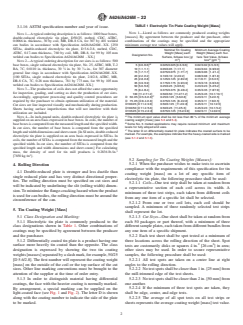
TABLE 1 Electrolytic Tin Plate Coating Weight [Mass]
3.1.16 ASTM specification number and year of issue.
NOTE 1—Listed as follows are commonly produced coating weights
NOTE 1—Atypical ordering description is as follows: 1000 base boxes,
[masses]. By agreement between the producer and the purchaser, other
double-reduced electrolytic tin plate, D50/25, melted, CDC, ATBC,
combinations of the coatings may be specified and the appropriate
0.0066 in. thickness, 30 by coil, MR, DR-8 CA, for 307 by 401 welded
minimum average test values will apply.
can bodies in accordance with Specification A626/A626M - XX. [250
SITAs, double-reduced electrolytic tin plate, D 5.6 ⁄2.8, melted, CDC,
Nominal Tin Coating Minimum Average Coating
ATBC, 0.17-mm thickness, 760 by coil, MR, DR-8, for 99 by 105 mm Weight [Mass] each Weight [Mass] each Sur-
Designation No.
Surface, lb/base box [g/ face Test Value, lb/base
welded can bodies to Specification A626/A626M - XX.]
2 A 2
m ] box [g/m ]
NOTE 2—Atypical ordering description for cut sizes is as follows: 500
B
base boxes, single reduced electrolytic tin plate, No. 25, ATBC, MR, T-2 5 [0.6 ⁄0.6] 0.025/0.025 [0.6 ⁄0.6] 0.02/0.02 [0.5 ⁄0.5]
3 7
10 [1.1 ⁄1.1] 0.05/0.05 [1.1/1.1] 0.04/0.04 [0.9/0.9]
BA, 7C, 0.0110 in. thickness, 30 ⁄4 in. by 30 ⁄16 in., for 307 diameter
15 [1.7 ⁄1.7] 0.075/0.075 [1.7/1.7] 0.06/0.06 [1.4/1.4]
general line rings in accordance with Specification A626/A626M -XX.
20 [2.2 ⁄2.2] 0.10/0.10 [2.2/2.2] 0.08/0.08 [1.8/1.8]
[100 SITAs, single reduced electrolytic tin plate, 2.8/2.8, ATBC, MR,
25 [2.8 ⁄2.8] 0.125/0.125 [2.8/2.8] 0.11/0.11 [2.5/2.5]
DR-8 CA, 7C, 0.28 mm thickness, 781 by 773 mm, for 99 by 105 mm
35 [3.9 ⁄3.9] 0.175/0.175 [3.9/3.9] 0.16/0.16 [3.6/3.6]
welded can bodies to Specification A626/A626M -XX.]
50 [5.6 ⁄5.6] 0.25/0.25 [5.6/5.6] 0.23/0.23 [5.2/5.2]
NOTE 3—The production of coils does not afford the same opportunity
75 [8.4 ⁄8.4] 0.375/0.375 [8.4/8.4] 0.35/0.35 [7.8/7.8]
for inspection, grading, and sorting as does the production of cut sizes.
100 [11.2 ⁄11.2] 0.50/0.50 [11.2/11.2] 0.45/0.45 [10.1/10.1]
C
Accordingly, appropriate processing and quality control procedures are
D 50 ⁄25 [D 5.6 ⁄2.8] 0.25/0.125 [5.6/2.8] 0.23/0.11 [5.2/2.5]
required by the purchaser to obtain optimum utilization of the material. D 75 ⁄25 [D 8.4 ⁄2.8] 0.375/0.125 [8.4/2.8] 0.35/0.11 [7.8/2.5]
D100/25 [D 11.2 ⁄2.8] 0.50/0.125 [11.2/2.8] 0.45/0.11 [10.1/2.5]
Cut sizes are line inspected visually and mechanically during production.
D100/50 [D 11.2 ⁄5.6] 0.50/0.25 [11.2/5.6] 0.45/0.23 [10.1/5.2]
Sheets having surface imperfections that will not interfere with their
D135/25 [D 15.2 ⁄2.8] 0.675/0.125 [15.2/2.8] 0.62/0.11 [14.0/2.5]
utilization are included.
A
NOTE 4—In inch-pound units, double-reduced electrolytic tin plate is
The minimum spot value shall be not less than 80 % of the minimum average
coating weight [mass] (see 5.3 and 5.4).
supplied on an area basis expressed in base boxes. In coils, the number of
B
Some No. 5 melted applications may require revised minimum and maximum
base boxes is computed from the measured length and the specified width.
levels for fully alloyed end uses.
In cut sizes, the number of base boxes is computed from the specified
C
The letter D on differentially coated tin plate indicates the coated surface to be
length and width dimensions and sheet count. [In SI units, double-reduced
marked. For example, the examples indicate that the heavy-coated side is marked
electrolytic tin plate is supplied on an area basis expressed in SITAs. In
(see 5.1.2 and 5.1.3).
coils, the number of SITAs is computed from the measured length and the
specified width. In cut sizes, the number of SITAs is computed from the
specified length and width dimensions and sheet count.] For calculating
mass, the density of steel for tin mill products is 0.2836 lb ⁄in.
[7850 kg ⁄m ].
5.2 Sampling for Tin Coating Weights [Masses]:
5.2.1 When the purchaser wishes to make tests to ascertain
4. Rolling Direction
compliance with the requirements of this specification for tin
4.1 Double-reduced plate is stronger and less ductile than
coating weight [mass] on a lot of any specific item of
single reduced plate and has very distinct directional proper-
electrolytic tin plate, the following procedure shall be used:
ties. The rolling direction must be specified on cut sizes and
5.2.1.1 Coils—One test strip shall be taken at random from
will be indicated by underlining the slit (rolling width) dimen-
a representative section of each coil across its width. A
sion.To minimize the flange-cracking hazard when the product
minimum of three test strips, each taken from different coils
is used for can bodies, the rolling direction must be around the
from any one item of a specific lot shall be selected.
circumferen
...
This document is not an ASTM standard and is intended only to provide the user of an ASTM standard an indication of what changes have been made to the previous version. Because
it may not be technically possible to adequately depict all changes accurately, ASTM recommends that users consult prior editions as appropriate. In all cases only the current version
of the standard as published by ASTM is to be considered the official document.
Designation: A626/A626M − 16 A626/A626M − 22
Standard Specification for
Tin Mill Products, Electrolytic Tin Plate, Double Reduced
This standard is issued under the fixed designation A626/A626M; the number immediately following the designation indicates the year
of original adoption or, in the case of revision, the year of last revision. A number in parentheses indicates the year of last reapproval.
A superscript epsilon (´) indicates an editorial change since the last revision or reapproval.
This standard has been approved for use by agencies of the U.S. Department of Defense.
1. Scope*
1.1 This specification covers double-reduced electrolytic tin plate produced from low-carbon cold-reduced steel furnished in coils
and cut sizes for use predominately in the manufacture of cans. It is furnished in commercially available tin coating weights
[masses] and is normally supplied with a trimmed edge.
1.2 This specification is applicable to orders in either inch-pound units (as A626) which is supplied in thicknesses from 0.0050
to 0.0118 in. 0.0118 in. or SI units [as A626M] which is supplied in thicknesses from 0.127 to 0.300 mm.0.300 mm.
1.3 Units—The values stated in either inch-pound or SI units or inch-pound units are to be regarded as standard. Within the text,
the SI units are shown in brackets. separately as standard. The values stated in each system are not exact equivalents. Therefore,
each system mustnecessarily exact equivalents; therefore, to ensure conformance with the standard, each system shall be used
independently of the other. Combiningother, and values from the two systems may result in nonconformance with this
specification.shall not be combined.
1.4 This standard does not purport to address all of the safety concerns, if any, associated with its use. It is the responsibility
of the user of this standard to establish appropriate safety safety, health, and healthenvironmental practices and determine the
applicability of regulatory limitations prior to use.
1.5 This international standard was developed in accordance with internationally recognized principles on standardization
established in the Decision on Principles for the Development of International Standards, Guides and Recommendations issued
by the World Trade Organization Technical Barriers to Trade (TBT) Committee.
2. Referenced Documents
2.1 ASTM Standards:
A623 Specification for Tin Mill Products, General Requirements
A623M Specification for Tin Mill Products, General Requirements [Metric]
A630 Test Methods for Determination of Tin Coating Weights for Electrolytic Tin Plate
A754/A754M Test Method for Coating Weight [Mass] of Metallic Coatings on Steel by X-Ray Fluorescence
B339 Specification for Pig Tin
This specification is under the jurisdiction of ASTM Committee A01 on Steel, Stainless Steel and Related Alloys and is the direct responsibility of Subcommittee A01.20
on Tin Mill Products.
Current edition approved Dec. 1, 2016March 1, 2022. Published December 2016March 2022. Originally approved in 1968. Last previous edition approved in 20132016
as A626/A626M -13. – 16. DOI: 10.1520/A0626_A0626M-16.10.1520/A0626_A0626M-22.
For referenced ASTM standards, visit the ASTM website, www.astm.org, or contact ASTM Customer Service at service@astm.org. For Annual Book of ASTM Standards
volume information, refer to the standard’s Document Summary page on the ASTM website.
*A Summary of Changes section appears at the end of this standard
Copyright © ASTM International, 100 Barr Harbor Drive, PO Box C700, West Conshohocken, PA 19428-2959. United States
A626/A626M − 22
3. Ordering Information
3.1 Orders for product under this specification shall include the following information, as required and applicable, to describe
adequately the desired product:
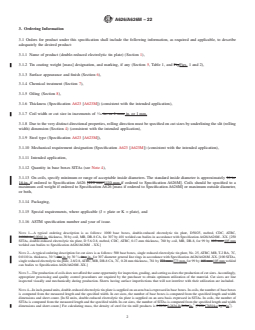
3.1.1 Name of product (double-reduced electrolytic tin plate) (Section 1),
3.1.2 Tin coating weight [mass] designation, and marking, if any (Section 5, Table 1, and FigFigs. 1 and 2),
3.1.3 Surface appearance and finish (Section 6),
3.1.4 Chemical treatment (Section 7),
3.1.5 Oiling (Section 8),
3.1.6 Thickness (Specification A623 [A623M]) (consistent with the intended application),
3.1.7 Coil width or cut size in increments of ⁄16 in. or 1 mm, in. or 1 mm,
3.1.8 Due to the very distinct directional properties, rolling direction must be specified on cut sizes by underlining the slit (rolling
width) dimension (Section 4) (consistent with the intended application),
3.1.9 Steel type (Specification A623 [A623M]),
3.1.10 Mechanical requirement designation (Specification A623 [A623M]) (consistent with the intended application),
3.1.11 Intended application,
3.1.12 Quantity in base boxes SITAs (see Note 4),
3.1.13 On coils, specify minimum or range of acceptable inside diameters. The standard inside diameter is approximately 16 in.
16 in. if ordered to Specification A626 [410 mm [410 mm if ordered to Specification A626M]. Coils should be specified to a
maximum coil weight if ordered to Specification A626 [mass if ordered to Specification A626M] or maximum outside diameter,
or both,
3.1.14 Packaging,
3.1.15 Special requirements, where applicable (J = plate or K = plate), and
3.1.16 ASTM specification number and year of issue.
NOTE 1—A typical ordering description is as follows: 1000 base boxes, double-reduced electrolytic tin plate, D50/25, melted, CDC, ATBC,
0.0066-in.0.0066 in. thickness, 30 by coil, MR, DR-8 CA, for 307 by 401 welded can bodies in accordance with Specification A626/A626M - XX. [250
SITAs, double-reduced electrolytic tin plate, D 5.6 ⁄2.8, melted, CDC, ATBC, 0.17-mm thickness, 760 by coil, MR, DR-8, for 99 by 105 mm 105 mm
welded can bodies to Specification A626/A626M - XX.]
NOTE 2—A typical ordering description for cut sizes is as follows: 500 base boxes, single reduced electrolytic tin plate, No. 25, ATBC, MR, T-2 BA, 7C,
3 7
0.0110 in. thickness, 30 ⁄4 in. in. by 30 ⁄16 in., in., for 307 diameter general line rings in accordance with Specification A626/A626M -XX. [100 SITAs,
single reduced electrolytic tin plate, 2.8/2.8, ATBC, MR, DR-8 CA, 7C, 0.28 mm thickness, 781 by 773 mm, 773 mm, for 99 by 105 mm 105 mm welded
can bodies to Specification A626/A626M -XX.]
NOTE 3—The production of coils does not afford the same opportunity for inspection, grading, and sorting as does the production of cut sizes. Accordingly,
appropriate processing and quality control procedures are required by the purchaser to obtain optimum utilization of the material. Cut sizes are line
inspected visually and mechanically during production. Sheets having surface imperfections that will not interfere with their utilization are included.
NOTE 4—In inch-pound units, double-reduced electrolytic tin plate is supplied on an area basis expressed in base boxes. In coils, the number of base boxes
is computed from the measured length and the specified width. In cut sizes, the number of base boxes is computed from the specified length and width
dimensions and sheet count. [In SI units, double-reduced electrolytic tin plate is supplied on an area basis expressed in SITAs. In coils, the number of
SITAs is computed from the measured length and the specified width. In cut sizes, the number of SITAs is computed from the specified length and width
3 3
dimensions and sheet count.] For calculating mass, the density of steel for tin mill products is 0.2836 0.2836 lb lb/in.⁄in. [7850 [7850 kg kg/m⁄m ].
A626/A626M − 22
4. Rolling Direction
4.1 Double-reduced plate is stronger and less ductile than single reduced plate and has very distinct directional properties. The
rolling direction must be specified on cut sizes and will be indicated by underlining the slit (rolling width) dimension. To minimize
the flange-cracking hazard when the product is used for can bodies, the rolling direction must be around the circumference of the
can.
5. Tin Coating Weight [Mass]
5.1 Class Designation and Marking:
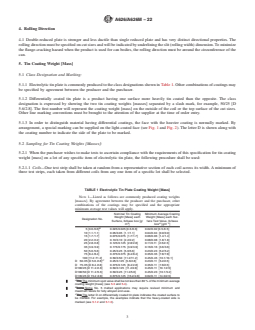
5.1.1 Electrolytic tin plate is commonly produced to the class designations shown in Table 1. Other combinations of coatings may
be specified by agreement between the producer and the purchaser.
5.1.2 Differentially coated tin plate is a product having one surface more heavily tin coated than the opposite. The class
designation is expressed by showing the two tin coating weights [masses] separated by a slash mark, for example, 50/25 [D
5.6/2.8]. The first number will represent the coating weight [mass] on the outside of the coil or the top surface of the cut sizes.
Other line marking conventions must be brought to the attention of the supplier at the time of order entry.
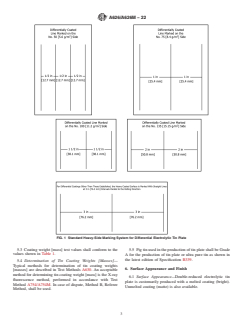
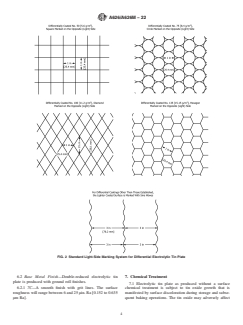
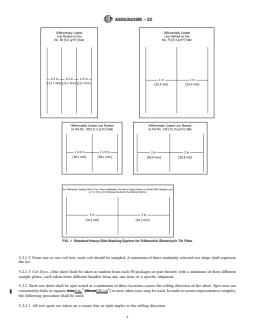
5.1.3 In order to distinguish material having differential coatings, the face with the heavier coating is normally marked. By
arrangement, a special marking can be supplied on the light-coated face (see Fig. 1 and Fig. 2). The letter D is shown along with
the coating number to indicate the side of the plate to be marked.
5.2 Sampling for Tin Coating Weights [Masses]:
5.2.1 When the purchaser wishes to make tests to ascertain compliance with the requirements of this specification for tin coating
weight [mass] on a lot of any specific item of electrolytic tin plate, the following procedure shall be used:
5.2.1.1 Coils—One test strip shall be taken at random from a representative section of each coil across its width. A minimum of
three test strips, each taken from different coils from any one item of a specific lot shall be selected.
TABLE 1 Electrolytic Tin Plate Coating Weight [Mass]
NOTE 1—Listed as follows are commonly produced coating weights
[masses]. By agreement between the producer and the purchaser, other
combinations of the coatings may be specified and the appropriate
minimum average test values will apply.
Nominal Tin Coating Minimum Average Coating
Weight [Mass] each Weight [Mass] each Sur-
Designation No.
Surface, lb/base box [g/ face Test Value, lb/base
2 A 2
m ] box [g/m ]
B
5 [0.6 ⁄0.6] 0.025/0.025 [0.6 ⁄0.6] 0.02/0.02 [0.5 ⁄0.5]
10 [1.1 ⁄1.1] 0.05/0.05 [1.1/1.1] 0.04/0.04 [0.9/0.9]
...