

ASTM D2035-19
(Practice)Standard Practice for Coagulation-Flocculation Jar Test of Water
General Information
- Abstract
SIGNIFICANCE AND USE
5.1 This practice permits the evaluation of various coagulants and coagulant aids used in the treatment of water and waste water for the same water and the same experimental conditions.
5.2 The effects of concentration of the coagulants and coagulant aids and their order of addition can also be evaluated by this practice.
SCOPE
1.1 This practice covers a general procedure for the evaluation of a treatment to reduce dissolved, suspended, colloidal, and nonsettleable matter from water or wastewater by chemical coagulation-flocculation, followed by gravity settling. The procedure may be used to evaluate color, turbidity, and hardness reduction.
1.2 The practice provides a systematic evaluation of the variables normally encountered in the coagulation-flocculation process.
1.3 The values stated in SI units are to be regarded as standard.
1.4 This standard does not purport to address all of the safety concerns, if any, associated with its use. It is the responsibility of the user of this standard to establish appropriate safety, health, and environmental practices and determine the applicability of regulatory limitations prior to use.
1.5 This international standard was developed in accordance with internationally recognized principles on standardization established in the Decision on Principles for the Development of International Standards, Guides and Recommendations issued by the World Trade Organization Technical Barriers to Trade (TBT) Committee.
- Status
- Published
- Publication Date
- 28-Feb-2019
- Technical Committee
- D19 - Water

Overview
ASTM D2035-19: Standard Practice for Coagulation-Flocculation Jar Test of Water outlines a methodology for evaluating the effectiveness of treatment options for reducing dissolved, suspended, colloidal, and nonsettleable matter in water and wastewater. Developed by ASTM International, this standard provides a comprehensive procedure utilizing chemical coagulation-flocculation followed by gravity settling. It is designed for comparative evaluation of various coagulants and coagulant aids under consistent experimental conditions, supporting reliable assessment for water treatment processes.
Key Topics
- Coagulation-Flocculation Process: Guidance on simulating water and wastewater treatment with chemical additives, followed by settling to evaluate the reduction in impurities such as color, turbidity, and hardness.
- Systematic Variable Evaluation:
- Chemical additives
- pH control
- Temperature influence
- Order and method of chemical addition
- Test Procedure: Step-by-step instructions for sample measurement, chemical dosing, mixing, settling, and analytical sampling.
- Reagents and Equipment:
- List of common coagulants (e.g., alum, ferric chloride), coagulant aids (e.g., polyelectrolytes), and necessary laboratory equipment (multiposition stirrers, beakers, pipets).
- Interference and Quality Control:
- Identification of factors affecting test accuracy such as temperature changes or biological activity.
- Recommendations on maintaining reproducibility and quality control in subjective test results.
- Safety and Compliance: Emphasis on adhering to safety, health, and environmental best practices as determined by the user.
Applications
The coagulation-flocculation jar test serves a critical role in water and wastewater treatment operations:
- Selection and Optimization of Treatment Chemicals: Enables evaluation and selection of the most effective coagulant and coagulant aids for specific water sources.
- Process Parameter Assessment: Facilitates investigation of factors such as chemical dosage, mixing intensity, and addition sequence that influence process efficiency.
- Water Quality Testing: Supports reduction of color, turbidity, and hardness, which are essential indicators of water quality.
- Operational Troubleshooting: Assists plant operators in investigating and resolving treatment issues by simulating process adjustments in a controlled laboratory setting.
- Training and Research: Widely used for operator training, process development, and water treatment research to provide hands-on experience with coagulation-flocculation principles.
Related Standards
Users of ASTM D2035-19 may also find these ASTM standards relevant when implementing water and wastewater treatment procedures:
- ASTM D1129: Terminology Relating to Water
- ASTM D1193: Specification for Reagent Water
- ASTM D1293: Test Methods for pH of Water
- ASTM D3370: Practices for Sampling Water from Flowing Process Streams
- ASTM D6855: Determination of Turbidity Below 5 NTU in Static Mode
- ASTM D7315: Determination of Turbidity Above 1 Turbidity Unit (TU) in Static Mode
Keywords: coagulation, flocculation, jar test, water treatment, wastewater, ASTM D2035-19, coagulants, turbidity reduction, water quality, flocculation process, laboratory testing, chemical aids, process optimization, standard practice.
Relations
- Effective Date
- 01-Mar-2019
- Effective Date
- 01-Nov-2023
- Refers
ASTM D6855-17(2023) - Standard Test Method for Determination of Turbidity Below 5 NTU in Static Mode - Effective Date
- 01-Nov-2023
- Effective Date
- 01-May-2020
- Effective Date
- 01-Jun-2012
- Effective Date
- 01-Jan-2012
- Effective Date
- 01-Dec-2010
- Refers
ASTM D6855-10 - Standard Test Method for Determination of Turbidity Below 5 NTU in Static Mode - Effective Date
- 15-Jun-2010
- Effective Date
- 01-Mar-2010
- Effective Date
- 01-Oct-2008
- Effective Date
- 01-Dec-2007
- Effective Date
- 01-Aug-2007
- Effective Date
- 15-Apr-2007
- Effective Date
- 01-Sep-2006
- Effective Date
- 01-Sep-2006
Get Certified
Connect with accredited certification bodies for this standard

CIS Institut d.o.o.
Personal Protective Equipment (PPE) certification body. Notified Body NB-2890 for EU Regulation 2016/425 PPE.

Kiwa BDA Testing
Building and construction product certification.
Kmetijski inštitut Slovenije
Agricultural Institute of Slovenia. Soil testing, plant health, agricultural product analysis.
Sponsored listings
Frequently Asked Questions
ASTM D2035-19 is a standard published by ASTM International. Its full title is "Standard Practice for Coagulation-Flocculation Jar Test of Water". This standard covers: SIGNIFICANCE AND USE 5.1 This practice permits the evaluation of various coagulants and coagulant aids used in the treatment of water and waste water for the same water and the same experimental conditions. 5.2 The effects of concentration of the coagulants and coagulant aids and their order of addition can also be evaluated by this practice. SCOPE 1.1 This practice covers a general procedure for the evaluation of a treatment to reduce dissolved, suspended, colloidal, and nonsettleable matter from water or wastewater by chemical coagulation-flocculation, followed by gravity settling. The procedure may be used to evaluate color, turbidity, and hardness reduction. 1.2 The practice provides a systematic evaluation of the variables normally encountered in the coagulation-flocculation process. 1.3 The values stated in SI units are to be regarded as standard. 1.4 This standard does not purport to address all of the safety concerns, if any, associated with its use. It is the responsibility of the user of this standard to establish appropriate safety, health, and environmental practices and determine the applicability of regulatory limitations prior to use. 1.5 This international standard was developed in accordance with internationally recognized principles on standardization established in the Decision on Principles for the Development of International Standards, Guides and Recommendations issued by the World Trade Organization Technical Barriers to Trade (TBT) Committee.
SIGNIFICANCE AND USE 5.1 This practice permits the evaluation of various coagulants and coagulant aids used in the treatment of water and waste water for the same water and the same experimental conditions. 5.2 The effects of concentration of the coagulants and coagulant aids and their order of addition can also be evaluated by this practice. SCOPE 1.1 This practice covers a general procedure for the evaluation of a treatment to reduce dissolved, suspended, colloidal, and nonsettleable matter from water or wastewater by chemical coagulation-flocculation, followed by gravity settling. The procedure may be used to evaluate color, turbidity, and hardness reduction. 1.2 The practice provides a systematic evaluation of the variables normally encountered in the coagulation-flocculation process. 1.3 The values stated in SI units are to be regarded as standard. 1.4 This standard does not purport to address all of the safety concerns, if any, associated with its use. It is the responsibility of the user of this standard to establish appropriate safety, health, and environmental practices and determine the applicability of regulatory limitations prior to use. 1.5 This international standard was developed in accordance with internationally recognized principles on standardization established in the Decision on Principles for the Development of International Standards, Guides and Recommendations issued by the World Trade Organization Technical Barriers to Trade (TBT) Committee.
ASTM D2035-19 is classified under the following ICS (International Classification for Standards) categories: 13.060.30 - Sewage water. The ICS classification helps identify the subject area and facilitates finding related standards.
ASTM D2035-19 has the following relationships with other standards: It is inter standard links to ASTM D2035-13, ASTM D7315-17(2023), ASTM D6855-17(2023), ASTM D1129-13(2020)e2, ASTM D7315-12, ASTM D1293-12, ASTM D3370-10, ASTM D6855-10, ASTM D1129-10, ASTM D3370-08, ASTM D3370-07, ASTM D7315-07a, ASTM D7315-07, ASTM D1129-06ae1, ASTM D1129-06a. Understanding these relationships helps ensure you are using the most current and applicable version of the standard.
ASTM D2035-19 is available in PDF format for immediate download after purchase. The document can be added to your cart and obtained through the secure checkout process. Digital delivery ensures instant access to the complete standard document.
Standards Content (Sample)
This international standard was developed in accordance with internationally recognized principles on standardization established in the Decision on Principles for the
Development of International Standards, Guides and Recommendations issued by the World Trade Organization Technical Barriers to Trade (TBT) Committee.
Designation: D2035 − 19
Standard Practice for
Coagulation-Flocculation Jar Test of Water
This standard is issued under the fixed designation D2035; the number immediately following the designation indicates the year of
original adoption or, in the case of revision, the year of last revision. A number in parentheses indicates the year of last reapproval. A
superscript epsilon (´) indicates an editorial change since the last revision or reapproval.
1. Scope D6855 Test Method for Determination of Turbidity Below 5
NTU in Static Mode
1.1 This practice covers a general procedure for the evalu-
D7315 Test Method for Determination of TurbidityAbove 1
ation of a treatment to reduce dissolved, suspended, colloidal,
Turbidity Unit (TU) in Static Mode
andnonsettleablematterfromwaterorwastewaterbychemical
coagulation-flocculation, followed by gravity settling. The
3. Terminology
procedure may be used to evaluate color, turbidity, and
hardness reduction.
3.1 Definitions:
3.1.1 For definitions of terms used in this standard, refer to
1.2 The practice provides a systematic evaluation of the
Terminology D1129.
variables normally encountered in the coagulation-flocculation
process.
4. Summary of Practice
1.3 The values stated in SI units are to be regarded as
standard.
4.1 The coagulation-flocculation test is carried out to deter-
mine the chemicals, dosages, and conditions required to
1.4 This standard does not purport to address all of the
achieve optimum results. The primary variables to be investi-
safety concerns, if any, associated with its use. It is the
gated using the recommended practice include, but are not
responsibility of the user of this standard to establish appro-
limited to:
priate safety, health, and environmental practices and deter-
4.1.1 Chemical additives,
mine the applicability of regulatory limitations prior to use.
1.5 This international standard was developed in accor-
4.1.2 pH,
dance with internationally recognized principles on standard-
4.1.3 Temperature, and
ization established in the Decision on Principles for the
4.1.4 Order of addition and mixing conditions.
Development of International Standards, Guides and Recom-
mendations issued by the World Trade Organization Technical
5. Significance and Use
Barriers to Trade (TBT) Committee.
5.1 This practice permits the evaluation of various coagu-
2. Referenced Documents
lants and coagulant aids used in the treatment of water and
waste water for the same water and the same experimental
2.1 ASTM Standards:
conditions.
D1129 Terminology Relating to Water
D1193 Specification for Reagent Water
5.2 The effects of concentration of the coagulants and
D1293 Test Methods for pH of Water
coagulant aids and their order of addition can also be evaluated
D3370 Practices for Sampling Water from Flowing Process
by this practice.
Streams
6. Interferences
6.1 Therearesomepossibleinterferencesthatmaymakethe
determination of optimum jar test conditions difficult. These
This practice is under the jurisdiction of ASTM Committee D19 on Water and
include the following:
is the direct responsibility of Subcommittee D19.03 on Sampling Water and
Water-Formed Deposits, Analysis of Water for Power Generation and Process Use,
6.1.1 Temperature Change (During Test)—Thermal or con-
On-Line Water Analysis, and Surveillance of Water.
vection currents may occur, interfering with the settling of
Current edition approved March 1, 2019. Published March 2019. Originally
coagulated particles. This can be prevented by temperature
approved in 1964. Last previous edition approved in 2013 as D2035 – 13. DOI:
10.1520/D2035-19. control.
For referenced ASTM standards, visit the ASTM website, www.astm.org, or
6.1.2 Gas Release (During Test)—Flotation of coagulated
contact ASTM Customer Service at service@astm.org. For Annual Book of ASTM
floc may occur due to gas bubble formation caused by
Standards volume information, refer to the standard’s Document Summary page on
the ASTM website. mechanicalagitator,temperatureincreaseorchemicalreaction.
Copyright © ASTM International, 100 Barr Harbor Drive, PO Box C700, West Conshohocken, PA 19428-2959. United States
D2035 − 19
FIG. 1 Reagent Rack for Multiple Stirrer Jar Test Apparatus
6.1.3 Testing-Period—Biological activity or other factors where such specifications are available. Other grades may be
may alter the coagulation characteristics of water upon pro- used, provided it is first ascertained that the reagent is of
longed standing. For this reason the period between sampling sufficiently high purity to permit its use without lessening the
and testing should be kept to a minimum, with the time being accuracy of the determination.
recorded.
8.2 Purity of Water—Reference to water that is used for
reagent preparation, rinsing or dilution shall be understood to
7. Apparatus
mean water that conforms to the quantitative specifications of
7.1 Multiple Stirrer—A multiposition stirrer with continu-
Type IV reagent water of Specification D1193.
ous speed variation from about 20 to 150 rpm should be used.
8.3 The following chemicals and additives are typical of
The stirring paddles should be of light gage corrosion-resistant
those used for test solutions and suspensions. The latter, with
material all of the same configuration and size.An illuminated
the exception of coagulant aids, may be prepared daily by
base is useful to observe the floc formation. Precautionary
mixing chemicals with water to a concentration of 10 (60.1)
measures should be taken to avoid heat being imparted by the
g/L (1.0 mL of test solution or suspension when added to 1 L
illumination system which may counteract normal settling.
of sample is equivalent to 10 mg/L):
7.2 Jars (or Beakers), all of the same size and shape;
Prime Coagulants
1500-mLGriffinbeakersmaybeused(1000-mLrecommended
Alum[Al (SO ) ·18H O]
2 4 3 2
Ferric sulfate [Fe (SO ) ·xH O]
2 4 3 2
minimum size).
Ferric chloride (FeCl ·6H O)
3 2
7.3 Reagent Racks—A means of introducing each test solu- Ferrous sulfate (FeSO ·7H O)
4 2
Magnesium carbonate (MgCO ·3H O)
3 2
tiontoalljarssimultaneously.Thereshouldbeatleastonerack
Sodium aluminate (NaAlO )
for each test solution or suspension. The racks should be
Coagulant Aids
Activated silica
similar to that shown in Fig. 1.
Anionic (polyelectrolyte)
7.4 Hand-Held High Speed Mixer, to mix up polymers (if
Cationic (polyelectrolyte)
Nonionic Polymer
needed). High speed on the multiple stirrer may not be
Oxidizing Agents
sufficient to mix up some wastewater polymers.
Chlorine (Cl )
Chlorine dioxide (ClO )
7.5 Pipets—Graduated or volumetric pipets to accurately
Potassium permanganate (KMnO )
measure chemicals used in the testing.
Calcium hypochlorite [CaCl(ClO)·4H O]
Sodium hypochlorite (NaClO)
7.6 Pipet Filler—Rubber bub or dedicated apparatus for
filling pipets.
8. Reagents
Reagent Chemicals, American Chemical Society Specifications, American
Chemical Society, Washington, DC. For suggestions on the testing of reagents not
8.1 Purity of Reagents—Reagent grade chemicals shall be
listed by the American Chemica
...
This document is not an ASTM standard and is intended only to provide the user of an ASTM standard an indication of what changes have been made to the previous version. Because
it may not be technically possible to adequately depict all changes accurately, ASTM recommends that users consult prior editions as appropriate. In all cases only the current version
of the standard as published by ASTM is to be considered the official document.
Designation: D2035 − 13 D2035 − 19
Standard Practice for
Coagulation-Flocculation Jar Test of Water
This standard is issued under the fixed designation D2035; the number immediately following the designation indicates the year of
original adoption or, in the case of revision, the year of last revision. A number in parentheses indicates the year of last reapproval. A
superscript epsilon (´) indicates an editorial change since the last revision or reapproval.
1. Scope
1.1 This practice covers a general procedure for the evaluation of a treatment to reduce dissolved, suspended, colloidal, and
nonsettleable matter from water or wastewater by chemical coagulation-flocculation, followed by gravity settling. The procedure
may be used to evaluate color, turbidity, and hardness reduction.
1.2 The practice provides a systematic evaluation of the variables normally encountered in the coagulation-flocculation process.
1.3 The values stated in SI units are to be regarded as standard.
1.4 This standard does not purport to address all of the safety concerns, if any, associated with its use. It is the responsibility
of the user of this standard to establish appropriate safety safety, health, and healthenvironmental practices and determine the
applicability of regulatory limitations prior to use.
1.5 This international standard was developed in accordance with internationally recognized principles on standardization
established in the Decision on Principles for the Development of International Standards, Guides and Recommendations issued
by the World Trade Organization Technical Barriers to Trade (TBT) Committee.
2. Referenced Documents
2.1 ASTM Standards:
D1129 Terminology Relating to Water
D1193 Specification for Reagent Water
D1293 Test Methods for pH of Water
D3370 Practices for Sampling Water from Flowing Process Streams
This practice is under the jurisdiction of ASTM Committee D19 on Water and is the direct responsibility of Subcommittee D19.03 on Sampling Water and Water-Formed
Deposits, Analysis of Water for Power Generation and Process Use, On-Line Water Analysis, and Surveillance of Water.
Current edition approved Jan. 1, 2013March 1, 2019. Published February 2013March 2019. Originally approved in 1964. Last previous edition approved in 20082013 as
D2035 –08. – 13. DOI: 10.1520/D2035-13.10.1520/D2035-19.
For referenced ASTM standards, visit the ASTM website, www.astm.org, or contact ASTM Customer Service at service@astm.org. For Annual Book of ASTM Standards
volume information, refer to the standard’s Document Summary page on the ASTM website.
Copyright © ASTM International, 100 Barr Harbor Drive, PO Box C700, West Conshohocken, PA 19428-2959. United States
D2035 − 19
D6855 Test Method for Determination of Turbidity Below 5 NTU in Static Mode
D7315 Test Method for Determination of Turbidity Above 1 Turbidity Unit (TU) in Static Mode
3. Terminology
3.1 Definitions—Definitions: For definitions of terms used in this practice, refer to Terminology D1129.
3.1.1 For definitions of terms used in this standard, refer to Terminology D1129.
4. Summary of Practice
4.1 The coagulation-flocculation test is carried out to determine the chemicals, dosages, and conditions required to achieve
optimum results. The primary variables to be investigated using the recommended practice include, but are not limited to:
4.1.1 Chemical additives,
4.1.2 pH,
4.1.3 Temperature, and
4.1.4 Order of addition and mixing conditions.
5. Significance and Use
5.1 This practice permits the evaluation of various coagulants and coagulant aids used in the treatment of water and waste water
for the same water and the same experimental conditions.
5.2 The effects of concentration of the coagulants and coagulant aids and their order of addition can also be evaluated by this
practice.
6. Interferences
6.1 There are some possible interferences that may make the determination of optimum jar test conditions difficult. These
include the following:
6.1.1 Temperature Change (During Test)—Thermal or convection currents may occur, interfering with the settling of coagulated
particles. This can be prevented by temperature control.
6.1.2 Gas Release (During Test)—Flotation of coagulated floc may occur due to gas bubble formation caused by mechanical
agitator, temperature increase or chemical reaction.
6.1.3 Testing-Period—Biological activity or other factors may alter the coagulation characteristics of water upon prolonged
standing. For this reason the period between sampling and testing should be kept to a minimum, with the time being recorded.
7. Apparatus
7.1 Multiple Stirrer—A multiposition stirrer with continuous speed variation from about 20 to 150 rpm should be used. The
stirring paddles should be of light gage corrosion-resistant material all of the same configuration and size. An illuminated base is
useful to observe the floc formation. Precautionary measures should be taken to avoid heat being imparted by the illumination
system which may counteract normal settling.
7.2 Jars (or Beakers), all of the same size and shape; 1500-mL Griffin beakers may be used (1000-mL recommended minimum
size).
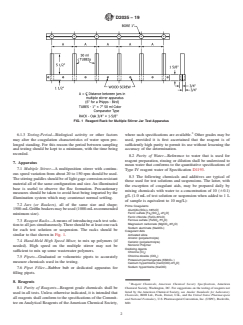
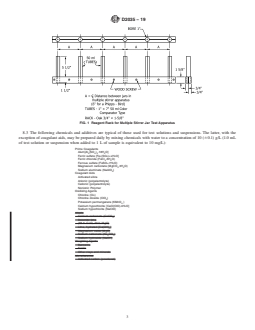
7.3 Reagent Racks—A means of introducing each test solution to all jars simultaneously. There should be at least one rack for
each test solution or suspension. The racks should be similar to that shown in Fig. 1.
7.4 Hand-Held High Speed Mixer, to mix up polymers (if needed). High speed on the multiple stirrer may not be sufficient to
mix up some wastewater polymers.
7.5 Pipets—Graduated or volumetric pipets to accurately measure chemicals used in the testing.
7.6 Pipet Filler—Rubber bub or dedicated apparatus for filling pipets.
8. Reagents
8.1 Purity of Reagents—Reagent grade chemicals shall be used in all tests. Unless otherwise indicated, it is intended that all
reagents shall conform to the specifications of the Committee on Analytical Reagents of the American Chemical Society, where
such specifications are available. Other grades may be used, provided it is first ascertained that the reagent is of sufficiently high
purity to permit its use without lessening the accuracy of the determination.
8.2 Purity of Water—Reference to water that is used for reagent preparation, rinsing or dilution shall be understood to mean
water that conforms to the quantitative specifications of Type IV reagent water of Specification D1193.
Reagent Chemicals, American Chemical Society Specifications Specifications, , American Chemical Society, Washington, DC. For suggestions on the testing of reagents
not listed by the American Chemical Society, see Analar Standards for Laboratory Chemicals, BDH Ltd., Poole, Dorset, U.K., and the United States Pharmacopeia and
National Formulary, U.S. Pharmacopeial Convention, Inc. (USPC), Rockville, MD.
D2035 − 19
FIG. 1 Reagent Rack for Multiple Stirrer Jar Test Apparatus
8.3 The following chemicals and additives are typical of those used for test solutions and suspensions. The latter, with the
exception of coagulant aids, may be prepared daily by mixing chemicals with water to a concentration of 10 (60.1) g/L (1.0 mL
of test solution or suspension when added to 1 L of sample is equivalent to 10 mg/L):
Prime Coagulants
Alum[Al (SO ) ·18H O]
2 4 3 2
Ferric sulfate [Fe (SO ) ·xH O]
2 4 3 2
Ferric chloride (FeCl ·6H O)
3 2
Ferrous sulfate (FeSO ·7H O)
4 2
Magnesium carbonate (MgCO ·3H O)
3 2
Sodium aluminate (NaAlO )
Coagulant Aids
Activated silica
Anionic (polyelectrolyte)
Cationic (polyelectrolyte)
Nonionic Polymer
Oxidizing Agents
Chlorine (Cl )
Chlorine dioxide (ClO )
Potassium permanganate (KMnO )
Calcium hypochlorite [CaCl(ClO)·4H O]
Sodium hypochlorite (NaClO)
Alkalis
Calc
...