


ASTM B945-21
(Practice)Standard Practice for Aluminum Alloy Extrusions Press Cooled from an Elevated Temperature Shaping Process for Production of T1, T2, T5 and T10-Type Tempers
Standard Practice for Aluminum Alloy Extrusions Press Cooled from an Elevated Temperature Shaping Process for Production of T1, T2, T5 and T10-Type Tempers
ABSTRACT
This practice establishes the controls necessary for production of extrusions cooled from an elevated temperature shaping (extrusion) process for the production of T1, T2, T5 and T10–type tempers. The equipment shall be used for billet preheating, extruding and quenching. Quenching methods may consist of, but are not limited to, air, water or water/glycol mixture in forced air, water spray, fog or mist, standing wave, a quench tank or another pressurized water device, or a combination thereof. Surveillance tests should include tensile properties for all material and metallographic examination to confirm that the elevated temperature shaping process has not resulted in eutectic melting or subsurface porosity from hydrogen diffusion. Specimens shall be sectioned in the plane perpendicular to the direction of the extrusion, polished to an appropriate fineness, mildly etched with an etchant such as Keller’s reagent to reveal any evidence of eutectic melting. Specimens shall also be subjected to tension and hardness tests. During the extrusion process, the following temperature measuring points should be monitored and controlled as per the producer’s internal procedures. The measuring points include but are not limited to: billet or log temperature in the heating equipment, billet or log temperature after heating and before charging into the extrusion press, temperature of the extrudate at the press exit, temperature of the extrudate at quench entry, temperature of the extrudate at the completion of quench, and billet temperature shall not exceed the maximum temperature for the alloy. Artificial aging shall be accomplished using times and temperatures as necessary to achieve required properties.
SCOPE
1.1 This practice establishes the controls necessary for production of extrusions cooled from an elevated temperature shaping (extrusion) process for the production of T1, T2, T5 and T10-type tempers (see ANSI H35.1/H35.1M).
1.2 This practice is for production of extruded product supplied in the 6xxx and 7xxx alloys shown in Table 1 in the T1, T2, T5 or T10-type tempers (see ANSI H35.1/H35.1M). It contains pertinent information to be used in establishing production practices and is descriptive rather than prescriptive. For the attainment of T3, T4, T6, T7, T8 and T9-type tempers by extrusion press solution heat treatment, refer to Practice B807/B807M.
1.3 This standard does not purport to address all of the safety concerns, if any, associated with its use. It is the responsibility of the user of this standard to establish appropriate safety, health, and environmental practices and determine the applicability of regulatory limitations prior to use.
1.4 This international standard was developed in accordance with internationally recognized principles on standardization established in the Decision on Principles for the Development of International Standards, Guides and Recommendations issued by the World Trade Organization Technical Barriers to Trade (TBT) Committee.
General Information
- Status
- Published
- Publication Date
- 30-Nov-2021
- Technical Committee
- B07 - Light Metals and Alloys
- Drafting Committee
- B07.03 - Aluminum Alloy Wrought Products
Relations
- Effective Date
- 01-Jul-2018
- Effective Date
- 01-Nov-2017
- Effective Date
- 01-Jul-2017
- Effective Date
- 15-May-2014
- Effective Date
- 01-May-2014
- Effective Date
- 01-Jun-2013
- Effective Date
- 01-Dec-2012
- Effective Date
- 01-Oct-2012
- Effective Date
- 01-Jan-2012
- Effective Date
- 01-Nov-2011
- Effective Date
- 01-Dec-2010
- Effective Date
- 01-Dec-2010
- Effective Date
- 01-Jul-2010
- Effective Date
- 01-Jun-2010
- Effective Date
- 01-Jun-2009
Overview
ASTM B945-21 is a standard practice developed by ASTM International for the production and quality assurance of aluminum alloy extrusions that are press cooled from an elevated temperature shaping process, specifically for T1, T2, T5, and T10-type tempers. This standard establishes essential controls and recommended practices for cooling, quenching, and post-processing of extruded aluminum products, focusing primarily on 6xxx and 7xxx series alloys. It serves as a critical reference for manufacturers to ensure mechanical properties, reduce defects, and maintain consistency in aluminum extrusion production.
Key Topics
Main considerations outlined in ASTM B945-21 include:
- Process Controls: Specifies the monitoring and control of billet or log temperatures during preheating, extrusion, and quenching, including maximum allowable billet temperatures to prevent eutectic melting or other thermal damage.
- Quenching Methods: Allows for the use of air, water, water/glycol mixtures, water spray, fog, mist, standing wave, quench tank, or other pressurized water devices, either individually or in combination. Quench parameters must be controlled and documented.
- Quality Assurance: Requires regular surveillance testing, including tensile properties and hardness, along with metallographic examination-especially to detect eutectic melting or subsurface porosity in 7xxx series alloys.
- Calibration and Record Keeping: Enforces documented calibration of temperature control and recording devices, ensuring system accuracy within ±1%. Records of equipment calibration, repairs, and test results must be maintained for each press/quench facility.
- Aging: Artificial aging must be tailored in terms of time and temperature to achieve the specified temper and properties.
Applications
ASTM B945-21 has significant industrial applications, particularly in sectors where aluminum extrusion quality is critical:
- Aerospace and Automotive: Ensures high-performance, defect-free extrusions for structural components requiring specific tempers and mechanical properties.
- Construction: Facilitates consistent production of aluminum extruded profiles used in architectural framing, window systems, and support beams.
- Electrical and Power Transmission: Provides guidelines for manufacturing extruded products like bus bars and connectors that rely on 6xxx and 7xxx alloys.
- General Manufacturing: Supports the production of custom shapes, rods, tubes, and profiles, maintaining desired strength and surface finish.
Manufacturers using 6xxx and 7xxx series aluminum extrusions in T1, T2, T5, and T10 tempers rely on this standard to meet customer requirements, reduce variability in production, and comply with international trade standards.
Related Standards
- ASTM B807/B807M: Practice for Extrusion Press Solution Heat Treatment for Aluminum Alloys-referenced for T3, T4, T6, T7, T8, and T9 tempers.
- ASTM B557: Test Methods for Tension Testing Wrought and Cast Aluminum- and Magnesium-Alloy Products.
- ASTM E10, E18, B648, B647: Hardness testing methods applicable for product evaluation.
- ASTM B918: Practice for Heat Treatment of Wrought Aluminum Alloys, offering guidance for artificial aging.
- ANSI H35.1/H35.1M: Alloy and temper designation systems for aluminum, referenced for consistent alloy identification.
Keywords: aluminum extrusion, ASTM B945-21, press cooled, T1 temper, T2 temper, T5 temper, T10 temper, 6xxx alloys, 7xxx alloys, quenching, quality control, aluminum manufacturing standards.
Buy Documents

ASTM B945-21 - Standard Practice for Aluminum Alloy Extrusions Press Cooled from an Elevated Temperature Shaping Process for Production of T1, T2, T5 and T10-Type Tempers
REDLINE ASTM B945-21 - Standard Practice for Aluminum Alloy Extrusions Press Cooled from an Elevated Temperature Shaping Process for Production of T1, T2, T5 and T10-Type Tempers
Get Certified
Connect with accredited certification bodies for this standard

Element Materials Technology
Materials testing and product certification.

Inštitut za kovinske materiale in tehnologije
Institute of Metals and Technology. Materials testing, metallurgical analysis, NDT.
Sponsored listings
Frequently Asked Questions
ASTM B945-21 is a standard published by ASTM International. Its full title is "Standard Practice for Aluminum Alloy Extrusions Press Cooled from an Elevated Temperature Shaping Process for Production of T1, T2, T5 and T10-Type Tempers". This standard covers: ABSTRACT This practice establishes the controls necessary for production of extrusions cooled from an elevated temperature shaping (extrusion) process for the production of T1, T2, T5 and T10–type tempers. The equipment shall be used for billet preheating, extruding and quenching. Quenching methods may consist of, but are not limited to, air, water or water/glycol mixture in forced air, water spray, fog or mist, standing wave, a quench tank or another pressurized water device, or a combination thereof. Surveillance tests should include tensile properties for all material and metallographic examination to confirm that the elevated temperature shaping process has not resulted in eutectic melting or subsurface porosity from hydrogen diffusion. Specimens shall be sectioned in the plane perpendicular to the direction of the extrusion, polished to an appropriate fineness, mildly etched with an etchant such as Keller’s reagent to reveal any evidence of eutectic melting. Specimens shall also be subjected to tension and hardness tests. During the extrusion process, the following temperature measuring points should be monitored and controlled as per the producer’s internal procedures. The measuring points include but are not limited to: billet or log temperature in the heating equipment, billet or log temperature after heating and before charging into the extrusion press, temperature of the extrudate at the press exit, temperature of the extrudate at quench entry, temperature of the extrudate at the completion of quench, and billet temperature shall not exceed the maximum temperature for the alloy. Artificial aging shall be accomplished using times and temperatures as necessary to achieve required properties. SCOPE 1.1 This practice establishes the controls necessary for production of extrusions cooled from an elevated temperature shaping (extrusion) process for the production of T1, T2, T5 and T10-type tempers (see ANSI H35.1/H35.1M). 1.2 This practice is for production of extruded product supplied in the 6xxx and 7xxx alloys shown in Table 1 in the T1, T2, T5 or T10-type tempers (see ANSI H35.1/H35.1M). It contains pertinent information to be used in establishing production practices and is descriptive rather than prescriptive. For the attainment of T3, T4, T6, T7, T8 and T9-type tempers by extrusion press solution heat treatment, refer to Practice B807/B807M. 1.3 This standard does not purport to address all of the safety concerns, if any, associated with its use. It is the responsibility of the user of this standard to establish appropriate safety, health, and environmental practices and determine the applicability of regulatory limitations prior to use. 1.4 This international standard was developed in accordance with internationally recognized principles on standardization established in the Decision on Principles for the Development of International Standards, Guides and Recommendations issued by the World Trade Organization Technical Barriers to Trade (TBT) Committee.
ABSTRACT This practice establishes the controls necessary for production of extrusions cooled from an elevated temperature shaping (extrusion) process for the production of T1, T2, T5 and T10–type tempers. The equipment shall be used for billet preheating, extruding and quenching. Quenching methods may consist of, but are not limited to, air, water or water/glycol mixture in forced air, water spray, fog or mist, standing wave, a quench tank or another pressurized water device, or a combination thereof. Surveillance tests should include tensile properties for all material and metallographic examination to confirm that the elevated temperature shaping process has not resulted in eutectic melting or subsurface porosity from hydrogen diffusion. Specimens shall be sectioned in the plane perpendicular to the direction of the extrusion, polished to an appropriate fineness, mildly etched with an etchant such as Keller’s reagent to reveal any evidence of eutectic melting. Specimens shall also be subjected to tension and hardness tests. During the extrusion process, the following temperature measuring points should be monitored and controlled as per the producer’s internal procedures. The measuring points include but are not limited to: billet or log temperature in the heating equipment, billet or log temperature after heating and before charging into the extrusion press, temperature of the extrudate at the press exit, temperature of the extrudate at quench entry, temperature of the extrudate at the completion of quench, and billet temperature shall not exceed the maximum temperature for the alloy. Artificial aging shall be accomplished using times and temperatures as necessary to achieve required properties. SCOPE 1.1 This practice establishes the controls necessary for production of extrusions cooled from an elevated temperature shaping (extrusion) process for the production of T1, T2, T5 and T10-type tempers (see ANSI H35.1/H35.1M). 1.2 This practice is for production of extruded product supplied in the 6xxx and 7xxx alloys shown in Table 1 in the T1, T2, T5 or T10-type tempers (see ANSI H35.1/H35.1M). It contains pertinent information to be used in establishing production practices and is descriptive rather than prescriptive. For the attainment of T3, T4, T6, T7, T8 and T9-type tempers by extrusion press solution heat treatment, refer to Practice B807/B807M. 1.3 This standard does not purport to address all of the safety concerns, if any, associated with its use. It is the responsibility of the user of this standard to establish appropriate safety, health, and environmental practices and determine the applicability of regulatory limitations prior to use. 1.4 This international standard was developed in accordance with internationally recognized principles on standardization established in the Decision on Principles for the Development of International Standards, Guides and Recommendations issued by the World Trade Organization Technical Barriers to Trade (TBT) Committee.
ASTM B945-21 is classified under the following ICS (International Classification for Standards) categories: 77.120.10 - Aluminium and aluminium alloys. The ICS classification helps identify the subject area and facilitates finding related standards.
ASTM B945-21 has the following relationships with other standards: It is inter standard links to ASTM E18-18, ASTM B881-17, ASTM E18-17, ASTM B557-14, ASTM E10-14, ASTM B807/B807M-13, ASTM E18-12, ASTM E2281-08a(2012)e1, ASTM E10-12, ASTM E18-11, ASTM B648-10, ASTM B647-10, ASTM B557-10, ASTM E10-10, ASTM B881-09. Understanding these relationships helps ensure you are using the most current and applicable version of the standard.
ASTM B945-21 is available in PDF format for immediate download after purchase. The document can be added to your cart and obtained through the secure checkout process. Digital delivery ensures instant access to the complete standard document.
Standards Content (Sample)
This international standard was developed in accordance with internationally recognized principles on standardization established in the Decision on Principles for the
Development of International Standards, Guides and Recommendations issued by the World Trade Organization Technical Barriers to Trade (TBT) Committee.
Designation: B945 − 21
Standard Practice for
Aluminum Alloy Extrusions Press Cooled from an Elevated
Temperature Shaping Process for Production of T1, T2, T5
and T10-Type Tempers
This standard is issued under the fixed designation B945; the number immediately following the designation indicates the year of
original adoption or, in the case of revision, the year of last revision.Anumber in parentheses indicates the year of last reapproval.A
superscript epsilon (´) indicates an editorial change since the last revision or reapproval.
1. Scope* B557Test Methods for Tension Testing Wrought and Cast
Aluminum- and Magnesium-Alloy Products
1.1 This practice establishes the controls necessary for
B647Test Method for Indentation Hardness of Aluminum
production of extrusions cooled from an elevated temperature
Alloys by Means of a Webster Hardness Gage
shaping (extrusion) process for the production of T1, T2, T5
B648Test Method for Indentation Hardness of Aluminum
and T10-type tempers (see ANSI H35.1/H35.1M).
Alloys by Means of a Barcol Impressor
1.2 This practice is for production of extruded product
B807/B807MPractice for Extrusion Press Solution Heat
supplied in the 6xxx and 7xxx alloys shown in Table 1 in the
Treatment for Aluminum Alloys
T1, T2, T5 or T10-type tempers (seeANSI H35.1/H35.1M). It
B881Terminology Relating toAluminum- and Magnesium-
contains pertinent information to be used in establishing
Alloy Products
productionpracticesandisdescriptiveratherthanprescriptive.
B918Practice for Heat Treatment of Wrought Aluminum
For the attainment of T3, T4, T6, T7, T8 and T9-type tempers
Alloys
by extrusion press solution heat treatment, refer to Practice
E10Test Method for Brinell Hardness of Metallic Materials
B807/B807M.
E18Test Methods for Rockwell Hardness of Metallic Ma-
1.3 This standard does not purport to address all of the
terials
safety concerns, if any, associated with its use. It is the E2281Practice for Process Capability and Performance
responsibility of the user of this standard to establish appro-
Measurement
priate safety, health, and environmental practices and deter-
2.3 ANSI Standard:
mine the applicability of regulatory limitations prior to use.
H35.1/H35.1MAlloy and Temper Designation Systems for
1.4 This international standard was developed in accor- 3
Aluminum
dance with internationally recognized principles on standard-
ization established in the Decision on Principles for the
3. Terminology
Development of International Standards, Guides and Recom-
3.1 Definitions—RefertoTerminologyB881forDefinitions
mendations issued by the World Trade Organization Technical
of Product terms used in this specification.
Barriers to Trade (TBT) Committee.
4. Equipment
2. Referenced Documents
NOTE 1—Equipment includes billet preheating, extruding and quench-
2.1 The following documents of the issue in effect on the
ing.
date of material purchase form a part of this standard to the
4.1 Priortobeingextruded,aluminumalloysareheatedtoa
extent referenced herein:
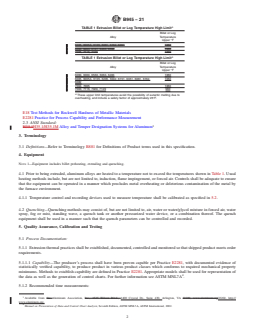
temperature not to exceed the temperatures shown in Table 1.
2.2 ASTM Standards:
Usual heating methods include, but are not limited to,
induction, flame impingement, or forced air. Controls shall be
adequate to ensure that the equipment can be operated in a
This practice is under the jurisdiction of ASTM Committee B07 on Light
manner which precludes metal overheating or deleterious
Metals and Alloys and is the direct responsibility of Subcommittee B07.03 on
contamination of the metal by the furnace environment.
Aluminum Alloy Wrought Products.
4.1.1 Temperature control and recording devices used to
Current edition approved Dec. 1, 2021. Published December 2021. Originally
approved in 1925. Last previous edition approved in 2014 as measure temperature shall be calibrated as specified in 5.2.
B945–06(2014).DOI: 10.1520/B0945-21.
For referenced ASTM standards, visit the ASTM website, www.astm.org, or
contact ASTM Customer Service at service@astm.org. For Annual Book of ASTM
Standards volume information, refer to the standard’s Document Summary page on Available fromAluminumAssociation, 1400 Crystal Dr., Suite 430,Arlington,
the ASTM website. VA 22202, http://www.aluminum.org.
*A Summary of Changes section appears at the end of this standard
Copyright © ASTM International, 100 Barr Harbor Drive, PO Box C700, West Conshohocken, PA 19428-2959. United States
B945 − 21
A
TABLE 1 Extrusion Billet or Log Temperature High Limit
5.4.1 Test Requirements:
Billet or Log
5.4.1.1 Surveillance tests of heating, extrusion, and quench
Alloy Temperature
facilities operated in accordance with documented procedures
Upper °F
shall have a demonstrated capability for producing material
6060, 6360, 6560, 6063, 6463 1060
6005, 6005A, 6105, 6205, 6042, 6151, 6351, 6061, 6162, 1050
meetingapplicablematerialspecificationrequirementsforeach
type of product (shapes, tube, rod, hollow section, etc.), and
7004, 7005 1060
alloy and temper produced. Surveillance tests should include
7003, 7116, 7029, 7129 980
tensile properties for all material and metallographic examina-
A
These upper limit temperatures avoid the possibility of eutectic melting due to
overheating, and include a safety factor of approximately 25°F. tion to confirm that the elevated temperature shaping process
hasnotresultedineutecticmeltingorsubsurfaceporosityfrom
hydrogen diffusion. (Eutectic Melting and Subsurface Porosity
tests are applicable to 7xxx alloys only.)
4.2 Quenching—Quenchingmethodsmayconsistof,butare
5.4.1.2 Frequency of Tests—Material property tests shall be
not limited to, air, water or water/glycol mixture in forced air,
carriedoutatthefrequencyrequiredbytheapplicablematerial
water spray, fog or mist, standing wave, a quench tank or
specification.When no material specification is applicable, the
another pressurized water device, or a combination thereof.
numberofsamplestestedshallbenotlessthanoneper1000lb
The quench equipment shall be used in a manner such that the
ofproductweighinglessthan1lbperftornotlessthanoneper
quench parameters can be controlled and recorded.
1000 ft of product for material weighing 1 lb or more per ft.
5. Quality Assurance, Calibration and Testing
Product is meant to include the alloy in the form being
extruded, such as tube, pipe, or shape. For 7xxx alloys only,
5.1 Process Documentation:
examination to confirm the absence of elevated temperature
5.1.1 Extrusion thermal practices shall be established,
shaping induced eutectic melting or subsurface porosity from
documented, controlled and monitored so that shipped product
hydrogen diffusion shall be performed at a minimum rate of
meets order requirements.
onesampleperalloyeverythreemonthsforeachpress/quench
5.1.1.1 Capability—The producer’s process shall have been
facility producing that alloy.
provencapableperPracticeE2281,withdocumentedevidence
5.4.1.3 Use of Production Test Results—The results of tests
ofstatisticallyverifiedcapability,toproduceproductinvarious
to determine process conformance of material cooled from an
product classes which conforms to required mechanical prop-
elevated temperature shaping process can use the results of
erty minimums. Methods to establish capability are defined in
testsforrequirementsoftherespectivematerialspecificationas
Practice E2281. Appropriate models shall be used for repre-
evidence of process surveillance of the equipment and proce-
sentationofthedataaswellasthegenerationofcontrolcharts.
dure employed.
For further information see A
...
This document is not an ASTM standard and is intended only to provide the user of an ASTM standard an indication of what changes have been made to the previous version. Because
it may not be technically possible to adequately depict all changes accurately, ASTM recommends that users consult prior editions as appropriate. In all cases only the current version
of the standard as published by ASTM is to be considered the official document.
Designation: B945 − 06 (Reapproved 2014) B945 − 21
Standard Practice for
Aluminum Alloy Extrusions Press Cooled from an Elevated
Temperature Shaping Process for Production of T1, T2, T5
and T10–TypeT10-Type Tempers
This standard is issued under the fixed designation B945; the number immediately following the designation indicates the year of
original adoption or, in the case of revision, the year of last revision. A number in parentheses indicates the year of last reapproval. A
superscript epsilon (´) indicates an editorial change since the last revision or reapproval.
1. Scope Scope*
1.1 This practice establishes the controls necessary for production of extrusions cooled from an elevated temperature shaping
(extrusion) process for the production of T1, T2, T5 and T10–typeT10-type tempers (see ANSI H35.1).H35.1/H35.1M).
1.2 This practice is for production of extruded product supplied in the 6xxx and 7xxx alloys shown in Table 1 in the T1, T2, T5
or T10–type tempers. T10-type tempers (see ANSI H35.1/H35.1M). It contains pertinent information to be used in establishing
production practices and is descriptive rather than prescriptive. For the attainment of T3, T4, T6, T7, T8 and T9-type tempers by
extrusion press solution heat treatment, refer to Practice B807/B807M.
1.3 This standard does not purport to address all of the safety concerns, if any, associated with its use. It is the responsibility
of the user of this standard to establish appropriate safety safety, health, and healthenvironmental practices and determine the
applicability of regulatory limitations prior to use.
1.4 This international standard was developed in accordance with internationally recognized principles on standardization
established in the Decision on Principles for the Development of International Standards, Guides and Recommendations issued
by the World Trade Organization Technical Barriers to Trade (TBT) Committee.
2. Referenced Documents
2.1 The following documents of the issue in effect on the date of material purchase form a part of this standard to the extent
referenced herein:
2.2 ASTM Standards:
B557 Test Methods for Tension Testing Wrought and Cast Aluminum- and Magnesium-Alloy Products
B647 Test Method for Indentation Hardness of Aluminum Alloys by Means of a Webster Hardness Gage
E648B648 Test Method for Critical Radiant Flux of Floor-Covering Systems Using a Radiant Heat Energy SourceIndentation
Hardness of Aluminum Alloys by Means of a Barcol Impressor
B807/B807M Practice for Extrusion Press Solution Heat Treatment for Aluminum Alloys
B881 Terminology Relating to Aluminum- and Magnesium-Alloy Products
B918 Practice for Heat Treatment of Wrought Aluminum Alloys
E10 Test Method for Brinell Hardness of Metallic Materials
This practice is under the jurisdiction of ASTM Committee B07 on Light Metals and Alloys and is the direct responsibility of Subcommittee B07.03 on Aluminum Alloy
Wrought Products.
Current edition approved Nov. 1, 2014Dec. 1, 2021. Published November 2014December 2021. Originally approved in 1925. Last previous edition approved in 20062014
as B945 – 06.B945 – 06 (2014). DOI: 10.1520/B0945-06R14.10.1520/B0945-21.
For referenced ASTM standards, visit the ASTM website, www.astm.org, or contact ASTM Customer Service at service@astm.org. For Annual Book of ASTM Standards
volume information, refer to the standard’s Document Summary page on the ASTM website.
*A Summary of Changes section appears at the end of this standard
Copyright © ASTM International, 100 Barr Harbor Drive, PO Box C700, West Conshohocken, PA 19428-2959. United States
B945 − 21
A
TABLE 1 Extrusion Billet or Log Temperature High Limit
Billet or Log
Alloy Temperature
Upper °F
6005, 6005A, 6105, 6061, 6162, 6351 1050
6060, 6063, 6101, 6463, 6560 1060
7005, 7116, 7129 1000
A
TABLE 1 Extrusion Billet or Log Temperature High Limit
Billet or Log
Alloy Temperature
Upper °F
6060, 6360, 6560, 6063, 6463 1060
6005, 6005A, 6105, 6205, 6042, 6151, 6351, 6061, 6162, 1050
7004, 7005 1060
7003, 7116, 7029, 7129 980
A
These upper limit temperatures avoid the possibility of eutectic melting due to
overheating, and include a safety factor of approximately 25°F.
E18 Test Methods for Rockwell Hardness of Metallic Materials
E2281 Practice for Process Capability and Performance Measurement
2.3 ANSI Standard:
H35.1H35.1/H35.1M Alloy and Temper Designation Systems for Aluminum
3. Terminology
3.1 Definitions—Refer to Terminology B881 for Definitions of Product terms used in this specification.
4. Equipment
NOTE 1—Equipment includes billet preheating, extruding and quenching.
4.1 Prior to being extruded, aluminum alloys are heated to a temperature not to exceed the temperatures shown in Table 1. Usual
heating methods include, but are not limited to, induction, flame impingement, or forced air. Controls shall be adequate to ensure
that the equipment can be operated in a manner which precludes metal overheating or deleterious contamination of the metal by
the furnace environment.
4.1.1 Temperature control and recording devices used to measure temperature shall be calibrated as specified in 5.2.
4.2 Quenching—Quenching methods may consist of, but are not limited to, air, water or water/glycol mixture in forced air, water
spray, fog or mist, standing wave, a quench tank or another pressurized water device, or a combination thereof. The quench
equipment shall be used in a manner such that the quench parameters can be controlled and recorded.
5. Quality Assurance, Calibration and Testing
5.1 Process Documentation:
5.1.1 Extrusion thermal practices shall be established, documented, controlled and monitored so that shipped product meets order
requirements.
5.1.1.1 Capability—The producer’s process shall have been proven capable per Practice E2281, with documented evidence of
statistically verified capability, to produce product in various product classes which conforms to required mechanical property
minimums. Methods to establish capability are defined in Practice E2281. Appropriate models shall be used for representation of
the data as well as the generation of control charts. For further information see ASTM MNL7A .
5.1.2 Recommended time measurements:
Available from the Aluminum Association, Inc., 1525 Wilson Blvd., 1400 Crystal Dr., Suite 430, Arlington, VA 22209, www.aluminum.org22202, http://
www.aluminum.org.
Manual on Presentation of Data and Control Chart Analysis, Seventh Edition, ASTM MNL7A, ASTM International, 2002.
B945 − 21
5.1.2.1 Time interval between removal of the billet from the billet heating equipment and start of extrusion,
5.1.2.2 Time interval between the metal exiting from press and its entering the quench, and
5.1.2.3 Time interval between metal entry into and exit from the quench below the identified critical maximum temperature.
5.2 Calibration—Temperature control and recording devices used to measure temperature shall be calibrated in accordance with
documented calibration practices.
5.2.1 Temperature Measuring System Accuracy—The accuracy of any temperature sensing system shall be within 61 %.
5.3 Records—Records shall be maintained for each extrusion press/quench facility involved in the production of extrusions cooled
from an elevated temperature shaping process to show compliance with this practice. The records shall include identification of
the specific press involved (which includes metal heating and quenching equipment), the frequency and results of calibration of
measurement equipment used for control, and the dates and description of equipment repairs or alteration and instances of
disqualification and corrective action.
5.4 Process Surveillance Tests:
5.4.1 Test Requirements:
5.4.1.1 Surveillance tests of heating, extrusion, and quench facilities operated
...
Questions, Comments and Discussion
Ask us and Technical Secretary will try to provide an answer. You can facilitate discussion about the standard in here.
Loading comments...