

ASTM C1068-21
(Guide)Standard Guide for Qualification of Measurement Methods by a Laboratory Within the Nuclear Industry
General Information
- Abstract
SIGNIFICANCE AND USE
4.1 Because of concerns for safety and the protection of nuclear materials from theft, stringent specifications are placed on chemical processes and the chemical and physical properties of nuclear materials. Strict requirements for the control and accountability of nuclear materials are imposed on the users of those materials. Therefore, when analyses are made by a laboratory to support a project such as the fabrication of nuclear fuel materials, various performance requirements may be imposed on the laboratory. One such requirement is often the use of qualified methods. Their use gives greater assurance that the data produced will be satisfactory for the intended use of those data. A qualified method will help assure that the data produced will be comparable to data produced by the same qualified method in other laboratories.
4.2 This guide provides guidance for qualifying measurement methods and for maintaining qualification. Even though all practices would be used for most qualification programs, there may be situations in which only a selected portion would be required. Care should be taken, however, that the effectiveness of qualification is not reduced when applying these practices selectively. The recommended practices in this guide are generic; based on these practices, specific actions should be developed to establish a qualification program.
SCOPE
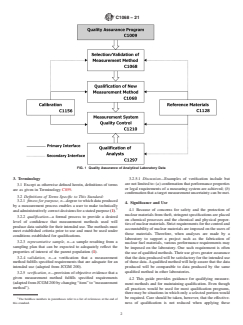
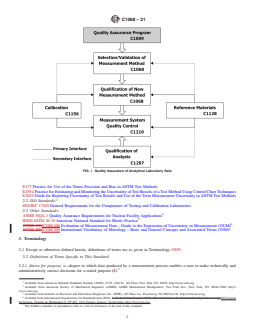
1.1 This guide provides guidance for selecting, validating, and qualifying measurement methods when qualification is required for a specific program. The recommended practices presented in this guide provide a major part of a quality assurance program for the laboratory data (see Fig. 1). Qualification helps to assure that the data produced will meet established requirements.
1.3 This standard does not purport to address all of the safety concerns, if any, associated with its use. It is the responsibility of the user of this standard to establish appropriate safety, health, and environmental practices and determine the applicability of regulatory limitations prior to use.
1.4 This international standard was developed in accordance with internationally recognized principles on standardization established in the Decision on Principles for the Development of International Standards, Guides and Recommendations issued by the World Trade Organization Technical Barriers to Trade (TBT) Committee.
- Status
- Published
- Publication Date
- 30-Sep-2021
- Technical Committee
- C26 - Nuclear Fuel Cycle
Buy Documents
ASTM C1068-21 - Standard Guide for Qualification of Measurement Methods by a Laboratory Within the Nuclear Industry
REDLINE ASTM C1068-21 - Standard Guide for Qualification of Measurement Methods by a Laboratory Within the Nuclear Industry
Overview
ASTM C1068-21, titled Standard Guide for Qualification of Measurement Methods by a Laboratory Within the Nuclear Industry, provides essential guidance for laboratories performing measurement and analysis activities in the nuclear sector. Developed by ASTM International, this standard addresses the selection, validation, and qualification of measurement methods, ensuring consistency, reliability, and comparability of analytical data across different facilities. As the nuclear industry faces stringent requirements on material safety, security, and regulatory compliance, robust qualification processes for measurement methods play a critical role in supporting nuclear material fabrication, safeguards, and safety projects.
Key Topics
Selection of Measurement Methods
Laboratories must ensure that chosen methods are technically sound, capable of addressing the desired concentration ranges, and free from interferences. Preference is given to methods recognized by national or international standards bodies or established through extensive usage.Verification and Validation
Verification ensures that a measurement method meets predefined requirements, while validation is the process of confirming its applicability to specific analytical tasks. Validation is especially important for novel or rarely-used methods before qualification.Qualification Process
Formal qualification gives confidence that the method delivers reliable, accurate, and comparable data. This involves demonstrating method performance under real operating conditions, including bias, precision, measurement uncertainty, and range.Control of Measurement Systems
Ongoing control is necessary to maintain method qualification. This includes calibration, use of control charts, and process documentation to guarantee sustained data quality and method suitability.Personnel Qualification
Laboratory staff must be appropriately trained and qualified, following structured programs to ensure competence in applying the measurement methods.Documentation and Traceability
All qualification activities must be fully documented. Calibration and analytical results should be traceable to the International System of Units (SI), ensuring global comparability.
Applications
Nuclear Fuel Fabrication and Quality Control
The guide supports laboratories in ensuring the accuracy and reliability of analyses for nuclear fuel materials, meeting rigorous industry and regulatory requirements for material control and accounting.Safeguards and Nuclear Safety
Laboratories tasked with nuclear safeguards must demonstrate that their measurement methods are "fit for purpose"-capable of achieving required detection limits and uncertainties to prevent the theft or misuse of nuclear materials.Laboratory Accreditation and Continuous Improvement
Following ASTM C1068-21 supports audits and accreditation to international standards (such as ISO/IEC 17025), underpinning confidence in laboratory data and fostering continuous quality improvement.Development of In-House Methods
When standardized methods are not available, the guide enables the development of robust in-house methods, subject to comprehensive qualification and validation.
Related Standards
- ASTM C859 – Terminology Relating to Nuclear Materials
- ASTM C1009 – Guide for Quality Assurance Programs in Analytical Laboratories Within the Nuclear Industry
- ASTM C1128 – Guide for Preparation of Working Reference Materials for Nuclear Fuel Cycle Materials Analysis
- ASTM C1156 – Guide for Establishing Calibration for Measurement Methods
- ASTM C1210 – Guide for Measurement System Quality Control
- ASTM C1297 – Guide for Laboratory Analyst Qualification
- ISO/IEC 17025 – General Requirements for the Competence of Testing and Calibration Laboratories
- ASME NQA-1 – Quality Assurance Requirements for Nuclear Facility Applications
- IEEE/ASTM SI 10 – American National Standard for Metric Practice
- JCGM 100 and 200 – Guides for Expression of Measurement Uncertainty and Metrological Terminology
Practical Value
Adopting ASTM C1068-21 helps laboratories ensure their measurement methods are reliable, validated, and fully qualified for use in the nuclear industry. This improves data integrity, simplifies compliance with regulatory and international requirements, and minimizes risk in nuclear material management-supporting safety, security, and operational excellence.
Relations
- Effective Date
- 01-Jan-2024
- Effective Date
- 01-Jan-2020
- Effective Date
- 01-Sep-2018
- Effective Date
- 01-Jul-2018
- Effective Date
- 01-Apr-2018
- Effective Date
- 01-Apr-2018
- Effective Date
- 01-Feb-2015
- Effective Date
- 15-Jun-2014
- Effective Date
- 01-May-2014
- Effective Date
- 15-Jan-2014
- Effective Date
- 01-Jun-2013
- Effective Date
- 01-May-2013
- Effective Date
- 01-May-2013
- Effective Date
- 01-Apr-2013
- Effective Date
- 01-Jan-2013
Buy Documents
ASTM C1068-21 - Standard Guide for Qualification of Measurement Methods by a Laboratory Within the Nuclear Industry
REDLINE ASTM C1068-21 - Standard Guide for Qualification of Measurement Methods by a Laboratory Within the Nuclear Industry
Get Certified
Connect with accredited certification bodies for this standard

BSMI (Bureau of Standards, Metrology and Inspection)
Taiwan's standards and inspection authority.
Sponsored listings
Frequently Asked Questions
ASTM C1068-21 is a guide published by ASTM International. Its full title is "Standard Guide for Qualification of Measurement Methods by a Laboratory Within the Nuclear Industry". This standard covers: SIGNIFICANCE AND USE 4.1 Because of concerns for safety and the protection of nuclear materials from theft, stringent specifications are placed on chemical processes and the chemical and physical properties of nuclear materials. Strict requirements for the control and accountability of nuclear materials are imposed on the users of those materials. Therefore, when analyses are made by a laboratory to support a project such as the fabrication of nuclear fuel materials, various performance requirements may be imposed on the laboratory. One such requirement is often the use of qualified methods. Their use gives greater assurance that the data produced will be satisfactory for the intended use of those data. A qualified method will help assure that the data produced will be comparable to data produced by the same qualified method in other laboratories. 4.2 This guide provides guidance for qualifying measurement methods and for maintaining qualification. Even though all practices would be used for most qualification programs, there may be situations in which only a selected portion would be required. Care should be taken, however, that the effectiveness of qualification is not reduced when applying these practices selectively. The recommended practices in this guide are generic; based on these practices, specific actions should be developed to establish a qualification program. SCOPE 1.1 This guide provides guidance for selecting, validating, and qualifying measurement methods when qualification is required for a specific program. The recommended practices presented in this guide provide a major part of a quality assurance program for the laboratory data (see Fig. 1). Qualification helps to assure that the data produced will meet established requirements. 1.3 This standard does not purport to address all of the safety concerns, if any, associated with its use. It is the responsibility of the user of this standard to establish appropriate safety, health, and environmental practices and determine the applicability of regulatory limitations prior to use. 1.4 This international standard was developed in accordance with internationally recognized principles on standardization established in the Decision on Principles for the Development of International Standards, Guides and Recommendations issued by the World Trade Organization Technical Barriers to Trade (TBT) Committee.
SIGNIFICANCE AND USE 4.1 Because of concerns for safety and the protection of nuclear materials from theft, stringent specifications are placed on chemical processes and the chemical and physical properties of nuclear materials. Strict requirements for the control and accountability of nuclear materials are imposed on the users of those materials. Therefore, when analyses are made by a laboratory to support a project such as the fabrication of nuclear fuel materials, various performance requirements may be imposed on the laboratory. One such requirement is often the use of qualified methods. Their use gives greater assurance that the data produced will be satisfactory for the intended use of those data. A qualified method will help assure that the data produced will be comparable to data produced by the same qualified method in other laboratories. 4.2 This guide provides guidance for qualifying measurement methods and for maintaining qualification. Even though all practices would be used for most qualification programs, there may be situations in which only a selected portion would be required. Care should be taken, however, that the effectiveness of qualification is not reduced when applying these practices selectively. The recommended practices in this guide are generic; based on these practices, specific actions should be developed to establish a qualification program. SCOPE 1.1 This guide provides guidance for selecting, validating, and qualifying measurement methods when qualification is required for a specific program. The recommended practices presented in this guide provide a major part of a quality assurance program for the laboratory data (see Fig. 1). Qualification helps to assure that the data produced will meet established requirements. 1.3 This standard does not purport to address all of the safety concerns, if any, associated with its use. It is the responsibility of the user of this standard to establish appropriate safety, health, and environmental practices and determine the applicability of regulatory limitations prior to use. 1.4 This international standard was developed in accordance with internationally recognized principles on standardization established in the Decision on Principles for the Development of International Standards, Guides and Recommendations issued by the World Trade Organization Technical Barriers to Trade (TBT) Committee.
ASTM C1068-21 is classified under the following ICS (International Classification for Standards) categories: 17.240 - Radiation measurements. The ICS classification helps identify the subject area and facilitates finding related standards.
ASTM C1068-21 has the following relationships with other standards: It is inter standard links to ASTM C859-24, ASTM E2655-14(2020), ASTM C1156-18, ASTM C1297-18, ASTM E2554-18, ASTM E2554-18e1, ASTM C1128-15, ASTM C859-14a, ASTM E177-14, ASTM C859-14, ASTM C859-13a, ASTM C859-13, ASTM E177-13, ASTM E2554-13, ASTM C1009-13. Understanding these relationships helps ensure you are using the most current and applicable version of the standard.
ASTM C1068-21 is available in PDF format for immediate download after purchase. The document can be added to your cart and obtained through the secure checkout process. Digital delivery ensures instant access to the complete standard document.
Standards Content (Sample)
This international standard was developed in accordance with internationally recognized principles on standardization established in the Decision on Principles for the
Development of International Standards, Guides and Recommendations issued by the World Trade Organization Technical Barriers to Trade (TBT) Committee.
Designation:C1068 −21
Standard Guide for
Qualification of Measurement Methods by a Laboratory
Within the Nuclear Industry
This standard is issued under the fixed designation C1068; the number immediately following the designation indicates the year of
original adoption or, in the case of revision, the year of last revision. A number in parentheses indicates the year of last reapproval. A
superscript epsilon (´) indicates an editorial change since the last revision or reapproval.
1. Scope C1009 Guide for Establishing and Maintaining a Quality
AssuranceProgramforAnalyticalLaboratoriesWithinthe
1.1 This guide provides guidance for selecting, validating,
Nuclear Industry
and qualifying measurement methods when qualification is
C1128 Guide for Preparation of Working Reference Materi-
required for a specific program. The recommended practices
als for Use in Analysis of Nuclear Fuel Cycle Materials
presented in this guide provide a major part of a quality
C1156 Guide for Establishing Calibration for a Measure-
assurance program for the laboratory data (see Fig. 1). Quali-
ment Method Used to Analyze Nuclear Fuel Cycle Mate-
fication helps to assure that the data produced will meet
rials
established requirements.
C1210 Guide for Establishing a Measurement System Qual-
1.2 Theactivitiesintendedtoassurethequalityofanalytical
ity Control Program for Analytical Chemistry Laborato-
laboratory measurement data are diagrammed in Fig. 1. Dis-
ries Within Nuclear Industry
cussion and guidance related to some of these activities appear
C1297 Guide for Qualification of Laboratory Analysts for
in the following sections:
the Analysis of Nuclear Fuel Cycle Materials
Section
E177 Practice for Use of the Terms Precision and Bias in
Selection of Measurement Methods 5
ASTM Test Methods
Validation of Measurement Methods 6
E2554 Practice for Estimating and Monitoring the Uncer-
Qualification of Measurement Methods 7
Control 8
tainty of Test Results of a Test Method Using Control
Personnel Qualification 9
Chart Techniques
1.3 This standard does not purport to address all of the
E2655 Guide for Reporting Uncertainty of Test Results and
safety concerns, if any, associated with its use. It is the
Use of the Term Measurement Uncertainty inASTM Test
responsibility of the user of this standard to establish appro-
Methods
priate safety, health, and environmental practices and deter- 3
2.2 ISO Standards:
mine the applicability of regulatory limitations prior to use.
ISO/IEC 17025 General Requirements for the Competence
1.4 This international standard was developed in accor-
of Testing and Calibration Laboratories
dance with internationally recognized principles on standard-
2.3 Other Standards:
ization established in the Decision on Principles for the
ASME NQA-1 QualityAssurance Requirements for Nuclear
Development of International Standards, Guides and Recom-
Facility Applications
mendations issued by the World Trade Organization Technical
IEEE/ASTM SI 10 American National Standard for Metric
Barriers to Trade (TBT) Committee.
Practice
JCGM 100 Evaluation of Measurement Data – Guide to the
2. Referenced Documents
Expression of Uncertainty in Measurement (GUM)
2.1 ASTM Standards:
JCGM 200 International Vocabulary of Metrology – Basic
C859 Terminology Relating to Nuclear Materials
and General Concepts and Associated Terms (VIM)
1 3
This guide is under the jurisdiction ofASTM Committee C26 on Nuclear Fuel Available fromAmerican National Standards Institute (ANSI), 25 W. 43rd St.,
Cycle and is the direct responsibility of Subcommittee C26.08 on Quality 4th Floor, New York, NY 10036, http://www.ansi.org.
Assurance, Statistical Applications, and Reference Materials. Available from American Society of Mechanical Engineers (ASME), ASME
Current edition approved Oct. 1, 2021. Published October 2021. Originally International Headquarters, Two Park Ave., New York, NY 10016-5990, http://
approved in 1986. Last previous edition approved in 2015 as C1068 – 15. DOI: www.asme.org.
10.1520/C1068-21. Available from Institute of Electrical and Electronics Engineers, Inc. (IEEE),
For referenced ASTM standards, visit the ASTM website, www.astm.org, or 445 Hoes Ln., Piscataway, NJ 08854-4141, http://www.ieee.org.
contact ASTM Customer Service at service@astm.org. For Annual Book of ASTM Available from International Organization for Standardization (ISO), ISO
Standards volume information, refer to the standard’s Document Summary page on Central Secretariat, Chemin de Blandonnet 8, CP 401, 1214 Vernier, Geneva,
the ASTM website. Switzerland, https://www.iso.org.
Copyright © ASTM International, 100 Barr Harbor Drive, PO Box C700, West Conshohocken, PA 19428-2959. United States
C1068−21
FIG. 1 Quality Assurance of Analytical Laboratory Data
3. Terminology 3.2.5.1 Discussion—Examples of verification include but
are not limited to: (a) confirmation that performance properties
3.1 Except as otherwise defined herein, definitions of terms
or legal requirements of a measuring system are achieved; (b)
are as given in Terminology C859.
confirmation that a target measurement uncertainty can be met.
3.2 Definitions of Terms Specific to This Standard:
3.2.1 fitness for purpose, n—degree to which data produced
4. Significance and Use
by a measurement process enables a user to make technically
4.1 Because of concerns for safety and the protection of
andadministrativelycorrectdecisionsforastatedpurpose (1).
nuclear materials from theft, stringent specifications are placed
3.2.2 qualification—a formal process to provide a desired
on chemical processes and the chemical and physical proper-
level of confidence that measurement methods used will
tiesofnuclearmaterials.Strictrequirementsforthecontroland
produce data suitable for their intended use.The methods must
accountability of nuclear materials are imposed on the users of
meet established criteria prior to use and must be used under
those materials. Therefore, when analyses are made by a
conditions established for qualifications.
laboratory to support a project such as the fabrication of
3.2.3 representative sample, n—a sample resulting from a
nuclear fuel materials, various performance requirements may
sampling plan that can be expected to adequately reflect the
be imposed on the laboratory. One such requirement is often
properties of interest of the parent population (1).
the use of qualified methods. Their use gives greater assurance
3.2.4 validation, n—a verification that a measurement
that the data produced will be satisfactory for the intended use
method fulfills specified requirements that are adequate for an of those data.Aqualified method will help assure that the data
intended use (adapted from JCGM 200).
produced will be comparable to data produced by the same
qualified method in other laboratories.
3.2.5 verification, n—provision of objective evidence that a
given measurement method fulfills specified requirements
4.2 This guide provides guidance for qualifying measure-
(adaptedfromJCGM200bychanging“item”to“measurement
ment methods and for maintaining qualification. Even though
method”).
all practices would be used for most qualification programs,
there may be situations in which only a selected portion would
be required. Care should be taken, however, that the effective-
The boldface numbers in parentheses refer to a list of references at the end of
this standard. ness of qualification is not reduced when applying these
C1068−21
practices selectively. The recommended practices in this guide 5.2.5 Fitness for Purpose of Safeguards and Nuclear Safety
aregeneric;basedonthesepractices,specificactionsshouldbe Applications—Methods intended for use in safeguards and
developed to establish a qualification program. nuclear safety applications shall meet the additional require-
ments specified in Annex A1.
5. Selection of Measurement Methods
6. Verification and Validation of Measurement Methods
5.1 General:
6.1 Verification—Objectiveevidencethattheproposedmea-
5.1.1 Before qualifying a method for a specific application,
surement method meets applicable requirements, such as those
there should be assurance that the method has been properly
described in 5.2, should be obtained and documented.
selected for that application.The guidance given in this section
6.2 Validation—There are occasions when it is desirable to
canbeusedtoassesstheadequacyofthemethod’sapplication.
investigate the applicability of a method to a particular use.
The guidance can also be used to select a new method when a
This may be the case when the method has had limited use or
new measurement capability is required within a laboratory.
it is being considered for a new or unique application. To
5.1.2 Measurement methods generally can be classified as
provide some confidence that a qualification effort would be
one of three types as follows:
successful,itmaybedesirabletovalidatetheapplicationofthe
5.1.2.1 Those published as national or international consen-
method. Validation is not a mandatory step in the selection and
sus standards,
qualification process, but it can prevent wasted effort from
5.1.2.2 Those established as acceptable for a specific appli-
attempts to qualify inadequate methods.
cation based on long-term and wide usage, and
5.1.2.3 Those having limited use, for example, those used
6.3 Validation of a method is usually done by an analyst
only by a few laboratories or those that are relatively new.
under controlled conditions. Basically, validation involves
5.1.3 For some applications, there is a choice available of
investigating any or all of the selection criteria in 5.2. The
two or more acceptable methods. In those cases, one method is
intent is to define method capability and to determine if the
usually recognized as the reference method, particularly if it is
method can be properly applied as intended. If modification of
a published standard or if it is capable of producing the least
the method is required for it to be applicable, validation will
bias and best precision.
provide the technical information needed for modification.
5.1.4 The selection of a method should be based on the
Validation also provides the experience and information to
criteria in 5.2. In situations where a reference method and one
write a detailed procedure if necessary. The result of the
or more acceptable methods are available, there should be no
validation process will be either the rejection of a proposed
technical restrictions placed on which method is used.
method or confidence that it is acceptable for use as intended.
5.2 Recommended Practices for Method Selection:
7. Qualification of Measurement Methods
5.2.1 Technical Basis—The method should be based on
7.1 General:
sound technology. This means that proven laboratory and
7.1.1 Although a method is selected based on the criteria in
instrumental techniques are used in ways recognized and
5.2 of this guide, there is no assurance that a laboratory can
accepted by the community of users.
actually obtain the performance expected from the method. In
5.2.2 Interferences—The method should not be adversely
addition, there may not be sufficient assurance that the method
affected by components in the matrix of the material to be
is in fact adequate for its intended use. To provide those
analyzed. Knowledge about the method’s limitations and about
assurances, demonstration is included in the qualification
the composition of the material should be used to determine if
process.
the analysis will be affected by interferences. Other potential
7.1.2 Qualificationrequireshavingalaboratorydemonstrate
interferences such as environmental or electrical/electronic
that a method can produce acceptable data under specified
conditions should be considered in the selection process.
conditions of qualification. Demonstration must be done under
5.2.3 Range—The method should be capable of responding
actual operating conditions and not under ideal test conditions.
adequately across the range of concentration levels that will be
Aspecified material is analyzed to produce a specified amount
encountered for the constituent to be measured. This require-
of data. These data are evaluated by the person or organization
ment is most often of concern for methods used to measure
that is responsible for approving qualification. The procedure
impurities in materials since impurity concentrations may
established for demonstration should include provisions for
fluctuate to a greater extent than other constituents. It is
handling failures in the demonstration and for repeating the
important that the measurement technique used discriminates
demonstration should the method not be used for a specified
adequately between concentration levels encountered. The
period of time. Demonstration could also include producing
lowestconcentrationlevelthatcanbemeasuredreliablyshould
other evidence such as appropriate literature references that the
be clearly established (detection limit).
method is in fact applicable to the material to be analyzed.
5.2.4 Reliability of Method—The method must be capable
of producing data that will meet the bias and precision 7.2 Recommended Practices:
requirements established for the required analysis under the 7.2.1 Procedures—The use of a method to make a labora-
expected conditions of use. The requirements are usually tory measurement involves taking discrete actions in a specific
established by the user of the data and they should be based on order. Any change in an action or in the order may produce
the concentration levels of the constituents to be measured and unsatisfactory data. To minimize potential problems, written,
on specification limits set for the constituents. stepwise procedures should be provided within the methods. It
C1068−21
is important that procedures are well-written, complete, and 7.2.4.2 Bias—A statistical sampling and hypothesis testing
correct. They should receive technical and editorial reviews, plan should be developed such that the risk of qualifying a
and should be approved by appropriate management.Approval method is acceptably small when the true bias exceeds the
by the user of the data to be produced also may be required.
stated requirement and the risk of not qualifying the method is
Procedures prepared in accordance with Guide C1009 will
acceptably small when the true bias is zero. The plan would
meet these criteria.
include the number of analyses of a test standard required to
7.2.2 Method Performance Requirements—To provide ac- controltheserisksatacceptablysmalllevelsandwouldexpress
the requirement for qualifying based on bias as a statistical
ceptable data, the method must be capable of meeting perfor-
hypothesis testing procedure.
mance requirements for bias, precision, and range. Before a
laboratory demonstrates its capability, these requirements
7.2.4.3 Precision—The precision requirement should state a
should be clearly established (this should be done even before
value of the true standard deviation (larger than zero) that is
a method is selected for use; see 5.2). Specifications estab-
both desirable and practical to maintain together with an upper
lished for a process or material are the primary source of
limit, above which the true standard deviation would be
information on which the performance requirements are based.
unacceptable.Astatisticalsamplingandhypothesistestingplan
The performance requirements should be used to establish
should then be developed such that: the risk of qualifying a
conditions required for qualification. Such conditions may
method is acceptably small when the true standard deviation
require a statistically designed experiment to allow for other
exceeds the specified upper limit, and the risk of not qualifying
sources of variability such as the number of analysts or
the method is acceptably small when the true standard devia-
instruments, or both, as well as the concentration range of
tion is less than or equal to the desired value. The plan would
interest.
include the number of analyses of a test material required to
7.2.3 Test Materials—The material or materials that will be
controltheserisksatacceptablysmalllevelsandwouldexpress
used for demonstration should be specified. The test materials
the requirement for qualifying based on precision as a statis-
should be as similar as possible to the material that will be
tical hypothesis testing procedure.
analyzed. When possible, the composition or properties of test
7.2.4.4 Range—A requirement, such as the following,
materials should be defined by measurements traceable to
shouldbestatedwhenrangeisofconcern:“Dataobtainedfrom
certified reference materials. See Guide C1128.
the analysis of test materials, including calibration standards,
7.2.3.1 Major Constituents—When the method is to be used
shall be submitted to demonstrate the range of the method
to determine a major constituent (for
...
This document is not an ASTM standard and is intended only to provide the user of an ASTM standard an indication of what changes have been made to the previous version. Because
it may not be technically possible to adequately depict all changes accurately, ASTM recommends that users consult prior editions as appropriate. In all cases only the current version
of the standard as published by ASTM is to be considered the official document.
Designation: C1068 − 15 C1068 − 21
Standard Guide for
Qualification of Measurement Methods by a Laboratory
Within the Nuclear Industry
This standard is issued under the fixed designation C1068; the number immediately following the designation indicates the year of
original adoption or, in the case of revision, the year of last revision. A number in parentheses indicates the year of last reapproval. A
superscript epsilon (´) indicates an editorial change since the last revision or reapproval.
1. Scope
1.1 This guide provides guidance for selecting, validating, and qualifying measurement methods when qualification is required for
a specific program. The recommended practices presented in this guide provide a major part of a quality assurance program for
the laboratory data (see Fig. 1). Qualification helps to assure that the data produced will meet established requirements.
1.2 The activities intended to assure the quality of analytical laboratory measurement data are diagrammed in Fig. 1. Discussion
and guidance related to some of these activities appear in the following sections:
Section
Selection of Measurement Methods 5
Validation of Measurement Methods 6
Qualification of Measurement Methods 7
Control 8
Personnel Qualification 9
1.3 This standard does not purport to address all of the safety concerns, if any, associated with its use. It is the responsibility
of the user of this standard to establish appropriate safety safety, health, and healthenvironmental practices and determine the
applicability of regulatory limitations prior to use.
1.4 This international standard was developed in accordance with internationally recognized principles on standardization
established in the Decision on Principles for the Development of International Standards, Guides and Recommendations issued
by the World Trade Organization Technical Barriers to Trade (TBT) Committee.
2. Referenced Documents
2.1 ASTM Standards:
C859 Terminology Relating to Nuclear Materials
C1009 Guide for Establishing and Maintaining a Quality Assurance Program for Analytical Laboratories Within the Nuclear
Industry
C1128 Guide for Preparation of Working Reference Materials for Use in Analysis of Nuclear Fuel Cycle Materials
C1156 Guide for Establishing Calibration for a Measurement Method Used to Analyze Nuclear Fuel Cycle Materials
C1210 Guide for Establishing a Measurement System Quality Control Program for Analytical Chemistry Laboratories Within
Nuclear Industry
C1297 Guide for Qualification of Laboratory Analysts for the Analysis of Nuclear Fuel Cycle Materials
This guide is under the jurisdiction of ASTM Committee C26 on Nuclear Fuel Cycle and is the direct responsibility of Subcommittee C26.08 on Quality Assurance,
Statistical Applications, and Reference Materials.
Current edition approved June 1, 2015Oct. 1, 2021. Published June 2015October 2021. Originally approved in 1986. Last previous edition approved in 20112015 as
C1068 – 03 (2011).C1068 – 15. DOI: 10.1520/C1068-15.10.1520/C1068-21.
For referenced ASTM standards, visit the ASTM website, www.astm.org, or contact ASTM Customer Service at service@astm.org. For Annual Book of ASTM Standards
volume information, refer to the standard’s Document Summary page on the ASTM website.
Copyright © ASTM International, 100 Barr Harbor Drive, PO Box C700, West Conshohocken, PA 19428-2959. United States
C1068 − 21
FIG. 1 Quality Assurance of Analytical Laboratory Data
E177 Practice for Use of the Terms Precision and Bias in ASTM Test Methods
E2554 Practice for Estimating and Monitoring the Uncertainty of Test Results of a Test Method Using Control Chart Techniques
E2655 Guide for Reporting Uncertainty of Test Results and Use of the Term Measurement Uncertainty in ASTM Test Methods
2.2 ISO Standards:
ISO/IEC 17025 General Requirements for the Competence of Testing and Calibration Laboratories
2.3 Other Standards:
ASME NQA-1 Quality Assurance Requirements for Nuclear Facility Applications
IEEE/ASTM SI 10 American National Standard for Metric Practice
JCGM-100JCGM 100 Evaluation of Measurement Data – Guide to the Expression of Uncertainty in Measurement (GUM)
JCGM-200JCGM 200 International Vocabulary of Metrology – Basic and General Concepts and Associated Terms (VIM)
3. Terminology
3.1 Except as otherwise defined herein, definitions of terms are as given in Terminology C859.
3.2 Definitions of Terms Specific to This Standard:
3.2.1 fitness for purpose, n—degree to which data produced by a measurement process enables a user to make technically and
administratively correct decisions for a stated purpose (1).
Available from American National Standards Institute (ANSI), 25 W. 43rd St., 4th Floor, New York, NY 10036, http://www.ansi.org.
Available from American Society of Mechanical Engineers (ASME), ASME International Headquarters, Two Park Ave., New York, NY 10016-5990, http://
www.asme.org.
Available from Institute of Electrical and Electronics Engineers, Inc. (IEEE), 445 Hoes Ln., Piscataway, NJ 08854-4141, http://www.ieee.org.
Available from International Organization for Standardization (ISO), 1, ch. de la Voie-Creuse, CP 56, CH-1211 Geneva 20, Switzerland, http://www.iso.org.ISO Central
Secretariat, Chemin de Blandonnet 8, CP 401, 1214 Vernier, Geneva, Switzerland, https://www.iso.org.
The boldface numbers in parentheses refer to a list of references at the end of this standard.
C1068 − 21
3.2.2 qualification—a formal process to provide a desired level of confidence that measurement methods used will produce data
suitable for their intended use. The methods must meet established criteria prior to use and must be used under conditions
established for qualifications.
3.2.3 representative sample, n—a sample resulting from a sampling plan that can be expected to adequately reflect the properties
of interest of the parent population (1).
3.2.4 validation, n—a verification that a measurement method fulfills specified requirements that are adequate for an intended use
(adapted from JCGM 200).
3.2.5 validation,verification, n—investigation to determine the applicability of a measurement method to a particular use.provision
of objective evidence that a given measurement method fulfills specified requirements (adapted from JCGM 200 by changing
“item” to “measurement method”).
3.2.5.1 Discussion—
Examples of verification include but are not limited to: (a) confirmation that performance properties or legal requirements of a
measuring system are achieved; (b) confirmation that a target measurement uncertainty can be met.
4. Significance and Use
4.1 Because of concerns for safety and the protection of nuclear materials from theft, stringent specifications are placed on
chemical processes and the chemical and physical properties of nuclear materials. Strict requirements for the control and
accountability of nuclear materials are imposed on the users of those materials. Therefore, when analyses are made by a laboratory
to support a project such as the fabrication of nuclear fuel materials, various performance requirements may be imposed on the
laboratory. One such requirement is often the use of qualified methods. Their use gives greater assurance that the data produced
will be satisfactory for the intended use of those data. A qualified method will help assure that the data produced will be comparable
to data produced by the same qualified method in other laboratories.
4.2 This guide provides guidance for qualifying measurement methods and for maintaining qualification. Even though all practices
would be used for most qualification programs, there may be situations in which only a selected portion would be required. Care
should be taken, however, that the effectiveness of qualification is not reduced when applying these practices selectively. The
recommended practices in this guide are generic; based on these practices, specific actions should be developed to establish a
qualification program.
5. Selection of Measurement Methods
5.1 General:
5.1.1 Before qualifying a method for a specific application, there should be assurance that the method has been properly selected
for that application. The guidance given in this section can be used to assess the adequacy of the method’s application. The
guidance can also be used to select a new method when a new measurement capability is required within a laboratory.
5.1.2 Measurement methods generally can be classified as one of three types as follows:
5.1.2.1 Those published as national or international consensus standards,
5.1.2.2 Those established as acceptable for a specific application based on long-term and wide usage, and
5.1.2.3 Those having limited use, for example, those used only by a few laboratories or those that are relatively new.
5.1.3 For some applications, there is a choice available of two or more acceptable methods. In those cases, one method is usually
recognized as the reference method, particularly if it is a published standard or if it is capable of producing the least bias and best
precision.
5.1.4 The selection of a method should be based on the criteria in 5.2. In situations where a reference method and one or more
acceptable methods are available, there should be no technical restrictions placed on which method is used.
C1068 − 21
5.2 Recommended Practices for Method Selection:
5.2.1 Technical Basis—The method should be based on sound technology. This means that proven laboratory and instrumental
techniques are used in ways recognized and accepted by the community of users.
5.2.2 Interferences—The method should not be adversely affected by components in the matrix of the material to be analyzed.
Knowledge about the method’s limitations and about the composition of the material should be used to determine if the analysis
will be affected by interferences. Other potential interferences such as environmental or electrical/electronic conditions should be
considered in the selection process.
5.2.3 Range—The method should be capable of responding adequately across the range of concentration levels that will be
encountered for the constituent to be measured. This requirement is most often of concern for methods used to measure impurities
in materials since impurity concentrations may fluctuate to a greater extent than other constituents. It is important that the
measurement technique used discriminates adequately between concentration levels encountered. The lowest concentration level
that can be measured reliably should be clearly established (detection limit).
5.2.4 Reliability of Method—The method must be capable of producing data that will meet the bias and precision requirements
established for the required analysis under the expected conditions of use. The requirements are usually established by the user
of the data and they should be based on the concentration levels of the constituents to be measured and on specification limits set
for the constituents.
5.2.5 Fitness for Purpose of Safeguards and Nuclear Safety Applications—Methods intended for use in safeguards and nuclear
safety applications shall meet the additional requirements specified in Annex A1.
6. Verification and Validation of Measurement Methods
6.1 Verification—Objective evidence that the proposed measurement method meets applicable requirements, such as those
described in 5.2, should be obtained and documented.
6.2 Validation—There are occasions when it is desirable to investigate the applicability of a method to a particular use. This may
be the case when the method has had limited use or it is being considered for a new or unique application. To provide some
confidence that a qualification effort would be successful, it may be desirable to validate the application of the method. Validation
is not a mandatory step in the selection and qualification process, but it can prevent wasted effort from attempts to qualify
inadequate methods.
6.3 Validation of a method is usually done by an analyst under controlled conditions. Basically, validation involves investigating
any or all of the selection criteria in 5.2. The intent is to define method capability and to determine if the method can be properly
applied as intended. If modification of the method is required for it to be applicable, validation will provide the technical
information needed for modification. Validation also provides the experience and information to write a detailed procedure if
necessary. The result of the validation process will be either the rejection of a proposed method or confidence that it is acceptable
for use as intended.
7. Qualification of Measurement Methods
7.1 General:
7.1.1 Although a method is selected based on the criteria in 5.2 of this guide, there is no assurance that a laboratory can actually
obtain the performance expected from the method. In addition, there may not be sufficient assurance that the method is in fact
adequate for its intended use. To provide those assurances, demonstration is included in the qualification process.
7.1.2 Qualification requires having a laboratory demonstrate that a method can produce acceptable data under specified conditions
of qualification. Demonstration must be done under actual operating conditions and not under ideal test conditions. A specified
material is analyzed to produce a specified amount of data. These data are evaluated by the person or organization that is
responsible for approving qualification. The procedure established for demonstration should include provisions for handling
failures in the demonstration and for repeating the demonstration should the method not be used for a specified period of time.
Demonstration could also include producing other evidence such as appropriate literature references that the method is in fact
applicable to the material to be analyzed.
C1068 − 21
7.2 Recommended Practices:
7.2.1 Procedures—The use of a method to make a laboratory measurement involves taking discrete actions in a specific order. Any
change in an action or in the order may produce unsatisfactory data. To minimize potential problems, written, stepwise procedures
should be provided within the methods. It is important that procedures are well-written, complete, and correct. They should receive
technical and editorial reviews, and should be approved by appropriate management. Approval by the user of the data to be
produced also may be required. Procedures prepared in accordance with Guide C1009 will meet these criteria.
7.2.2 Method Performance Requirements—To provide acceptable data, the method must be capable of meeting performance
requirements for bias, precision, and range. Before a laboratory demonstrates its capability, these requirements should be clearly
established (this should be done even before a method is selected for use; see 5.2). Specifications established for a process or
material are the primary source of information on which the performance requirements are based. The performance requirements
should be used to establish conditions required for qualification. Such conditions may require a statistically designed experiment
to allow for other sources of variability such as the number of analysts or instruments, or both, as well as the concentration range
of interest.
7.2.3 Test Materials—The material or materials that will be used for demonstration should be specified. The test materials should
be as similar as possible to the material that will be analyzed. When possible, the composition or properties of test materials should
be defined by measurements traceable to certified reference materials. See Guide C1128.
7.2.3.1 Major Constituents—When the method is to be used to determine a major constituent (for example, uranium in uranium
oxide), a single test material may be specified. The concentration of the constituent in this test material should approximate the
specification value established for the constituent in the material to be analyzed. The concentration value of the test material should
not be given to the laboratory; only those responsible for evaluating the data and approving qualification should know the value
(see 7.2.4.47.2.4.5). The calibration standard should be specified. See Guide C1156.
7.2.3.2 Impurities—When the method is to be used to determine an impurity, at least two test materials should be specified. One
should serve as a test standard, meeting the same criteria given in 7.2.3.1 of this guide. Another should be used to demonstrate
the detection limit of the method. When possible, the detection limit should be sufficiently below the specification limit to
determine whether or not the concentration level of the impurity is within specification. Both test materials would serve to
demonstrate the range of the method. When a method requires one or more standards for calibration, the calibration standard(s)
that will be used should be specified. See Guide C1156.
7.2.4 Qualification Requirements—A procedure to be followed during demonstration should be established. The procedure that
will govern qualification should include the following criteria:
7.2.4.1 Measurement Uncertainty—Equations should be developed t
...