

ASTM D7237-18
(Test Method)Standard Test Method for Free Cyanide and Aquatic Free Cyanide with Flow Injection Analysis (FIA) Utilizing Gas Diffusion Separation and Amperometric Detection
General Information
- Abstract
SIGNIFICANCE AND USE
5.1 Cyanide and hydrogen cyanide are highly toxic. Regulations have been established to require the monitoring of cyanide in industrial and domestic wastes and surface waters.4
5.2 It is useful to determine the aquatic free cyanide to establish an index of toxicity when a wastewater is introduced into the natural environment at a given pH and temperature.
5.3 This test method is applicable for natural water, saline waters, and wastewater effluent.
5.4 Free cyanide measured using this test method is applicable for implementation of the International Cyanide Code Guidance in accordance with Guide D7728.
SCOPE
1.1 This test method is used to establish the concentration of free cyanide in an aqueous wastewater, effluent and in-stream free cyanide concentrations after mixing treated water with receiving water. The test conditions of this test method are used to measure free cyanide (HCN and CN–) and cyanide bound in the metal-cyanide complexes that are easily dissociated into free cyanide ions at the pH of 6. Free cyanide is determined at pH 6 at room temperature. The aquatic free cyanide can be determined by matching the pH to the water in the receiving environment in the range of pH 6 to 8. The extent of HCN formation is less dependent on temperature than the pH; however, the temperature can be regulated if deemed necessary for aquatic free cyanide to further simulate the actual aquatic environment.
1.2 The free cyanide test method is based on the same instrumentation and technology that is described in Test Method D6888, but employs milder conditions (pH 6–8 buffer versus HCl or H2SO4 in the reagent stream), and does not utilize ligand displacement reagents.
1.3 The aquatic free cyanide measured by this procedure should be similar to actual levels of HCN in the original aquatic environment. This in turn may give a reliable index of toxicity to aquatic organisms.
1.4 This procedure is applicable over a range of approximately 5 to 500 μg/L (parts per billion) free cyanide. Sample dilution may increase cyanide recoveries depending on the cyanide speciation; therefore, it is not recommended to dilute samples. Higher concentrations can be analyzed by increasing the range of calibration standards or with a lower injection volume. In accordance with Guide E1763 and Practice D6512 the lower scope limit was determined to be 9 μg/L for chlorinated gold leaching barren effluent water and the IQE10 % is 12 µg/L in the gold processing detoxified reverse osmosis permeate waste water sample matrix.
1.5 The values stated in SI units are to be regarded as standard. No other units of measurement are included in this standard.
1.6 This test method is not recommended for samples that contain reduced sulfur compounds such as sulfides.
1.7 This standard does not purport to address all of the safety concerns, if any, associated with its use. It is the responsibility of the user of this standard to establish appropriate safety, health, and environmental practices and determine the applicability of regulatory limitations prior to use. Specific hazard statements are given in 8.6 and Section 9.
1.8 This international standard was developed in accordance with internationally recognized principles on standardization established in the Decision on Principles for the Development of International Standards, Guides and Recommendations issued by the World Trade Organization Technical Barriers to Trade (TBT) Committee.
- Status
- Published
- Publication Date
- 30-Nov-2018
- Technical Committee
- D19 - Water
- Drafting Committee
- D19.06 - Methods for Analysis for Organic Substances in Water
Buy Documents
ASTM D7237-18 - Standard Test Method for Free Cyanide and Aquatic Free Cyanide with Flow Injection Analysis (FIA) Utilizing Gas Diffusion Separation and Amperometric Detection
REDLINE ASTM D7237-18 - Standard Test Method for Free Cyanide and Aquatic Free Cyanide with Flow Injection Analysis (FIA) Utilizing Gas Diffusion Separation and Amperometric Detection
Overview
ASTM D7237-18 is the internationally recognized standard test method for determining free cyanide and aquatic free cyanide concentrations in water using Flow Injection Analysis (FIA) with gas diffusion separation and amperometric detection. Developed by ASTM International, this method provides a reliable, sensitive, and automated means of monitoring cyanide levels, supporting environmental compliance and protection of aquatic ecosystems. Due to the high toxicity of cyanide and hydrogen cyanide, accurate quantification in industrial discharges, surface waters, and effluents is critical for regulatory monitoring and risk assessment.
Key Topics
- Measurement Principle: The method utilizes Flow Injection Analysis (FIA) paired with gas diffusion separation and amperometric detection. Free cyanide (HCN and CN–) and certain dissociable metal-cyanide complexes are measured by diffusing hydrogen cyanide gas through a hydrophobic membrane, subsequently detected by an amperometric sensor.
- Test Conditions: Free cyanide is typically determined at pH 6 and room temperature. For aquatic free cyanide, the pH matches the receiving water (usually between pH 6–8). Temperature may be regulated to simulate environmental conditions.
- Applicability: The test is suitable for natural waters, saline waters, and wastewater effluents, with a detection range of approximately 5–500 μg/L (parts per billion). It is especially relevant for compliance with international cyanide code guidance and environmental regulations.
- Interference and Limitations: This method is not recommended for samples with significant reduced sulfur compounds (such as sulfides) due to potential interference. Proper sample collection, preservation, and handling are essential to prevent cyanide degradation or loss.
- Regulatory Relevance: Meets requirements for national and international water quality programs, and is applicable to compliance monitoring under the International Cyanide Management Code.
Applications
ASTM D7237-18 is applied across various sectors where cyanide contamination needs to be monitored to safeguard public health and the environment:
- Industrial Wastewater Monitoring: Used by mining operations, metal plating facilities, and chemical manufacturers to assess and report free cyanide in effluents before discharge.
- Surface Water and Environmental Assessment: Facilitates monitoring of lakes, rivers, and estuaries for cyanide pollution; especially important near industrial sites or accidental spills.
- Regulatory Compliance: Helps organizations meet EPA and other international regulatory limits for cyanide in water, supporting environmental permits and reporting.
- Toxicity Indexing: By simulating natural environmental conditions, the method provides actionable data on the toxic potential of discharges to aquatic organisms.
- Gold Mining and Processing: Especially relevant for operations implementing the International Cyanide Management Code, ensuring safe water management in gold extraction.
Related Standards
For laboratories seeking to implement ASTM D7237-18 in routine water analysis, understanding its relationship with other ASTM standards enhances methodological robustness:
- ASTM D6888 - Available cyanides with ligand displacement and FIA; similar instrumentation.
- ASTM D1293 - Methods for pH determination in water.
- ASTM D7365 - Guidelines for sampling and handling water samples for cyanide analysis.
- ASTM D2036 - General methods for cyanides in water.
- ASTM D6512 - Practice for interlaboratory quantitation estimates.
- ASTM D7728 - Guides for selecting analytical methods for the International Cyanide Management Code.
- ASTM D2777, E691, E1601 - Practices for evaluation of laboratory precision and bias.
Summary: ASTM D7237-18 establishes a reliable, regulatory-compliant approach for rapid assessment of free and aquatic free cyanide in water. It supports industry, laboratories, and authorities in managing environmental risks linked to cyanide, ensuring protection of aquatic resources and human health.
Relations
- Effective Date
- 15-Nov-2023
- Effective Date
- 15-Nov-2023
- Effective Date
- 01-May-2020
- Effective Date
- 01-Nov-2019
- Effective Date
- 15-Jul-2018
- Effective Date
- 01-Apr-2016
- Effective Date
- 15-Mar-2015
- Effective Date
- 01-Jan-2014
- Effective Date
- 01-May-2013
- Effective Date
- 01-Jan-2013
- Effective Date
- 01-Jan-2013
- Effective Date
- 15-Dec-2012
- Effective Date
- 15-Jun-2012
- Effective Date
- 01-Jan-2012
- Refers
ASTM D3856-11 - Standard Guide for Management Systems in Laboratories Engaged in Analysis of Water - Effective Date
- 15-Nov-2011
Buy Documents
ASTM D7237-18 - Standard Test Method for Free Cyanide and Aquatic Free Cyanide with Flow Injection Analysis (FIA) Utilizing Gas Diffusion Separation and Amperometric Detection
REDLINE ASTM D7237-18 - Standard Test Method for Free Cyanide and Aquatic Free Cyanide with Flow Injection Analysis (FIA) Utilizing Gas Diffusion Separation and Amperometric Detection
Get Certified
Connect with accredited certification bodies for this standard

CIS Institut d.o.o.
Personal Protective Equipment (PPE) certification body. Notified Body NB-2890 for EU Regulation 2016/425 PPE.

Kiwa BDA Testing
Building and construction product certification.
Kmetijski inštitut Slovenije
Agricultural Institute of Slovenia. Soil testing, plant health, agricultural product analysis.
Sponsored listings
Frequently Asked Questions
ASTM D7237-18 is a standard published by ASTM International. Its full title is "Standard Test Method for Free Cyanide and Aquatic Free Cyanide with Flow Injection Analysis (FIA) Utilizing Gas Diffusion Separation and Amperometric Detection". This standard covers: SIGNIFICANCE AND USE 5.1 Cyanide and hydrogen cyanide are highly toxic. Regulations have been established to require the monitoring of cyanide in industrial and domestic wastes and surface waters.4 5.2 It is useful to determine the aquatic free cyanide to establish an index of toxicity when a wastewater is introduced into the natural environment at a given pH and temperature. 5.3 This test method is applicable for natural water, saline waters, and wastewater effluent. 5.4 Free cyanide measured using this test method is applicable for implementation of the International Cyanide Code Guidance in accordance with Guide D7728. SCOPE 1.1 This test method is used to establish the concentration of free cyanide in an aqueous wastewater, effluent and in-stream free cyanide concentrations after mixing treated water with receiving water. The test conditions of this test method are used to measure free cyanide (HCN and CN–) and cyanide bound in the metal-cyanide complexes that are easily dissociated into free cyanide ions at the pH of 6. Free cyanide is determined at pH 6 at room temperature. The aquatic free cyanide can be determined by matching the pH to the water in the receiving environment in the range of pH 6 to 8. The extent of HCN formation is less dependent on temperature than the pH; however, the temperature can be regulated if deemed necessary for aquatic free cyanide to further simulate the actual aquatic environment. 1.2 The free cyanide test method is based on the same instrumentation and technology that is described in Test Method D6888, but employs milder conditions (pH 6–8 buffer versus HCl or H2SO4 in the reagent stream), and does not utilize ligand displacement reagents. 1.3 The aquatic free cyanide measured by this procedure should be similar to actual levels of HCN in the original aquatic environment. This in turn may give a reliable index of toxicity to aquatic organisms. 1.4 This procedure is applicable over a range of approximately 5 to 500 μg/L (parts per billion) free cyanide. Sample dilution may increase cyanide recoveries depending on the cyanide speciation; therefore, it is not recommended to dilute samples. Higher concentrations can be analyzed by increasing the range of calibration standards or with a lower injection volume. In accordance with Guide E1763 and Practice D6512 the lower scope limit was determined to be 9 μg/L for chlorinated gold leaching barren effluent water and the IQE10 % is 12 µg/L in the gold processing detoxified reverse osmosis permeate waste water sample matrix. 1.5 The values stated in SI units are to be regarded as standard. No other units of measurement are included in this standard. 1.6 This test method is not recommended for samples that contain reduced sulfur compounds such as sulfides. 1.7 This standard does not purport to address all of the safety concerns, if any, associated with its use. It is the responsibility of the user of this standard to establish appropriate safety, health, and environmental practices and determine the applicability of regulatory limitations prior to use. Specific hazard statements are given in 8.6 and Section 9. 1.8 This international standard was developed in accordance with internationally recognized principles on standardization established in the Decision on Principles for the Development of International Standards, Guides and Recommendations issued by the World Trade Organization Technical Barriers to Trade (TBT) Committee.
SIGNIFICANCE AND USE 5.1 Cyanide and hydrogen cyanide are highly toxic. Regulations have been established to require the monitoring of cyanide in industrial and domestic wastes and surface waters.4 5.2 It is useful to determine the aquatic free cyanide to establish an index of toxicity when a wastewater is introduced into the natural environment at a given pH and temperature. 5.3 This test method is applicable for natural water, saline waters, and wastewater effluent. 5.4 Free cyanide measured using this test method is applicable for implementation of the International Cyanide Code Guidance in accordance with Guide D7728. SCOPE 1.1 This test method is used to establish the concentration of free cyanide in an aqueous wastewater, effluent and in-stream free cyanide concentrations after mixing treated water with receiving water. The test conditions of this test method are used to measure free cyanide (HCN and CN–) and cyanide bound in the metal-cyanide complexes that are easily dissociated into free cyanide ions at the pH of 6. Free cyanide is determined at pH 6 at room temperature. The aquatic free cyanide can be determined by matching the pH to the water in the receiving environment in the range of pH 6 to 8. The extent of HCN formation is less dependent on temperature than the pH; however, the temperature can be regulated if deemed necessary for aquatic free cyanide to further simulate the actual aquatic environment. 1.2 The free cyanide test method is based on the same instrumentation and technology that is described in Test Method D6888, but employs milder conditions (pH 6–8 buffer versus HCl or H2SO4 in the reagent stream), and does not utilize ligand displacement reagents. 1.3 The aquatic free cyanide measured by this procedure should be similar to actual levels of HCN in the original aquatic environment. This in turn may give a reliable index of toxicity to aquatic organisms. 1.4 This procedure is applicable over a range of approximately 5 to 500 μg/L (parts per billion) free cyanide. Sample dilution may increase cyanide recoveries depending on the cyanide speciation; therefore, it is not recommended to dilute samples. Higher concentrations can be analyzed by increasing the range of calibration standards or with a lower injection volume. In accordance with Guide E1763 and Practice D6512 the lower scope limit was determined to be 9 μg/L for chlorinated gold leaching barren effluent water and the IQE10 % is 12 µg/L in the gold processing detoxified reverse osmosis permeate waste water sample matrix. 1.5 The values stated in SI units are to be regarded as standard. No other units of measurement are included in this standard. 1.6 This test method is not recommended for samples that contain reduced sulfur compounds such as sulfides. 1.7 This standard does not purport to address all of the safety concerns, if any, associated with its use. It is the responsibility of the user of this standard to establish appropriate safety, health, and environmental practices and determine the applicability of regulatory limitations prior to use. Specific hazard statements are given in 8.6 and Section 9. 1.8 This international standard was developed in accordance with internationally recognized principles on standardization established in the Decision on Principles for the Development of International Standards, Guides and Recommendations issued by the World Trade Organization Technical Barriers to Trade (TBT) Committee.
ASTM D7237-18 is classified under the following ICS (International Classification for Standards) categories: 13.060.50 - Examination of water for chemical substances. The ICS classification helps identify the subject area and facilitates finding related standards.
ASTM D7237-18 has the following relationships with other standards: It is inter standard links to ASTM D6696-16(2023), ASTM D6888-16(2023), ASTM D1129-13(2020)e2, ASTM E1601-19, ASTM D7728-18, ASTM D6696-16, ASTM D4658-15, ASTM D6696-14, ASTM E691-13, ASTM D4841-88(2013), ASTM D4841-88(2013)e1, ASTM E1601-12, ASTM D2777-12, ASTM D1293-12, ASTM D3856-11. Understanding these relationships helps ensure you are using the most current and applicable version of the standard.
ASTM D7237-18 is available in PDF format for immediate download after purchase. The document can be added to your cart and obtained through the secure checkout process. Digital delivery ensures instant access to the complete standard document.
Standards Content (Sample)
This international standard was developed in accordance with internationally recognized principles on standardization established in the Decision on Principles for the
Development of International Standards, Guides and Recommendations issued by the World Trade Organization Technical Barriers to Trade (TBT) Committee.
Designation: D7237 − 18
Standard Test Method for
Free Cyanide and Aquatic Free Cyanide with Flow Injection
Analysis (FIA) Utilizing Gas Diffusion Separation and
Amperometric Detection
This standard is issued under the fixed designation D7237; the number immediately following the designation indicates the year of
original adoption or, in the case of revision, the year of last revision. A number in parentheses indicates the year of last reapproval. A
superscript epsilon (´) indicates an editorial change since the last revision or reapproval.
1. Scope* is 12 µg/L in the gold processing detoxified reverse osmosis
permeate waste water sample matrix.
1.1 Thistestmethodisusedtoestablishtheconcentrationof
free cyanide in an aqueous wastewater, effluent and in-stream 1.5 The values stated in SI units are to be regarded as
free cyanide concentrations after mixing treated water with standard. No other units of measurement are included in this
receivingwater.Thetestconditionsofthistestmethodareused standard.
–
to measure free cyanide (HCN and CN ) and cyanide bound in
1.6 This test method is not recommended for samples that
the metal-cyanide complexes that are easily dissociated into
contain reduced sulfur compounds such as sulfides.
free cyanide ions at the pH of 6. Free cyanide is determined at
1.7 This standard does not purport to address all of the
pH 6 at room temperature. The aquatic free cyanide can be
safety concerns, if any, associated with its use. It is the
determined by matching the pH to the water in the receiving
responsibility of the user of this standard to establish appro-
environment in the range of pH 6 to 8. The extent of HCN
priate safety, health, and environmental practices and deter-
formation is less dependent on temperature than the pH;
mine the applicability of regulatory limitations prior to use.
however,thetemperaturecanberegulatedifdeemednecessary
Specific hazard statements are given in 8.6 and Section 9.
for aquatic free cyanide to further simulate the actual aquatic
1.8 This international standard was developed in accor-
environment.
dance with internationally recognized principles on standard-
1.2 The free cyanide test method is based on the same
ization established in the Decision on Principles for the
instrumentation and technology that is described in Test
Development of International Standards, Guides and Recom-
Method D6888, but employs milder conditions (pH 6–8 buffer
mendations issued by the World Trade Organization Technical
versus HCl or H SO in the reagent stream), and does not
2 4 Barriers to Trade (TBT) Committee.
utilize ligand displacement reagents.
2. Referenced Documents
1.3 The aquatic free cyanide measured by this procedure
should be similar to actual levels of HCN in the original
2.1 ASTM Standards:
aquatic environment. This in turn may give a reliable index of
D1129 Terminology Relating to Water
toxicity to aquatic organisms.
D1193 Specification for Reagent Water
D1293 Test Methods for pH of Water
1.4 This procedure is applicable over a range of approxi-
D2036 Test Methods for Cyanides in Water
mately 5 to 500 µg/L (parts per billion) free cyanide. Sample
D2777 Practice for Determination of Precision and Bias of
dilution may increase cyanide recoveries depending on the
Applicable Test Methods of Committee D19 on Water
cyanide speciation; therefore, it is not recommended to dilute
D3856 Guide for Management Systems in Laboratories
samples. Higher concentrations can be analyzed by increasing
Engaged in Analysis of Water
the range of calibration standards or with a lower injection
D4658 Test Method for Sulfide Ion in Water
volume. In accordance with Guide E1763 and Practice D6512
D4841 Practice for Estimation of Holding Time for Water
the lower scope limit was determined to be 9 µg/L for
Samples Containing Organic and Inorganic Constituents
chlorinatedgoldleachingbarreneffluentwaterandtheIQE
10 %
D5847 Practice for Writing Quality Control Specifications
for Standard Test Methods for Water Analysis
This test method is under the jurisdiction of ASTM Committee D19 on Water
andisthedirectresponsibilityofSubcommitteeD19.06onMethodsforAnalysisfor
Organic Substances in Water. For referenced ASTM standards, visit the ASTM website, www.astm.org, or
Current edition approved Dec. 1, 2018. Published January 2019. Originally contact ASTM Customer Service at service@astm.org. For Annual Book of ASTM
approved in 2006. Last previous edition approved in 2015 as D7237 – 15a. DOI: Standards volume information, refer to the standard’s Document Summary page on
10.1520/D7237-18. the ASTM website.
*A Summary of Changes section appears at the end of this standard
Copyright © ASTM International, 100 Barr Harbor Drive, PO Box C700, West Conshohocken, PA 19428-2959. United States
D7237 − 18
D6512 Practice for Interlaboratory Quantitation Estimate 5. Significance and Use
D6696 Guide for Understanding Cyanide Species
5.1 Cyanide and hydrogen cyanide are highly toxic. Regu-
D6888 Test Method for Available Cyanides with Ligand
lations have been established to require the monitoring of
Displacement and Flow InjectionAnalysis (FIA) Utilizing 4
cyanide in industrial and domestic wastes and surface waters.
Gas Diffusion Separation and Amperometric Detection
5.2 It is useful to determine the aquatic free cyanide to
D7365 Practice for Sampling, Preservation and Mitigating
establish an index of toxicity when a wastewater is introduced
Interferences in Water Samples for Analysis of Cyanide
into the natural environment at a given pH and temperature.
D7728 GuideforSelectionofASTMAnalyticalMethodsfor
Implementation of International Cyanide Management 5.3 This test method is applicable for natural water, saline
waters, and wastewater effluent.
Code Guidance
E691 Practice for Conducting an Interlaboratory Study to
5.4 Free cyanide measured using this test method is appli-
Determine the Precision of a Test Method
cable for implementation of the International Cyanide Code
E1601 Practice for Conducting an Interlaboratory Study to
Guidance in accordance with Guide D7728.
Evaluate the Performance of an Analytical Method
E1763 Guide for Interpretation and Use of Results from
6. Interferences
Interlaboratory Testing of Chemical Analysis Methods
6.1 Sulfide, as H S, will diffuse through the gas diffusion
(Withdrawn 2015)
membrane and can be detected in the amperometric flowcell.
Also, residual flotation reagents have been shown to interfere,
3. Terminology
which is indicated by failure of the amperometric signal to
return to baseline compared to the standards. This effect is
3.1 Definitions:
attributed to the formation of volatile carbon disulfide. If
3.1.1 For definitions of terms used in this standard, refer to
sulfides are suspected, confirm by means of Test Method
Terminology D1129 and Guide D6696.
D4658. Aside from this method, ion chromatography may be
3.2 Definitions of Terms Specific to This Standard:
used as a reliable means for determining sulfide interference.
3.2.1 aquatic free cyanide, n—free cyanide measured when
See Appendix X1. For National Pollutant Discharge Elimina-
the buffer or temperature is adjusted to mimic the receiving-
tion System reporting, however, the user is advised to analyze
water environment.
the sample using Test Method D6888 for samples containing
reduced sulfur compounds.
3.2.2 free cyanide, n—sum of the free cyanide (HCN and
–
CN ) and cyanide bound in the metal-cyanide complexes that
6.2 Oxidants can continue to react with free cyanide, if
are easily dissociated into free cyanide under the test condi-
present, lowering the concentration, if not immediately treated
tions described in this test method at pH 6 and room tempera-
with a reducing reagent during sampling.
ture.
7. Apparatus
4. Summary of Test Method
7.1 The instrument must be equipped with a precise sample
introduction system, a gas diffusion manifold with hydropho-
4.1 Thetestisgenerallyperformedatroomtemperature,but
bic membrane, and an amperometric detection system to
temperature of the sample and flow injection reagents can be
include a silver working electrode, a Ag/AgCl reference
regulated to match the aquatic environment if necessary to
electrode, and a Pt or stainless steel counter electrode. An
measure aquatic free cyanide.
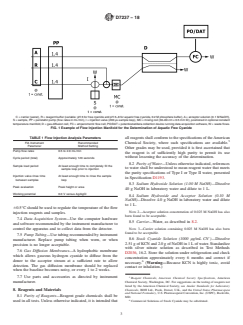
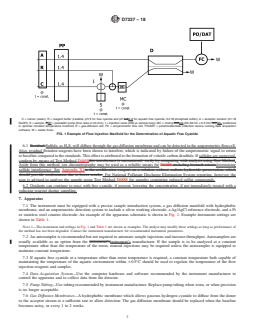
example of the apparatus schematic is shown in Fig. 1.
4.2 The sample is introduced into a carrier solution of the
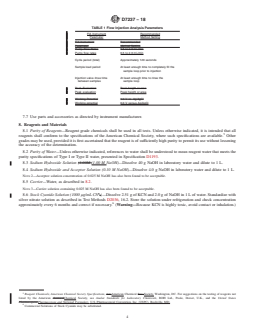
Example instrument settings are shown in Table 1.
flow injection analysis (FIA) system via an injection valve and
NOTE 1—The instrument and settings in Fig. 1 and Table 1 are shown
confluence downstream with a phosphate buffer solution at pH
as examples. The analyst may modify these settings as long as perfor-
6 to measure free cyanide or in the range of pH 6 to 8 to
mance of the method has not been degraded. Contact the instrument
measure aquatic free cyanide. The released hydrogen cyanide
manufacturer for recommended instrument parameters.
(HCN) gas diffuses through a hydrophobic gas diffusion
7.2 An autosampler is recommended but not required to
–
membrane into an alkaline acceptor stream where the CN is
automate sample injections and increase throughput.Autosam-
captured and sent to an amperometric flowcell detector with a
plers are usually available as an option from the instrument’s
silver-working electrode. In the presence of cyanide, silver in
manufacturer. If the sample is to be analyzed at a constant
the working electrode is oxidized at the applied potential. The
temperature other than the temperature of the room, manual
anodic current measured is proportional to the concentration of
injections may be required unless the autosampler is equipped
cyanide in the standard or sample injected.
to maintain constant temperature.
4.3 Calibrations and sample data are processed with the
7.3 If aquatic free cyanide at a temperature other than room
instrument’s data acquisition software.
temperature is required, a constant temperature bath capable of
maintaining the temperature of the aquatic environment within
The last approved version of this historical standard is referenced on
www.astm.org. 40 CFR Part 136.
D7237 − 18
C = carrier (water), R = reagent buffer (variable: pH 6 for free cyanide and pH 6–8 for aquatic free cyanide, 0.2 M phosphate buffer), A = acceptor solution (0.1 M NaOH),
S = sample, PP = peristaltic pump (flow rates in mL/min),I=injectionvalve(200µL sample loop), MC = mixing coil (30–60 cm × 0.5 mm ID), positioned in optional constant
temperature manifold, D = gas-diffusion cell, FC = amperometric flow cell, PO/DAT = potentiostat/data collection device running data acquisition software, W = waste flows.
FIG. 1 Example of Flow Injection Manifold for the Determination of Aquatic Free Cyanide
TABLE 1 Flow Injection Analysis Parameters
all reagents shall conform to the specifications of theAmerican
FIA Instrument Recommended Chemical Society, where such specifications are available.
Parameter Method Setting
Other grades may be used, provided it is first ascertained that
Pump flow rates 0.5 to 2.0 mL/min
the reagent is of sufficiently high purity to permit its use
without lessening the accuracy of the determination.
Cycle period (total) Approximately 120 seconds
8.2 Purity of Water—Unless otherwise indicated, references
Sample load period At least enough time to completely fill the
to water shall be understood to mean reagent water that meets
sample loop prior to injection
the purity specifications of Type I or Type II water, presented
Injection valve rinse time At least enough time to rinse the sample
in Specification D1193.
between samples loop
8.3 Sodium Hydroxide Solution (1.00 M NaOH)—Dissolve
Peak evaluation Peak height or area
40 g NaOH in laboratory water and dilute to 1 L.
Working potential 0.0 V versus Ag/AgCl
8.4 Sodium Hydroxide and Acceptor Solution (0.10 M
NaOH)—Dissolve 4.0 g NaOH in laboratory water and dilute
to1L.
60.5°C should be used to regulate the temperature of the flow
NOTE 2—Acceptor solution concentration of 0.025 M NaOH has also
injection reagents and samples.
been found to be acceptable.
7.4 Data Acquisition System—Use the computer hardware
8.5 Carrier—Water, as described in 8.2.
and software recommended by the instrument manufacturer to
control the apparatus and to collect data from the detector. NOTE 3—Carrier solution containing 0.025 M NaOH has also been
found to be acceptable.
7.5 Pump Tubing—Use tubing recommended by instrument
–
8.6 Stock Cyanide Solution (1000 µg/mL CN )—Dissolve
manufacturer. Replace pump tubing when worn, or when
2.51 g of KCN and 2.0 g of NaOH in 1 Lof water. Standardize
precision is no longer acceptable.
with silver nitrate solution as described in Test Methods
7.6 Gas Diffusion Membranes—A hydrophobic membrane
D2036, 16.2. Store the solution under refrigeration and check
which allows gaseous hydrogen cyanide to diffuse from the
concentration approximately every 6 months and correct if
donor to the acceptor stream at a sufficient rate to allow 6
necessary. (Warning—Because KCN is highly toxic, avoid
detection. The gas diffusion membrane should be replaced
contact or inhalation.)
when the baseline becomes noisy, or every 1 to 2 weeks.
7.7 Use parts and accessories as directed by instrument
Reagent Chemicals, American Chemical Society Specifications, American
manufacturer.
Chemical Society, Washington, DC. For suggestions on the testing of reagents not
listed by the American Chemical Society, see Analar Standards for Laboratory
8. Reagents and Materials
Chemicals, BDH Ltd., Poole, Dorset, U.K., and the United States Pharmacopeia
and National Formulary, U.S. Pharmacopeial Convention, Inc. (USPC), Rockville,
8.1 Purity of Reagents—Reagent grade chemicals shall be
MD.
used in all tests. Unless otherwise indicated, it is intended that Commercial Solutions of Stock Cyanide may be substituted.
D7237 − 18
8.7 Intermediate Cyanide Standards: ideorsulfuricacid.ThisbuffersolutionistobeusedintheFIA
–
8.7.1 Intermediate Standard 1 (100 µ g/mL CN )—Pipette system when aquatic free cyanide is to be determined at pH
7.0.
10.0 mL of stock cyanide solution (see 8.6) into a 100 mL
volumetric flask containing 1 mL of 1.0 M NaOH (see 8.3).
8.15 1 M Phosphate Buffer pH 6.0 Stock Solution—Add
Dilute to volume with laboratory water. Store under refrigera-
219.25 mLBuffer SolutionAand 30.75 mLof Buffer Solution
tion. The standard should be stable for at least 2 weeks.
B to a 500 mL volumetric flask. Dilute to volume with water.
–
8.7.2 Intermediate Cyanide Solution 2 (10 µg/mL CN )—
8.15.1 Alternatively, substitute 61.5 mL of 1 M sodium
Pipette 10.0 mLof Intermediate Cyanide Solution 1 (see 8.7.1)
phosphate dibasic for the 30.75 mL of Buffer Solution B.
into a 100 mL volumetric flask containing 1.0 mL of 1.00 M
8.16 0.2 M Phosphate Buffer pH 6.0—In a 1-L volumetric
NaOH (see 8.3). Dilute to volume with laboratory water. The
flask, add 200 mL 1 M Phosphate Buffer Solution pH 6.0 and
standard should be stable for at least 2 weeks.
dilute to volume with water. The pH should be pH 6.0 6 0.1.
8.8 Working Cyanide Calibration Standards—Prepare fresh
Verify the pH as described in Test Methods D1293 (Test
daily as described in 8.8.1 and 8.8.2 ranging in concentration
MethodA) and adjust if necessary with dilute sodium hydrox-
–
from 2 to 500 µg/L CN .
ideorsulfuricacid.ThisbuffersolutionistobeusedintheFIA
8.8.1 Calibration Standards (20, 50, 100, 200, and 500 µg/L
system when free cyanide or aquatic free cyanide is to be
–
CN )—Pipette 20, 50, 100, 200, and 500 µL of Intermediate
determined at pH 6.0 or if the pH of the aquatic environment
Standard 1 (see 8.7.1) into separate 100 mL volumetric flasks
has not been specified.
containing1.0mLof0.10MNaOH(see8.4).Dilutetovolume
8.17 1 M Phosphate Buffer pH 8.0 Stock Solution—Add
with laboratory water.
10.0 mL Buffer SolutionAand 240 mL Buffer Solution B to a
–
8.8.2 Calibration Standards (2, 5, and 10 µg/L CN )—
500-mL volumetric flask. Dilute to volume with water.
Pipette 20, 50, and 100 µL of Intermediate Cyanide Solution 2
8.18 0.2 M Phosphate Buffer pH 8.0—In a 1-L volumetric
(see 8.7.2) into separate 100 mL volumetric flasks containing
flask, add 200 mL 1 M Phosphate Buffer Solution pH 8.0 and
1.0 mL of 0.10 M NaOH (see 8.4). Dilute to volume with
dilute to volume with water.The pH should be pH = 8.0 6 0.1.
laboratory water.
Verify the pH as described in Test Methods D1293 (Test
8.9 Cyanide Electrode Stabilization Solution (Approxi-
MethodA) and adjust if necessary with dilute sodium hydrox-
–
mately 5 ppm as CN )—Pipette 500 µL of Stock Cyanide (see
ideorsulfuricacid.ThisbuffersolutionistobeusedintheFIA
8.6) into a 100 mL volumetric flask containing 1.0 mL of
system when aquatic free cyanide is to be determined at pH
0.10M M NaOH (see 8.4). Dilute to volume with laboratory
8.0.
water. The solution should be stored under refrigeration.
8.19 Ag/AgCl Reference Electrode Filling Solution—Fillthe
8.10 Acetate Buffer—Dissolve 410 g of sodium acetate
reference electrode as recommended by the instrument manu-
trihydrate (NaC H O ·3H O) in 500 mL of laboratory water.
2 3 2 2
facturer.
Add glacial acetic acid (approximately 500 mL) to yield a pH
of 4.5.
9. Hazards
8.11 Buffer Solution A, 2M Sodium phosphate monobasic
9.1 Warning—Because of the toxicity of cyanide, great
solution—Weigh 276 g sodium phosphate monobasic monohy-
care must be exercised in its handling.Acidification of cyanide
drate (NaH PO ·HO)ina1L volumetric flask. Dissolve and
solutions produces toxic hydrocyanic acid (HCN).All manipu-
2 4 2
dilute to volume with water.
lations must be done in the hood so that any HCN gas that
might escape is safely vented.
8.12 Buffer Solution B, 2 M Sodium phosphate dibasic
solution—Weigh 284 g sodium phosphate dibasic, anhydrous
9.2 Warning—Many of the reagents used in these test
(Na HPO ) in a 1-L volumetric flask. Dissolve and dilute to
methods are highly toxic. These reagents and their solutions
2 4
volume with water. If necessary, warm to approximately 40°C
must be disposed of properly.
on a hot plate and stir to completely dissolve the sodium
9.3 All reagents and standards should be prepared in vol-
phosphate dibasic into the water. Allow the solution to cool
umesconsistentwithlaboratoryusetominimizethegeneration
prior to use.
of waste.
8.12.1 Alternatively, preparea1M solution by dissolving
142 g sodium phosphate dibasic, anhydrous in 1 L.
10. Sample and Sample Preservation
8.13 1 M Phosphate Buffer pH 7.0 Stock Solution—Add
10.1 Collect the sample in accordance with latest version of
97.5 mL Buffer SolutionAand 152.5 mL Buffer Solution B to
Practice D7365. This practice is applicable for the collection
a 500-mL volumetric flask. Dilute to volume with water.
and preservation of water samples for the analysis of cyanide.
8.13.1 Alternatively, substitute 305 mL of 1 M sodium Responsibilities of field sampling personnel and the laboratory
phosphate dibasic for the 152.5 mL of Buffer Solution B.
are indicated. Usually 100 mL sample volume is sufficient.
Samples must be collected and stored in dark (amber or low
8.14 0.2 M Phosphate Buffer pH 7.0—Ina1L volumetric
actinic) containers to minimize reactions of ultra violet light.
flask, add 200 mL 1 M Phosphate Buffer Solution pH 7.0 and
dilute to volume with water. The pH should be pH 7.0 6 0.1. 10.2 The sample must be stabilized at time of collection
Verify the pH as described in Test Methods D1293 (Test with the addition of sodium hydroxide. Add 1 mL of 0.1 M
MethodA) and adjust if necessary with dilute sodium hydrox- NaOH to 100 mL of the sample or until the sample is pH 11.
D7237 − 18
10.3 See Section 11 if oxidizing agents or sulfide are 12.4 After the electrode system has stabilized, aspirate the
suspected to be present in the sample. highest working standard (see 8.8) into the flow injection
apparatus. Follow the instrument manufacturer’s instructions
10.4 Samples must be stored in dark bottles that minimize
to store the retention time window for cyanide using the data
exposure to ultraviolet radiation and refrigerated.
acquisition software.
NOTE 4—Practice D7365 recommends refrigeration by storing the
12.5 Select the buffer to be used for instrumental analysis of
sample between its freezing point and 6°C.
the sample, which is pH 6 for free cyanide or the closest pH to
10.5 Synthetic samples have been shown to be stable for at
that of the receiving water for the sample for aquatic free
least 14 days and up to 30 days, but in actual samples the
cyanide.
cyanide concentrations may decrease significantly prior to this
12.6 Inject each working standard and a reagent blank into
holding time if there are traces of chlorine, Caro’s acid,
the apparatus and record the amperometric response with the
reduced sulfur, or hydrogen peroxide present. Treat, filter and
data acquisition system. Plot the response versus the cyanide
measure the sample as soon as possible to avoid degradation.
concentration with a straight line or a quadratic fit curve
Holding times can be estimated in accordance with Practice
depending on the instrument and data acquisition system
D4841.
employed. If the calibration model is polynomial, it may be no
more than third order. A second order polynomial is recom-
11. Elimination of Interferences
mended.
11.1 Sulfides—Test for sulfides by placing a drop of sample
NOTE 5—Some regulatory agencies such as the United States Environ-
on lead acetate paper previously moistened with acetate buffer
mental Protection Agency (EPA) may not allow use of a third or higher
solution (see 8.10). If the paper turns black, sulfide is present.
...
This document is not an ASTM standard and is intended only to provide the user of an ASTM standard an indication of what changes have been made to the previous version. Because
it may not be technically possible to adequately depict all changes accurately, ASTM recommends that users consult prior editions as appropriate. In all cases only the current version
of the standard as published by ASTM is to be considered the official document.
Designation: D7237 − 15a D7237 − 18
Standard Test Method for
Free Cyanide and Aquatic Free Cyanide with Flow Injection
Analysis (FIA) Utilizing Gas Diffusion Separation and
Amperometric Detection
This standard is issued under the fixed designation D7237; the number immediately following the designation indicates the year of
original adoption or, in the case of revision, the year of last revision. A number in parentheses indicates the year of last reapproval. A
superscript epsilon (´) indicates an editorial change since the last revision or reapproval.
1. Scope*
1.1 This test method is used to establish the concentration of free cyanide in an aqueous wastewater, effluent and in-stream free
cyanide concentrations after mixing treated water with receiving water. The test conditions of this test method are used to measure
-–
free cyanide (HCN and CN ) and cyanide bound in the metal-cyanide complexes that are easily dissociated into free cyanide ions
at the pH of 6. Free cyanide is determined at pH 6 at room temperature. The aquatic free cyanide can be determined by matching
the pH to the water in the receiving environment in the range of pH 6 to 8. The extent of HCN formation is less dependent on
temperature than the pH; however, the temperature can be regulated if deemed necessary for aquatic free cyanide to further
simulate the actual aquatic environment.
1.2 The free cyanide test method is based on the same instrumentation and technology that is described in Test Method D6888,
but employs milder conditions (pH 6–8 buffer versus HCl or H SO in the reagent stream), and does not utilize ligand displacement
2 4
reagents.
1.3 The aquatic free cyanide measured by this procedure should be similar to actual levels of HCN in the original aquatic
environment. This in turn may give a reliable index of toxicity to aquatic organisms.
1.4 This procedure is applicable over a range of approximately 5 to 500 μg/L (parts per billion) free cyanide. Sample dilution
may increase cyanide recoveries depending on the cyanide speciation; therefore, it is not recommended to dilute samples. Higher
concentrations can be analyzed by increasing the range of calibration standards or with a lower injection volume. In accordance
with Guide E1763 and Practice D6512 the lower scope limit was determined to be 9 μg/L for chlorinated gold leaching barren
effluent water and the IQE is 12 μg/L in the gold processing detoxified reverse osmosis permeate waste water sample matrix.
10 %
1.5 The values stated in SI units are to be regarded as standard. No other units of measurement are included in this standard.
1.6 This test method is not recommended for samples that contain reduced sulfur compounds such as sulfides.
1.7 This standard does not purport to address all of the safety concerns, if any, associated with its use. It is the responsibility
of the user of this standard to establish appropriate safety safety, health, and healthenvironmental practices and determine the
applicability of regulatory limitations prior to use. Specific hazard statements are given in 8.6 and Section 9.
1.8 This international standard was developed in accordance with internationally recognized principles on standardization
established in the Decision on Principles for the Development of International Standards, Guides and Recommendations issued
by the World Trade Organization Technical Barriers to Trade (TBT) Committee.
2. Referenced Documents
2.1 ASTM Standards:
D1129 Terminology Relating to Water
D1193 Specification for Reagent Water
D1293 Test Methods for pH of Water
D2036 Test Methods for Cyanides in Water
This test method is under the jurisdiction of ASTM Committee D19 on Water and is the direct responsibility of Subcommittee D19.06 on Methods for Analysis for
Organic Substances in Water.
Current edition approved June 1, 2015Dec. 1, 2018. Published June 2015January 2019. Originally approved in 2006. Last previous edition approved in 2015 as
D7237 – 15.D7237 – 15a. DOI: 10.1520/D7237-15A.10.1520/D7237-18.
For referenced ASTM standards, visit the ASTM website, www.astm.org, or contact ASTM Customer Service at service@astm.org. For Annual Book of ASTM Standards
volume information, refer to the standard’sstandard’s Document Summary page on the ASTM website.
*A Summary of Changes section appears at the end of this standard
Copyright © ASTM International, 100 Barr Harbor Drive, PO Box C700, West Conshohocken, PA 19428-2959. United States
D7237 − 18
D2777 Practice for Determination of Precision and Bias of Applicable Test Methods of Committee D19 on Water
D3856 Guide for Management Systems in Laboratories Engaged in Analysis of Water
D4658 Test Method for Sulfide Ion in Water
D4841 Practice for Estimation of Holding Time for Water Samples Containing Organic and Inorganic Constituents
D5847 Practice for Writing Quality Control Specifications for Standard Test Methods for Water Analysis
D6512 Practice for Interlaboratory Quantitation Estimate
D6696 Guide for Understanding Cyanide Species
D6888 Test Method for Available Cyanides with Ligand Displacement and Flow Injection Analysis (FIA) Utilizing Gas
Diffusion Separation and Amperometric Detection
D7365 Practice for Sampling, Preservation and Mitigating Interferences in Water Samples for Analysis of Cyanide
D7728 Guide for Selection of ASTM Analytical Methods for Implementation of International Cyanide Management Code
Guidance
E691 Practice for Conducting an Interlaboratory Study to Determine the Precision of a Test Method
E1601 Practice for Conducting an Interlaboratory Study to Evaluate the Performance of an Analytical Method
E1763 Guide for Interpretation and Use of Results from Interlaboratory Testing of Chemical Analysis Methods (Withdrawn
2015)
3. Terminology
3.1 Definitions:
3.1.1 For definitions of terms used in this standard, refer to Terminology D1129 and Guide D6696.
3.2 Definitions of Terms Specific to This Standard:—For definitions of terms used in this test method, refer to Terminology
D1129 and Guide D6696.
3.2.1 aquatic free cyanide, n—free cyanide measured when the buffer or temperature is adjusted to mimic the receiving-water
environment.
-–
3.2.2 free cyanide, n—sum of the free cyanide (HCN and CN ) and cyanide bound in the metal-cyanide complexes that are
easily dissociated into free cyanide under the test conditions described in this test method at pH 6 and room temperature.
4. Summary of Test Method
4.1 The test is generally performed at room temperature, but temperature of the sample and flow injection reagents can be
regulated to match the aquatic environment if necessary to measure aquatic free cyanide.
4.2 The sample is introduced into a carrier solution of the flow injection analysis (FIA) system via an injection valve and
confluence downstream with a phosphate buffer solution at pH 6 to measure free cyanide or in the range of pH 6 to 8 to measure
aquatic free cyanide. The released hydrogen cyanide (HCN) gas diffuses through a hydrophobic gas diffusion membrane into an
-–
alkaline acceptor stream where the CN is captured and sent to an amperometric flowcell detector with a silver-working electrode.
In the presence of cyanide, silver in the working electrode is oxidized at the applied potential. The anodic current measured is
proportional to the concentration of cyanide in the standard or sample injected.
4.3 Calibrations and sample data are processed with the instrument’sinstrument’s data acquisition software.
5. Significance and Use
5.1 Cyanide and hydrogen cyanide are highly toxic. Regulations have been established to require the monitoring of cyanide in
industrial and domestic wastes and surface waters.
5.2 It is useful to determine the aquatic free cyanide to establish an index of toxicity when a wastewater is introduced into the
natural environment at a given pH and temperature.
5.3 This test method is applicable for natural water, saline waters, and wastewater effluent.
5.4 Free cyanide measured using this test method is applicable for implementation of the International Cyanide Code Guidance
in accordance with Guide D7728.
6. Interferences
6.1 Sulfide will diffuse through the gas diffusion membrane and can be detected in the amperometric flowcell. Oxidized
- -
products of sulfide can also rapidly convert CN to SCN at a high pH. Refer to 11.3 for sulfide removal.
6.2 Refer to 6.1 of Test Method D6888 and Test Methods D2036 for elimination of cyanide interferences.
The last approved version of this historical standard is referenced on www.astm.org.
40 CFR Part 136.
D7237 − 18
C = carrier (water), R = reagent buffer (variable: pH 6 for free cyanide and pH 6-86–8 for aquatic free cyanide, 0.2 M phosphate buffer), A = acceptor solution (0.1 M
NaOH), S = sample, PPP = peristaltic pump (flow rates in mL/min), I = injection valve (200 μL sample loop), MC = mixing coolcoil (30–60 cm × 0.5 mm i.d.),ID), positioned
in optional constant temperature manifold, D = gas-diffusion cell, FC = amperometric flow cell, PO/DAT = potentiostat/data collection device running data acquisition
software, W = waste flows.
FIG. 1 Example of Flow Injection Manifold for the Determination of Aquatic Free Cyanide
6.1 Residual Sulfide, as H S, will diffuse through the gas diffusion membrane and can be detected in the amperometric flowcell.
Also, residual flotation reagents have been shown to interfere, which is indicated by failure of the amperometric signal to return
to baseline compared to the standards. This effect is attributed to the formation of volatile carbon disulfide. If sulfides are suspected,
confirm by means of Test Method D4658this interference is encountered, verify by comparing with analysis using Test Method.
Aside from this method, ion chromatography may be used as a reliable means for D6888 including bismuth nitratedetermining
sulfide interference. See Appendix X1in the acidification reagent on a solution without sodium hydroxide preservation, which
should provide confirmation due to lower results. For National Pollutant Discharge Elimination System reporting, however, the
user is advised to analyze the sample using Test Method D6888 for samples containing reduced sulfur compounds.
6.2 Oxidants can continue to react with free cyanide, if present, lowering the concentration, if not immediately treated with a
reducing reagent during sampling.
7. Apparatus
7.1 The instrument must be equipped with a precise sample introduction system, a gas diffusion manifold with hydrophobic
membrane, and an amperometric detection system to include a silver working electrode, a Ag/AgCl reference electrode, and a Pt
or stainless steel counter electrode. An example of the apparatus schematic is shown in Fig. 1. Example instrument settings are
shown in Table 1.
NOTE 1—The instrument and settings in Fig. 1 and Table 1 are shown as examples. The analyst may modify these settings as long as performance of
the method has not been degraded. Contact the instrument manufacturer for recommended instrument parameters.
7.2 An autosampler is recommended but not required to automate sample injections and increase throughput. Autosamplers are
usually available as an option from the instrument’sinstrument’s manufacturer. If the sample is to be analyzed at a constant
temperature other than the temperature of the room, manual injections may be required unless the autosampler is equipped to
maintain constant temperature.
7.3 If aquatic free cyanide at a temperature other than room temperature is required, a constant temperature bath capable of
maintaining the temperature of the aquatic environment within 60.5°C should be used to regulate the temperature of the flow
injection reagents and samples.
7.4 Data Acquisition System—Use the computer hardware and software recommended by the instrument manufacturer to
control the apparatus and to collect data from the detector.
7.5 Pump Tubing—Use tubing recommended by instrument manufacturer. Replace pump tubing when worn, or when precision
is no longer acceptable.
7.6 Gas Diffusion Membranes—A hydrophobic membrane which allows gaseous hydrogen cyanide to diffuse from the donor
to the acceptor stream at a sufficient rate to allow detection. The gas diffusion membrane should be replaced when the baseline
becomes noisy, or every 1 to 2 weeks.
D7237 − 18
TABLE 1 Flow Injection Analysis Parameters
FIA Instrument Recommended
Parameter Method Setting
FIA Instrument Recommended
Parameter Method Setting
Pump Flow Rates 0.5 to 2.0 mL/min
Pump flow rates 0.5 to 2.0 mL/min
Cycle period (total) Approximately 120 seconds
Sample load period At least enough time to completely fill the
sample loop prior to injection
Injection valve rinse time At least enough time to rinse the
between samples sample loop
Peak Evaluation Peak height or area
Peak evaluation Peak height or area
Working Potential 0.0 V vs. Ag/AgCl
Working potential 0.0 V versus Ag/AgCl
7.7 Use parts and accessories as directed by instrument manufacturer.
8. Reagents and Materials
8.1 Purity of Reagents—Reagent grade chemicals shall be used in all tests. Unless otherwise indicated, it is intended that all
reagents shall conform to the specifications of the American Chemical Society, where such specifications are available. Other
grades may be used, provided it is first ascertained that the reagent is of sufficiently high purity to permit its use without lessening
the accuracy of the determination.
8.2 Purity of Water—Unless otherwise indicated, references to water shall be understood to mean reagent water that meets the
purity specifications of Type I or Type II water, presented in Specification D1193.
8.3 Sodium Hydroxide Solution (1.00M (1.00 M NaOH)—Dissolve 40 g NaOH in laboratory water and dilute to 1 L.
8.4 Sodium Hydroxide and Acceptor Solution (0.10 M NaOH)—Dissolve 4.0 g NaOH in laboratory water and dilute to 1 L.
NOTE 2—Acceptor solution concentration of 0.025 M NaOH has also been found to be acceptable.
8.5 Carrier—Water, as described in 8.2.
NOTE 3—Carrier solution containing 0.025 M NaOH has also been found to be acceptable.
-–
8.6 Stock Cyanide Solution (1000 μg/mL CN )—Dissolve 2.51 g of KCN and 2.0 g of NaOH in 1 L of water. Standardize with
silver nitrate solution as described in Test Methods D2036, 16.2. Store the solution under refrigeration and check concentration
approximately every 6 months and correct if necessary. (Warning—Because KCN is highly toxic, avoid contact or inhalation.)
Reagent Chemicals, American Chemical Society Specifications, Am.American Chemical Soc.,Society, Washington, DC. For suggestions on the testing of reagents not
listed by the American chemicalChemical Society, see Analar Standards for Laboratory Chemicals, BDH Ltd., Poole, Dorset, U.K., and the United States
Pharmacopeia.Pharmacopeia and National Formulary, U.S. Pharmacopeial Convention, Inc. (USPC), Rockville, MD.
Commercial Solutions of Stock Cyanide may be substituted.
D7237 − 18
8.7 Intermediate Cyanide Standards:
-–
8.7.1 Intermediate Standard 1 (100 μ g/mL CN )—Pipette 10.0 mL of stock cyanide solution (see 8.6) into a 100 mL volumetric
flask containing 1 mL of 1.0 M NaOH (see 8.3). Dilute to volume with laboratory water. Store under refrigeration. The standard
should be stable for at least 2 weeks.
-–
8.7.2 Intermediate Cyanide Solution 2 (10 μg/mL CN )—Pipette 10.0 mL of Intermediate Cyanide Solution 1 (see 8.7.1) into
a 100 mL volumetric flask containing 1.0 mL of 1.00 M NaOH (see 8.3). Dilute to volume with laboratory water. The standard
should be stable for at least 2 weeks.
8.8 Working Cyanide Calibration Standards—Prepare fresh daily as described in 8.8.1 and 8.8.2 ranging in concentration from
-–
2 to 500 μg/L CN .
-–
8.8.1 Calibration Standards (20, 50, 100, 200, and 500 μg/L CN )—Pipette 20, 50, 100, 200, and 500 μL of Intermediate
Standard 1 (see 8.7.1) into separate 100 mL volumetric flasks containing 1.0 mL of 0.10 M NaOH (see 8.4). Dilute to volume with
laboratory water.
-–
8.8.2 Calibration Standards (2, 5, and 10 μg/L CN )—Pipette 20, 50, and 100 μL of Intermediate Cyanide Solution 2 (see 8.7.2)
into separate 100 mL volumetric flasks containing 1.0 mL of 0.10 M NaOH (see 8.4). Dilute to volume with laboratory water.
-–
8.9 Cyanide Electrode Stabilization Solution (Approximately 5 ppm as CN )—Pipette 500 μL of Stock Cyanide (see 8.6) into
a 100 mL volumetric flask containing 1.0 mL of 0.10M M NaOH (see 8.4). Dilute to volume with laboratory water. The solution
should be stored under refrigeration.
8.10 Acetate Buffer—Dissolve 410 g of sodium acetate trihydrate (NaC H O ·3H O) in 500 mL of laboratory water. Add glacial
2 3 2 2
acetic acid (approximately 500 mL) to yield a pH of 4.5.
8.11 Buffer Solution A, 2M Sodium phosphate monobasic solution—Weigh 276 g sodium phosphate monobasic monohydrate
(NaH PO ·H O) in a 1 L volumetric flask. Dissolve and dilute to volume with water.
2 4 2
8.12 Buffer Solution B, 2 M Sodium phosphate dibasic solution—Weigh 284 g sodium phosphate dibasic, anhydrous (Na HPO )
2 4
in a 1-L volumetric flask. Dissolve and dilute to volume with water. If necessary, warm to approximately 40°C on a hot plate and
stir to completely dissolve the sodium phosphate dibasic into the water. Allow the solution to cool prior to use.
8.12.1 Alternatively, prepare a 1 M solution by dissolving 142 g sodium phosphate dibasic, anhydrous in 1 L.
8.13 1 M Phosphate Buffer pH 7.0 Stock Solution—Add 97.5 mL Buffer Solution A and 152.5 mL Buffer Solution B to a 500-mL
volumetric flask. Dilute to volume with water.
8.13.1 Alternatively, substitute 305 mL of 1 M sodium phosphate dibasic for the 152.5 mL of Buffer Solution B.
8.14 0.2 M Phosphate Buffer pH 7.0—In a 1 L volumetric flask, add 200 mL 1 M Phosphate Buffer Solution pH 7.0 and dilute
to volume with water. The pH should be pH 7.0 6 0.1. Verify the pH as described in Test Methods D1293 (Test Method A) and
adjust if necessary with dilute sodium hydroxide or sulfuric acid. This buffer solution is to be used in the FIA system when aquatic
free cyanide is to be determined at pH 7.0.
8.15 1 M Phosphate Buffer pH 6.0 Stock Solution—Add 219.25 mL Buffer Solution A and 30.75 mL of Buffer Solution B to
a 500 mL volumetric flask. Dilute to volume with water.
8.15.1 Alternatively, substitute 61.5 mL of 1 M sodium phosphate dibasic for the 30.75 mL of Buffer Solution B.
8.16 0.2 M Phosphate Buffer pH 6.0—In a 1-L volumetric flask, add 200 mL 1 M Phosphate Buffer Solution pH 6.0 and dilute
to volume with water. The pH should be pH 6.0 6 0.1. Verify the pH as described in Test Methods D1293 (Test Method A) and
adjust if necessary with dilute sodium hydroxide or sulfuric acid. This buffer solution is to be used in the FIA system when free
cyanide or aquatic free cyanide is to be determined at pH 6.0 or if the pH of the aquatic environment has not been specified.
8.17 1 M Phosphate Buffer pH 8.0 Stock Solution—Add 10.0 mL Buffer Solution A and 240 mL Buffer Solution B to a 500-mL
volumetric flask. Dilute to volume with water.
8.18 0.2 M Phosphate Buffer pH 8.0—In a 1-L volumetric flask, add 200 mL 1 M Phosphate Buffer Solution pH 8.0 and dilute
to volume with water. The pH should be pH=8.0 pH = 8.0 6 0.1. Verify the pH as described in Test Methods D1293 (Test Method
A) and adjust if necessary with dilute sodium hydroxide or sulfuric acid. This buffer solution is to be used in the FIA system when
aquatic free cyanide is to be determined at pH 8.0.
8.19 Ag/AgCl Reference Electrode Filling Solution—Fill the reference electrode as recommended by the instrument
manufacturer.
9. Hazards
9.1 Warning—Because of the toxicity of cyanide, great care must be exercised in its handling. Acidification of cyanide
solutions produces toxic hydrocyanic acid (HCN). All manipulations must be done in the hood so that any HCN gas that might
escape is safely vented.
9.2 Warning—Many of the reagents used in these test methods are highly toxic. These reagents and their solutions must be
disposed of properly.
D7237 − 18
9.3 All reagents and standards should be prepared in volumes consistent with laboratory use to minimize the generation of
waste.
10. Sample and Sample Preservation
10.1 Collect the sample in accordance with latest version of Practice D7365. This practice is applicable for the collection and
preservation of water samples for the analysis of cyanide. Responsibilities of field sampling personnel and the laboratory are
indicated. Usually 100 mL sample volume is sufficient. Samples must be collected and stored in dark (amber or low actinic)
containers to minimize reactions of ultra violet light.
10.2 The sample must be stabilized at time of collection with the addition of sodium hydroxide. Add 1 mL of 0.1 M NaOH to
100 mL of the sample or until the sample is pH 11.
10.3 See Section 11 if oxidizing agents or sulfide are suspected to be present in the sample.
10.4 Samples must be stored in dark bottles that minimize exposure to ultraviolet radiation and refrigerated.
NOTE 4—Practice D7365 recommends refrigeration by storing the sample between its freezing point and 6°C.
10.5 Synthetic samples have been shown to be stable for at least 14 days and up to 30 days, but in actual samples the cyanide
concentrations may decrease significantly prior to this holding time if there are undetectable traces of chlorine, reduced sulfur
species, Caro’s acid, reduced sulfur, or hydrogen peroxide present. Analyze Treat, filter and measure the sample as soon as
possible to avoid degradation. Holding times can be estimated in accordance with Practice D4841.
11. Elimination of Interferences
11.1 Sulfides—Practice Test for sulfides by placing a drop of sample on lead acetate paper previously moistened with acetate
buffer solution (see 8.10). If the paper turns black, sulfide is present. An odor of “rotten eggs” also indicates the presence of sulfide.
Lead acetate test strips may not be sensitive enough to detect sulfide concentrations below approximately 50 mg/L. If the presence
of sulfide below concentrations of 50 mg/L is suspected, confirm using Test Method D7365D4658 specifies mitigation of
interference procedures. Mitigate using Test Method D6888 for testing water samples for cyanide.to measure available weak and
dissociable cyanide without sulfide interference. Although also effective in overcoming sulfide interference, ion chromatography
is not an approved test procedure for determining free and aquatic free cyanide in accordance with 40 CFR 136.3.
11.2 Oxidizing Agent—Test for the presence of oxidizing agents. Add a drop of the sample to acidified KI starch test paper
(acidify KI starch paper with acetate buffer, see 8.10) as soon as the sample is collected; a blue color indicates the need for
treatment. If oxidizing agents are present, add 0.1 g/L sodium arsenite to the sample and mix until a drop of sample on the test
strip shows no blue color, to avoid degradation of cyanide.
11.3 Sulfide—Test for sulfide by placing a drop of sample on lead acetate paper previously moistened with acetate buffer
solution (see 8.10). If the paper turns black, sulfide is present. Add lead acetate, or if the sulfide concentration is too high, add
powdered lead carbonate to avoid significantly reducing the pH. Repeat this test until a drop of treated sample no longer darkens
the acidified lead acetate test paper. The supernatant containing cyanide must be filtered immediately to avoid the rapid loss of
cyanide due to the formation of thiocyanate.
NOTE 5—Lead acetate test strips may not be sensitive enough to detect sulfide concentrations below approximately 50 mg/L; therefore, treatment may
be performed on samples where sulfide is suspected. Interference can be confirmed by analyzing the sample with and without treatment. If the measured
cyanide in the untreated sample is significantly higher, sulfide is likely present and treatment described in 11.3 should be performed to remove sulfide.
12. Calibration and Standardization
12.1 Turn on the power to the apparatus and the autosampler (if equipped). Start the data acquisition system.
12.2 Clamp the pump tube platens in place and start pumping reagents in the flow injection system. Allow the system to warm
up at least 15 min or until a stable baseline is achieved. Take care not to over-tighten the pump tube platens as this greatly reduces
the lifetime of the tubing.
-–
12.3 If recommended by the instrument manufacturer, aspirate the Cyanide Stabilization Solution (5 ppm CN ) from 8.9. After
at least 30 s, inject the stabilization solution into the apparatus and record the amperometric response (pA value) after the cycle
period has completed. Repeat this procedure until the peak responses are less than 2 % RSD. This process will ensure that the
electrode system has stabilized.
12.4 After the electrode system has stabilized, aspirate the highest working standard (see 8.8) into the flow injection apparatus.
Follow the instrument manufacturer’smanufacturer’s instructions to store the retention time window for cyanide using the data
acquisition software.
Reduced sulfur samples will cause high results due to direct interference, or low results through the formation of SCN.
D7237 − 18
12.5 Select the buffer to be used for instrumental analysis of the sample, which is pH 6 for free cyanide or the closest pH to
that of the receiving water for the sample for aquatic free cyanide.
12.6 Inject each working standard and a reagent blank into the apparatus and
...