

ASTM D6916-18
(Test Method)Standard Test Method for Determining the Shear Strength Between Segmental Concrete Units (Modular Concrete Blocks)
General Information
- Abstract
SIGNIFICANCE AND USE
5.1 The shear strength between segmental concrete units (with and without geosynthetic reinforcement) is used in design of reinforced soil retaining walls.
5.2 This test is used to determine the shear strength for the design of the facing stability of segmental retaining walls. Performing a series of these shear tests at varying normal loads permits development of a relationship between shear strength and normal load. This relationship may be linear, bilinear, or some other complex mathematical expression.
5.3 This shear strength test is meant to be a performance test (laboratory or field); therefore, it should be conducted using full-scale system components. The conditions for the test are selected by the user and are not for routine testing.
5.4 As a performance test on full-scale system components, it accounts for some of the variables in construction procedures and materials tolerance normally present for these types of retaining wall systems.
SCOPE
1.1 This test method is used to determine the shear strength between two layers of segmental concrete block units used in construction of reinforced soil retaining walls. The test is carried out under conditions determined by the user that reproduce the facing system at full scale. The results of a series of tests are used to define a relationship between shear strength developed between segmental concrete units and normal load.
1.2 This is a performance test used to determine properties for design of retaining wall systems utilizing segmental concrete units and soil reinforcing geosynthetics, either geotextiles or geogrids. The test is performed on a full-scale construction of the facing system and may be run in a laboratory or the field.
1.3 The values stated in SI units are regarded as the standard. The values stated in inch-pound units are provided for information only.
1.4 This standard does not purport to address all of the safety concerns, if any, associated with its use. It is the responsibility of the user of this standard to establish appropriate safety, health, and environmental practices and determine the applicability of regulatory limitations prior to use.
1.5 This international standard was developed in accordance with internationally recognized principles on standardization established in the Decision on Principles for the Development of International Standards, Guides and Recommendations issued by the World Trade Organization Technical Barriers to Trade (TBT) Committee.
- Status
- Published
- Publication Date
- 14-Jul-2018
- Technical Committee
- D35 - Geosynthetics
- Drafting Committee
- D35.01 - Mechanical Properties
Buy Documents
ASTM D6916-18 - Standard Test Method for Determining the Shear Strength Between Segmental Concrete Units (Modular Concrete Blocks)
REDLINE ASTM D6916-18 - Standard Test Method for Determining the Shear Strength Between Segmental Concrete Units (Modular Concrete Blocks)
Overview
ASTM D6916-18: Standard Test Method for Determining the Shear Strength Between Segmental Concrete Units (Modular Concrete Blocks) is a globally recognized standard developed by ASTM International. This test method is specifically designed to measure the shear strength between two layers of segmental concrete block units, which are commonly used in the construction of reinforced soil retaining walls. The assessment can be conducted in laboratory or field settings, utilizing full-scale components to better replicate real-world conditions and performance.
Shear strength data generated from this method are fundamental for designing the facing stability of segmental retaining walls, both with and without geosynthetic reinforcement. The test provides practical value by defining the relationship between applied normal loads and the shear strength developed at the interface of modular concrete blocks.
Key Topics
- Shear Strength Testing: Evaluates the maximum resistance to sliding between segmental concrete units under varying normal loads.
- Full-scale Performance Testing: Uses actual system components as they appear in field installations, accounting for construction variability and material tolerances.
- Geosynthetic Reinforcement Compatibility: Applicable to walls constructed with or without reinforcing geosynthetics, such as geotextiles and geogrids.
- Repeatability and Reliability: Specifies the importance of multiple tests and repeatability checks to ensure consistent and reliable results.
- Result Reporting: Emphasizes detailed documentation of material characteristics, assembly methods, loading conditions, and resultant data in compliance with ASTM protocols.
Applications
ASTM D6916-18 is widely used by engineers, designers, and construction professionals for:
- Retaining Wall System Design: Critical for determining the interface shear strength used in stability calculations for segmental retaining walls, especially those incorporating modular blocks and soil reinforcement.
- Quality Assurance and Specification Compliance: Ensures that the wall systems meet engineering specifications and perform as designed under expected loading conditions.
- Performance Validation: Assesses the effectiveness of different materials and construction methods, helping select suitable block and geosynthetic combinations.
- Research and Development: Facilitates new product development by providing a framework for comparative performance evaluation of different segmental unit types and reinforcements.
- Construction Method Evaluation: Assists in evaluating the impact of construction practices, such as infill compaction and block placement, on wall stability.
Related Standards
The following ASTM standards are frequently referenced in conjunction with ASTM D6916-18:
- ASTM D448: Standard Classification for Sizes of Aggregate for Road and Bridge Construction
- ASTM D4354: Practice for Sampling of Geosynthetics and Rolled Erosion Control Products for Testing
- ASTM D4439: Terminology for Geosynthetics
- ASTM D4595: Test Method for Tensile Properties of Geotextiles by the Wide-Width Strip Method
- ASTM D6637/D6637M: Test Method for Determining Tensile Properties of Geogrids by the Single or Multi-Rib Tensile Method
These related standards help define test materials, sampling protocols, and supporting terminology, ensuring consistency and reliability in geosynthetic-reinforced soil structures.
Keywords: shear strength, segmental concrete units, modular concrete blocks, geosynthetic reinforcement, geotextile, geogrid, reinforced soil retaining walls, ASTM D6916-18, performance testing, retaining wall design.
Relations
- Effective Date
- 15-Jul-2018
- Effective Date
- 01-Feb-2024
- Effective Date
- 15-Nov-2023
- Effective Date
- 01-May-2020
- Effective Date
- 15-Apr-2018
- Effective Date
- 01-Aug-2017
- Effective Date
- 01-Sep-2015
- Effective Date
- 15-Jul-2015
- Effective Date
- 01-Jul-2015
- Effective Date
- 01-Mar-2014
- Refers
ASTM D448-12 - Standard Classification for Sizes of Aggregate for Road and Bridge Construction - Effective Date
- 01-Dec-2012
- Effective Date
- 01-Jul-2012
- Effective Date
- 01-Oct-2011
- Effective Date
- 01-Oct-2011
- Effective Date
- 15-Jan-2009
Buy Documents
ASTM D6916-18 - Standard Test Method for Determining the Shear Strength Between Segmental Concrete Units (Modular Concrete Blocks)
REDLINE ASTM D6916-18 - Standard Test Method for Determining the Shear Strength Between Segmental Concrete Units (Modular Concrete Blocks)
Get Certified
Connect with accredited certification bodies for this standard

DIBt (Deutsches Institut für Bautechnik)
German Institute for Building Technology.
DIN CERTCO
DIN Group product certification.

Aboma Certification B.V.
Specialized in construction, metal, and transport sectors.
Sponsored listings
Frequently Asked Questions
ASTM D6916-18 is a standard published by ASTM International. Its full title is "Standard Test Method for Determining the Shear Strength Between Segmental Concrete Units (Modular Concrete Blocks)". This standard covers: SIGNIFICANCE AND USE 5.1 The shear strength between segmental concrete units (with and without geosynthetic reinforcement) is used in design of reinforced soil retaining walls. 5.2 This test is used to determine the shear strength for the design of the facing stability of segmental retaining walls. Performing a series of these shear tests at varying normal loads permits development of a relationship between shear strength and normal load. This relationship may be linear, bilinear, or some other complex mathematical expression. 5.3 This shear strength test is meant to be a performance test (laboratory or field); therefore, it should be conducted using full-scale system components. The conditions for the test are selected by the user and are not for routine testing. 5.4 As a performance test on full-scale system components, it accounts for some of the variables in construction procedures and materials tolerance normally present for these types of retaining wall systems. SCOPE 1.1 This test method is used to determine the shear strength between two layers of segmental concrete block units used in construction of reinforced soil retaining walls. The test is carried out under conditions determined by the user that reproduce the facing system at full scale. The results of a series of tests are used to define a relationship between shear strength developed between segmental concrete units and normal load. 1.2 This is a performance test used to determine properties for design of retaining wall systems utilizing segmental concrete units and soil reinforcing geosynthetics, either geotextiles or geogrids. The test is performed on a full-scale construction of the facing system and may be run in a laboratory or the field. 1.3 The values stated in SI units are regarded as the standard. The values stated in inch-pound units are provided for information only. 1.4 This standard does not purport to address all of the safety concerns, if any, associated with its use. It is the responsibility of the user of this standard to establish appropriate safety, health, and environmental practices and determine the applicability of regulatory limitations prior to use. 1.5 This international standard was developed in accordance with internationally recognized principles on standardization established in the Decision on Principles for the Development of International Standards, Guides and Recommendations issued by the World Trade Organization Technical Barriers to Trade (TBT) Committee.
SIGNIFICANCE AND USE 5.1 The shear strength between segmental concrete units (with and without geosynthetic reinforcement) is used in design of reinforced soil retaining walls. 5.2 This test is used to determine the shear strength for the design of the facing stability of segmental retaining walls. Performing a series of these shear tests at varying normal loads permits development of a relationship between shear strength and normal load. This relationship may be linear, bilinear, or some other complex mathematical expression. 5.3 This shear strength test is meant to be a performance test (laboratory or field); therefore, it should be conducted using full-scale system components. The conditions for the test are selected by the user and are not for routine testing. 5.4 As a performance test on full-scale system components, it accounts for some of the variables in construction procedures and materials tolerance normally present for these types of retaining wall systems. SCOPE 1.1 This test method is used to determine the shear strength between two layers of segmental concrete block units used in construction of reinforced soil retaining walls. The test is carried out under conditions determined by the user that reproduce the facing system at full scale. The results of a series of tests are used to define a relationship between shear strength developed between segmental concrete units and normal load. 1.2 This is a performance test used to determine properties for design of retaining wall systems utilizing segmental concrete units and soil reinforcing geosynthetics, either geotextiles or geogrids. The test is performed on a full-scale construction of the facing system and may be run in a laboratory or the field. 1.3 The values stated in SI units are regarded as the standard. The values stated in inch-pound units are provided for information only. 1.4 This standard does not purport to address all of the safety concerns, if any, associated with its use. It is the responsibility of the user of this standard to establish appropriate safety, health, and environmental practices and determine the applicability of regulatory limitations prior to use. 1.5 This international standard was developed in accordance with internationally recognized principles on standardization established in the Decision on Principles for the Development of International Standards, Guides and Recommendations issued by the World Trade Organization Technical Barriers to Trade (TBT) Committee.
ASTM D6916-18 is classified under the following ICS (International Classification for Standards) categories: 91.100.30 - Concrete and concrete products. The ICS classification helps identify the subject area and facilitates finding related standards.
ASTM D6916-18 has the following relationships with other standards: It is inter standard links to ASTM D6916-06c(2011), ASTM D4439-24, ASTM D6637/D6637M-15(2023), ASTM D4354-12(2020), ASTM D4439-18, ASTM D4439-17, ASTM D4439-15a, ASTM D6637/D6637M-15, ASTM D4439-15, ASTM D4439-14, ASTM D448-12, ASTM D4354-12, ASTM D4439-11, ASTM D4595-11, ASTM D4354-99(2009). Understanding these relationships helps ensure you are using the most current and applicable version of the standard.
ASTM D6916-18 is available in PDF format for immediate download after purchase. The document can be added to your cart and obtained through the secure checkout process. Digital delivery ensures instant access to the complete standard document.
Standards Content (Sample)
This international standard was developed in accordance with internationally recognized principles on standardization established in the Decision on Principles for the
Development of International Standards, Guides and Recommendations issued by the World Trade Organization Technical Barriers to Trade (TBT) Committee.
Designation: D6916 − 18
Standard Test Method for
Determining the Shear Strength Between Segmental
Concrete Units (Modular Concrete Blocks)
This standard is issued under the fixed designation D6916; the number immediately following the designation indicates the year of
original adoption or, in the case of revision, the year of last revision. A number in parentheses indicates the year of last reapproval. A
superscript epsilon (´) indicates an editorial change since the last revision or reapproval.
1. Scope D4354 Practice for Sampling of Geosynthetics and Rolled
Erosion Control Products (RECPs) for Testing
1.1 This test method is used to determine the shear strength
D4439 Terminology for Geosynthetics
between two layers of segmental concrete block units used in
D4595 Test Method for Tensile Properties of Geotextiles by
construction of reinforced soil retaining walls. The test is
the Wide-Width Strip Method
carried out under conditions determined by the user that
D6637/D6637M Test Method for Determining Tensile Prop-
reproduce the facing system at full scale.The results of a series
erties of Geogrids by the Single or Multi-Rib Tensile
of tests are used to define a relationship between shear strength
Method
developed between segmental concrete units and normal load.
1.2 This is a performance test used to determine properties
3. Terminology
for design of retaining wall systems utilizing segmental con-
3.1 Definitions:
crete units and soil reinforcing geosynthetics, either geotextiles
3.1.1 displacement criteria, n—a user-prescribed maximum
or geogrids. The test is performed on a full-scale construction
movement, mm (in.), of the top segmental concrete unit out
ofthefacingsystemandmayberuninalaboratoryorthefield.
from the back of lower segmental concrete units.
1.3 The values stated in SI units are regarded as the
3.1.2 geosynthetic, n—a planar product manufactured from
standard. The values stated in inch-pound units are provided
polymeric material used with soil, rock, earth, or other geo-
for information only.
technical engineering-related material as an integral part of a
1.4 This standard does not purport to address all of the
manmade project, structure, or system. D4439
safety concerns, if any, associated with its use. It is the
3.1.3 granular infill, n—coarse-grained soil aggregate used
responsibility of the user of this standard to establish appro-
to fill the voids in and between segmental concrete units.
priate safety, health, and environmental practices and deter-
mine the applicability of regulatory limitations prior to use. 3.1.4 peak shear strength, n—the maximum shear capacity
1.5 This international standard was developed in accor- between segmental concrete units.
dance with internationally recognized principles on standard-
3.1.5 segmental concrete depth, n—the segmental concrete
ization established in the Decision on Principles for the
unit dimension perpendicular to the wall face.
Development of International Standards, Guides and Recom-
3.1.6 segmental concrete unit (modular concrete block),
mendations issued by the World Trade Organization Technical
n—a concrete unit manufactured specifically for mortarless,
Barriers to Trade (TBT) Committee.
dry-stack retaining wall construction.
2. Referenced Documents
3.1.7 segmental concrete unit width, n—the segmental con-
crete unit dimension parallel to the wall face.
2.1 ASTM Standards:
D448 Classification for Sizes of Aggregate for Road and
3.2 For definitions of other terms relating to geosynthetics,
Bridge Construction
refer to Terminology D4439.
4. Summary of Test Method
This test method is under the jurisdiction of ASTM Committee D35 on
Geosynthetics and is the direct responsibility of Subcommittee D35.01 on Mechani-
4.1 In this test method, segmental concrete units are as-
cal Properties.
sembled in two rows (layers). The bottom row is laterally
Current edition approved July 15, 2018. Published August 2018. Originally
restrained. The top row is loaded vertically to a constant
approved in 2003. Last previous edition approved in 2011 as D6916 – 06c (2011).
DOI: 10.1520/D6916-18.
surcharge load, and the interface is sheared at a constant rate of
For referenced ASTM standards, visit the ASTM Web Site, www.astm.org. or
displacement until a drop of load after the peak load occurs.
contact ASTM Customer Service at service@astm.org. For Annual Book of ASTM
The test may be run with the geosynthetic reinforcement
Standards volume information, refer to the standard’s Document Summary page on
the ASTM web site. sandwiched between the two rows of segmental concrete units
Copyright © ASTM International, 100 Barr Harbor Drive, PO Box C700, West Conshohocken, PA 19428-2959. United States
D6916 − 18
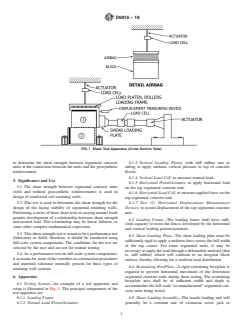
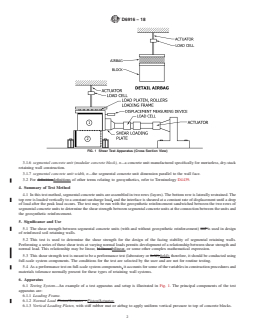
FIG. 1 Shear Test Apparatus (Cross Section View)
to determine the shear strength between segmental concrete 6.1.3 Vertical Loading Platen, with stiff rubber mat or
units at the connection between the units and the geosynthetic airbag to apply uniform vertical pressure to top of concrete
reinforcement. blocks.
6.1.4 Vertical Load Cell, to measure normal load.
5. Significance and Use
6.1.5 Horizontal Piston/Actuator, to apply horizontal load
5.1 The shear strength between segmental concrete units
on the top segmental concrete unit.
(with and without geosynthetic reinforcement) is used in
6.1.6 Horizontal Load Cell, to measure applied force on the
design of reinforced soil retaining walls.
top segmental concrete unit.
5.2 This test is used to determine the shear strength for the 6.1.7 Two (2) Horizontal Displacement Measurement
design of the facing stability of segmental retaining walls. Devices, to record displacement of the top segmental concrete
unit.
Performing a series of these shear tests at varying normal loads
permits development of a relationship between shear strength
6.2 Loading Frame—The loading frame shall have suffi-
and normal load. This relationship may be linear, bilinear, or
cient capacity to resist the forces developed by the horizontal
some other complex mathematical expression.
and vertical loading pistons/actuators.
5.3 Thisshearstrengthtestismeanttobeaperformancetest
6.3 Shear Loading Plate—The shear loading plate must be
(laboratory or field); therefore, it should be conducted using
sufficiently rigid to apply a uniform force across the full width
full-scale system components. The conditions for the test are
of the top course. For some segmental units, it may be
selected by the user and are not for routine testing.
necessary to apply the load through a deformable material (that
5.4 As a performance test on full-scale system components,
is, stiff rubber) which will conform to an irregular block
itaccountsforsomeofthevariablesinconstructionprocedures
surface, thereby allowing for a uniform load distribution.
and materials tolerance normally present for these types of
6.4 Restraining Box/Plate—A rigid restraining box/plate is
retaining wall systems.
required to prevent horizontal movement of the lowermost
segmental concrete units during shear testing. The restraining
6. Apparatus
box/plate area shall be of sufficient width and depth to
6.1 Testing System—An example of a test apparatus and
accommodate the full-scale “as-manufactured” segmental con-
setup is illustrated in Fig. 1. The principal components of the
crete units being tested.
test apparatus are:
6.1.1 Loading Frame. 6.5 Shear Loading Assembly—The tensile loading unit will
6.1.2 Normal Load Piston/Actuator. generally be a constant rate of extension screw jack or
D6916 − 18
NOTE 1—Any modification to the width of bottom units should
hydraulic actuator that can be displacement rate controlled.
maintain the integrity of the test shear interface and ensure that a
The loading equipment shall have a capacity that is at least
representative (repeatable) test shear interface is maintained.
equal to 120 % of the anticipated shear strength of the
7.1.5 Test Height—The height of the segmental concrete
segmentalconcreteunits.Thepistonshallbecapableofatleast
150mm(6in.)ofmovementinordertofacilitatetestsetupand unit may be reduced to facilitate handling and safety issues.
Any modification to the segmental concrete unit height shall
toensurethatthereisadequatestroketoachievepeakload.The
orientation of the tensioning force shall be horizontal and not alter the geometry of the test shear interface and shall be
clearly stated in the test report (see 10.2).
perpendicular to the back of the segmental units. The horizon-
tal loading arrangement must not permit rotation of the top
7.1.6 Conditioning—The segmental concrete unit test speci-
concrete unit during shear. men shall be brought to standard temperature and relative
humidityconditionsfortestinginalaboratory.Thetemperature
6.6 Load Cells—A calibrated load cell shall be used to
is to be 21 6 2 °C (70 6 4 °F) and the relative humidity 65 6
measure the shear force and normal load during the test. The
10 %. For field testing, the specimen shall be brought to
load cell used for measuring shear shall have a capacity that is
ambient conditions for not less than 1 h. The temperature and
greater than or equal to 120 % of the anticipated shear force
humidity at the start and end of the test shall be recorded for
between units. The load cell used for measuring the normal
field testing.
surcharge load shall have a capacity that is greater than or
equal to 100 % of the maximum anticipated normal load. The
7.2 Geosynthetic (If Required):
load cells shall be accurate to within 60.5 % of its full-scale
7.2.1 If the segmental concrete units are to be used for a
range.
geosynthetic-reinforced segmental retaining wall, then a layer
ofaspecifiedgeosyntheticmaterialshallbeplacedbetweenthe
6.7 Displacement Measuring Devices—Two (2) linear vari-
segmental concrete units.
able displacement transducers (LVDTs) or similar electronic
displacement measuring devices are recommended to continu- 7.2.2 Sampling Requirements—The latest version of ASTM
ously monitor the displacement of the top segmental concrete sampling protocol for geotextiles (Practice D4354) shall be
used for the geosynthetic reinforcement material.
unit out from the back of the lower segmental concrete units.
Alternatively, dial gauges may be read and recorded manually
7.2.3 Conditioning—The geosynthetic reinforcement test
at regular intervals not greater than 1 min. LVDTs, dial gauges,
specimen shall be brought to standard temperature and relative
or similar measuring devices shall be accurate to 60.1 mm
humidityconditionsfortestinginalaboratory.Thetemperature
(0.005 in.).
is to be 21 6 2 °C (70 6 4 °F) and the relative humidity 60 6
10 %. For field testing, the specimen shall be brought to
7. Sampling
ambient conditions for not less than 1 h. The temperature and
humidity at the start and end of the test shall be recorded for
7.1 Segmental Concrete Units:
field testing.
7.1.1 Segmental concrete units shall be full-size blocks and
7.2.4 Specimen Width—When included, the geosynthetic
meet the manufacturer’s material and dimensional specifica-
reinforcement test specimen shall be the full width of the shear
tions. Model or prototype units shall not be used unless it can
test interface.
be demonstrated that they are equivalent to production units.
7.2.5 Specimen Length—The geosynthetic specimen shall
7.1.2 The user shall specify or collect (or both) a sufficient
have sufficient length to cover the interface surface as specified
sample of representative segmental units, from a standard
by the user. The specimen must be trimmed to provide
production lot, to construct th
...
This document is not an ASTM standard and is intended only to provide the user of an ASTM standard an indication of what changes have been made to the previous version. Because
it may not be technically possible to adequately depict all changes accurately, ASTM recommends that users consult prior editions as appropriate. In all cases only the current version
of the standard as published by ASTM is to be considered the official document.
Designation: D6916 − 06c (Reapproved 2011) D6916 − 18
Standard Test Method for
Determining the Shear Strength Between Segmental
Concrete Units (Modular Concrete Blocks)
This standard is issued under the fixed designation D6916; the number immediately following the designation indicates the year of
original adoption or, in the case of revision, the year of last revision. A number in parentheses indicates the year of last reapproval. A
superscript epsilon (´) indicates an editorial change since the last revision or reapproval.
1. Scope
1.1 This test method is used to determine the shear strength between two layers of segmental concrete block units used in
construction of reinforced soil retaining walls. The test is carried out under conditions determined by the user that reproduce the
facing system at full-scale. full scale. The results of a series of tests are used to define a relationship between shear strength
developed between segmental concrete units and normal load.
1.2 This is a performance test used to determine properties for design of retaining wall systems utilizing segmental concrete
units and soil reinforcing geosynthetics, either geotextiles or geogrids. The test is performed on a full-scale construction of the
facing system and may be run in a laboratory or the field.
1.3 The values stated in SI units are regarded as the standard. The values stated in inch-pound units are provided for information
only.
1.4 This standard may involve hazardous materials, operations, and equipment. This standard does not purport to address all
of the safety concerns, if any, associated with its use. It is the responsibility of the user of this standard to establish appropriate
safety safety, health, and healthenvironmental practices and determine the applicability of regulatory limitations prior to use.
1.5 This international standard was developed in accordance with internationally recognized principles on standardization
established in the Decision on Principles for the Development of International Standards, Guides and Recommendations issued
by the World Trade Organization Technical Barriers to Trade (TBT) Committee.
2. Referenced Documents
2.1 ASTM Standards:
D448 Classification for Sizes of Aggregate for Road and Bridge Construction
D4354 Practice for Sampling of Geosynthetics and Rolled Erosion Control Products (RECPs) for Testing
D4439 Terminology for Geosynthetics
D4595 Test Method for Tensile Properties of Geotextiles by the Wide-Width Strip Method
D6637D6637/D6637M Test Method for Determining Tensile Properties of Geogrids by the Single or Multi-Rib Tensile Method
3. Terminology
3.1 Definitions:
3.1.1 displacement criteria, n—a user prescribed user-prescribed maximum movement, mm (in.), of the top segmental concrete
unit out from the back of lower segmental concrete units.
3.1.2 geosynthetic, n—a planar product manufactured from polymeric material used with soil, rock, earth, or other geotechnical
engineering related engineering-related material as an integral part of a man-mademanmade project, structure, or system. D4439
3.1.3 granular infill, n—coarse grained coarse-grained soil aggregate used to fill the voids in and between segmental concrete
units.
3.1.4 peak shear strength, n—the maximum shear capacity between segmental concrete units.
3.1.5 segmental concrete depth, n—the segmental concrete unit dimension perpendicular to the wall face.
This test method is under the jurisdiction of ASTM Committee D35 on Geosynthetics and is the direct responsibility of Subcommittee D35.01 on Mechanical Properties.
Current edition approved Oct. 1, 2011July 15, 2018. Published October 2011August 2018. Originally approved in 2003. Last previous edition approved in 20062011 as
D6916D6916 – 06c (2011).–06c. DOI: 10.1520/D6916-06CR11.10.1520/D6916-18.
For referenced ASTM standards, visit the ASTM Web Site, www.astm.org. or contact ASTM Customer Service at service@astm.org. For Annual Book of ASTM Standards
volume information, refer to the standard’s Document Summary page on the ASTM web site.
Copyright © ASTM International, 100 Barr Harbor Drive, PO Box C700, West Conshohocken, PA 19428-2959. United States
D6916 − 18
FIG. 1 Shear Test Apparatus (Cross Section View)
3.1.6 segmental concrete unit (modular concrete block), n—a concrete unit manufactured specifically for mortarless, dry-stack
retaining wall construction.
3.1.7 segmental concrete unit width, n—the segmental concrete unit dimension parallel to the wall face.
3.2 For definitiondefinitions of other terms relating to geosynthetics, refer to Terminology D4439.
4. Summary of Test Method
4.1 In this test method, segmental concrete units are assembled in two rows (layers). The bottom row is laterally restrained. The
top row is loaded vertically to a constant surcharge load, and the interface is sheared at a constant rate of displacement until a drop
of load after the peak load occurs. The test may be run with the geosynthetic reinforcement sandwiched between the two rows of
segmental concrete units to determine the shear strength between segmental concrete units at the connection between the units and
the geosynthetic reinforcement.
5. Significance and Use
5.1 The shear strength between segmental concrete units (with and without geosynthetic reinforcement) and is used in design
of reinforced soil retaining walls.
5.2 This test is used to determine the shear strength for the design of the facing stability of segmental retaining walls.
Performing a series of these shear tests at varying normal loads permits development of a relationship between shear strength and
normal load. This relationship may be linear, bi-linear,bilinear, or some other complex mathematical expression.
5.3 This shear strength test is meant to be a performance test (laboratory or field),field); therefore, it should be conducted using
full-scale system components. The conditions for the test are selected by the user and are not for routine testing.
5.4 As a performance test on full-scale system components, it accounts for some of the variables in construction procedures and
materials tolerance normally present for these types of retaining wall systems.
6. Apparatus
6.1 Testing System—An example of a test apparatus and setup is illustrated in Fig. 1. The principal components of the test
apparatus are:
6.1.1 Loading Frame.
6.1.2 Normal Load Piston/Actuator . Piston/Actuator.
6.1.3 Vertical Loading Platen, with stiff rubber mat or airbag to apply uniform vertical pressure to top of concrete blocks.
D6916 − 18
6.1.4 Vertical Load Cell, to measure normal load.
6.1.5 Horizontal Piston/Actuator , Piston/Actuator, to apply horizontal load on the top segmental concrete unit.
6.1.6 Horizontal Load Cell, to measure applied force on the top segmental concrete unit.
6.1.7 Two (2) Horizontal Displacement Measurement Devices, to record displacement of the top segmental concrete unit.
6.2 Loading Frame—The loading frame shall have sufficient capacity to resist the forces developed by the horizontal and
vertical loading pistons/actuators.
6.3 Shear Loading Plate—The shear loading plate must be sufficiently rigid to apply a uniform force across the full width of
the top course. For some segmental units, it may be necessary to apply the load through a deformable material (that is, stiff rubber)
which will conform to an irregular block surface, thereby allowing for a uniform load distribution.
6.4 Restraining Box/Plate—A rigid restraining box/plate is required to prevent horizontal movement of the lowermost
segmental concrete units during shear testing. The restraining box/plate area shall be of sufficient width and depth to accommodate
the full scale “as manufactured” full-scale “as-manufactured” segmental concrete units being tested.
6.5 Shear Loading Assembly—The tensile loading unit will generally be a constant rate of extension screw jack or hydraulic
actuator that can be displacement rate controlled. The loading equipment shall have a capacity that is at least equal to 120 % of
the anticipated shear strength of the segmental concrete units. The piston shall be capable of at least 150 mm (6 in.) of movement
in order to facilitate test set up setup and to ensure that there is adequate stroke to achieve peak load. The orientation of the
tensioning force shall be horizontal and perpendicular to the back of the segmental units. The horizontal loading arrangement must
not permit rotation of the top concrete unit during shear.
6.6 Load Cells—A calibrated load cell shall be used to measure the shear force and normal load during the test. The load cell
used for measuring shear shall have a capacity that is greater than or equal to 120 % of the anticipated shear force between units.
The load cell used for measuring the normal surcharge load shall have a capacity that is greater than or equal to 100 % of the
maximum anticipated normal load. The load cells shall be accurate to within 6 0.5 % 60.5 % of its full-scale range.
6.7 Displacement Measuring Devices—Two (2) Linear Variable Displacement Transducerslinear variable displacement
transducers (LVDTs) or similar electronic displacement measuring devices are recommended to continuously monitor the
displacement of the top segmental concrete unit out from the back of the lower segmental concrete units. Alternatively, dial gauges
may be read and recorded manually at regular intervals not greater than one minute. 1 min. LVDTs, dial gauges, or similar
measuring devices shall be accurate to 6 0.1 60.1 mm (0.005 in.).
7. Sampling
7.1 Segmental Concrete Units:
7.1.1 Segmental concrete units shall be full-size blocks and meet the manufacturer’s material and dimensional specifications.
Model or prototype units shall not be used unless it can be demonstrated that they are equivalent to production units.
7.1.2 The user shall specify and/oror collect (or both) a sufficient sample of representative segmental units, from a standard
production lot, to construct the anticipated number of test configurations for the shear system within the testing agency’s load frame
and testing system.
7.1.3 The shear interface must be constructed with full-size or modified (see 7.1.4) segmental concrete units randomly selected
from the usersuser’s sampling of a standard production lot,lot; see 7.1.2.
7.1.4 Test Width—The width of the shear interface for testing shall be constructed to a minimum of 750152.4 mm (29.5(6 in.)
in width. The test section shall consist of at least two bottom course segmental concrete units, with at least one top course
segmental unit placed on top of the lower segmental concrete units. The shear interface shall include at least one typical segmental
concrete unit running bond joint. The top unit must be the full width of the unit. The bottom units may be adjusted to fit into the
test apparatus. Testing of segmental concrete unit widths greater than 500 mm (19.7 in.),in.) may be represented in this test by
limiting the test wall to 1000 mm (39.4 in.) in width.
NOTE 1—Any modification to the width of bottom units should maintain the integrity of the test shear interface and insureensure that a representative
(repeatable) test shear interface is maintained.
7.1.5 Test Height—The height of the segmental concrete unit may be reduced to facilitate handling and safety issues. Any
modification to the segmental concrete unit height shall not alter the geometry of the test shear interface and shall be clearly stated
in the test report (see 10.2).
7.1.6 Conditioning—The segmental concrete unit test specimen shall be brought to standard temperature and relative humidity
conditions for testing in a laboratory. The temperature is to be 21 6 2°C2 °C (70 6 4°F)4 °F) and the relative humidity of 65 6
10 %. For field-testing field testing, the specimen shall be brought to ambient conditions for not less than one hour. 1 h. The
temperature and humidity at the start and end of the test shall be recorded for field-testing.field testing.
7.2 Geosynthetic (if required) : (If Required):
7.2.1 If the segmental concrete units are to be used for a geosynthetic reinforced geosynthetic-reinforced segmental retaining
wall, then a layer of a specified geosynthetic material shall be placed between the segmental concrete units.
D6916 − 18
7.2.2 Sampling Requirements—The latest version of ASTM sampling protocol for geotextiles (Practice D4354) shall be used for
the geosynthetic reinforc
...